The Steam Engine and the Puzzle of Delayed Invention
4 tier-5 · 7 tier-4
Howes's flagship investigation: why the atmospheric steam engine — the Industrial Revolution's defining machine — did not appear centuries before it actually did. Across these pieces he dismantles the textbook story in which a chain of seventeenth-century vacuum science (Torricelli, Boyle, Papin) ‘unlocked’ the engine, showing instead that tinkerers from Hero of Alexandria through della Porta, Salomon de Caus, Drebbel, Kalthoff and Petty had exploited steam's expansion and condensation with no theory of atmospheric pressure at all. The real constraint, he argues, was never missing science, tooling, or fuel but the sheer rarity of inventors willing to try: low-hanging fruit stays on the tree because almost no one reaches for it. The same ‘ideas behind their time’ logic recurs for the thermometer, long-distance signalling, and other inventions that could have arrived far earlier.
Howes develops his signature 'low-hanging fruit' / 'ideas behind their time' thesis: inventions such as the flying shuttle, wheeled suitcases, semaphore and tabletop role-playing games required no new science, skill or materials and could have appeared centuries or millennia earlier. Testing and rejecting the proposed constraints for D&D (bureaucratic mindset, literacy, printing, population density), he concludes there were no real barriers, hard or soft — innovation is simply extremely rare because very few people ever bother to do things differently, making these delays a matter of absence rather than obstacle.
Anton Howes argues many inventions were "low-hanging fruit," available centuries or millennia before they appeared, because innovation is simply rare, not blocked by real constraints. His example is John Kay's 1730s flying shuttle, a trivial addition of wood and string to looms unchanged for 5,000 years, needing no new materials or skill, per historian Bennet Woodcroft. Parallel puzzles: wheeled suitcases, the bicycle, and semaphore, which spread widely only in the late 18th century despite ancient Chinese and American smoke-signal precedents.
His running case is tabletop role-playing games, invented only in the 1970s despite storytelling and dice (used since 3000 BCE) both being ancient, and despite Prussia's 1820s Kriegsspiel already combining most elements. He rejects three explanations: that RPGs needed a "bureaucratic," numbers-reducing mindset, undercut by 17th-century English political arithmetic; that they needed literacy, numeracy, or printing, when the game needs only tallying, playable with sticks in sand; and that they needed higher population density, contradicted by chess and cards existing for centuries. He also weighs Matt Clancy's suggestion that RPGs were invented and reinvented worldwide but lost for lack of printing and low population density, rejecting this too: he finds it hard to believe something this fun would go unmentioned. The real explanation, he concludes, is that few people ever bother to innovate.
low-hanging fruitideas behind their timerarity of innovationtabletop RPGsflying shuttle
Challenges Robert Allen's influential thesis that cheap domestic coal was the necessary cradle of the steam engine. Drawing on Celia Fiennes's 1698 travel account and James Greener's reconstructed timeline, Howes shows Newcomen's earliest engines ran in fuel-poor Cornish tin districts, the very first likely fired by turf rather than coal, and that engines quit Cornwall only because of steep wartime coal taxes, not because of the economics of fuel. He argues the decisive factor was instead the science of atmospheric pressure, concentrated in England through the Royal Society's network of experimenters.
The steam engine's invention in England owed less to Britain's abundant coal than to a shared European science of air pressure, channeled through the Royal Society — a claim that cuts against the standard resource-cost explanation for why the breakthrough happened where it did. Coal had already transformed England by 1800, supplying fuel equivalent to 11 million acres of forest, a third of the country's land area, freeing land from the fuel-food-clothing trade-off and spreading from home heating into brickmaking, salt-boiling, and iron smelting. But the steam engine multiplied coal's uses further, moving from pumping flooded mines to turning machinery by the 1780s and driving locomotion by the 1830s.
The engine's principle wasn't pushing steam, like Hero of Alexandria's ancient aeolipile, but condensing it: cold water collapsed steam in a cylinder into a partial vacuum, and atmospheric pressure did the lifting. Devon ironmonger Thomas Newcomen applied this practically in the 1700s, building on decades of air-pump and barometer experiments by mostly non-English scientists — Torricelli, von Guericke, Papin, Huygens — coordinated through England's Royal Society, founded in the 1660s.
Economic historian Robert Allen argues coal mines kept the energy-hungry early engine economically alive long enough to be improved, making Britain's coal abundance decisive. Howes disputes this using James Greener's reconstructed Newcomen timeline: the first engine, built around 1703 at the landlocked Cornish mine Balcoath, pumped tin, not coal, and likely burned local turf, since Celia Fiennes' 1698 travel account describes Cornwall's southern coast as short of both wood and coal, especially during wartime piracy threats. Newcomen's next two Cornish engines burned coal but still weren't at coal mines. Political taxation, not economics, ultimately killed them: a 1710 coal tax rise pushed Newcomen toward Midlands coal mines, and a 1713 tax doubling wiped out the Cornish engines entirely; by 1721 only coal-mine engines survived in Britain. The first exported engine, sent to Venice in 1717, also likely ran on turf, reinforcing that coal was never necessary to the invention.
Debunks the widely repeated online claim that Spaniard Jeronimo de Ayanz invented the steam engine a century before Newcomen. Ayanz's 1606 device did pump water using steam's expansive pushing force through twin alternating tanks, superficially resembling Savery's engine, but, as historian Nicolas Garcia Tapia actually stressed, it never exploited atmospheric pressure and condensation-driven vacuum, the real breakthrough behind the Savery and Newcomen engines. Ayanz came too early for the science of air, so he built a steam engine but not the atmospheric engine that mattered.
Claims that Jerónimo de Ayanz y Beaumont invented the steam engine a century before Newcomen rest on a press misreading of the historical evidence, and the Spanish device worked on a fundamentally different principle than its English successors.
Ayanz, a Navarrese aristocrat who administered Spain's royal mines from 1597, invented diving gear, mine ventilation, and mill and furnace improvements. Historian Nicolás García Tapia's 2010 biography revealed that in 1606 Ayanz secured a 20-year monopoly on over fifty inventions, including a steam gas-extraction injector and a mine-drainage engine, which he tried implementing at the flooded Guadalcanal silver mines (1608-11) before dying without confirmed success.
Tapia's description of Ayanz's engine as "very similar" to Thomas Savery's was misread as equivalence. Both used two alternating tanks and steam's pushing force to expel water. But Savery's engine, invented roughly a century later, also condensed steam to create a vacuum that sucked mine water up into the tank (to about 8 metres); Ayanz's tanks filled only by gravity, sitting below the mine water. Tapia states plainly that Ayanz never contemplated atmospheric pressure as a force, since the science wasn't yet understood. Even Savery's more sophisticated engine proved a practical dead end, limited by suction height and fuel costs, until Newcomen's piston-and-beam design applied vacuum power more elegantly.
steam engineJeronimo de AyanzSaveryatmospheric pressuremyth-busting
The standard story that the atmospheric steam engine required a chain of seventeenth-century scientific discoveries (Torricelli, von Guericke, Boyle, Papin) is upended by Salomon de Caus's 1615 solar-powered fountain, which already exploited both the expansive force of steam and, crucially, atmospheric pressure through condensation as vessels cooled at night. That machine predates Torricelli's barometer by nearly three decades and Savery's engine by eighty years, and since heat had been put to mechanical and even industrial work continuously since Hero of Alexandria, Howes argues a practical atmospheric engine could plausibly have emerged far earlier without the celebrated scientific breakthroughs. It reframes the Savery engine as no dead end but a parallel, science-independent path to the same result.
Salomon de Caus's neglected 1615 book describes a solar-powered engine combining steam's expansive force with atmospheric suction to draw water back as it cools -- the same core mechanism behind Thomas Savery's 1698 steam engine -- more than eighty years before Savery, and decades before the scientific discoveries historians treat as its prerequisites.
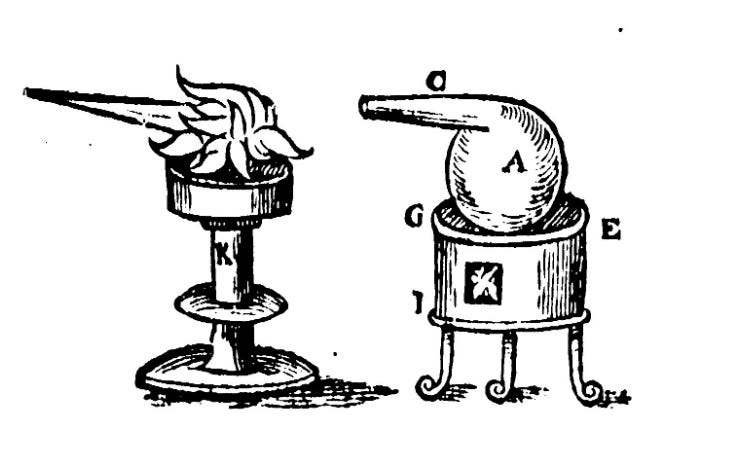
Heat-driven devices had a long pedigree before de Caus. Hero of Alexandria's first-century aeolipile, a vessel with a narrow spout shooting pressurized steam, stayed in use into the seventeenth century as a "philosophical bellows" for blow-torch tasks like bending glass and fine metalwork, lighting fires from damp wood, spouting wine onto altar flames, spinning miniature dancers, and making bird automata sing; a 1630s English version made a dragon hiss. Engineers pushed it toward real mechanical work: Leonardo da Vinci's notebooks and a 1551 Ottoman manuscript by Taqi ad-Din describe aeolipile jets turning turbines to drive roasting spits, and Giovanni Branca's 1629 illustrations show one crushing ores into powder and, separately, a flue-powered mill using forge smoke to roll hot metal bars. In 1605 the Frenchman Marin Bourgeois built a compressed-air "wind-gun"; David Rivault soon tried heating water in a cannon for the same effect, while Spanish engineer Jeronimo de Ayanz y Beaumont tried using steam's expansive force to drain mines.
The philosophical bellows in action.Here’s Giovanni Branca’s 1629 suggestion of using an aeolipile — note its Aeolus face — to crush powders.Giovanni Branca’s 1629 depiction of a forge-driven metal-rolling engine.
None of this is how the real steam engine works: Savery's 1690s engine first sucked water up a pipe by condensing steam, then Thomas Newcomen's 1710s "atmospheric engine" used a piston on a counterweight, pulled down by atmospheric pressure once steam beneath it was condensed into a partial vacuum with a cold-water spray. Historians' standard chain of prerequisites runs: Evangelista Torricelli's early-1640s barometer experiments in Florence, proving vacuums possible and that "we live at the bottom of an ocean of elemental air" (1644); Otto von Guericke's air pump, which by 1654 lifted a piston by atmospheric pressure and by 1672 hoisted 1,200kg; Robert Boyle, Robert Hooke, Christiaan Huygens and Denis Papin refining vacuum-creation under a piston through the 1660s-70s, including failed gunpowder-explosion experiments; Papin's discovery, from his steam-digester (pressure cooker), that immersing a heated cylinder in cold water condenses steam into a vacuum, published in English in 1687; and Newcomen, who plausibly read that book and, per a friend's account, stumbled onto rapid condensation when solder melted and cold water leaked into his piston cylinder.
Savery's engine fits this chain awkwardly -- it used atmospheric suction but pumped water directly rather than lifting a piston, and Savery beat Papin to cold-water condensation (Papin had to ask him how he'd done it); Newcomen was reportedly unaware of Savery's work, though the two later sold engines jointly under Savery's patent. Savery's design couldn't lift water more than about 9 metres by suction and was further limited by boiler and pipe strength, so it failed in deep mines -- but it was cheaper than Newcomen's and stayed in use for a century: for fountains, marsh drainage, saltworks, waterwheel supply, and London's York House water system, improved by Theophilus Desaguliers and Willem 's Gravesande in the 1710s, automated by Bento de Moura in 1740s Portugal, and installed across Europe by William Blakey in the 1760s-80s.
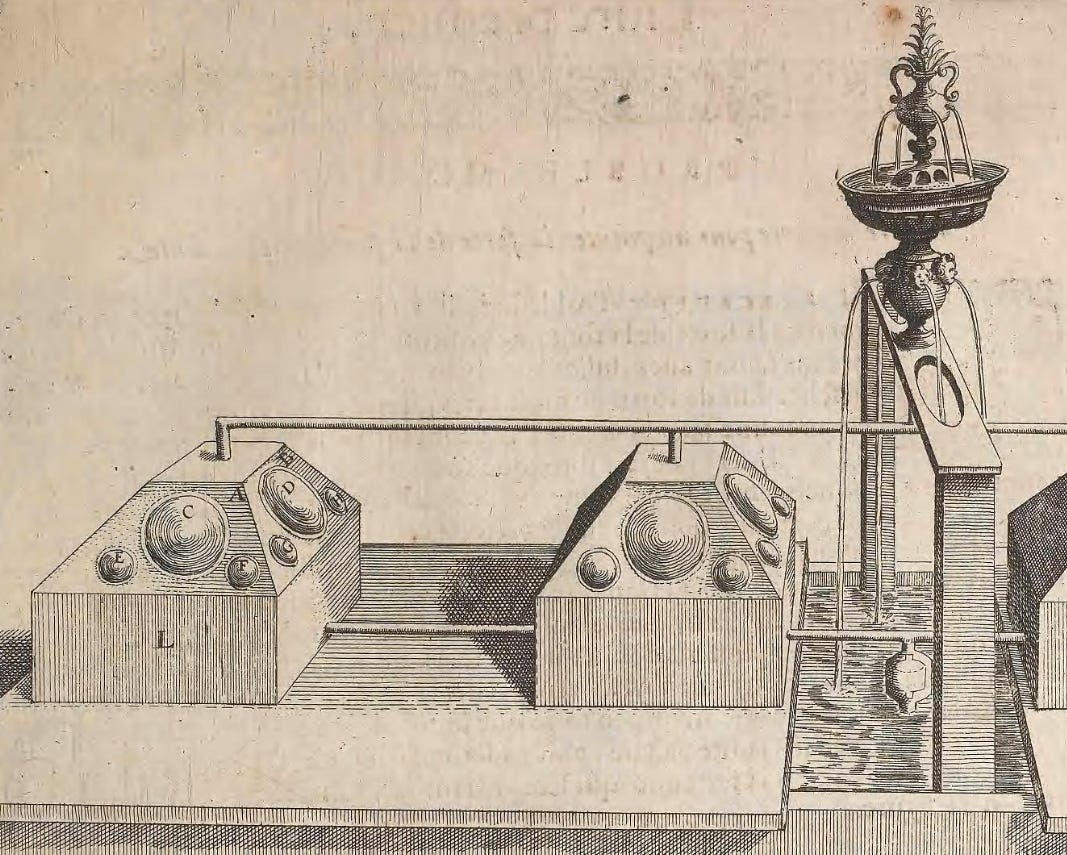
De Caus's engine anticipated all this: four sun-heated copper vessels, linked by a pipe and valve to a cistern, pushed water into a fountain by day, then drew water back at night as cooling created a vacuum -- explained by de Caus purely as nature's "horror of a vacuum," with no concept of atmospheric weight. He added focusing glass lenses and heat-resistant cement (evidence of a working model), applied the same principle to a singing statue, and hinted at further uses he never published. The puzzle for Part II: where de Caus got the idea, and what happened to it in the eighty years before Savery.
Salomon de Caus’s solar-powered steam engine — the basic version.
steam engineSalomon de Causatmospheric pressurehistory of technologycounterfactual
The mechanical exploitation of condensation and atmospheric 'suction' — the true principle behind the eighteenth-century steam engine — has a continuous history reaching back to antiquity, long before Torricelli's 1640s vacuum experiments. Philo of Byzantium and Hero of Alexandria built solar-heated devices that raised water and even opened temple doors by cooling-driven contraction; della Porta's best-selling Natural Magic (1558/1589) spread the inverted-flask trick in print; and Salomon de Caus by 1615 had effectively built a solar-powered version of Savery's engine. Establishing this deep, widely-published lineage sharpens the puzzle the series answers: why a practical atmospheric engine still took until the 1690s to appear.
Thomas Savery's 1690s water-raising engine works in two stages: it first exploits the vacuum's suck when steam is rapidly condensed with cold water, harnessing atmospheric weight, then uses steam's own expansive, pushing force to drive the water still higher. The standard story credits the condensation half to Evangelista Torricelli's 1640s demonstrations that vacuums are possible and air has weight, but the principle -- and devices built on it -- traces back nineteen centuries earlier, making Savery's late arrival harder, not easier, to explain.
The earliest known example is Philo of Byzantium's 3rd-century-BC device: a hollow leaden sphere with a bent tube dipping into a water jug, its sun-heated air bubbling out through the tube until cooling drew the water back up. Hero of Alexandria, writing in the 1st century AD, improved this into a "dripper" fountain and a mechanized temple-door opener: fire on a hollow altar forced heated air into a water-filled sphere, pushing water into a hanging bucket whose weight pulled a rope to open the doors; when the fire went out, cooling air drew the water back and lightened the bucket, letting a counterweight shut them -- combining water-raising, fuel, cooling contraction, and mechanical work -- Savery's essential ingredients. The texts were copied through the Middle Ages and printed in Latin at Urbino in 1575 and Italian at Bologna in 1589.
Philo of Byzantium’s device, as illustrated in a 1617 book by Robert Fludd. It corresponds exactly to a very basic sketch found in a 13thC manuscript copy of Philo’s work in Oxford, where Fludd studieHero of Alexandria’s “dripper” fountain, as illustrated when it was first published in Latin in 1575.Hero of Alexandria’s temple doors, triggered by heat on an altar, and exploiting atmospheric pressure to close them and reset the device when the fire was extinguished. From the 1589 printed Italian t
Giovanni Battista della Porta popularized the effect: his 1558 bestseller Magiae Naturalis, translated into Italian, French, and Dutch, described the "inverted flask" trick -- heat a glass flask, invert it into water, let it cool to draw water up -- credited to Hero. A 1589 revision scaled this into a sun-heated brass vessel atop a tower, piped to water below, and della Porta claimed a solar-powered fountain in Venice, anticipating by three decades the fountain Salomon de Caus published in 1615. More significantly, the flask fed a live debate over the cause of wind: Aristotle held the sun drew "exhalations" from the earth, while Turin mathematician Giovanni Battista Benedetti argued in 1585 that it instead showed wind as air expanding and contracting with heat and cold, its trapped air a microcosm of the atmosphere.
One of the more advanced versions of Salomon de Caus’s solar-powered atmospheric engines of 1615. The glass lenses are in the walls of the copper vessels, to concentrate the sun’s rays.The earliest printed illustration of the inverted flask experiment that I could find, from 1606.
Behind all this lay a cosmology in which a vacuum was literally impossible: following Aristotle, the world was a sphere sealed by the firmament and full of matter, so any threat of empty space made the universe instantly supply matter to prevent it. A closed universe also implied perpetual motion built into Creation, since winds, tides, and the rotating heavens were set going by God and kept moving forever after. Cornelis Drebbel, the Dutch alchemist-engineer and Europe's most famous inventor, built his life's work on this logic, framing his project not as creating perpetual motion of his own -- only God could do that -- but as harnessing the universe's existing perpetual motion in miniature. His apparatus, shaped more like Philo's sphere-and-tube than della Porta's flask and likely descended from the alchemists' aeolipile (known by 1594 to be filled by heating it empty, then plunging it into cold water), rose and fell on its own with ambient temperature and pressure. Because the cosmos was held to be inherently self-moving, contemporaries read this not as atmospheric pressure but as a "living" microcosm of Creation, with fire as the animating principle behind weather, elemental transmutation, and life.
Drebbel’s illustration of the device, from a 1608 translation of his extremely rare / missing original 1604 Dutch publication.
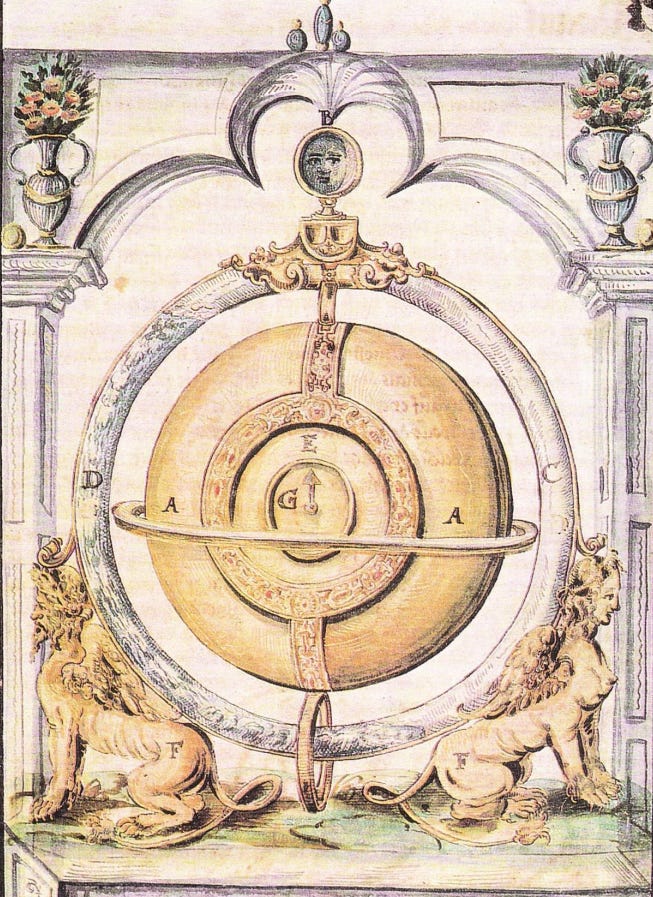
Drebbel patented a perpetual clock in 1598 and later built the Eltham Palace machine for King James I from 1606: a central sphere tracking time, date, and zodiac; a glass ring of tinted liquid ebbing like tides; a rotating sphere for moon phases, self-sustaining for months. De Caus's 1615 "machine that moves of itself" -- a simpler flask variant where rising and falling water raised or dropped a pulley-weight to drive a dial -- is the likely mechanism behind Drebbel's self-rewinding clockwork: an eyewitness recorded the clock hand lurching forward two hours when the sun reappeared from clouds.
One of many known illustrations of Drebbel’s famous perpetual motion displayed at Eltham Palace, this one from a 1612 work by his friend and colleague Thomas Tymme.Salomon de Caus’s machine that moved of itself: the likely key to Drebbel’s perpetual clocks. Published in 1615.
steam enginecondensationHero of Alexandriadella Portaatmospheric pressure
The climax of Howes's flagship series shows that condensing-steam engines for raising water were being built by Kaspar Kalthoff and William Petty around 1649 — decades before Thomas Savery and before Torricelli's vacuum science was widely understood — while the celebrated Marquess of Worcester's 'water-commanding engine' was actually a bucket-and-man mechanical device. Kalthoff, a forgotten precision toolmaker who could bore brass 'as if into wood' a century before Wilkinson, had every material, skill and incentive but was derailed by civil war, seized assets and a burned workshop. The steam engine's centuries-long delay was therefore not a matter of missing vacuum theory or tooling but of the sheer rarity of inventors: low-hanging fruit stays on the tree because almost no one thinks to try. The conclusion overturns the standard science-unlocks-technology account of the Industrial Revolution's defining machine.
Thomas Savery's practical atmospheric engine of the 1690s wasn't held up by missing science or technology — every piece it needed existed by the 1620s — but by the sheer rarity of people who actually try to invent, and by circumstance derailing the few who did. Cornelis Drebbel's inverted-flask device (c.1606), drawing water up by heating then cooling trapped air, became the basis for the thermometer (Santorio Santorio, Padua, 1612) and the weather-glass or barometer known as the donderglas, first documented predicting storms in 1619 Ghent. Drebbel also invented the thermostat before 1624 — a mercury float regulating a furnace's air supply — spread across Europe and New England by his Kuffler sons-in-law, and used for egg incubation, army bread ovens, and shipboard seawater distillation. By the 1630s weather-glass makers had built versions where the whole flask assembly rose and fell like a piston (illustrated in a 1635 figure). Savery himself later described being inspired by essentially the same flask trick.
The inverted flask experiment. The air bubbles out on the left. As the remaining trapped air cools, on the right, the water rises up the flask (in fact pushed up by the pressure of the atmosphere).A Dutch-style weather-glass, often J- or U-shaped, signalling an impending storm.A weather-glass as almost-piston, one of a wide variety likely available for sale in London by 1635. As the air trapped in the flask KL cools, it draws the water up into it, so that the falling level
The traditional candidate for an earlier steam engine, the Marquess of Worcester's "water-commanding engine" (patented 1663), turns out to have been mechanical — bucket-driven, pushing water rather than sucking it — making the Victorian legend (Bennet Woodcroft breaking into Worcester's grave hunting a buried steam-engine model) baseless. The real pioneer was Worcester's gunsmith Kaspar Kalthoff, who by 1649 was building a fuel-burning steam pump near Dordrecht, paralleling a project by economist William Petty. Correspondence relayed through Samuel Hartlib and Benjamin Worsley shows both invoking the inverted-flask "Christmas trick"; Kalthoff's lead test-vessel imploded ("the sides also of the vessel fell in"), evidence of condensation-vacuum rather than overpressure, and he proposed a two-pipe design — one vessel filling while the other draws — anticipating Savery's later engine.
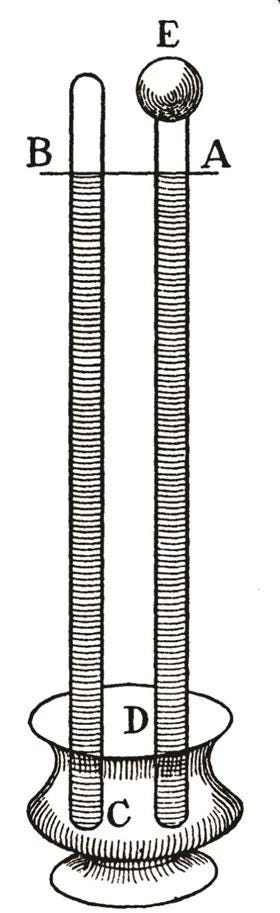
A newly uncovered letter from Petty to Worsley, asking whether Kalthoff had ever raised water above "32 feet... by one operation," is the decisive clue: Petty's engine relied on atmospheric suction, which has a hard physical ceiling around 34 feet (about 10 metres) regardless of pipe width. That limit was first exposed when Giovanni Battista Baliani's copper siphon, built in 1630 to cross a hill over 34 feet high, refused to draw water any higher — an anomaly Galileo explained by treating the water column as a rope snapping under its own weight, positing a vacuum above the break (published 1638). Gasparo Berti's 1643 lead-pipe replication in Rome, and Torricelli and Viviani's miniaturized mercury-tube version, confirmed the effect (a figure shows the mercury settling at the same level regardless of the space above it); Torricelli argued the height was set by the counterbalancing weight of "an ocean of elementary air," the basis of the barometer. Petty and Kalthoff were experimenting in 1649, before this account was published, so their trial and error had already hit the wall the theorists were about to formalize. Kalthoff, having struck it, switched to steam's expansive push, claiming a prototype that could raise water 60 feet — impossible by suction alone — and telling Petty his method was "toto caelo different."
The trouble with Baliani’s siphonTorricelli and Viviani demonstrate that mercury always fell to the same level AB, even though the size of the space above it varied.
Neither project matured. Petty lost interest, pursuing more profitable work. Kalthoff was undone by circumstance: fleeing England as a suspected royalist during the Civil War, he abandoned his Vauxhall prototypes to Parliamentary seizure, lost a fortune in the 1645-47 collapse of the Dutch West India Company, and watched his Dordrecht engine burned down by locals. This wasn't a shortage of tools: Kalthoff had already invented a method for boring brass and iron "as if it were into wood" in 1640, over a century before John Wilkinson's cannon-boring machines enabled James Watt, and was Hartlib's go-to craftsman for replicating foreign inventions in a London engineering scene already thriving by the 1640s-50s. The nearly seventy-year gap to Savery is thus not science unlocking technology but the pattern seen in early textile machinery and signalling systems: invention is rare, so individual setbacks can leave a ready idea stranded for decades.
The thermometer was a trivially simple reinterpretation of the ancient inverted-flask experiment, yet its true inventor was Santorio Santorio (1612), the measurement-obsessed professor of medicine at Padua — not Galileo, whose disciples later inflated his claim, nor rivals like Telioux or Antonini who saw the same device but failed to grasp its potential. The decisive difference was that Santorio met the old experiment while already hunting for measuring instruments, so his mind was primed to make the connection. The lesson is that 'Eureka' breakthroughs come not from ordinary people struck by mundane sights but from rare individuals already searching for a solution to a specific problem, which is why such low-hanging fruit can hang unplucked for centuries.
The 1610s "invention" of the thermometer -- adding a graduated scale to the ancient inverted-flask experiment -- shows that obvious breakthroughs sit unclaimed until a mind already searching for that problem stumbles on them, and whoever gets there first faces rivals racing to claim or dismiss it.
The trick was ancient: heat the base of a long-necked glass flask, invert it mouth-first into a bowl of water, and as the trapped air cools, atmospheric pressure pushes water up the neck (a diagram traces the bubbling-out and rising stages). A scale on that water level made it a thermometer. Santorio Santorio, a Padua medicine professor, gets credit from an 1612 book, but as soon as his device became known, rivals rushed either to claim it as their own or dismiss it as nothing new. Santorio himself conceded in 1630 that his instrument was similar "in form" to the ancient device Hero of Alexandria had described, resting his originality claim only on the application, not the mechanism. A 1611 Rome manuscript by Bartolomeo Telioux describes a graduated version for tracking weather "in degrees or minutes," with a drawing -- but drawn back-to-front, suggesting Telioux misunderstood a secondhand report.
The inverted flask experiment. The air bubbles out on the left. As the remaining trapped air cools, on the right, the water rises up the flask (in fact pushed up by the pressure of the atmosphere).Telioux’s 1611 depiction of a gradated inverted flask experiment
Galileo Galilei posed a sharper challenge. Venetian Gianfrancesco Sagredo wrote to Galileo in 1612 describing Santorio's device, then built his own copy and used it for years to track weather. By 1615, though, Sagredo credited Galileo as "the first author and inventor," dismissing Santorio -- and Galileo's disciples later dated the claim to 1592-1603. Howes doubts it: Galileo's own 1620s letter calls the effect merely a "trick" he'd toyed with around 1606, suggesting he never grasped its potential; even Sagredo first heard of it as Santorio's. A third claimant, Daniello Antonini, deduced in 1612 that Cornelis Drebbel's perpetual-motion device ran on heating and cooling air and built a marked model, but never measured anything with it, calling it a whim.
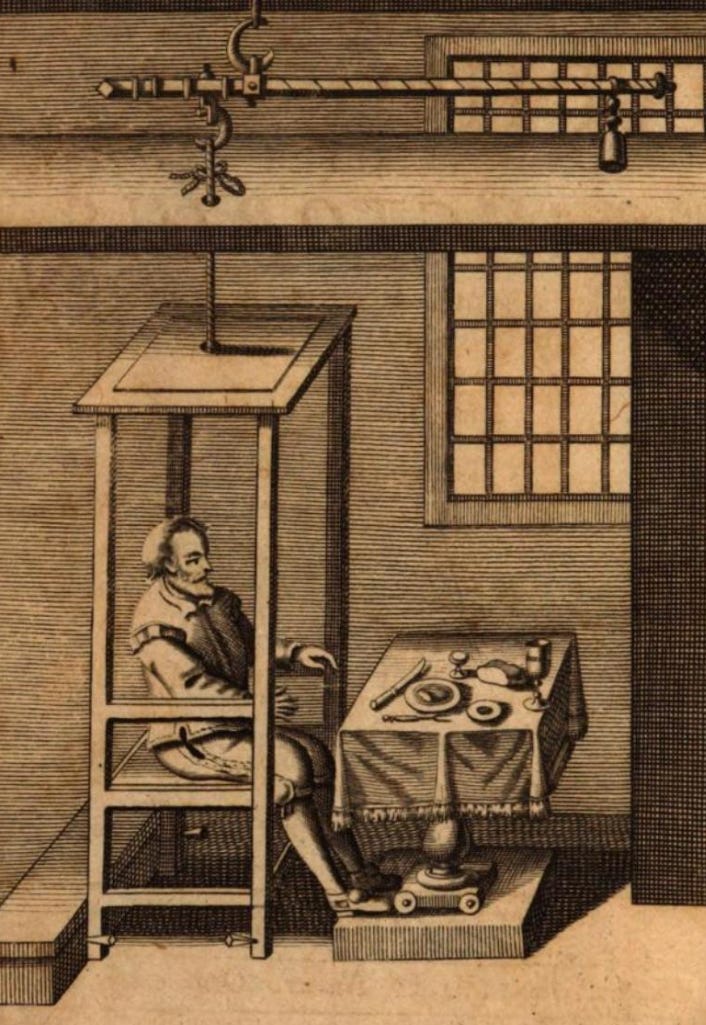
The idea sat unplucked so long partly because opaque metal containers, hiding the water level, weren't replaced by glass flasks until the mid-1500s -- though even the open bucket's visible water could have been scaled centuries earlier. Santorio's edge was preparation: already inventor of a pulse-tracking pendulum, hygrometers, flow gauges, and a weighing chair for tracking sweat loss, he was primed to spot what others missed. This is what "Eureka" legends (Hargreaves's cart wheel, Watt's kettle) get wrong: invention isn't a mundane sight sparking a finished idea, but someone already hunting a problem recognizing its answer.
Santorio’s device to measure the effects of imperceptible sweating.
Sophisticated long-distance signalling — beacon codes, torch alphabets (Polybius), flag semaphore, shuttered lamps and sun-powered heliographs — was repeatedly invented and then forgotten, the technology actually regressing after antiquity before finally taking off only in the 1790s. The materials, optics and even Morse-like codes were all available for millennia (Franz Kessler built a working shuttered signal lamp in 1616), so the delay cannot be pinned on science, telescopes, materials, or the cost to states. As in Howes's other 'ideas behind their time', the binding constraint was simply the scarcity of inventors bothering to work on the problem, reinforcing his claim that innovation is gated by the number of would-be improvers rather than by technical or economic preconditions.
Non-electric long-distance signaling systems -- fire beacons, flag semaphore, and light telegraphs capable of transmitting complex, spelled-out messages -- were invented and re-invented for millennia before finally sticking in the eighteenth and nineteenth centuries, and the delay had nothing to do with missing science, materials, or demand.
Simple single-message beacon chains are ancient and global: the Mari kingdom of Syria used them in the eighteenth century BC, Ashurbanipal's Assyria in the seventh, and they appear in the Old Testament, Herodotus, Aeschylus, and Thucydides, plus Spanish conquistador reports of Native American smoke signals. But more complex versions existed too. At Plataea in the fifth century BC, defenders confused Theban torch signals by waving their own, implying multi-message signaling. Aeneas Tacticus described pairing torches with matched water clocks to select from prearranged messages, a method the Carthaginians reportedly used to request "transports," "warships," or "money" from Sicily. By the second century BC, Polybius described a ten-torch grid (five left, five right) keyed to a letter tablet, improving on an older method by Cleoxenus and Democleitus. Three centuries later, Romans used a faster three-field, Morse-like wave code -- up to eight waves per field across left, middle, and right. Then this sophistication vanished.
Beacon chains reverted to single-signal simplicity for nearly a millennium: Arab chains from Damascus to Cairo (tenth century), a Venetian chain from Euboea (thirteenth century), Crusader-state and English coastal chains, a 1455 Scottish chain with a one-to-four-bale severity scale, and England's 1588 Armada warning. The last complex system was Byzantine mathematician Leo's ninth-century chain, spanning 720 km from Anatolia to Constantinople using paired water clocks keyed to hours of the day, lit end-to-end in 30-40 minutes. Torches needed tight spacing to stay legible -- about a kilometre at most, versus Roman relay stations 1.5-2.5 km apart -- so complexity traded directly against range. This wasn't simply cost: shorter-range signaling stayed militarily useful, and many medieval states funded expensive horse-relay postal networks anyway -- Rome's cursus publicus (stations every 15-40 km, ~75 km/day, up to 150 km in emergencies) and the 1860s Pony Express (150 km/day, stations every 15 km).
Flag semaphore shows the same pattern. The ninth-century Byzantine navy used at least eight distinct flag-based tactical commands from the flagship. Afterward, sophistication regressed: a fifteenth-century Castilian navy document (commonly misdated 1340, actually c.1430) used torches and trumpets for only a handful of set messages, and England's navy as late as the 1670s mainly used flags to summon captains aboard, adding real commands via cannon fire and sails. Only in the 1740s did French innovator Bertrand-François Mahé de la Bourdonnais build a Polybius-like flexible semaphore -- two millennia after the precedent.
The telescope (1608) is often credited with unlocking semaphore, but the author is skeptical: Robert Hooke's 1684 proposal to the Royal Society (a wooden-sign alphabet needing a 2-metre telescope for 10 km legibility) went unbuilt, and John Wilkins in the 1640s treated the telescope as a mere bonus to Polybius's method. Claude Chappe's 1790s French semaphore used telescopes and 9-metre arms with 25 km spacing, but 1660s Cornish pilchard-fishery watchers directed boats with feathered signs and body movements, no telescope needed.
Hooke’s 1684 signalling alphabet
Light signals followed suit. Franz Kessler's 1616 shuttered lamp -- a torch in a lead-lined, mirror-enhanced barrel with a shutter -- paired daytime cloth-waving with nighttime flashes into a Morse-like letter code (one wave for D, two for I, three for R), yet was forgotten until the 1860s. Carl Friedrich Gauss's 1821 heliotrope, adapted into the heliograph, used sunlight reflected off simple mirrors; British, Boer War, and US Army heliographs (against Zulus, Apaches, and each other) were visible up to 80 km unaided and 160 km with 20 cm mirrors, predating 1856's silver-nitrate mirror coating. Nothing physical blocked earlier invention -- only a shortage of inventors, and specifically of inventors focused on long-distance communication, until the eighteenth and nineteenth centuries' surge in inventor numbers finally picked this long-ripe fruit.
Sadi Carnot laid the foundations of modern thermodynamics in his 1824 'Reflections on the Motive Power of Fire' while wholly committed to the caloric theory, the belief that heat was a conserved, weightless fluid flowing from hot bodies to cold. Howes argues that this now-debunked material theory actually enabled Carnot's correct insights: treating caloric like conserved matter, and analogising its 'fall' between temperature reservoirs to water falling through a wheel, let him derive the primacy of temperature difference, the impossibility of perpetual motion, and a heat engine's theoretical maximum efficiency. A wrong physical picture, in other words, yielded durable results, and he notes that engineers such as Stephenson and Brunel still spoke of caloric into the 1850s.
Caloric theory, the mistaken belief that heat was a subtle fluid, nevertheless generated many insights later formalized in 1840s thermodynamics, because treating heat as flowing matter led Sadi Carnot to conclusions that still hold. Carnot, son of Lazare Carnot, published Reflections on the Motive Power of Fire in 1824 but died at 36 before it gained recognition. He argued an engine's power comes from heat flowing from hot to cold bodies to re-establish equilibrium; heat alone cannot yield motion without a temperature difference. Reasoning the process reversible, he showed the resulting motion could recreate a temperature imbalance via friction, collision, or compressing vapor, and defined any equilibrium re-established without producing motive power as a "loss" -- giving a theoretical maximum efficiency that ruled out perpetual motion. He then related temperature to volume, pressure, and changes of state -- building on Joseph Black's 1770s discovery of latent heat in melting ice -- to find further efficiency gains. Though lacking true energy conservation, Carnot implicitly conserved caloric, as matter, together with motion, prefiguring the first law. He likened caloric's flow to water falling through a wheel, power depending on quantity and "height of fall," echoing water-engineer Antoine de Parcieux. Stephenson and Brunel still spoke of caloric as late as the 1850s.
Sadi Carnotthermodynamicscaloric theoryhistory of sciencesteam engine
Thomas Savery, inventor of the first widely used steam engine, is badly under-studied and saddled with fabricated biography, yet his own 1702 writings reveal a strikingly advanced mind: he gestured at the conservation of energy and a theoretical maximum efficiency, articulated mechanical work and horsepower more than eighty years before Watt, and grasped the losses from friction and impact. Howes argues Savery came close to anticipating the mid-eighteenth-century insight that water wheels work best when driven with minimal impact, but buried or omitted the reasoning for the sake of brevity. The revisionist appreciation makes the case that Savery deserves a far larger place in the histories of both steam and water power.
Thomas Savery, inventor of the first widely-used steam engine, is unjustly overshadowed by Newcomen and Watt, sometimes omitted from the standard narrative entirely. Even specialists neglect him: the Newcomen Society's journal, the best source on steam pioneers, has named Savery in the title of only three articles in over a century, the last in 1986. His engine, built to pump water from mines, used two chambers: steam admitted then condensed by cold water created a vacuum that pulled mine water up a pipe, after which fresh steam pushed it further up a second pipe, the chambers alternating for continuous flow. It stayed in use for decades, especially in continental Europe.
Almost nothing reliable is known about Savery's background or training — even the claim that he was a "military engineer" or "trenchmaster" is unsupported speculation. He appears in the 1690s with his inventions seemingly fully formed.
His writings hint at brilliance: an 1702 passage on falling water's force anticipates conservation of energy, decades before Sadi Carnot, and his horse comparison introduces horsepower over eighty years before Watt (also used by Desaguliers in the 1720s and Smeaton in the 1770s). He noted his engine's near-elimination of friction, unlike piston designs. His earlier capstan-driven paddle-wheel proposal, replacing ship oars, anticipated Smeaton's mid-eighteenth-century finding that water-wheels work best with minimal impact — insight Savery never fully wrote up.
Thomas Saverysteam enginehorsepowerconservation of energyhistory of technology
Howes overturns the textbook prehistory of the steam engine — the tidy leap from Hero's toys to Torricelli's 1640s vacuum to Newcomen — by tracing a centuries-long chain of tinkerers who exploited steam's expansion and condensation with no concept of atmospheric pressure and no belief that vacuums were possible. From Philo and Hero through della Porta's inverted-flask experiment, Drebbel's perpetual-motion machine, de Caus, Beeckman, Kalthoff and Petty, he shows the atmospheric engine took shape incrementally, and adds his own archival find: Jean Francois's 1653 water-raising device that worked identically whether explained by horror vacui or Torricelli's theory. The thesis is that apparent bolt-from-the-blue inventions almost always dissolve, on inspection, into dozens of accumulated marginal steps — progress does not come in leaps.
The textbook history of the steam engine -- Hero of Alexandria's aeolipile, Torricelli proving vacuums possible in the 1640s, Otto von Guericke's air pump around 1650, Boyle, Hooke, Huygens, and Papin's piston experiments, and Thomas Savery's and Thomas Newcomen's commercial engines of the 1690s-1700s -- gets the causation backward: atmospheric pressure and steam condensation were being exploited centuries before Torricelli, by people with no concept of vacuums.
Third-century-BC Philo of Byzantium described raising water by heating and cooling air; first-century Hero of Alexandria applied the same principle to a self-replenishing fountain and temple door, more consequential than his aeolipile. From the 15th-17th centuries alchemists used a stationary aeolipile as a glassworking blowtorch, with Leonardo da Vinci, Taqi ad-Din (1551), and Giovanni Branca (1629) proposing turbine designs, while Marin Bourgeois and David Rivault (c.1605-7) used expanding steam to fire guns, and Spanish engineer Jerónimo de Ayanz y Beaumont (c.1606) to drain flooded mines. By 1558 Giovanni Battista della Porta published the "inverted flask" trick -- heat a vessel, dip its spout in water, cooling air sucks water in -- shown in a diagram.
The inverted flask experiment, as described since at least 1558
Cornelis Drebbel turned this into a 1598 "perpetual motion" machine, its weather-driven water levels resetting clockwork; his c.1606 version for King James I, kept at Eltham Palace and pictured with its water-filled tube CD, tracked time, tides, and moon phases. Drebbel applied the same principle to a self-regulating oven -- perhaps the first thermostatic feedback mechanism -- for artificially incubating eggs, and to the weather-glass, independently matched as a thermometer by Santorio Santorio in 1612. Salomon de Caus added further fountain devices in 1615; Isaac Beeckman in 1622 only noted in his diary, without building it, that the principle could raise water to drive a waterwheel.
Drebbel’s “perpetual motion” at Eltham Palace. Note the “tides” in circular tube CD.
In the 1630s-40s gunmaker Kaspar Kalthoff built large water-raising engines at Vauxhall and Dordrecht, hitting suction's 34-foot limit before turning to expansive steam alone; his former employer the Marquess of Worcester described an expansive-steam-only engine in 1663. Independently, the vacuum was established: Baliani's failed 1630 siphon experiment, Galileo's 1638 verdict that the gap above it was a true vacuum, and Berti's 1643 water-column test preceded Torricelli and Viviani's 1644 mercury experiment, which explained suction as atmospheric weight rather than nature's abhorrence of a vacuum. William Petty hit the same 34-foot limit in 1649, aware of Torricelli's result but unpersuaded.
Jesuit teacher Jean François's 1653 "La Science des Eaux" describes a chimney-heated device for raising well water, functionally identical to Savery's, explicitly noting it works whether explained by vacuum-abhorrence or Torricelli's atmospheric pressure -- proof theory wasn't the bottleneck. Invention accumulates in marginal steps, not sudden leaps.
steam engineatmospheric pressureincremental inventionhistory of scienceDrebbel
Malthus, Growth, and the Improving Mentality
2 tier-5 · 10 tier-4
The conceptual core of the newsletter: why sustained growth is possible at all, and what actually produces the inventors who deliver it. Howes frames escape from the Malthusian trap as achievable only through intensive growth — accelerating innovation that does more with less — rather than conquest, trade, or colonisation, all of which are ultimately self-limiting. He argues that invention is caught person-to-person as a contagious ‘improving mentality’, so the highest-leverage interventions are upstream ones that widen the pool of people exposed to it; crises, necessity, and ‘forgotten decades’ of broad transformation redirect and showcase inventors rather than create them. Together these essays supply the model that the rest of the archive tests against the historical record.
In 1550 England was an unexceptional backwater with no native artists, clockmakers, cartographers, or instrument-makers of note, lagging Italy's Leonardo, the Low Countries' Mercator, Germany's Agricola, and Poland's Copernicus. Yet within a generation London built a hub of internationally renowned innovators (Digges, Dee, Harriot, Hilliard, Baker) and daring seafarers (Willoughby, Gilbert, Drake), completing much of the transformation by the 1570s. Howes argues that 1550-1650 is therefore the crucial century for identifying the underlying sources of England's acceleration of innovation.
Around 1550, England was unexceptional by every quantitative measure a hypothetical extraterrestrial observer might use to predict the site of an Industrial Revolution: urbanisation, the size of its major cities, living standards, military might, and state capacity all placed it as a backwater rather than a leader. Qualitatively it lagged too. Continental Europe had its towering figures -- Leonardo da Vinci in Italy, cartographer Gerardus Mercator in the Low Countries, metallurgist Georgius Agricola in Germany, astronomer Nicolaus Copernicus in Poland -- each surrounded by circles of collaborators, while England depended on imported foreigners like the German painter Hans Holbein and lacked native-born artists, clockmakers, cartographers, or instrument-makers of note. England was also not yet a seafaring nation, its trade largely confined to hopping the Channel to Antwerp or Calais.
That changed abruptly. By the 1570s London had its own hub of internationally renowned innovators; by 1595, John Davis's "The Seaman's Secrets" could celebrate Thomas Digges, John Dee, Thomas Harriot, Emery Molyneux, Nicholas Hilliard, and Matthew Baker, alongside explorers like Hugh Willoughby, Humphrey Gilbert, John Hawkins, George Raymond, and Francis Drake. The transformation, still unexplained, makes 1550-1650 the crucial century for England's innovative acceleration.
Mid-sixteenth-century England was gripped by compounding crises: coinage debasement and the Price Revolution drove prices up 50% in the 1540s, enclosure for sheep pasturage destroyed farming jobs, dissolution of the monasteries cut charity, and the brutal 1547 Vagrancy Act enslaved beggars, provoking rebellions across half the counties. Compounding the misery, the woollen-cloth export market collapsed, Calais was lost in 1558, and Protestant England grew diplomatically isolated as its Antwerp and Mediterranean trade routes were choked off. Howes sets up the puzzle at the heart of his book — how a period of such acute economic, social, and religious crisis nonetheless coincided with England's first signs of sustained innovation.
Mid-sixteenth-century England, the century Anton Howes argues explains Britain's later acceleration into the Industrial Revolution, was gripped by overlapping crises even as innovation began stirring. Henry VIII and Edward VI's regents drained the treasury on wars with France and Scotland and debased the coinage, driving prices up 50% in the 1540s alone, atop Europe's broader silver-driven Price Revolution; harvests failed in 1545, 1549-51, and 1555-57, pushing food prices higher still. Rising wool prices made pasturage more profitable than farming, so landlords raised rents or enclosed land, throwing tenants off it ("forty persons had their livings, now one man and his shepherd has all"). The dissolution of the monasteries removed a major charity source; displaced people turned to begging and theft, and the 1547 Vagrancy Act answered by enslaving unemployed beggars, branding them "V," triggering riots in over half of England's counties in 1548-49 and rebellions in Cornwall and Norfolk. Though repealed, with the currency revalued from 1551, the cloth-export market then collapsed, making farming profitable again while shifting unemployment onto urban clothworkers; Habsburg import bans, blocked Mediterranean routes, and Calais's 1558 loss deepened the isolation, and Elizabeth's government still weighed reviving forced labor.
Against the maxim that necessity is the mother of invention, Howes argues that mid-sixteenth-century England's navigation and shipbuilding advances were not caused by its commercial crisis: voyages of exploration and the spread of applied mathematics (via Recorde's translations) both had deep independent roots predating the loss of the Antwerp trade. What the crisis actually supplied was a PR opportunity — a set of bogeymen (inflation, unrest, isolation) against which innovators could pitch their projects and expeditions as saviours, winning over England's commercial and political elites. The acceleration of English innovation, on this reading, owed less to raw need than to skilled promotion of solutions.
Crisis did not cause the innovation that followed it in Tudor England; it gave innovators an opportunity to sell projects that already existed as solutions to the crisis.
Between the 1540s and 1560s England endured religious upheaval, inflation, hunger, unemployment, collapsing export trade, diplomatic isolation, and epidemics (sweating sickness in 1551, influenza in 1557, plague killing roughly 17,000 Londoners in 1563). Yet innovation accelerated through this period. The obvious story is that losing the Antwerp cloth market in 1551 pushed England to seek an Arctic passage to China and Japan; the 1553 expeditions found no passage but opened trade with Russia via the White Sea and built navigational experience that culminated in Francis Drake's 1577-80 circumnavigation.
Howes rejects "necessity is the mother of invention." Exploration voyages predate the crisis: Bristol sailings from 1480, John Cabot's 1497 Newfoundland claim, John Rastell's 1517 attempt, and a 1527 Henry VIII-backed voyage show latent capacity already existed. Robert Recorde's mathematics translations (1547) and Matthew Baker's Venetian-inspired shipbuilding geometry also predate 1551 and served fields beyond navigation.
Instead, crisis was a catalyst: it handed innovators ready-made "bogeymen" - inflation, unrest, isolation - letting them pitch existing projects to elites as solutions.
necessity vs inventionTudor crisisexplorationinnovation promotionnavigation
A rediscovered 1826 speech by Olinthus Gregory to the Deptford Mechanics' Institution embodies Howes's 'improving mentality': the conviction that every natural and artificial advantage can be progressively bettered, and that Britain's industrial ascent owed as much to its interconnected community of inventors and a receptive government as to coal. Gregory's deeper aim was self-improvement, exhorting working self-educators to study the biographies of great men and see themselves as 'improveable beings' — a bootstrapping theme Samuel Smiles would popularise in 1859's Self-Help. Howes's takeaway is that inspiration and self-education were treated as engines of national progress, and probably still matter.
Britain's industrial pre-eminence rested not just on material causes but on an "improving mentality" holding that nothing had yet reached its zenith and everything could still be bettered — visible in an 1826 speech by Dr Olinthus Gregory, mathematics teacher at the Royal Military Academy, Woolwich, to the Deptford Mechanics' Institution (a worker-funded evening school). Gregory catalogued the nation's progress — enclosed lands, improved roads, new canals and docks — while insisting more remained to be done. He credited coal as more valuable than Spain's gold mines, since without it manufacturing would stall; a government that never turned away petitioners from the arts and sciences; and above all a community of inventors — Boulton, Watt, Smeaton, Arkwright, Bramah, Trevithick, Maudslay, Stephenson among them.
Gregory's deeper aim was personal: "man is in his nature an improveable being." He cited labourers turned classicists, militiamen turned mathematicians, and tin-plate workers who invented new solutions to cubic equations, and urged his audience of self-educators to study biographies of "great men" to discern and emulate the causes of their greatness — prefiguring Samuel Smiles's bestselling 1859 "Self-Help." Every person inspired to learn, Gregory argued, added not only to the nation's stock of mechanical knowledge, invention, and practical skill, but to its stock of happiness, prosperity, and peace.
The 1620s were a decade of landscape, institutional, and scientific transformation: Dutch engineers like Vermuyden drained the fens, Inigo Jones imported classical architecture, Dud Dudley experimented with smelting iron by coal, and Robert Mansell's abusive coal-fired glass monopoly helped provoke the 1624 Statute of Monopolies, England's only patent legislation in force through the Industrial Revolution. It was also the decade of Bacon's programme for organised science and 'Salomon's House', Gunter's mathematical instruments, Harvey's discovery of blood circulation, and Drebbel's Thames submarine. Howes opens his 'forgotten decades' series by arguing these overlooked '20s were periods of pivotal technological and institutional change.
The 1620s in England was a decade of sweeping change across landscape, architecture, industry, law, and science, largely forgotten next to the 1820s and 1920s. Dutch engineers led by Cornelius Vermuyden straightened rivers and drained marshes into farmland, while Inigo Jones, Surveyor-General of the King's Works from 1615, imported classical Vitruvian and Palladian architecture that reshaped England's palaces, churches, and Covent Garden. Fossil fuels transformed industry: Dud Dudley experimented with smelting iron using coal and peat, a technique his great-great-nephew Abraham Darby later perfected, while Sir Robert Mansell used political connections to monopolize coal-fired glassmaking, even trying to ban rival glass. Backlash against such abuses under James I - including a crony's patent on inns and alehouses - produced the Statute of Monopolies of 1624, England's only patent legislation until 1852; ironically, Mansell's own patent was renewed and exempted from the Act it helped provoke. Francis Bacon, Mansell's brother-in-law, as attorney-general had helped draft that patent, and in 1621 was convicted, fined, and briefly imprisoned for the corrupt system - though he appears to have been a scapegoat - even as he published works envisioning organized science. Edmund Gunter applied Napier's logarithms to navigation, coining "cosine" and "cotangent" and creating the surveying chain echoed today in cricket-pitch length. The decade also brought the Mayflower's voyage, Harvey's discovery of blood circulation, and Drebbel's Thames submarine demonstration.
1620sStatute of MonopoliesFrancis Baconcoal smeltingpatents
Britain's 1720s deserve the label 'roaring' for a burst of innovation spanning far more than the famous cotton-coal-iron-steam industries: the start of systematic smallpox inoculation, Cheselden's fast low-mortality lithotomy, George Graham's precision clockwork and Harrison's marine chronometer for the longitude problem, plus mahogany furniture, flint glass, and the Lombe brothers' stolen-silk mill at Derby. Howes uses the decade to press his recurring claim that the Industrial Revolution was an economy-wide acceleration across medicine, instruments, navigation, pottery, textiles and more, not a handful of celebrated breakthroughs.
Britain's 1720s deserve the "roaring twenties" label more than the 1920s: the decade saw innovation across every field, not just the famous cotton, coal, iron, and steam industries.
In medicine, smallpox inoculation spread after Lady Mary Wortley Montagu, who saw it in the Ottoman Empire, inoculated her daughter in London during an 1721 outbreak; New England trials supplied statistical proof, and her connections got the royal children inoculated. Surgeons James and John Douglas developed bladder-stone removal, soon superseded by William Cheselden, who cut the operation to under 30 seconds and lowered mortality from a third to 10 percent; Alexander Pope credited him with saving thousands, and in 1728 he restored sight to a blind boy.
London also became a precision-instrument center: Christopher Pinchbeck's automata and imitation-gold alloy, George Graham's dead-beat escapement and temperature-compensating pendulums, John Hadley's improved telescope, and Servington Savery's discovery of how to make magnets artificially rather than from lodestones, cheapening the compass. William Whiston's 1714 longitude prize spurred failed fireworks- and eclipse-based schemes before John Harrison began the marine chronometer, in the 1720s, that solved the problem. Furniture-making (mahogany), cut flint glass, Staffordshire pottery, and an early silk factory built on stolen Piedmontese machinery rounded it out — plus, beyond industry, landscape gardening, Mrs Clements's English mustard, fire engines, Handel dominating music, and Swift and Defoe dominating literature.
Howes sets out the core mechanism behind sustained prosperity: the Malthusian trap, in which population growth eats up any gains, was escaped not through extensive growth (more inputs and conquest) or Smithian growth (specialisation via trade) — both ultimately logarithmic — but through intensive growth, using ever-faster innovation to do more with less, which alone can be exponential. He shows Elizabethans like Richard Hakluyt and Sir Thomas Smith articulated Malthusian logic two centuries before Malthus yet sought escape through colonisation, a costly dead-end that could never truly break the trap. The essay is a foundational framing of why only accelerating invention delivered lasting growth, tying the whole newsletter's project to a clear economic model.
England escaped the Malthusian trap not through the extensive growth Elizabethan colonizers pursued, but through the intensive, technology-driven growth that came later. Malthus warned population growth would always erase any technology's gains, but England had already been outpacing this: agricultural output rose 171% against 113% population growth in the two centuries before he wrote. Pre-Malthusian societies sensed the trap intuitively — Aztec "Flower Wars" followed 1450s famines, Greek colonists were exiled with slingers posted to kill returnees, and "surplus" infants were often exposed.
Richard Hakluyt's 1584 tract gives an early, explicit statement of the trap, warning England's peace and low mortality had made it "more populous than ever," breeding unemployment, crime, and overflowing prisons; Sir Thomas Smith made a similar 1571 argument for plantation in Ireland, blaming the dissolved monasteries. But Hakluyt was not a pessimist seeking to shed surplus population — he mocked "fools" who called England overpopulated, invoking Solomon that "the honour and strength of a prince consists in the multitude of the people." His colonization scheme aimed to support an even larger population under the crown, an ideology of national growth pursued through conquest and trade at Irish and Native American expense. Such extensive growth was inherently limited; only later intensive, innovation-driven growth proved genuinely exponential.
Malthusian trapintensive vs extensive growthRichard Hakluytcolonisationgrowth theory
Mines the rare surviving accounts of early non-European visitors to Europe, the Chinese Jesuit Michael Shen Fuzong, Ottoman ambassador Yirmisekiz Mehmed Celebi, and Mughal envoy Mirza Shaikh Ictisam al-Din, for outside testimony on Britain and France. Their fascination with Western instruments, canals and fountains, and Ictisam al-Din's observation that the English were visibly better-shod and better-fed than the French, corroborate Howes's recurring claim that Britain's wealth and inventive reputation predate the conventional 1760 dating of the Industrial Revolution.
Foreign travelers' accounts of Europe give a franker gauge of British wealth and technology than domestic sources, but non-European testimony from the 1540-1650 period Anton Howes studies is almost entirely lost. Michael Shen Fuzong, a Chinese Jesuit convert who met Louis XIV, the Pope, and James II in the 1680s, learned Latin and befriended scientist Robert Boyle, yet his letters mainly asked for mathematical instruments like microscopes and "optic tubes." The pattern held across Asia: France's ambassador to Siam in the 1680s traveled with a clockmaker, glass-maker, and fireworks engineer, at the Siamese king's own request. A Siamese embassy's meticulous Paris journal burned twice, and Shen Fuzong died before writing his own account -- why so little survives from this early period.
Eighteenth-century Ottoman and Indian accounts survive fuller because they were quickly translated into French or English and published. Ottoman ambassador Yirmisekiz Mehmed Celebi (1720s) marveled at the Canal du Midi and Paris's fountains and pumps, toured the Gobelins tapestry works, and viewed Jupiter, Saturn, and the Moon through the observatory's telescopes -- though he doubted French claims of seeing trees and water there. He described 11-year-old Louis XV examining his clothes and daggers, feeling the king's hair, watching him parade his "partridge gait," hearing him explain the paintings, and offering royal jewels before being reprimanded. Mughal envoy Mirza Ictisam al-Din (1760s) read barefoot French peasants against well-shod English ones as evidence Britain's wealth predated the usual Industrial Revolution start date, and rebutted French claims that the English were a "stupid race" as mere self-flattery -- alongside Scottish-English rivalry, ice-skating milkmaids, trained dogs, and English discomfort with praise.
Howes argues that although innovation has been accelerating continuously, each new invention has had less and less macro-economic impact, because growth itself keeps multiplying and narrowing industries and thereby dilutes the effect of any single improvement — a "paradox of progress" that hides real technological advance from productivity statistics (illustrated via Gregory Clark's consumption baskets and the collapsing share of agriculture and textiles in the economy). The crucial exception is energy technology: because everything requires energy and electrification lets us improve the input and its storage rather than each separate application, energy is immune to the paradox and becomes relatively more important over time. This reconciles apparent stagnation with an undergrowth still teeming with improvement, and explains why energy breakthroughs matter disproportionately.
Anton Howes argues that innovation itself has been diluted by economic growth, even as energy technology remains uniquely immune to that dilution. Responding to a reader's claim that only concentrated external power (coal, then oil, then electrification) drove the Industrial Revolution's productivity gains, and to Noah Smith's optimism that solar and battery breakthroughs will end a decades-long energy stagnation, Howes agrees coal was essential -- by 1700 it already supplied half of England's energy, and by 1850 its notional forest-acreage equivalent exceeded the country's entire land area -- but insists slower growth without coal would not have meant no innovation. Citing Gregory Clark's "A Farewell to Alms," he shows that historical living standards only doubled between 1270-1870 because 75-85% of a laborer's budget went to food, masking steady cheapening of glass, books, wine, and other goods; had spending patterns matched Clark's modern ones, purchasing power would have risen fivefold. As agriculture's share of the English economy fell from over 40% (1600) to under 1% today, and as textiles' 16-17% eighteenth-century share splintered into countless modern fibers and machine types, each individual improvement's macro impact shrank even as innovation multiplied -- explaining why British manufacturing, though larger and more valuable than ever, employs far fewer people and goes unnoticed, and why more researchers now coincide with flat productivity growth. Modern general-purpose technologies like telecommunications, computing, and software show the same muted, slow-diffusing effect, and Howes expects every future GPT except energy to fare worse as industries keep multiplying. Only a few sectors -- construction, arguably financial services -- still approach or exceed textiles' old 5% threshold. Energy alone, needed everywhere, escapes this dilution entirely.
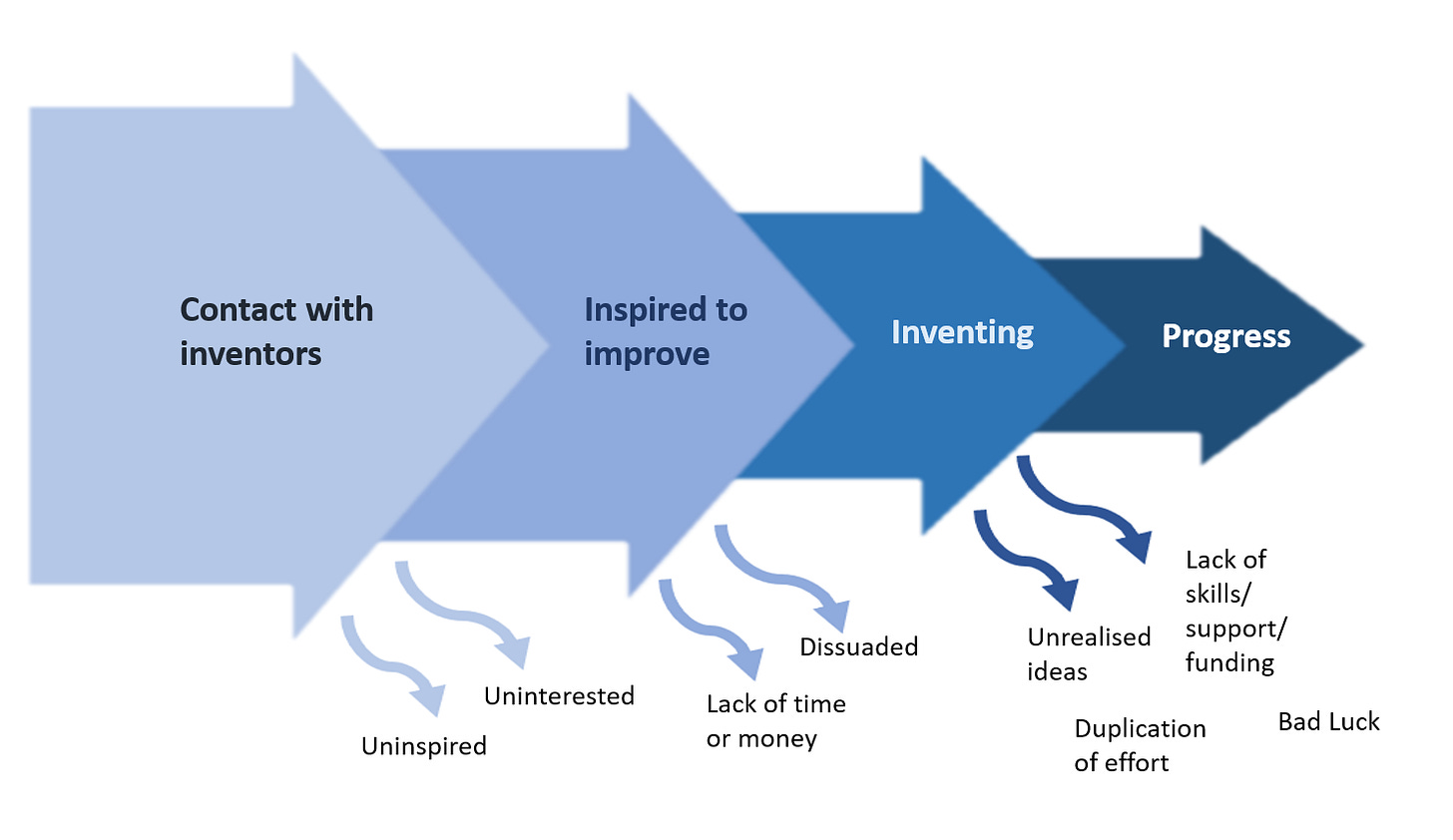
Distilling a decade studying ~1,500 inventors (83% of whom had documented contact with an existing inventor before inventing anything), Howes presents his general "funnel" model: innovation is a mentality caught person-to-person, and exposure to an inventor is the ultimate upstream cause from which everything else — intellectual property, funding, skills, entrepreneurship support — is downstream. Because most innovation policy tinkers at the narrow downstream end, he argues the highest-leverage but hardest-to-measure interventions are "upstream" ones that widen the initial pool exposed to the improving mentality. Necessity is not the mother of invention; crises only redirect inventors who already exist, they do not create them.
Innovation's ultimate cause is not funding, intellectual property, or education, but simple prior exposure to an inventor -- everything else policymakers worry about is downstream of that initial contact. Drawing on a decade-long study of roughly 1,500 British inventors active 1550-1850, the author finds evidence that 83% had contact with an existing inventor before inventing anything themselves, and suspects the true figure is near 100%; a large NBER study of modern American inventors reaches similar conclusions. Necessity is not the mother of invention: crises like famine or blocked trade routes historically produced resignation or retreat to familiar markets, not innovation, because pre-existing inventors -- not the crisis itself -- supply the response.
Exposure alone is not sufficient. A crude funnel diagram illustrates how the pool of potential inventors narrows at each stage: many who meet an inventor aren't inspired; of those inspired, many lack time, money, or freedom from other distractions; of those who start tinkering, many lack the skill to realize their ideas, duplicate existing work unknowingly, or never get past a prototype; and of genuine inventions, only a few gain the business acumen, funding, or luck to have real impact.
Most innovation policy -- intellectual property, entrepreneur funding schemes -- targets only the narrow trickle of people already inventing, far downstream. Skills training sits further upstream; the internet, especially YouTube, has expanded self-education and broken old apprenticeship-based barriers to tacit knowledge more than any single policy. But the most upstream and most neglected lever is simply expanding exposure to the "improving mentality" itself, akin to the awareness stage of a marketing funnel -- through face-to-face contact, cultural visibility, and inspiring portrayals of invention, rather than the lone-genius or lightbulb-moment tropes that make invention look unattainable. The author notes this is exactly what accelerated Britain's Industrial Revolution: inventors raising their own status, forming societies, publishing, building exhibitions and museums, creating funding sources, and lobbying -- with early patents used to entice inventors to migrate, not merely protect IP -- and closes by cataloguing (and critiquing) a crowdsourced list of invention-themed films and shows.
Extending his "improving mentality" thesis to popular culture, Howes proposes a five-part rubric for whether a film actually transmits the drive to invent: does it show the detail of the inventive process, the marginality of improvements, the identification of ordinary things as problems, that inventors can be emulated, and does it make invention cool. Judged this way most films (The Prestige, The Current War, Radioactive, Iron Man) fail by treating invention as mere scenery or as unattainable lone genius, while Pad Man and the opening of The Founder succeed by walking through problem-spotting and incremental tinkering step by step. The point is that how we depict invention is itself an "upstream" lever for producing more inventors.
Modern media offers far more exposure to invention than the Industrial Revolution's mostly face-to-face transmission, yet film does a poor job spreading the "improving mentality" -- spotting marginal problems and fixing them -- because most inventor movies treat invention as scenery rather than process. Historically, reading sometimes helped: John Harrison may have been pushed toward his longitude clock by a clergyman's gift of Nicholas Saunderson's lectures; Francis Maceroni credited Benjamin Franklin's writings; George Stephenson's reading led him toward a failed perpetual motion machine; and Samuel Smiles's Self Help inspired later improvers.
Judging films against a five-part rubric -- process detail, marginality, problem identification, emulability, and appeal -- several score 0/5: The Prestige (2006) makes Tesla's machine a plot device without showing invention; Guru (2007) skips over how its polyester magnate builds his empire; Radioactive (2019) subordinates Marie Curie's discoveries to her relationships; The Current War (2017) never shows Edison or Westinghouse actually inventing, just name-checking achievements like a Wikipedia summary. These zero scores judge neither historical accuracy, since a fictional character can inspire as well as a real one, nor overall quality: The Prestige is called a good watch despite scoring 0/5.
Partial successes follow. The Wind Rises (2013) shows engineer Jiro Horikoshi flush-mounting bolts to cut drag, a genuine marginal improvement, and scores well on emulability since his path -- an ordinary boy who dreamt of planes and pursued the right schooling -- is one any viewer could follow, unlike the ultra-privileged Tony Stark of Iron Man (2008), whose invention (inherited billions, an AI doing the actual work) looks cool but reads as near-divine genius. Big Hero 6 (2014) gives its boy inventor an emulable background but reverses the sequence, hunting for an invention before identifying a problem. Joy (2015) gets the origin right -- Joy Mangano invents after cutting her hands on broken glass -- but reduces the engineering to a dream and a montage. The Founder (2016) opens strongly with the McDonald brothers identifying kitchen inefficiencies one by one; its second half, following Ray Kroc's national scale-up, still credits intangible gains in hiring, financing, and quality control, and Kroc's turn as villain is no drawback, since villains can inspire if successful or cool enough, as Byrne Hobart argued of The Social Network (2010). Strongest is Pad Man (2018), where Indian laborer Arunachalam Muruganantham invents cheap sanitary pads for his wife, showing full process, emulability, and problem-solving -- losing points only for indulgent length and sentimentality.
Robert Bakewell, a Leicestershire tenant farmer, treated livestock breeding as pure optimization: he mentally divided a cow into horizontal value-zones and selectively bred over decades for the largest backs, where the priciest roasting meat sat, and the leanest, feed-cheap lower parts, then extended the same ruthless improvement to sheep, horses, farm layout, irrigation, and even cattle docility. His story exemplifies Howes's 'improving mentality' — the compulsive habit of reframing the status quo as a problem to solve that he argues all inventors share. Bakewell also pioneered agricultural marketing and IP protection, running controlled comparison trials to advertise his breeds and selling only slaughtered meat so rivals could not breed from his stock.
Robert Bakewell, an eighteenth-century Leicestershire farmer, shows the "improving mentality" — the habit of treating everything as a problem to optimize — as the trait common to all inventors, applied here to livestock rather than machinery. Visiting Frenchmen Alexandre and Francois de La Rochefoucauld toured his 500-acre Dishley farm in 1785 and described the results.
Bakewell's insight was that a cow's carcass had zones of unequal value: the back yielded "gentlemen's meat" (sirloin, fillet), the middle less, the belly "only fit for the army." He selectively bred cattle with large backs and lean, triangular bellies, applied the same logic to sheep (bred fat and small-boned) and to draft horses (short, low-jointed, broad-chested). He ran controlled trials in hedge-enclosed 6-10 acre fields, comparing his stock against ordinary county breeds under identical feed — which doubled as advertising. Rather than sell animals, he leased out breeding males to protect his edge, and ran his own abattoir so rivals couldn't breed from slaughtered stock.
Optimization extended to management: he trained docile cattle directable by a boy's switch, calculated that tethering cattle beat free-roaming (better manure, less trampling), redesigned his farm layout to cut wasted cartage, and dug roughly ten miles of irrigation canals, getting sevenfold more hay from watered meadow.
Howes is a compulsive myth-buster, and this cluster turns his method on the discipline of history itself. He shows that history suffers a reproducibility crisis worse than science's — the same sources yield different conclusions, myths persist for decades, and retraction is almost unheard of — using the phantom Napoleonic canning prize, the Luddite-troops legend, and above all the Henry Cort/Bulstrode controversy as evidence, and proposes an ‘Open History’ movement requiring cited sources to be made public. The Ottoman-printing trilogy is his signature demonstration: archival detective work dissolving the supposed Ottoman ‘ban’ on print into a tangle of commercial, missionary, and economic causes. The throughline is a plea for signalling speculation as speculation and for correction proportional to a myth's reach.
A primary-source investigation dismantling the myth of a clear Ottoman printing ban: the oft-cited 1485/1515 edicts trace back to the unreliable André Thevet, while the strongest documented suppression targeted non-Muslims printing in Arabic characters rather than printing as such. Howes reconstructs an intricate story, from the Medici Oriental Press's covert bid to sell secular Arabic books into the Islamic world and the Bandini bankers' 1588 import privilege to the wartime blocking of those books and Jesuit sabotage of Metaxas's Greek press, arguing that European beliefs about a "ban" grew out of episodes of foreign, missionary, and commercial meddling. Original archival detective work that rewrites how the episode should be read.
The Ottoman Empire's near-total non-adoption of the moveable-type printing press for roughly three centuries was not the blanket technological rejection popular accounts describe, but a narrower, evolving suppression of Arabic-script printing by non-Muslims, driven by religious, wartime, and protectionist motives that later writers garbled into a single mythical ban. Jared Rubin's *Rulers, Religion & Riches* frames the puzzle: the printing press let the Reformation succeed, and wherever it did, commercial elites displaced religious ones. Spain fully adopted the press, yet its religious elites kept control anyway and the Reformation still failed there — making the Ottoman case, where the press was barely adopted at all, the genuinely strange outlier.
The most-cited "fact" — that Bayezid II banned printing by firman in 1485, confirmed by Selim I in 1515 — traces to a single source: André Thevet's 1584 biographical entry on Gutenberg, which actually dates the edict to 1483, not 1485, a discrepancy that got garbled by later writers. Thevet, France's royal cosmographer, was a known plagiarist writing thirty years after his 1549-54 Ottoman visit, at age 82, so historians rightly doubt him. Yet his specifics check out elsewhere: Georgian, Persian, Armenian, and Greek presses genuinely didn't exist yet in 1584. The earliest corroboration is Pierre Belon's 1553 account of Istanbul's Jewish press, which printed in Spanish, Italian, Latin, Greek, and German but "not in Turkish or Arabic because it is not permitted" — evidence the restriction targeted Arabic characters, not language, since Arabic text was printed using Hebrew characters (the Soncino press's 1546 multilingual Torah) and Syriac characters (a 1610 Karshuni Psalter at Quzhayya).
Howes's most speculative and, he argues, most promising lead concerns a 1588 firman of Murad III permitting the Florentine bankers Pier'Antonio and Orazio Bandini to import Arabic books — preserved only because it was printed inside a 1594 Arabic Euclid from the Medici Oriental Press. Founded in 1584 by Ferdinando de' Medici, the press marketed ostensibly missionary but mostly secular Arabic texts (al-Idrisi's geography, Ibn Sina, Euclid commentaries) to Islamic markets, but the trade collapsed after 1596 amid war with the Habsburgs, leaving thousands of copies unsold. Howes suggests the Bandini — bankers to the French crown and connected, like Thevet, to Catherine de' Medici — may have been Thevet's actual informants about the older Bayezid/Selim edicts, since Thevet published them just years before the Bandini secured their own privilege from the sultan.
Two further strands complicate the picture. First, religious anxiety: the Czech noble Kryštof Harant (1608) reported that Arabic and Turkish were withheld from Jewish printers as unworthy and tarnishing, while the French diplomat Antoine Galland (1697) explained that the Ottomans feared a printed Quran, produced under Papal patronage, would eventually follow the Medici books — a profanation they could not tolerate. Second, the protectionist "scribe unemployment" justification, which emerges only in the seventeenth century and inflates implausibly over time: an English traveler in 1610 cites merely "a number" of threatened scribes; by the 1670s this becomes "infinity"; the 1680s specify 10-12,000; the 1700s claim 30,000; and Count Marsigli's 1730s account reaches 90,000 — an escalation Howes reads as evidence the figure was rhetorical protectionism rather than a real employment count, aimed specifically at foreign or non-Muslim printers rather than domestic industry.
Later suppressions followed the same pattern of targeting foreign-linked printing rather than Muslims themselves: Nikodemos Metaxas's 1627-8 Greek press in Istanbul was destroyed after Jesuit agents (directed by Cardinal Ottavio Bandini, kin to the 1588 firman's bankers) framed its backers for sedition, before a fatwa cleared them; 1701 decrees suppressed an Armenian press caught in a Jesuit-versus-anti-Jesuit church schism. Howes concludes that Ottoman suppression, where real, consistently targeted non-Muslim and foreign printers of Arabic script for religious, wartime, and protectionist reasons — leaving unexplained why Muslims themselves never printed, a question he takes up in a follow-up piece.
Explains three centuries of Ottoman non-adoption of Arabic-character printing not by religious prohibition or weak demand but by economics: early printing everywhere in Europe required heavy top-down patronage because of enormous up-front capital costs, and a cursive Arabic script, with distinct forms per letter position and roughly 900 type compartments against Europe's 150, made presses far costlier still. Only the sultan could realistically bear that expense, so mere royal apathy sufficed to prevent adoption until Muteferrika's press in the 1720s, which actually sold well. Scarce fine paper and a thin patronage base among non-Muslim printers compounded the problem.
The Ottoman Empire went nearly three centuries without adopting Arabic-character printing not because of religious prohibition or organized scribal resistance, but because such presses were extraordinarily capital-intensive and, unlike in Europe, never received the sustained top-down patronage that capital intensity required.
The religious explanation traces to a 1560 claim by ambassador Ogier Ghiselin de Busbecq that printing would desecrate scripture, but nearly all other such objections concern only non-Muslims handling holy texts, and the claim can't explain the absence of printed secular works or earlier block-printed Islamic texts. Scribal opposition is also thin: Russia's printer Ivan Fyodorov faced hostile "officials, clergymen, and teachers" in 1574 Moscow, including a possibly arson-caused fire at his press, yet Russian printing continued under the Tsar's patronage regardless, and many bishops, abbots, and cardinals were themselves early patrons and printers in Gutenberg's Europe — so uniform, centuries-long scribal opposition in the Ottoman case is implausible.
The real difference was that printing in fifteenth-century Europe required, and usually got, heavy ruler backing, since presses, type, moulds, and punches demanded huge upfront investment: Gutenberg's press reached Bamberg via a prince-bishop's secretary, Venice granted patent monopolies from 1469, and Rome's press was bailed out by the Pope. Istanbul faced even higher costs, and non-Muslim presses there struggled: the Jewish press from 1493 went dormant a decade during a war with Venice, source of almost all printing paper; the Maronite press at Quzhayya printed just one book (1610); and minorities, lacking ruling-class patrons, were mostly refused help by the Pope too. Paper supply was a broader, recurring problem, not just a wartime blip: a Kağıthane mill near Istanbul reportedly made fine paper in the early sixteenth century but was apparently later repurposed for gunpowder, the restarted Jewish press ran on imported French paper, and Nikodemos Metaxas, bringing a Greek press from London, likewise brought his own French paper. Even the English tended to import white printing paper from France despite repeated efforts to produce it domestically — fine printing paper was evidently a hard industry to localize.
Market size wasn't the barrier: mid-sixteenth-century Istanbul held roughly 660,000 people, and even a quarter of Venice's or Frankfurt's literacy rate would have yielded more readers than those cities; Evliya Çelebi counted 300 people across 60 Istanbul bookshops in the 1630s. A preference for manuscripts over print, resting on a single 1670s anecdote from Antoine Galland about an unsold, century-old Medici-printed book, is too thin to bear weight, especially since European tastes for print were themselves shaped only after printers tested the market. The Müteferrika press, the state's first official press (1720s), printed only 16 books but at large runs of 500-1,000 copies — versus Rome's 275-300 early on — and most sold at high prices despite being barred from religious texts, so its reputed "failure" is overstated.
Its greater burden was Arabic's cursive, ligature-heavy script, needing cases of up to 900 compartments across 18 feet versus Europe's roughly 150 in 3 feet. Only a monarch could absorb such costs: Müteferrika's press was funded by the Sultan and grand vizier, and the empire's first Arabic press, at Aleppo (1706), was funded by Wallachia's prince Constantin Brâncoveanu, collapsing after five years when he was executed and the Tsar ignored further appeals. The script barrier was eventually dissolved rather than fixed: the lithographic press, adopted in the early nineteenth century, cut much of the typesetting cost and spawned Turkish-language newspapers, with officials apparently only noticing printing once it was already common. Direct intervention came later still: after the "three pashas" seized power in 1913, the government tried imposing a simplified, ligature-free Arabic script for military telegraphy, but its wartime rollout mainly caused confusion, and the matter was settled in 1929 when the new Turkish Republic adopted a Latin-based alphabet. The earlier centuries of non-adoption, then, reflect sultanic apathy, ending only when Müteferrika made his case in the 1720s.
Responding to debate over Ottoman printing, Howes weighs Pseudoerasmus's point that classical Arabic, like Latin, had no vernacular market to drive presses, and seeks a synthesis with Jared Rubin, arguing his own capital-cost explanation and Rubin's religious-suppression thesis need not be mutually exclusive. He surfaces fresh evidence of Ottoman attitudes, including a Cairo eunuch's claim that costly hand-copying acted as quality control, and notes the empire's rapid, selective adoption of clocks and firearms as evidence against any blanket opposition to innovation.
Responding to reader debate over his claim that high capital costs explain why the Ottoman Empire never developed Arabic-character printing before the eighteenth century, Anton Howes weighs counter-arguments without abandoning his thesis. Pseudoerasmus suggested he overestimated demand: Europe's early printers profited from vernacular Bibles, but classical Arabic, like Latin, had no vernacular substitute for the Quran. Howes isn't fully convinced, noting a single press could still have served the empire's scholars and officials.
Jared Rubin's book Rulers, Religion, and Riches argues sultans actively suppressed presses under religious pressure; Howes proposes synthesis rather than refutation. A Flemish traveller, Vincent Stochove, recorded a 1650 conversation with a Cairo eunuch who argued printing bred bad books, that handwriting's cost enforced quality control, and that satire and libel were harder because handwriting was traceable — "the nature of men brings them to all things forbidden." Howes finds the anecdote too idiosyncratic to be invented.
Still, he maintains capital, not culture, set the ceiling: only the sultan, not merely "rich people" as Rubin suggests, could plausibly fund a press, as with Europe's Medici and popes; the empire's two known attempts were funded by the prince of Wallachia and the Sultan himself. A reader added that Istanbul's interest rates were so punishing that the English Levant Company forbade its merchants from borrowing on local markets, compounding the capital problem. Chroniclers İbrahim Peçevi and Katib Çelebi described printing favorably, and ambassador de Busbecq observed the Ottomans were ready adopters of anything useful — especially firearms — while judging some technologies, like public clocks, superfluous given the muezzin's call; they later embraced clocks anyway, even accepting them as tribute, showing selective, shifting resistance rather than blanket opposition.
Responding to Jenny Bulstrode's headline-making paper that Henry Cort stole his iron rolling-and-puddling process from 76 enslaved Black Jamaican metallurgists, Howes lays out the paper's actual evidence point by point and argues the theory requires a chain of unproven 'smoking guns' — that Reeder's Jamaican ironworks used a newly invented process, that it involved passing iron bundles through sugar rollers, that word reached Cort, that the works were shut to suppress competition, and that its machinery reached him. He grants that inventions were often stolen from abroad but insists speculation must be signalled as such rather than presented as certainty, especially when it becomes a compelling news narrative. A later edit notes the paper's sourcing problems proved even worse than he first thought.
Anton Howes argues that Jenny Bulstrode's claim -- that ironmaster Henry Cort stole his 1783 rolling-and-puddling patent from 76 Black Jamaican metallurgists -- is suggestive but unproven. Cort's patent covered bundling scrap iron, heating it, and rolling it through grooved rather than flat rollers to make bar iron. Cort's history is murky: his financier, a navy deputy paymaster, secretly used government funds and died; the government then bankrupted Cort, seizing his unenforced patents and letting rivals adopt the process freely, though he later won a pension and died bankrupt regardless.
Bulstrode's evidence: Igboland and the Gold Coast, prime sources of enslaved Africans, were ironworking centers, and many such workers, free and enslaved, worked Jamaica's ironworks despite British bans on colonial iron manufacture. John Reeder's Jamaican works (est. 1772) used reverberatory furnaces and rolling mills, by 1781 produced bar iron worth £4,000/year (about £7m today), and employed 30 white and 76 "principally employed" Black workers per an 1788 petition; African societies used bundled iron-blade currency, and Jamaican sugar mills used grooved rollers. Cort's relative John Cort visited Jamaica in 1781, then reached Portsmouth, where Henry Cort ran a struggling ironworks under an Admiralty scrap-iron contract. Martial law then closed Reeder's works; its materials went to Naval stores, and Cort patented his grooved-roller process months later. Bulstrode infers the 76 collectively invented the process from sugar-mill rollers, that John Cort relayed it to Henry Cort, and that the Admiralty closed Reeder's works to eliminate competition and supply Cort reverse-engineered evidence.
Howes rejects each link. Reeder's profitability is no proof of a new process just because Cort struggled simultaneously: the two sold into different markets, using different materials and unfree labor, so the contrast proves nothing about method. Granting a new process existed, there is no proof of who invented it, that the 76 used iron bundles, or that the technique came from sugar-mill rollers, which he disputes directly: sugar rollers were grooved lengthwise to crush cane, while iron rollers, per period manuals, were grooved around their width to stretch bars -- different in form and function. Granting identical rollers, there is no proof John Cort heard of the process in Jamaica or met Henry Cort in Portsmouth. Granting that meeting, Howes finds no evidence Cort orchestrated or was involved in Reeder's works closing via his Admiralty ties, that its machinery was seized rather than destroyed, that it reached Portsmouth specifically, or that it was made available to him. Some era inventions genuinely were stolen -- he cites John Lombe's theft of Piedmont silk-mill secrets -- but this case lacks proof either way. A later edit notes some cited sources turned out not to show what Bulstrode claimed.
Henry Cortironhistoriographyslaveryinvention attribution
History suffers not just science's replication problem but a worse reproducibility problem: using the very same sources, historians routinely fail to reach the same conclusions, myths persist for decades, and there is almost no culture of retraction or correction. Howes marshals the Luddite-troops myth, the phantom Napoleonic food-canning prize, and above all the Bulstrode paper on Henry Cort (with Oliver Jelf's source-transcriptions showing the narrative simply doesn't follow from the evidence) to argue for a 'metascience for history'. His key proposal, that citing historians be required to make their archival sources publicly available, launched a broader movement and much subsequent debate.
History suffers from something worse than the replication crisis that hit psychology after 2011: a reproducibility crisis, since almost nobody checks whether the same sources support a historian's conclusions — a lower bar than replicating an experiment with new data. Unlike science, history has no retraction or correction process, journals rarely print critical exchanges, and incentives favor playing nice — except for anonymous peer reviewers, who feel free to be rude.
Myths persist because no one has time to check every citation, and citation chains often lead to archives too costly or time-consuming to access — history, like any field, runs on trust. The claim that more troops suppressed the 1812 Luddites than fought Napoleon in the 1808 Peninsular War originated with Eric Hobsbawm in 1964, was debunked by the author in 2017, yet still repeated by Terry Deary in a 2020 book. The claim that a 12,000-franc Napoleonic prize prompted Nicolas Appert to invent canned food is false — his reward came over a decade after the invention — a distortion traced to an 1869 mistranslation, repeated for over 150 years. Checking her own citations for a malaria vaccine history, Saloni Dattani found Louis Pasteur's microscope anecdote had no primary source, a WHO eradication timeline misstated as 5-7 years versus the sourced 10-15, and a cholera death toll graph citing one million against roughly 12 million actually documented in British India, 1865-1947. Such pervasive honest error also gives cover to people who deliberately fabricate history.
The starkest case: Jenny Bulstrode's paper in History & Technology claimed Henry Cort stole his 1783 iron-rolling process from 76 enslaved metallurgists at Reeder's mill in Jamaica, drawing 22,756 views, eleven times the journal's next-most-read paper. The author's critique showed the grooves on Reeder's sugar rollers were entirely different from those used in Cort's process. Oliver Jelf then transcribed Bulstrode's sources himself, showing the mill used ordinary methods, was destroyed fearing Franco-Spanish invasion rather than competition, and that the relative supposedly linking Cort to the mill sailed from Jamaica to Lancaster, nowhere near Cort's Portsmouth.
The fix: require historians to publish transcriptions of cited sources, mirroring scientific data-sharing, enabling real peer review and building toward a "metascience"-style movement for history.
Following up his reproducibility-crisis piece, Howes gathers reader-supplied evidence that history does sometimes self-correct (retracted books, forthright reviews) alongside cases of citogenesis and myths that refuse to die, and argues the deeper fix is an 'Open History' movement modelled on Open Science. He commits publicly to maintaining a corrections log, uploading transcripts and photographs of the archival sources he cites, and eventually opening his book's inventor database. The proposal is that making cited sources accessible should become a rewarded, routine scholarly norm.
History does not self-correct fast enough, and the discipline should respond by becoming radically more open with its sources. Responding to readers who doubted his earlier claim that history has a reproducibility crisis, Anton Howes catalogs cases where errors were caught: University of North Carolina Press dropped Designs against Charleston (1999) in 2001/2 after a critic showed hundreds of altered trial-transcript words; Arming America (2000) had its prize revoked and its author resigned from Emory after fabrications surfaced; and James D. Perry's 2020 review eviscerated Nigel Hamilton's FDR at War trilogy for misquoting and inventing dialogue. Yet Howes cautions it is impossible to tell whether these retractions show history self-correcting or are rare exceptions amid many undetected errors. He cites two "zombie" myths: the tale of Euler humiliating Diderot with an algebraic "proof" of God, debunked since the 1950s but still circulating; and the Duke of Wellington's toast "to the corpse of India" on Tipu Sultan's death, traced by Eamonn O'Keeffe to a work of historical fiction -- a case of citogenesis. Scholars including Michael Stevens and Te Maire Tau warn that an uncritical claim of seventh-century Polynesian voyages to Antarctica threatens Maori historical credibility. Commenter Ananyo Bhattacharya proposed the term "Open History," modeled on "Open Science." Howes lists precedents -- UPenn's early-North-America dataset repository, a slavery-sources transcript archive, the New American Antiquarian journal, Kurt Schuler's Bretton Woods photo archive, and Bruce Ivar Gudmundsson's public error log -- and pledges to publish his own correction log, source transcripts, and photograph inventory.
open historyreproducibilityprimary sourcesmetasciencehistoriography
Reaching a wide public audience carries both risk and responsibility, and correcting misinformation should be proportional to how far it has spread and how hard the source is to change. Howes applies this to the Henry Cort affair: after the journal editors of History & Technology issued 'unreserved support' for Bulstrode's evidence-free claim that Cort stole iron-rolling from Jamaican metallurgists, he shows how they misrepresented and ignored the substantive critiques, turning a routine self-correction into an institutional credibility crisis. He closes with tentative commandments of good public history: don't impugn critics' motives, make correction easier, and publicise your work.
Reaching a mass public audience for historical writing cuts both ways: it multiplies the risk of being misused or misread, but it also exposes work to a discipline private scholarship never gets — being caught and corrected fast by readers who know more than you do.
Howes illustrates the danger from his own record: a speculative, carefully hedged piece on whether the Ottoman Empire "banned" the printing press still gets shared by Turkish nationalists as definitive proof. As his newsletter has grown past 26,000 readers, he has grown more cautious and slower to publish, but also more grateful for correction from specialists who catch his errors. Correcting others' misinformation, he argues, should be proportional to how large an audience the error reached and how easily the source can be fixed: a stray tweet merits a private note, but something amplified by major outlets and hard to retract — a journal article — merits public rebuttal.
The test case is Jenny Bulstrode's June 2023 paper in *History & Technology*, claiming ironmaster Henry Cort stole his 1783 iron-rolling process from 76 Black metallurgists at Reeder's Pen, a Jamaican ironworks, who allegedly adapted grooved sugar-cane rollers to iron; that Cort learned of it via his cousin John Cort; and that Cort used Admiralty connections to have the works destroyed and machinery shipped to Portsmouth. Made open-access and promoted by Taylor & Francis and UCL, it went viral in the Guardian, Mirror, New Scientist, and NPR, prompting calls to strip Cort's name from streets and buildings.
Howes argues the paper got fought over regardless of whether it was true: some wanted it right as an illustration of neglected Black achievement and colonial injustice — the author herself framed it as evidence for reparations — while others wanted it wrong to discredit political opponents; neither side's stake depended on the case being correct. Philosopher Liam Kofi Bright mocked the frenzy, tweeting that "the fate of equality" apparently rested on whether some Black metallurgists "did something with rollers" later "nicked by some Brit."
Howes judged the claims unsubstantiated in a July piece, writing "no evidence presented" rather than "no evidence." Other critics emerged independently: Oliver Jelf, a Buckingham master's student, transcribed the cited sources and showed several claims unsupported. Metallurgical historians Peter King and Richard Williams contacted the newspapers, UCL, and the journal directly and were ignored; against the grooved-roller theory they offered an account consistent with the evidence — that Reeder's Pen likely ran old, well-known scrap-iron technology: a water-powered bellows, chafery and helve hammers, plus an air furnace, no rollers involved. Jelf separately flagged that Reeder himself, petitioning for restitution after his ironworks was destroyed, never mentioned any rolling innovation — despite every incentive to over-claim his losses.
In November, editors Slaton and Saraiva admitted there is "no direct reference in any source... to grooved rollers used to work iron at John Reeder's foundry," yet still declared "unreserved support" for the paper, never engaging King and Williams's account or Reeder's silence. Howes dismantles their central defense: sugar-cane rollers were crushers, grooved lengthwise to grip and squeeze, typically vertical, while iron rollers needed grooves around the circumference, mounted horizontally, to stretch and smooth heated bar iron — incompatible operations; forcing scrap iron through a sugar crusher would simply break it. Their rebuttal — a "1754 patent" for horizontal sugar rollers by "George Smeaton" — garbles engineer John Smeaton's unexecuted 1754 Jamaica drawings; such mills weren't built until after 1794.
The editors also claimed they couldn't verify Jelf's credentials despite having corresponded with him, and closed by invoking Du Bois and Fanon to frame empiricism as conditioned by "colonialism and racial capitalism" — triggering a UCL press release calling Bulstrode "fully vindicated," then a British Society for the History of Science statement condemning her critics.
Howes closes with three rules for public history: don't impugn motives, make correcting mistakes easier, and keep publicizing work, since public scrutiny disciplines scholarship toward accuracy.
public historymisinformationHenry Cortacademic integritypeer review
Patents and the Law of Monopoly
2 tier-5 · 4 tier-4
The deep institutional history of the patent as an instrument for encouraging invention — and the myths encrusted around it. Howes traces patents not to wise rulers but to a bottom-up diffusion from Venice's 1474 law, reaching England obliquely through discovery grants and printing privileges before crises and lobbying made them routine. He reframes the 1624 Statute of Monopolies as a constitutional struggle over royal prerogative rather than a piece of pro-invention policy, exposes the celebrated Darcy v Allen precedent as largely manufactured after the fact by Sir Edward Coke, and shows through cases like the lobster monopoly how patents actually functioned as vehicles for technology transfer and regulation. The arc closes with Boulton and Watt, whose business was built almost entirely on the intangible assets patents were meant to protect.
Traces patent monopolies for invention not to wise top-down rulers but to a bottom-up diffusion from Venice, whose 1474 law systematized ten-year monopolies for new or imported techniques. The practice spread across Europe and reached England obliquely, first as John Cabot's 1496 'discovery' patent (invention and discovery being then the same word, inventio) and as printing privileges, before foreign inventors' persistent lobbying plus the mid-sixteenth-century crises finally made English policymakers grant them regularly. Patents thus emerge as an imported, demand-driven institution rather than a deliberate English creation.
Patents for invention did not descend from wise top-down policy; England's version was assembled piecemeal from bottom-up lobbying, borrowing a Venetian model over more than a century. Since the 1330s English monarchs used letters patent to grant denizenship protections to foreign artisans who promised new industries -- a Flemish weaver in 1331, Brabant weavers in 1336, Delft clockmakers in 1368, a Dutch salt-maker in 1440, Bohemian miners in 1452 -- but these functioned as immigration visas, not monopolies (the exception being John Utynam's 20-year 1449 stained-glass grant). Individual monopolies over new techniques emerged instead in fifteenth-century Italy: Venice granted Franciscus Petri a 50-year fulling-mill monopoly in 1416, Florence gave Brunelleschi rights over his marble-transport vessel in 1421, and Venice granted Johannes of Speyer a 5-year printing monopoly in 1469. In 1474 Venice codified the practice into law, offering 10-year monopolies for new or imported technologies -- soon covering mills, pumps, dredges, textile machines, printing techniques, even lasagna -- and the model spread through inventors' own lobbying to Salzburg, Ferrara, the Habsburgs, and Spain.
England's first version arrived via exploration. John Cabot's 1496 patent adapted Venetian form rather than Columbus's Spanish arrangement, letting him keep 80% of profits versus Columbus's mandatory 90% cut -- though it also carried Iberian-derived features, obliging Cabot's heirs to act as "vassals and lieutenants" subduing non-Christian lands, and, unusually for a Venetian-style grant, making the monopoly permanent. A 1501 patent to Azorean navigators hewed closer to Venice, capping the monopoly at exactly ten years while also granting denizenship and aiming to spur further discovery, including celestial-navigation techniques.
Patents for invention and literary privilege were originally one institution: Venice extended identical monopolies to publishers, covering italics, printed sheet music, a Greek typeface, a shaded-woodcut illustration technique, and, in 1492, a method for training memory. England's own version, granted to physician Thomas Linacre in 1512, traced to his Venetian ties with typeface-patentee Aldus Manutius. Uptake then stalled -- no exploration patents appeared between 1502 and the 1550s, and Antonio Guidotti's 1537 bid for a 15-to-20-year silk-weaving monopoly failed -- until the crises of the 1540s-50s, when statesman Thomas Smith held up Venice's practice of "cherishing" skilled immigrants, finally pushing policymakers to adopt Venetian-style ten-year patents systematically.
patentsVeniceJohn Cabotprinting privilegesTudor England
The 1624 Statute of Monopolies is routinely miscast as the birth of the patent system, but patents for invention long predated it — Venice legislated in 1474, and English grants ran back into the fifteenth century — and were creatures of the Crown's prerogative, a subset of the letters patent monarchs used simply to rule. Howes lays out how Elizabeth and James stretched these grants to cover pre-existing industries, breeding parasitic "projector" abuses (leather, playing cards, vinegar) and blocking common-law challenges, until the lack of any legitimate channel for complaint provoked Parliament's revolt. This foundational installment reframes the whole statute as a constitutional struggle over prerogative rather than a piece of pro-invention policy.
The Statute of Monopolies of 1624 is misread as the origin of patent law, but patents for invention were centuries older and were never a creation of parliaments — they were a sovereign privilege granted by monarchs or ruling councils (Venice's senate legislated on invention monopolies as early as 1474, after earlier grants by Venice's grand council and Florence). English monarchs used letters patent broadly — for titles, lands, offices, incorporating cities and guilds, even theatre troupes — and began granting invention/industry monopolies from 1552, after exploration monopolies (1496) and printing monopolies (1512). Some privileges instead used "placards," a parallel form now barely documented because the official records burned; traces survive of Peter Anthony van Ghemen's 1567 monopoly on an iron-slitting engine and cartographer Christopher Saxton's 1576 mapping privilege.
Because patents required court influence and a personal deal with the sovereign, who often took a cut, the system invited abuse. Elizabeth I and James I began granting monopolies over existing industries, not just inventions: in 1594 a courtier won a 21-year patent to regulate ale/beer quality for vinegar-making, then simply licensed existing producers at fourpence a barrel. Tin, coal, leather, wine, salt, inns, and alehouses saw similar grants, often to favorites like Sir Walter Raleigh and the Duke of Buckingham. Edward Darcy's leather patent provoked a glove-makers' apprentice riot, and his playing-card monopoly raised prices and let him raid houses for counterfeiters — though some complaints, like those against a glasses patent, may have simply been sore merchants.
The real problem was blocked recourse: petitions asking the monarch to rescind a patent were routinely ignored, and although common law barred monopolies from displacing existing workers, Elizabeth and James used writs of assistance to keep challenges out of common-law courts. Parliament, cowed since a 1571 rebuke, only grew bold enough by 1601 to debate curbing the monarch's monopoly power.
patentsStatute of Monopoliesroyal prerogativeletters patentintellectual property history
In the 1601 Parliament, anti-monopolist MPs led by the lawyer Lawrence Hyde finally dared to debate curbing Elizabeth I's grants of patent monopolies, while carefully insisting they were not touching the royal prerogative — framing their measure as a mere "explanation of the common law" to defuse any constitutional crisis, against ministers like Cecil and Bacon who warned them off meddling. Elizabeth ended the standoff by abruptly cancelling a swathe of the most-hated patents and promising common-law trials, a mass revocation that delighted Parliament but set a precedent her successor would come to regret.
Elizabeth I's 1601 Parliament forced a resolution to patent-monopoly abuses that petitioning alone had failed to fix, with the queen cancelling patents by royal fiat only after MPs risked a constitutional confrontation. Having granted lucrative monopolies to courtiers and blocked common-law challenges to them, she had promised reform after an earlier 1597 petition and then done nothing, pushing MPs toward legislation.
MPs split over strategy: some argued Parliament shouldn't bind the queen by statute, since she could simply exempt herself, and abuses were better fixed by asking nicely. Ministers and cronies seized on this petitioning option to derail the bill, promising she'd listen if MPs drew up a precise list of offending patents. Lawyer Lawrence Hyde pressed ahead anyway, framing his bill as merely declaring existing common law rather than binding the prerogative, citing an 1370s precedent where Parliament itself cancelled a sweet-wine-import patent. Robert Cecil and Francis Bacon insisted the prerogative was untouchable -- Bacon called the bill "injurious and ridiculous" -- while Cecil blocked its reading procedurally, foiled by Gregory Donhault. Debate grew so heated it spilled into the streets, prompting Cecil to warn of populist anarchy.
The queen then intervened: the Speaker read her message cancelling the most-complained-of patents and promising common-law hearings for the rest. Parliament rejoiced, but the cancellation set a precedent her successor, James I, would come to lament.
patentsParliament 1601royal prerogativeElizabeth Icommon law
The Case of Monopolies (Darcy v Allen, 1602-3), over Edward Darcy's playing-card patent, is revered as a common-law victory that constrained royal prerogative and is still cited as precedent — yet the judges never explained their reasoning and the ruling had almost no immediate effect. Howes argues the precedent was largely manufactured after the fact by Sir Edward Coke, who in 1615, while himself waging war on James I's monopolies, inserted an agenda-driven account into his Reports that retrofitted the defence's most radical arguments. The revisionist thesis — that the legend is essentially "anti-monopolist fake news" whose later power came from the myth rather than the judgement — reframes one of the most-cited episodes in intellectual-property and constitutional history.
The "Case of Monopolies" (Darcy v Allen, 1602-3), later cited for centuries as proof that English common law constrained royal prerogative, was less a judicial breakthrough than retrospective propaganda. The case centered on a monopoly over manufacturing, importing, and selling playing cards, first granted in 1571 to Ralph Bowes, who also held the crown's "master of games" patent over baiting bulls and bears with mastiffs -- so lucrative a trade that rivals, including Shakespeare's competitors Philip Henslowe and Edward Alleyn, spent years and finally paid a large bribe to seize it after Bowes died in 1598 (once theirs, they added apes, lions, tigers, and polar bears to the show). The card patent instead went to courtier Edward Darcy, who defended it through repeated Privy Council interventions and ever-stronger proclamations, making him a target when Parliament revolted against monopolies in 1601 -- a debate so charged that mention of his patent reportedly made Sir Walter Raleigh blush, suggesting he had corruptly brokered it for a fee. Rather than revoke the grant, Elizabeth let it be tested at common law. In 1602 a haberdasher, Thomas Allen, backed by London's lord mayor and aldermen, seemingly baited Darcy into a test case; though Darcy was represented by the crown's own attorney- and solicitor-general, he lost after Elizabeth's death in 1603.
The judges never explained their reasoning, and the ruling had little immediate effect -- older cases had already established that patents could not cover existing industries or harm the public good. Its outsized reputation stems from Sir Edward Coke, the attorney-general who had argued Darcy's side, who republished and reframed the case in his 1615 law reports -- while himself battling James I's monopolies -- crafting a sweeping precedent that contemporaries disputed and Coke partly retracted. That same year, a new playing-card import tax, granted to Richard Coningsby, revived the monopoly in weaker form before merchants got it revoked within a couple of years.
patentsDarcy v AllenEdward Cokelegal myth-makingmonopolies
The 1621 Parliament's examination of Paul Bassano's patent, which combined a Dutch technique for keeping lobsters alive in seawater-welled ships with a monopoly over lobster imports around London, opens a window onto how early patent monopolies actually functioned: rewarding technology transfer, funding apprenticeship-length training, and justifying trade regulation as coordination against gluts and scarcities. Bassano co-opted rival fishmongers into partnership and plausibly lowered and stabilised London lobster prices, but the monopoly's blocking of a foodstuff and its imprisonment of interlopers led Parliament to declare it a 'grievance.' The case prefigures the 1624 Statute of Monopolies and hints that parliamentary scrutiny may itself have had a chilling effect on investment in nascent industries.
Paul Bassano's 1616 patent for London's lobster trade shows how a genuine transfer of technology could still calcify into a monopoly Parliament had legal grounds to strike down. Bassano imported a Dutch method of keeping lobsters alive in well-ships, but used the patent to monopolize all lobster imports to London for 31 years -- unusually long, since patents typically ran 14-21 years to cover an apprenticeship. He framed blocking Dutch imports as industrial policy: Dutch capital at 4-5% interest let sellers profit on 10% margins, while English sailors needed 15%-plus given higher costs and shipwreck risk (he had already lost two ships). He paid English sailors above-market wages to build domestic expertise over time. To defuse opposition he brought existing lobster-importing fishmongers into his partnership as a "win-win," winning the Fishmongers' Company's backing; when younger fishmongers still balked, he had some imprisoned under Francis Bacon's judicial authority and bought off only the richest of the rest with partnership shares. Bassano argued a fleet of twenty ships delivering one full ship to market daily, rather than a free-for-all -- which would take two to three weeks to fill a single ship and produce alternating gluts and scarcities -- gave consumers steadier supply through efficiencies of scale and coordination, at £6 per hundred versus the Dutch's earlier £5-9 range.
Opponents cited old laws guaranteeing the freedom to catch and sell fish as a foodstuff, and Parliament's 1621 inquiry into monopoly "grievances" declared the patent void on that legal basis, which Howes judges probably correct even while doubting the outside-London price evidence used against it. In 1622 Bassano and his partner Sir John Lawrence got the patent upheld by promising not to block English fishmongers from buying lobsters from the Dutch, but the 1624 Statute of Monopolies likely killed it for good.
patent monopolies1621 ParliamentStatute of Monopoliestechnology transferDutch competition
Boulton and Watt's partnership was one of the first businesses built almost entirely on intangibles: instead of selling steam engines, they licensed Watt's fuel-efficiency improvements, charging customers a third of the coal savings (metered and collected as royalties) and later a per-horsepower annual fee. The savings-based model aligned their incentives with customers', steered them toward high-fuel-cost markets like Cornwall, and rested on patents, branding, consultancy, and quality control rather than physical capital. Howes reads it through Haskel and Westlake's 'Capitalism without Capital,' arguing that legal and institutional failure to protect such intangibles, vividly shown when France reneged on its patent protection, slowed the steam engine's spread abroad and Europe's catch-up to Britain.
Matthew Boulton and James Watt's celebrated partnership, formed in 1775, was originally an intangibles business despite its association with the tangible steam engine. Watt's Soho Manufactory looked like a conventional factory, but it was mostly devoted to Boulton's other, unrelated trades, and the pair didn't build the Soho Foundry to manufacture engines themselves until over twenty years later, coinciding with Watt's 1800 retirement and the expiry of the patent their business had been built on.
Watt patented his engine improvements in 1769, giving him fourteen years of exclusivity, but backer John Roebuck went bankrupt and the patent sat largely unused until Boulton bought out Roebuck's two-thirds share. With only eight years left, Boulton and Watt lobbied Parliament for an extension, winning one that pushed the patent to 1800. On that foundation they built a business that, by their own account, sold no engines at all: "we only sell the licence for erecting our engines." Instead they charged a third of the fuel savings a customer would gain over an old Newcomen engine, so they earned most where coal was expensive, at Cornwall's copper and tin mines rather than cheap-coal collieries. For rotary engines, lacking a Newcomen baseline, they switched to an annual per-horsepower fee, the unit now called the watt, reaching £5 a year in most of England and £6.3 in London by 1785.
The savings-based fee was itself the mechanism for overcoming customers' notorious resistance to unfamiliar machinery: because Boulton and Watt earned nothing unless the customer saved money, their incentives were explicitly aligned with the buyer's, building trust that showcase installations like Albion Mill, credited with cutting London's flour costs by roughly £200,000 a year, could reinforce but not substitute for. They also sold consultancy and coordination with suppliers like ironmaster John Wilkinson, since almost no customer could erect the engines alone. Piracy and patent disputes were constant threats, worst in France, where a 1778 arrêt de conseil induced them to install engines before officials reneged and threatened to prosecute the ministers who'd granted it, a failure of intangibles-protecting institutions Howes ties to Haskel and Westlake's argument that weak legal support for intangible assets still stunts growth today.
Boulton and Wattintangible capitalpatentssteam enginebusiness models
Fuel and Power: Coal, Salt, and Water
1 tier-5 · 11 tier-4
Energy is, for Howes, the one technology immune to the ‘paradox of progress’, and this cluster is his sustained account of how Britain came to burn coal. Piece after piece overturns the standard deforestation story: woodland was a renewable, coppiced resource, so rising firewood prices were a consequence of coal's arrival rather than its cause, and what needs explaining is coal's sudden late-sixteenth-century cheapness — driven, he argues, by industrial demand from brewers, dyers, and above all salt-makers. Salt itself gets its own flagship series as an ‘unsung’ general-purpose technology on par with grain and fuel, while water power, canals, and railways round out a picture of energy and its distribution as the true infrastructure of growth.
London's households switched from wood to coal with startling speed between 1570 and 1600 — a costly 'Domestic Revolution' requiring chimneys and iron grates to tame a filthy, sulphurous fuel, coinciding with the city's momentous late-Tudor expansion. Howes challenges the standard wood-shortage explanation, arguing that deforestation was often a consequence rather than a cause of the switch, since coal freed coppiced woodland for food production, while official anxiety centred on preserving timber for the navy. He frames the whole episode as a suggestive historical parallel for today's decarbonisation challenge.
London's rapid switch to coal-burning between 1570 and 1600 remains puzzling because the standard explanations don't fully hold up. Coal had circulated from Newcastle since the Middle Ages for limited industrial uses, but within a generation ordinary Londoners adopted it domestically despite its severe drawbacks: sulphurous, lingering smoke that stung eyes, tarnished goods, and required costly chimneys and iron grates — a change historian Ruth Goodman calls a "Domestic Revolution."
The common wood-shortage theory holds that rising prices from deforestation pushed people toward cheap coal. But population growth (England's roughly doubling to 4 million; London's quadrupling from 50,000 to 200,000) increased demand for wood, which should have made coppiced woodland more valuable, not scarcer — suggesting deforestation was often coal's consequence, freeing land for food production, rather than its cause.
Official policy focused almost entirely on preserving timber for naval shipbuilding: Elizabeth I's 1589 patent warned that iron- and glassmaking with wood would starve the navy of timber, and James I later mandated coal for glassmaking. Howes stresses this remains unproven as an explanation for household adoption — he calls government policy's role "an open question," noting the 1589 patent "certainly failed to yield results."
Falling transport costs from the sixteenth to nineteenth centuries pulled even the bulkiest commodities — grain, coal, meat — into a single world market, converging prices globally and splitting the world into an industrial 'core' and a commodity-exporting 'periphery' (in Arthur Lewis's terms). Fossil fuels globalised (coal, then oil as 'one great pool'), which capped and stabilised their prices, but natural gas only partly globalised because it must be liquefied to ship — the gap that left Europe facing an 800%-higher regional price during the 2022 crisis. Renewables like wind and solar resist globalisation almost entirely, and even nuclear's market stayed national despite globally-traded uranium, so cleaner energy forfeits the price-stabilising security a globalised fuel supply provides.
Falling transportation costs from the sixteenth through nineteenth centuries turned local commodity markets into one global market, and this history explains why renewable energy remains stubbornly unglobalized while fossil fuels became a single worldwide pool.
Better ships, canals, railways, and dynamite let even bulky, cheap goods like grain, coal, and meat travel profitably across oceans, converging prices worldwide. This produced a terms-of-trade boom for agrarian periphery economies: their grain, raw fibers, minerals, and ores bought more manufactured imports, incentivizing them to extend their frontiers further, plowing more wilderness and digging deeper for ore. Industrial "core" economies got cheaper inputs in turn, making their own exports cheaper still -- the split economist W. Arthur Lewis described between an industrial core and a commodity-producing periphery.
Coal globalized first, its shipping costs falling 65-70% in the twentieth century's second half, with traded volumes rising over 230% between 1970 and 2000. Oil globalized faster still, treated by analysts as one interconnected pool. Uranium is likewise globally tradable, but the technology to convert it, built out only in France, Sweden, and Slovakia, remains national. Natural gas, requiring expensive liquefaction/regasification infrastructure to cross oceans, stayed regional -- leaving Europe exposed when Russia cut pipeline exports, with European gas prices last month over 800% above US levels. Because that market was still regional rather than globalized, Russia was able to act as an energy price maker for Europe this year: its withdrawn supply was too large and too regionally specific to be replaced quickly from elsewhere.
Renewables are even less globalizable than gas -- there is no way to ship sunlight to Scandinavia or wind to the Sahara -- but this may be an advantage. Regional producers, unlike globalized exporters, can be price makers rather than price takers, so a region that rapidly builds renewable capacity could gain a lasting edge, its prices decoupled from the high global baseline. Europe's gas crisis creates sharp incentive to invest not just domestically but regionally, in North Africa's "Aeolian-Helian Zone." Algeria's solar/wind potential and existing gas pipelines to Spain and Italy make it an obvious target; yet renewables investment across most North African countries has been pitifully small, with Morocco still heavily reliant on oil and coal. Jordan is a counterexample, jumping from 1% renewable electricity in 2014 to 29% today, proof political will can move fast.
globalisationenergy crisistradefossil fuelseconomic history
Britain's canals, river navigations and earliest railways were built overwhelmingly to move goods and energy — coal and grain — not passengers, and Howes warns that reading them as passenger infrastructure commits the historian's sin of presentism. Because coal and grain were bulky and low in value, cheap water and rail transport effectively extended an energy grid: it let cities concentrate, freed nearby land for food, and let coal-fuelled goods be traded for distant grain. He distils a hierarchy of infrastructure's value for growth — energy first, then access to goods markets, and only then labour — and argues modern governments' passenger-first infrastructure decisions ignore it.
Transport infrastructure's contribution to growth follows a hierarchy: access to energy and bulk goods first, access to markets second, labor-market efficiency only third — passenger convenience is a nice-to-have, not the historical driver of infrastructure booms. Britain's eighteenth- and nineteenth-century transport expansion — navigable river mileage rising from 950 miles in 1600 to 4,000 by 1835, 14,000 miles of road improved between 1680 and 1830, and railway mileage exploding from 125 miles in 1830 to over 13,000 by 1871 — was built overwhelmingly to move coal and grain, not people.
Coal demand surged in late-sixteenth-century Britain, and any seam within reach of a navigable river or sea, or within 10-12 miles of a town, was exploited; London drew its supply from Northumberland and Durham. Cheap coal let cities grow, freed nearby land from fuel production for farming, powered lime-burning to improve soil, and fueled trades from brewing to glassmaking, letting coal and goods be traded for food from coal-less regions — as a visitor to Staffordshire observed in 1776, "wherever fuel can be had cheap, there inhabitants are never wanting." Grain fed the horses (per historian Tom Almeroth-Williams's City of Beasts) and humans who powered milling, weaving, and hauling.
Coal-, horse-, human-, and wind-power, all in a single image.
Case after case bears this out: the Thames was made navigable to Oxford in 1635 for grain and coal, followed by the Wey from 1651; the Sankey (1757) and Bridgewater (1761) Canals were dug to supply Liverpool and Manchester with coal; the Middleton Railway (1812) and Stockton and Darlington Railway (1825) carried coal first, with passenger service leased to horse-drawn coaches until 1833. Even the Liverpool and Manchester Railway (1830), built to break the canals' monopoly, only proved unexpectedly popular with passengers afterward. Railways and cars later did expand cities' effective labor pools — but that came after, and beneath, the energy logic that built the network.
Sandstone could not stand in the way of the Liverpool and Manchester Railway
transport infrastructurecanalsrailwayscoaleconomic growth
Long before the cotton mills, the medieval world of the seventh to thirteenth centuries drove a dramatic expansion of water power — mooring floating mills to fast rivers and bridge arches, damming reservoirs, and even storing the tide — and, crucially, extended it far beyond grinding flour to sawing, lathing, fulling cloth, tanning, papermaking, and metallurgy. Howes draws on Terry Reynolds's history while flagging scepticism about claimed regional differences between Christendom, China, and the Islamic world. His original wrinkle is that diverting rivers for mill races competed with navigation and irrigation, so the later rise of canals and river navigations often came at water power's expense.
Waterpower's dramatic expansion predates the Industrial Revolution's cotton mills by half a millennium: from the seventh to thirteenth centuries, medieval Europe adapted waterwheels — previously confined to aqueducts for milling flour and irrigation — to large natural rivers. Floating mills were moored to riverbanks or chained to stone bridges, where water ran fastest through the arches; where neither worked, dams and mill races were built, with sluice gates timed to store even tidal flow. By 1500 waterpower had spread into metallurgy and cloth-making too; historian Terry S. Reynolds, in Stronger than a Hundred Men (1983), catalogued medieval life as touched by hydropower everywhere: sawn timber, turned bowls, bored pipes, pressed oil, tanned leather, fulled cloth, forged iron, milled paper.
Reynolds also proposed regional contrasts: a European core in France, Italy and Germany; China adapting waterpower to more industries earlier, before the eleventh century; and an Islamic world (Fez's huge waterwheels by 1600) matching Christendom's dams and mill races but with less evidence of non-milling use. Howes calls this comparative evidence "too sparsely documented... to repeat without a grain of salt," adding he's "a little sceptical." If real, he suggests abundant muscle power dampened the incentive to adopt waterpower, itself a rival to muscle: diverting rivers for mill races could hurt navigation, irrigation and flood control — foreshadowing the later tradeoff between waterpower and canals.
water powermedieval technologywatermillsmechanizationTerry Reynolds
From a commission for the innovation agency Nesta on Britain's original coal transition, Howes distils four takeaways: the switch began by finding ways to exploit cheap, low-grade sulphurous coal (in homes, then salt pans that anchored the Scottish Lowland economy); lime is a glaring blind spot for economic historians despite raising agricultural productivity; cheap coal indirectly multiplied grain and therefore horse muscle-power across industry; and the Dutch Golden Age did not collapse from any lack of energy, since peat and grain were cheaper than ever amid a demand slump. Bullet-point research takeaways, several genuinely revisionist, pointing to the fuller report.
Researching Britain's original coal transition for the UK innovation agency Nesta, which wanted lessons for today's renewable-energy shift, Anton Howes reports four findings. First, coal's rise began with exploiting cheap, sulphurous low-grade coal: burning it in homes without noxious fumes, then scaling supply enough to fuel seawater-boiling salt pans (fed by the lowest grade, literally called "pan coal") that underpinned the Scottish Lowlands economy by the eighteenth century, though the specific inventors remain unidentified. Second, cheaper coal expanded lime-burning beyond mortar into agriculture, turning barren sandy heaths into farmland as a soil-acidity regulator and pest control — a use economic historians largely ignore, with Stephen Broadberry et al.'s British Economic Growth 1270-1870 mentioning lime only once, as a construction input. Third, coal-driven agricultural abundance fed more grain to horses and other animals, which powered milling, papermaking, metal-flatting, and transport, part of a broader, underexplored history of "improvement of animals" including dogs harnessed for mechanical tasks. Fourth, the Dutch Golden Age's collapse in the 1650s-80s wasn't caused by energy scarcity: peat and grain prices fell to record lows amid slumping demand, ruling the energy theory out.
coalenergy transitionlimeDutch Golden Ageeconomic history
Salt was a general-purpose technology of the early modern economy on par with grain and fuel: a universal flavour enhancer, a food preservative that cut waste and extended the range of trade, sieges and voyages, and both a livestock supplement and a fertiliser that raised agricultural productivity when farming was most of the economy. Howes argues salt's enormous effect on living standards and output has been almost entirely ignored by economic historians, even as controlling salt supplies drove taxes, monopolies and wars. This heavily-sourced flagship of the 'unsung materials' series aims to be a near-comprehensive reference on salt's forgotten importance.
Salt was one of the most economically and politically consequential commodities in early modern history — as vital as grain and fuel, capable of starting wars and building empires — yet it barely registers in most economic histories. Seventeenth-century households spent 75-85% of their budgets on food and drink; a 1612 treatise called salt "the seasoner of all things," since it preserved meat and fish for months and was called "a second soul" for keeping corpses from corruption. It was also fertilizer and livestock feed, and physiologically essential: losing it brought fatigue, cramps, and eventual death by desiccation.
That inelastic, universal demand made salt a natural target for taxation. In 1633 Charles I's new Lord Deputy for Ireland, Baron Wentworth, proposed monopolizing Ireland's salt to make the Irish economically dependent on England: salt "preserves and gives value" to their staple exports, so controlling it, he argued, would leave the Irish unable to "depart from us without nakedness and beggary." Though never enacted, the scheme captured the general logic: because everyone needed a minimum amount, and supply was pinned to particular coasts, springs, or mines, monopolizing and overpricing salt worked as a disguised poll tax — per head of people and livestock — without the burden of a census.
States that controlled cheap, sun-evaporated coastal salt built "empires of the sun." Charles of Anjou, ruling Provence from 1246, monopolized its Mediterranean salt marshes so thoroughly that by the 1260s salt revenue nearly equaled all his other income, funding his conquest of Sicily and, in exchange for Tuscany, the Greek principality of Achaea (mapped as his 1278 empire). Venice's salt gabelle, reaching roughly 15% of state revenue by the late fifteenth century, funded the debt service behind its rare medieval creditworthiness, and forced cities like Verona, Vicenza, and Padua to buy only its salt; it annexed Cyprus partly to secure supply.
What do you think of my newfound mapmaking skills?
France's gabelle, rooted in 1315 anti-hoarding rules, became a full tax in 1342-43 amid Edward III's invasion, splitting the kingdom into a harshly taxed zone around Paris, a lighter southern zone, and exempt regions like Brittany; a 1540s attempt to equalize rates sparked revolt in Bordeaux, and the rebels bought permanent exemption as the "pays rédimés" (mapped as the 1600 patchwork). Salt decided the Wars of Religion: Huguenots funded their revolt by selling Bay of Biscay and, from 1575, Aigues-Mortes salt to England and Genoa, holding La Rochelle through an 1573 siege before losing their salt bases in 1577; Henri of Navarre's later access to Biscay salt helped him become Henri IV. Richelieu's 1620s strategy — build a navy, crush La Rochelle, extend the gabelle — succeeded militarily despite a failed 1627 English attempt to seize Ré and Oléron (pictured in an 1881 painting); the gabelle was never extended.
France’s gabelle regions during the Wars of Religion, shown more or less (my hand wasn’t always steady) with its 1559-1600 borders. The enclave in the south-east is the county of Venaissin around AvigRichelieu at the blockade of La Rochelle in 1628, as envisaged in 1881 by Henri Motte
France's own vulnerability had a specific cause: salt-producing coasts but almost no inland sources until conquering Lorraine, Alsace, and the Free County of Burgundy in the 1670s. Because bulky salt was too costly to move overland, whoever held the coasts and blocked the river mouths controlled the whole interior's revenue and population — the logic behind both the Huguenot wars and Richelieu's strategy. Spain, with abundant coastal and inland sources, never got salt above 6% of crown revenue (falling to roughly 3%) despite a compulsory 1564 nationalization, since sources were too numerous to police; Naples, with no major inland sources but dense coastline (38.5m/km²), fared no better: policing that shore cost more than it yielded. Landlocked Lorraine, by contrast, drew half to two-thirds of its revenue from salt. Extraction had limits: gabelle-extension revolts hit Normandy (1639), Roussillon (1660s), and Piedmont's Mondovì (1680), while Spain's 1632 extension attempt was dropped after opposition; Russia's salt revenue, peaking near 15% in the 1750s, went negative by the 1790s as the state grew too afraid to raise prices. Part I closes noting the greatest windfalls lay ahead, in northwestern Europe's cold, damp corner.
saltunsung materialseconomic historyagricultureearly modern economy
Salt was a survival-critical second soul that preserved food and underpinned an agrarian economy, and the path to saline superabundance runs through the four sources of salt: seawater evaporation, sleeching of tidal flats, inland brine springs, and mined rock, each with very different fuel, land, labour, and weather demands. Cases from Cheshire's unusually strong brine springs to India's Sambhar lake, whose output could swing 94-98% with the monsoon, show how geography and energy costs governed who could make salt at all. The thread returns to the Baltic, where Lüneburg salt, the Stecknitz Canal (an early summit canal), and Hanseatic-Danish rivalry set up the coming Dutch challenge.
Salt's modern superabundance -- only 12% now goes to food, the rest to industry and de-icing roads -- is a recent inversion of millennia of scarcity, best seen by comparing two regions geography starved of salt: Bengal and the Baltic. There were four ways to get salt: evaporating seawater (about 3.5% salt), labor-intensive "sleeching" of tidal mud, tapping a concentrated inland brine spring (Cheshire's Northwich and Nantwich ran 16%, Middlewich and Upwich to 25%, cutting fuel needs to a ninth of seawater's), or mining rock salt, the most efficient method. Inland brine was vulnerable to dilution: India's Sambhar lake could yield 250,000 tons in a good year but crash to 3,000-14,000 tons after floods. Places with no local source, like Habsburg-controlled Bohemia, fell under salt-rich neighbors' sway.
Bengal was a rarer case: coastal yet salt-poor, because extreme humidity blocked sun-evaporation and the Ganges-Brahmaputra delta diluted seawater to 2% in winter and under 0.5% near the delta in the rainy season. It imported salt across an ocean-wide network -- barged 1,500 km down the Ganges from Sambhar salt stockpiled at Agra, shipped from Peddapalli and Bombay, even rock salt hauled as ballast from Hormuz. Nearby Sandwip island was the closest domestic source and became a magnet for conquest: Mughals, Portuguese, the Arakan kingdom of Mrauk-U, and the Dutch East India Company all fought over it, with the Portuguese merchant Sebastião Gonçalves Tibão running it as a pirate kingdom from 1609-16. The chaos depopulated the coast and choked commerce, and as Bengal's ability to pay for imports collapsed while its population still needed salt, it was forced by the 1670s into large-scale sleeching -- work reserved for the lowest castes.
Bengal’s main salt sources in 1600.
By the 1760s, merchant Archibald Keir estimated some 130,000 workers produced 120,000 tons a year, living in tiger-infested jungle camps for months. Seasonal death rates ran about 6% -- two-thirds from tiger attacks -- versus roughly 0.3% per year for enslaved Jamaican sugar workers and 0.082% per year in America's most dangerous modern job, logging. Debt bondage passed the obligation to work the salt-jungles through families and villages for generations. Against the common claim that the East India Company de-industrialized Bengal's salt sector, the argument runs the other way: the industry's existence was a symptom of prior impoverishment, and the EIC's fault was entrenching it, not ending it. After conquering Bengal in 1765, the EIC turned the monopoly into a revenue engine; reforms by Governor Cornwallis and others to curb forced labor and mortality failed against fiscal pressure, and output rose from about 100,000 tons a year in the 1760s to 230,000 by the early 1830s. To suppress competition the Company annexed Bihar (1781) and Orissa (1804), then built the "Customs Line," which by the 1860s was a guarded hedge barrier 3-4 meters high running 3,700 km with 12,000 officials at 1,700 checkpoints -- fending off cheaper solar salt from Bombay, by the 1820s the world's cheapest. The monopoly lasted until an 1870s India-wide excise tax replaced it.
The Baltic offers the counterfactual: its water, under 1% salt at sea and about 0.3% near shore (a freshwater lake just 9,000 years ago), made local salt roughly twelve times costlier than average coastlines. Rather than fight over the shortage, salt-fish rivals Hamburg and Lübeck allied in 1230 and 1241, founding what became the Hanseatic League, chiefly to counter Danish tolls on the Øresund strait carrying Lüneburg salt. War with Denmark won the League control of the Sound's tolls in 1370, and Lübeck's 1398 Stecknitz Canal -- Europe's first canal over a summit linking two river valleys, and the world's second after China's Grand Canal -- gave Lüneburg salt a toll-free route into the Baltic, cementing Hanseatic power even as Denmark, Norway, and Sweden merged into the Kalmar Union in 1397.
Look at just how salt-less the Baltic is. The scale shown here is of 0-4% salt, as measured at the sea surface, which is what’s most relevant to early salt-making. Source here .The Baltic’s medieval salt supply
Two maps show Bengal's scattered 1600-era salt sources, and the Baltic's near-zero salinity alongside the Lübeck-Hamburg-Lüneburg route that let the League bypass Denmark.
The salt-poor Baltic, as low as 0.3% salinity, shaped northern European power: Lüneburg's inland springs and the Hanseatic League's control of the salt-and-herring trade, then the rise of cheap but dirty Atlantic bay salt. The decisive move was Dutch refining, burning abundant peat to purify cheap French bay salt into white salt fit for butter, cheese, and herring, which underpinned the mother trade and the seventeenth-century Dutch Golden Age. Hunting for solar salt after Spain and Portugal turned hostile pushed the Dutch into the Arctic, Cape Verde, and the Caribbean, until peat's dominance was in turn challenged by British coal.
Dutch merchants built their commercial empire not on having salt of their own, but on turning cheap imported sea salt into a superior refined product with inexhaustible domestic peat fuel, then riding that edge into dominance of the Baltic's grain, timber, and herring trades.
The Baltic made almost no salt, so it depended on inland brine springs at Luneburg, shipped via Lubeck and Hamburg -- whose alliance against Denmark founded the Hanseatic League. As Baltic demand outgrew Luneburg's capacity, merchants turned to "bay salt," sun-evaporated in shallow pools around France's Bay of Biscay, Setubal, and southern Spain -- half the price of Luneburg salt but inferior, since dirt and "bitterns" (magnesium and calcium compounds) discolored food and left fish tough or rotten inside. By 1400 over 70% of ships reaching Reval carried salt, mostly French; Hanseatic shipping alone couldn't meet demand, so Dutch vessels filled the gap. When Lubeck attacked them in 1438 the League refused to back the fight, and an 1441 treaty admitted the Dutch to the Baltic on equal terms, trading bay salt for Baltic grain, timber, and naval stores -- hemp for rope, pitch for caulking.
The Dutch had first tried making salt directly, digging salt-laden peat near shore, burning it to ash, and boiling the brine into fine white salt. But digging near the dikes had to be tightly restricted to avoid flooding, and the process was too labor-intensive to scale -- "fen salt" stayed costly and marginal. What did scale was ordinary peat dug farther inland -- effectively inexhaustible, later dredged from below the water table once surface supplies ran out in the 1530s. From around 1450 they used this fuel to refine the bay salt they already carried -- dissolving it, boiling it over peat fires, clarifying it with egg whites or ox blood -- producing pure white "salt upon salt" that undercut Luneburg salt on price. Dutch ships, a mere foothold in 1441, made up roughly 50% of Baltic entrants by 1500.
Salt was the entry to a self-reinforcing "mother trade." Ships swapped salt for Baltic rye feeding the booming cities of Flanders and Brabant, but grain demand soon exceeded what salt could pay for -- by the 1550s two-thirds of Dutch Baltic-bound ships carried only ballast, paid for with silver earned elsewhere. The Dutch undercut Hanseatic freight rates with lower sailor wages and, later, fewer crew per ship, while the Low Countries' milder climate let them complete a France-to-Baltic round trip in one season before Hanseatic ports iced in. Cheap grain let farmers shift to fodder and cattle, producing butter and cheese that made the northern Dutch famous as "butter boxes." Above all, cheap refined salt let the Dutch out-fish everyone at herring: unlike Luneburg's wood-constrained springs, Dutch peat scaled indefinitely. Fishermen built the herring buss -- made from salt-bought Baltic and Norwegian timber, processing catch at sea with the 1.4-kilometer vleet dragnet -- letting them fish the open North Sea. By the 1460s Dutch herring displaced Hanseatic-cured Baltic herring even in Flanders and Brabant, and by 1500 the Dutch supplied roughly half the herring sold at Gdansk.
This salt-grain-timber-herring-butter-cheese cycle generated the silver that made Amsterdam Europe's commodities hub, though the Dutch produced almost none of it themselves. When Habsburg Spain cracked down on its Protestant subjects in the Low Countries after 1559, triggering revolt in 1566 and the 1588 Dutch Republic, hostility cut off easy access to Iberian bay salt. The Dutch responded on two fronts: pushing into the Arctic in the 1590s to trade with Russia via Arkhangelsk, and hunting new solar-salt sources at Cape Verde and in the Caribbean (Punta de Araya, Tortuga, Saint Martin), only to be driven off by Spanish forces through the 1620s-30s. Contemporaries still judged Dutch herring as valuable a "gold mine" as Spain's American silver -- a foundation soon to face a new rival: coal.
Setting up the salt series' turn to British coal, Howes demolishes the ubiquitous claim that deforestation caused England's shift to coal: woodland was a renewable, coppiced resource, so rising firewood prices were a consequence of coal's arrival, not its cause. Because planting woodland meant forgoing years of food and pasture income while a coal mine cost only the digging, coal supply could always advance faster than wood when prices rose, and woodland always retreated first when prices fell, making it nearly impossible for wood to fight back once coal appeared. He argues that what needs explaining is coal's sudden late-16th-century cheapness rather than any wood scarcity, and points to salt as the driver.
England's shift from wood to coal after 1570 caused deforestation; deforestation did not cause the shift to coal. The standard story — that a growing population exhausted the firewood supply, driving prices up until coal became the cheap alternative — fails on its own terms. Forests were a renewable resource, coppiced and pollarded on cropping cycles, not one-off stores like coal or peat. Rising prices should have prompted the English to grow more wood, not destroy it, much as rising food prices prompt more farming, not abandoned fields.
The record confirms this, and shows exploitation intensity actually falling as population rose. At London's medieval peaks (1290s, 1340s), wood prices rose but supply expanded, exports to the Low Countries continuing; coppices were cropped every six or seven years to squeeze out fuel, and London drew firewood from as far as 17 miles overland. After the Black Death halved the population, the cycle lengthened to about eleven years. By the 1570s — though London's population had by then finally passed its medieval peak — an MP admitted the city only sometimes needed wood from as far as 12 miles, and coppices were cropped on roughly a twelve-year cycle, twice the pre-plague rate (fourteen or fifteen years by the nineteenth century). By 1550 London, still below its medieval peak, sat amid ample woodland. The real mid-1500s strain came instead from Henry VIII's debasement, making Spanish iron dear and English wood cheap to export, spurring an eightfold rise in Wealden pig-iron output (1530-1550), each ton needing 86 tons of wood once refined to bar. Parliament answered with export bans (1548-55) and a timber reserve (from 1543, tightened 1559); a 1581 Act, after a contested 1572 debate, barred ironworks within 22 miles of London or the Thames, the Weald exempted. Yet iron output grew for two more centuries, peaking in the 1750s, as ironworks simply relocated wherever wood was cheap.
Glassmaking told the same story: window glass, introduced by French workers in the 1550s-60s, expanded within London while its price stayed flat. Timber was never actually short despite worries about the reserve: a separate 1605 proclamation by James I, citing a navy timber shortage, banned new wood-framed houses around London, mandating brick or stone facades — reaffirmed in 1615, hoping to leave London "of brick" as Augustus left Rome "of marble." London's population quadrupled 1550-1600 and its merchant fleet doubled twice by 1686, while timber supply held.
Farmland conquered woodland instead, because coal — not any lack of wood — made land clearable: a 1607 forest surveyor judged England's woodlands had receded by two-thirds in the previous two decades, wood now "rather held a hurtful weed" than left standing when corn paid better. Coal moved cheaply by water (10 miles overland cost the same as 250 by sea, hence "sea coal"), so deforestation radiated inward from coastal, coal-accessible regions — Lowlands Scotland, the Isle of Man, Cornwall, south Wales — while inland areas kept hedgerows and timber, a gradient a Swedish visitor traced in London's hedges in the 1740s. An English visitor to overpopulated northern Italy, lacking coal, found farmers interplanting elm within crop furrows for fuel; Britain avoided that fate because coal freed land for farming, worth over three times woodland's income by the 1680s.
Paradoxically, wood- and charcoal-burning industries preserved remaining woodland — Cornwall's few coppices existed only to smelt tin; Swedish iron imports closing English ironworks in the 1670s was blamed for accelerating deforestation, since ironworks had paid to keep coppices. Arthur Standish (1610s) feared coal would run out, since unlike wood it could "never more grow or increase" — but mines, unlike young trees, could be reopened instantly when demand returned, while planting wood meant years of fenced, income-less land. This let coal expand freely while woodland could only resist retreat. The piece closes promising that why coal turned cheap enough to trigger this shift ties to salt, explained next time.
coaldeforestation mythcoppicingenergy economicssalt series
Howes rejects both the deforestation story and the better-hearths-and-chimneys story for why late-16th-century Londoners switched from wood to stinking Newcastle coal, arguing instead that industrial demand, above all brewing, drove the change. Immigrant Germans brought the wood-saving art of heating water through a flue wall so coal's fumes never touched the brew, and once brewers, dyers, and hatmakers converted their furnaces, London's coal demand roughly doubled and then multiplied eight- to tenfold by the 1590s. That surge forced mines deeper, yielding the larger, less sulphurous coals that only then became easy to burn in ordinary homes, so domestic coal use was a consequence of industrial adoption, not its cause. It is a strong causal reversal of the standard account of Britain's fossil-fuel transition.
London's switch from wood to coal around 1570-1600 was not driven by deforestation or firewood scarcity, nor by Londoners inventing better ways to burn coal at home; it was an unintended consequence of German fuel-saving furnace technology adopted by the city's brewers. Anton Howes overturns two received explanations. The deforestation story he had dismissed earlier: England's forest clearance was a consequence of cheap coal, not its cause, freeing land for crops and horses (a 1780s French visitor thought England had double France's horses, "tall, well-made," powering London's fulling, pumping, paper and metal trades).
The second theory, associated with economic historian Robert Allen, holds that a quadrupling London became "the laboratory that brought coal into the home" through new iron grates, cast-iron chimney-backs, and tall narrow chimneys (an illustrated 1628 grate with an armorial chimney-back to reflect heat shows the kit). Howes, who once spread this story himself, found facts that refuse to fit. Coal-burning homes with chimneys and grates existed near the coalfields by the 1300s (Durham, Jarrow, Lindisfarne monks). Foreign visitors noted coal burning in Scotland (1551, 1553), northern England (1556), and Liege (1545) — never London. A 1545 drawing of Newcastle shows nearly every house already chimneyed. By the 1570s coal heated Dublin, the Isle of Man, and Cambridge (shipped Newcastle to King's Lynn then up the Cam) before London: it was pushing out of Newcastle, not being pulled by the capital, which stayed a laggard despite importing coal for lime-kilns and blacksmiths (10-15,000 tons a year by the 1560s). Population and wealth arguments also collapse: London held only ~50,000 people versus 70-80,000 in the 1300s, and a richer city would have avoided an inferior, comfort-losing fuel, drawing firewood from further afield.
An iron grate for burning coals, as illustrated in 1628. Note the cast-iron chimney back with a coat of arms behind it, to reflect the heat back into the room.Newcastle as drawn in 1545. Almost every single house already has a chimney.
The real trigger came from inland Germany, where genuine wood shortages spurred invention (in 1617 Reichenhall piped brine 30km over a 300m mountain to reach fuel). At Strasbourg around 1550 carpenter Friedrich Frommer and refugee preacher Konrad Zwick devised the holzersparungs kunst — a furnace separating flame and smoke from what was heated, warming indirectly through flue pipes and saving about a third of the fuel (illustrated in their 1560s catalogue). Patented across the Holy Roman Empire and beyond, it reached the Low Countries and, through Protestant agents, England: a 1557 patent to Nuremberger John Herdegen; a 1559 petition by Jacopo Aconcio of Trento; and a 1562-63 patent won via diplomat George Gilpin for "Peter Stowghberghen," later backed by mercenary Godert von Bocholt. Plague and death dogged every attempt.
The Frommer-Zwick furnaces for various industrial processes, from their 1560s catalogue
On 20 April 1565 furnaces installed by the German Sebastian Brautigam were demonstrated to London brewers, saving a third of their fuel and cutting two hours from beer-brewing. Brewing consumed enormous fuel, so brewers had both need and means. Howes reconstructs the ensuing patent scramble — agents Richard Pratt, Cornelius de Vos, and Steven van Herwijck (gem-engraver portraitists), rival petitions from "Peter Jordayne" and George Cobham — through the era's convention of one broad monopoly per industry.
Success came with a 1563 improvement by Strasbourg gunsmith Michael Kogmann, patented with Jeremias Neuner, who brought it to England in 1574. A Privy Council minute reveals the twist: a crossed-out line (read from the manuscript's secretary hand) orders London's mayor to stop brewers using "the device of the two strangers for the sparing of wood." The reason: the flue separated smoke from the brew, so brewers could now burn cheap, stinking coal instead of wood — coal being denser, filling half the furnace space. By 1579-86 coal-burning was universal among brewers, dyers, and hatmakers; jailings and royal complaints over the Thames stench failed to reverse it. London's ~400,000 barrels a year needed roughly 10,000 tons of coal, near-doubling city demand. That surge forced the Newcastle mines deeper, yielding larger, less-sulphurous coals easily burned at home. By the 1590s London's coal use was eight- to tenfold its 1560 level, mostly domestic — whetted first not by hearths but by beer.
If you’d like to practise your sixteenth-century secretary hand, here’s the all-important line: “A letter to the L Maior of the citie of London, willinge him to call before him such brewers & others o
coal transitionbrewingLondonwood-saving artenergy history
Because pale ale signalled malt dried with minimal smoke, maltsters faced a long, unwritten struggle to dry malt cheaply without tainting it, since wood was smoky and charcoal costly. The prize was a kiln that could burn cheap coal without its sulphurous fumes reaching the grain, pursued through a string of Elizabethan and Stuart smokeless-kiln patents (Page, Shotbolt and Halse, the Kufflers) and Cornelis Drebbel's thermostatic stove, several of which were suppressed by the powerful Howard family working the patent-monopoly system. The whole technology race was ultimately overtaken by a simpler fix: removing the smoke from the coal itself as coke, rather than from the kiln.
Mass-produced pale ale depended not on brewers but on their suppliers, the maltsters, and on solving one problem: drying malt without smoke. (The 1580s coal switch was in brewing itself, boiling water via flue walls; the 1640s pale-ale story concerns malt preparation instead.) Paleness signalled malt dried well and smoke-free; smoky malt turned dull reddish, and a 1691 physician warned its "high martial colour" hurt the head and eyes and bred kidney stones ("stone and gravel"). Sun- or wind-drying was smoke-free but impossible year-round in wet northwest Europe, so malt had to be kiln-dried: germinating grain, drained, spread on a haircloth over a porous woven "bedding" above a flue, fire below. The maltster's art was to hold a gentle heat for days, hot enough to halt germination but not so hot as to roast and destroy the starch-to-sugar enzymes ("firefanged" malt was useless). "Soft fire makes sweet malt." Kilns caused house fires, so maltsters, usually women, sang to stay awake ("sing out as a bell").
Fuel compounded the difficulty. Wood was too smoky (Yorkshire's wood-dried malt was notorious); charcoal was clean but affordable only for rich households; furze and bracken smoked; straw was cheapest and commonest, wheat-straw best, but hard to keep at constant heat. Only rare Welsh anthracite from Pembrokeshire burned clean, drying even cloth "without stain or blemish." Common British coal was cheapest of all yet "not by any means to be used under kilns." Taming sooty coal would cut maltsters' costs and free vast straw to feed winter livestock, yielding more manure, meat and grain for all.
The fix was indirect heat, separating fire from grain. A traditional open-hearth kiln is illustrated. In 1573 the spy William Herle sent Lord Burghley a drawing of a Dutch kiln in which sooty seacoal was "as sweet a fuel as any straw"; it vanished. Mathematician John Blagrave (c.1580), then Hugh Plat (1596, proposing grain on an impermeable lead sheet heated by recycled brewers' steam, illustrated), and John Rovenzon (1613, an iron coal-stove) all went nowhere. Gervase Markham described a popular brick "French Kiln" (illustrated as brick baffles stripping soot from the smoke) but thought it too commonplace to detail.
A traditional malt kiln with an open hearthHugh Plat’s malt kiln, based on his description. He mentions “four vents within a foot of the floor, made in equal distance each from the other, both to draw up the heat and steam of the fire, as alsoDid the “French Kiln” work something like this?
In 1623 Sir Nicholas Halse partnered with Sir Henry Mallory and the likely inventor John Shotbolt, a saltpetre-stove man backed by Sir Philiberto Vernatti. James I promised a 31-year patent, double the Statute of Monopolies' 14-year cap, but died before sealing it. Revived in 1634, the partners sought a "Society of Maltsters" corporation, exploiting a loophole exempting corporations from the Statute, to force all roughly 40,000 English maltsters (nearly 1% of the population) to join, pay licensing fees, and hand the king a cut: a de facto malt tax. Rejected. Brewer James Duppa's rival malt-tax scheme briefly ran but, worsened by poor harvests and London's exemption, bred discontent feeding the civil war; Parliament's proper 1643 ale excise helped it win. Halse settled for an ordinary 14-year monopoly in 1635.
His backers, the powerful Howards (Arundel and Berkshire), crushed rival patentees Nicholas Page and the heirs of Cornelis Drebbel, Page being denied a trial and judged by a committee of Howard clients. Dr Edward May's shipboard "pendant furnace" hints Shotbolt's kiln walled smoke off with iron plates (illustrated). Drebbel, the era's greatest inventor, had gone furthest: exploiting heat and pressure for motion (a perpetual-motion clock, singing statues), inventing the barometer-thermometer, then the thermostat, a cork floating on mercury that opened or restricted the fire's air to hold any chosen heat automatically. His sons-in-law, the Kufflers, used it to incubate eggs, distil seawater, bake for armies, and dry malt with no skill required, but the Howards suppressed them too and they fled to the Netherlands. A 1641 pamphlet mocked Shotbolt's kilns; the trail then goes cold. When the Kufflers returned in 1656, malt-drying no longer needed them: a simpler, cheaper trick had emerged, removing the smoke from the coal itself. (Part II follows.)
Might Shotbolt’s malt kiln have looked something like this? I suspect he was more sparing with the iron, but without further details I don’t know where he’d have placed it.
malt and brewingsmokeless kilnspatents and monopoliesCornelis Drebbelcoal
Recovering the forgotten inventor Nicolas Romero (who introduced England to pasta, sandbags, and plague pills) and the promoter Hugh Plat, Howes tells the four-century history of the coal briquette, coal dust bound with mud into coal balls, and solves the mystery of why it repeatedly failed to catch on in London despite constant re-invention and endorsements from Count Rumford and the Royal Society. The answer is economic: coal balls only paid where the price gap between waste culm dust and whole coal was wide, as near inland anthracite mines, so in coal-abundant Britain they never beat cheap raw coal except in wartime or fuel crises. He adds that Simon Sturtevant's 1612 pipe coal briquettes failed to smelt iron because briquetting changed how coal burned but not its sulphurous chemistry, a job only coke could do.
The Liège-style coal briquette -- coal dust bound with wet clay and worked into balls -- was an effective smokeless, fuel-stretching technology known in England from the 1580s, yet it failed to catch on in London for over three centuries; the barrier was never ignorance or that it did not work, but economics, and its one chance to transform iron-smelting was blocked by chemistry.
The technique reached London via Nicolas Romero, a forgotten Italian defector who learned coal-ball-making in the Low Countries before abandoning Spain for England after its failed 1589 invasion of Portugal. He fed inventions to the barrister-alchemist Hugh Plat: the sandbag, plague pills distributed to Elizabeth I and the Privy Council in 1593, and pasta -- his "macaroni" won praise from Francis Drake.
Plat demonstrated the coal balls before London's Lord Mayor and Aldermen (1591-3), making them "hot in every man's mouth," but could not profit: crushing cheap coal into wet dirt was too easily copied to protect without a patent or upfront pay. He touted them from 1593 -- the poor would save a third of their fuel -- and in 1595 proposed a population-wide tax. Lampooned by Sir John Harrington in 1596, he published the full recipe in 1603 (a figure shows his coal-ball fire). The secret was then serially forgotten and "re-discovered": Gosling (1628), an executor (1644), Theodore de Vaux reading Plat's tract almost verbatim to the Royal Society (1666), a 1674 advert, and Aaron Hill (1716).
Plat’s coal ball fire, as illustrated in 1603
Did they work? Yes. Hill claimed one bushel beat two of sea-coal; William Hanbury supplied the Royal Society in 1741. The French chemist Gabriel Venel dismissed them in the 1770s, but was biased toward raw coal and ran no real measurements. Count Rumford, a founder of thermodynamics, vindicated them in 1796: ordinary coal is inefficient because much goes up the chimney -- London's black cloud being "unconsumed coal" -- while the binding mud forces the dust to burn completely where the heat is wanted. Mechanized manufacture became a major 1860s industry in Belgium and France (hence "briquette"), yet British factories in Sunderland and Wales exported over 90% of their 230,000 annual tons, and the balls stayed a recurring novelty -- a 1926 Sunday Mirror figure shows how to make them.
How to make coal balls, as illustrated in 1926 by the Sunday Mirror
Crucially, non-adoption was not ignorance. The recipe stayed widely known and latent, resurfacing whenever conditions called for it, which is why observers found London's neglect "surprising" in 1767, still surprising in 1789 and 1828, and why an 1867 correspondent expected the papers to be "inundated" with coal-ball tips at the first hard frost. The real explanation is price. Coal balls demanded heavy labour, so they paid only when fuel was scarce and unemployment high -- hence their recurrence in wartime (privateers cut Newcastle's coal in 1593-1603, 1628, 1644, 1666), frozen-Thames winters, and miners' strikes like the 1873 "coal famine." But they were also standard where coal was most abundant -- Liège, Aachen, Leinster, Wales, the Pennines -- all anthracite ("stone coal") regions. There, locals were priced out of the large coal and burned its near-worthless dust (culm, clute, crow coal), which could only burn once bound into balls. The wider the gap between cheap local dust and exported coal, the more balls were used; Britain's own coal was too cheap for briquettes to compete. For Londoners, who received only the largest premium coals, crushing them into balls was "like buying rare books just to pulp them for toilet paper."
The theory passes its negative test too. Along Scotland's Firth of Forth the fine local dust was already consumed on the spot making salt, and Newcastle's softer, bituminous coal shed little dust -- so in both places the culm-to-coal price gap was too narrow to justify the labour, and coal balls were scarcely used, resorted to only by the very poorest.
Finally, in 1612 Simon Sturtevant patented smelting iron with coal, using his "lenicke instrument" -- a compressing machine that had already mass-produced earthen pipes -- to form tubular "pipe coal." But shaping coal like charcoal could not alter its chemistry: its sulphurous fumes still ruined the iron. Economics banished the coal ball from the hearth; physics barred it from industry. Only coke could be king.
The Stuart Crown, Its Projectors, and the Fiscal-Constitutional Crisis
1 tier-5 · 10 tier-4
Howes ties the history of invention directly to the constitutional convulsions usually treated as a separate subject. Early-Stuart inventors and ‘projectors’, having learned in Tudor times to pitch schemes as solutions to crises, increasingly sold monarchs pure revenue devices — monopolies to ‘regulate’ industries, hunt concealed lands, and levy fines — that let James I and Charles I rule without Parliament and, in the process, discredited the very word ‘projector’. He reconstructs the fiscal machinery behind this: James's ruinous largesse and inherited debts, the near-miss ‘Great Contract’ of 1610 that might have made the Crown self-sufficient and averted the Civil War, the rise of favourites like Buckingham, and the patent abuses (beer, gold thread, inns) that provoked the backlash of 1621. Along the way he rehabilitates scapegoats like Giles Mompesson as effective proto-bureaucrats of a nascent centralising state.
Howes recovers the neglected early-seventeenth-century inventors and "projectors," arguing they became tools of absolutism: having won elites' attention in Tudor times by pitching projects as solutions to crises, they increasingly offered monarchs pure revenue schemes — monopolies to "regulate" industries, hunt "concealed lands," and enforce fines — that let James I and Charles I raise money and rule without Parliament. This made projectors the crown's lackeys and villains to the public, discrediting the very word "projector" (as Koji Yamamoto's work charts) and helping set the political stage for the Wars of the Three Kingdoms. It ties the history of invention directly to the constitutional conflict usually treated as a separate subject.
Early seventeenth-century English innovators became instruments of royal absolutism, which is why standard accounts of Britain's Industrial Revolution skip from Tudor patents to the 1660s Royal Society, obscuring how that institution's authority actually formed. In the mid-1540s, innovators exploited compounding crises -- inflation, currency debasement, unemployment, trade slumps, and threatened Catholic invasion -- to sell schemes (a northeast passage to China, a brass industry, colonizing Virginia, Dutch salt-making for fisheries) as commonwealth solutions, winning patents and privileges. Historian Joan Thirsk showed some projects delivered real benefits: woad-growing could nearly double a laboring household's income for four months, and by the late 1580s roughly 5,000 woad acres in southern England employed 20,000 people (against a typical market town of 800, and a London of 50-70,000); projectors also sometimes genuinely substituted for costly imports or secured strategic resources. But "commonwealth" easily blurred into Crown interest: projectors offered profit shares, tariff and excise revenue, monopolies over alleged "abuses" like alehouses and playing cards, "concealed lands," and fines -- circumventing Parliament, city corporations, and guilds so James I and Charles I could rule 1610-40 largely by proclamation. "Projector" became an epithet, and Koji Yamamoto traces innovators' decades-long struggle to rebuild public trust.
projectorsabsolutismpatentsStuart monarchycivil war
Despite James I's personal loathing of "so vile and stinking a custom," his 1619 ban on growing tobacco in England and Wales was driven less by the moralism of his Counterblaste than by hard interests — customs revenue from taxed imports, fear of disorderly smoking crowds, convenient College of Physicians health claims, food security, and above all protecting the fragile Virginia and Bermuda colonies whose economies depended on the crop. Howes reads the single proclamation as a microcosm of every central concern of early-Stuart governance and an early foreshadowing of Britain's imperial economic policy, notable for how baldly it admits the fiscal motive usually hidden behind public-good justifications.
James I's 1619 proclamation banning domestic tobacco cultivation in England and Wales reveals that his stated moral hatred of "so vile and stinking a custom" masked a tangle of revenue, security, and colonial interests, openly acknowledged in the text itself. Though James wrote his own anti-smoking tract, A Counterblaste to Tobacco, in 1604, imported tobacco was taxed heavily and became a crucial revenue source; Francis Bacon privately estimated the ban on home-grown tobacco would protect roughly £3,000 a year in customs, and the proclamation itself cited the "diminution of our customs" as justification. James also argued homegrown tobacco spread the habit from wealthy Londoners to "every mean village," worsening disorder, and cited a College of Physicians finding that English tobacco was more "crude, poisonous and dangerous" than imports. Food security mattered too: tobacco displaced land needed for grain, echoing contemporary bans on starch-making and restrictions on woad and brewing barley for the same reason. Above all, suppressing English tobacco protected the fragile Virginia and Somers Isles colonies, which depended on tobacco exports to survive — a justification that outlasted James's own distaste for smoking and persisted under his successors as colonial lobbying grew.
James VI/I's 1603 accession set off an explosion of largesse — 934 knighthoods before his first year was out, plus peerages and a newly invented baronet rank openly put up for sale — that, layered on an enlarged court and Elizabeth's inherited debts, left the Crown chronically cash-strapped. His opening proclamation suspending all of Elizabeth's patent monopolies pending review looked like principled reform but quickly became just another vehicle for dispensing and selling patronage, so the hated patentees soon bribed their way back. The piece shows how fiscal desperation, not policy conviction, drove the next stage of the patent system's evolution.
James VI of Scotland's 1603 accession as James I of England set off a frenzy of patronage-seeking that, within a few years, corrupted his own attempt to reform patent monopolies. When Elizabeth I died, courtiers raced north; Sir Robert Carey rode two days straight, was thrown from his horse, and still arrived first with the news, winning a bedchamber appointment and later an earldom for his family. James rewarded arrivals lavishly: 934 knighthoods within his first year, more than Elizabeth had created in 45 years, including 48 before breakfast at Belvoir Castle (prompting Francis Bacon to call the title "prostitute"), plus 12 new peerages before his coronation, against Elizabeth's 18 in her whole reign.
James also moved on policy, proclaiming the suspension of all Elizabethan patent monopolies pending Privy Council review for public benefit, framing it as "perfecting" Elizabeth's earlier partial reforms, and won popular applause alongside cuts to court fees.
The goodwill did not survive contact with the treasury. James spent freely on a wife, children, and a rebuilt, brick London meant to impress foreign ambassadors, assuming England's wealth — over four times Scotland's population, London six times Edinburgh's size — could cover it. But Elizabeth's wars had already left the Crown deeply in deficit. James secured peace with Spain and ended the Tyrone Rebellion in Ireland to cut costs, yet the ongoing expense of an enlarged court kept debts high. He then monetized patronage itself: selling nomination rights to knighthoods (six for about £373 in 1606, over a million pounds today), creating the baronetcy in 1611 to sell directly, and offering peerages for sale by 1615. His suspended patent monopolies became another revenue tool — patentees bought their way back, worse than before.
patentsJames ICrown financesmonopoliesJacobean England
Details James I's 1604 attempt to 'modernise' Crown finances by 'compounding' — abolishing hated feudal privileges such as purveyance (below-market royal requisitioning) and wardship (Crown control of noble minors' lands and marriages) in exchange for permanent 'support' taxes rather than one-off parliamentary 'subsidies'. The reform foundered largely because James's own early generosity had elevated his ablest managers, above all Robert Cecil, into the House of Lords, leaving the Commons to radicals like Lawrence Hyde and Nicholas Fuller who drove the two houses' price expectations apart and opened a lasting Commons–Lords rift. It supplies the mechanical origin of the fiscal-constitutional standoff running through the whole series.
James I's 1604 attempt to swap one-off parliamentary subsidies for permanent Crown income failed because his own generosity toward the nobility had gutted his negotiating team in the Commons.
After succeeding Elizabeth I in 1603, James ended the costly wars in Spain and Ireland but still had to pay off her war debts while running a far larger, more expensive court, trading Elizabeth's rare, large one-off costs for a smaller but constant drain. Elizabeth's revenue system, built on irregular parliamentary "subsidies" plus customs and rents, could not support this shift, and asking for extra subsidies was politically toxic (one MP: "we have no sheep that yields two fleeces in the year"). So at his first Parliament in 1604, James proposed "compositions": abolishing unpopular feudal prerogatives for regular ongoing payments, or "support." The targeted rights were purveyance (the Crown's power to buy household provisions below market price, routinely abused by corrupt purveyors) and wardship (the Crown's right to sell guardianship, property, and marriage control over underage heirs of tenants-in-chief, via the lucrative Court of Wards).
The deals collapsed because James, by rewarding allies with peerages, had promoted his best Commons operators, especially chief minister Robert Cecil, into the Lords, leaving the Commons to weaker proxies like Sir Robert Wroth, himself an old purveyance opponent. Radicals including Lawrence Hyde and Nicholas Fuller seized the agenda, and negotiations hardened into a Lords-versus-Commons standoff, with the Lords effectively standing in for the Privy Council. The two sides could not agree on price: the Lords wanted 50,000 pounds a year to give up purveyance against the Commons' offer of under half that, while the Commons offered 30,000 pounds a year for wardship against the Lords' demand for more than double. Once purveyance had been declared illegal in open debate, negotiators could not retreat, and the deal died, leaving James's debts to keep mounting.
Argues that 1610 may be the most under-rated year in British history: had the 'Great Contract' been agreed — James I trading feudal prerogatives like wardship and purveyance for a permanent £200,000 annual tax — the Stuart Crown could have become fiscally self-sufficient and ruled for decades without Parliament, plausibly averting the Civil War, the 1689 Bill of Rights, and the parliamentary fiscal machine that later made Britain a superpower. Howes reconstructs how a coordinated proto-party of common-law opponents led by Nicholas Fuller weaponised grievances against the prerogative courts, nearly struck the bargain, and how James's last-minute overreach in autumn 1610 caused the deal to collapse. It stands out as a sharp counterfactual pivot and an origin story for England's whole constitutional trajectory.
In 1610 England came close to a permanent constitutional shift: had King James I secured a large enough ongoing income from Parliament, he and his successors might have ruled indefinitely without ever needing to call one again, potentially foreclosing the Civil War, the Crown's 1670s financial dependence on France, the 1689 Bill of Rights, and the Protestant succession — a divergence that would have reshaped the eighteenth-century world even if it left Britain's rate of invention largely unchanged.
James inherited Elizabeth I's war debts and ran a large deficit, prompting him to summon Parliament in 1604 seeking not one-off "subsidies" but an ongoing peacetime tax, called "support", in exchange for surrendering unpopular feudal prerogatives: purveyance (the Crown's right to requisition goods and carts, often underpaid or overpriced by corrupt purveyors) and wardship (the sale of noble orphans' guardianship, separating them from their families). The Commons balked, partly over a deeper jurisdictional grievance: purveyance disputes were tried in prerogative courts, where judges without juries weighed written evidence with the presumption against the defendant — as with monopoly patents, which Elizabeth had in 1601 agreed, after Lawrence Hyde's campaign, to move into common-law courts instead. That 1601 concession emboldened wider attacks on prerogative jurisdiction: Hyde targeted the Board of Green Cloth, which supervised purveyors; Sir Herbert Croft sought to free four English border shires (Herefordshire, Shropshire, Gloucestershire, Worcestershire) from the Council of Wales and the Marches; and puritan MPs, led by the lawyer Nicholas Fuller, fought the Court of High Commission's use of the "ex officio oath", which forced defendants to incriminate themselves. By 1610 Fuller headed a disciplined, secretive faction — dubbed a "confederacy" by James himself and "the Patriots" by contemporaries — that controlled Commons procedure and negotiating delegations to prevent unauthorized concessions.
The faction debated tactics: Hyde warned that "buying" reform of purveyance would only incentivize the Crown to invent fresh abuses to sell back, like paying Danegeld; wardship, having no legal defense at all, drew broader support for outright abolition. A 1606 attempt collapsed when the Lords killed a purveyance bill despite the Commons having voted two unprecedented peacetime subsidies. Matters worsened as the Crown then raised "impositions" — new customs duties on spices, silks, raisins and currants — and won Bate's Case, a prerogative-court ruling affirming the king's right to impose taxes without Parliament, convincing MPs their property was no longer secure.
When Robert Cecil recalled Parliament in 1610 to cover renewed debts (including funding an Irish rebellion), the Commons broke precedent by demanding grievances be resolved before granting money at all. Cecil, risking his own income as Master of the Court of Wards, helped broker the "Great Contract": in exchange for £200,000 annually (down from James's requested £300,000) plus an extra one-off subsidy, the Crown would abolish wardship and purveyance and curb impositions. Reforming the Court of High Commission and the Council of Wales and the Marches — the other two grievances Fuller's and Croft's coalition had campaigned on — did not make it into the settled deal. By summer's end the deal seemed otherwise settled. But when Parliament reconvened that autumn, James abruptly demanded more — compensation for sacked officials, a further £500,000 subsidy, and a land-based levy — and negotiations collapsed amid mutual recrimination, for reasons participants themselves professed not to fully understand: possibly disputes over how to tax land, courtier lobbying against the deal, or simply James overplaying his hand.
Great ContractJames Icounterfactual historyprerogative vs common lawparliamentary finance
Explains why, after the 1610 collapse of the Great Contract, James I chose to attempt 'personal rule' as an absolutist without adequate finances — a decision that forced England into an enforced peace, left the king susceptible to foreign marriage-dowry bids, and drove him to sell strategic Dutch 'cautionary towns' and liquidate Crown lands. Doing so enriched a class of corrupt but effective patent-wielding prerogative-finance courtiers such as Arthur Ingram and Lionel Cranfield, the 'odious men' whose revenue extraction ultimately brought the whole patent system into disrepute and set up the backlash of 1621. It connects fiscal desperation directly to the discrediting of patents.
James I's failure to secure permanent parliamentary taxation in the 1610 "Great Contract" pushed him into an unaffordable "personal rule," and the resulting cash crisis reshaped English foreign policy, marriage diplomacy, Ireland, and the domestic economy. After six fruitless years with MPs, James called the Commons a "House of Hell" and resolved never to summon Parliament again, despite debts that made absolutist rule financially impossible. Needing peace to survive, he let Spain intervene freely against the Protestant German states, confident England could not afford to fight.
His poverty made him biddable: Savoy offered £210,000, Tuscany £300,000, and France £240,000 for Prince Henry's hand, until Henry died in 1612 aged eighteen; by 1616 Spain dangled £600,000 for heir Charles while stalling talks to keep James compliant. James turned to Ireland in 1613, gerrymandering a Protestant majority via new boroughs, provoking a dual-Speaker standoff before the Irish Parliament voted him funds in 1615. Recalling the English Parliament in 1614 backfired: unpopular customs impositions and Sir Edwin Sandys's comparison of James to a tyrant brought dissolution within two months, MPs' notes burned and ringleaders jailed.
A charity "benevolence" drive raised little, resembling parliamentary taxation too closely for gentry to embrace. James then liquidated assets, selling the Dutch "cautionary towns" of Vlissingen, Briel, and Fort Rammekens in 1616 for £213,000, discharging £600,000 in Dutch debt though the towns held strategic value, since they netted only £13,000 yearly. Domestically he sold crown lands through corrupt courtier-financiers like Cranfield, Ingram, and Cope—likened to post-Soviet oligarchs—whose patent-based extraction discredited the patent system, setting up the 1620 reforms.
James Ipersonal ruleCrown financeprerogative courtspatents/monopolies
Traces how James I, ruling as a cash-strapped would-be absolutist, bureaucratised the granting of monopoly patents via his 1610 'Book of Bounty' — which barred monopolies except for genuine new inventions — while simultaneously corrupting that system through his romantic and political reliance on favourites, first Robert Kerr and then the meteoric George Villiers, Duke of Buckingham. Buckingham shepherded his family's and friends' abusive patents past the ministerial referees, storing up the grievances that the outbreak of the Thirty Years' War, by forcing James to summon Parliament in 1621, would finally unleash. It supplies the immediate political mechanism linking court favouritism to patent abuse and the reform to come.
By the early 1620s, King James I's reliance on unpopular prerogative powers to fund his rule without Parliament had bred a system of court favourites whose corruption in dispensing patents would eventually force him to summon Parliament and face the consequences. Disliking petitioners, James in 1610 issued the Book of Bounty, restricting what suits he would grant: no monopolies, and no patents "dispensing penal laws," which he declared "contrary to our laws." Two explanations exist for its timing: it may have aimed to appease Parliament by showing restraint on the prerogative, or it may have started as an earlier ministerial plan to cut the deficit, which also banned new pensions. The Book carved out one exception, patents for genuine new inventions, vetted by ministerial committees checking legality and policy impact.
James also relied on personal favourites to filter petitioners and absorb blame. His favourite from 1607, Robert Kerr, rose rapidly through titles until 1614, when the younger George Villiers displaced him, climbing from knight to duke by 1623, the first commoner made a duke in 140 years. Villiers proved politically skilled and independent, charting his own course and remaining favourite even after James died and Charles I succeeded him, while Kerr ended up imprisoned for murder. Villiers used his influence corruptly, shepherding allies' patents, including Francis Bacon's, past the reviewers while helping destroy obstructive officials like Henry Yelverton. This fed the monopoly abuses of the late 1610s, until the Thirty Years' War, sparked by son-in-law Frederick's disastrous acceptance of the Bohemian crown, humiliated James into summoning Parliament in 1621.
James Iroyal favouritesBuckinghampatents/monopoliesBook of Bounty
Reconstructs the 1610s drive by James I to extract revenue from England's biggest industry — beer, ale, and inns — through patents handed to Villiers-clan cronies, culminating in Giles Mompesson's licensing of inns. Against Mompesson's lasting reputation as the archetypal corrupt patent monopolist, Howes argues from the surprisingly thin evidence that he was likely a merit-appointed, unusually effective proto-bureaucrat running something closer to a modern regulatory quango, and that the 1621 Commons' assault on him was a politically motivated witch-hunt by threatened local powerbrokers and factional rivals of Buckingham. It matters because it shows how 'monopoly' grievances on the road to the Statute of Monopolies could actually mask a nascent, centralising state.
The 1621 English Parliament's furious attack on courtier Giles Mompesson over his inn-licensing patent looks, on the surface, like a straightforward case of monopolist corruption — but the surviving evidence points instead to a fight over centralized versus local power, dressed up as a corruption scandal.
Beer and ale were second only to bread as a source of calories and the financial backbone of inns and alehouses, making them a major axis of social control. Brewing had originally been dominated by female brewsters and hopped beer by immigrants, but as London grew, male English ale-brewers consolidated control, absorbing the immigrant Beer-Brewers' Guild in 1556 and, by 1574, excluding foreigners from all city guilds.
From the 1550s, local Justices of the Peace profited by licensing alehouses; the Crown then moved to tap the same revenue, granting tavern-licensing patents (Sir Edward Horsey in 1570, later Sir Walter Raleigh, then the earl of Nottingham, whose administrators paid him £3,000 a year) while repeatedly rebuffing MPs' attempts, 1604-1614, to bring licensing under local control. Later patents targeted alehouse recognizance bonds via Kit Villiers and, most consequentially, inn licensing, awarded to Mompesson, a family associate of favourite Buckingham, who examined over 3,000 innkeepers and outlawed more than a thousand.
Most complaints against Mompesson concerned him overriding local JPs' authority rather than extortion — and even this may have been justified: years before his project began, another would-be bureaucrat had reported that innkeepers themselves wanted Crown licences to escape the "tyranny" of local Justices' taxations and unauthorized informers. Only a handful of complaints alleged improper fines or licensing: one dubious case of an elderly Staffordshire innkeeper billed after taking in a lodger, and a second — an inn punished for illegally expanding its premises — upheld as justified by a common-law court. Mompesson kept just 20% of fines and fees, funding his whole travelling enforcement network from that cut; truly corrupt patents, by contrast, typically paid the Crown only a flat rent of a few hundred pounds while the patentee kept all surplus revenue, whereas Mompesson's gave the Crown the overwhelming benefit. The Commons tried to brand him an illegal "general inquisitor," arguing licensing and punishment powers belonged to the king alone and could not legally be delegated to one man — but licences required co-signature by a fellow commissioner and by judges, undercutting the charge and making the operation resemble a modern regulatory agency rather than a personal monopoly.
Aristocratic resentment had another source: Mompesson, of wealthy yeoman stock but university-educated and law-trained, appears to have been appointed largely on merit, itself provoking jealousy among hereditary peers already smarting from James I's cheapening of titles. The real target was likely Buckingham himself: Francis Bacon had warned him in 1620 that these patents were widely resented, and the betrayed courtier Southampton, allied with opposition leader Sir Edwin Sandys, used Mompesson — a threat to JPs' local power — as a convenient scapegoat. MPs' case kept shifting as earlier arguments collapsed, succeeding only on the weak charge that he had licensed some new inns — not on any proven illegality or corruption.
The obscure 1611 patent for gold and silver thread was, Howes shows, the seed of an ambitious attempt to build a centralised financial regulator, a 17th-century analogue of the FCA or SEC. Set against a decade-long bimetallic crisis in which James I overvalued gold, drove silver from the mint, and left goldsmiths free to cull and smuggle bullion, the thread commission sought to stop bullion leaking abroad and force it toward the mint. Its effective administrator Sir Giles Mompesson — whom Howes defends against four centuries of vilification — became the scapegoat of the 1621 Parliament, and his fall would shape how patents for invention were regulated for centuries.
A 1611 patent granting London merchants a monopoly on making gold and silver thread looks like ordinary import substitution. It was actually the opening move in a decade-long Crown campaign to build a centralized financial regulator over England's bullion supply — and its 1621 unraveling, through the prosecution of Sir Giles Mompesson, set the template for how patents were later policed.
Gold and silver thread, or "Venice gold," was either spun — foil wound on a silk core, introduced to London in the 1440s by Byzantine refugees — or drawn into wire, an English skill since the fourteenth century. England still imported most from Venice, so James I's 1611 patent for the spinning method looked routine. But 1611 also marked a monetary crisis: silver at the mint had halved in 1608-9 and halved again, then stabilized, while gold inflows kept dwindling from 1609. The culprit, by 1610-11, was bimetallic arbitrage: the Dutch mint valued gold at 12.5 ounces of silver against England's 12, so merchants shipped gold to Holland and silver home. James overcorrected, setting England's ratio at 13:1, Europe's highest — reversing the flow so gold flooded in and silver coinage nearly stopped for a decade.
Figures derived from J. D. Gould, ‘The Royal Mint in the Early Seventeenth Century’, The Economic History Review 5, no. 2 (1952): 240–48. Most of the years go from April to March, and I’ve evenly divi
Why wasn't the overcorrection reversed, despite fears a silver outflow would cause deflation? One explanation: rising mint profits from the gold surge made the king unwilling to give them up. Howes calls this "far from convincing" — a better balance could have been just as lucrative, and mint profits were never more than 2-3% of total Crown revenue. Historian Nicholas Mayhew instead argues policymakers were scarred against raising silver's value after Henry VIII's 1540s debasements. Howes rejects this too: debasement (secretly cutting a coin's fineness) was only one of three ways to revalue coin, alongside an open cut in weight or a declared new exchange rate. The real reason, he argues, is that silver wasn't scarce — a 1612 taskforce found merchants confirming it kept arriving "much like as in former times," but it went to goldsmiths, who paid a premium for plate and thread over coin. Nudging the ratio toward silver risked unleashing the goldsmiths' hoard on the mint at once — a "gigantic torrent" of inflation, since Cheapside was a short walk from the mint.
Three different methods of changing the intrinsic, or precious-metal value of a coin: fineness, weight, and simply declaring a new conversion rate with other coins.
Unable to safely touch the coinage, the Crown turned to regulating bullion use — laws against clipping, melting, or exporting coin, long assumed toothless since goldsmiths were best placed to evade them: culling heavy coins for excess metal, smuggling clippings abroad, or hiding bullion in embroidered "diplomatic gifts" sent with ambassadors and merchants. An earlier proposal to strip goldsmiths of culling power via an "Office of the Exchanger" was killed by Company lobbying.
The thread patent became the vehicle instead: first extended from spinning alone to cover wire-drawers too, then strengthened until it covered essentially all methods of making gold and silver thread, merged with a separate import-control patent, and backed by a pledge to import £5,000 of bullion annually. As German states debased their currencies ahead of the Thirty Years' War, draining English silver further, James nationalized the whole industry in 1618 into a "commission," eventually run by the effective but friction-generating Mompesson. As its salaried bureaucrat, he extended its reach far beyond thread, forcing refiners, silk-workers, button-makers, and haberdashers into contracts penalizing poor bullion record-keeping.
When Parliament investigated Mompesson in 1621 — egged on by MPs who were themselves Goldsmiths' Company members — it blamed his commission for the shortage it was built to fix, ignored that he had merely administered rather than created it, and likened him to figures executed for treason. He fled the country, and the episode set the precedent for regulating patent monopolies.
Two figures accompany the piece: a chart of mint bullion inflows showing silver halving in 1608-10 and gold collapsing from 1609, and a diagram of the three ways to devalue coin — fineness, weight, and calling up/down.
bimetallismmonetary policygold and silver threadGiles Mompessonpatents
A 1621 bill to ban cheap foreign grain imports, an almost exact precursor of the 1815 Corn Laws, failed in the Commons, which Howes reads as evidence that urban, commercial interests were already strong enough to override landed ones two centuries early. Set amid the Silver Crisis of 1619-23, the debate rehearsed strikingly modern free-trade arguments (retaliation risk, harm to the poor, dependence on rival suppliers), and MPs who were themselves landowners voted against their own rent interests out of duty to their town constituents. The episode reframes the Corn Laws not as the norm but as the landed gentry's brief last gasp after two centuries of English agriculture's declining economic weight.
England's landed gentry lost political supremacy to urban commercial interests far earlier than the famous 1846 repeal of the Corn Laws suggests — as early as 1621, when a nearly identical grain-import ban was defeated in Parliament.
The 1815 Corn Laws, passed after peace reopened trade and cheap grain threatened landlords' rents, are usually read as the start of a decades-long city-versus-countryside fight. Anton Howes argues they were really the gentry's "last gasp" after two centuries of agriculture's declining weight. Proof: in 1621, amid the Silver Crisis of 1619-23 — German mints debasing currency to fund the Thirty Years War, draining silver from England just as bumper harvests crashed grain prices (wheat fell from 24 to 20-22 pence a bushel, November 1620 to February 1621) — MPs proposed banning cheap grain imports to prop up rents and the trade balance. Urban MPs fought back: restricting Polish grain risked retaliation and dependence on the Dutch; falling cloth exports were already worsening the silver shortage; and cheap food helped the poor, one opponent calling high prices "unthankfulness to God." Supporters countered on every front: farm laborers, they argued, were better served by employment on thriving, high-priced farms than by cheap food, since low prices left farmers unable to pay wages — and cheap grain mainly benefited "handicraftsman, citizens and townsmen," not England's grain-dependent "middle countries."
The bill died before reaching the Lords. The Commons was entirely landowning gentry who stood to gain from higher rents, yet enough sided with urban constituents' interests over their own to sink it — evidence, Howes argues, that commercial England's political leverage was already substantial nearly two centuries before free trade's Victorian triumph.
The Elizabethan Society of Antiquaries (c.1585-1607), often cast as a scholarly forerunner of the Royal Society, is better understood as a secretive, politically active body, closer to a shadowy modern think tank, whose lawyer-members mined archives to weaponise historical precedent. Their 'ancient constitutionalism', the doctrine that older law and custom trump recent 'innovations', gave MPs cover to attack monopoly patents, new taxes, and prerogative courts by citing medieval cases, helping the Commons assert court-like powers and edge England toward civil war. Howes shows how appeals to precedent could paradoxically smuggle in fresh legal innovations, and why James I and Charles I came to treat antiquarian history as genuinely dangerous.
History carries a natural authority that makes precedent -- genuine or invented -- a powerful tool for attacking established custom, and Anton Howes argues this weaponizing of the past by England's Parliament against the crown would help put the country on the path to its civil war. In sixteenth- and seventeenth-century England, "innovation" rarely meant technology; it meant a perceived break from social, legal, or religious custom. In the 1620s Parliament increasingly stood up to James I and Charles I, treating itself as a court able to impeach and punish officials on precedents that were centuries old or simply misunderstood.
Howes traces this to the secretive Elizabethan Society of Antiquaries, active roughly 1585-1607 with a failed 1614 revival. Unlike its 1707 namesake, a genuine learned society, it functioned more like a political think tank: mostly lawyers and clerks with privileged access to state records, several sitting MPs, meeting weekly in legal term at herald William Dethick's house under strict secrecy (1597-8 summons letters forbade telling anyone). In the 1601 Parliament, MP John Davies and lawyer Lawrence Hyde both invoked the 1376 case of John Peache, whose sweet-wine import patent Parliament had judged void, cancelled, and punished by imprisoning him until he repaid his profits plus a fine -- proof, Hyde said, that opposing monopolies was "no new invention." Secretary Robert Cecil dismissed the parallel, but citing obscure medieval precedent became routine, feeding a broader "ancient constitutionalist" ideology -- one whose adherents, claiming to restore continuous ancient custom, often misread sources and thereby introduced legal innovations of their own. The Society disbanded in 1614 once James I learned of it; in 1629 Charles I arrested member Robert Cotton and seized his manuscript archive.
Society of Antiquariesancient constitutionalismprecedentmonopoly patentsStuart England
Useful Knowledge: Science, Navigation, and Medicine
1 tier-5 · 10 tier-4
England in 1550 was a backwater with no clockmakers, cartographers, or instrument-makers of note; within a generation it had a hub of mathematicians and navigators. This cluster charts the rise of the useful knowledge that made the difference — Robert Recorde's popular geometry, Matthew Baker's scale ship-drawings, the Casa de Contratación as a model R&D institution, home-grown latitude-finding, and the ‘thought-saving’ tables and instruments that let ordinary pilots skip the mathematics. It also gathers Howes's recurring argument that much genuine knowledge works long before anyone understands why: alchemical demonstrations that really did what they claimed, ancient authority that was rational rather than stupid, and medical techniques — hospital hygiene, ventilation, scurvy cures, medicinal clays — that were repeatedly discovered, used, and then lost because their mechanisms were opaque.
Sixteenth-century alchemists took observation and experiment seriously long before the conventional Scientific Revolution, and their demonstrations often genuinely worked, seeming to confirm ancient theory. Richard Eden's growing silver 'trees' were real (silver nitrate precipitated with mercury), and William Medley's apparent transmutation of iron into copper at Parys Mountain worked because the copper-sulphate-rich water displaced copper onto the scrap iron. The reason alchemy failed to become a cumulative science was not stupidity but excessive secrecy and the small, scattered numbers of practitioners who would not share their results.
Alchemists, though wrong about why their methods worked, took experiment and observation seriously, and many demonstrations really did produce genuine results. Richard Eden's 1560s account of growing "a hundred silver trees an inch high" was no fabrication: precipitating silver nitrate with mercury really does make crystalline "Diana's trees" shoot outward, taken then as proof of ancient texts attributed to Hermes Trismegistus and of the theory that metals grow underground like roots.
Transmutation had an empirical basis too. Governments banned unlicensed gold transmutation, fearing for the coinage, and in the 1570s the English court funded William Medley's attempt to transmute iron into copper at Parys Mountain, Anglesey. The royal mint's assay master, William Humfrey, sent to observe, was astonished that the process yielded a greater weight of copper than the iron put in -- "beyond the reason of all" -- and after test after test he allowed experiment to trump theory, admitting it really worked. In fact, mineral-rich Parys Mountain water precipitated copper when scrap iron was boiled in it.
Medley never scaled up, and secrecy, a rival's rumors, and delays angered his investor the Earl of Warwick, who jailed him for debt -- common among alchemists too secretive to share findings. These ancestors readily let observation override theory, as Humfrey did, but were too scattered and guarded to compare notes and build cumulative knowledge.
The long persistence of ancient authority was rational rather than stupid: early modern experiments often seemed to confirm inherited theories, as when alchemical demonstrations or van Helmont's mice from a sweaty shirt appeared to validate spontaneous generation (a theory only fully debunked by Pasteur in the 1860s). In a world of wooden houses and dirt floors, the still-standing pyramids and aqueducts, plus written accounts of lost technologies and inventors deified as gods, made ancient sources look like a goldmine and their claims the sensible default. Breaking free would require the systematic testing of all existing knowledge, which demanded time, effort, and organisation.
Ancient theories about nature survived for centuries not because early modern thinkers were credulous, but because direct experimentation repeatedly seemed to confirm them. The Greeks held that peacock flesh never rots and that creatures like mice, maggots, and clams spontaneously generate from inanimate matter such as wheat, meat, and sand. Two experiments reinforced such beliefs: the rapid "growth" of metals observed in certain solutions seemed to confirm that metals also grew, more slowly, underground; and Jan-Baptiste van Helmont's early-seventeenth-century trial, in which wheat and a sweaty shirt left in a barrel produced mice days later (he also reported scorpions generating from basil left under a brick in sun), seemed to confirm spontaneous generation -- a theory not fully debunked until Louis Pasteur in the 1860s.
The ancients' authority made sense in context: to Europeans living amid wooden houses and dirt floors, the still-standing pyramids, aqueducts, and legendary feats -- Archimedes's mirror-weapon at Syracuse, Archytas's wooden flying pigeon, Daedalus's flight -- suggested a lost golden age when inventors held godlike status, as Polydore Vergil argued in 1499 and mathematician Robert Recorde lamented in his own "iron world." Only systematic, organized testing, not yet undertaken, would eventually overturn inherited knowledge.
ancient authorityspontaneous generationScientific Revolutionexperimentalchemy
The applied mathematics of Euclidean geometry was a key driver of England's late-sixteenth-century catch-up in innovation, spread to English-speakers by Robert Recorde's popular textbooks (beginning with The Pathway to Knowledge, the first English geometry book), which created a market for mathematical works. Geometry then crept into invention after invention: land surveying, navigation and instrument-making, cartography, and above all warfare, where it improved artillery accuracy, fortification design, and troop deployment. Recorde tied mathematics to the celebrated feats of the ancients, inspiring emulation, and by the 1570s geometry was deemed essential to elite military education.
The spread of printed geometry, not raw talent, explains much of England's rapid catch-up in innovation between 1550 and 1650: nearly every notable Elizabethan advance traced back to applying Euclidean mathematics. Euclid's Elements had circulated in Latin manuscript through the Middle Ages and was first printed in Venice in 1482, but stayed inaccessible to English readers until the mathematician Robert Recorde built a deliberate staircase of instructional books: The Ground of Arts (1543, arithmetic), The Pathway to Knowledge (1551, England's first geometry text), the now-lost Gate and Treasure of Knowledge, the Castle of Knowledge (applying geometry to astronomical instruments), and the Whetstone of Wit (1557, advanced arithmetic), before his death in 1558. The Pathway, invoking Archimedes and Daedalus as proof of what geometric understanding could achieve, created a public market for mathematics and inspired gunners, navigators, and instrument-makers to apply it.
Geometry's uses multiplied: more accurate land surveying (triggering rent disputes when plots proved larger or smaller than assumed), improved navigational and mapmaking instruments (Recorde advised explorers and invented one such instrument), and military applications, from artillery accuracy and fortification design to calculating troop capacity for battle lines and camps. By the early 1570s geometry was deemed essential for the warrior elite, and in 1588, facing the Spanish Armada, London trained its merchant militia through mathematical lectures.
In the 1570s Matthew Baker revolutionised English shipbuilding by taking design out of the shipyard and onto paper, drawing ships to scale with geometry so that variations in frames, weight, and carrying capacity could be tested cheaply in ink rather than wastefully in full-scale wood. This abstraction of design let him separate planning from construction, raised the master shipwright into a mathematical and gentlemanly profession, and drew academic mathematicians like Thomas Harriot and John Wells (who applied logarithms) into the craft. By the 1580s English ships were among Europe's most advanced, with scale ship plans still unknown in France decades later — a case study in how mathematical drawing gave England a technological edge.
Matthew Baker, a master shipwright, moved English ship design from the shipyard onto paper in the 1570s, and the shift reshaped both shipbuilding and the shipwright's status. Since around 1500, Italian and Portuguese "carvel" construction — building a skeleton of frames and pliable ribbands first, then planking a smooth hull around it — had been replacing the older overlapping-plank "clinker" method in northern Europe, but sizing the frames required trial-and-error calculation done directly in wood. Baker instead drew ships to scale using geometry, letting him record Mediterranean innovations, speculate about Noah's ark and ancient ships, and test variations in frame shape, weight, and capacity cheaply with ink and paper rather than costly full-scale wooden experiments. He could now design on paper and delegate construction to a subordinate, so mastery required mathematics alongside hands-on skill — raising the trade's social standing enough that noblemen like Sir Robert Dudley studied under him, and an academy proposal in 1572 named shipwrightry an essential subject. Baker's work drew mathematician Thomas Harriot into ship design and prompted his pupil John Wells to apply newly invented logarithms to it. By the 1580s English ships led Europe technically, and French shipbuilders still lacked plans in the mid-1600s.
Matthew Bakershipbuildinggeometrydesign abstractionTudor mathematics
Seville's Casa de Contratación, founded in 1503, was the sixteenth century's most important research-and-development hub — a living encyclopaedia of navigation where every returning pilot's observations were collated, evaluated, and re-disseminated as maps, manuals, instruments, and instruction. England, lacking any real ocean-going tradition in 1550, spent decades trying to emulate it: poaching its Pilot Major Sebastian Cabot, sending Stephen Borough to glean its secrets and translate its key manual, and petitioning for an English equivalent that never materialised. Howes frames the Casa as a model of institutionalised knowledge-gathering whose partial imitation kept English explorers from sailing wholly into the unknown.
Mid-sixteenth-century England lacked both accurate geographic knowledge and the seafaring experience to strike out for distant markets like China, so it turned to Iberian models for how to close the gap. Mapping before trigonometric surveying and telescopic longitude was so rough that even Louis XIV, on seeing a corrected map decades later, joked he'd lost more territory to his astronomers than his enemies. English merchants in 1550 rarely sailed past Calais, Antwerp, Bordeaux, or Spain; the North Sea and Baltic trade were the Hanseatic League's preserve, and England's defenses still rested on land forts at Calais and Berwick-upon-Tweed rather than a navy.
Spain's answer, since 1503, was the Casa de Contratación in Seville: officially a customs house for New World trade, but functionally a research hub where pilots, astronomers, and cartographers debriefed every returning sailor, adjudicated their reports, and turned them into standardized maps, manuals, and instruments.
England spent decades trying to copy it. Before the 1550s voyages toward Russia, it poached the Casa's Pilot Major, Sebastian Cabot. Later, navigator Stephen Borough visited the Casa during Mary I's marriage to Spain, had its key manual translated, and petitioned Elizabeth I for an English equivalent. That institution never materialized, but the ambition seeded the lectures, manuals, globes, and maps that gradually reduced England's navigational ignorance.
Casa de Contratacionnavigationknowledge institutionscartographyexploration
Before the 1550s, English pilots relied on route-memory, dead reckoning and lead-line soundings, dismissing mathematical celestial navigation as landlubbers' theory and depending on foreign Italian, Portuguese and Spanish pilots for any voyage of exploration. Howes charts how Sebastian Cabot's return, John Dee's instruments and advice, and a surge of English mathematical learning finally delivered home-grown latitude-finding — the skill that launched England's own age of exploration, exemplified by Richard Chancellor's 1553 northeast-passage voyage.
English mariners in the 1550s lagged behind Spain and Portugal because they could not find their latitude at sea. English pilots navigated by memorized routes: recognizing landmarks, sounding depth and sea-floor sediment with a lead-and-line, and dead reckoning by compass bearing, estimated speed, and a wooden traverse table. This worked only on known routes; exploration, with no route to follow, demanded a different skill.
Celestial navigation — measuring heavenly bodies' altitude to calculate latitude — had for centuries been used by Islamic navigators crossing the deserts of North Africa and the Indian Ocean, using quadrants and astrolabes. By the mid-1400s these instruments reached Europe, where Portuguese, Spanish, and Italian explorers adopted them along with newer instruments like the cross-staff. English pilots resisted the technique as impractical theorizing detached from their route-based thinking.
So England depended on foreigners: Italian John Cabot, who used latitude to reach Newfoundland; Portuguese pilots after his death; and his son Sebastian Cabot, Spain's pilot major for thirty years, who had Roger Barlow secretly learn Spanish routes in 1526-30. Sebastian returned to England in 1548, training pilots via trial voyages to Morocco and the Mediterranean, alongside a surge in mathematical learning led by John Dee and Euclid's translation. By 1553, pilot Richard Chancellor sailed for the northeast passage with Cabot's training, Dee's advice, and latitude instruments.
Alongside labour-saving machines, Howes identifies a distinct category of 'thought-saving' inventions — the navigational tables, instruments, map projections, flowcharts and rules of thumb by which a handful of 16th-century mathematicians (Bourne, Wright, Harriot, Dee, Mercator) let ordinary pilots skip complex trigonometry. He traces the line forward to Babbage's difference engine and to modern programmers and spreadsheet users, arguing that up-front expert calculation embedded in tools has shrunk the globe and saved incalculable mental effort.
A distinct class of inventions saves not manual labor but mental labor -- thought-saving innovations that let a handful of experts do hard calculation once so everyone after them doesn't have to. Sixteenth-century English navigation supplies the clearest examples: before mid-century, English pilots rarely knew how to calculate latitude, yet within decades England became a world leader in navigation. William Bourne, a self-taught mathematician and gunner, devised a string-and-diagram instrument in the 1560s that found the linear distance of a degree of longitude without trigonometry; John Davis found a multiplication-free way to calculate high tide in the 1590s. Cartography did similar work: Gerardus Mercator's 1560s projection turned course-plotting into straight lines by stretching latitude near the poles (distorting size -- Africa looks smaller than Greenland despite being nearly fifteen times larger), while John Dee's "paradoxall compass" centered the pole to ease navigation toward the northeast and northwest passages. Instrument-makers corrected human error too: Edward Wright tabulated the error from an observer's eye height, and Thomas Harriot repositioned the cross-staff, wrote corrections on it, and devised a flowchart of which calculations to run. Charles Babbage, bored compiling navigational tables, was moved to build his difference engine; today's programmers and spreadsheet experts continue the lineage.
Liverpool surgeon Edward Alanson pioneered hospital hygiene and hand-washing decades before Semmelweis or Nightingale, cutting amputation deaths to near zero through meticulous, trust-building documentation and disciplined ward management (ward rotation, iron beds, forced ventilation, washing of patients). Howes argues that much life-saving medical progress is intangible technique rather than machines or medicines, and that every invention, examined closely, 'dissolves into a mass of marginal adjustments.'
Edward Alanson's career shows that invention typically dissolves not into single breakthroughs but into a mass of marginal, patiently accumulated adjustments. A Liverpool surgeon trained under John Hunter, Alanson pioneered hand-washing in hospitals decades before Ignaz Semmelweis or Florence Nightingale, publishing an amputation method that cut deaths from 10 of 46 to zero of 35. He complained of "how slowly the most valuable improvements are adopted," and argued healthcare innovation hinges on public trust: introducing new practices required that "the public have a right to be fully acquainted with the author's reasons and motives," so he published his results transparently, unable to cherry-pick patients at the charity-funded Liverpool Infirmary. Though he shared the era's mistaken "noxious airs" theory of disease, that belief drove real reforms: wards were emptied and whitewashed every four months, iron bedframes and frequently changed bedding replaced vermin-ridden ones, gangrenous patients were isolated, surgical patients placed in the best-ventilated rooms, and nurses fined for failing to air wards. New patients were washed and reclothed, hands and faces washed daily. Alanson hoped his methods would spread gradually to "all ranks, nations, and ages" — which they eventually did.
medical hygieneEdward Alansonsurgeryintangible inventionstrust in innovation
England's late-16th-century leap from coast-hugging to out-competing Spain, Portugal, and Venice on the open seas rested on a stack of modest technological edges: adopted celestial navigation, cheap domestic iron cannon made affordable by the spreading blast furnace (arming even merchants and privateers), and Matthew Baker's mathematically designed "race-built" galleons, which were sleeker, lower-castled, more manoeuvrable, and gun-heavy. Together these underwrote English exploration, piracy, and trade, and help explain London's dramatic growth. Howes frames each advantage as minor alone but decisive in combination.
England's late-sixteenth-century leap from coast-hugging trade to global reach, and its ability to supplant Iberian sea powers in distant seas, rested on a bundle of compounding advantages, not just catching up with Spanish and Portuguese celestial navigation.
Sebastian Cabot brought celestial navigation to England in the early 1550s, launching trial voyages to Morocco, Guinea, and the White Sea. Early captains like Hugh Willoughby (who died in the Arctic after losing his pilot) and Thomas Wyndham were chosen for military rank, not navigational skill. The next generation, typified by Francis Drake, combined violence with genuine mastery of charts and instruments, seizing captured pilots' knowledge before discarding them.
A second advantage was cheap iron cannon: blast-furnace ironmaking spread from Germany through Normandy to the Weald by the 1540s, and England's iron consumption quintupled by 1590 while it became self-sufficient; iron guns cost only 10-20% of bronze, arming merchants and privateers on a scale unique to England. This let English ships intrude on Iberian monopolies: John Hawkins tried repeatedly in the 1560s to muscle into the transatlantic slave trade, capturing Portuguese slave ships and raiding and trading along Africa and in Spanish colonies, though his fleet was destroyed in 1568, ending English slaving involvement for nearly a century. Drake's 1578 raiding into the Pacific and subsequent circumnavigation showed the same pattern of displacing Iberian rivals by force. Yet armament only mattered when war risk was high: during the 1609-21 Spanish-Dutch truce, the cheaper, lightly-armed Dutch fluyt took over the Iberian and Mediterranean carrying trade from the English, whose defensive edge was worthless in peacetime; English dominance returned only once war resumed.
The decisive factor was ship design. Shipwright Matthew Baker's mathematical hull methods, developed from the 1560s, produced lower, sleeker "race-built" galleons — the Foresight (1570) and Revenge (1575-77) — modeled below the waterline on a cod's head and mackerel tail, trading defensive height for gundecks and speed. Against the Armada these ships out-tacked Spanish vessels four to five times over and inflicted heavy structural damage while suffering little themselves, a shift one historian calls Tudor England's "Dreadnought Revolution." The same nimbleness let English ships outrun Venetian rivals even in home waters.
Howes argues the history of medicine is far less linear than hindsight suggests: pre-modern remedies that really worked, from mercury and later bismuth for syphilis to ventilation, quarantine, and especially the terra sigillata 'stamped earths' like Lemnian clay, were often prematurely discarded by advancing science. Nineteenth-century chemistry dismissed the medicinal clays as 'just clay,' but recent DNA sequencing shows their ritual treatment introduced a Penicillium-relative fungus that produced genuine antibacterials. The lesson is that folk knowledge can be effective without being understood, and that new tools can vindicate what an earlier, overconfident science threw away.
Pre-modern medicine looks superstitious in hindsight, but many old remedies actually worked, even when practitioners misunderstood why — and science, in sweeping them away, sometimes threw out real cures along with the errors. Some sixteenth-century alchemy got results; mechanical ventilation, invented on the false theory that bad air caused disease, likely saved lives; Mediterranean cities quarantined plague arrivals in "Lazarettos" long before germ theory. Mercury, prescribed for syphilis (which affected perhaps one in five Londoners by the late 1700s), worked chemotherapy-style, killing the disease before the patient; it was replaced by less-toxic bismuth in the 1880s, then arsenic-based Salvarsan, then penicillin in the 1940s.
A parallel case: Lemnian clay, or terra sigillata, an Ottoman-monopolized cure-all stamped with Artemis's or the sultan's seal, spawned imitators across England, Ireland, France, Florence, Spain, Portugal, Armenia, Malta, and the Baltic before eighteenth-century skeptics and chemical analysis dismissed it as "just clay." Recent DNA sequencing by researchers at the University of Basel's Pharmacy Museum found the ritual preparation — soaking, stagnating, digging at specific times and depths — introduced a Penicillium relative, Talaromyces, yielding an antibacterial/antimalarial compound, bioxanthracene B. Armenian boles proved even more potent than the Lemnian original. Medical history, the piece concludes, is not the linear march it appears to be.
history of medicineterra sigillataantibioticsfolk knowledgescience
Tracing centuries of scurvy remedies (Iroquois evergreen bark, Scandinavian cloudberries, citrus discovered by Portuguese and Dutch voyagers, scurvygrass salads), Howes shows that effective cures were repeatedly found, used, and then lost or discredited because nobody understood why they worked. Mistaking a simple vitamin deficiency for an infection, physicians boiled away the fragile vitamin C, prescribed lethal bleedings, and let faddish 'specific' cures come and go while sailors kept dying into the twentieth century. The essay's lasting point is that discovering that something works is not enough: without knowing why, a genuine solution stays vulnerable to being doubted, discarded, and forgotten, a warning for anyone innovating at the edge of understanding.
Knowing a remedy works without understanding why leaves it fragile—vulnerable to being forgotten, discredited, or lost—a pattern scurvy's repeatedly-rediscovered cures illustrate. Scurvy, a vitamin C deficiency causing collapsing gums, blackened cracking bones, leaking blood vessels, and violent mood swings, was recorded in Egypt by 1550BC and became associated with the Netherlands, whose flat, besieged coast and fishing economy bred deficiency despite abundant fish and Baltic grain.
Cures arose independently: the Iroquois' evergreen bark and needles saved Jacques Cartier's Quebec colonists in 1536 (hence "arborvitae"); the Saami used cabbage and berry-filled reindeer-milk casks; Bergen quarantined sufferers on a cloudberry island; Britain, Germany, and the Low Countries relied on watercress and scurvygrass salads. Citrus entered when Vasco da Gama's 1498 crew was accidentally cured by traded oranges near Mombasa, though two-thirds still died before reaching Lisbon. Cabral deliberately used oranges in 1500; Dutch sailors followed by the 1560s; van Neck rationed 10,000 oranges in 1598 and was later saved by orange trees the Portuguese had planted on St Helena, himself planting pips on Mauritius. Lancaster's 1601 East India Company voyage dosed crews with lemon juice, yet a third still died at Table Bay.
Yet scurvy kept killing hundreds of thousands because it was misdiagnosed as infection or a "stoppage of the spleen," treated with bleeding and purgatives rather than recognized as deficiency—Fridtjof Nansen still trusted unspoiled meat in the late 1800s. The disease's own pattern reinforced the infection theory: ordinary sailors fell ill far more than officers, passengers, or ships' boys, sometimes leaving inexperienced crew to navigate home, while a few seemed wholly immune. Cartier himself was the only untouched man on his 1536 crew; hearing of an outbreak among the Iroquois, he quarantined the sick and hid them in a fort to avoid appearing weak, a decision that likely cost lives, since he learned the bark cure late, by chance, from a recovered native he met. Even ashore, cures were lost: crews reduced to boiling newly available vegetables rather than eating them raw destroyed the fragile vitamin and kept dying. Vitamin C, isolated in the 1920s, was named ascorbic acid after scurvy's Latin scorbutus, and its fragility under heat likewise discredited citrus juice as a treatment in the 1870s. A cure found without a theory of why it works, the piece concludes, stays perpetually vulnerable to loss.
scurvytacit knowledgehistory of medicineage of sailinnovation
Trade, Empire, and the Chartered Company
1 tier-5 · 9 tier-4
Howes's account of how English and Dutch commerce reshaped the world, and how its institutions were born. He argues the modern business corporation descended directly from the patent for invention — Sebastian Cabot's Muscovy Company was a share-issuing vehicle built to outlive a patentee — and that the chartered monopoly company would be reached for again and again by latecomer states, from the Duchy of Courland to (he predicts) the colonisers of space. Reading merchants' own manuals, he shows how peripheral the Atlantic still was on the eve of civil war, why English traders substituted a reputation for ‘fair dealing’ where the Dutch used force and volume, and how technology and goods — Moroccan saltpetre, stolen Lancashire machinery, protectionist embargoes — moved across contested borders.
Reading Giovanni Botero's 1590s survey of world powers, Howes notes that mid-Elizabethan England still registered mainly as a raw-materials exporter while the Low Countries were Europe's innovation hub — and, strikingly, that Botero singled out Saadi Morocco (Fez) as a wealthy, industrialised, learned centre. He argues the Saadi Empire is an overlooked 'efflorescence,' absent from debates on the Long Divergence between northwestern Europe and the Islamic world, and one that must be reckoned with if we are to explain why Britain's later burst of growth did not also fizzle out.
England's sixteenth-century poverty makes its rapid rise to a hub of innovation by the 1650s puzzling, and Howes looks for clues in how contemporaries described it. Reading Giovanni Botero's 1590s survey "The Traveller's Breviat," he finds England praised mainly for shipbuilding and navigation (Francis Drake's circumnavigation, Matthew Baker's shipwrighting) and London's rising trade, but otherwise still a raw-materials economy exporting wool, tin, lead, and beer. Botero instead singles out the Low Countries as Europe's innovation leader -- inventor, by Dutch tradition, of printing, oil painting, clockmaking, and the compass, with Antwerp as commercial capital.
More surprising: Botero also praises the Saadi Empire's Morocco, centered on Fez under Ahmad al-Mansur "the Golden" -- a city with 200 schools, 200 inns, 400 water mills, and 600 water conduits, plus a renowned library of Islamic manuscripts later seized by Spain. Wealthy, industrious in wool, silk, and cotton, militarily capable against Portugal, and allied with England and the Dutch against Spain, Fez nonetheless never appears in accounts of the Long Divergence -- not even Jared Rubin's book, which focuses solely on the Ottomans. Howes allows this may just reflect which sources exist in English, or the prominence of Ottomanist historians like Sevket Pamuk and Timur Kuran, or that Fez's reported wealth was exaggerated or its decline had a mundane explanation -- but still concludes Morocco's efflorescence merits serious consideration.
BoteroefflorescencesSaadi MoroccoLong Divergencecomparative economic history
The rise of Morocco's Saadi Empire was powered by trading sugar and saltpetre to Europeans — especially English smugglers evading Portuguese blockades — in exchange for gunpowder weapons, letting the Saadis unify the country, expel the Portuguese, win the 1578 battle of Wadi al-Makazin, and conquer Timbuktu for its gold. Howes shows the exchange ran both ways: Moroccan copper and saltpetre helped arm Elizabethan England against Spain and seeded London's own sugar-refining industry, making Anglo-Moroccan cooperation a mutual and now-forgotten engine of both states' rise.
A mutually reinforcing trade in sugar, gunpowder, and saltpetre between Morocco's Saadi dynasty and England reshaped both empires in the sixteenth century. After Portugal's 1415 seizure of Ceuta reduced coastal Morocco to vassalage, the Saadis rose from Sus in the 1510s, selling sugar to European merchants for firearms. English smugglers evaded Portuguese patrols; when Hanseatic League merchants asked London to let English mariners ship iron shot to Morocco, the request was denied but tacitly permitted, since the shipments smuggled copper and saltpetre for England's gunpowder.
By the mid-1540s Saadi firearms had taken Marrakech and Fez, and the new wealth let the Saadis buy popular allegiance by supplying grain during famines -- allegiance used to starve Portugal's coastal forts of food and labor until Portugal had to feed them. Portugal's power broke at the 1578 Battle of Wadi al-Makazin, which killed three kings including Portugal's; Ahmad al-Mansur then conquered Timbuktu and Gao for the gold trade, as 1590s cooperation continued: England attacked Cadiz and sold ash timber for galley oars, and Moroccan fleets harried the Spanish-held Canaries. Copper and saltpetre underpinned England's war with Spain, and by the 1590s England had reversed from importing refined sugar via Antwerp to exporting it to Germany and the Low Countries. Both al-Mansur and Elizabeth I died in 1603, after which the alliance frayed and the Saadi Empire began fracturing.
Saadi MoroccoAnglo-Moroccan tradesaltpetre/gunpowdersugar refiningElizabethan geopolitics
Argues that the world's first joint-stock corporation, Sebastian Cabot's 1550s Muscovy Company, was born directly out of the patent monopoly for invention. Because Cabot's re-certified 1496 patent gave him an exclusive but merely lifetime monopoly over trade with any lands he discovered, and he was already in his seventies, he needed an institution that could outlive him and keep exploiting future discoveries; leveraging the patent into a share-issuing corporation solved that. The Company of Mines Royal and other 1560s ventures followed the same template, so Howes contends the modern business corporation descended from the patent for invention.
Patent monopolies granted to individual inventors gave rise to the joint-stock business corporation, first realized by explorer Sebastian Cabot in the 1550s. Corporations already existed as legal persons that could buy, sell, and contract as a unit -- cities, guilds, universities, charities -- but none combined shareholding with delegated management to conduct trade. Trade-related corporations such as the Company of Merchant Adventurers of London and the Company of Merchants of the Staple were regulatory bodies, not businesses: members were licensees trading with their own capital under a shared monopoly, with dues funding dispute resolution and lobbying rather than pooled commercial capital. Unincorporated partnerships pooled capital but formed no legal entity. Cabot filled the missing quadrant: joint-stock plus incorporation.
Cabot held one of England's first invention patents, granted in 1496 for a voyage of "discovery." In 1550 he obtained a certified copy, just as patent monopolies were reviving in England. Such monopolies were almost costless for the crown: if a venture succeeded, the monarch took a 20% cut of the profits, but otherwise left patentees to raise capital themselves. Cabot needed serious funds for an unprecedented, high-risk voyage northeast toward China, and, entering his seventies, needed a vehicle that could outlast his own lifetime patent -- hence a corporation rather than a single-voyage partnership.
About 240 investors backed the 1553 expedition, sailing under the name "Mystery and Company of Merchant Adventurers for the Discovery of Regions, Dominions, Islands and Places Unknown" before incorporation was finalized; Edward VI died weeks later, delaying the charter until 1555 under Mary I. Renamed the Muscovy Company, it never reached China but opened trade with Ivan the Terrible's Russia. The Company of Mines Royal and Company of Mineral and Battery Works followed the same pattern in the 1560s.
patentsjoint-stock corporationSebastian CabotMuscovy CompanyTudor England
Reading Lewes Roberts's meticulous 1638 merchant's manual The Marchant's Mappe of Commerce, Howes shows how peripheral the Atlantic still was to English commerce on the eve of civil war: the Americas got 11 pages to Asia's 108 and Europe's 262, the New World was 'shut up' from strangers by Spain, the Moroccan and Guinea trades were in decline, and the famous English slave and colonial economies were still to come. He uses this single unusually accurate source as a snapshot of what English merchants actually cared about at the tail end of London's century of explosive growth. It matters as a corrective to Atlantic-centric accounts of early English trade, pinpointing just how late the Atlantic economy actually arrived.
Lewes Roberts's 1638 merchant's guide, The Marchant's Mappe of Commerce, shows that England's Atlantic trade was still marginal on the eve of the Civil War. Roberts, a careful merchant, organized the world by commercial opportunity, giving Europe 262 pages, Asia 108, Africa 45, and the Americas just 11.
His American entries dwell mainly on privateering against Spanish colonies and Newfoundland's cod fishery. The new mainland colonies, lumped together as "Virginia," rate barely a sentence, with no mention of tobacco; New England appears only as somewhere "said to be" settled by religious dissenters. Roberts blames Spain's exclusionary monopoly for this underdevelopment, and condemns Spanish killing of native populations as both atrocity and lost market: "trade might have seen a larger harvest." He also notes Spain's monopoly on selling manufactures to its own colonies foreshadowed a central eighteenth-century Atlantic dynamic — colonies as a market for British goods.
Across the Atlantic in West Africa, English trade with Morocco's Saadi empire, once a weapons-for-sugar-and-saltpetre alliance against Spain, had been wrecked by civil war and piracy at Salé. Further south in the Gulf of Guinea, Portuguese forts locked English traders out of storing goods ashore, letting local brokers' fees climb to 6-7% amid Dutch competition; by 1638 Roberts found none of the Dutch, French, or English making great profits from that coast. He noted the Dutch capture of Elmina in 1637 without grasping its significance, and barely registered the Portuguese-Kongo slave trade, unaware England would soon join it.
England still obtained New World goods only indirectly, buying them secondhand in Portugal and Spain, while its older Atlantic trades — Moroccan sugar, Guinean gold — were themselves apparently in decline. The plantation and slave economies that would later define the Atlantic were still to come.
Lewes RobertsEnglish tradeAtlantic economyearly modern commerceslave trade
Pursuing why London exploded from 50,000 to half a million between 1550 and 1650, Howes zeroes in on how English merchants took direct control of their own trade and, unusually, sailed to shores where their rulers held no sway, a risk almost every other European nation's merchants (Hanseatic, French, Italian, Iberian, Flemish) declined. He puzzles over why the English, unlike the Dutch, refused to price-discriminate and sold only wholesale, and argues they were substituting a hard-won reputation for 'fair and square' dealing, worth more than Dutch-style arbitrage when a ruined reputation abroad could cost a merchant his goods and his life. It matters as part of his case that London's growth, and eventually the Industrial Revolution, rested on this transformation of English commerce.
London's tenfold growth between 1550 and 1650, from 50,000 to half a million people, sprang from English merchants seizing direct control of trade rather than depending on foreigners to bring goods to them. Having learned celestial navigation from the Iberians and Italians, English sailors could find their latitude and chart repeatable routes to "the well head" — buying at source. Yet they rarely exploited arbitrage fully: they bought abroad but sold wholesale in London, unlike the Dutch, who by 1600 led all others by price-discriminating retail sales that English and Italian merchants considered beneath them.
Other nations receded from long-distance trade for different reasons: the Hanseatic League, stripped of London privileges, retreated to the Baltic; French gentry saw commerce as ignoble; Italians, hurt by Portugal's route around Africa and by corsair raids, stopped risking the seas themselves, their Venetian ships now crewed by Greeks and a 1608 Tuscan Guiana expedition captained by Englishmen; Spain and Portugal traded only within their own empires, even routing Manila's silver-for-silk exchange through Fujianese middlemen instead of sailing on to China.
Only the English and Dutch risked foreign-ruled ports, a gamble that could end in imprisonment or torture, as English traders in Yemen discovered. Unwilling to match Dutch price discrimination, the English cultivated a reputation for "fair and square" dealing instead, to win trust and concessions abroad.
London growthmerchantsinternational tradereputationearly modern economy
Howes explains why the Dutch, despite arriving in the Indian Ocean a decade after the English, came to dominate European trade there by the mid-seventeenth century. English merchants traded fair and survived by ingratiating themselves with local rulers (sometimes as vassals), while the Dutch could project force, but the decisive factor was sheer volume: thirteen Dutch fleets in 1598-1603 against a trickle of English voyages, and 201 VOC ships to the EIC's 82 in 1613-22, which let them resupply factors, seize Portuguese forts, and shut the English out. He flags that this ship-count advantage ultimately traced back to Dutch financial and organisational innovation, teed up for a later post.
Dutch commercial dominance rested on no single formula: in Europe, Dutch ships' sailing efficiency won market share during peace with Spain, but pirate and enemy threats pushed them out of routes like the Mediterranean, where cheaper, cannon-armed English ships remained defensible regardless. That absence of one superior strategy in Europe makes the Dutch capture of the Indian Ocean trade by the mid-seventeenth century, despite arriving after the Portuguese and English, all the more striking.
Portugal monopolized the Cape route for a century after 1498, building forts and spreading exaggerated claims of conquest. English pirate-explorers (Drake, 1579) and then the chartered East India Company chipped at the monopoly from 1600, sending only ten voyages by 1610 - one of them, an independently licensed 1604 voyage, turned pirate and plundered Indian and Chinese shipping, poisoning the EIC's relations with local rulers. The Dutch, arriving via intelligence gathered by merchant Jan Huygen van Linschoten and Cornelis de Houtman's 1595 voyage, and often piloted by poached English navigators (John Davis, William Adams, Henry Hudson), sent thirteen fleets in 1598-1603 alone. After merging rival companies into the VOC in 1602, they sent 201 ships to the EIC's 82 between 1613 and 1622.
That volume let the Dutch resupply and staff their factors, the essential infrastructure of long-distance trade, giving them a sustained presence and force-projection capacity the English lacked. Dutch ships could seize forts and intimidate rivals; by 1638 even an EIC official admitted the English were "the last and least." Lacking that leverage, the English instead survived through ingratiation, debt, intermarriage, and outright subordination to local rulers, as at Madras in 1640.
Dutch RepublicVOCEast India CompanyIndian Ocean tradeearly modern commerce
Howes catalogues the surprising crowd of minor European powers that scrambled for a share of seventeenth-century intercontinental trade: Danish and Swedish forts in Africa and America, a Brandenburg-Prussian Caribbean lease, the Knights Hospitaller's rogue governor on St Kitts, and above all the Duchy of Courland's doomed colonies on Tobago and the Gambia. He argues these ventures clustered into just a few decades because Dutch and English navigational and shipbuilding expertise had spread to their Baltic trading partners, who then bid to grab their own slice, only to be crushed as latecomers with under-supplied colonies repeatedly seized or starved. It matters as a corrective to the tidy Portugal-Spain-Netherlands-England story of European overseas expansion.
Seventeenth-century intercontinental trade drew far more European powers than the Dutch and English, and their scattered fortunes suggest two rival explanations for this sudden wave of minor colonizers: either Dutch and English navigational and shipbuilding know-how had simply spread farther afield, or Baltic states were making a late bid to grab a share of the North Sea-centered trade boom. Denmark founded Dansborg in India (1620) plus Caribbean and Ghanaian outposts; Brandenburg-Prussia leased part of St Thomas and held African forts before selling out to the Dutch by the 1710s; Sweden's African and Delaware River colonies were quickly seized by Dutch, English, or Danish rivals. The Knights Hospitaller, who leased Caribbean islands from France under governor Philippe de Poincy, are the one exception: French-born aristocrats experienced fighting Algerian corsairs and the Ottomans, not Baltic traders. Most striking was Courland: Duke Jacob von Kettler financed Tobago and Gambia River colonies from the 1640s, but after his 1658 capture the duchy's ambassador handed the Gambian forts to the Dutch for safekeeping; the English seized the settlements anyway after Jacob's 1660 release, triggering a year-long dispute over rival Dutch and Couronian claims before a 1664 English-Couronian deal. Courland abandoned its colonial project in 1687.
colonialismDuchy of Courlandchartered companiesBaltic trade17th century
Drawing on his research into age-of-sail trade, Howes argues that future space colonisation will replay the logistics and governance problems of long-distance European commerce: infrequent resupply windows will make colonies fragile and resupply capacity the decisive competitive edge, just as it let the late-arriving Dutch outmatch the English in the Indian Ocean. He predicts that latecomer states will again reach for state-granted monopoly corporations (the VOC/EIC model, itself rooted in patents for exploration) as a catch-up tool, while vast distances revive principal-agent problems such as mutiny, defection, and the ambiguity between crime and act of war. The value is in showing how enduring institutional patterns, not just technology, will shape who wins the commercial exploitation of space.
Anton Howes argues that long-distance seaborne empire offers a working model for coming space colonization, since both share the same constraints: seasonal, months-long voyages, and colonies dependent on resupply. Unlike stranded merchants of the past, who could beg or borrow from local populations to survive, space colonists will have no such safety net, making resupply frequency decisive -- it was resupply that let the Dutch outlast the English in the Indian Ocean for half a century. Direct state funding built first-mover advantage for Spain and Portugal in the fifteenth and sixteenth centuries, but state-granted monopolies became the catch-up tool for latecomers England and the Dutch, and Howes expects future latecomers to space to use similar monopoly grants over planetary or lunar resource extraction. Principal-agent problems will recur too: the Duchy of Courland and Semigallia's ambitions were curtailed by exactly these resupply and control failures, and in 1623 Dutch governors on Ambon tortured and murdered allied English merchants on trumped-up charges, unresolved until the First Anglo-Dutch War, by which point every perpetrator was already dead. Howes's lesson: far-flung empires are inherently fragile, as shown when Portuguese forts simply surrendered to the arriving Dutch -- a vulnerability future space powers should expect from late-arriving rivals too.
space colonisationchartered companiesDutch East India Companyprincipal-agent problemsapplied history
The Jacobite fugitive John Holker became France's master industrial spymaster in the 1750s, smuggling Lancashire cotton-velvet workers and machinery across the Channel and rising to Inspector-General of Manufactures. His career shows that Britain held a continent-wide technological lead recognised since at least the 1710s, decades before the canonical 1760s Industrial Revolution, and that France closed the gap not through monopoly patents but by subsidising skilled emigrants with high wages, pensions and benchmark grants. A well-told biographical narrative carrying a revisionist point about the timing of Britain's lead and how technology transfer actually worked.
Britain's technological lead was recognized and targeted for theft decades before the classic 1760s Industrial Revolution narrative, and John Holker's career shows how systematically the French state pursued catch-up. A Manchester calenderer and Catholic Jacobite, Holker fought in the 1745 rising, was captured, escaped Newgate prison, fled to France, fought in the French army in the Austrian Netherlands, and in 1750 secretly guided Bonnie Prince Charlie to London and back. In 1751 the French government recruited him as an industrial spymaster targeting British textile technology. Since the 1710s France, Spain, and Russia had tried to copy British industries -- iron founding, steel-making, clock- and watchmaking, sailcloth, Newcomen-type steam engines, glass-making -- and by the 1750s the textile list had grown to include dyeing, bleaching, the flying shuttle, and Lancashire's cotton velvets and fustians. Holker toured Lancashire building models, buying sample cloth, and recruiting three or four competing agents, then enticed a colony of roughly thirty people to France: over a dozen actual workers -- weavers, dyers, fustian cutters, loom- and calender-makers -- plus their families. A bilingual English silk worker recruited as interpreter proved essential to transmitting skills to French workers. Because an 1719 law made skilled emigration illegal, the workers feared prosecution as traitors as well as abandonment once trained -- some took pseudonyms -- so the French offered high salaries, training bonuses, and pensions (half-pay continued to widows, disability cover), funded directly rather than via monopoly patent, plus ten-year production bounties. Promoted Inspector-General of Manufactures in 1755, Holker toured France advising on watermills, hardware, and livestock as well as textiles, believing demonstration, not persuasion, overcame workers' scepticism. His son later applied the same method to sulphuric acid; Holker was recognized as French nobility in 1774.
industrial espionagetechnology transfertextilesJohn HolkerFrance vs Britain
Henry VII's 1493 embargo on trade with the Habsburg Low Countries, imposed to punish Maximilian for backing the pretender Perkin Warbeck, is often miscast via Defoe and Ha-Joon Chang as far-sighted infant-industry protectionism that grew England's cloth manufacture. The reality was the opposite: the ban specifically exempted raw wool exports, so it gutted English clothmaking (throwing perhaps 2.4% of the workforce out of work), handed captive markets to Flemish weavers, and let Maximilian consolidate control and extract tolls, with English trade ultimately restored on worse terms. The episode's lasting legacy was domestic, as rising unemployment and import prices drove Parliament to tighten the labour laws, expand informer-driven enforcement, and briefly raise wage caps. The piece corrects a widely cited economic-history myth about the origins of protectionism.
Henry VII's 1493 embargo on trade with the Low Countries was not the enlightened, infant-industry protectionism often claimed, but a self-defeating political weapon wielded by an insecure usurper — one that gutted English cloth manufacturing and left trade restored on worse terms than before.
Howes first corrects a related myth: England's post-Black-Death labour laws (wage caps, compulsory employment, restricted movement) were continuously enforced through the Cousins' Wars, not abandoned and resurrected by the Tudors. Henry VII in 1485 ordered the 1349-1388 laws "put in effectual execution," so overflowing the gaols that within five months Justices of the Peace were assigning jailed vagabonds to forced work; a 1493 proclamation put able-bodied "sturdy" beggars three days in the stocks on bread and water and sent the sick back to their birthplaces.
The trade war grew from dynastic panic. In late 1492 a young man claiming to be Edward IV's vanished son "Richard IV" — Henry called him Perkin Warbeck, a Flemish merchant's son — was recognised by Margaret of York and backed by the Habsburg Maximilian, who held a stronger legitimate claim to England's throne than Henry. Unable to risk open war, Henry banned direct trade in September 1493, hoping unemployment among Brabant's cloth-finishers would tip the rebellious cities (Ghent, Bruges, Ypres) back into revolt. He expected success: the tactic had worked in 1487, when a weaker Maximilian, distracted by rebellion, was pressured into the 1489 commercial treaty. But 1493 differed structurally — trade had since grown far larger and England more dependent on it, so the Habsburgs could respond from strength. They retaliated in April 1494, banning English cloth outright.
Because Henry exempted raw wool (a bigger, more heavily taxed revenue source), wool exports tripled, feeding Flanders's clothmakers with cheap material and a captive market. Maximilian consolidated control and in September 1495 rerouted all English cloth through Bergen op Zoom under a hefty new tariff.
The costs to England were severe. Merchant Adventurers were shut out; imports of linen, copper, metalware, Spanish iron, French salt and Baltic grain grew dearer. From the surge in raw-wool exports (under 4,000 to nearly 12,000 sacks), Howes estimates cloth exports fell about two-thirds and the industry shrank a sixth — corroborated by 16,000 cloths recorded at Bergen op Zoom in 1495-6. At least 29,000 people, roughly 2.4% of the workforce, lost full-time work.
The damage then fed the very instability Henry had begun the embargo to prevent. Warbeck's invasion finally came in summer 1495 but foundered in Kent; he fled to Scotland, whose king merely raided the border. Henry's tax hike to fund a retaliatory Scottish invasion triggered major revolts in the southwest — the region producing most of England's exported broadcloth and so hit hardest by the embargo. Warbeck joined the rebels, lost his nerve, and was captured and executed.
This demolishes the Defoe-derived claim, popularised by Ha-Joon Chang, that Henry favoured cloth over wool to build industry: the policy did the opposite, and lasted only two and a half years. The 1496 Intercursus Magnus (praised by Bacon) restored trade but kept the tariff; only the 1499 treaty dropped it — at the price of lower wool prices and a surviving Habsburg ban on retailing English cloth. Only once Henry stopped imposing bans did exports more than double over fifty years.
The lasting legacy was to the labour laws. Facing mass unemployment, Parliament in 1495 handed enforcement to profit-seeking informers — fines paid to whoever reported a lax official, plus a general informers' charter bypassing sympathetic juries — and raised the wage caps for the first time in fifty years. When trade resumed, that raise was repealed in 1497, legally lowering caps back to 1445 levels. Howes argues the protests by London's journeymen carpenters and Kentish workers were not against newly imposed caps but because the raise was too small in the regions hit hardest by import inflation; the master-carpenters' guild itself lobbied to lower wages once costs fell.
Henry VIIprotectionismcloth tradeHabsburgslabour laws
London, Population, and the Agrarian Base
1 tier-5 · 7 tier-4
The puzzle that anchors much of the archive: how London grew roughly tenfold between 1550 and 1700, plausibly the fastest rise from obscurity to half a million in history, and what fed it. Howes argues the city's growth was driven by ‘pull’ rather than the ‘push’ of enclosure, resting above all on woollen cloth — the shift to lighter ‘new draperies’, home dyeing and finishing, and a bulk-import trade that swelled the port. Crucially, Britain fed its own urbanisation domestically, staying a grain exporter even as agriculture's share of the workforce collapsed, a structural transformation he argues raised farm productivity as a result rather than a cause. Beneath it all sits the deep demographic strangeness of an England whose population failed to recover for a century after the Black Death.
Identifies a long-running intellectual tradition Howes dubs 'agglomerationism', the belief that concentrating more people, especially densely in cities, yields more trade, ideas, innovation and national strength. He traces it to late-sixteenth-century England, then barely urban, emulating the Dutch Republic, Venice and Nuremberg and expressed in policies from attracting skilled immigrants and patent monopolies to Defoe's proposed charter city for Palatine refugees. The essay links today's urbanists, natalists and pro-immigration advocates to a coherent ideology already four centuries old.
An "agglomerationist" ideology has run through English and British thought since the late sixteenth century, holding that concentrating people, especially in dense cities, generates trade, innovation, and national strength. Today's adherents call themselves urbanists, but the coalition heavily overlaps with natalists, pro-immigration campaigners, charter-city builders, advocates of cheaper housing, and enthusiasts for mass transit.
The tradition traces to the maxim that "the honour and strength of a prince consists in the multitude of the people," attributed to Solomon, which took hold even as England remained barely urban -- only 3.5% lived in cities in 1550, versus over 10% in the Netherlands, Italy, and Spain. Role models included Nuremberg, built on manufactures alone, and France, whose vast population and grain, silk, and tapestry exports were said to drain Spain's silver. Most influential was the Dutch Republic: unable to feed itself, it dyed raw English wool into fine cloth and sold it back to England at a profit, built ships from imported Baltic timber and then used those ships to dominate the Baltic trade, and relieved English grain shortages despite growing almost no grain itself. English agglomerationists copied Dutch tactics -- compulsory Wednesday fish-eating from 1563 to sustain the fishing fleet, a ban on coal prospecting near London to protect Newcastle's sea-coal trade, land reclamation using imported Dutch engineers, and Venetian-style patent monopolies to lure skilled foreigners -- and favored immigration, welcoming Protestant refugees who brought silk-weaving. In 1709, Daniel Defoe proposed settling 13,000-14,000 Palatinate refugees in a purpose-built charter city in the New Forest, but anti-agglomerationist arguments prevailed and the refugees were dispersed instead.
Howes frames the puzzle that anchors the series: between 1550 and 1700 London grew roughly tenfold to about 575,000 people — plausibly the fastest rise from obscurity to half a million in history, achieved despite catastrophic plague mortality — and argues the usual explanations (piecemeal enclosure, coal, agricultural productivity, American and Asian colonial trade) are each insufficient or get the causation backwards. Colonies were too small and late, and the Asian and American trades supplied luxury imports rather than employment, so the answer must lie in England's commerce with Europe, above all in woollen cloth. The piece reframes early economic growth as being about surging population and urbanisation, not merely output per head.
Between 1550 and 1700, London's population rose roughly tenfold, from about 50-70,000 to 575,000 — a growth rate that appears unprecedented in urban history, and the standard explanations for it don't hold up.
Population growth itself is a marker of economic dynamism alongside GDP per capita: Jack Goldstone's pre-industrial "efflorescences" (Islamic world, Song China, Renaissance Italy, Dutch Golden Age, Tokugawa Japan, Rome) typically combined both, but Qing China (1680-1780) added 200 million people — double Europe's 1700 population — through agricultural intensification alone, without raising living standards, which later estimates suggest actually fell. Visitors described both China and Renaissance Italy as farmed to their absolute limits, land used to the last scrap.
England, by contrast, stayed overwhelmingly rural until the 17th century: population never exceeded 5 million before 1700, only 3-4% lived in cities of 5,000+, and London's medieval peak (1340s) was just 45,000, around Salisbury's size today. By the 1550s London had reached only 50-70,000, five times second-place Norwich. Then, over the following century and a half, England "londonised" rather than simply urbanised: by 1700, 16% of the population was urban, two-thirds of them in London, which was now nineteen times Norwich's size and rivaled in Europe only by Paris and Constantinople. This came despite catastrophic mortality — plagues killed roughly 30,000 in 1603, 41,000 in 1625, and 100,000 (a quarter of the city) in 1665 — and despite the fact that comparable rapid risers elsewhere (Chang'an, Constantinople, Ctesiphon, Agra, Edo) owed their size to administrative relocation, while Rome took three or four centuries to achieve what London did in just a century and a half.
Howes tests and rejects several causes. Piecemeal enclosure was too slow and localized, and likely followed London's pull-driven wage premium rather than causing migration to it. Agricultural productivity gains and the coal-for-firewood switch from Newcastle look like responses to London's demand, not enablers of it — and England's surplus grain and coal could as easily have fed Amsterdam instead. Colonial and Asian trade were still marginal: American colonies (400,000 people by 1700) bought only 15% of London's exports; the East India Company, chartered 1600, was defeated by the Mughals in the 1680s "Child's War," and Asian trade was just 4% of exports. The likelier answer, Howes suggests, lies in London's dominant woollen-cloth trade with Europe (80-90% of exports by the mid-1600s) — to be explored in a future piece.
Londonurbanisationpopulationenclosureeconomic history
Howes argues that London's tenfold growth (1550–1700) rested on wool cloth, which made up over 90% of English exports, and specifically on the mid-century shift to the lighter "new draperies" (worsteds) that Flemish and Dutch refugees introduced — cloth suited to warm Mediterranean markets that English ships, uniquely able to defend themselves against pirates and corsairs, came to dominate. Though total cloth volumes stayed roughly flat, the new southern trades let London merchants exchange cloth for luxuries they could monopolise at home, making the city Europe's entrepôt and drawing in shipping, servants, nobility, and a whole luxury economy. The worsteds were also far more spinning-intensive, plausibly employing three-quarters of women over fourteen.
London's tenfold population growth between 1550 and 1700 — from roughly 50,000 to over half a million — was driven by its capture of England's wool-cloth export trade and by a mid-period shift in that trade's geography and products, not by any single, static advantage. In the 1550s cloth made up over 90% of English exports, and London handled over 90% of that cloth, even though the weaving itself happened in Norwich and Exeter (which grew far more modestly, from about 10-12,000 to 30,000, and 8,000 to 14,000, respectively). London's initial edge came from the concentration of English trade on Antwerp, then Europe's commercial hub via its overland route to Italy; since English cloth had been banned from Flanders, Bruges, the Baltic, Scandinavia, Gascony, and the Mediterranean, Antwerp was one of the only major markets still open to it.
That advantage should have collapsed when Antwerp was wrecked by the Dutch Revolt and the 1580s Dutch blockade of the Scheldt, fracturing English trade across Emden, Middelburg, Hamburg, Stade, and Frankfurt. Yet London kept growing because two other changes arrived at the same time. First, improved navigation and shipbuilding let English merchants sail directly to Morocco, Russia, and the eastern Mediterranean, where they soon dominated — an English visitor to Venice in 1600 boasted English ships could round-trip to Syria faster than Venetian ones could get there once. Total cloth exports stayed roughly flat at 100,000 "cloths" a year from 1550-1650, and the new markets (3,000 to Morocco, 2,500 to Russia, 6,000 to the Mediterranean) were tiny next to the 70-80,000 sent north — but they were growing while the northern trade declined, effectively replacing it.
Second, refugee Flemish and Dutch clothworkers fleeing the Low Countries' troubles brought the "new draperies": lighter worsted cloths suited to warm climates, unlike England's traditional heavy, felted "woollen" broadcloth, which required greasing, carding, fulling in urine and clay, and napping. Worsteds skipped fulling and finishing but were paradoxically far more labor-intensive to spin — 250 spinners per week per wool-pack versus 35 for woollens — pushing spinners back to the older rock-and-distaff technique for finer thread. An estimated 75% of English women over 14 may have spun cloth, work some historians link to lower marriage and fertility rates.
That spinning happened in Norfolk, Devon, and Yorkshire, not London, but the new cloth could be traded for Moroccan sugar, Greek currants, American tobacco, and Asian silk — luxury trades London merchants had financed and monopolized, so both imports and the cloth paying for them routed through London. Between the 1580s and 1680s, London merchants' shipping tonnage grew from 12,000 to 150,000 tons; by 1700 the port handled over 300,000 tons annually and employed roughly a quarter of London's workforce, while the nobility relocated to the city to spend on servants, coachmakers, silk weavers, and lawyers.
Answering a reader's objection that flat cloth-export volumes cannot explain London's tenfold growth, Howes shows how export value rose even as England shifted to cheaper "new draperies": cloth was increasingly dyed and finished at home (up from almost none in the 1550s to two-thirds by the 1650s, with finishing sometimes doubling a cloth's value abroad), aided by Flemish refugees and London's access to exotic imported dyestuffs. Meanwhile London's imports moved down the value chain toward bulky goods — sugar, tobacco, timber, Baltic naval stores — and because bulk multiplies ships and dockworkers, the port swelled far out of proportion to trade value. Exports moving up and imports moving down the value chain together drove the city's rise.
London's early modern export values must have risen even though the number of cloths shipped stayed roughly flat from 1550-1650, since flat volumes couldn't explain London's outsized growth. Import values roughly doubled, from about £1m in 1600 to £2.5m by 1638; coinage nearly tripled (£3.5m to £10m); and exchange rates showed a trade surplus -- so exports grew more valuable even as cheaper worsted "new draperies" displaced pricier woollen broadcloth, reaching nearly half of cloth exports by 1640.
The resolution: London increasingly finished and dyed its own cloth rather than exporting it raw to Antwerp. After Antwerp's fall, Flemish refugees helped build domestic dye production (woad, madder, copperas, alum) alongside imported dyes like indigo and cochineal. William Cockayne's 1614 scheme to restrict raw-cloth licenses backfired, crashing exports once the Dutch banned finished English cloth too. Still, the dyed-and-finished export share rose from near zero in the 1550s to a quarter by 1600 and two-thirds by the 1650s, sometimes doubling cloth's value.
Triangular trades, like Newfoundland cod sold for Mediterranean wine, offset London's own trade deficit. The remaining puzzle -- why imports grew bulkier -- had two causes: London merchants increasingly bypassed intermediaries like Antwerp to trade directly with source markets (raw Mediterranean silk rose as woven Italian silk fell), and domestic import-substitution let England manufacture at home former luxury imports like glassware, paper, and German metalware. What remained to import was bulkier and rawer: sugar, spices, tobacco, wine. Tobacco fell from 6s 8d to under 1s per pound as spending grew nearly 40-fold and volume rose almost 240-fold. Baltic shipbuilding materials came directly too; Ralph Davis reckoned a ship of foreign materials needed two to three ships its own size just to import them, swelling the port's workforce.
The forgotten "Agricultural Revolution" mattered as much as its famous industrial sibling: Britain's singular feat was feeding its own population growth and urbanisation domestically, staying a net grain exporter into the late 18th century, whereas Nuremberg, the Dutch Golden Age, and the Italian Renaissance all leaned on imported Baltic grain. This self-sufficiency amid rapid de-agrarianisation, with agriculture falling below half the male workforce by 1700, was unprecedented. Howes sets up the puzzle without yet resolving what actually changed in British farming.
Britain's population growth before the Industrial Revolution was unusually self-sufficient: unlike other early-modern European growth centers, it fed itself. England's population regained its pre-Black Death peak of about 5 million by the early 1600s, then doubled to 10 million by 1800 - years in which Britain was a net grain exporter, sending enough abroad, to the Netherlands, France, and Spain, with government subsidies, to feed a quarter of its own population. Only in the 1760s did it begin importing Irish beef, butter, and pork to free land for grain; the 1770s brought occasional shortage-year grain imports from Ireland, the Baltic, and America. Not until the 1800s, under Napoleonic-era harvest failures, did it become a regular, major grain importer - yet population doubled again by 1850 despite the Corn Laws' import tariffs.
By contrast, Nuremberg paid for grain "from afar" with its artificers' earnings, and the Dutch Republic's Golden Age ran on imported Baltic grain feeding 15-20% of the Low Countries before the 1560s independence war, later re-exported via Livorno to feed the Italian Renaissance. Britain's workforce shifted from over 70% agricultural and 3-4% urban before 1550 to under 60% agricultural and 16% urban by 1700. Its urbanization still trailed the Dutch and Italians until the 19th century, but where those cities depended on foreign peasants from England, Scandinavia, Prussia, and Poland, Britain's were fed by its own.
agricultural revolutiongrain tradeurbanisationBaltic graineconomic history
England de-agrarianised before 1650 not because farming technology improved and pushed labourers off the land, but because London's explosive trade-driven growth pulled workers into industry and services, making agriculture de facto more productive. Slack from post-Black-Death pasture, reduced fallow, and regional crop-and-livestock specialisation (each county supplying London's particular wants) raised output without genuine agricultural innovation. Howes argues the productivity gain was a result, not a cause, of structural transformation, leaving open when a real farming innovation actually arrived.
England's shift out of agriculture between 1500 and 1650 was pulled by London's growth, not pushed by any breakthrough in farm technology. Population merely returned to its pre-Black Death level of about 5 million, yet less than half the workforce remained in farming and an unprecedented share of the country urbanized — while England still fed itself, unlike the seventeenth-century Baltic, which met similar grain-price pressure by specializing further into agriculture.
Two explanations compete: a "push" thesis, in which productivity-boosting farm innovation freed or forced labor into industry and cities, versus a "pull" thesis, in which growing urban and industrial demand drew workers off the land, making agriculture more productive as a byproduct. The evidence favors pull. After the Black Death, arable land had reverted to pasture, deer parks, warrens, and fishponds; from the 1420s trough, rising grain prices and falling farm wages simply drew this slack land back under the plough, requiring no new techniques. Even by 1700, arable acreage (about 9.6 million acres) was still only three-quarters of its pre-plague peak, not fully recovered until the early nineteenth century. Fallow land fell from over a third in medieval times to about a fifth by the 1650s — intensive, but not unprecedented, since Norfolk had long farmed that way.
London's expanding market, not new technology, drove regional specialization: Durham grew more arable to feed Newcastle's coal miners, Middlesex raised pasture for horses, Suffolk and Essex supplied poultry, Kent fruit and hops, Devon cider, Cheshire cheese, Oxfordshire malt from West Country barley, Buckinghamshire timber, and Wales cattle. Migrants overwhelmingly chose London over nearer cities like Norwich or York, traveling hundreds of miles rather than the usual twenty — evidence of pull, as was the sixteenth-century wool-export trade that industrialized villages in place rather than displacing them. Whether genuine agricultural innovation contributed at all, and when, is left open for a future installment.
London's eightfold growth from 50,000 to 400,000 between 1550 and 1650 was driven by 'pull,' not the 'push' of enclosure-driven rural displacement: the rural and rural-industrial populations kept growing, enclosure was largely complete before the boom, and migrants trekked hundreds of miles specifically to disease-ridden London rather than to nearer, safer cities. As fresh evidence Howes marshals London's county feasting clubs, charitable annual dinners where successful migrants raised funds for their home counties, akin to Japan's 'hometown tax,' whose geographic spread, traceable back to at least 1621, maps how far the city's pull reached. He treats London's independent economic gravity as the first real sign of England's economic peculiarity and its coming Industrial Revolution.
London's eightfold growth between 1550 and 1650 -- from 50,000 to 400,000 people, nearly all migrants from elsewhere in England -- was driven by the city's pull, not by rural displacement.
Several lines of evidence favor pull over push. Agricultural employment grew in absolute terms, from 2.1 million to 3.3 million workers, rather than collapsing. Rural industry also expanded, from 0.7 to 1.5 million workers, and some urban trades relocated to the countryside -- York's textile industry left the city in the 1560s. England remained a net grain exporter to the Netherlands and Italy throughout; unlike the Baltic states, which agrarianized further under the same foreign demand, England still produced London -- evidence of the city's own economic gravity. Enclosure, the usual scapegoat, doesn't fit the timeline: by 1550, before London's growth began, roughly half of English land was already enclosed (one estimate: 73% by 1600); a further quarter was enclosed gradually over the seventeenth century, leaving only a small remainder for Parliament's enclosure acts to mop up from the 1760s -- far too late to explain the surge. Most tellingly, urbanization concentrated specifically on London: the urban share of population rose from 3-4% in 1550 to 9% by 1650, 85% of it in London alone, a city whose brutal mortality meant it absorbed roughly half of England's entire natural population increase just to sustain growth. Migrants also traveled unusually far: Sheffield drew apprentices from within twenty miles, London from hundreds, especially the midlands and north -- and London's catchment radius shrank over the seventeenth century, implying migrants came from even further afield during the city's initial growth burst.
New evidence anchors this: county-based feasting clubs, where successful London migrants funded clergy, apprenticeships and poor relief back home, are attested from the 1650s for ten counties, expanding to many more (plus the Isle of Man) by the 1670s-80s -- versus Bristol, England's third city, whose feasts covered only three adjacent counties. A map of first-mentioned feast counties by decade traces this pull, while earlier hints -- an 1621 letter, 1630s sermons -- suggest wider, older migrant networks, later carried on by county-specific coffee-houses.
London growthurbanisationmigrationenclosurecounty feasts
Against the consensus that England's post-Black-Death labour laws lapsed into dead letters, Howes argues they were broadly enforced for centuries: wage caps, compulsory employment, annual contracts, an internal-passport regime, and hereditary farm labour built a genuine prison for servants. He reads contemporary complaints about idle, over-dressed, luxury-fed workers as evidence the caps bit, since employers competed in food, clothing, and lodging precisely because cash wages were capped, and he traces how enforcing this system birthed summary justice and informer-policing. Most ambitiously, he ties the laws to England's uniquely strong, never-debased currency and its anomalous century-plus failure of population to recover after the plague, proposing a grand political bargain in which price and wage suppression, not just monetary policy, held population and the economy down. It is a sweeping, explicitly novel revisionist synthesis of labour law, money, and demography.
England's post-Black-Death labour laws were enforced far more thoroughly, and for far longer, than historians assume, and by holding down wages, prices, and the currency together they produced a century-long economic depression and a uniquely stagnant population from roughly 1350 to 1500. When plague killed half of England's people in 1348-49, the surviving coinage per head doubled, driving rapid inflation and demands for higher wages. Edward III's 1349 ordinance responded by simply banning the inflation: every able-bodied person had to work for the first employer who asked, at pre-plague wages, with prison for idlers and for anyone giving alms to beggars. Before 1349 workers had largely been free to contract; only about 10% of peasant labour was owed to lords, and villeins were mostly rent-paying farmers (roughly a third owing small labour dues) who could themselves be employers.
The 1351 Statute of Labourers built the prison's walls: no leaving one's village at harvest, forced annual contracts, open hiring in market towns, twice-yearly oaths, and three days in the stocks for refusal. It set national maximum wages and created Justices of Labourers (later Justices of the Peace) sitting at Quarter Sessions four times a year. A tax incentive let fines from over-paid workers offset a village's war-tax bill, prompting neighbours to indict: in 1352 Essex, over 7,500 workers—15% of adults—were indicted, cutting the county's tax by more than half.
Howes rejects the consensus that enforcement collapsed in the 1360s. Complaints that workers "loafed" show they were underpaid and rationally worked less; complaints of servants demanding wheaten bread, fresh meat, ale, beds, pillows, and ermine furs show employers competing through loopholes because cash caps could not be broken—as pre-1979 US airlines, barred from price cuts, offered piano lounges instead. Parliament kept plugging gaps: in 1361 it voided masons' union oaths, banned weekly contracts and holy-day pay; imposed 15-day imprisonment and branding runaways with an "F" for falsity; in 1362 extended caps to priests; and in 1363 capped in-kind clothing and food by class—a sumptuary overreach repealed in 1364.
From 1375-85 inflation ended and grain slumped while industry (tin, fishing, leather, cloth) surged, pulling workers off farms; the cash share of farm-servant wages rose from a fifth to over a third by the 1390s. Villeins, still owing labour dues, drove the 1381 Peasants' Revolt. Parliament answered with a 1388 internal-passport regime (letters testimonial, likened to China's post-1950s hukou), compelled town craftsmen to help with harvest, made farming hereditary (children of farmers barred from apprenticeship), set national annual-wage caps, and pegged urban wages to agricultural ones.
Reinforcing this system transformed English law itself. The 1406 rule requiring £1 of land to apprentice a child spawned repeated exemption fights (London 1429, Oxford failing in 1450 and 1455, Norfolk's clothmakers in 1495). The 1414 statute let Justices convict on confession without a jury; by 1423-4 they could convict on their own opinion alone—inventing the summary trial. Re-unionising masons faced death for ringleaders in 1425. In 1445 Parliament re-imposed national caps and pegs, demanded six months' notice from farm servants, and made each Justice a roving one-man court.
Sparse case records, Howes argues, are the tip of an iceberg of unrecorded enforcement, corroborated by priests in 1449 prizing a wage-taking pardon alongside pardons for rape, the laws figuring among 1450 Kentish rebels' grievances, and their prominence in the 1470-71 restoration. Measured wages barely rose for half a century to the 1490s, and England's population by 1500 remained under half its pre-plague level while France, the Low Countries, Italy, and Scotland recovered. Rather than blaming England's never-debased currency and chronic coin shortage, Howes proposes the labour laws were the reason to keep the currency strong: a political bargain in which employer-dominated Parliament suppressed wages while stable prices kept labourers content, so debasement—rejected even in the 1445 deflation—was near-impossible. Price caps, wage caps, and hard money together strangled population growth; only Norway, minting no coin after 1387, matched it.
labour lawsBlack Deathwage capsmonetary policymedieval economy
Money, Banking, and Finance
1 tier-5 · 4 tier-4
Why some economies could borrow cheaply and mobilise capital while others could not — and what that did to growth. Howes catalogues the Dutch financial practices the English envied, and advances a provocative thesis that England's statutory caps on interest rates may have delayed rather than reflected its financial revolution, pushing capital toward direct investment, colonial expansion, and the slave trade. He traces bullion flows and money-supply arguments for London's rise, the joint-stock manias and the Bubble Act that hobbled incorporation for a century, and — in his reframing of the Scottish Enlightenment — argues that Scotland's real engine was not Calvinist literacy but a distinctive legal-financial system of unchartered partnerships, competitive banks, and the overdraft.
The 1720s were an age of grand financial schemes: John Law's Mississippi Company in France and the South Sea Company in Britain both tried to swallow national war debt in exchange for monopoly-backed shares, and both crashed in 1720. The lasting consequence was institutional, since the South Sea Company's own self-serving Bubble Act banned new joint-stock companies with transferable shares for over a century, meaning the factories and steam engines of the Industrial Revolution had to be financed despite severe limits on incorporation and no widespread limited liability until the 1850s. The crash also stigmatised 'projectors' and stock-jobbers, tarring genuine entrepreneurs alongside the fraudsters.
The 1720s in Britain and France were defined by grand financial schemes whose collapse reshaped corporate law for a century. In France, Scottish banker John Law built the Mississippi Company into a Company of the Indies holding a monopoly on all overseas trade and on collecting French taxes, using it to absorb the government's war debt in exchange for shares, backed by paper currency he eventually over-printed. In Britain, the South Sea Company followed a similar plan: having won the asiento (the monopoly on supplying slaves to Spanish America) after the War of the Spanish Succession, it persuaded government creditors to swap debt for its shares. Both schemes crashed in 1720 -- Law's when a currency devaluation spiraled out of control, the South Sea Company's more mysteriously, possibly triggered by wealthy shareholders selling to fund European holidays. The resulting Bubble Act, actually engineered by the South Sea Company beforehand to block rivals, banned new joint-stock companies with transferable shares without parliamentary or royal charter -- a restriction lasting over a century that shaped how Industrial Revolution firms raised capital; limited liability wasn't widespread until the 1850s. The crash also bred lasting distrust of "stock-jobbers" and "projectors," tainting genuine innovators alongside fraudsters, even as British innovation kept rising through the decade.
South Sea BubbleJohn LawBubble Actjoint-stock companies1720s
Having exhausted high-return opportunities at home, Dutch savings chased the roughly 8% interest available abroad — funding Baltic mines and canals, the explosive rise of Swedish iron, and English fen drainage and loans — even where it threatened national interests and despite official attempts to stop the outflow. Howes uses the 1618-19 arrests of foreign merchants, Cornelius Vermuyden's contentious drainage schemes, and the 1624 fight to cut the legal interest rate from 10 to 8 per cent to show how moralist and self-interested politics repeatedly drove capital away, yet England's rapidly urbanising economy kept pulling it back.
Dutch capital, having exhausted investment options at home and earning only 4-5% there, pursued higher yields abroad -- up to 8% in England -- flowing mainly to the Baltic and fueling Sweden's iron industry, which left England reliant on Sweden for half its iron by 1700, versus near self-sufficiency in 1590. In England the money bred friction: eighteen merchants were arrested in 1618-19 for allegedly exporting £7m in cash, and when coin grew scarce in 1621 some MPs blamed Dutch merchants' withdrawal. Dutch funds later backed Vermuyden's fen-drainage schemes, netting investors reclaimed land and the king a cut of proceeds, while locals -- losing thatch, peat, fish and fowl, and landowners angered by diverted water -- resisted violently, per James Boyce's Imperial Mud. Admiral Sir William Monson warned the Dutch played "the panther," luring England with cheap credit to recoup loans plus interest and buy political influence -- though the piece concludes Dutch capital doesn't appear to have bought them much influence. In 1624 an alliance of religious moralisers, indebted MPs standing to gain personally, and those convinced the Dutch had deliberately cut their own rates for trade advantage overrode economists and cut the legal maximum interest rate from 10 to 8%, despite warnings it would drive out £800,000 in Dutch investment. Capital returned: by the early 1700s London was again flush with foreign cash.
Dutch capitalinterest ratesfen drainageiron industryeconomic history
Engaging Joe Francis and the work of Nuno Palma, Howes weighs whether London's dramatic 1550-1650 growth was driven chiefly by overseas-trade demand (his own view) or by an export-surplus-fed rise in the money supply that cut internal trade costs and enabled regional specialisation. He argues the monetary channel is complementary rather than prior, since both specialisation and bullion inflows passed through London first, and illustrates the era's financial ferment with the forgotten 1611 "Public Register for General Commerce" — a print-based, almost proto-internet platform for peer-to-peer lending and cashless money transfer that failed because people feared exposing the true extent of their wealth.
London's explosive growth in England between 1550 and 1650 traced back to overseas trade -- but ultimately to how much gold and silver coin was in circulation. Anton Howes argues that navigational advances let English merchants find new markets and cheaper import sources, producing a trade surplus (imports rose 150% in 1600-38, exports faster still) that pulled money into London and financed its expansion. Economic historian Joe Francis countered that trade was too small a share of the economy to explain this, and that an export-driven rise in the money supply instead cut the cost of internal trade, enabling regional specialization from which London naturally emerged. Howes pushes back: agricultural specialization only becomes visible from the 1600s, by which point London had already grown roughly fourfold, from 50,000 in 1550 to 200,000; internal transport (roads, waggons, river navigation) shows no real improvement until the 1700s. He suggests the two narratives are complementary, since bullion entered via London first. He then explains what monetization actually solved: without coin, people relied on barter or trust-dependent IOUs, both inefficient; but coin itself was cumbersome and theft-prone to move, so merchants adopted bills of exchange from Italy, Germany, and the Low Countries -- loans, transfers, and near-currency instruments letting coin "quicken" without physically moving. Bills of exchange were a complement to cash, not a substitute: they only grew in use and sophistication once enough coin was already circulating. A 1611 patent, the Public Register for General Commerce (Arthur Gorges and Sir Walter Cope), tried to build a national financial marketplace, including a way to transfer money without shipping bullion, but collapsed when the public feared exposing their wealth. Despite all these financial innovations, growth still came down to the sheer quantity of coin.
money supplyLondon growthbills of exchangefinancial innovationeconomic history
Josiah Child's c.1665 wishlist of thirteen Dutch practices, from merchants in government, equal-inheritance succession, trusted quality standards, and rewards for inventors to cheap fluyt ships, universal numeracy, low customs but high consumption taxes, fast merchant courts, transferable bills of exchange, public banks, and land registers, catalogues why the Dutch borrowed at 3-4% while the English paid 6-10%. Howes then advances a provocative hypothesis: that England's successive statutory cuts to the legal interest-rate cap (to 8% in 1624, 6% in 1651), rather than tracking a falling market rate, actually delayed its financial revolution by forcing lenders to demand more security, invest directly, or divert capital abroad, possibly channelling it into aggressive colonial expansion and the slave trade.
England's belated "Financial Revolution" was not a natural market outcome but a self-inflicted delay, caused by badly timed government caps on interest rates that cut off credit just as demand for it was rising.
Merchant Josiah Child, writing around 1665, catalogued why the Dutch outperformed England: merchants sat on councils of state and war; gavelkind inheritance split estates equally rather than to the eldest son alone; strict goods-regulation meant a marked barrel of Dutch herring was trusted unopened, unlike England's; the cheap, lightly-armed fluyt outcompeted heavily-armed English ships; universal education, including girls, made husbands and wives real business partners; low customs duties paired with high consumption taxes funded the state while preserving incentives to save; the Law-Merchant resolved disputes in three or four days versus England's half-year-plus delays; transferable bills of exchange let merchants "turn their stocks twice or thrice" instead of waiting months for payment; and banks (Amsterdam's Wisselbank, 1609, and Bank van Lening, 1614) plus public land registers gave security England lacked for two more centuries.
The result was Dutch rates of 3-4% against English rates of 6-8%. Commentators assumed the gap reflected the Dutch simply running out of profitable domestic investment; Child argued England could legislate the same low rates, and the legal maximum -- capped at 10% since the mid-1500s -- was cut to 8% in 1624 and 6% in 1651, even as the Dutch cap sat unchanged at 12% throughout. Howes reverses the usual assumption that England's cap merely tracked the market: rates instead "hovered at the level of the cap," and the City of London, among the most reputable borrowers in the country, still borrowed from individuals at or near the legal maximum -- evidence the cap sat below what the market would bear.
Spurned lenders facing an artificially low ceiling had options: demand more security and grow choosier at the lower rate; invest directly in trade or land improvement themselves; simply consume wealth on luxuries like extra servants and fancy coaches rather than lend; or redirect capital abroad. Dutch arbitrageurs, borrowing at 3-4% at home and lending into England at the capped rate, switched to France, Denmark, Poland-Lithuania, Spain, or Sweden when English lending turned unprofitable, fueling Sweden's iron industry among others. English lenders redirected to Ireland (capped at 10%) and the colonies -- New England, Virginia, Barbados, Jamaica -- where rates ran as high as 15%. A 1660s push to cut the cap further to 4% failed; it was only lowered again, to 5% in 1713, tied to state fundraising. Howes suspects the mistimed caps delayed the financial revolution and pushed capital toward colonial expansion and the slave trade.
Scotland's outsized 18th- and 19th-century contribution to ideas, engineering, and industry is usually credited to Calvinist tax-funded schooling and high literacy, but literacy actually lagged England's until the 1870s and followed wealth rather than causing it. The real engine was Scotland's distinctive legal and financial system after the 1707 Union: Scots law let unchartered partnerships act as durable legal entities, spawning competitive banks that issued small banknotes, invented the overdraft, and enforced debts easily, giving a capital advantage that let Glasgow merchants seize the tobacco and sugar trades and funded linen, mills, and infrastructure. Howes argues the causation on slavery runs backwards too: Glaswegian capital financed plantation expansion, so the Atlantic economy rode on Scottish savings rather than the reverse. It is a clean reframing of the Scottish Enlightenment and industrialization around capital and institutions instead of culture or literacy.
Scotland's outsized contribution to global ideas and industry flowed not from its schools but from a financial and legal system that marshalled capital faster than anywhere else. With a population under a quarter of England's, it still prevailed politically — James VI's line, not Henry VIII's, rules the UK — and Scots proved disproportionately original in exploration (the North-West Passage, the Nile), administration (Canada's first PM, Glaswegian John A. MacDonald), and fields from botany and economics to electromagnetism and medicine.
The usual explanation — that Calvinism's 1560s tax-funded schools made Scots unusually literate — fails. Eighteenth-century male literacy barely differed from England's, which had no such system, and was still much lower among Scottish women; only by the 1870s was the edge notable, at 90% of Scottish men versus 80% of English. By then fewer than a third of Scottish children attended the tax-funded schools, most paying for private ones. Literacy tracked the ability to pay: Scots became literate because they grew wealthy, not the reverse.
That wealth was not inevitable. Before the 1740s Scotland was poorer than England, agrarian and near subsistence, the last part of Britain to banish famine, short of coin, and starkly unequal (an English spy in 1580 called its merchants "few and mean"). Even after the 1707 Union opened English and imperial markets, the gap persisted, at real risk that landlords' rents would be spent in London rather than reinvested in Scotland. Yet from just 10% of tobacco imports in 1738, Glasgow surpassed London within twenty years and by 1769 handled more than every other British port combined, as Clyde shipping tonnage rose tenfold. Edinburgh's shops filled with luxuries, its university became an international centre of excellence in medicine and chemistry drawing students from across north-western Europe, and the elegant New Town rose. Linen and cotton enriched Dundee, Paisley, and Perth; Scotland became the world's fastest-urbanising region, its share of British output climbing from a tenth in the 1820s to over a fifth by the 1850s. Lowland farms became "factories for making corn and meat," and Highland clearances evicted labourers. The common root of this compressed agricultural, industrial, and urban revolution was capital.
England had one chartered bank; Scotland by 1750 had three in Edinburgh plus regional partnerships. Scots law let unchartered firms outlast partners, trade shares, and reinvest profits, drawing dozens or hundreds of partners where England averaged three. Competing banks offered branches, deposit interest, personal-security loans, the world's first overdrafts (Royal Bank, 1728), savings banks in the 1810s, and small banknotes that ended the coin shortage, plus faster debt enforcement. This let Glasgow out-borrow and out-invest its English rivals — bigger ships, Virginia warehouses, cheap goods and cash advances to planters. When Virginia's planters defaulted during the American Revolution and the warehouses were seized, Glasgow's merchants were capitalised enough to absorb the loss and pivot to dominate Caribbean sugar and cotton; Scots savings thus bankrolled the Atlantic economy, not the reverse. The British Linen Company (1746) raised huge equity within Scotland and financed every stage of cloth-making on credit — never making more than a tenth of Scottish linen itself — before becoming a pure bank in the 1770s. The same capital built mills, ironworks (Tennant's St Rollox, the world's largest chemical plant), and infrastructure, and backed the landless "lad o' pairts," seeding Samuel Smiles's self-help genre. England copied the banking in the 1820s but not the debt-enforcement rules; Scotland lost most of its edge yet keeps a capacity to be different.
Scotlandbanking and financeIndustrial RevolutionUnion of 1707tobacco trade
Institutions of Innovation: Prizes, the Society of Arts, and Exhibitions
0 tier-5 · 12 tier-4
The formal and informal institutions that Britain built to encourage invention. Howes recovers the Society of Arts and its prize premiums as a deliberate complement to the patent system — rewarding precisely what the market and patents would not, from life-saving devices to child-labour-ending machines — and reinterprets the 1851 Great Exhibition and its French forebears not as vanity spectacles but as pre-GDP ‘industrial audits’ that spurred laggards, raised consumer taste, and doubled as free-trade manifestos. He is as interested in the mechanisms as the myths, debunking neat origin stories about innovation prizes, recovering the ‘guarantee fund’ that financed the Exhibition, and showing how inventors organised themselves into effective patronage-seeking and lobbying communities — around Prince Henry, or around a tavern table defending the steamboat from a ban.
The 1817 boiler explosion aboard the steamboat Telegraph threatened to get the infant technology banned, but engineer Bryan Donkin rushed to the scene, seized the narrative, engineered a parliamentary select committee, and coordinated fellow engineers at the Crown & Anchor tavern so their near-unanimous testimony secured light regulation rather than prohibition. Donkin had no stake in steamboats himself; his motive was defending innovation in general, made possible by a densely cross-linked engineering community that could mobilise instantly. Howes offers this as evidence for his book's central claim that inventors' talent for public relations and lobbying was a key reason Britain's innovation accelerated.
Inventors' skill at lobbying, not just technical genius, drove Britain's Industrial Revolution — and engineer Bryan Donkin is the era's foremost example. Donkin improved threshing and dredging machinery, invented the steel pen, dabbled in chemistry and phrenology, and perfected French-invented papermaking and canned food; even before 1817 he had helped overturn the centuries-old law compelling seven-year apprenticeships. His real talent was advocacy.
In April 1817 the boiler on the steamboat Telegraph exploded near Norwich, killing 8 of 22 passengers instantly and 6 more later, threatening a ban on a technology barely established (Bell's Comet had run Glasgow-Greenock since 1812; London's first steamboat, Margery, arrived in 1815). Donkin rushed to Norwich with engineers Timothy Bramah and John Collinge, secured a parliamentary select committee via Norwich's MP, and rallied London's engineers at the Crown & Anchor Tavern to agree a shared account before testifying. Facing near-unanimous testimony, the committee ruled steamboats safe with sound boiler materials and safety valves — regulation, not prohibition.
None of these engineers built steamboat engines themselves; cross-industry ties (Society of Arts, Society of Master Millwrights, shared factory tours and pub life) had primed them to defend innovation generally. Donkin later testified again that steamboats were safe at sea, and campaigned for patent reform (failed), repealing union bans (succeeded), lifting the machinery export ban (failed), and allowing skilled emigration (succeeded).
Stephen Hales's 18th-century ventilator sharply cut mortality in prisons and ships despite resting on the mistaken miasma theory of disease — its drying and oxygenating effect apparently helped even though it never killed the lice actually spreading typhus. Howes uses Hales, a scientist who only late in life turned from understanding nature to applying it, to trace how the 'improving mentality' spread and culminated in his co-founding of the Society of Arts in 1754. The case is a reminder that inventions can work for the wrong reasons and that our ancestors' beliefs were empirically grounded, not stupid.
Eighteenth-century typhus was widely blamed on "miasma," noxious air, a theory reinforced by the disease's tendency to strike confined spaces: ships' holds, prisons, mines, workhouses, hospitals. One remedy actually worked: the ventilator, a bellows-driven air-circulation device from the 1740s. At Newgate prison, powered by a windmill, it halved annual deaths; the Savoy prison fared even better, and mortality fell among sailors, passengers, soldiers, and especially slaves on Atlantic crossings. Why it worked was unclear, since it did not kill the lice or fleas that actually spread typhus. Possible explanations: better oxygen supply aided the body generally (surgeons on slave ships noted deaths from suffocation without ventilation), or the device's drying effect, the same mechanism used to keep grain stores free of weevils, discouraged the humidity fleas favor. Sailors reportedly pumped the bellows willingly for the cool air, and ventilators spread to the House of Commons and London's theatres.
The inventor, clergyman-scientist Stephen Hales, had spent decades studying sap and blood flow before applying his knowledge to prevention in his sixties, after his own brother died of typhus in debtors' prison. He later dispensed household "life hacks" and, in 1754, co-founded the Society for the Encouragement of Arts, Manufactures and Commerce, now the Royal Society of Arts, at Rawthmell's coffeehouse.
miasma theoryventilationtyphusStephen HalesSociety of Arts
The Royal Society of Arts and allied campaigners (the SSNCB, including William Wilberforce) used prize premiums to spur socially-oriented inventions, most notably George Smart's 'scandiscope' — a mechanical chimney-sweeping tool built specifically to make the employment of child 'climbing boys' unnecessary and thereby make abolition legislatable. Howes argues this technology-plus-campaign strategy (invent a replacement, then legislate the practice away) was a real and underappreciated strand of Industrial-Revolution innovation, and that forgotten inventors like Smart deserve a place beside Watt and Arkwright.
Britain's Industrial Revolution included a strand of invention aimed not at profit but at solving social ills, exemplified by the Society for the Encouragement of Arts, Manufactures and Commerce's century-long premium program, which handed out over 2,000 cash prizes and bounties -- including fifty guineas to lifeboat claimant Henry Greathead, a medal for a needle-grinders' eye-protection device, and an 1767 bounty to clockmaker Christopher Pinchbeck for a safer crane fitted with a pneumatic braking mechanism. Its most consequential premium targeted the "peculiar disgrace" of climbing boys sent up chimneys to their deaths. An earlier campaign led by philanthropist Jonas Hanway had failed to end the practice; the 1803 Society for Superseding the Necessity of Climbing Boys, whose members included William Wilberforce, succeeded where Hanway hadn't. In 1805 timber merchant George Smart won the Society's premium with his "scandiscope," a cheap, musket-weight mechanical brush. Master sweeps sabotaged the machines to discredit them, so in 1809, emboldened by the 1807 abolition of the slave trade, campaigners abandoned cooperation for disruption, recruiting new sweeps and equipping homeowners' own servants with scandiscopes to starve out the old trade. Laws followed in 1834, 1840, and 1875. Smart, largely forgotten, also pioneered mass-produced barrels, safer topmast-lowering, and civil-engineering techniques.
Society of Artsprize premiumschild labourphilanthropyforgotten inventors
Explains why the Society of Arts barred patented inventions from its prizes and how that ban made the prizes complement rather than rival the patent system. Because an existing patent signaled that an invention was already profitable enough to pursue, the Society deliberately rewarded only what the market would not, life-saving devices, unpatentable agricultural and trade improvements, and minor tweaks, and drew in inventors otherwise excluded from patenting, including the poor, women, and Native Americans. It thereby filled the gaps at the margins of innovation.
A single rule — inventions submitted to the Society of Arts could not be patented — explains why its prizes, even as its advertisements grew vague by the 1820s, kept rewarding a consistent type of invention. The ban had two roots. Founder William Shipley, who in 1740s Northampton had run a subscription fund to undercut fuel "engrossers," distrusted monopolies generally, and the Society's 1750s hand-mill premium likewise targeted millers' local monopolies (entrants included John Harrison and James Ferguson, neither of whom won). More practically, patents cost roughly £300,000 in modern terms, so a patented process was already profitable and needed no extra incentive; the Society existed to reward what otherwise wouldn't get invented. That meant trivial tweaks not worth patenting, unprofitable but valuable humanitarian devices like the child-labor-replacing scandiscope, and unpatentable innovations such as naval semaphore signaling. The rule also drew submitters excluded from the patent economy: the poor (cash prizes), aristocrats (medals, since profit-seeking seemed vulgar), American colonial Native Americans (admitted from 1758), and women, including Gravesend postmistress Ann Williams, who won twenty guineas in 1778 for raising silkworms in post-office pigeonholes. The Society thus complemented the patent system by working its margins.
prizespatentsSociety of Artsincentivesinnovation policy
Explains what the 1851 Great Exhibition was actually for, tracing the idea to French national industrial exhibitions that served as an 'industrial audit' in the pre-GDP era, measuring, directing and spurring manufacturers through prizes and competitive emulation while educating consumer taste. British anxiety over French catch-up drove the Society of Arts, under Henry Cole, to stage an international version that doubled as a free-trade manifesto ('a competition of arts, and not of arms') and gave reformers ammunition to push change where Britain lagged.
The Great Exhibition of 1851 functioned as a deliberate instrument for industrial audit, competitive emulation, consumer education, free-trade diplomacy, and domestic reform, not just spectacle. The idea began with Society of Arts secretary Francis Whishaw, who copied France's national industrial exhibitions, held since 1798, where the state funded venues, awarded medals and cash prizes, and sometimes inducted top exhibitors into the Légion d'honneur; these gave France a periodic snapshot of its manufacturing capacity, guided subsidies and schooling, spurred manufacturers to outdo rivals, and taught consumers to expect better goods. The 1844 Paris exhibition alarmed Britain, which saw France pulling ahead in mechanization, chemistry, and design. Civil servant Henry Cole revived the stalled British project and, borrowing from the 1849 Paris exhibition, proposed making it international. The scheme won over Britain's free-trade movement, fresh from repealing the Corn Laws: displaying foreign goods would push British consumers to demand cheaper prices, and free traders argued rival nations' productive classes competed peacefully while it was the landed aristocracy whose pride turned rivalry violent — a "competition of arts, and not of arms." It drew six million visits, roughly two million individual visitors (near a tenth of Britain's population, many returning repeatedly), and its industrial audit later armed reformers to push changes in education, intellectual property, and design.
Great Exhibitionindustrial exhibitionsSociety of ArtsHenry Colefree trade
Recounts how a small band of Victorian reformers, chiefly Henry Cole and radical MP William Ewart, used the shock of the 1851 Great Exhibition to expand the British central state into education, science, design, museums and libraries. Facing religious deadlock over schooling, they devised 'payment-by-results', funding teachers by exam outcomes, to steer curricula without directly controlling schools, a workaround that snowballed through successive world's fairs into the first Board of Education. The essay shows how audit-driven anxiety was turned into permanent institution-building.
In early-nineteenth-century Britain, government spent almost entirely on war and war debt; by century's end, prodded by a small group of reformers, it had expanded into public health, sanitation, education, museums, libraries, and design. Reform began with piecemeal wins: utilitarians like William Ewart won school-building grants in 1833 and design schools in 1836 to compete with France, plus the Museums Act (1845) and Public Libraries Act (1850), both watered down to require a two-thirds local referendum before towns could raise taxes for them.
The real mechanism was a recurring cycle: world's fairs exposed British weaknesses against France, Prussia, and the US, triggering calls for education in the exposed subject, answered by creating examinations with payment-by-results -- repeating across chemistry, drawing, and science. Henry Cole's Department of Science and Art, born from the 1851 Great Exhibition, ran the scheme; chemistry exam candidates grew from about a hundred a year to thousands once payments began, and by 1862 the approach reached ordinary schools' reading, writing, and arithmetic. It did not always succeed: in the 1870s government refused to fund adult technical exams, so London's ancient guilds and livery companies took them over -- a body still offering vocational qualifications today. The Department merged into the first Board of Education in 1899.
The Great Exhibition of 1851, and the French national exhibitions it copied, were not vanity showcases but purpose-built engines of improvement: a pre-GDP national audit of manufacturing, a spur that let laggard producers see exactly how to catch up, a lever for free trade, and a way to raise consumer taste. Modern imitations (the Festival of Britain, post-war World Fairs, Festival UK 2022) invert this by starting with the spectacle and hunting for a purpose afterward, whereas the original was self-funding rather than a taxpayer vanity project. Howes argues for reviving the exhibition of industry as a deliberate tool for accelerating invention.
The Great Exhibition of 1851 succeeded because it had a purpose before the event, not after -- a sequence modern imitators invert. Anton Howes argues later events (the 1951 Festival of Britain, postwar World Fairs, the Millennium Experience, the 2018 Great Exhibition of the North, and the planned Festival UK* 2022) got it backward: they started with "let's hold an exhibition" and searched for a reason, as Festival of Britain director-general Gerald Barry admitted, likening the process to apes randomly typing at typewriters. Even so, the 1951 Festival was widely lauded and is fondly remembered today.
The 1851 event was entirely self-funded, raised through public subscription and a guarantor-backed loan, and turned so profitable its Royal Commission still exists -- it bought 87 acres at South Kensington that became London's major museums, funded a follow-up 1862 exhibition there that drew even more visitors than 1851 yet is now largely forgotten, and still distributes over £3m annually to students. This self-funding mattered causally: needing public buy-in before the event began forced a clear purpose from the outset rather than post-hoc rationalization, and avoided the modern criticism that such events waste taxpayer money.
Modeled on France's state-run exhibitions (running since 1798, funded by patent fees, with Légion d'honneur medals as incentives), the Great Exhibition worked as industrial policy: a national audit revealing which industries lagged, a spur for manufacturers to catch up or defend leads, a way to raise consumer standards by exposing shoppers to the best goods available, an engine of serendipitous cross-industry connections, and -- via its international scope -- a driver of free trade, postal/telegraph treaties, and wider passport access.
Howes concedes the internet's search and "suggested" feeds have partly replaced exhibitions' discovery function, but argues in-person exhibitions retain unique value: you can feel, touch, smell, hear, and taste things, not just glimpse a gif on a screen.
Status and prestige are the cheapest "upstream" lever for encouraging invention, argued through the 19th-century evangelist Henry Brougham, who built mechanics' institutes, promoted statues to inventors, and co-opted the Royal Guelphic Order to knight scientists and improvers. Howes uses the history to pitch his and Ned Donovan's proposal for a new British order of chivalry dedicated to honouring innovators, especially the many marginal improvers who never get rich, as a potentially very cost-effective innovation policy.
Raising the social status of inventors is the cheapest, most neglected lever in innovation policy — more valuable than tinkering with incentives for people already inventing.
The case rests on Henry Brougham, a nineteenth-century barrister, politician, and minor inventor whose real talent was evangelism. With George Birkbeck he founded the London Mechanics' Institute, helped create University College London, and started the Society for the Diffusion of Useful Knowledge to spread science to workers. This made him a celebrity among self-taught inventors like John Condie, a Glasgow cabinet maker's apprentice turned noted iron-making and photography improver. As Lord Chancellor from 1830, Brougham backed statues of Gutenberg, Newton, and Watt, and launched a biographical dictionary of notable figures. He also used the Royal Guelphic Order — a Hanoverian chivalric order previously given to Uranus-discoverer William Herschel — to knight inventors like David Brewster and Charles Bell. The scheme was flawed: it didn't confer "Sir" in Britain, insulted Charles Babbage, and collapsed in 1837 when Victoria lost the Hanoverian throne.
Modern British honours (Sir, Dame, MBE/OBE/CBE) are meritocratic and widely recognized but poorly reward innovation. Howes and Ned Donovan have published a paper proposing a new chivalric order for scientists and inventors, with herald-designed medals. Its value lies less in celebrating the handful of entrepreneurs who get rich off their inventions than in recognizing the hundreds of unsung marginal improvers tinkering in labs, workshops, garages, and sheds — not to lure young people into inventing with the promise of a medal, but because even a small lift to inventors' status could be an unusually cost-effective policy.
innovation policystatus and prestigeHenry Broughamhonoursrole models
Popular stories about innovation prizes collapse under scrutiny: the Longitude Prize's John Harrison was lavishly funded rather than shunned, the Board of Longitude behaved more like a grant-giving 'navigation-themed DARPA' than a prize committee, and the 1707 Scilly naval disaster was neither the cause of the 1714 reward nor clearly a longitude failure. Most strikingly, the celebrated Napoleonic 12,000-franc food-preservation prize never existed — Nicolas Appert's award was an ex-post payment for publishing his canning method, later misremembered as an incentive prize. The broader lesson is to distrust neat, plausible 'just-so' origin stories that pervade the history of invention.
Popular stories about historical innovation prizes are largely myths, persisting because tidy origin stories are too satisfying to check. The 1714 Longitude Prize: John Harrison was no shunned outsider but received massive Board of Longitude funding; Astronomer Royal Nevil Maskelyne was no villain; and little evidence shows the prize actually spurred innovation -- the Board acted more like a navigation-themed DARPA than judges. A smaller myth holds the 1707 Scilly disaster killing Admiral Cloudesley Shovell triggered the reward, but lobbyists and MPs never mentioned it, and the wreck likely stemmed from compass error and mischarted longitude at Cape Spartel, Morocco.
The bigger myth: Napoleon's supposed 12,000-franc prize for food preservation, credited to Nicolas Appert. Sources disagree wildly on its date, 1795 to 1824, because no such prize existed. Appert began experiments by 1790, sold bottled food from 1795, won naval endorsements by 1803, and in 1809 got the Societe d'Encouragement pour l'Industrie Nationale to recommend an ex-post reward for publishing his already-finished method. The myth traces to an 1869 source that mistook this after-the-fact reward for an up-front prize; later writers simply re-cited that error because the story was "too good to check."
The lesson generalizes: distrust neat causal stories for inventions, like Gutenberg's press supposedly inspired by wine presses or coin-stamping, Watt devising the steam engine after watching a kettle boil, or Hargreaves inventing the spinning jenny after seeing a spinning wheel overturned.
The Great Exhibition of 1851 was financed not by the state or by up-front donations but by a 'guarantee fund' in which supporters pledged to cover potential losses up to a stated cap, securing an ordinary bank loan and never having to pay once the event turned a surplus. This mechanism mobilised far more money far faster than subscriptions could — roughly £350,000 in weeks against £65,000 raised over months. Howes argues the guarantee fund is a largely forgotten instrument that could finance capital-intensive, potentially self-sustaining philanthropy today, including decarbonisation.
The Victorians funded massive public events like the Great Exhibition of 1851 not through government money or sufficient upfront donations, but through a "guarantee fund" that let philanthropy be leveraged rather than spent. Instead of asking supporters to donate cash, organizers asked them to pledge to cover potential losses up to a stated maximum, payable only if the event lost money; backed by this pledge, they secured a bank loan to fund the event. Because the Exhibition broke even, none of the £350,000 pledged in weeks was ever spent — dwarfing the £65,000 raised through months of conventional subscription campaigning, after railway contractor Sir Morton Peto pledged £20,000 to start it off. The structure let guarantors multiply their philanthropic capacity: someone able to donate £100 outright but £300 at a pinch could guarantee £100 each to three causes, potentially paying nothing. Howes can't identify a true modern equivalent — a neighbor guaranteeing a mortgage, government sector guarantees, and Lloyd's of London "Names" are only imperfect analogues — and doesn't know when or why the mechanism disappeared, last spotting it in a loss-making 1935 Society of Arts exhibition. He argues it would work even better today than in 1851, given the Internet and the growth of effective-altruism-style innovation and more secure financial contracts, floating decarbonization as one candidate use.
Great Exhibitionguarantee fundphilanthropy financeVictorianfunding mechanisms
Many leading early-seventeenth-century inventors deliberately cultivated Henry Frederick, Prince of Wales, as a would-be inventor-scientist king, much as Stephen Hales and others later shaped George III into 'Farmer George.' The connecting figure was Sir Thomas Chaloner, Henry's governor and holder of the Yorkshire alum monopoly, who placed navigational improvers, the hydraulic engineer Salomon de Caus, and polymaths like Cornelis Drebbel into the prince's orbit. The episode illustrates Howes's book thesis that inventors organised themselves as an effective patronage-seeking lobby, building the institutions that later accelerated innovation.
Several leading inventors of early seventeenth-century England were deliberately cultivating Henry Frederick, Prince of Wales, as a future inventor-scientist king, mirroring how tutors later shaped George III's love of science and invention. Henry's younger brother and successor, Charles I, received an education centered on languages, theology, and sports for his health; Henry instead was raised under governor Sir Thomas Chaloner, who had a direct financial stake in innovation. Chaloner's cousin, also named Thomas Chaloner, found alum veins on Chaloner's Yorkshire estate, yielding a 31-year alum monopoly patent backed by London merchants; after the cousin was fired and replaced by German and Belgian experts, losses forced the Crown to nationalize the works in 1609, buying Chaloner out generously. Chaloner had his own stake in innovation too: a respected mathematician, he had visited John Dee and advised inventor Hugh Plat on an Italian fountain design. He placed inventors around Henry: William Barlow (compasses) as chaplain, Edward Wright as mathematical tutor, Salomon De Caus teaching perspective, and Cornelis Drebbel, later famous for a Thames submarine, microscope improvements, and a "perpetual motion machine" exploiting temperature and pressure. Iron-by-coal patentee Simon Sturtevant even gave Henry a business share. Henry died in 1612 at 18; had he lived, like "Farmer George," he might have become associated with navigation or hydraulic engines.
Prince HenrypatronageThomas Chaloneralum monopolyinventor networks
Howes argues the 1851 Great Exhibition was not a triumphalist celebration of British superiority but an anxious attempt to prevent decline by learning from other nations, part of a long tradition of industrial exhibitions used (by France especially) as innovation policy. He identifies three mechanisms by which such exhibitions actually improved industry: concentration generated serendipitous cross-pollination, comparison bred competitive emulation, and exposure to superior foreign goods shattered consumer complacency — because seeing really is believing. The piece doubles as the launch of his published blueprint for staging a new Great Exhibition, alongside news of his move to Edinburgh and his book's paperback release.
Industrial exhibitions like Britain's 1851 Great Exhibition originated not as celebrations of technological superiority but as anxious attempts to prevent decline by learning from rivals -- a model pioneered by France, which had run catch-up exhibitions every few years since 1798. Original exhibitions combined trade fair and academic conference, showing every industry at once rather than specializing the way today's Consumer Electronics Show does; they were the CES, but for everything. Three mechanisms made them work. Concentration generated serendipity: manufacturers and inventors stumbled across materials or ideas from unrelated fields. Comparison bred emulation: producers, and whole countries, seeing rivals' output side by side, were shamed into improving. Exposure shattered complacency: ordinary visitors, confronted with superior foreign goods, raised their standards and pressured domestic suppliers to match them -- the same effect a recent Japan trip drove home, where spotless public toilets (a Royal Society of Arts innovation trialled at the 1851 exhibition) made British and European facilities feel decades behind. Modern successors -- the Millennium Experience, the "Festival of Brexit," the World's Fairs generally -- have drifted into branding and infotainment, losing that economic purpose. A new "Blueprint for a New Great Exhibition," published at tenentrepreneurs.org, argues for reviving the original model, answers common objections, and proposes holding such exhibitions again within a few years.
Great Exhibitionindustrial exhibitionsinnovation policyRoyal Society of Artseconomic decline
Metals, Mining, and Metallurgy
0 tier-5 · 4 tier-4
The material substrate of the Industrial Revolution, told through resource economics and vivid archival detail. Howes shows England transformed from a ‘developing country’ importing German metallurgists to refine its debased coinage into two-thirds of Europe's lead producer, using the ‘leaky bucket’ logic of depletable resources and the expendability of lead bullets to explain the scale-up. Drawing on Samuel More's travel diaries he reconstructs the explosive copper boom at Parys Mountain and documents cast-iron railroads in widespread industrial use decades before steam locomotives — evidence, once again, that Britain's technological lead ran well ahead of the conventional 1760 dating of the Industrial Revolution.
How a copper-and-brass industry was transplanted into backward 1560s England: German metallurgists from the Augsburg firm Haug, Langnauer & Co. were hired to refine Henry VIII's debased 'Old Coppernose' coinage, then set up the Company of Mines Royal at Keswick. Howes shows the multinational-firm-exploiting-a-raw-materials-supplier dynamic is ancient, with England cast as the 'developing country,' and how English insistence on local ownership plus the Germans' refusal to share brass and zinc secrets shaped a technology transfer that ultimately stuck even after the foreign investors gave up.
England in 1560 had copper deposits but no real copper industry, despite copper's strategic importance for bronze cannon and for brass, used in navigational instruments, kettles, and the wire for wool cards that prepared fiber for spinning. The opening came when Henry VIII's and Edward VI's war debts drove currency debasements so severe that Henry's coin-portrait wore through to copper, earning him "Old Coppernose" — forcing Elizabeth's government to re-mint. German metallurgists Johannes Loner and Daniel Ulstätt, hired to refine the debased coin and paid in the copper extracted, were agents of the Augsburg firm Haug, Langnauer and Company, which controlled Tirolean mines and wanted cheap English copper for its own brass industry. They formed the Company of Mines Royal, majority English-owned, monopoly-protected and tax-exempt, mining about 300 tons of ore at Keswick. Financially it struggled: English partners refused further capital, since English investor culture expected quick, up-front profits rather than patient long-term returns; domestic demand was thin, cannon orders sporadic, and the queen automatically took a fifteenth of all copper produced; and the Germans withheld zinc-mining and brass secrets, wanting raw copper exported to Germany, while export bans required royal approval per sale. The Germans eventually withdrew, though their metallurgy and staff remained.
metallurgycoinage debasementtechnology transfermonopoly patentsCompany of Mines Royal
Using the "leaky bucket" idea of resources steadily depleted by use, Howes explains how England went from a minor lead producer (300 tons in the 1560s) to two-thirds of Europe's output (20,000 tons by 1700). Henry VIII's dissolution of the monasteries dumped some 12,000 tons of roof lead on the market, wiping out domestic producers in the short term but leaving England one of the few suppliers still standing once the glut cleared, while new Mendip furnace-smelting cut costs and unlocked old waste ores. The demand that drove the scale-up was firearms: unlike recyclable roof lead, lead bullets were expendable, so the century's warfare turned lead into a constantly consumed resource that England was positioned to supply.
England's rise to become Europe's dominant lead producer came not from imported expertise, as with copper and iron, but from a religious accident compounded by war. Before the 1560s, lead demand came mainly from Germany, then the New World, which used it to extract silver from copper ore -- demand that dissipated mid-century once New World mines switched to mercury. England produced barely 300 tons a year, recycling roof lead. Henry VIII's dissolution of the monasteries in the 1530s then dumped roughly 12,000 tons of lead -- a year's worth of Europe's output -- onto the market via melted-down monastic roofs. This first annihilated England's own lead industry; only by the 1580s, once the stockpile was worked through and Continental rivals had collapsed, did England's producers end up dominant. A second boost came from furnace smelting introduced in the Mendips in the 1540s, raising extraction rates from mined ore and, via simple sifting, letting previously unusable ore from old waste tips be smelted. Output reached 3,000 tons by 1600. The real scaling, to 20,000 tons by 1700, came from muskets and pistols: bullets, unlike recyclable roofing, were a "leaky bucket" -- a fifth of Europe's annual lead output lost yearly to gunfire, as war, including the Thirty Years' War, consumed ammunition faster than it could be recovered.
leadmetallurgydissolution of the monasteriesfirearmsindustry
Introducing the little-used travel diaries of Samuel More, secretary of the Society of Arts and friend to Wedgwood, Wilkinson, Boulton and Watt, Howes mines the 1776 Midlands journal for first-hand impressions of industrial Britain — including More's volcano metaphor for Wilkinson's New Willey ironworks and his sketch of Watt's engine reassembled for his entertainment at Soho. The standout finding is documentary evidence that iron railroads were already in widespread industrial use well before steam locomotives: cast-iron rails on wooden sleepers at Coalbrookdale, laid around 1767, built at a speed that shames modern infrastructure and hauling coal and ore by horse to canals and rivers. It opens a series drawing on this archival goldmine.
Samuel More's British Library travel diaries, kept during his 1769-1799 tenure as secretary of the Society for the Encouragement of Arts, Manufactures and Commerce, record firsthand impressions of Britain's industrial revolution that show iron railroads were already in widespread industrial use well before steam locomotives.
On an 1776 Midlands tour, More watched Boulton demonstrate Watt's steam engine at Soho, then accompanied ironmaster John "Iron Mad" Wilkinson to his New Willey works near Broseley, Shropshire, where one of Watt's earliest commercial engines powered the furnace bellows and a waterwheel bored cannon. More described the furnace, producing 20-28 tons of iron weekly with molten metal tapped every twelve hours, as resembling a volcano, its flame like a crater and streams of iron like lava, audible a mile off at Wilkinson's house.
Samuel More’s diagram of Watt’s improved steam engine, presumably done at Soho during his stay there on 11 July 1776. Excuse my thumb.
At Coalbrookdale, More detailed the "rail-roads" carrying ore, limestone, and coal: cast-iron bars pinned to wooden sleepers, on which horses hauled three-ton loads with ease. His 15 July 1776 diagram of these rails, installed around 1767, may be one of the earliest surviving illustrations of iron rail-roads. Iron rails cost about £1,000 per mile (roughly £1.7 million today) but far outlasted wooden predecessors, and by 1800 iron railroads linked to canals had become common across England and Wales. Wedgwood was planning ten miles of double railing to link his house to a canal, and More watched a new two-mile double railroad at Coalbrookdale built by some 500 men in under a month.
Samuel More’s 15 July 1776 diagram of the early rail roads at Coalbrookdale, which were installed c.1767. Is this one of the earliest illustrations of them? I’d be interested to know from readers.
Samuel Moreiron railroadsCoalbrookdaleJohn WilkinsonSociety of Arts
Drawing on Samuel More's 1780 travel diary, Howes reconstructs the brief, explosive copper boom at Parys Mountain on Anglesey, whose late-1760s discovery of a single vast ore mass — quarried in open caverns rather than shafts — flooded Britain with cheap copper, drove Cornwall's mines out of business, and swelled smelting towns like Swansea and St Helens. He profiles Thomas Williams, the attorney who leveraged a client's disputed claim into control of the mountain and, by 1787, a brief monopoly over Britain's entire copper output. More's account vividly captures the disintegrating mountain — constant gunpowder blasting, seventy hellish sulphurous calcining kilns, and men, women and children 'buckering' the ore.
Parys Mountain on Anglesey held such a mass of copper that its 1768 discovery reshaped Britain's economy: it drove Cornwall's mines out of business, turned towns like Swansea, Macclesfield, St Helens, and Warrington into smelting centers, cheapened the copper sheathing that protected Royal Navy hulls from the Caribbean teredo worm, and supplied the West Midlands' brass trade. Thomas Williams, an attorney who got involved by representing Reverend Edward Hughes's claim on the mountain against owner Sir Nicholas Bayly, leased the contested mines in 1778, then took over the rest of the mountain and by 1787 Cornwall's smelting too, monopolizing British copper.
Samuel More, secretary of the Society of Arts, visited in 1780 and described the ore as quarried in one solid mass rather than veins, leaving caverns forty feet high held up by columns of ore; miners burned 10-12 tons of gunpowder yearly blasting collapsing rock. Seventy kilns, each holding 2,000 tons, calcined ore for four months, fumes killing nearby vegetation. Men, women, and children then "buckered" (hammered) and washed the ore, running it through scrap iron to yield copper flakes. The mine had transformed nearby Amlwch from a six-house village into a bustling port via a road built solely for the Parys Mine Company. Williams's dominance later collapsed under competition, political pressure, and the mountain's declining output.
copper miningAngleseyThomas WilliamsSamuel Moreindustrial history