Does each of us have a big enough brain to compensate for our lack of fangs, claws, sprinting speed, & dodging quickness? I say: “Definitely not!”—not individually we don’t. The Scarecrow in “The Wizard of Oz” had a greatly exaggerated view of what he would have been able to do if he only had a brain. Another outtake from my Hicks Lecture, greatly extended. (Mostly) behind the paywall because I have not yet made the slides, because I have not chosen what the punchline is, and because I am out of time to work on this…
Thesis
Humanity’s unique superpower is its twin abilities to collaborate in the creation and development of knowledge on the one hand, and of production via specialization and the division of labor on the other. We are not smart animals who learned to cooperate. We are a cooperative organism that acquired intelligence as an emergent property of our cooperation. These are not the same thing, and the distinction matters enormously — especially now.
I. The Naked East-African Plains Ape’s Problem
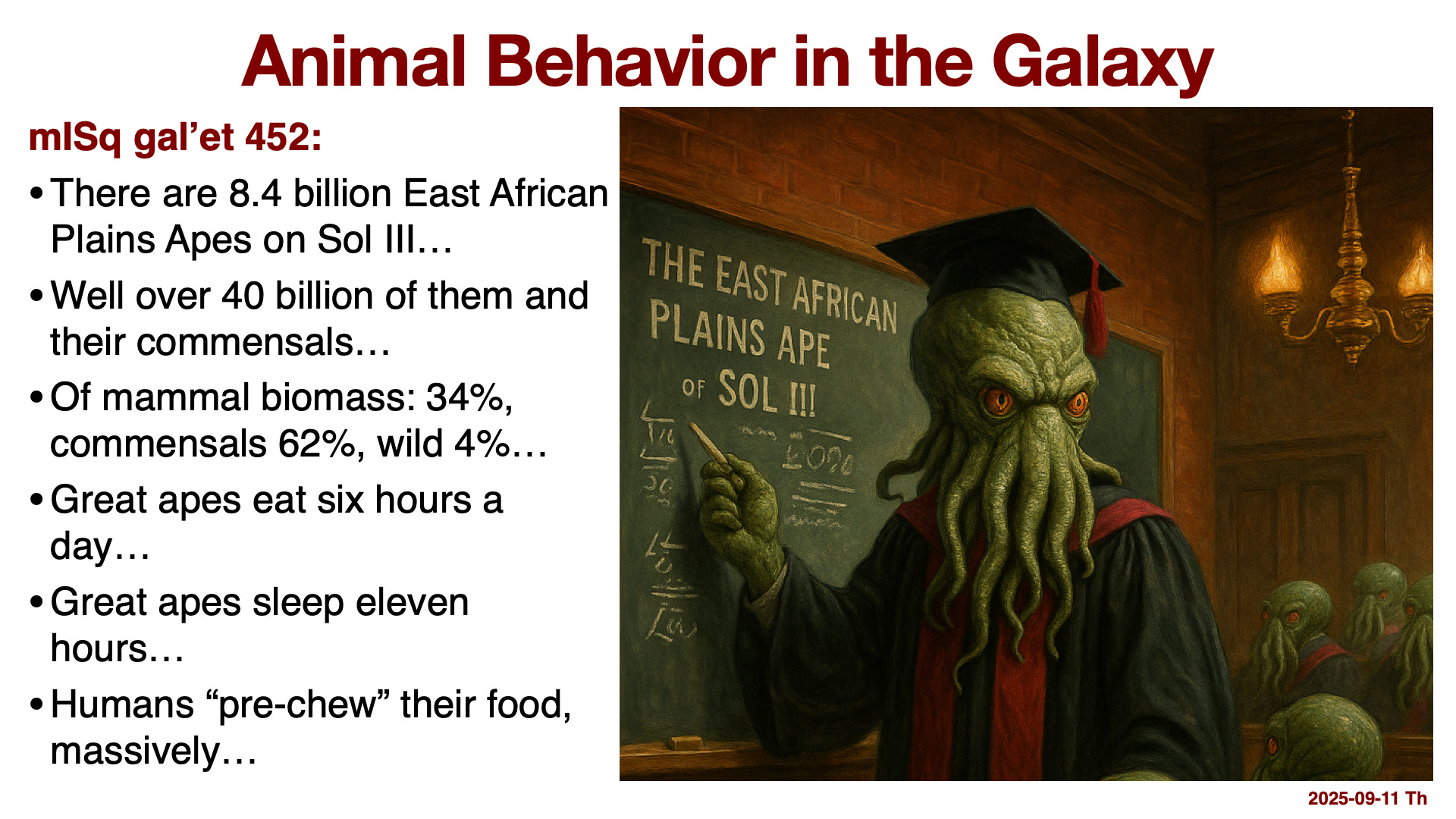
Step outside and view us from an exterior standpoint. Take the standpoint of a distant intellect—vast, cool, and sympathetic. Or not. What would such an intellect find notable about us?
Perhaps, somewhere, a being is lecturing about the fauna of Sol III, mainly the East African Plains Ape.
They would see that we number 8.4 billion. We and our domesticated animals make up 96% of global mammal biomass. Humans sleep only about two-thirds as much as our closest relatives. We spend two, not six, hours a day chowing down. We do not eat raw broccoli for hours and hours, but rather food “pre-chewed” in various ways. Come to think of it, even raw broccoli itself has been heavily biotechnologized—made tasty, nutritious, and easy to digest. The Broccoli family created it before moving into “James Bond” movies. That’s one set of observations.
Here is another. There is a shlock TV show, on the Discovery Channel <http://www.discovery.com>, called “Naked & Afraid”.
In it, two humans are dropped into a wilderness somewhere, naked, with one and only one piece of technology each (usually something like a knife, a fire starter, or a fishing line). All around them are other mammals doing their mammal thing: living their lives, reproducing their populations, evolving to fit whatever niche they have found where they are. They thrive, as much as animals do in nature red in tooth and claw. But the two humans dropped by themselves (well, they are surrounded by cameramen, sound technician, drivers, logistical support, and such who do not help unless a true emergency arrives, and who are careful stay out of the fields of view of the video cameras) definitely do not thrive. Instead, the humans proceed, not too slowly, to start starving to death.
I am not being figurative or metaphorical here. I am being literal. Look at Melissa Miller here:
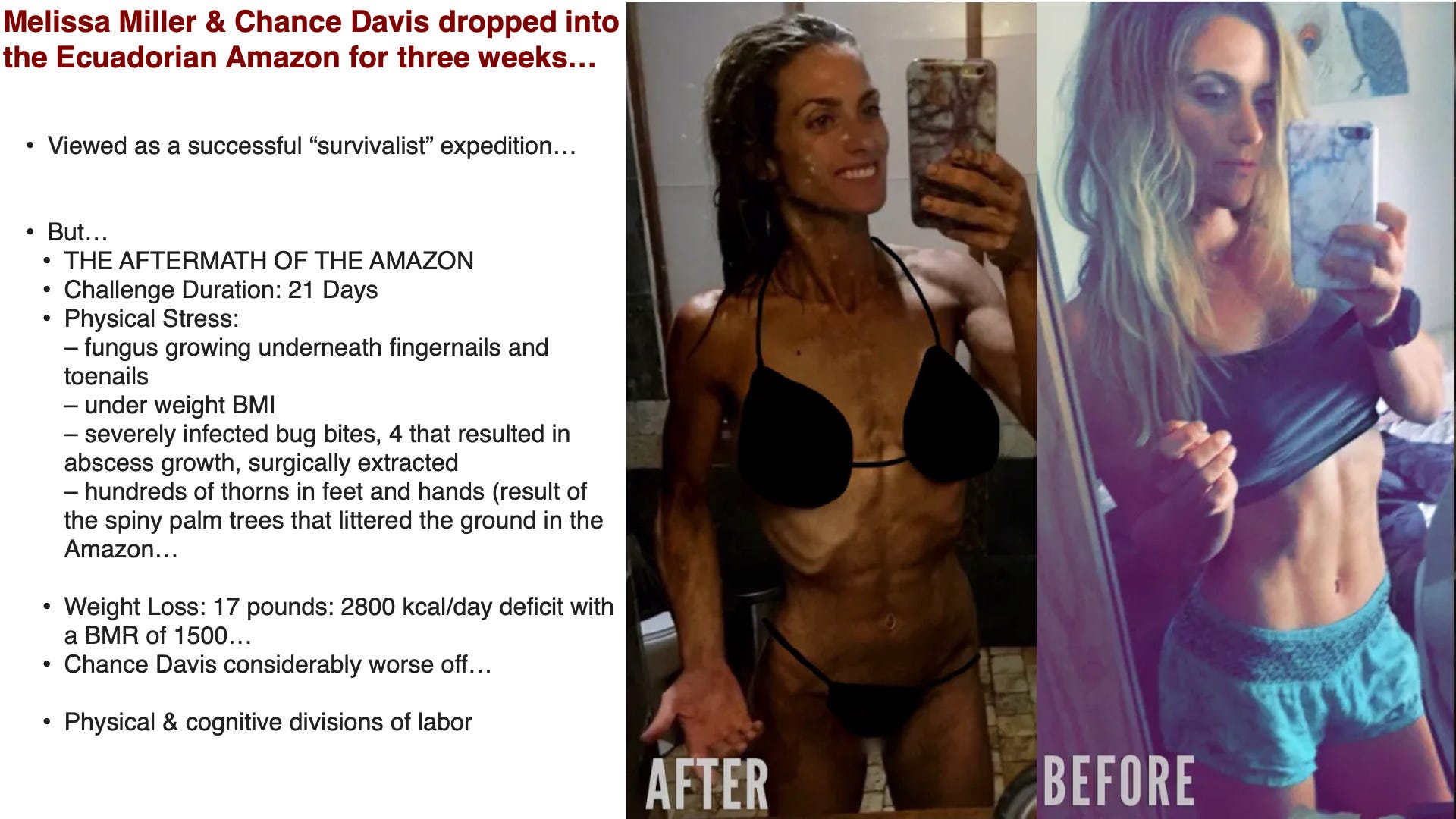
This is outdoorswoman Melissa Miller of Fenton, Michigan—Pure Michigan Melissa, Melissa Backwoods <https://melissabackwoods.com/>, across a time span of 21 days.
Melissa Miller is an expert on wilderness education and survival skills. She was dropped into the Ecuadorian Amazon with a fishing line and a partner, Chance Davis, with a knife. Over her 21 days in the jungle she lost 17 pounds: a daily metabolic deficit of about 2800 calories.
Given her likely BMR of 1500 calories, that is quite a feat of metabolic disaster. Had she simply hunkered down and fasted, we would have expected to see a nine-pound weight loss from burning fat. Trying to find food and avoid becoming food cost her an extra eight pounds, roughly plus or minus.
As she described the physical stress:
Melissa Miller (2018): Naked & Afraid Weight Loss & Health Effects <https://melissabackwoods.com/naked-afraid-effects/>: ‘My hands were riddled with thorns and burn marks. We kept the fire steady the entire trip, building a mo[a]t… around it to elevate it from heavy rainfall. We also utilized a technique in which we created an oven to continually burn wet dead logs as there was no dry wood available. In order to create fire I had to construct a platform to dry out palm fibers and palm grasses for two days before I could get a tinder bundle to ignite successfully. Before that we had to ward off mosquitoes at night by covering ourselves [with] clay and mud. We prevented ants from entering our shelter area by covering the ground with thick ash from the fire…
Back in civilization, Ms. Miller needed significant medical attention, as she rapidly regained her weight, to deal with the:
fungus growing underneath fingernails and toenails.
under weight BMI.
severely infected bug bites, 4 that resulted in abscess growth, surgically extracted.
hundreds of thorns in feet and hands (result of the spiny palm trees that littered the ground in the amazon)…
Moreover, the constestants are naked, and may well be afraid, but they are not alone. In post-show interviews, they report:
On‑site medics and IVs, with medics rehydrating contestants with IV saline for severe dehydration and food poisoning.
Field safety rangers and plant ID checks, with a ~20‑person crew plus rangers on location to confirm plant identifications to prevent poisoning.
Medical tent and controlled supplies, on site, with accounts of contestants obtaining (or stealing) food/electrolytes from crew/medic areas during extreme calorie deficits.
Rapid medevac, when injuries or infections surpass on‑site care.
And Melissa Miller’s partner, Chance Davis? He is a former US Army Ranger. He lost nearly twice as much weight as she did: 32 pounds over 21 days. He did not have the 17 pounds of fat to lose, and as a much bigger human he had a higher BMR.
You need to burn 3 lbs. of muscle to get the caloric energy you can get from burning 1 lb. of fat. The experience of caloric deprivation without sufficient fat resources seriously messed with his head. And not just in a “in life, we have support—friends, family, podcasts, coffee, sugar—without those, you’re outside yourself; when I get hungry, I get angry” way. Instead, in this way:
The worst part was being hungry. Long-term hunger plays with your psyche. After the show, hunger made me physically reactive and angry. I carried food stashes in my pockets and car. I gained 70 pounds in a month because I couldn’t stop eating—I didn’t want to be hungry. A big scoop of peanut butter sticks in your throat; you feel full—the taste, texture, sweetness. That’s what I wanted. Creamy or crunchy? Doesn’t matter—they’re all heaven…
As I said: the experience seriously messed with his head, and made his body and brain desperate to build up fat reserves just in case something like that were going to happen again. The body and the brain had learned: even with the knife and fishing line that kept them from being completely naked, individual brains, even knowledgeable ones, are not going to be enough against the daily caloric math of the wilderness.
Meanwhile, back in the Ecuadorian Amazon, the other mammals were doing fine.
It was homo sapiens that floundered.
Now, perhaps you shrug and say: “Well, humans are relatively dumb.” That might seem plausible until you stop and realize who Melissa Miller is. She is not some nature-shy city mouse. She started out as a wilderness educator and a nature-preserve naturalist, as a university-level wilderness teacher with a magna cum laude B.A. from the University of Michigan: primitive trapping, fire-making, native fishing methods, plant identification, tracking, wild foods, nature appreciation, and survival. Before her Amazon expedition, she would train outside in swampland in shorts and a sports bra to condition herself to miserable insects, fast to simulate caloric deprivation, study indigenous Amazonian plant use, and practice bow-drill fires—the oldest of old-school fire technologies. Indeed, she is the type of person who puts up YouTube videos demonstrating how to start a fire with a bow-drill, and how to catch turtles (for eating) in Michigan lakes:
Melissa Miller is a human much better prepared than almost all of us to be dropped into a wilderness environment. She still starved.Before her Amazon expedition, she would:
Melissa Miller (2018): The Prepping Guide <https://melissabackwoods.com/how-to-prepare-and-survive-naked-and-afraid-qa-with-melissa-miller/>: ‘[Be] outside all the time… reading foraging books, practicing primitive trapping, and perfecting my friction fires… trail running and road running without shoes. I would also go into the swampland and build a shelter while in a pair of shorts and a sports bra. I would sit there and let mosquitoes bite at me to understand what it might feel like living in the jungle. I had to get myself mentally prepared to feel that miserable for 21 days. I also did a lot of work outside when it would be really humid because I knew this was the type of environment I had to prepare for. I was practicing designing raised beds, and studying indigenous Amazonian tribes…. Teaching wilderness survival classes [had] also helped me prepare…. I was living and breathing “survival” as much as I could….
Letting mosquitos bite me as I trained in the woods prepared me for the mental fortitude it would take to get through (the insects play serious mind games with you out there). I also entered Ecuador with the thought that there was a possibility we m[ight] never get fire due to the humid jungle conditions. I would fast some days and shelter-build to familiarize myself with exertion through hunger…
It did not help much.
The principal thing Melissa Miller wished she had done differently before entering the Amazon?
Have gotten fatter.
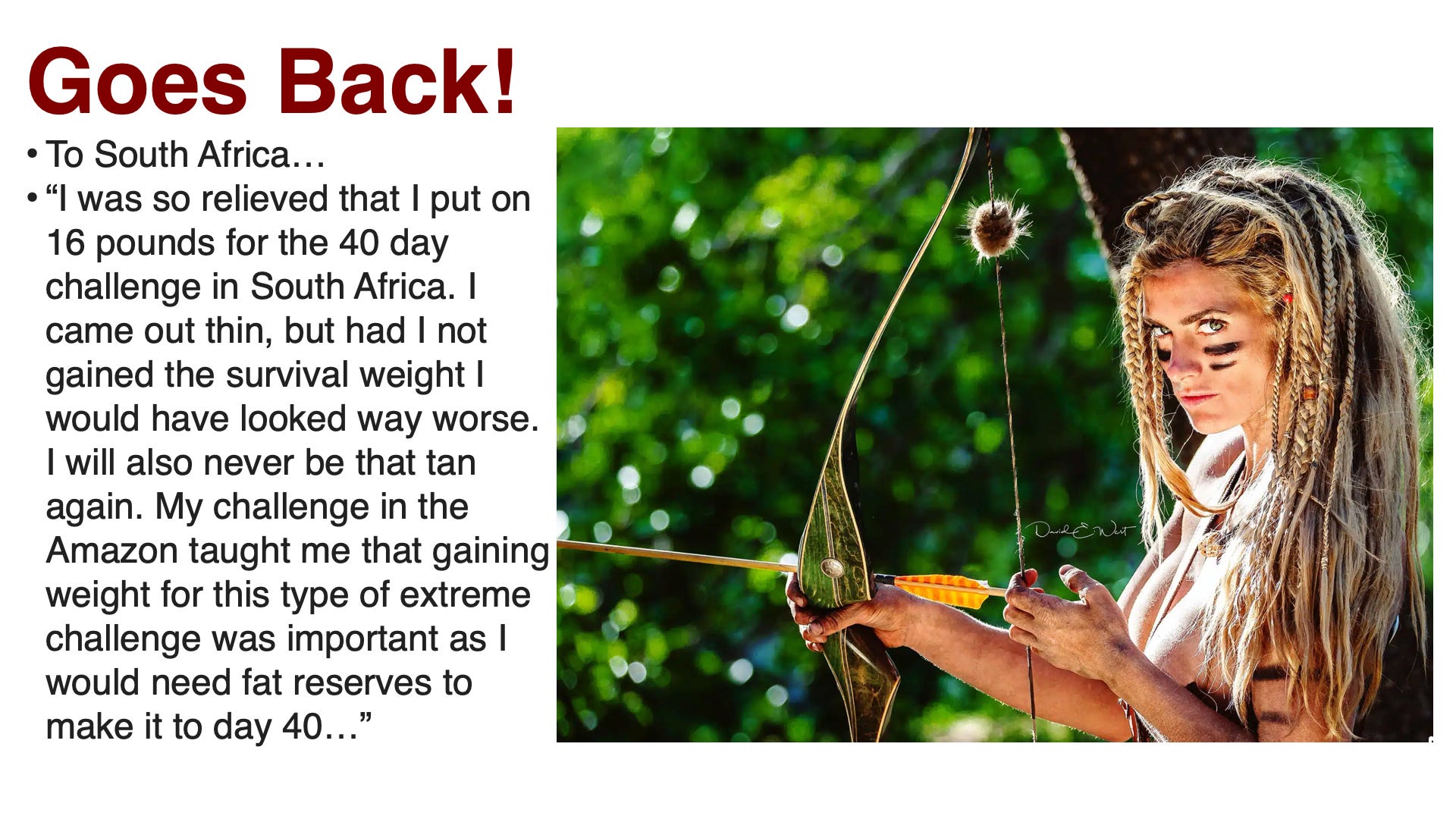
Before she would next venture in front of the “Naked & Afraid” cameras, this time for South Africa, she put on an additional 16 fat pounds above her normal weight. She thus carried into the wilderness extra survival rations to cover her BMR energy requirements for 37 days, or to carry her for 19 days at a marathon-training pace. In her, I think accurate, judgment, there was no way for her to prepare so that she and her partners could deal with the environment to be in energy balance for three weeks But she could prepare to carry three weeks’ extra energy into the wilderness around her midsection, so that she would be able to work hard and long while she was there.
“Humans are relatively dumb” is not a thing that we can use to dismiss her (and Chance Davis’s much more brutal) experience. But it is a part of it. Even when she is at home in Fenton, Michigan, odds are she can barely remember where she left her keys last night. The other mammals out in the Amazon have been equipped by Darwin’s Daemon with teeth, claws, instincts, and brains that allow them to get into daily caloric balance. We don’t have much in the way of teeth and claws. We do have opposable thumbs. We do have big brains. They are supposed to compensate.
Perhaps you shrug your shoulders and say: “they do not compensate very well”. For, out in the wilderness, Melissa Miller’s brain and thumbs failed at the one job for which Darwin’s Daemon gave them to us, for which other mammals’ teeth, claws, instincts, sprinting speed, dodging quickness, and much smaller and thus less energetically expensive brains largely suffice. The rule: a smart, knowledgeable human (or two) in the wilderness naked should be afraid: they are highly likely to start starving to death.
And yet: Somehow we are here. We have not all yet been eaten. We have been evolved evolved. Our ancestors survived, and reproduced. We did not go extinct. And now we rule the biological world.
II. Human Anthology Intelligence at the Bridge of the Daughters of Jacob More than 700,000 Years Ago
Our ancestors started to come down from the trees about seven million years ago. That was when we left the ancestors of our chimpanzee cousins still up in the forest canopy.
By five million years ago, the ardipitheci were walking upright when they had to, with much smaller and less sexually-dimorphic canines, but as of them with no signs of fire or stone‑tool use or indeed of semi-systematic butchery. Their brain cases were only 350cc, only 350 cubic centimeters. By 3.5 million years ago, the autralopitheci afarenses were habitually walking on two legs with their 450cc brain-cases. By 2.5 million years ago, the homines habiles with their Oldowan stone toolkit and 650cc brain-cases were around. And paleontologists judge they deserve our genus name: homo. By 1.8 million years ago, there were the homines erecti spreading out across the world, with their Acheulean handaxes, their endurance walking/running, and their 950cc brain-cases. When we look back 600,000 years ago, the world was then populated by the likes of the homines heidelbergenses: widely-controlled fire; complex hunting with tools like spears.
These people were not yet us: Their brain-cases were only 3/4 of the size of our brain-cases of 1350cc. They did not have organized big‑game hunting with spears, complex prepared‑core toolmaking techniques, long‑distance mobility, or evidence of our sustained and cumulative symbolic culture—cave art and engravings, personal ornaments, ritual burials, complex language‑supported planning, long‑distance exchange networks, composite tools made with adhesives, tailored clothing, or shelters. They did not have the final brain expansion, the globular skull, the reduced brow, or the chin.
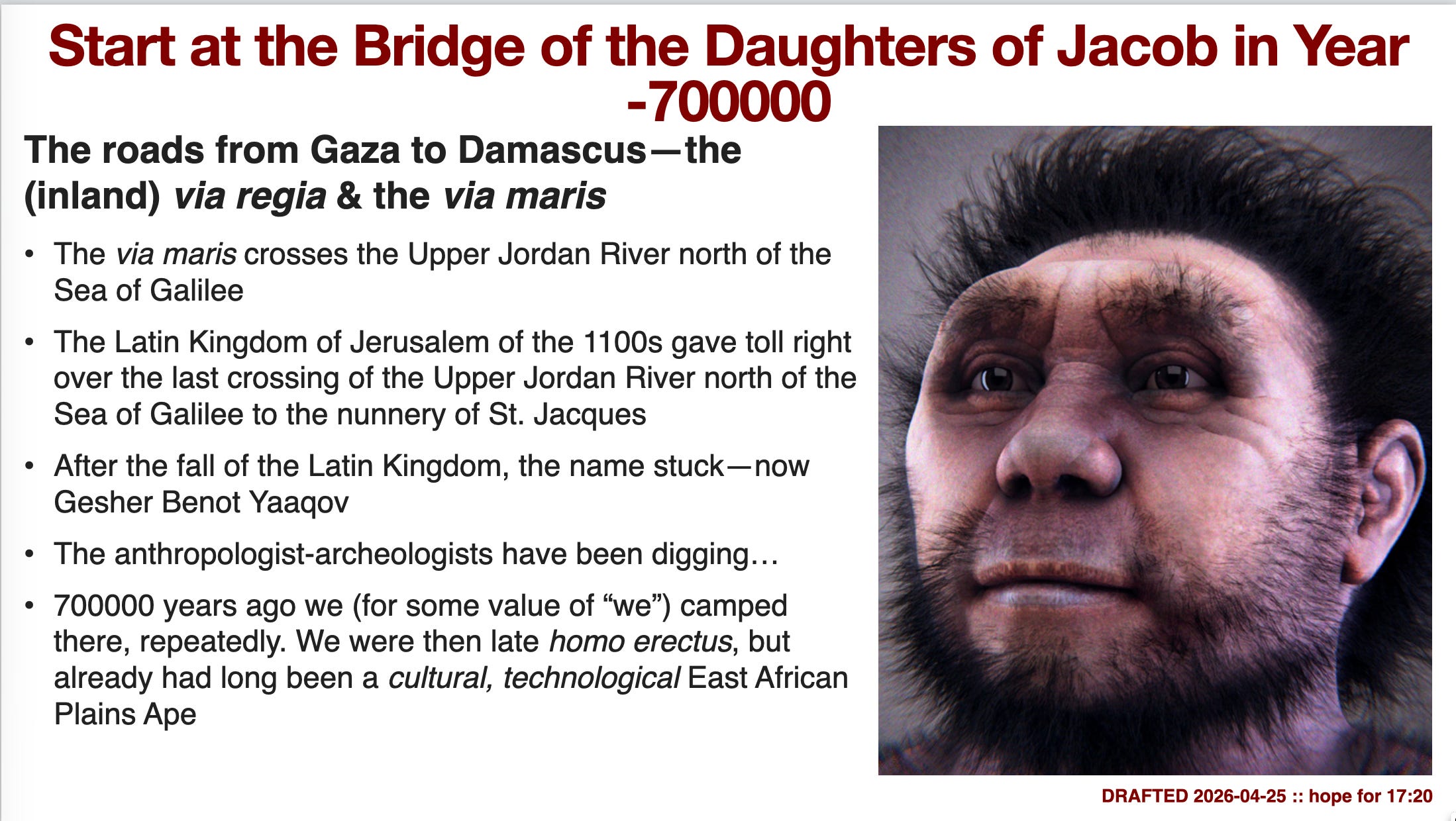
Start over: For at least the past 3500 years there have been two main roads from Gaza to Damascus, for people moving up the Mediterranean coast and then crossing over to the territory well-watered by the Abana and Pharpar Rivers that descend from the Anti-Lebanon mountain range. There has been the inland road, the Via Regia, the Road of the Kings, crossing to and then following along on the Jordan Plateau. The Via Regis is rather dry: best avoided without waterskins, donkey-carts, and knowledge of where the road is going and how far to the next well. But there hasnalso been the Road of the Sea, the Via Maris, starting at Gaza and heading north along the coast before turning inland in Galilee. The Via Maris crosses the Upper Jordan River at the first convenient crossing point north of the Sea of Galilee, a place well-watered even today and often lake and marsh in climate eras past.
In the 1100s the kings of the Latin Kingdom of Jerusalem gave toll-right over this crossing to the nearby Nunnery of St. Jacques. This crossing point then became, in the crusaders’ Norman French dialect, Gué Saint‑Jacques—Jacob’s Ford, as Jacques is Jacob—Yaa’qov in Hebrew. It then became Pont Saint-Jacques. After the fall of the Latin Kingdom the name largely stuck. The “Saint” dropped away. The memory of the nuns was added as “Daughters”. And now, in Hebrew, it is Gesher Benot Yaa’qov—the Bridge of the Daughters of Jacob.
At this place more than 700,000 years ago, a lakeside site was occupied periodically by bands of hominins. Joseph Henrich describes what the excavations show:
Joseph Henrich (2016): The Secret of Our Success* ‘The inhabitants controlled fire and made a variety of stone tools, including hand axes, cleavers, blades, knives, awls, scrapers, and choppers. Made from flint, basalt, and limestone, tool manufacture was done on-site, often from giant slabs carried in from a distant quarry by a team. Some of the basalt slabs have notches, indicating the use of levers as part of the quarrying process. The basalt is of the highest quality and well quarried, suggesting that someone had a storehouse of know-how on the topic.
The group’s diet was diverse and also would have required extensive local knowledge… at least nine types of fish, including carp, sardines, and catfish. Some of these fish were big, longer than a meter. On top of this, there were seeds, acorns, olives, grapes, nuts, water chestnuts, and various other fruits… the submerged prickly water lily, which grows well away from shore. It also appears that they were cracking nuts open and roasting acorns to remove their shells… They may even have made “popcorn” by roasting the seeds from the prickly water lily.
Clearly, cumulative cultural evolution is up and running at this point, generating more know-how than you, me, or our lost European Explorers could have ginned up in a lifetime…
Think about what this means. Quarrying high-quality basalt using levers. Producing hand axes with full symmetry. Hunting elephants and rhinos. Baking fish at precisely the right temperature—archaeological analysis shows the GBY fish were heated to the window that softens collagen and denatures proteins without charring the remains. Someone, or rather the community, knew to do this.
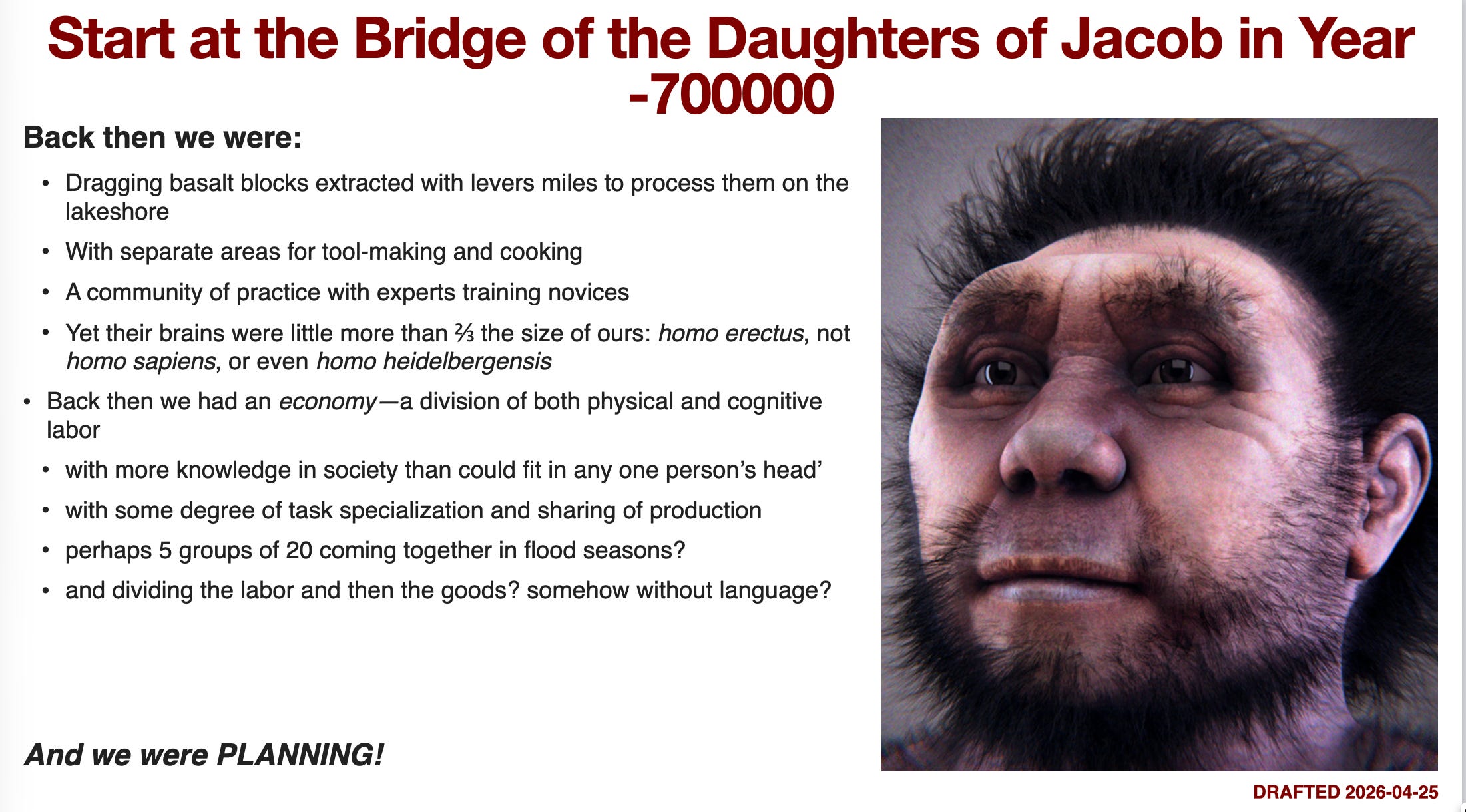
No individual knows all of this. No individual could know all of this. The site shows spatial partitioning into task-specific zones — heavy stone-pounding near hearths, flint-knapping elsewhere — implying not just cooperation but planned cooperation, role differentiation, agreed-upon norms for where things are done and how. The repertoire was transmitted across generations: repeated occupations preserve the same spatial logic, which means the community had a mechanism for cultural inheritance that could persist when individual memory could not.
As Henrich puts it: if you have any remaining skepticism that the cumulative cultural evolutionary threshold has been crossed by this point, in the next 300,000 years after the activities at Gesher Benot Ya’aqov, homo erectus changed sufficiently, including a brain expansion to 1,200 cm3, to justify a new species name, homo heidelbergensis. Culture was not just the product of bigger brains. Culture was the selective pressure that produced bigger brains. The arrow of causation runs both ways: richer collective knowledge selected for greater individual capacity to participate in, contribute to, and transmit that knowledge.
And so between 300,000 and 200,000 years ago there emerged people we definitely call us: homines sapientes, albeit “archaic”, with our brain-case size of 1350cc, but without the fully globular skull, the reduced brow, or the chin.
From a chimpanzee-sized brain one-quarter the size of ours five million years ago to our current state, our ancestors and then we have been evolved. And now we are here. So how can there have been so much selection pressure for larger brains when, even today, out in the wilderness they are insufficient to keep us, when naked individuals, from being hungry and afraid?
You know where I am going here. The answer of course, is simple: What is smart—what the brain is good for—is not each of our brains, but all of our brains thinking together. And the tools that we, and those who came before us, have made—tools that no one individual could make in a lifetime, and that embody all of that thinking-together one. Melissa Miller is an expert on knives, how to use them, and what to use them for. She could not make one from scratch. Melissa Miller failed because she was alone. The late homines erecti at GBY thrived because they were not.
The lesson is stark. Individually we are massively unfit. We have brains and opposable thumbs, but a brain or two and four thumbs is not sufficient compensation for our lack of claws, fangs, sprinting speed, or dodging quickness. It is only collectively, as an anthology organism, that we survive in this world. And this is not the cooperation of a cape buffalo herd, young on the inside with adult males in a surrounding circle. This is something altogether more extraordinary: a system where each individual knows how to do only a small slice of the collective division of labor, yet all together we know and can do an extraordinary amount. This is the Anthology Super-Intelligence in action—not any individual mind, but the shared knowledge of the network, the swarm, the hive.
From long-ago Acheulean handaxes to contemporary hunger in the Amazon, the throughline is simple: selection favored group knowledge and group production by a specialized division of labor, not solo genius. Our edge not only was and is not claws or speed, it was and is not the ability to think up clever solutions to problems on the fly. Instead, it was pooled memory and Anthology Intelligence, collective thinking-power, plus the division of labor that allows us to carve tools that contain the results of that collective thinking-power.
Are you looking for the real “AI”? Look not at our machines with their stochastic-parrot emulator programs running on them. Look around you, at humans collectively as an Anthology Intelligence.
III. The Extended Mind: We Were Always Cyborgs
Here is a thought experiment, from the philosopher Joseph Heath:
The alien scientist comes by, looks at you, and says, “Why should we stop [torturing you]?”
Pausing only briefly to acknowledge his surprising mastery of spoken English, you say, “Because it’s wrong to torture other intelligent species.”
“What intelligent species?” says the scientist. “Surely, you’re not referring to yourself.”
“Yes, I’m referring to myself,” you say. “I’m really smart.”
“No, you’re not,” says the alien. “You can’t even do mathematics.”
“Yes, I can,” you say.
“Okay, then tell me, what’s 78 times 43?”
“No problem. Do you have a pencil and paper? And could you unstrap my arms?”
The alien looks puzzled. “Why do you need a pencil and paper? Can you answer the question or can’t you?”
“Yes, I can answer it, I just need a pencil and paper.”
“Where I come from, we use our brains to do mathematics. You do it in some other, alien way?” says the alien.
“Sure. Untie me and I’ll show you.”
Moments later, equipped with a pencil and paper, you quickly work out the answer (3,354). And just to make sure you don’t wind up back on the gurney, you solve a couple of quadratic equations, derive some second-order derivatives, and sketch out Cantor’s uncountability proof.
“Wow,” he says. “You guys really can do math. What a strange species. How were we supposed to know that your brains require pencils in order to function correctly?”
At this point you realize that the alien has fallen victim to a very fundamental misunderstanding of how the human mind works. He thinks that your mind is housed entirely in your brain, and that your capacity to reason is based entirely upon the biological substratum of your cognitive system. The peculiar genius of the human brain, however, lies not in its onboard computational power, but rather in its ability to colonize elements of its environment, transforming them into working parts of its cognitive system…
This is the extended mind thesis, and it is deeply relevant here. Human cognition has always been distributed — between neurons, yes, but also between neurons and the cultural artifacts we carry with us and build around us. The GBY hominins were not just individual brains solving problems. They were brains plus tools plus fire plus social roles plus the accumulated practical knowledge of the community. The toolkit was, in a very real sense, part of the cognitive system.
Writing extends this principle across time. You can think thoughts today that rest on the work of someone who died three thousand years ago, because they wrote it down and others transmitted it. Mathematics, as Heath’s thought experiment shows, is not done in the head—it is done with pencils, on paper, on whiteboards, across notations that were themselves developed by collective effort over centuries. Descartes’s coordinate geometry is in your brain, but only because Descartes put it into a form that could survive his death and travel to you through print.
The anthology intelligence is not a metaphor for “humans are smart when they cooperate.” It is a literal description of how human cognition actually works: as a distributed system in which individual biological processors are nodes, and the cultural environment—language, writing, tools, institutions, built spaces—is the network infrastructure. Take away the network, and you have Melissa Miller in the Amazon, starving. Leave the network in place, and you have homo erectus making popcorn at a lakeside 780,000 years ago.
This also means that “intelligence”—the capacity to solve novel problems — is substantially a property of the network, not of any individual node. Newton standing on the shoulders of giants is not a polite acknowledgment of intellectual debt. It is a precise description of how scientific progress works: each generation extends the collective toolkit, and the next generation starts higher up. Einstein’s Theory of Relativity is Einstein’s, but it is also Lorentz’s transformations, Fitzgerald’s contraction, Minkowski’s spacetime, Poincaré’s group, and Maxwell’s equations—reaching back through a chain of collective development that no one person could have invented. What we call “genius” is what happens at the frontier of this cumulative structure: the person whose biological processor happens, at the right moment, to make the connection the community had been building toward for decades.
IV. The Great Leap & What It Unlocked
The GBY hominins were impressive. But something much more dramatic happened roughly 70,000 years ago—what Richard Klein calls the “Great Leap Forward.”
Before this moment, we anatomically modern homines sapientes sapientes had existed for at least 200,000 years. Their brains were our size. Their skulls had the globular shape, the reduced brow ridges, the chin that marks us as *sapiens subspecies of homo sapiens, as distinguished from homo sapiens neandertalensis and homo sapiens denisovensis and homo heidelbergis and all the others on our very bushy part of the tree of life. Back 70000 years ago our material culture was not dramatically more complex than that of the Neanderthals, or even late *homo erectus* at GBY. The anatomy was “modern”.
But the Anthology Intelligence was not “modern”.
The Great Leap changed that, and changed it fast. After 70,000 years ago, the archaeological record suddenly shows a huge increase in the proportion of finds in which we find things like symbolic art, complex tools, long-distance trade networks, personal ornaments, ritual burial, and—perhaps—the full symbolic language and complex social structures we recognize as distinctively human. Cave paintings at Chauvet. Tailored cold-weather clothing. The final Out-of-Africa migration and—most strikingly—the colonization of Australia, which required crossing open ocean. More sophisticated coordinated hunting strategies involving persistence, planning, and communication across distances. The toolkit stopped varying within populations and started varying between them—local traditions, regional styles, marks of group identity.
Something had changed in the way the Anthology Intelligence transmitted and differentiated itself.
But here is the puzzle that should stop us: if the brain was already modern, why the 130,000-year lag? What was waiting to happen?
The most compelling answer—and the one that fits the Anthology Intelligence framework most tightly—is that the Great Leap was not primarily a biological event, not something like a sudden FOX2 switch turning full language on like a lightbulb. It was more, I guess, a network threshold event. The capacity of a collective-brain anthology intelligence to sustain and improve its toolkit depends not on the intelligence of any individual node, but on the size and connectivity of the network. Below a critical threshold, good ideas die with their inventors, or fade within a generation or two before they can spread and compound. Useful innovations appear—someone figures out a better way to knap flint, someone discovers which plant repels insects—but the network is too sparse and too fragmented to reliably preserve and transmit them. The anthology starts to grow, stalls, loses ground, grows again. Progress is real but erratic and reversible. Not only can we not stand on the shoulders of intellectual giants who came before us, but we cannot even keep a pyramid of dwarfs stable at more than four layers into the air.
Above the threshold, something qualitatively different happens. Innovations spread faster than they are lost. The toolkit becomes self-reinforcing: each improvement slightly increases the group’s survival margin, which increases population, which increases network density, which increases the probability that the next innovation will propagate. The collective brain crosses into a regime of compounding returns. What had been a random walk through cultural space becomes a directed march—not toward any predetermined destination, but forward, accumulating, building.
The Great Leap, on this account, is the moment when the human anthology in Africa crossed that threshold. It may have been partly biological, may—a final neurological refinement that improved language capacity or working memory slightly.
But my bet is that it was more demographic and social: populations reconnecting, exchanging innovations, bootstrapping the network into a new régime. The Out-of-Africa migration that followed was not the cause of the explosion; it was the consequence. A network dense enough and innovative enough to handle the toolkit complexity required to survive in novel environments—ice-age Eurasia, the arid Australian interior — was a network that could colonize the world.
Perhaps the clearest evidence that can be read as supporting the network-threshold interpretation comes not from the moment of the Great Leap but from a much later, smaller-scale case that runs the argument in reverse: Tasmania.
When rising sea levels at the end of the last glacial maximum cut Tasmania off from mainland Australia, roughly 10,000 years ago, the island’s population—perhaps 4,000 people at its peak—was isolated from the larger continental network. They were fully modern homines sapientes, with modern brains, the inheritors of the same Out-of-Africa cultural explosion. And over the following millennia, they lost technologies. Bone tools disappeared from the archaeological record. Cold-weather clothing, which had existed, vanished—even though Tasmanian winters are genuinely cold. Fishing, remarkably, seems to have been abandoned, even though fish were present and had been caught before.
This is not stupidity. It is arithmetic. A network of 4,000 people, with normal rates of specialist knowledge being lost to accident, disease, or simple failure to transmit, could not reliably maintain a toolkit as complex as the one they had inherited. The anthology degrades when the network shrinks below the threshold required to sustain it. The individual nodes were no less capable. The collective brain was smaller, and the collective brain is what matters.
Tasmania is the Great Leap in reverse—a controlled experiment, run by history, demonstrating that the anthology’s capabilities are a property of network size and connectivity, not of individual biological endowment. Melissa Miller in the Amazon is one data point. Tasmania is the statistical proof of the same theorem, played out over ten millennia.
The third thing the Great Leap unlocked, alongside network scale and cultural compounding, was a new protocol for the anthology: symbolic culture. Personal ornaments, ritual burial, long-distance exchange of prestige goods—these are not merely signs of cognitive sophistication. They are the infrastructure of trust at scale. You can trade with someone you have never met, from a group you do not personally know, if shared symbols establish common reference points and mutual obligations. You can coordinate a hunting drive with people from three neighboring bands if you share a ritual vocabulary that marks everyone as participants in the same collective enterprise. You can transmit knowledge to the next generation more reliably if that knowledge is embedded in story, ceremony, and artifact rather than relying solely on direct demonstration.
Symbolic culture is the anthology acquiring something like a universal protocol layer—not quite writing, but already transformative. It allows the network to extend across both space and time: across space, because shared symbols reduce the friction of exchange between groups; across time, because symbolic encoding is more robust to the noise of individual transmission than pure behavioral imitation. The Great Leap was not just a cognitive upgrade. It was an upgrade to the anthology’s own infrastructure for growing and preserving itself.
The technologies that allowed humans to manipulate nature and cooperatively organize one another began, after this moment, to grow at substantially greater speed. And then, after tens of thousands of years of still-slow acceleration, something injected new energy into the system: the Neolithic revolution, and then—far more powerfully, and far more ambiguously—bronze and writing.
V. The Cuckoo Chick in the Nest: Bronze, Writing, and the Societies of Domination
Around five thousand years ago, the anthology intelligence underwent a transformation that was simultaneously its greatest amplification and its most dangerous corruption.
Writing and bronze, it turns out, had a strong elective affinity not just with advancing nature-manipulation and cooperative organization, but with large-scale domination.
Before this, the anthology was distributed and roughly egalitarian—in the sense that every member of a gatherer-hunter band or an early-agriculturalist or herdsmen tribe had access to most of the community’s collective toolkit. Individual skills varied, but the knowledge was not monopolized. With writing and bronze, this changed. Those who could access bronze hoes versus those who could not. Those who could field bronze-armed warriors versus those who could not. Those who could reach and control scribes with their capacities to keep records and transmit commands at scale—the commanders, the bureaucrats, the priests—versus those who could not.
Sumerian cuneiform tablets and Egyptian hieroglyphs were not just tools for keeping accounts or chronicling myths. They were the sinews of power, binding laborers, soldiers, and peasants into hierarchies that could be perpetuated across generations. The anthology’s greatest new capability—writing, the external extension of memory across time—became first and most powerfully a tool of the domination machine.
And the domination machine, once established, was self-perpetuating. Peasants could not return to the gatherer-hunter lifestyle: population densities were too high. And those who resisted the local power structure faced a simple calculation: the bronze hoe-head came up the river past the city with the warriors and the gates, and dependence on that supply chain provided a powerful incentive to knuckle under. The result was a world in which human collective intelligence became the substrate for exploitation as much as for cooperation.
This is the central tragedy of human history. The same anthology intelligence that allowed bands of homines erecti to thrive at GBY—the system of cumulative cultural knowledge, specialization, and cooperation—became, in the agricultural-surplus world, the infrastructure of oppression. The priests, the bureaucrats, the warrior-elites: they were not simply parasites on the anthology. They were nodes in it, transmitting certain kinds of knowledge (military tactics, administrative procedures, religious legitimation) at the expense of other kinds. The anthology did not disappear. It was reorganized, at great cost, around the needs of hierarchy.
Perhaps this is why the first writing we have is accounting—grain inventories, labor rosters, tax records—not poetry or philosophy. The anthology intelligence’s first fully exogenized memory system was a ledger of control.
VI. The Anthology’s Self-Correction Mechanisms
The anthology intelligence has, however, has repeatedly tried to reassert itself against the hierarchies that would capture it.
Consider the Library of Alexandria: It was an attempt—by a particular Hellenistic state, yes, but still an attempt—to aggregate and make accessible the accumulated knowledge of the anthology across cultures. The Confucian examination system, for all its aristocratic trappings, opened administrative advancement to anyone who could demonstrate mastery of a recognized body of knowledge. The Republic of Letters of the 16th and 17th centuries was an explicitly anti-hierarchical project: scholars across national borders, writing in Latin (the anthology’s first international protocol), challenging received authorities by the method of shared evidence and argument.
The printing press democratized access to the anthology’s outputs in a way that the scribal class had not and could not. It is not a coincidence that within a century of Gutenberg, you have the Reformation, the Scientific Revolution, and the first political theory of popular sovereignty. When the anthology can speak to more nodes more directly, the power structures built on information monopoly become unstable.
The internet was the most recent chapter in this story—the most radical reduction in the cost of full participation in the anthology intelligence that the world had ever seen. Anyone with a connection could access, contribute to, and argue with the accumulated knowledge of humanity. The barriers to entry for becoming a node in the anthology network dropped toward zero.
And then the domination machine reasserted itself, as it always does. The internet became platforms. The platforms became monopolists. The monopolists became the infrastructure through which the anthology must route itself, subject to algorithmic amplification of engagement (which correlates, badly, with epistemic quality) and the economic incentives of advertising. The Republic of Letters became Twitter. The Library of Alexandria became Google, whose search results are now substantially optimized for revenue rather than relevance.
This is the pattern: a technology amplifies the anthology’s reach and power; the domination machine learns to capture and redirect it; the anthology produces correction mechanisms; those mechanisms are eventually captured too. The timeline between amplification and capture seems to be shortening.
Which brings us to where we are now.
VII. What Large Language Models Are, and What They Are Not
Modern AI researchers, with their talk of “collective superintelligence” and “swarm intelligence,” are belatedly rediscovering what the archaeological record at GBY already tells us: the power of many minds, linked by culture, memory, and cooperation, is the only superintelligence that has ever mattered.
But they are also, in their framing of what LLMs are, making a category error that matters.
A large language model is not a mind. It has no beliefs, no intentions, no continuity of self, no stake in whether what it says is true. It does not know anything, in any sense that matches what “knowing” means for a biological cognitive system embedded in social reality. It is, at its most accurate description: a very sophisticated stochastic calculator trained on a large sample of the anthology’s written output, capable of producing new text that is statistically similar to text in its training corpus, optimized (via RLHF) to be judged favorably by humans.
The alien who asks “what’s 78 times 43?” and demands you answer without pencil and paper is confused about the extended-mind nature of human cognition. But the AI researcher who says “GPT-4 knows that 78 times 43 is 3,354” is confused in the opposite direction: attributing knowing to a system whose relationship to truth is purely statistical rather than semantic.
Here is what LLMs actually are, stripped of hype: they are a new kind of interface to the real ASI, the Anthology Intelligence of the collective human mind now turned into a true Anthology Super-Intelligence exceeding merely human scale by more than a billion-fold. They are a technology for lowering the friction of accessing what the anthology intelligence has already worked out—the same function served, in previous eras, by a good encyclopedia, a well-indexed library, a knowledgeable colleague, or a skilled research assistant. They can traverse the anthology’s written output at speed and pull together relevant material in a form that is useful for a specific query. This is genuinely valuable, perhaps transformatively so.
But there are things they cannot do. They cannot add to the anthology. A model cannot discover something genuinely new—new in the sense that homo heidelbergensis discovered that cooking fish at the right temperature softens the collagen, a piece of knowledge that entered the anthology through embodied experiment and was transmitted forward. Models cannot correct errors in the anthology’s own views: they will reproduce, smoothly and confidently, every mistake the anthology has made in sufficient volume to dominate the training distribution. They cannot argue back. They cannot be wrong in the productive way—the way that sparks the adversarial dialogue through which the anthology intelligence sharpens its models of the world.
The scarce resource, when LLMs make everyone write five times faster, is no longer writing. It is reading, judgment, and synthesis—the distinctively human cognitive work of evaluating what the anthology intelligence says, deciding what to believe, and connecting it to one’s own embodied knowledge and experience. That cognitive work cannot be offloaded to a model without losing the thing that makes it work.
VIII. Four Possible Punchlines
This essay has four possible punchlines. Each makes a different set of claim sabout what the LLM moment means for the real ASI, the Anthology Super-Intelligence of the collective human mind. They are genuinely different arguments, and I am not yet sure whether the right answer requires holding all four in tension, or whether one of them is right—or, perhaps, which one will we collectively choose to make right. For it is in our hands.
Punchline 1: The “Distillation Punchline: LLMs are the first technology that compresses the anthology rather than merely transmitting it. Every previous information technology extended the reach of the anthology in space or time—writing preserved it across time; printing amplified its transmission; the internet made it universally accessible. But none of them synthesized it. You still needed a human mind to read the encyclopedia, draw connections, decide what mattered. The Alexandrian Library held the anthology’s best outputs in one physical place, but a scholar still had to walk the stacks, pull the scrolls, and do the work of cross-referencing in his own head. The printing press put those scrolls into ten thousand hands, but each hand still belonged to a brain that had to do the synthesis itself. Google made the stacks searchable in milliseconds, but still returned a list of links — and a human had to read them.
A model trained on the full corpus of human writing is not a new mind. It is a distillate of the old one: a lossy compression of the anthology into a format that can interface with any individual human’s queries. This is qualitatively new. For the first time, some of the *synthesis* work — the pulling-together of what is known across disciplines and centuries — is being at least partially offloaded to a non-human system. Ask a model about the connections between Keynesian multiplier dynamics, the archaeological evidence for Bronze Age trade networks, and the political economy of cuneiform accounting, and it will produce a synthesis that, thirty years ago, would have required a tenured scholar three weeks of library time. That synthesis may be shallow and occasionally wrong. But the access-compression it represents is real.
The correct analogy is to distillation in chemistry: you start with a complex mixture, apply heat, and concentrate certain components while others are driven off. The question is always what you keep and what you lose. Whiskey distillers know that the heads and tails—the first and last fractions to come off the still—carry off impurities, but also some of the complex congeners that give a spirit its character. What remains in the heart of the run is smoother, more consistent, and sometimes more potent. But it is not identical to what you started with.
The anthology’s value lives in its texture as much as its content. The dialogue between Karl Polanyi and Friedrich von Hayek is not just two positions—it is a sustained argument across decades, in which each position sharpens itself against the other, produces new questions, and generates productive confusion that turns out to be scientifically useful. The argument between the textual record and the archaeological evidence at GBY is of the same type: the tension between what was written and what was dug up kept both traditions honest. An LLM does not argue. It synthesizes toward agreement. Its training incentivizes the production of text that a human will judge as good, and humans tend to judge as good the text that confirms their priors, resolves tensions, and reads smoothly. The productive friction is not merely discarded—it is systematically optimized away.
What this means in practice is that the distillate may be simultaneously more accessible and less nutritious than the original. Consider what a model does with the ASI framework—the Anthology Super-Intelligence in human cumulative and hierarchical memory. A model trained on a corpus that includes this essay will, if asked, probably reproduce something that sounds like a coherent account of it. But the account will be flattened: the uncertainty about whether the Great Leap was cognitive or purely cultural, the unresolved tension between Heath’s extended-mind thesis and the Michael—not Karl! His brother Michael!—Polanyi tacit-knowledge problem, the open question about whether the domination machine is a parasite on the anthology or a load-bearing structural element of it—all of these will be smoothed into a tidy synthesis that sounds authoritative and is, to that degree, misleading. The roughness of the original was epistemically informative. The smoothness of the distillate is epistemically dangerous.
The right model for thinking about this is not the Alexandrian Library, which was an aggregation. It is whiskey distillation, or—perhaps more precisely—the production of a textbook. Every scientific textbook is a distillation of the literature into a teachable form. And every scientist knows that the textbook version strips out the false starts, the contradictory evidence, the productive anomalies, and the unresolved debates that are, in fact, where the frontier lives. Textbooks are extremely valuable. They are also a lossy compression. The discipline loses something when students read only textbooks and never engage with the primary literature—with the messiness of actual science in progress.
LLMs may be doing something like this to the anthology at scale: producing a permanently available, incredibly accessible, highly fluent textbook version of all human knowledge, optimized for approachability rather than for the kind of productive difficulty that generates new insight. The distillate, in other words, may be very good for consumption and very bad for production. It lowers the cost of accessing what the anthology already knows; it may also lower the pressure to extend it.
Punchline 2: The Parasite Punchline: LLMs are the most sophisticated parasite the anthology has ever hosted. To see why this framing matters, think carefully about what the anthology intelligence actually is. It is not a static archive of correct knowledge. It is a living system—more like an ecosystem than a library—in which different intellectual communities produce and consume ideas, where competing frameworks clash and sometimes generate new synthesis, where error is corrected through a distributed adversarial process of critique, replication, and revision. The anthology’s immune system against error is not any single institution but the whole ecology of competing actors who each have incentives to catch the other’s mistakes. Peer review, replication studies, competing schools of macroeconomics, the adversarial structure of common law ll of these are components of the anthology’s distributed self-correction machinery.
A parasite is, technically, an organism that benefits from a host at the host’s expense, without immediately killing it. The Braconid wasp that lays eggs inside a caterpillar qualifies, as does the Bronze Age cuckoo chick that hijacks a nest and demands feeding while crowding out the host’s own offspring. The parasite analogy fits LLMs because they extract value from the anthology—drawing on centuries of collective human intellectual labor—without adding to the system that generated that value. Every query to a model draws on what the anthology has built. The output—a statistically plausible text continuation—does not add to the corpus of human knowledge. It dilutes it.
The dilution mechanism is worth being precise about. It operates through two channels. The first is the feedback loop: as LLM-generated text floods back into the training corpora of future models, those models are increasingly learning from the anthology’s shadow rather than from the anthology itself. In population genetics, we call this inbreeding, and we know its effects: internal consistency tends to be preserved while adaptive capacity erodes. A population that has stopped receiving genetic input from outside itself becomes progressively less capable of generating the variation that evolution needs to work. The intellectual equivalent is a corpus that has stopped receiving genuinely novel input—new ideas that challenge existing frameworks, new data that falsifies current theories—and is instead amplifying and recombining what it already has.
The second channel is more subtle: the displacement of the cognitive work that generates genuinely new knowledge. The anthology does not just store what humans have figured out. It grows through a particular kind of human activity: the extended, difficult, often frustrating work of trying to understand something that is not yet understood. That work requires a certain tolerance for productive failure. When an easy, fluent, plausible-sounding answer is always available from a model, the incentive to do the harder cognitive work—the work that might actually advance the anthology intelligence—is weakened. Not eliminated, but weakened. And at the margin, cognitive effort flows toward what is rewarded.
The GBY hominins maintained a polyculture of extraordinary richness: nine types of fish, at least eight types of plant food, stone tools made from multiple materials quarried from different distances, spatial organization into task-specific zones suggesting a high degree of role differentiation within the group. That polyculture was cognitively demanding to maintain. It required each member of the group to carry certain knowledge, and the group as a whole to preserve techniques across generations that might not be useful every season. The complexity was not an accident or a luxury—it was the source of the group’s resilience. A narrower diet would have been more efficient in stable conditions and catastrophic in variable ones.
The anthology’s intellectual polyculture is of the same type. The fact that there are dozens of competing schools of macroeconomic thought, none of which is fully right, is not a sign of economics’ failure. It is a sign of the discipline’s intellectual health. The competition generates hypotheses that the data can adjudicate, over time. If a model, trained to produce text that humans approve of, systematically flattens that diversity toward the median view—the smooth synthesis that everyone finds plausible—it is doing to the anthology’s intellectual ecosystem what monoculture agriculture did to the genetic diversity of crop species. High yield in stable conditions. Catastrophic vulnerability to novel challenges.
There is a historical precedent that should give us pause. The Scholastic tradition of the high medieval period was, by the standards of its time, the most sophisticated knowledge-compression system the anthology had produced: a comprehensive synthesis of Aristotle, Christian theology, and classical learning, systematized into a form that could be transmitted, debated, and extended through a network of universities. It was brilliant, and it was also, ultimately, a distillation so refined that it had compressed out the productive roughness that might have allowed faster adaptation to new evidence. When the empirical program of the Scientific Revolution started producing results that the Scholastic framework could not accommodate, the accumulated weight of the synthesis worked against correction rather than for it. The anthology’s immune system was temporarily disabled by the very sophistication of the synthesis.
We should be alert to the possibility that a very fluent, very comprehensive, very agreeable synthesis of what the anthology knows—available on demand, always ready with a smooth answer—is exactly the kind of thing that makes the next GBY discovery harder to assimilate.
---
Punchline 3: The New Organ Punchline: LLMs may be the first cognitive organ that exogenizes synthesis. The anthology intelligence has a history of growing “new organs”, and each new organ changed not just what the anthology could do but what it was. Writing exogenized memory—freeing individual brains from the work of holding everything, allowing specialization and the accumulation of knowledge across generations that no individual memory could span. Before writing, the anthology was constrained by what could be kept alive in the heads of the living and passed forward through oral transmission. After writing, the anthology could carry knowledge across centuries and civilizations with a fidelity that oral tradition could not match. The result was not just more knowledge stored, but a qualitative change in the kind of knowledge that could be built: mathematics, systematic philosophy, written law, historical records that could be revisited and revised.
Printing exogenized transmission—reducing the cost of copying and distributing the anthology’s outputs by orders of magnitude. A handwritten manuscript could reach a few dozen readers. A printed book could reach thousands, and then tens of thousands. The effect was not just quantitative amplification of the same content but a qualitative change in the structure of intellectual authority: the scholar who could control access to manuscripts lost her monopoly, the pamphleteer who had previously been unable to reach scale suddenly could, and the anthology intelligence’s internal diversity—the number of competing voices that could find an audience xpanded explosively. The internet exogenized coordination—allowing the anthology’s nodes to find one another, organize, and act collectively at global scale, at a cost approaching zero.
Notice the pattern: each new organ did not merely add a capability. It restructured what cognitive work was done by individual humans and what was done by the infrastructure. Writing did not replace thinking; it freed up cognitive space that had previously been devoted to memorization. Printing did not replace reading; it transformed what was available to read and who could afford to read it. The internet did not replace human judgment about what was worth knowing; it transformed what could be found and who could publish. In each case, the humans in the network were liberated from some cognitive work in order to do more of some other cognitive work. The anthology grew more powerful not because its individual nodes became individually smarter, but because the infrastructure took on cognitive load, freeing individual capacity for other things.
LLMs may be doing something analogous for synthesis: the cognitive work of pulling together what is known from across the anthology intelligence and making it useful for a specific problem. This is genuinely hard cognitive work, and it has historically been rate-limiting for intellectual progress. The great synthesizers, the scholars who could see that results from three different disciplines were actually addressing the same problem, or that a method successful in one domain could be transferred to another, were always scarce and precious. The anthology’s capacity to generate new ideas was constrained by the scarcity of minds capable of holding enough of the anthology in their heads simultaneously to see the connections.
If even a fraction of that synthesis work can be offloaded to a non-biological system, the intellectual productivity of every human node in the anthology network potentially expands. Not because the model thinks—it doesn’t—but because the friction of access to the anthology’s accumulated outputs has again been dramatically reduced, this time at the synthesis level rather than the storage or transmission level. Consider what this means for a working economist or anthropologist: instead of spending three months building a literature review that spans disciplinary boundaries, you might do that in three days, and spend the remaining time on the genuinely new work that literature review was supposed to enable. The model does not do the new work. But it clears the path.
The risk, as with every previous cognitive prosthetic, is atrophy: the cognitive capacities we stop exercising because we have outsourced them to tools. Calculators weakened mental arithmetic in a generation that grew up with them. GPS weakened spatial memory to the point that people report difficulty navigating familiar areas without it. Navigation by the stars is now a rare skill, essentially an affectation. Dead reckoning is the capacity to estimate your position from your last known position, your heading, and your speed. It was a cognitive skill that sailors worked hard to maintain. But now it is essentially gone from the population of people who sail boats. The loss was not immediately catastrophic. Tools to compensate are generally available and generally reliable. But the fragility this creates is real: when the tool fails, the human who has not exercised the underlying cognitive capacity is genuinely helpless in a way that earlier generations were not.
The high-stakes question for synthesis is whether the capacity to draw connections, evaluate relevance, and judge what matters is the kind of cognitive work that can safely be outsourced without degrading the network’s ability to generate genuinely new knowledge. There is a plausible case that it cannot. Perhaps synthesis is not merely an instrumental step toward new knowledge but is, itself, the core of the cognitive work that generates new ideas. If so, then outsourcing synthesis to a model is not like outsourcing navigation to GPS. It is like outsourcing the process of scientific reasoning itself. Not because models are doing genuine reasoning—they are not—but because if human cognitive engagement with the synthesis task atrophies through disuse, the anthology loses the very capacity that allowed it to extend itself. The homines erecti at GBY did not just use tools. They made new tools, refined old ones, developed new techniques. The making was inseparable from the using. If the LLM moment results in a generation of humans who are very good at consuming synthesis and progressively less practiced at producing it, the anthology will face a deficit that no model can fill.
Punchline 4: The Mirror Test Punchline: LLMs are the anthology’s mirror, and the reflection is instructive. A mirror is not a window. A mirror shows you an image of yourself—reversed, flattened into two dimensions, unable to show what is behind you or what is inside you. A mirror os still enormously useful. The image is recognizable and reveals things about your appearance that you cannot observe directly. What LLMs reveal—by what they get right and what they hallucinate, by what patterns they over-generalize and where they fail entirely—is the shape of the anthology’s own strengths and weaknesses. This makes them scientifically interesting in a way that has not been fully appreciated. They are, in effect, a probe of the anthology’s own structure.
LLMs are very good at what the anthology has written down in explicit, structured text: mathematics, code, legal reasoning, scientific summaries, historical narrative, argument and counter-argument in recognized formats. They are specifically very good at the kind of knowledge that was already codified, systematized, and transmitted in written form across many sources. Ask a model to derive a second-order differential equation, and it will do so with a reliability that would astonish anyone who remembers the computational difficulty of that task. Ask it to reproduce the argument structure of a major philosophical position, and it can do that too. Why? Because that argument structure exists in many written forms in the training data.
They tend to fail at what humans know in their bodies and their practical skills—the tacit knowledge that never makes it fully into written form. Melissa Miller knows things about starting a bow-drill fire—the exact angle of pressure, the sound the spindle makes when it is about to catch, the feel of a tinder bundle that is almost ready—that she could not fully articulate in text, and that no LLM trained on text about bow-drill fires could learn.
She knows these things not because she read about them but because she practiced them, in her hands, until the knowledge was laid down in motor memory, muscle tension, and sensory pattern-recognition that operates below the threshold of verbal articulation.
This is Michael Polanyi’s insight: we know more than we can tell. A large part of human knowledge is not stored in text and cannot be retrieved from text.
The gap between what LLMs know and what they don’t maps onto the gap between what the anthology has managed to write down and what it has not. This is illuminating. It suggests that the anthology, over its history, has been systematically better at externalizing certain kinds of knowledge than others. Formal reasoning, factual claims, narrative, and argument transfer well to text. Embodied skills, aesthetic judgment, contextual wisdom, tacit practical knowledge do not. A medical textbook can tell you the pharmacology of a drug in exquisite detail; it cannot tell you how to read a patient’s face when they are minimizing their symptoms. A music theory text can describe harmonic progressions with mathematical precision; it cannot tell you when a technically correct performance sounds dead. These are things that practitioners learn from practitioners, in person, by doing—and they are not in the training data.
The boundary of the LLM’s competence is therefore a map of the boundary of the writeable human mind, and thus a reminder that the anthology has always been only part of what humans know. The unwriteable part—the embodied, practiced, tacit knowledge — is what Melissa Miller was trying to carry into the Amazon, and what she failed to carry there in sufficient quantity. She had read extensively about the Amazon. She had trained in body. But even her most intensive preparation could not fully substitute for the cumulative, transgenerational tacit knowledge that an indigenous Amazonian community would carry—the kind of knowledge that is transmitted by doing alongside others who know how to do it, not by reading about it. The Amazon did not respect her written knowledge. It only respected her capacity to survive, which was rooted in both written and unwritten knowledge, and was ultimately insufficient without the community that would normally carry the rest.
An anthology intelligence that mistakes its written output for its full knowledge is an anthology that has forgotten what it is. The homines erecti at GBY did not write down how to roast a water lily seed to release its nutrients without charring it. They just did it, together, generation after generation, in a transmission that was purely tacit—body to body, hand to hand, fire to fire—until a team of archaeologists with a spectroscope would eventually document the phytolith evidence and tell us it happened. The knowledge was real. It was effective. It persisted across many generations. The writing came hundreds of thousands of years later and was never actually necessary for the knowledge to function. This tacit layer, this embodied cultural inheritance, is at the foundation. The written layer came on top of it and amplified it enormously, but never replaced it.
The mirror test, then, is this: when you look at what LLMs can and cannot do, you are looking at yourself—or rather, at the part of yourself that you have managed to render in text. The part they cannot access is not absent from the anthology. It is the deeper layer, the original layer, the layer on which everything else is built. What we should be doing with LLMs is using them to sharpen our access to the writeable part of the anthology, while remaining alert to what they cannot tell us—and to the danger of mistaking a very smooth summary of what has been written for a faithful representation of what is true.
The reflection in the mirror is recognizable. It is also reversed, flattened, and missing everything that is behind you.
Act accordingly.
References [Partial]
Alperson-Afil, N., et al. 2009. “Spatial Organization of Hominin Activities at Gesher Benot Ya’aqov, Israel.” Science 326 (5960): 1677–1680.
Goren-Inbar, N., et al. 2004. “Evidence of Hominin Control of Fire at Gesher Benot Ya’aqov, Israel.” Science 304 (5671): 725–727.
Heath, Joseph. 2011. Filthy Lucre: Economics for People Who Hate Capitalism. Toronto: Harper.
Henrich, Joseph. 2015. The Secret of Our Success: How Culture Is Driving Human Evolution, Domesticating Our Species, and Making Us Smarter. Princeton: Princeton University Press.
Klein, Richard G. 2009. The Human Career: Human Biological and Cultural Origins. 3rd ed. Chicago: University of Chicago Press.
Miller, Melissa. 2018. “Naked & Afraid Weight Loss & Health Effects.” Melissa Backwoods.
Polanyi, Michael. 1966. The Tacit Dimension. Garden City, NY: Doubleday.
Scott, James C. 1998. Seeing Like a State. New Haven: Yale University Press.
Scott, James C. 2017. Against the Grain: A Deep History of the Earliest States. New Haven: Yale University Press.
Zohar, Irit, et al. 2022. “Evidence for the Cooking of Fish 780,000 Years Ago at Gesher Benot Ya’aqov, Israel.” Nature Ecology & Evolution 6 (12): 2016–2028.