A hornfels quarry in KwaZulu‑Natal and a basalt workshop in the Jordan Valley show that spatial division of labor, long‑term planning, and cumulative culture are not modern inventions but Pleistocene facts long predating our evolution as Homo sapiens sapiens…
In my email inbox this morning, the highly-estimable Johan Fourie makes me aware of a brilliant Nature Communications archeology piece by Will & al. <https://www.nature.com/articles/s41467-026-70783-8>, setting a stake in the ground marking the remarkable complexity of the human division of labor extending far across space more than 200 millennia ago:
Johan Fourie: The Oldest Tool in the Book <https://www.ourlongwalk.com/p/the-oldest-tool-in-the-book?>: ‘Imagine… people walking across a grassland in… 220,000 BCE… not hunting… not gathering food. They are heading, with intent, to a particular outcrop of dark grey rock above the Jojosi River. They have walked this route before. So did their parents, and their parents’ parents, probably for 5000 generations or more. The stone they want is hornfels – a hard, fine-grained rock baked by ancient magma into something that flakes beautifully. They will arrive, knock large blocks into long blades, and carry the blades away to use somewhere else. And then, over the next hundred thousand years, others will keep coming back to do the same thing. That picture comes from a paper just published in Nature Communications by Manuel Will and an interdisciplinary team working at the Jojosi Dongas, an eroded landscape in the grasslands east of the Drakensberg….
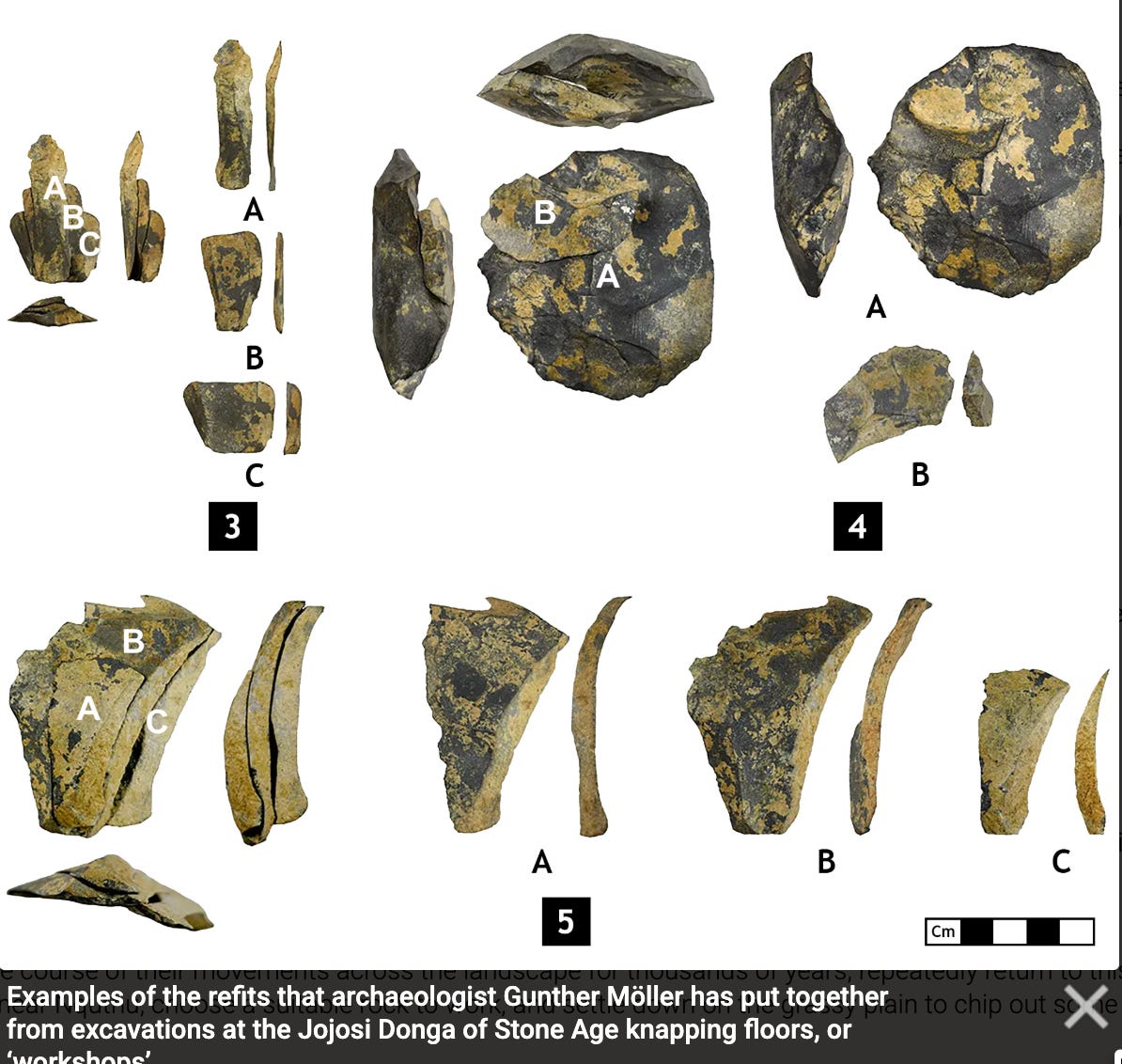
Making a special trip to a particular place to get a particular rock was thought to be rare, and late…. Pleistocene hunter-gatherers, the textbook said, did not really do this. Jojosi shows that they did. And much earlier than anyone thought…. Rough flakes, partly worked cores, and tiny chips of debris… [from] shaping blocks of stone into portable blanks….. The blades are missing because the people who made them carried them away. The site is not a camp. It is a workshop. A quarry. A place you go only to get stone. And the visitors were choosy. Dolerite was right next to the site. Quartz and quartzite pebbles sat in the riverbed below. The knappers ignored all of them. They wanted hornfels, and only hornfels….
Blombos Cave… overlooking the Indian Ocean about 300 kilometres east of Cape Town… where archaeologists found… a cross-hatched pattern drawn… in red ochre, about 73,000 years old… push[ing] back the timeline of symbolic thought by more than 30,000 years and helped overturn… [the] idea: that the cognitive package… was acquired in Eurasia…. Jojosi extends the same argument by another 150,000 years – and shifts it from art to economics. Long-term planning is not only about drawing a pattern on a rock. It is also about deciding, in advance, where you will be, what you will need, and how to make sure you have it. The Jojosi knappers were not opportunists but managers of a supply chain…. We make tools. We plan their use. We invest effort today for a payoff tomorrow. We build supply chains and pass knowledge across generations. We are different because of our economic function, and that function is older than almost anything else we can name about ourselves…

You probably know that I have two ongoing active book projects right now: What Rough Beast?: The Economic History of the World 1980-2040, and Enlarging the Bounds of Human Empire to the Effecting of All Things Possible: The Human Economy since the Dawn of Time. I think it is time to start seriously pushing out draft chapters, which are only DRAFTS at this stage, at least to paid subscribers. Will & al. (and Fourie) impelled me to rewrite one of the early sections of Enlarging the Scope of Human Empire. I did this because I have been wondering if that is where to start my Hicks Lecture, that I am going to be giving at Oxford All Souls’ in a week and a half.
So here it is in its current state:
Origins of a “Human” Economy
About five miles north of the Sea of Galilee and the town of Capernaum, at the foot of the Golan Heights, Route 91 crosses a bridge at what is the last natural ford of the upper Jordan River. In that place, in the northern sector of the Dead Sea transform fault, the river narrows enough that you can easily wade across.
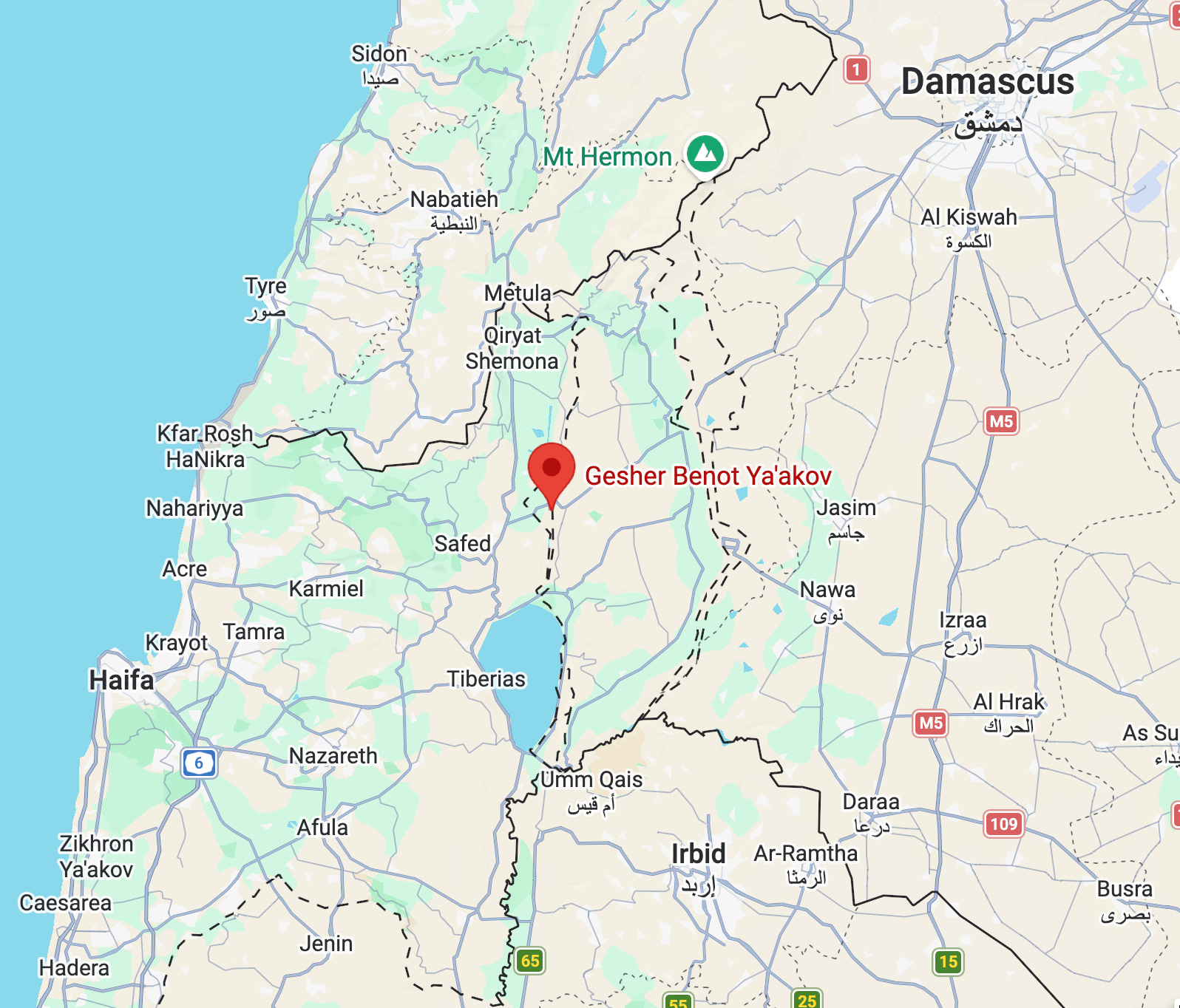
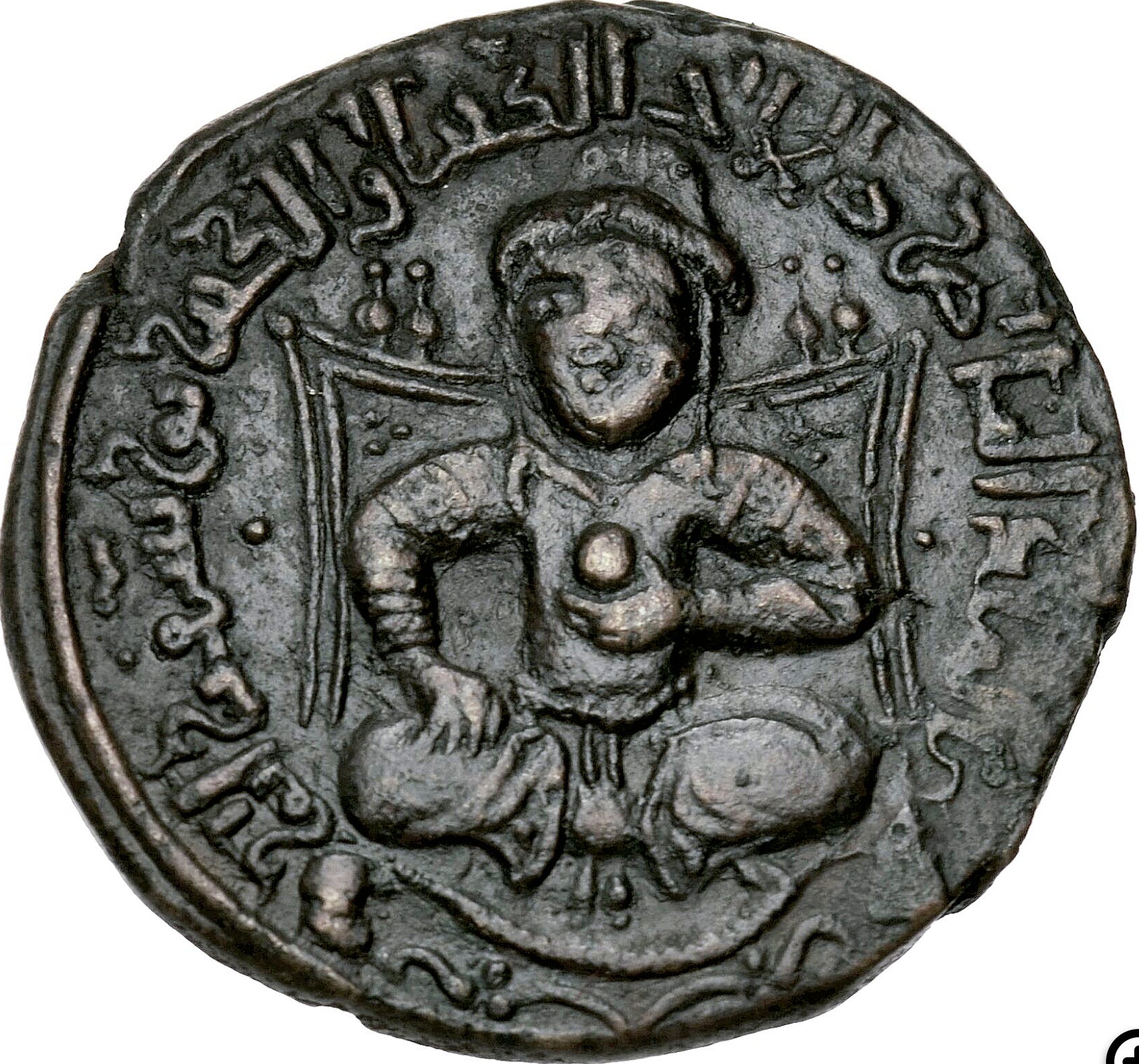
The Crusader kings of the Latin Kingdom of Jerusalem assigned some of the tolls from the ford to the nearby Latin Nunnery of St. James. The Crusader military élites then named the strategically important ford le Gué Saint-Jacques, Latinized into charters and such as Vadum Jacob: Jacob’s Ford.
Paid subscribers get the full arguments/unfounded speculations below:
The Latin Kingdom fell to the armies of Sultan Salah-ed-Din Yusuf after his decisive victory in 1187 at Qurun Hattin, a day’s march southwest of the ford. But the Crusader-era toponym stuck. And the nuns made it into public memory. And so to this day the place is Jisr Banat Yaʿqub in Arabic, Gesher Benot Yaʿaqov in Hebrew: the Bridge of the Daughters of Jacob.
For about the last century archaeologists have found a lot of stuff there.
Traces of humans. Humans started coming by and leaving their traces at a time almost 800,000 years ago. That stuff has, over the course of decades, substantially forced a progressive revision of what we had thought we knew about when human economic behavior began.
But, first, move forward half a megannum—500 millennia, 500,000 years—forward in time and move 5000 miles south and west across a continent, to the eastern Drakensberg-mountain foothills of southern Africa, to the eroded landscape the Zulu call the Jojosi Dongas (perhaps originally the “surging, eroding gullies”, perhaps a Nguni or pre-Nguni linguistic survival). A team led by Manuel Will has just published, in Nature Communications, an account of what people were doing at that site from approximately the year -220,000 to -120,000. They were quarrying hornfels — a fine-grained metamorphic rock produced when magma bakes sediment into something that flakes very well They were not camping there. They were not hunting. They were not gathering They went there to obtain a specific material. And they did not use the sharp tools they then created there where they were made. They carried their new-made tools elsewhere.
They were certainly human: Homo sapiens. They were almost surely more able to easily interbreed with us than the Homo sapiens neandertalensis and the Homo sapiens denisova and the other unidentified ghost human subspecies populations that the microbiology gene people can see in our ancestry. Were they Homo sapiens sapiens or something else like Homo sapiens adultu? How could we know? Were they behaviorally modern? Again, how could we know—and, really, can we say that anybody back before the invention of writing and bronze in -3000 was “behaviorally modern”, in the sense of possessing any clue with respect to the cultural and cognitive meaning of what I am doing right now as I write these words on my Apple MacBookPro M5Pro 64GB 2TB 16-inch XDR personal computer?
Other rocks were there. Dolerite was right there, tough and durable but not glassy, and no not as knappable as hornfels. Quartz and quartzite were in the riverbed. They ignored all of that They wanted hornfels, and only hornfels: much better for light, thin, long blades you can carry and resharpen. And they had wanted hornfels for so many generations that the site had become institutionalized — not a memory held in individual minds but a fact embedded in culture, passed from parent to child.
For how long?
Across 100,000 years, or more, they visited to make their tools. Across five thousand generations or more.
As Johan Fourie puts it, the Jojosi Dongas knappers of more than 100,000 years ago were not opportunists grabbing for a sharp rock now, but instead managers of a supply chain.
A supply chain requires things that we tend to think of as distinctively “modern”—or at least post-paleolithic—as organizational-economic achievements. It requires spatial division of labor — different activities happening in different places, coordinated across distance. It requires temporal planning — investment of effort now for payoff later, in a different location. It requires knowledge transmission — the information about where the hornfels is, what it looks like, how to knap it, and why it is worth the walk cannot be painfully rediscovered reliably every single generation; it must be taught and learned. And it requires institutional trust in the persistence of the arrangement — a willingness by someone to specialize in acquiring something you cannot personally use at the site of acquisition, because you have confidence that the broader network within which you operate will still be functioning when you return.
All of this was happening 220,000 years ago in southern Africa.
But what we can guess from what we see happening 500,000 years earlier at trhe Bridge of the Daughters of Jacob evidence is that something structurally similar — the maintenance of complex, multi-component knowledge systems that no individual could hold alone, coupled with a sophisticated societal division of labor — was happening half a megaannum—500 millennia before—in the Jordan Valley.
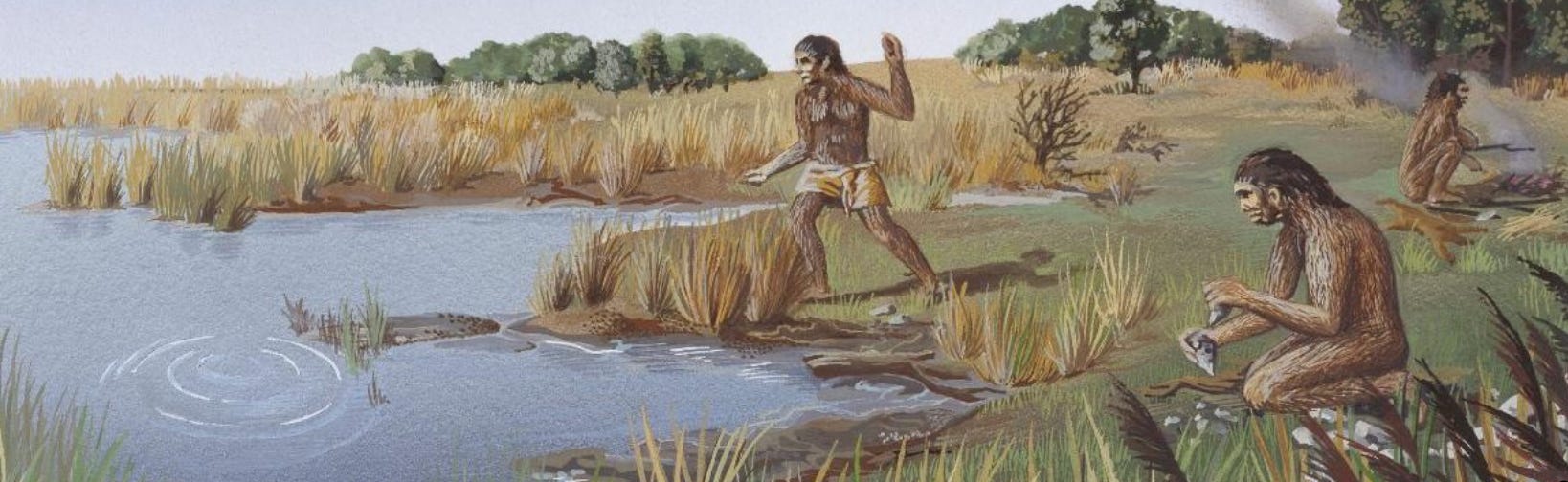
Now the human creatures who camped there in the years just after the year -800,000 years ago were not us: they were not of our subspecies Homo sapiens sapiens. Our subspecies would not appear for another 550,000 years. They were almost certainly late Homo erectus or Homo heidelbergensis. Not our species: mating and hybrids possible and perhaps fertile, but strong selection pressure against any significant gene flow. Their brains were substantially smaller than ours. Their culture we would find unrecognizable. We believe that they had not yet developed language in any form we would identify as such.
And yet: They controlled fire. Not accidentally, not opportunistically, but continuously — the evidence at the Bridge of the Daughters of Jacob suggests persistent, maintained, intentional fire use over an extended period.
And yet: They cooked fish — large carp from the ancient Lake Hula — in what may be the earliest known instance of food processing by any hominin.
And yet: they may well have been using medicinal plants, selecting specific species from a landscape full of alternatives, predating any previous evidence of pharmaceutical knowledge by more than 700,000 years.
And yet: They quarried and hauled basalt from a distant outcrop, in teams, using levers — requiring organized labor, specialized know‑how, and a shared mental model of the entire handaxe-use value and supply chain. chaîne
And yet: They orchestrated a diet whose breadth would shame most modern foodies — elephant and rhino, deer and gazelle, rodents and freshwater crabs, turtles and at least nine kinds of fish, plus acorns, olives, grapes, nuts, water chestnuts, and prickly water lilies from well offshore — not just opportunistic foraging but a collectively remembered seasonal calendar and map
And yet: They had already crossed Henrich’s Rubicon of cumulative culture — the local store of techniques, tricks, and work‑arounds was far too large and too intricate for any one East African Plains Ape brain to rediscover in a lifetime or indeed for any one brain to remember: a fine structured division of knowledge, cognition, and labor long before we think there were markets, prices, or money.
The picture that emerges is not of brutes huddled around an accidental blaze. It is of beings who knew things — specific, accumulated, transmissible things. Knowledge that had to be taught. Knowledge that would explode a single mind. Knowledge that was, in the most fundamental sense, social. And cultural.
As Joseph Henrich writes in his The Secret of Our Success:
Joseph Henrich: The Secret of Our Success <https://press.princeton.edu/books/paperback/9780691178431/the-secret-of-our-success>: ‘Hearths and areas for both stone-tool manufacturing and food processing. The inhabitants controlled fire and made a variety of stone tools, including hand axes, cleavers, blades, knives, awls, scrapers, and choppers. Made from flint, basalt, and limestone, tool manufacture was done on-site, often from giant slabs carried in from a distant quarry by a team. Some of the basalt slabs have notches, indicating the use of levers as part of the quarrying process. The basalt is of the highest quality and well quarried, suggesting that someone had a storehouse of know-how on the topic.
The group’s diet was diverse and also would have required extensive local knowledge. The stone tools were used to process the carcasses of elephants, deer, gazelles, and rhinos as well as boars and rodents. The cut marks left on deer bones are not much different from the same marks made hundreds of thousands of years later by late Paleolithic hunters. The inhabitants of Gesher Benot Ya’aqov also, somehow, obtained freshwater crabs, turtles, reptiles, and at least nine types of fish, including carp, sardines, and catfish. Some of these fish were big, longer than a meter. On top of this, there were seeds, acorns, olives, grapes, nuts, water chestnuts, and various other fruits. This bounty included the submerged prickly water lily, which grows well away from shore. It also appears that they were cracking nuts open and roasting acorns to remove their shells and perhaps reduce the bitter tannins. They may even have made “popcorn” by roasting the seeds from the prickly water lily, as has been done for thousands of years in India and China.
Clearly, cumulative cultural evolution is up and running at this point, generating more know-how than you, me, or our lost European Explorers could have ginned up in a lifetime. If you aren’t sure, go quarry some high-quality basalt slabs (you’ll need a lever, I think), make a beautiful hand axe with full symmetry (remember to make that antler or bone hammer first), bring down an elephant (trust your Paleolithic instincts?), butcher the carcass (use the hand axe), make a fire or find naturally occurring flame, and then whip up a raft to paddle out and pick some prickly water lily (you can spot this plant, right?). Then, enjoy the elephant steaks and “popcorn.”
Of course, this is not to imply that these ancient humans were like us, but merely that they had crossed the Rubicon and embarked on a genetic evolutionary trajectory that was primarily driven by culture and its products…
I have been thinking for some time now about what I, picking up an idea from my friend Noah Smith want to call the “five magics “of human prosperity. I want to use the Surging, Roaring Gullies and the Bridge of the Daughters of Jacob evidence to argue that the deepest and most foundational ones of those magics is considerably older than we have hitherto recognized.
The first magic operates at the individual level: eyes, hands, and a brain that can plan. This allows an otherwise moderately capable East African Plains Ape to acquire, in effect, fangs, claws, fur, levers, and much else. Tools. But tools alone do not get you very far. A crow uses tools. A chimpanzee uses tools. What the archaeological record at the Bridge of the Daughters of Jacob and the Surging, Roaring Gullies reveals is that these pre-sapiens hominins were already operating well beyond the first magic, already operating in the territory of the second.
The second magic operates at the collective level: ears, mouths, and — eventually — language. This is what transforms a band of a hundred East African Plains Apes into something qualitatively different: an AI—where this time “AI” stands for “Anthology Intelligence”, for what one ape in the band knows, soon all can know. The band becomes, in a meaningful sense, a single distributed mind, capable of storing and processing far more information than any individual within it. And it is this second magic — not the individual tool-user but the collective knowledge-holder — that is what I see at work in the Jordan Valley 800,000 years ago and in the Drakensberg 220,000 years ago.
Let me be precise about what I mean by “AI” here, because I think it is a key concept for understanding human economic history. No individual hominin at the Bridge of the Daughters of Jacob knew everything that the group knew. No single person held in their head the full set of knowledge about fire management, carp anatomy, medicinal plant selection, and stone tool production that the group collectively possessed. The knowledge was distributed across minds, encoded in practice, transmitted through demonstration and apprenticeship and story, maintained against forgetting by cultural repetition. The intelligence was in the network, not in any node. And the scope of the intelligence increases over time.
Writing is the third magic. With the coming of writing, it extends well beyond the band: an AI that potentially covers the whole globe, and all of time since the year -3000. That extension of memory indefinitely into the past, across gaps in cultural transmission, and across space is a jump that it would not be hyping unduly to call a singularity, as the horizon expands from the small living in-touch community of those here-and-now face-to-face to principle, all of recorded human civilization. It is a jumpfrom AI to ASI.
This is what I mean by the real ASI — not the Artificial Super-Intelligence of the AI hype cycle, but the Anthology Super-Intelligence that is all of us humans, thinking and knowing and remembering together.
This ASI is the deep substrate of the human economy. Before there were markets, before there were prices, before there were property rights or contracts or any of the institutional apparatus we normally associate with economic life, there was the ASI: the distributed, culturally transmitted, multigenerational accumulation of knowledge and expertise that makes specialization possible and valuable in the first place.
What the Surging, Roaring Gullies supply chain adds to this picture, and why it matters so much, is the spatial dimension.
The AI at the Bridge of the Daughters of Jacob could have been, in principle, a purely local phenomenon — a band that had accumulated a body of local knowledge and transmitted it internally. The fire, the fish, the plants: all of these are resources of a particular place, and one could tell a story in which the knowledge was all about that particular place.
But a hornfels quarry 220,000 years ago — a specialized extraction site visited deliberately, purposefully, over 100,000 years, by people who were then carrying the product elsewhere — cannot be explained by local knowledge alone. It requires knowledge that transcends the immediate camp, the immediate season, the immediate necessity. It requires, at minimum, a cognitive map in which particular places have particular properties that are worth traveling to obtain. It requires, at a higher level, an economic understanding that your camp can be better served by someone going to the hornfels outcrop than by everyone attempting to make do with the quartz in the riverbed.
This is the division of labor in space. And it is the spatial division of labor that is, ultimately, the engine of everything we call globalization.
Here is the argument in compressed form: humanity’s unique superpower is its twin abilities to collaborate in the creation and development of knowledge on the one hand, and to divide labor on the other. These two abilities are not independent; they are two aspects of the same underlying capacity of the ASI. The division of labor requires knowledge — you cannot specialize in hornfels procurement if you do not know that hornfels is worth procuring. And knowledge creation requires division of labor — you cannot accumulate a body of knowledge large enough to be genuinely useful if every individual must personally acquire every piece of it from scratch.
The AASI is the solution to this chicken-and-egg problem. Once you have a group capable of storing knowledge socially — across minds, across generations — and capable of coordinating specialized activities across space, you have the basic architecture of the human economy. Everything else is elaboration and amplification.
The elaborations matter, of course. They are the subject of the rest of this book.
Gift exchange and the market — my fourth magic — transform the ASI’s ability to coordinate the spatial division of labor. The Jojosi hornfels supply chain was presumably organized through social obligation, reciprocity, kinship claims, status competition: the full repertoire of what anthropologists call the moral economy of small-scale societies. The market does not replace these mechanisms; it supplements and eventually supersedes them by extending coordination capacity far beyond the reach of personal relationship networks.
Science — my fifth magic — transforms the rate at which the ASI can accumulate and validate knowledge. The experimental method is, among other things, a technology for distinguishing knowledge from coincidence, for preventing the ASI from filling itself with confident errors that work to the advantage of those with lots of social. Before science, the ASI accumulated everything that worked well enough to persist — including an enormous amount of false belief, and a lot of things that “worked” only in the sense that they enabled a stable society-of-domination, in which an élite of thugs with spears (and their bosses, and their tame accountants, bureaucrats, and propagandists) managed to grab a third of the crops and a third of the crafts for themselves, so that they and their families, at least, could have enough in a world of scarcity and dire Malthusian poverty. After science, the ASI has a mechanism for systematic self-correction.
But all of these later magics rest on the foundation that was already being laid 800,000 years ago by the hominins at the Bridge of the Daughters of Jacob, and 220,000 years ago by the knappers at the Surging, Roaring Gullies. The foundation is the Anthology itself: the distributed, multigenerational, cross-spatial multi-armed collective intelligence that is the human economy in its most basic form.
There is one more thing I want to say about the Jojosi knappers and the Gesher Benot Yaʿaqov hominins. It is perhaps the most important thing.
The still-standard narrative of human cognitive evolution places most of the interesting action in the Upper Paleolithic, roughly 40,000-50,000 years ago — the “cognitive revolution” or “behavioral modernity” characterized by cave paintings, personal ornaments, long-distance trade in exotic materials, and complex burial practices. On this account, what came before was a long prologue of relatively unchanging, relatively unsophisticated behavior. The real economy, the economy that exhibits the features we recognize as fundamentally human, begins late.
What Gesher Benot Yaʿaqov and Jojosi show, with increasing clarity, is that this narrative is wrong. Or at least: it is wrong about the origins of the key capacities. The sustained, intentional use of fire requires exactly the kind of socially transmitted, multigenerational knowledge system that the cognitive revolution is supposed to have introduced. The specialized hornfels quarry requires exactly the kind of spatial division of labor and economic coordination that we associate with fully modern human behavior.
The cognitive revolution may have amplified and elaborated capacities that were already present, already in operation, hundreds of thousands of years earlier. And if that is true, then the origins of the human economy — the Anthology Super-Intelligence, the division of cognitive and material labor across space — are not a late development in the story of human evolution. They are among the oldest things we can know about our lineage. Older than art. Older than symbolic thought as we had previously defined it. As Johan Fourie puts it: we are different because of our economic function, and that function is older than almost anything else we can name about ourselves.
The bridge at Jisr Banat Yaʿqub has been crossed by Acheulean hominins, by Neolithic farmers, by the armies of ancient Egypt and Assyria and Rome, by Crusaders and Saracens and Mamluks and Ottomans, by British imperial forces and Israeli tanks. The name has changed hands — Old Norman French to Latin to Arabic to Hebrew — without the essential identity of the place ever being lost. The knowledge of where the crossing is, and why it matters, is one small thread of today’s ASI: not held in any single mind, transmitted across 800,000 years of human and pre-human habitation, still useful today.
That is what the human economy is. Everything else is commentary.