Lecture Notes: Framing the “Dover Circle”’s post-1500 economic breakthrough as a historical anomaly, the result of a failure to find an equilibrium society-of-domination configuration. It thus emerged from specific ecological, social, financial, and imperial configurations. All three of the Crone, Wyman, and Allen readings argue that most agrarian-age “great empires” were highly successful solutions to the pre‑industrial problems of keeping the population alive while running an effective society-of-domination extraction machine for the thugs-with-spears and their allies at the top of the societal pyramid. From this perspective, the Dover Circle’s post-1500 exceptionalism reflected the inability of its mediæval elites to Do the Job—its failure to stabilize such an equilibrium. That by itself would not be interesting. You had to add on contingent access to coal, late female first marriage, high wages, and imperial profits. Crone’s Europe is an odd, unstable outlier—feudal, fragmented, weak on kinship, and unusually urban‑bourgeois—which made continued transformation into capitalism and modern science hard to avoid. Wyman’s 1490–1530 “critical juncture” shows how Europe’s flexible credit culture financed mutually reinforcing complexes of war, exploration, printing, and state‑building, setting up a Europe‑centered world system. Allen’s “great empires” chapter recasts 19th‑century Asian deindustrialization as the outcome not of any civilizational stagnation, but as stable gunpowder empires opened up to the global market by caravels and cannon, and the global market’s subsequent acid bath on the previous society-of-domination equilibrium…

READINGS: Mandatory:
Allen, Robert C. 2011. Global Economic History: A Very Short Introduction. Oxford: Oxford University Press. <https://archive.org/details/global-economic-history-a-very-short-introduction>. Read: 5. Great Empires. <https://bcourses.berkeley.edu/courses/1551896/files?preview=93933399>.
Crone, Patricia. 1989. Pre-Industrial Societies: Anatomy of the Pre-Modern World. Oxford: Basil Blackwell. <https://archive.org/details/preindustrialsoc0000cron>. Read: 8. The Oddity of Europe. <https://bcourses.berkeley.edu/courses/1551896/files?preview=93933400>
Wyman, Patrick. 2021. The Verge: Reformation, Renaissance, & Forty Years That Shook the World. New York: Twelve. <https://archive.org/details/the-verge-reformation-renaissance-forty-years-that-shook-the-world>. Read: Selections *(from intro, ch. 1, ch, 5, conclusion) <https://bcourses.berkeley.edu/courses/1551896/files?preview=93933404>
ANSWER: the following six questions in the text-entry box in the text-entry box on <https://bcourses.berkeley.edu/courses/1551896/assignments/9054589> (one-paragraph answers for each):
Crone says that most Eurasian “high civilizations” converged on a broadly similar pre‑industrial pattern. What are the core structural features of that pattern in her account, and which of them you think are most important for understanding economic performance?
The post-Black Death after 1348 “western European marriage pattern” (late marriage, neolocality, substantial female celibacy) is central to Crone’s story. How exactly does that pattern moderate Malthusian pressures, and how plausible do you find it as a key causal lever?
Wyman is explicit that many of these capital‑intensive processes are, in moral terms, “intensely evil”: conquest, enslavement, massacres, religious persecution. How does he hold together the story of economic dynamism with the story of human catastrophe, and does that alter how we ought to talk about the Great Divergence?
In Wyman’s account, Europe’s institutions are “good” not because they are inclusive or equitable but because they are flexible, risk‑tolerant, and able to mobilize capital quickly into scale‑intensive projects. How does that sit with contemporary development policy’s normative emphasis on inclusive institutions?
If you had to put Allen, Crone, and Wyman in one synthetic sentence about the great empires, it might be: “Successful agrarian empires solve the Malthusian problem set so well that they become extremely vulnerable when a coal‑and‑commerce‑driven industrial‑global regime comes into being elsewhere.” How fair is that summary?
Looking forward to future weeks and the “development of underdevelopment”, Allen repeatedly returns to the idea that policy choices made by independent states (e.g., Meiji Japan, some late‑19th‑c European periphery) differ sharply from those of colonies. How far can you push that dichotomy? Are there important intermediate cases (Egypt, the Ottoman Empire, semi‑colonial China)?
======
I need to have the answers to these by when I wake up Monday AM so that I can use them to plan the shape of Tuesday’s class. Hence no credit will be given for late answers.
NOTE: Why did the once-relatively mighty agrarian empires of Asia—above all China, India, the Ottoman and Russian Empires—the mightiest and most effective agrarian-age societies-of-doination the world had ever seen, fail to keep pace with first the Dover-Circle and then the Dover-Circle-Plus societies as they industrialized in the 1800s and became the locus of Simon Kuznets’s modern economic growth after 1875?
We read Allen’s “The Great Empires” chapter from his Global Economic History: A Very Short Introduction to set up the gameboard here. Allen sees the “great empires” of the late agrarian age—Ottoman, Russian, Persian, Mughal, Japanese, Southeast Asian, and above all Chinese—as remarkably successful civilizational projects and as archetypal societies of domination. On the civilizational side, Allen emphasizes their longevity, territorial scale, and administrative sophistication. From “the Balkans, to the Middle East and North Africa” under the Ottomans, across the Tsar’s Eurasian reach “from Poland to Vladivostok,” to a Chinese Empire that had “existed for thousands of years,” these polities managed to sustain complex legal orders, elaborate fiscal structures, and high cultures attractive even to European observers. Jesuit reports synthesized in Du Halde’s Description de la Chine offered Enlightenment Europe a “glowing picture of Chinese civilization”. The sheer persistence of these empires signals that they solved, at least tolerably well for centuries and better than more evanescent and protean kingdoms and political orders elsewhere, the problems of large-scale governance, conflict management, and provision of some basic order and infrastructure.
Yet this civilizational achievement was inextricable from entrenched domination. These were agrarian class societies organized around extracting surplus from peasants and subject populations. The classical economists’ critique of China—Smith on constraints on trade and insecure property, Malthus on marriage and fertility, Marx on a “pre-capitalist social structure”—highlights that the Asian empires were locked in hierarchical orders that stifled individual initiative. California-School revisionist claim that Chinese property rights and markets were in fact “comparable to Europe’s”, and that living standards in regions like the Yangzi Delta may have been “similar at both ends of Eurasia”, do not deny the basic point that these were strongly status- and state-structured societies.
Like the earlier Imperium Romanum, the absence of an Industrial Revolution in the great agrarian empires is not evidence of civilizational failure, but as the product of missing, highly specific triggers in societies that were successful civilizational solutions to the agrarian problem of order and surplus, in which there very success as societies of domination left them without discontented-élite drivers of mobilization and transformation. In other words, as Cosma Shalizi once said to me, perhaps the gunpowder empire is the most probable climax ecological state of the East African Plains Ape.
We read Patricia Crone’s “The Oddity of Europe” chapter from her Pre-Industrial Societies book to register, well, the oddity of western Europe in this agrarian-age societies-of-domination great gunpowder-empires context. Crone powerfully argues that Europe’s path out of the pre‑industrial world was not the “natural” endpoint of complex societies in general but a pronounced historical anomaly: produced by an unusual ecology, demography, kinship structure, political collapse, and cultural configuration that had it not been followed by the bizarre post-1500 civilizational explosion of the Dover Circle would have led to a unanimous historical judgment that those societies were, well, in fact not very successful. Elsewhere pre‑industrial complex societies found a relatively stable equilibrium pattern of large agrarian empires with capstone states and dense kinship structures. Mediæval Latin Christendom did have a surface resemblance to other Eurasian civilizations—a military‑religious élite, a cosmopolitan high culture, and a mass of poorly integrated peasant communities. But as a “traditional” society, Crone insists, Mediæval Latin Christendom was effectively a failure long before industrialization. For it was not converging on a more sophisticated version of the standard pre‑industrial empire. Instead, it generated territorial states with vernacular cultures, overseas colonies, capitalism, and novel scientific and other modes of thought deployed by disjunctive sub-élites grasping for power and authority.
The point, Crone concludes, is not that Europe possessed some transhistorical “rational restlessness,” but that its failure to find a stable pre‑industrial equilibrium, in a setting rich in ecological and institutional possibilities, made further transformation unavoidable and ultimately pushed it, alone, into modernity.
We read the selections (from the intro, Christopher Columbus, Aldus Manutius, from the conclusion) from Patrick Wyman’s book The Verge: Reformation, Renaissance, & Forty Years That Shook the World to see in embryo the basic configuration of technology, market, productive economy, finance, warfare, state capacity, religious conflict, maritime excellence, and religion-, power-, and money-driven global reach that would underpin Europe’s later dominance. Wyman sees his “forty years that shook the world” as a period when multiple trends—exploration, state‑building, gunpowder warfare, printing, the rise of sophisticated finance, and religious upheaval—collided and amplified one another. After 1530, a Europe‑centered world became imaginable in a way it had not been in 1490.
What western Europe did then possess was a widely diffused, flexible credit culture that allowed capital to be mobilized across space, sectors, and social networks. Venetian merchants, Genoese financiers in Seville, Augsburg bankers like the Fuggers, English wool traders, Portuguese noble‑investors, and middling burghers all operated with broadly similar understandings of risk, security, and obligation, even if their legal forms and local practices varied. Those shared institutions proved particularly well suited to funding capital‑intensive, high‑risk projects: oceanic voyages, permanent gunpowder armies, large printing operations, and state debt. Wyman’s portraits of Columbus and Vasco da Gama demystify “exploration” as essentially a joint venture between cash‑starved monarchs and profit‑hungry merchant syndicates engaged in clever financial engineering led by figures like Luis de Santángel and networks of Genoese merchants who expected monopoly rights and high returns. Similarly, the Portuguese seaborne empire hinged on syndicated investment in spice fleets, backed by religious missionary-crusading enthusiasm, royal charters, and state-of-the-art caravels and cannon.
Similarly, the press of Aldus Manutius is not an autonomous “technology of enlightenment” but a business venture in a brutally competitive environment in which up‑front fixed costs (type, paper, labour) had to be recouped through risky bets on uncertain markets. Aldus’s scholarly ambitions—to disseminate the Greek and Latin classics, to shape a new humanist pedagogy—were inseparable from the hard calculations of partners like Andrea Torresani and aristocratic investors such as Pierfrancesco Barbarigo. The result was a genuine information revolution—millions of books, cheaper access to texts, the infrastructure for Reformation polemics and later scientific exchange—driven by relentless capitalist expansion as the only way to make profits and avoid bankruptcy.
There is a strong sense in which the destiny of the world after 1600 looks, qualitatively, very different than anything one would have anticipated from the history of humanity up until then in the gatherer-hunter, pre-writing agrarian-, and writing-and-metal agrarian-ages. Globally, the pace of technological advance is at least five times what it had been back before the classical-antiquity apogee of the year 200.
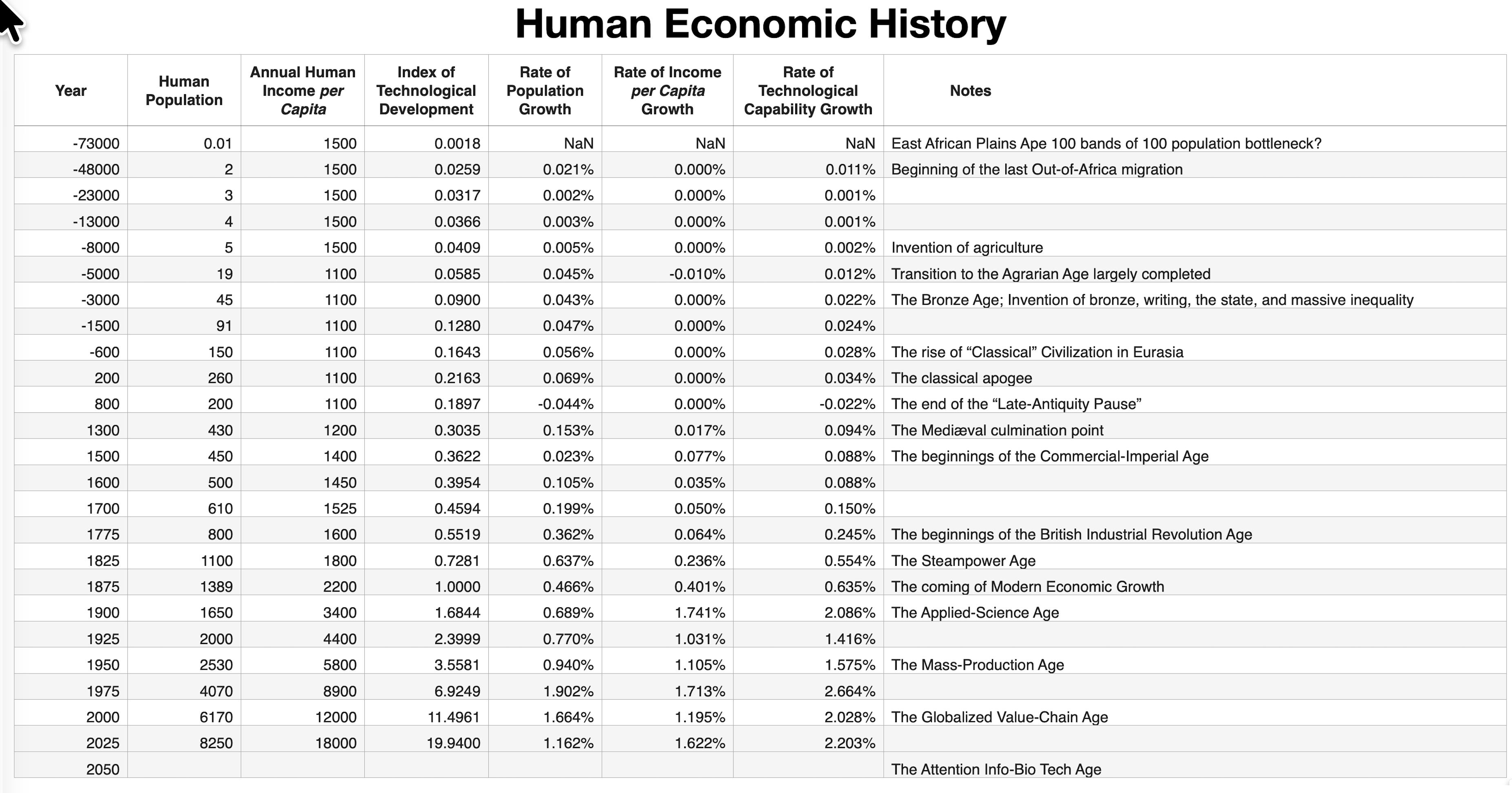
Perhaps you might want to make the case that the year 800 is worth attention—the staggered coming of the Sui-Tang-Song in the east, the arrival of the al-’asr al-‘Abbasi régime in the center, the coming of the Carolingians in the west—does seem to be followed by more rapid civilizational advance at three times that of classical antiquity. But it is not until 1400 or so that the global population curve crosses what would have been the trend of pre-200 growth had it not been for the 200 to 800 late-antiquity pause.
Whatever you think of 800, things were sufficiently different after 1600 that we should speak, globally, of a commercial-imperial age rather than a continued agrarian-age. This week’s readings are an attempt gesture at some guesses and hypotheses about just why that was so.
If reading this gets you Value Above Replacement, then become a free subscriber to this newsletter. And forward it! And if your VAR from this newsletter is in the three digits or more each year, please become a paid subscriber! I am trying to make you readers—and myself—smarter. Please tell me if I succeed, or how I fail…
##pre-class-assignment-breaking-through-the-coming-of-commercial-imperial-society
##lecture-notes
##enlarging-the-bounds-of-human-empire
##pre-class-assignment
#breaking-through-the-coming-of-commercial-imperial-society
#economic-history
#great-empires
#oddity-of-europe
#commercial-imperial-age
#societies-of-domination
#gunpowder-empires
#great-divergence
#malthusian-dynamics
#asia-europe-comparison
#long-run-growth
#econ-196
=