From Veldhoven, in the Brainport Eindhoven region of the Netherlands, comes the bleeding-edge point of the spear of human technological capabilities: the manipulation of nature and the organization of the human economic division of labor at a truly insane and unbelievable—and that is not hyperbole: I simply do not believe that Naked East African Plains Apes with brains of only 1400 cc each and neuronal processing clock speeds only one-ten-millionth as fast as NVIDIA Blackwells in our data centers actually manage to do this…
The stack is vertical and unforgiving. Cymer → Zeiss → ASML → TSMC (right now using CoWoS) → Shin-Etsu Chemical → NVIDIA chip-design → CUDA (NVIDIA’s software stack): Cymer makes the light. Zeiss makes the mirrors. ASML assembles the machines to make the EUV photolithography carve the right circuit paths. Shin-Etsu Chemical makes and slices the pure silicon crystal wafers for TSMC to imprint with the chips NVIDIA designs that then run CUDA. And it is, right now, the single most pricey economic value chain in the world today. And all parts of it are essential. (OK: Shin-Etsu faces competition, and you could with perhaps a 30% penalty replace TSMC with Samsung or Intel, and you could with perhaps a 75% penaltry replace NVIDIA’s chips-plus-CUDA with an alternative).
And yet, somehow, right now, rather than being divided up, NEARLY ALL THE MONIES FLOW TO NVIDIA.
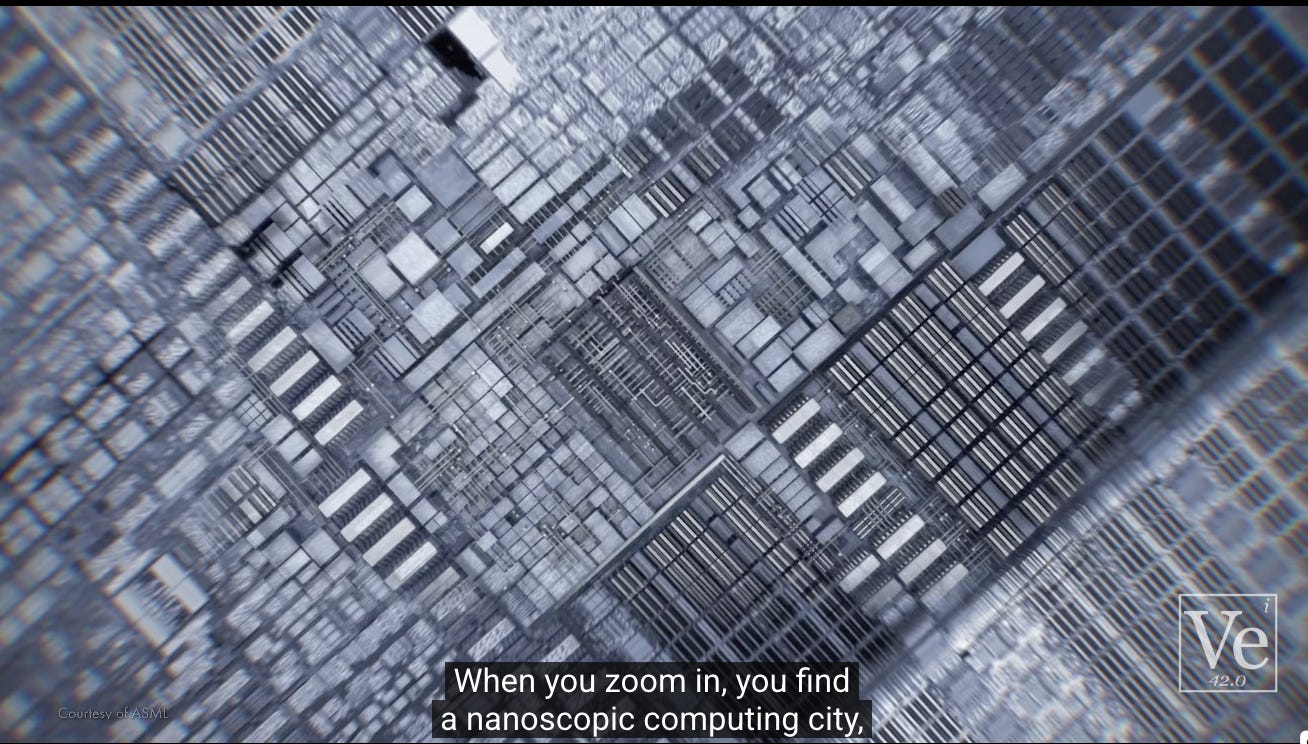
Rightly recommended by the Accidental Tech Podcast <https://www.youtube.com/channel/UC0QTVSHTjBKExtdExrBca5w> of John Siracusa, Casey Liss, and Marco Arment: the most mind-blowing hour you can spend learning about engineering today. It is all about the Twinscan NXE and EXE EUV (Extreme Ultra-Violet) photolithography silicon chip-making machines manufactured by ASML at its factories in Veldhoven in the Brainport Eindhoven region of the Netherlands, and elsewhere:
<https://www.youtube.com/watch?v=MiUHjLxm3V0>
Yes, “Brainport” is a Dutch term for regions built around dense collaboration between industry, universities, and government to create knowledge‑intensive growth.
ASML has no competitors in the making of EUV photolithgraphy. It and its partners own the business in a way that nobody else—not Applied Materials, even—can match.
It seems to be a matter of:
Light control: The EUV imaging system is all mirrors, shaped and polished to atomic smoothness, with in‑place measurements to hold the light beam’s pointing precise to less than a trillionth of a circle’s angle and precise in it location to a billionth of a meter—how fast your fingernail grows in a second. Zeiss designs, fabricates, and qualifies these projection and illuminator optics: one industrial source, and then one integration path.
Light production: Cymer’s laser‑produced plasma fires a high‑power CO₂ laser at tin droplets to emit Extreme Ultra-Violet light with a wavelength of 13.5 nanometers, with pre‑pulses to “pancake” and rarify the target, hydrogen chemistry to keep the collector clean, and droplet/laser timing at tens of thousands of shots per second. ASML owns Cymer, and engineered the source, collector, gas dynamics, and controls as a single unit.
Control Integration: ASML deploys mechanics, electronics, control systems, and software to precisely move and position the machines to produce masks guiding transistor deposition, holding things precise to nanometer scales across hundreds of different deposited layers. This requires vibration isolation, thermal management, encoders, and actuators that start, stop, and scan with such precision that the pieces of the machine experience sudden twenty-Earth’s gravity force levels of acceleration while holding things precise to one nanometer, 1/100000 of the thickness of a human hair.
And, no, I do not understand how, even in theory, you can use photons with a wavelength of 13.5 nanometers to reliably carve a hundred billion electrical current paths six times smaller on a silicon crystal.
At unbelievable—this is not hyperbole: I simply cannot believe this is done—levels of precision and quality control:
Path dependence & co‑development: EUV was a 30‑year effort. ASML, Zeiss, and Cymer solved interlocking problems together (mirror reflectivity vs. source spectrum vs. contamination vs. alignment). Each solution constrained the others, creating a proprietary “system of systems.”
Capacity & qualification: Making a handful of flawless high‑numerical aperture optics sets per month and qualifying them in a scanner is a production discipline in itself. The same is true for stable 200–500 watt EUV sources delivering tight stability and timing of 100,000 laser pulses per second and spectral purity over long runs, while maintaining the formation of identical liquid tin droplets for the plasma. There’s no parallel supply chain to tap.
IP plus tacit knowledge: Even where patents exist, the true economic yield comes from recipes, tooling, and teams—polishing sequences, nanometer-layer deposition, laser cavity tuning, droplet modulation, hydrogen/oxygen chemistries, control laws—that aren’t “codified” in ways a licensee could reliably execute.
Commercial lock‑ins: Exclusive supply agreements, joint R&D contracts, and field‑performance guarantees bind customers to the integrated stack. Breaking those guarantees to allow third‑party replication would jeopardize fab uptime.
From an industrial-technological perspective, we may well be done here. 2 nm features are merely ten atoms wide, after all. Enzymes can do work at single atom-scale precision, but then things are wet and messy, and there is no plausible path to then controlling the arrangement of hundreds of billions of such features to lock them in to any sort of designed structure.
From an industrial-organization perspective, we have a stack of three bleeding-edge monopolists: ASML → TSMC → NVIDIA. ASML builds the machines, TSMC operates the machines, NVIDIA (and Apple, which was TSMC’s lead client before the ChatGPT explosion) designs chips worth building using the machines. It’s expensive to use AMD-designed rather than NVIDIA-designed chips in your systems. It’s expensive to have your chips fabricated by Samsung or Intel rather than TSMC: Samsung seems content to be a fast second in chipmaking node deployment; under Pat Gelsinger Intel focused on regaining process primacy without caring about short- or medium-term profits, and the consensus is that it came up short on all except the “packaging” dimension (thus Intel’s profit stream now comes from monetizing US national pride, economic robustness, and national defense rather than from making the best chips). And there is no option to ASML: nobody sees a competing technological stack built for at least a decade to come.
And yet it is NVIDIA that is, right now, collecting ALL THE MONIES.
I should figure out how this came to be…