Engels pitched methodology; but Marx’s A Contribution to the Critique of Political Economy delivered very little in the way of actually, you know, critiqueing political economy, let alone using that as a springboard to transform how you should think about the economy, or what one should do to bring progress toward true human flourishing. The “Preface” endures, the book does not. Perhaps Marx thought he needed to publish it to demonstrate that he was doing something more than occasional pieces in the long drought between 1852 and 1867. But, if so, it does not look to me as though it was a successful demonstration…
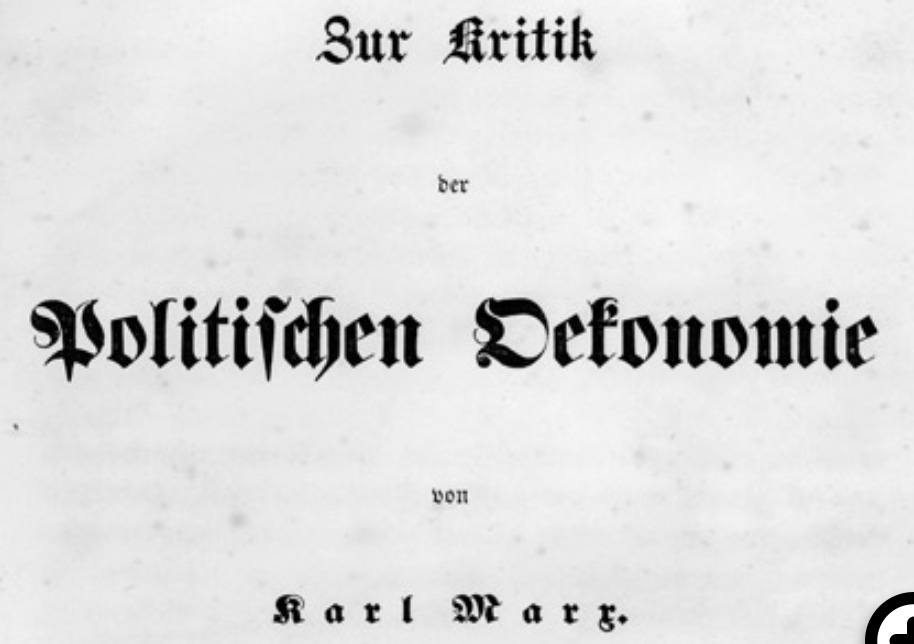
Columbia’s Adam Tooze said a couple of days ago that he is thinking a lot about the 1859 Preface to Karl Marx’s abysmal A Contribution to the Critique of Political Economy.
He does not say why:
Adam Tooze: Top Links 976 <https://adamtooze.substack.com/p/top-links-976-ai-investment-surges>: ‘[I] keep thinking of this…. [Karl Marx] “Men… enter into definite relations… independent of their will… [with] their material forces of production…. [That] constitutes the economic structure of society… on which arises a legal and political superstructure and… forms of social consciousness.... Material productive forces… come into conflict with… [property] relations of production… [which] turn into their fetters [on development]. Then begins an era of social revolution. The changes in the economic foundation lead sooner or later to the transformation of the whole immense superstructure…. [Then come] the legal, political, religious, artistic or philosophic—in short, ideological forms in which men become conscious of this conflict and fight it out…. This consciousness must be explained from the contradictions of material life….
New superior relations of production never replace older ones before the material conditions for their existence have matured within the framework of the old society. Mankind thus inevitably sets itself only such tasks as it is able to solve….
In broad outline, the Asiatic, ancient, feudal and modern bourgeois modes of production may be designated as epochs marking progress in the economic development of society. The bourgeois mode of production is the last… form… antagonistic… emanat[ing] from the individuals’ social conditions of existence—but… bourgeois society create[s] also the material conditions for a solution of this antagonism. The prehistory of human society accordingly closes with this social formation…
A couple of days ago I said why I, at least think about this <https://braddelong.substack.com/p/six-analytical-threads-in-search>. I divided the passage into six threads:
Theology: the millenarian claim (made in 1859!) that the end was at hand of the long era in which human societies were societies of domination,
Stage Theory of History: The six modes of production—tribal, Asiatic, ancient, feudal, bourgeois, and socialist—as the successive stages of human history, social revolutions driving the transitions between them.
Theology: Refracted through Hegel’s thesis-antithesis-synthesis: the claim that history has an arrow of progress driven by econo-political change.
Sociology & Ideology: The conflicts generated by the rupture between old relations of production and the requirements of the new, growing forces of production play themselves out in ideological forms.
Political Economy: Relations of production constrain technological development and investment, and then constraint fails as society’s property order is broken by social revolution.
Historical Materialism: The relations of production have to be fitted to the technology of society and thus to the way people experience their worklife. And then everything else has to be fitted to that
I argued strongly that to pick up one (or more) of these six claims and then to try to develop it and demonstrate its truth and draw forth its implications for human knowledge, human society, human political action, and the human future is what it is to be a “Marxist” in any sense meaningful. And I argued:
(6) Historical Materialism is, in a soft sense, true: to be stable, human relations of production have to be fitted to the technology of society and thus to the way people experience worklife; and the rest of society must fit as well.
(5) Political Economy is sof-sense true, except for the “social revolution”—reworking can emerge in lots of ways.
(2) Stage Theory—well, setting up ideal-types of forms of techno-economic-societal orders can be very useful. But I favor something more like: Attention info-bio tech: 2040 (human technological capability index H = 35); globalized value-chain: 2000 (H = 15); mass-production: 1960 (7); applied science: 1920 (3); steampower: 1870 (1); commercial-imperial: 1700 (0.65); feudal: 1200 (0.35); ancient: -500 (0.2); early bronze: -3000 (0.8); tribal: -7000 (0.065); gatherer-hunter: -48000 (0.03)
With (4), Marx has left reality behind: Historical conflicts are often not about forces and relations of production at all, but about, for example, whether al-‘Azīz, al‑Raḥmān, and al‑Raḥīm are merely three principal attributes of a unitary divinity, or actually the three hypostases of some trinitarian theology.
(3) as well is nonsense on stilts: the arc of history does not bend toward justice, or even prosperity.
And (1), of course, is millenarian theological fantasy.
But I had more to say. Here is some of it:
On the curious reception of Marx’s 1859 book:
Of all of the Contribution to a Critique of Political Economy, the “Preface” is now the only thing that is ever read—indeed, as best as I can grasp, pretty much the only thing that was ever read.
The book as a whole is a mess.
Friedrich Engels tried to push the book. He wrote a review: The first part argued that standard political economy should be understood not as a description of the economy but rather as an ideological reflection of its operation—hence the need for a critique. The second part argued that Marx’s reinterpretation of Hegel had produced a sound method of analysis.
There was supposed to be a third part of Engels’s review: “the economic content of the book will be discussed in a third article”. It never appeared. That even Engels could not get it together to write about what Marx could use historical-materialist and Hegel-turned-right-side-up analytical methodology to conclude about the economy—that tells us that the actual “therefore…” results of setting up the apparatus and turning the crank were thin gruel indeed.
This was, I think, because the actual content of the thing was very thin indeed. Marx had constructed a neo-Hegelian analytical method. He had made his historical materialism bet that political economy should be analyzed not as a science but as an ideological reflection of the economy. And what he had come up with and was willing to publish in 1859 was: the dual use‑value versus exchange‑value character of the commodity, with exchange-value determined by the necessary amount of "homogeneous social labor” time, and with exchange value’s equivalences leading to our world in which exchange leads to and is then mediated by money. and universal equivalent leading toward money.
The book was, as I understand it, intended to lay down a marker that he, Karl Marx, was doing something with his time more worthwhile for the long run than earning money by writing European current-affairs commentary for the New York Herald Tribune. The hope, perhaps, was to publish Capital in yearly installments, of which this Contribution would be the first.
But if that was the hope, that plan was stillborn. Yes, much of the Contribution does show up, rewritten but not necessarily improved, in the first chapters of Capital. But otherwise there is a drought. Marx’s Herr Vogt appears in 1860. He gave—but did not publish—his Value, Price, & Profit speech in 1865. Otherwise it is only the Contribution that breaks the surface as a substantial work between 1852 and 1867.
And was the Contribution thick and meaty enough to demonstrate that Marx was doing something truly worthwhile and great?
No. It was noticed within a narrow German socialist and émigré circle, completely ignored by mainstream economists German and English, and intermittently misread by philosophers still shadow-boxing with Hegel. Engels’s positioning it as a methodological breakthrough convinced few. Within German political economy, the focus was on trade policy, monetary debates, national political consolidation (Zollverein, then unification), and how to jump-start industrial development. An abstract attempt to rebuild value and circulation from abstract principles was of little interest. In the broader European radical press, the reception was sporadic yet respectful, but not so much through the result of the book itself but rather of those in Engels’s and Marx’s network being team players.
Thus I have never understood why Marx thought the book worth publishing.
Note: The full quoted Marx passage as Tooze gives it:
Karl Marx (1859): Preface to “A Contribution to the CI am running a few minutes late; my previous meeting is running overitique of Political Economy”: ‘In the social production of their existence, men inevitably enter into definite relations, which are independent of their will, namely relations of production appropriate to a given stage in the development of their material forces of production. The totality of these relations of production constitutes the economic structure of society, the real foundation, on which arises a legal and political superstructure and to which correspond definite forms of social consciousness. The mode of production of material life conditions the general process of social, political and intellectual life. It is not the consciousness of men that determines their existence, but their social existence that determines their consciousness. At a certain stage of development, the material productive forces of society come into conflict with the existing relations of production or – this merely expresses the same thing in legal terms – with the property relations within the framework of which they have operated hitherto. From forms of development of the productive forces these relations turn into their fetters. Then begins an era of social revolution. The changes in the economic foundation lead sooner or later to the transformation of the whole immense superstructure.
In studying such transformations it is always necessary to distinguish between the material transformation of the economic conditions of production, which can be determined with the precision of natural science, and the legal, political, religious, artistic or philosophic – in short, ideological forms in which men become conscious of this conflict and fight it out. Just as one does not judge an individual by what he thinks about himself, so one cannot judge such a period of transformation by its consciousness, but, on the contrary, this consciousness must be explained from the contradictions of material life, from the conflict existing between the social forces of production and the relations of production. No social order is ever destroyed before all the productive forces for which it is sufficient have been developed, and new superior relations of production never replace older ones before the material conditions for their existence have matured within the framework of the old society.
Mankind thus inevitably sets itself only such tasks as it is able to solve, since closer examination will always show that the problem itself arises only when the material conditions for its solution are already present or at least in the course of formation. In broad outline, the Asiatic, ancient, feudal and modern bourgeois modes of production may be designated as epochs marking progress in the economic development of society. The bourgeois mode of production is the last antagonistic form of the social process of production – antagonistic not in the sense of individual antagonism but of an antagonism that emanates from the individuals’ social conditions of existence – but the productive forces developing within bourgeois society create also the material conditions for a solution of this antagonism. The prehistory of human society accordingly closes with this social formation.…
References:
Anderson, Perry. 1976. Considerations on Western Marxism. London: New Left Books. <https://archive.org/details/considerationson0000ande>.
DeLong, J. Bradford. 2026. “Six Analytical Threads in Search of Useful Empirical Traction: On Karl Marx’s 1859 ‘Preface’”. Grasping Reality. January 8. <https://braddelong.substack.com/p/six-analytical-threads-in-search>.
Engels, Friedrich. 1880. Socialism: Utopian & Scientific. Bonn, Germany: Marxists Internet Archive. <https://www.marxists.org/archive/marx/works/1880/soc-utop/index.htm>.
Gilman, Nils. 2025. “How Did Academia Not See It Coming.” Small Precautions. March 7. <https://nilsgilman.substack.com/p/how-did-academia-not-see-it-coming>.
Marx, Karl. 1859. “Preface” to A Contribution to the Critique of Political Economy. Bonn, Germany: Marxists Internet Archive. <https://www.marxists.org/archive/marx/works/1859/critique-pol-economy/preface.htm>.
Tooze, Adam. 2026.“Top Links 976”. Chartbook. January 8. <https://adamtooze.substack.com/p/top-links-976-ai-investment-surges>.
Wikipedia. 2026. “A Contribution to the Critique of Political Economy”. January 10. <https://en.wikipedia.org/wiki/A_Contribution_to_the_Critique_of_Political_Economy>.