Jane Austen wrote amid a peculiar peace: rents flowed, muskets hung idle, and reputations ruled, and in that context crafted Great Novels with each sentence a step in the moral education of the leisured upper class…
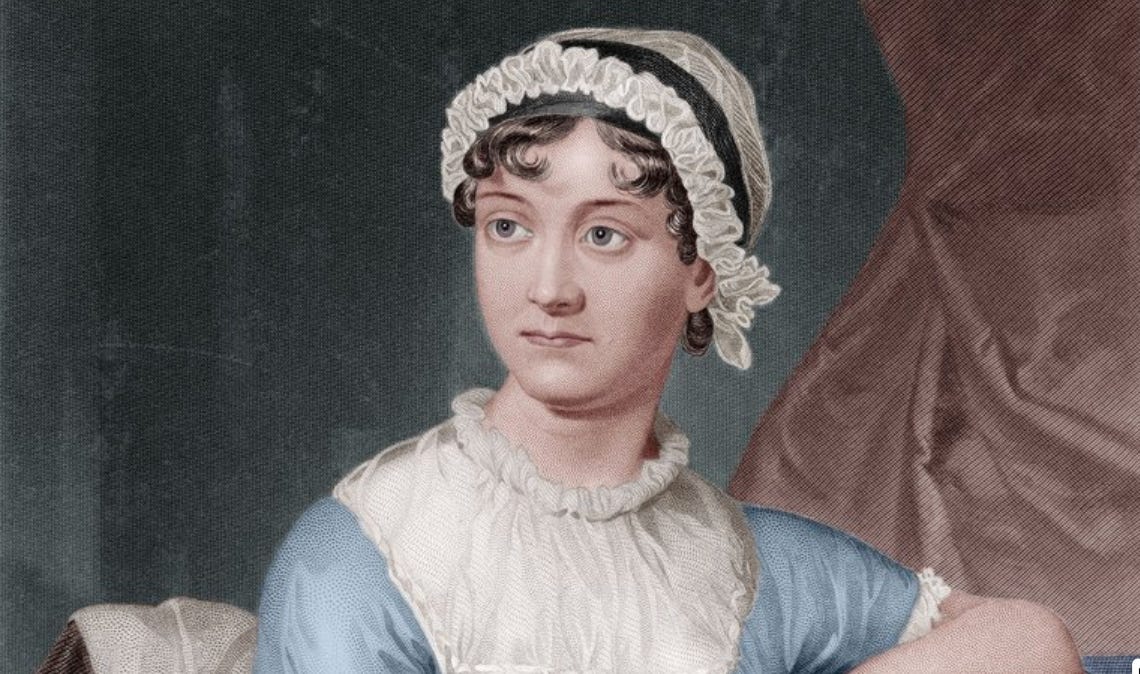
And Henry Oliver has thoughts:
Henry Oliver: Why we love Jane Austen more than ever after 250 years <https://www.commonreader.co.uk/p/why-we-love-jane-austen-more-than>: ‘She wrote about what really matters…. [But] it is still easy to be dismissive…. Giles Coren th[inking]… it… funny to describe her as “an average chick-lit writer of her day”…. Giles Coren had his little joke, but Pride and Prejudice has sold over twenty million copies…. Her novels are about questions that are still central to our lives. How to live a good life in a commercial society? What is a moral education in the modern world? Who should we marry? Jane reigns supreme because no other novelist else invented such important narrative techniques or had so much to say to readers about their lives and what it means to live in modernity. To some, Austen looks like a romance novelist. A clever, ironic, wry romance novelist, it’s true…. This is only part of the truth.
Austen did unprecedented things with narrative. There are very few books that move so subtly between impartial narrative and the character’s perspective…. Defoe made real characters…. ichardson gave us direct access to the wild and exciting thoughts and feelings…. Fielding gave us rollicking, rolling, ever diverging tales within tales. But it was Austen who gave us the perfect art of… people having to overcome their inner problems—rather than having to overcome problems imposed upon them by the world. Austen did no less than create what we now expect from a novel…. Austen’s novels are all about what it means to see things from someone else’s point of view. That is the moral lesson Lizzie Bennet learns about Mr. Darcey, it is what Marianne learns about Elinor, and it is what Emma Woodhouse learns about all her meddling…. Her innovations are still relevant to our lives today.… Long may she be read…
Plus there is:
Hugh Hou: Explore Jane Austen’s Bath, UK in 16K Immersive Video | 250 Years Celebration from Royal Crescent to Roman Bath <https://www.patreon.com/cw/HughHouFilm/> <https://public.hey.com/p/L6toez2am6UX6nQaSZ8aFfVz>
I seem to have written a fair amount about Jane Austen here on this SubStack:
And there was still more over at Þe Olde Weblogge, Back in The Day…
What do I think you should focus on as you read the Great Novels, in addition to simply absorbing them as Great Novels, doing what Great Novels do, and specifically these particular Great Novels? This:
Start here: Register the oddity that the Bennets, the Bingleys, and the Darcys exist as they do—comfortably ensconced, with incomes large enough to allow idleness, conversation, and the occasional social humiliation—without either knights to enforce their will or factories to justify their rents? Two centuries earlier, their predecessors were and had armed men—warriors and magistrates with the power to deal out death and order. A century later, their successors would claim legitimacy through capital accumulation, organization, and skill.
But in Austen’s England—call it 1795–1815—the landed gentry sits in a curious institutional interregnum: revenues flowing, status revered, power formalized mostly through habits and the yeomanry’s muskets, not through any visible contribution to production. And yet the world does not burn; there is no English August 4, 1789. Even though it is the era of the American, the French, and the Industrial Revolutions.
This is a distinct oddity. A little less than a generation before in France, rumors of aristocratic conspiracy and tangible fiscal crisis fuse into what Lefebvre called the Great Fear: peasants arm themselves, châteaux burn, the records of feudal obligation go up in smoke, and the National Assembly preempts further conflagration by abolishing feudal dues.
In England, the jacquerie does not arrive. Edmund Burke, admittedly, is terrified, writing of how “sophisters, economists, and calculators” will set in motion chaos that will destroy all socieal order but the English state’s fiscal capacity, legitimacy of taxation, and a less acute harvest-fiscal shock defuse any potential revolutionary moment. There is discomfort—enclosure riots, Luddite distress, food price spikes—but the social order that makes Austen’s drawing rooms possible remains intact.
Austen’s fiction places its characters inside this remarkably bizarre historically peculiar equilibrium. Mr. Bennet of Longbourn—£2,000 yearly income—is not a technologist, not a warrior, not a manager of complex production. He did not make the land.
He barely rouses himself to swat a fly.
Yet something very real and quite hard to change binds 300 families to transfer roughly a third of their product in rent, tithe, and fees to the local proprietors. That “something” is an institutional package: property rights embedded in common law and custom; a state capable of taxation and public debt management without unraveling; parish poor relief as a pressure valve; and a social psychology that legitimates status via gentility, reputation, and the promise of paternal governance. Austen never lectures about this machinery. She shows it—by making it the water her characters swim in.
Thus I at least find myself focusing on:
First, the economic history lesson: Pure rents can persist when the fiscal state is strong enough to keep order, when the legal architecture makes land ownership the bedrock of claims, and when the opportunity set for the non-propertied is narrow enough that exit is costly. England’s Glorious Revolution settlement, the rise of the Bank of England, and the normalization of public borrowing make for a polity in which taxes can be levied, debts honored, grain imported when possible, and local violence minimized. A world safe for £2,000‑a‑year incomes—and for Elizabeth Bennet’s walks—rests on the boring triumph of administrators over zealots. No Necker, no immediate fiscal break, no August Night.
But there is much more here:
Second, the psychology lesson: Austen draws a moral economy of the upper class that polices itself not through brute force but through reputation, self-command, and ritual—balls, visits, proposals, letters, and, crucially, shame. The sanction mechanism is not the dungeon; it is the cold shoulder at the assembly rooms. Her heroines learn to see from another’s point of view—Lizzie reads and rereads Darcy’s letter; Emma finally perceives what she has done to Miss Bates; Elinor survives by feeling deeply but acting prudently. This is Enlightenment psychology filtered through drawing-room empiricism: sympathetic identification as moral education. The virtuous are those who can look about with prudence. The rakes—the Wickhams, Willoughbys—are the high‑T merchants of immediate gratification (but Austen does not give them any full comeuppance!). The colonels—Brandon, sober, wounded, reliable—are low‑variance, high‑responsibility equilibria.
It is comedy, yes, but comedy with a spine: preference formation under social constraint.
Third, the marriage market as an allocation mechanism in a constrained gender-economy. Austen’s plots are portfolio optimization under legal and informational frictions. Women possess human capital—wit, judgment, beauty, network position—but face primogeniture, entail, and limited labor-market access, and so they have to actively woo beneath the pose of bashful maidenly modesty. Men’s wealth is sticky—land, commissions, trade profits—but reputation can be fragile. The equilibrium outcomes—Lizzie with Darcy, Jane with Bingley, Marianne with Brandon—are not random. They are achieved through signal extraction in repeated interactions. Letters are the costly signals; elopements are negative shocks; public dances are noisy marketplaces where type and temperament are inferred. Good outcomes require moral education: learn to see others’ utility functions, correct for your own biased priors, and then choose.
Fourth, the absence of English jacquerie is telling. England’s inequality is visible—Longbourn’s park versus the Lucas’s scrap, Lady Catherine’s condescension about west-facing windows—but there are some compensating institutions: parish relief, evangelical movements, the yeomanry, and a national mythos of liberty that convinces the poor that change will be gradual and ordered. From this angle, Austen is evidence for a broader thesis: legitimacy and capacity can stabilize an unjust distribution long enough for technological change—the steam and factory age—to reassign both rents and moral narratives. By the time capital justifies wealth, rentier gentility has already enjoyed a century of grace.
Fifth and last, Austen’s contribution to the “modern novel” is itself part of the Enlightenment’s institutional-psychological learning. She perfects free indirect discourse—the technique that moves between narrator and character seamlessly—and thereby teaches readers to inhabit other minds without forgetting the social frame. That is more than literature. To understand choice you must understand belief formation, emotion, and status anxiety, all under constraint. Austen’s achievement is to make you feel Marianne’s blaze and yet endorse Elinor’s calm; to register Lizzie’s anger and then to accept Darcy’s accounting; to notice Emma’s meddling and finally to choose kindness.
There is, of course, a darker coda. The rents that sustain Longbourn are part of a global portfolio—naval power, colonial extraction, sugar, and cotton soon to come—fully entangled with lash and cash. The genteel surface depends on distant violence and poverty. But Austen does not dwell there. However, we must.
But step back: These are Great Novels. A great novel transforms perception, widens empathy, and rewards rereading. Criteria ossify into checklists, but we can note:
anguage of high quality;
complexity and depth of resonant theme;
universality;
memorableness;
credible character arcs;
conflicts that force change;
purposeful point of view;
deliberate pacing;
vivid description;
dialogue that carries subtext;
all adding up to rereadability; and that felt internal shift—after which the world won’t look quite the same. (I like Rick Gekoski, “What’s the definition of a great book?”<https://www.theguardian.com/books/2011/dec/23/definition-great-book-rick-gekoski> here).
The test is emotional and cognitive: do we feel seen, think harder, and keep turning pages without manipulation. And I see one thing as key to Austen’s innovativeness and her greatness: it is her absolute mastery of the subtle merging of narrator and character consciousness. When done well (Austen is canonical), it lets us inhabit other minds while maintaining the social frame, producing empathy and irony in the same breath. That widening of perspective is both a literary achievement and a moral education.
Ian Watt, The Rise of the Novel <https://archive.org/details/riseofnovel0000ianw_i1p5>, I think, puts it best here:
Jane Austen’s variant of the commenting narrator… was so much more discreet that it did not substantially affect the authenticity of her narrative. Her analyses of her characters and their states of mind, and her ironical juxtapositions of motive and situation are as pointed as anything in Fielding, but they do not seem to come from an intrusive author but rather from some august and impersonal spirit of social and psychological understanding. At the same time, Jane Austen varied her narrative point of view sufficiently to give us, not only editorial comment, but much of Defoe’s and Richardson’s psychological closeness to the subjective world of the characters. In her novels there is usually one character whose consciousness is tacitly accorded a privileged status… but the identification is always qualified by the other role of the narrator acting as dispassionate analyst, and as a result the reader does not lose his critical awareness of the novel as a whole.
The same strategy as regards point of view is employed with supreme brilliance in Emma (1816)…. The unfolding of Emma Woodhouse’s inner being has much of the drama of progressive revelation…. Jane Austen’s novels, in short, must be seen as the most successful solutions of the two general narrative problems[:]… combin[ing] into a harmonious unity the advantages both of realism of presentation and realism of assessment, of the internal and of the external approaches to character; her novels have authenticity without diffuseness or trickery, wisdom of social comment without a garrulous essayist, and a sense of the social order which is not achieved at the expense of the individuality and autonomy of the characters….
Jane Austen faces more squarely than Defoe, for example, the social and moral problems raised by economic individualism and the middle-class quest for improved status; she follows Richardson in basing her novels on marriage and especially on the proper feminine role in the matter…. It was Jane Austen who completed the work that Fanny Burney had begun, and challenged masculine prerogative in a much more important matter. Her example suggests that the feminine sensibility was in some ways better equipped to reveal the intricacies of personal relationships and was therefore at a real advantage in the realm of the novel…. In Jane Austen, Fanny Burney and George Eliot the advantages of the feminine point of view outweigh the [patriarchy-enforced] restrictions of social horizon…
A Great Novel is not a formula. It’s a durable machine for seeing—built from language, structure, and point of view—that changes how we apportion attention and judge motives, and that keeps yielding new returns as our own context shifts.
If reading this gets you Value Above Replacement, then become a free subscriber to this newsletter. And forward it! And if your VAR from this newsletter is in the three digits or more each year, please become a paid subscriber! I am trying to make you readers—and myself—smarter. Please tell me if I succeed, or how I fail…