Marcella Alsan's bioculturalsociogeographical take on long-run African economic development: why the story is radically incomplete without the tsetse fly: one insect and the fate of a continent, for it looks like the most important player in Africa’s economic history wasn’t a king or a conqueror, but a bloodsucking fly…
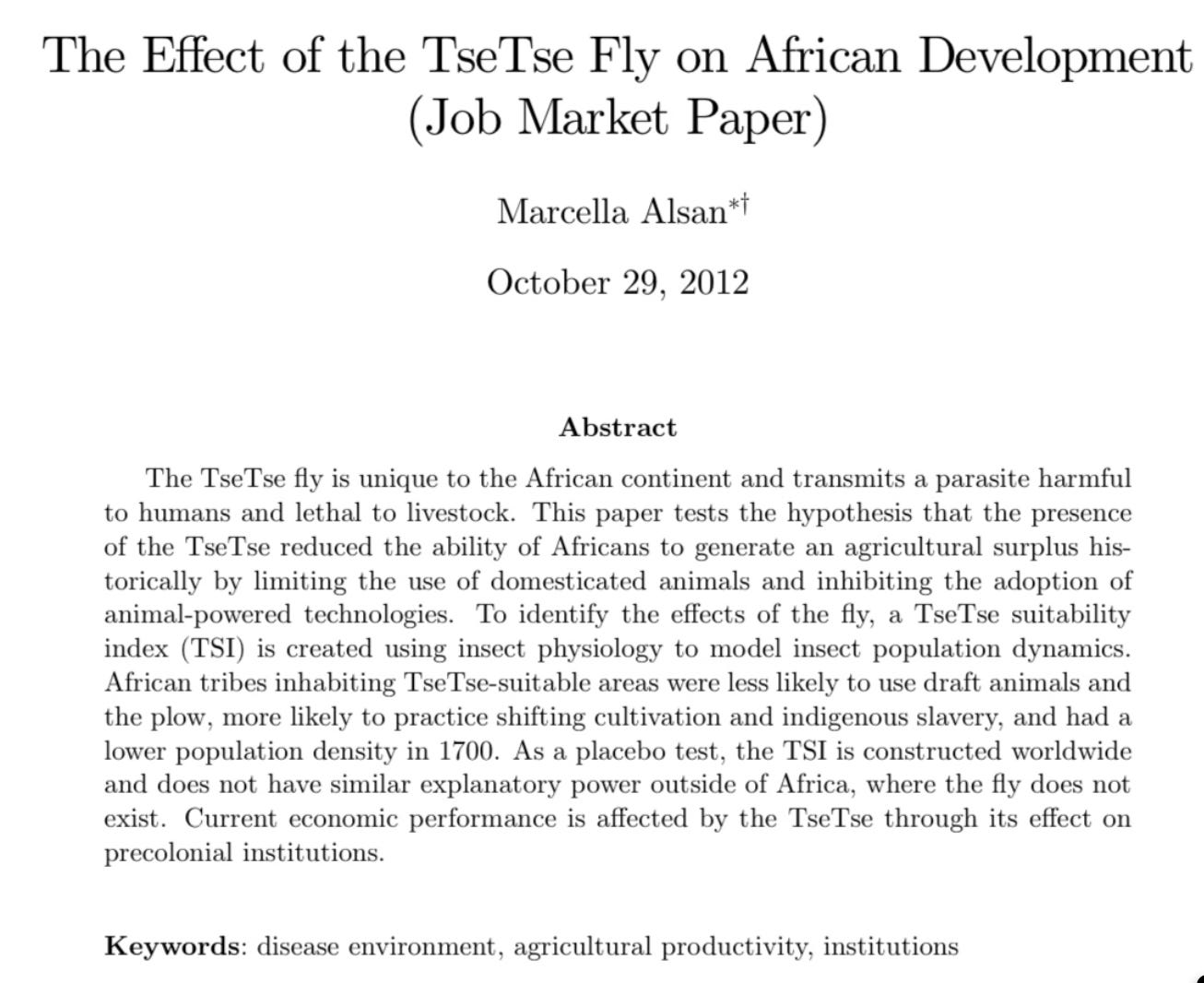
Nick Decker reminds me of the great Marcella Alsan’s job market paper of a decade and a half ago. How the tsetse fly, by killing cattle and stymieing plow agriculture, set the stage for centuries of institutional divergence: a lack of plows and of centralized states leading to the peculiar vulnerabilities of its societies to modes of imperial-colonial exploitation.
Her thesis is fully persuasive. And yet it is part of a pattern of very good articles that together I find somewhat problematic, for history can only be truly causally explained once.

Nick Decker <https://x.com/captgouda24/status/1937388725299781764>: ‘Why was Africa so empty, and for so long?… Marcella Alsan argues that it was the TseTse fly which did it, by rendering vast swathes of land uninhabitable. It is not the direct effect of sleeping sickness which matters, terrible though it is, but how it kills livestock. The wild game of Africa is immune, but it is absolutely murderous to cattle. Without cattle, you can have no plow. You have no dung to fertilize crops. You have no carts or wheels, or even packhorses—you must rely upon human portage. Without carts, there are no roads. In short, productivity tanks and centralization is impossible…. The Bantu migration was recent, and they abandoned crops and animals when they crossedh terrain unsuited for them…. She finds truly enormous effects….
In particular, it increases the incidence of slavery, an institution which is incredibly toxic to sustained economic growth. Without livestock, the value of humans goes up, and without cities, they can’t run. What might Africa have been like without the fly? We already know — there would have been states, just as there was in Ethiopia and Great Zimbabwe. It is little surprise that those ethnic groups which perform the best today are those which have had the longest exposure to centralization, states, and reading. It would not surprise me if their descendants are still afflicted by the environment thousands of years hence. An incredible paper…
Not “uninhabitable” for people, but uninhabitable for oxen, and oxen being an absolutely key factor in the web of biotechnology throughout all of the non-rice lands of Eurasia-Africa.
People began to herd domesticated cattle in Africa in large numbers starting around the year -5000. Remember: back then the Sahara was very different than it is today. It was in no sense a barrier. Crossing it was in no sense arduous. Then was the African Humid Period, when rainfall was much higher, monsoon patterns were stronger, and the region supported a rich array of wildlife, as well as human communities. Instead of the vast, arid desert we know today, it was a landscape of lakes, rivers, grasslands, and scattered woodlands—a true “Green Sahara.”
As of the year -1500, in Africa, we find substantial numbers of oxen and ox-cultures north of the tsetse fly belt, but not south. We find oxen no longer in the Sahara, which is now too dry, but along its northern and southern edges, in the Nile Valley, and in the Ethiopian highlands. Then the Iron Age, along with the yam and the oil palm. comes to the Bantu population around the Benue River Valley, in the borderlands of southeastern Nigeria and western Cameroon. And the Bantu expansion follows: not a conquest, or, rather, not just a conquest. We see a slow, multi-century process of migration, adaptation, and cultural diffusion, radiating out from this heartland. As Bantu-speaking peoples moved, they carried with them not just language, but a package of agricultural and technological innovations that allowed them to thrive in new environments—except, of course, where the tsetse fly or dense rainforest posed insurmountable barriers to their lifeways:

With newly-bread somewhat trypanotolerant cattle like the N’Dama in West Africa, and following the “green highway” that was the Lake Victoria-Tanganyika-Malawi corridor, they made their way through the highlands along the west edge of the rainforest into the Zambezi-Limpopo-high veldt corridor, bringing culture, technology, and cattle all he way down to the Cape of Good Hope
And so we get to Marcella Alsan’s results using bioecological climatic suitability of a region to the tsetse fly as her instrumental variable. Her TseTse Suitability Index (TS) predicts significant, detrimental effects on development only within Africa. Outside Africa, the same index has no explanatory power. And a one standard-deviation increase in the TSI is associated with:
a 22%-point decrease in the likelihood that an African ethnic group had large domesticated animals.
a 9 %-point decrease in intensive cultivation (i.e., less use of land-saving, labor-intensive farming).
a 7%-point decrease in plow use.
a 19.5%-point increase in the probability that females performed the majority of agricultural tasks.
a 12%-point increase in the likelihood an ethnic group used slaves.
an 8%-point decrease in the probability an ethnic group was politically centralized.
A one standard deviation increase in TSI is associated with
a 28% decrease in intensive farming.
a 46% reduction in population density in 1700.
Her simulations of Africa without the tsetse fly generate a continent with only half as much indigenous slavery, and nearly double the pre-colonial population. Plus the TSI has a negative correlation with current economic performance that is robust to including colonizer-legal origin effects.
What do I think of this?
Marcella Alsan’s “The Effect of the TseTse Fly on African Development” is, by any reasonable metric, an extremely good piece of economic history—a model of how to blend epidemiology, institutional economics, and cliometrics into a single, elegant causal argument. Yet it has a big problem. It lands in a field already so thickly sown with grand causal claims that one cannot help but worry about the intellectual overcrowding. There are just too damned many papers, each with a plausible story of how geography, institutions, pathogens, or colonial policy left indelible marks on the present. And they all have convincing instrumental variables. Yet they cannot all be right. There is only so much historical variation to explain.
It cannot be truly causally explained more than once. Yet Acemoglu, Johnson, and Robinson’s “institutions rule” thesis, Sachs’s malaria hypothesis, Nunn’s slave trade channel, Engerman and Sokoloff’s factor endowments, more, and now Alsan’s trypanosomal barrier—all claim to account for the deep determinants of African poverty and state weakness.
So what do we do with a literature in which each piece seems solid, but the entire thing cannot add up to an accurate picture of the past.
Yet Alsan’s core thesis—that the tsetse fly, by making large swathes of Africa inhospitable to cattle, shaped the continent’s agricultural systems, population density, political centralization, and ultimately its developmental trajectory—is completely convincing. It is intuitively compelling and empirically robust. She constructed her TseTse Suitability Index (TSI) and linked it to precolonial ethnographic records with the patience of a medieval scribe. With the firepower of modern econometrics she demonstrates that where the fly flourished, cattle, plow agriculture, and centralized states did not. The effect sizes are enormous, the placebo tests are convincing, and the robustness checks are, well, robust.
So you have to wonder bout the problem of there being, somehow, leakage into other channels. Alsan admirably tries to constrain her computer to look only at the consequences of high TSI on outcomes through the cattle channel—she wants to show us the world as it would have been had the tsetse fly not rendered oxen and plows impossible. But is the computer, with its insatiable appetite for correlation, finding ways to attribute to the absence of cattle what might actually be the effect of, say, the slave trade, or malaria, or the absence of navigable rivers? Are we, in our zeal to isolate a mechanism, simply channeling the effects of unobserved variables through the cattle story, because the model gives us no other outlet?
And Iworry about the ease with which one can trick oneself when the construction of the TSI index is not hermetically sealed off from the rest of the empirical project. Alsan’s modeling of tsetse habitat is, on its face, admirably rigorous—she draws on entomological studies, laboratory data, and historical climate records. But the choices made in constructing the index—thresholds for temperature and humidity, spatial smoothing, historical climate imputation—are, inevitably, informed by knowledge of the outcomes. The computer may not know the answers in advance, but the researcher, being human, cannot help but peek.
This is not a criticism of Alsan, who has done as well as is humanly possible. But it is a reminder that the best causal inference is, at best, to some degree a controlled hallucination: we see what we want to see, and we must always ask whether the model is telling us something real, or simply echoing our priors back at us.
And yet I am sure that Alsan’s paper is very right. Without the tsetse fly rendering cattle impossible, Africa would have had more plows, more centralized states, higher population densities, and, perhaps, a very different colonial encounter.
Which brings me to what I most want to see next: a serious exploration of how the absence of cattle-derived sociocultural patterns left African societies especially vulnerable to the deleterious effects of imperialism and colonialism. Forced labor, cash crop production, and the infrastructure investments of the colonial state were not distributed randomly—they landed, with particular force, on societies without centralized states, without surplus-generating agriculture, without the social capital that comes from herding and plowing. How did the tsetse fly’s long shadow shape the way colonialism was experienced, and how did it structure the legacies of postcolonial economic geography and inequality? This, it seems to me, is the next frontier: to trace the path from vector-borne disease to the political economy of extraction, and from there to the present.
References:
Acemoglu, Daron, Simon Johnson, & James A. Robinson. 2001. “The Colonial Origins of Comparative Development: An Empirical Investigation.” American Economic Review 91(5): 1369–1401. https://www.aeaweb.org/articles?id=10.1257/aer.91.5.1369
Alsan, Marcella. 2015. “The Effect of the TseTse Fly on African Development.” American Economic Review 105(1): 382–410. https://doi.org/10.1257/aer.20130604
Diamond, Jared. 1997. Guns, Germs, & Steel: The Fates of Human Societies. New York: W.W. Norton. https://archive.org/details/gunsgermssteelfa00diam_0
Engerman, Stanley L., & Kenneth L. Sokoloff. 2000. “History Lessons: Institutions, Factor Endowments, & Paths of Development in the New World.” Journal of Economic Perspectives 14(3): 217–232. https://archive.org/details/historylessonsinstitutions
Food & Agriculture Organization of the United Nations (FAO). 2024. “FAO Publishes Continental Atlas of Tsetse Flies in Africa.” https://www.fao.org/newsroom/detail/fao-publishes-continental-atlas-of-tsetse-flies-in-africa/en
Goody, Jack. 1971. Technology, Tradition & the State in Africa. London: Oxford University Press. https://archive.org/details/technologytradit0000good
Herbst, Jeffrey. 2000. States & Power in Africa: Comparative Lessons in Authority & Control. Princeton: Princeton University Press. https://archive.org/details/statespowerinafr0000herb
Krafsur, E.S. 2009. “Tsetse flies: Genetics, Evolution, & Role as Vectors.” Infection, Genetics and Evolution 9(1): 124–141. https://doi.org/10.1016/j.meegid.2008.10.004
Murdock, George P. 1967. Ethnographic Atlas. Pittsburgh: University of Pittsburgh Press. https://archive.org/details/ethnographicatla0000murd
Nunn, Nathan. 2008. “The Long-Term Effects of Africa’s Slave Trades.” Quarterly Journal of Economics 123(1): 139–176. https://archive.org/details/longtermeffectso00nunn
Nunn, Nathan, & Leonard Wantchekon. 2011. “The Slave Trade & the Origins of Mistrust in Africa.” American Economic Review 101(7): 3221–3252. https://www.aeaweb.org/articles?id=10.1257/aer.101.7.3221
Sachs, Jeffrey D., & Pia Malaney. 2002. “The Economic & Social Burden of Malaria.” Nature 415: 680–685. https://archive.org/details/nature415680a
World Health Organization (WHO). “Trypanosomiasis, human African (sleeping sickness).” https://www.who.int/news-room/fact-sheets/detail/trypanosomiasis-human-african-(sleeping-sickness)
Wikipedia contributors. “Tsetse fly.” Wikipedia, The Free Encyclopedia. https://en.wikipedia.org/wiki/Tsetse_fly