With the exoteric subject of the post being the rise of Deng Xiaoping to paramountcy in China in the late 1970s at the head of a coalition of PLA Fourth Front Army veterans, and the esoteric subject being obvious. Why any dictator not superstrong cannot afford even semi-competent senior lieutenants. Behind the paywall as I still hope to turn it into a, you know, actual essay, rather than a gnawing on the bone that is an analytical problem…
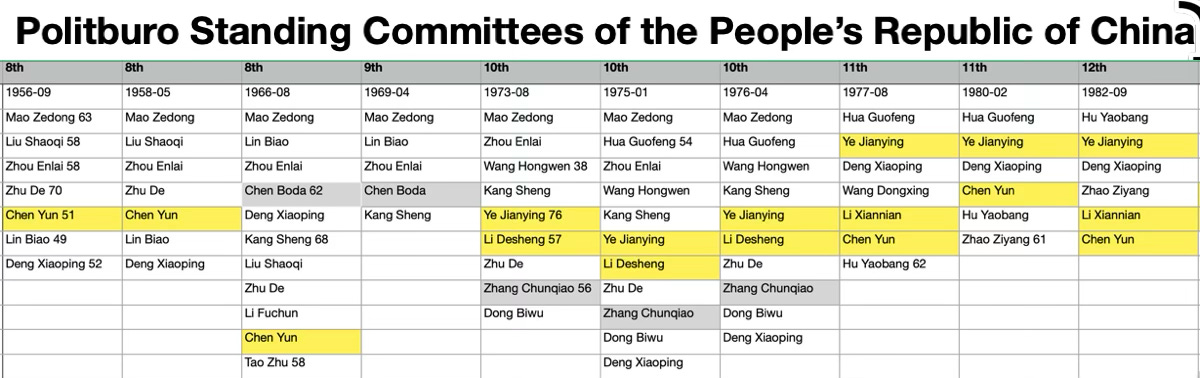
In my view, very smart by UCSD’s Victor Shih. From his book Coalitions of the Weak:
Shih, Victor C. 2022. Coalitions of the Weak: Elite Politics in China from Mao’s Stratagem to the Rise of Xi. Cambridge: Cambridge University Press. <https://www.cambridge.org/core/books/coalitions-of-the-weak/>
Why a dictator cannot afford a too-competent and too-connected lieutenant. And why in the 1940s Zhou Enlai—in his cups (or was he?)—would tell U.S. naval attaché staff that he had no higher ambitions than to rise to be #3 in the hierarchy of the CCP:
Victor Shih: Coalitions of the Weak: ‘The rise of Deng has never been satisfactorily explained…. He headed the Second Field Army, but there were a dozen or so other commanders…. Deng took a tough stance against “Two Whateverism,” but why was he able and willing to do so?… Mao needed Deng rehabilitated so that he could strengthen command over the military… [but with] so many veterans who had joined the party before the end of the Long March, why was Deng uniquely suitable to put the military in order? Why was he rehabilitated so soon after the fall of the Gang of Four?… The composition of the core leadership group in the 1980s—Deng Xiaoping, Chen Yun, Ye Jianying, and Li Xiannian—in many ways seemed unlikely.
Deng… had been purged twice… came from a relatively weak faction.…
Li… accused of “counterrevolutionary splittism” in the 1930s, served mainly in… budget [jobs]… [alongside] dozens of other technocrats…. Li’s… high-level position during the Cultural Revolution… implied cooperation with the Gang of Four…. Li was certainly a major beneficiary of the late Cultural Revolution….
Ye… had not commanded troops directly since the early 1930s. Throughout the Cultural Revolution, he continuously held some of the most powerful positions in the PLA, and yet, when Deng came to power, Ye continued as a high-level military leader….
Chen… likewise… puzzling…. Mao and Zhou Enlai found Chen to be replaceable as an economic planner…. Yet, suddenly and effortlessly, Chen Yun found himself back in the pinnacles of power in the late 1970s, where he stayed until his death….
[In my view] Mao’s appointment of Fourth Front Army (FFA) veterans in the 1970s to control the military [as a “coalition of the weak” strategy] greatly influenced the composition of the ruling coalition not only in the late Mao period but also through much of the Deng Era.… FFA commanders Li Xiannian and, to a lesser extent, Xu Xiangqian and Xu Shiyou, retained a great deal of influence over the military and over the party throughout the latter parts of their lives. Their former underlings continued to serve in senior army positions until well into the 1990s.…
Mao’s… coalition of the weak strategy [composed of] FFA veterans and young scribblers. Both groups had major flaws in their biographies, which challenged their roles as future senior officials in the Maoist one-party state. Yet… each group began to serve their roles…. The tainted members of the former FFA… increasingly became a valuable counterweight against Lin Biao…. The scribblers, they took great risks for Mao and also for Lin Biao as they tested the power and determination of Mao’s rivals….
Not having to contend with serious challengers did not mean the end of the agency problem for Mao…. Even the scribblers began to position themselves for post-Mao politics…. Rehabilitated veterans… actively positioned and signaled for post-Mao politics… le[a]d[ing] to Deng’s [second] downfall.… After Mao’s death, Deng almost immediately returned and ruled in a coalition with FFA veterans and rehabilitated veterans, demonstrating the fragility of the coalition of the weak after the dictator’s passing. The late-Mao coalitional arrangements had a profound impact on the composition of Deng’s own ruling coalition… <https://www.cambridge.org/core/books/coalitions-of-the-weak/>
As Victor points out, there were multiple layers.
After the catastrophe of the Great Leap Forward and the 50 million or more dead in the Great Chinese “Hungry Ghosts” Famine that followed, Mao became a weak king indeed. The clock was ticking away on him as Liu Shaoqi, his designated successor, pondered exactly what to do, Thus Mao’s number 2 Liu Shaoqi was much too strong for Mao’s comfort. So Mao’s response was to promote the weaker Lin Biao as a counterweight and an insurance policy. But after Liu Shaoqi was dead, Lin Biao then became too strong and too well-networked. Lin Biao, now his #1 comrade-in-arm and designated successor, pondered exactly what to do. So Mao’s response was to promote the weaker FFA veterans as a counterweight and an insurance policy. Feeling potentially threatened by them, Mao’s response was to promote the recently-purged and thus very weak Deng Xiaoping as someone loyal to him (but for how long?) who had powerful historical ties with the FFA as a bridge to subjects who he feared were, in their turn, becoming overmighty.
And there I do lose the thread.
Yes, all of the members of the coalition under Mao are weak. Mao wants to keep them that way. A skillful politician could have rapidly gained strength. As Deng dead. In which case Mao would have purged them again, as he did Deng. But neither a Wong Hongwen nor a Hua Guofeng could show any signs of being able to bring the masses into Tienanmen Plaza to demonstrate that they are on their side during the Qingming Festival. And at the decisive moment, what you really need is to have Marshall G.K. Zhukov or Marshall Ye Jianying and the 8341 Regiment on your side. And then be able to keep the country quiet afterwards.
And with Mao’s death that game of musical chairs stopped. And a new one began, with the FFA veterans possessing enormous power, and Deng Xiaoping as the only potential party-cadre ringmaster they felt they could trust at all.
Other historical examples of such a “coalition of the weak” strategy?
As my longtime friend Jon Southard says, surely such—and taking steps to break the network coalitions of subordinates just before you promote them—are surely older than the Romans.
This is much of the story of mediæval European politics, of course. Only the most powerful kings wanted powerful servants who bring their own resources to the table to reinforce the régime. Weaker kings feared the “overmighty subject”—those like Richard Neville “the Kingmaker”, 16th Earl of Warwick (1428-1471), one of the few who drew his affinity from a concentrated territorial base (a legacy of the Welsh wars). Weaker (and sometimes stronger) kings wanted servants—Jews, churchmen who by definition lack legitimate heirs, lower-class functionaries promoted above their station—who could not threaten to replace them, but who can serve as their hands to control the overmighty subjects.
For example, in England in 1185 King Richard I “Coeur de Leon” Plantagenet does not marry his ward Isabeau de Clare, Countess of Pembroke, to the Earl of Arundel or Derby or Norfolk, but rather to the penniless William Marshall, fourth son of a relatively minor châtelain. Several generations later Richard II Plantagenet is very sorry indeed because he did not extirpate his over-mighty subject and cousin Henry of Lancaster, but let him go into exile. And Henry's grandson is in turn very sorry indeed because he only killed his overmighty subject and cousin Richard of York, and not kill all of Richard's sons Edward, George, and Richard.
In France, Philippe IV “the Beautiful” Capet does not run his kingdom in 1300 through his nobly-titled cousins, but through two senior bureaucrats whom he himself had raise from nothing, Guillaume de Nogaret and Enguerrand de Marigny—Guillaume was fortunate enough to die before his master, but Enguerrand was convicted of sorcery and hanged by his master’s son and successor, Louis X “the Wayward Fool” Capet in 1315.
In order to untangle all of this—whether in mediæval France, modern China, or ancient Rome—you need to know a huge amount about individual power-brokers and their affinities and networks, and also how a political system works in which people are in theory all on the same side, engaged in a common régime-maintenance project, but not all completely on the same side, and then sometimes the really sharp knives come out, unexpectedly and disastrously for some. Where people were in the formative period in which most of the deep networks were formed. What their trajectories were later on—the positions they held, who their guangxi patrons were, who their guangxi clients were, how they rose and fell, and so on. You have to know all that.
Ronald Syme in his truly great Octavian-as-Mussolini book The Roman Revolution does, I think, a very good job of figuring out how to present the replacement of one elite by another and the inner networks constructed, as a dictator attempts to entrench his power and survive (the dictator in Syme's case being the Emperor Augustus,). But it is a very hard thing to do as it is neither a few biographical threads nor a large-n statistical study.
I think that one of my root problems I have in understanding this is that I do not understand politics within a Leninist party.
I think I understand feudal lord-and-vassal fief-and-lordship politics.
I think I understand republic elections, offices, and factions politics.
I know that I do not understand network-and-connections politics, especially in a "Rousseauist" context in which the people are supposed to be united, and divergences of opinion on policy can very easily and suddenly change from being contradictions among the people to contradictions between the people and the enemy. Who has legitimate authority in a bureaucratic system overlaid with patron-client, common-patron, and peer-solidarity bonds? How is “legitimate” authority granted and removed? How do organizations like the PLA, and within the PLA the 8341 Regiment, affect authority within the CCP? These are, to a large extent, beyond me.
Plus there is Mao's Cult of Personality: his ability to mobilize hundreds of thousands to "bombard the headquarters". He could also take 3/4 of some layers of the bureaucracy in ministries and send them out to the countryside, or worse And very few of them indeed, would take the road of Xu Shiyou of heading of to Mount Tianzhu, and preparing to defend themselves with weapons.
How is the network-selectorate politics changed by such mass charisma phenomena?
References:
Shih, Victor C. 2022. Coalitions of the Weak: Elite Politics in China from Mao’s Stratagem to the Rise of Xi. Cambridge: Cambridge University Press. <https://www.cambridge.org/core/books/coalitions-of-the-weak/>
Syme, Ronald. 1939. The Roman Revolution. Oxford: Oxford University Press. <https://archive.org/details/romanrevolution0000syme>.