👋 Hey there, I’m Lenny. Each week, I answer reader questions about building product, driving growth, and accelerating your career. For more: Lenny’s Podcast | Lennybot | How I AI | My favorite AI/PM courses, public speaking course, and interview prep copilot
P.S. Get a full free year of Lovable, Replit, Manus, Gamma, n8n, Canva, ElevenLabs, Amp, Factory, Devin, Bolt, Wispr Flow, Linear, PostHog, Framer, Railway, Granola, Warp, Perplexity, Magic Patterns, Mobbin, ChatPRD, and Stripe Atlas by becoming an Insider subscriber. Yes, this is for real.
As AI makes it trivial to build and launch products (and, soon, even come up with product ideas), the biggest challenge for product teams is quickly becoming distribution: getting people to pay attention to your product in the increasing cacophony of launches.
One of the most powerful tools to cut through that noise is positioning. Strong, specific positioning grabs people’s attention and helps them instantly understand why your product is for them.
April Dunford is the world’s leading expert on the topic. She is the author of the book on positioning, Obviously Awesome, and has worked with over 300 B2B companies to nail their positioning. She’s also a two-time Lenny’s guest contributor and podcast guest. As she explained in her previous, widely shared, guest post, “a single shift in positioning can mean the difference between a product that flops and one that breaks through.”
In her latest guest post, below, April offers a guide to advanced B2B positioning—four lessons for getting past the trickiest and most common roadblocks that teams run into.
Let’s get into it.
P.S. April just published an updated and expanded edition of Obviously Awesome. Grab a copy if you know what’s good for you. For more from April, subscribe to her excellent Substack (she’ll be dropping some new plug-and-play positioning templates in the next couple of weeks), and follow her on LinkedIn.
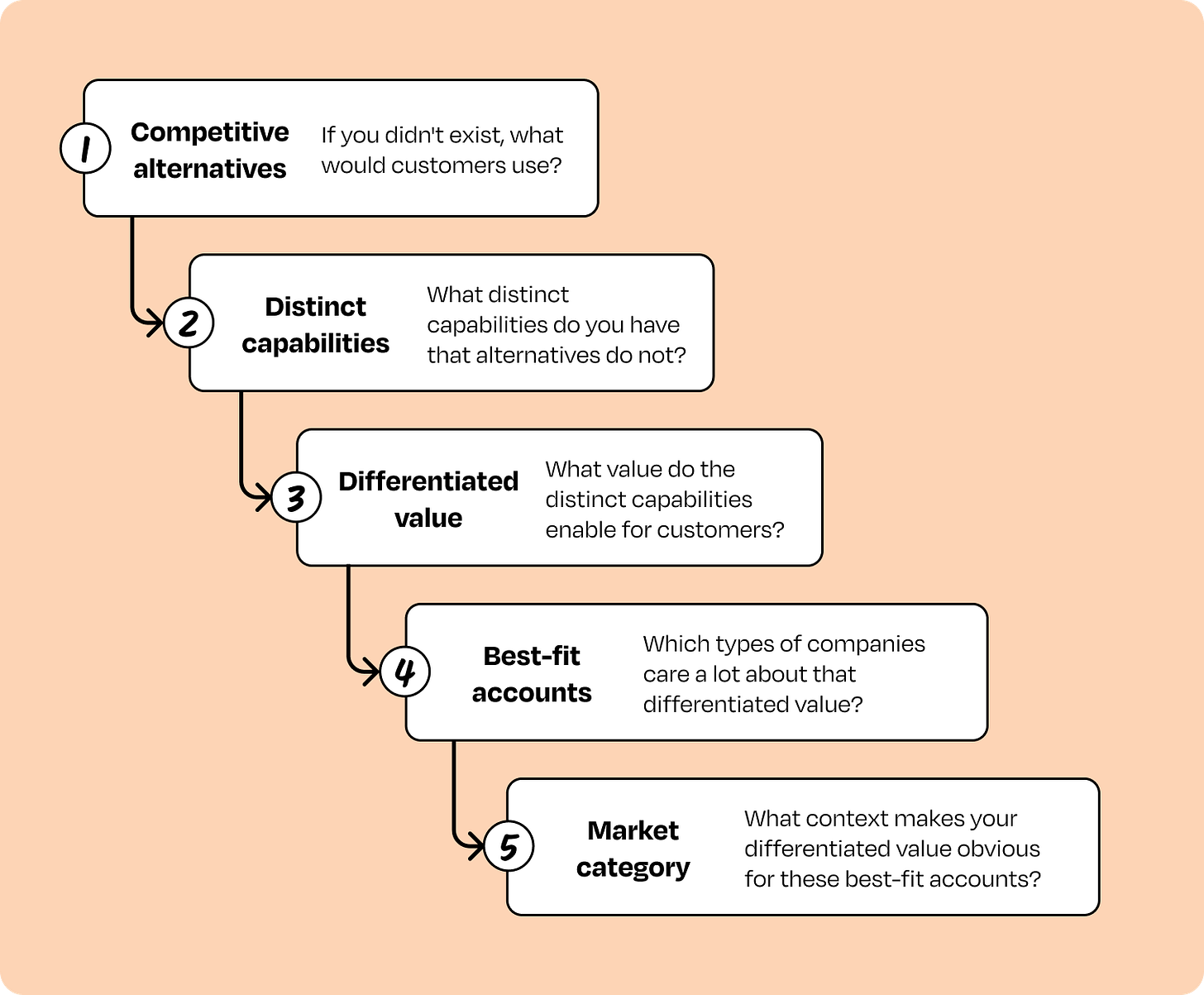
When I started out as a junior product marketer, positioning was something everyone understood but no one knew how to do, especially for tech companies. My work over the past 10 years has focused on developing a repeatable process that any B2B technology company can use as a starting point for creating strong positioning. I wrote a book, Obviously Awesome, about how a cross-functional team should work through the five components of positioning in a specific order. I’ve also covered it in this article and this podcast with Lenny.
Today, we have a much deeper understanding of how to develop good positioning—which is great for product marketers and great for the industry. But teams may encounter more advanced and challenging roadblocks that can slow momentum, derail collaboration, and break a project entirely. In this post, I’m looking beyond the basics of running a positioning process to address how to get past difficult roadblocks at different stages of the positioning development process to develop a positioning that clearly sets your product apart from your competition.
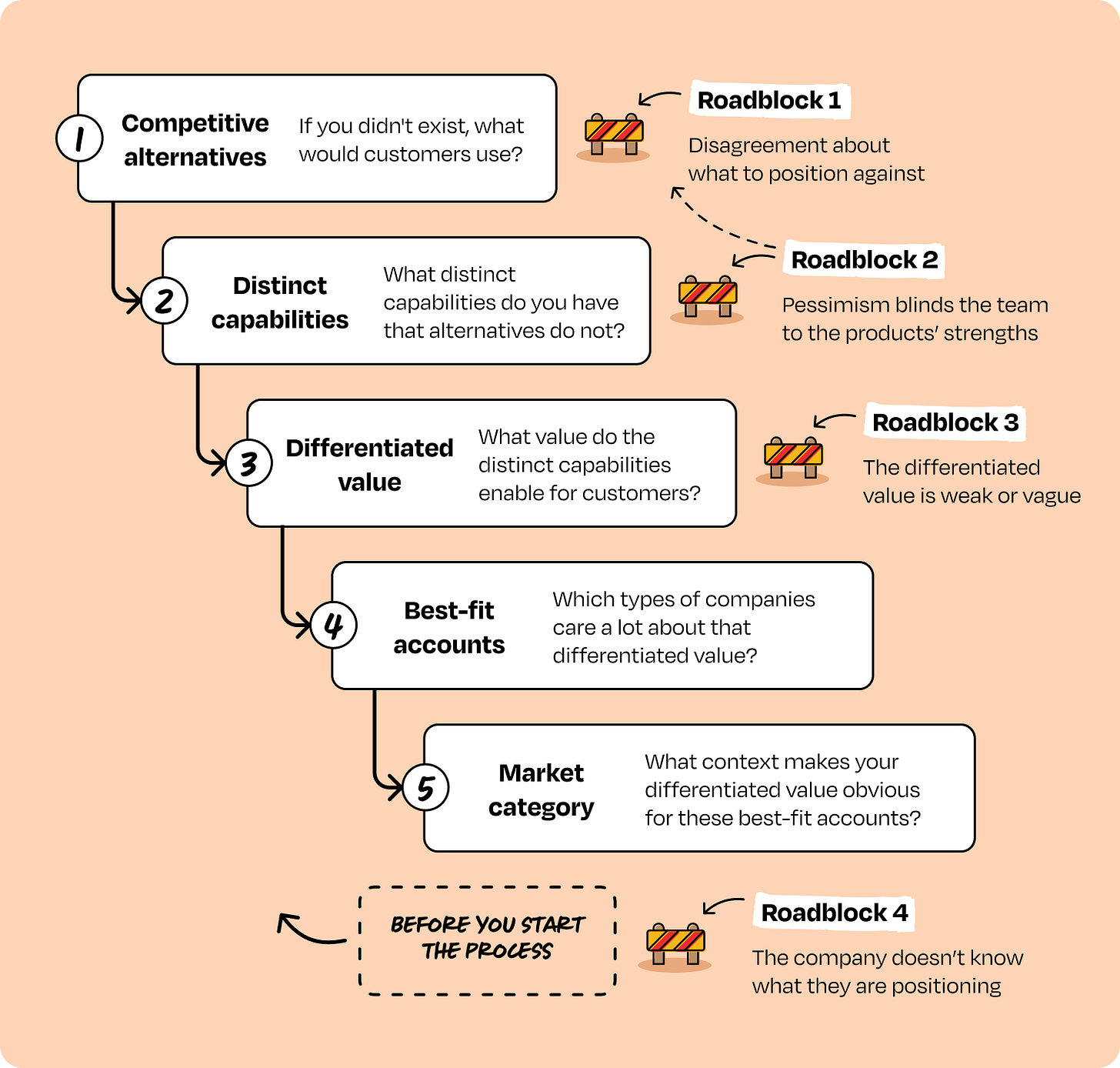
There are four patterns I see where teams encounter roadblocks during positioning development that are hard to see coming and to navigate around:
- Disagreement about what to position against
- Product pessimism blinds the team to product strengths
- The differentiated value is poorly defined
- The company doesn’t know what they are positioning
These roadblocks are common, but they’re far from impossible to manage. In this post, I’ll give you a clear view of where they may appear down the road and how you can avoid them entirely or guide your team safely around them to achieve consistent, lasting success in your B2B positioning. You’ll walk away with a greater understanding of the positioning process and four real-world strategies that you can immediately take into your next project. Now let’s get into it.
Four positioning roadblocks and how to move past them
Roadblock 1: Disagreement about what to position against
The first step in a positioning process is to look at the competitive alternatives. One of the most surprising things I have seen in positioning work is how often marketing, product, sales, and the founder/CEO have very different views on who they compete with. I’ve seen it so consistently that I believe disagreement about what to position against is the root of most weak positioning.
Each function in a B2B tech company tends to have its own set of biases when it comes to thinking about “competition.”
Marketing: Marketing is often overly influenced by a potential competitor’s marketing spend, regardless of the effectiveness of that spend (which is often completely unknown). Marketing teams watch how competitors show up in media, online, ads, and at conferences, and then often equate market visibility with competitive success—even if the sales team rarely encounters this competitor on a prospect’s short list and never loses deals to them.
Product Management: The product team is focused a little further into the future than the marketing and sales teams. Product roadmap work requires an understanding of what I would call “horizon competitors,” products that aren’t causing any pain today but could in the future. In a positioning exercise, product teams will often list twice as many “competitors” as a sales team does, many of which are never seen on a prospect’s short list.
Sales: Sales teams can have a skewed perception of competitors in two distinct ways. Firstly, they tend to have what I would call a “whale” bias. Sales can feel the sting of losing one very big deal and become overly focused on that winning competitor, even if they are never seen in more “normal” deals. The second bias is that they rarely define the status quo solution as a “competitor.” Deals lost to the status quo are often categorized as “no decision.” In the mind of a good salesperson, the customer’s “No” is mentally translated to “Not yet.” I have seen this even when the overwhelming majority of deals are lost to the status quo.
Founders: Most founders I’ve worked with have a great gut feel for positioning. In fact, many positioning exercises I’ve led end up helping newer executives understand the nuances of what the founder already knows. However, in certain situations, founders might muddy the positioning waters by bringing a bias that the rest of the team doesn’t fully understand. Three situations where I see this happening:
- The founder was once heavily involved in closing deals but became less so. The founder may be biased toward what the competitive landscape used to look like and less familiar with current market dynamics.
- Recent acquisitions have opened opportunities in market segments that the acquiring team (including the founder) may not understand as well as the folks on the recently acquired team.
- The founder has recently been very focused on fundraising. In fundraising, the company orients more toward the future state it is building. Often, that future state is not something the sales team can sell today. Too much focus on future capabilities the company does not yet deliver can result in stalled deals and customers saying, “We love that. Come back in two years when you have it.”
The solution: Focus on the prospect’s view of the competition
The prospect’s view of competitive alternatives is the only one that matters. Because different teams interact with customers in different ways and at different points in the sales process, their understanding of how customers view alternatives won’t always align. If we go into the positioning process understanding this, we can get past the roadblock in these ways:
-
Imagine a world from the prospect’s POV: Rather than have the team list conflicting sets of perceived competitors, ask, “If we didn’t exist, what would a prospect do?” That reframing helps the team focus on what is happening in sales deals out in the real world, rather than who they should or could compete with.
-
Stay rooted in the near term: As an old boss of mine used to say, “We have to sell what’s on the truck.” The path to success is to focus on the product as it exists, in the market as it exists, and selling to the customers we can win with today. We should expect our positioning to change over time as the product, competitors, and target customers evolve, but we should also accept that we are terrible at predicting how the changes will unfold.
-
Don’t forget the status quo: In B2B, vendors typically lose about half their sales opportunities to whatever the prospect is currently using. I’ve worked with companies where that number exceeds 80%. We need to understand the strengths and weaknesses of the status quo solution to convince buyers to move on. Research shows that about half the time, a status quo decision is more about customer indecision than a vote for the status quo solution (see Matt Dixon’s JOLT Effect research, for example). Still, we ignore the other half at our peril. Strong positioning wins both types of “no decision” deals.
-
Work with a cross-functional team: The first and most obvious way to ensure that the positioning accounts for different perspectives is to work with a cross-functional team. My recommendation is that we have the heads of marketing, sales, product management, and customer success, along with the founder, CEO, or head of the business (if it is a larger company). Often it helps to include a couple of very experienced account executives from the sales team to verify what is happening in the early sales stages. If we are positioning the company or a grouping of products (more on this later), we will need to make sure we have folks with product and commercial experience for each product. We might also need sales representation across different geographies if the competitive landscape varies.
Roadblock 2: Pessimism blinds the team to the products’ strengths
Some companies suffer from overly pessimistic product thinking—where teams convince themselves their product is an undifferentiated loser despite clear evidence that they’re winning in parts of the market. This can happen when teams are overly focused on closing perceived gaps with competitors or when product teams and sales teams don’t communicate well or often. The pessimism pattern is dangerous because it blinds teams to their competitive strengths and prevents the company from positioning around them. Also, this mindset tends to be contagious, spreading to marketing and sales teams, who may lose confidence in the product’s ability to deliver differentiated value. It’s hard to convince prospects to invest in a product that sellers don’t believe in.
The pessimism manifests in four key ways:
- Defining ideal customers so broadly that every lost deal seems like a product failure: I have worked with companies where product teams become over-exposed to bad deals and under-exposed to good ones. PMs get pulled in to try to save lost-cause deals, even when the prospect was a poor fit for the product in the first place. Meanwhile, deals with good-fit prospects are easily closed without any PM involvement. The result is that the product team begins to develop a skewed idea of what a good-fit prospect typically looks like.
- Maintaining long hypothetical competitor lists:It’s hard to differentiate your product from an overly long list of competitors, particularly when we know little about many of them because we have never had to compete against them in a deal. For roadmap work, it makes sense to track future potential competitors. For positioning work, we have to stay oriented in the reality of the market—and be prepared to shift if and when a competitor begins to truly cause us pain.
- Dismissing sales team insights about why customers buy: Sometimes this type of pessimism persists even in the face of proof that the product is doing well. In one workshop, a sales team listed a set of large accounts they had won because the product was superior in a particular way. The product team insisted that those prospects had failed to evaluate the other alternative properly. In another, despite the company generating hundreds of millions in revenue with solid growth, the product leader insisted that the sales team was winning through trickery and lies. I have seen salespeople who went too far in stretching the truth, but never one who was very successful with that strategy.
- Viewing the role of product management as “problem identification” rather than architecting true differentiated value: Some companies get trapped in a cycle of competitive catch-up, to the point where the team becomes very adept at pointing out product problems and less attuned to where the product is leading. Often, there is a big, boring, long-standing differentiator hiding in plain sight. The product team takes it for granted (“Oh, we have always done that!”) while sales are selling the heck out of it.
Each symptom reinforces the others, creating a toxic cycle that undermines the company’s ability to articulate and amplify its genuine competitive advantages.
The solution: Keep coming back to what’s working
To break the pattern for positioning work, expose the product team to what sales understands about what’s working in the majority of deals, and work through a positioning exercise to help both teams understand each other.
We can get past this roadblock by:
- Focusing the whole team on strengths and the near-term competitive advantage: A positioning process is really about finding the heart of why we win. To get there, we need to understand the product’s strengths and competitive advantages. We understand the product isn’t perfect and that we have competitive gaps. But we need to win business now, and we need positioning that tells a clear, compelling story about the product we have today (with the full understanding that that positioning will change and hopefully improve over time). Positioning is not a product strategy, nor does it set the product’s future direction. A discussion of the ways the product falls short does not lead to strong, differentiated positioning.
- Including experienced sales voices in the room: Nobody understands how a customer behaves across a sales process better than your sales team does. For positioning work, we need to rely on that experience to understand who our true competitors are, what our true differentiators are, and which types of buyers care most about those differentiators. If the company’s CRO and VP of Sales do not have much experience with early-stage deals, it helps to have an experienced account executive in the room, and having two is generally better than just one, giving us a view across a broader set of deals.
- Preparing the moderator to challenge participants: If you do a group positioning exercise, choose your moderator carefully. An experienced moderator can help the team stay grounded in reality and should be prepared to challenge participants if they become overly pessimistic. The moderator should remind the team that every day, customers spend months evaluating their options and then selecting the product. These customers can’t all be careless, gullible shoppers. Similarly, if a participant claims that many deals are won for a particular reason, they should be prompted to provide evidence and details. The team needs to agree on a position to work together and make it stick after the exercise.
It’s not unusual for teams to get together to discuss product problems and gaps. However, a positioning exercise should focus on where the product outperforms the competition. Getting the team oriented around the differentiated strengths of the product is critical for great positioning.
Roadblock 3: The differentiated value is poorly defined
As vendors (and particularly product folks), it’s easy to focus on features and assume buyers will easily understand why those features matter. In my experience, a product’s most differentiated capabilities are often the most difficult for prospects to understand, precisely because they are uncommon. If we really want to answer the question “Why pick us over the alternatives?” We have to clearly articulate the value our product can deliver that other alternatives cannot. This step in the process is the one I see teams struggle with the most.
There are four ways I see teams get stuck around differentiated value:
-
Assuming prospects understand why a feature is important: Today, a smartphone vendor can simply advertise that their phone has a 50-megapixel camera, and the audience knows what that means. However, 20 years ago, when few people had experience with digital cameras, you would have had to explain what a megapixel was, why anyone should care, and why 50 is better than 20. The more unique a feature is, the less likely a potential customer is to understand why it is important.
-
Stopping short of capturing value the prospect actually understands: I once worked for a database company with patented technology that enabled us to execute a specific type of query 1,000 times as fast as our competitors. We assumed anyone buying a database would find query speed valuable. Interestingly, many companies did not care. They were running the query for a monthly or quarterly report, so getting the answer in a day or two was perfectly fine. Our best-fit accounts, however, were running those types of queries to respond to a customer question. The real value lay in responding to customers more quickly, not executing the query faster. Recently, many of the teams I’ve worked with have a value point around efficiency. But their buyers may be much more focused on driving revenue—and can’t connect the dots between efficiency and revenue themselves.
- Going too far and losing the differentiation completely: In B2B, we really only have two “pure” points of value. We are helping businesses make money or save money. (Insurance folks would add reducing risk, but that one is a special case!) Unlike consumer products, a successful B2B software project isn’t going to get you a date or make you look rich. We are increasing revenue or decreasing costs, and that’s it. If you abstract the value of your product all the way down to “This product saves you money,” you will sound exactly like every other product you compete with.
- Overwhelming customers by attempting to communicate too many differentiated value themes: Differentiated value should succinctly answer the question “Why pick us over the alternatives?” If we give prospects a list of 10 reasons why, they aren’t likely to connect with a clear story or remember more than a couple of them (if we’re lucky).
- Confusing differentiated value with sales objection handling: If there are people on the team who have never worked in sales, they might not understand what a sales objection is or how it differs from value. Value is a reason to buy. An objection is a reason a prospect might not buy, even if the value is something they really want. Often, objections come from constituents who are not the deal champion but can kill a deal if they have specific problems with the product. For example, I worked with a company whose product was very easy for the IT team to manage, which gave them an advantage over many competitors and the status quo. However, the purchase decision was driven by a business buyer who didn’t see any value in ease of management. In this case, ease of management was only used to handle the potential objection of the IT department after the business champion had selected the product.
The solution: Home in on the “so what?”
Differentiated value is difficult to get right, but it is the key to having a clear, compelling story for your product. In the work I do, we spend the majority of our time on this step to make sure we get it right. Here are a few ways teams can stay on track:
- Answer the question “So what?” The best way to go from features to value is to ask the question “So what?” or “Why does a customer care?” I worked for a company whose data warehouse used a patented fuzzy-logic algorithm. Despite selling to highly technical buyers, no one really understood why fuzzy logic was important or how it might produce different results compared with other types of query logic. The aspects that make your offering unique typically require some education. It is our job to teach buyers why our different approach to a problem is better and what that means for their business.
- Keep asking, “So what?” until you have value that your buyer understands—and then stop. Taking the fast-query example from above, the customers who really cared about time savings ran the query in customer support. The value to them was responding to their customers 70% faster. But if we asked the “so what?” question again, our answer becomes something very vague, like “improve operational efficiency,” a claim that any of your competitors might make. The team should use their knowledge of what buyers find valuable to get a crisp value statement, without going so far that the value seems meaningless.
- Stay focused on the champion: In a typical B2B enterprise purchase process, there are 4 to 12 or more people involved in the decision. However, not all of those people matter equally in a deal. The “champion” is the person tasked with making a purchase recommendation (often by the “economic buyer,” the person with final signing authority), and it is also their job to ensure that all relevant stakeholders agree with the recommendation. The champion is generally the person who makes the short list and conducts initial calls with vendors. Our positioning needs to really resonate with the champion, or we don’t make the short list and the lead never progresses into a real sales opportunity. Once we have hooked the champion, it’s our job to help them manage the potential objections of the rest of the stakeholders. Effective positioning focuses on the champion’s perspective on value.
- Remove objections from your value themes: It helps to remember that we don’t need to address every objection within our value themes. Often it helps to look at the value point and ask ourselves whether this would be a reason to buy, or something a prospect would only worry about after they are sold on our value and are working through the potential risks of picking us. If you could imagine the prospect saying, “This all sounds great, but . . .,” then things that come after the “but” are generally objections, not value. The objections I see most often are related to total cost of ownership, ease of deployment, and change management. A good sales pitch will address these concerns, but we shouldn’t try to position these as value.
In my opinion, nailing differentiated value is the key to great positioning. It’s difficult but worth the effort. The key here is to focus on what your buyers truly value and avoid overwhelming them with too many value themes.
Roadblock 4: The company doesn’t know what they are positioning
We can position a product, a group of products, or the entire company—but we need to be clear on which and why. If we are a multi-product company, we will also need to make go-to-market strategy decisions before deciding what to position and how to position it.
This roadblock comes up in two situations:
-
Single-product companies attempting to have different positioning for the company and the product: When we position a company, we consider all the capabilities it brings to the market. If you are a single-product company, there is no difference between your product positioning and your company positioning. Some teams believe the company should have its own positioning because the plan is to offer many products in the future. However, when they attempt to develop this positioning, they get stuck trying to distinguish it from the product positioning.
-
Multi-product companies wrestling with what to position and when: If the company has multiple products, then there are choices to make. Should we position the company, the product, or both? Is the positioning for each of those distinct? Do we need to do company positioning first and then cascade it down to individual products or the other way around? Should every add-on product get its own positioning? It’s easy to see how teams get stuck: there are a lot of choices to make.
The solution: Position the way you sell
If we frequently sell products together (or would like to), then we need to position the combination. Which combinations require separate positioning, and how you do that, depends a lot on how you intend to sell those products, either together or separately.
Here are some ways to make sure the team does not get stuck here:
- One product, one position in the market. Any distinct capabilities of the company should be included in the product positioning as a reason for a buyer to choose you. There is no value in positioning the company separately from the product for customers. When (if!) you add a second product, you can decide if you need separate company positioning.
- Multi-product companies should let their go-to-market strategy drive their positioning. How you position multiple products and the company will depend on your go-to-market strategy. Getting clear on that before deciding what to position is critical.
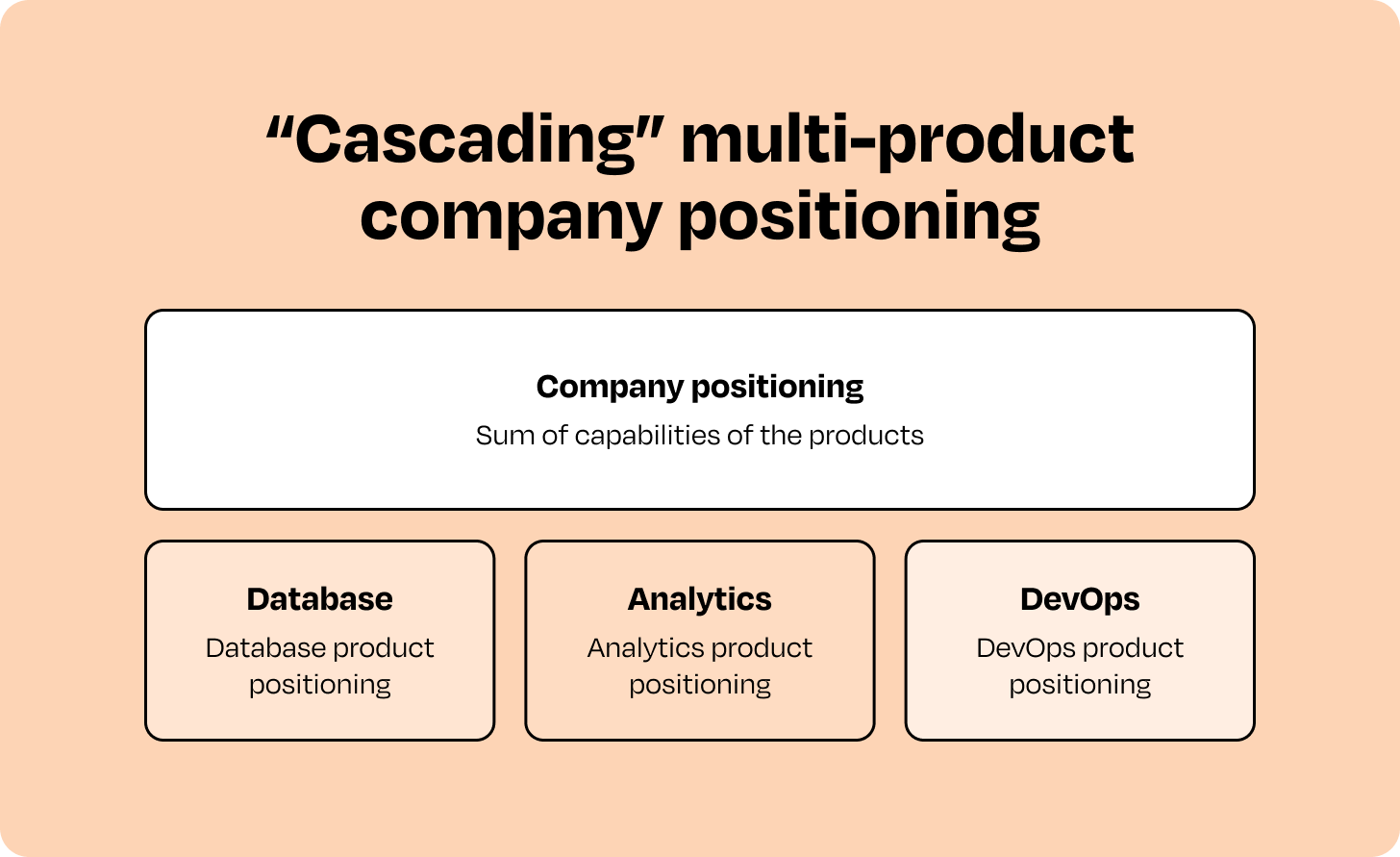
Option 1: Cascading multi-product positioning
When a company has multiple products, its positioning is often an umbrella that encompasses the distinct capabilities of all its products. We usually see this when the company sells each product separately, with no obvious bundles or suites. A simplified version of multi-product positioning might look like this:
Option 2: Multi-product positioning with a lead product
Sometimes the go-to-market strategy is to sell a lead product first, and then there are other products that are sold later to those existing customers as cross-selling or upselling. In this case, you need positioning for the lead product, then add-on product positioning that assumes the account has already purchased the lead product. For example, in the early days of Salesforce, the CRM (Sales Cloud) was positioned as the lead product, and the marketing and service products were sold only to teams that had purchased the core CRM. This was a successful go-to-market strategy for a couple of reasons. First, they could focus all their marketing and sales energy on selling one thing to new accounts, rather than trying to sell a wide variety of things. Second, the lead product was the market leader, making it much easier to sell than the other products, which faced stronger competition. The additional products could then be positioned as add-ons or upgrades to the CRM. For example, Marketing Cloud had its own positioning for marketers, but that positioning assumed the buyer already owned the CRM. Salesforce didn’t need to position the marketing product as the best marketing product in the world; they could simply position it as the best marketing product for companies using the Salesforce CRM product.
Option 3: A multi-product family or platform
Suppose you have two or more products sold to the same company, and you would expect companies to buy both together or one at a time in no particular order. You would certainly want buyers to know that all the products exist and to understand the value of buying some or all of them from you. In this situation, I’ve seen many companies position products together as either a “family” or a “platform,” depending on how integrated the products are. (Grumpy tech lady side note: When I started in tech, a platform was something with tightly integrated functionality that could be extended. Today, the term is used to describe any collection of capabilities, regardless of whether they are integrated or extensible. In my experience, many customers find the term “platform” meaningless and interchangeable with “product family” or “suite.”) Your positioning should reflect your company’s point of view about the market. If the company believes customers should buy the products together, position them together and explain why. Whether you allow customers the flexibility to purchase products separately is more a matter of pricing and packaging than positioning.
Option 4: Position by target market segment (but be very careful)
If you have multiple products and sell them to different types of companies, you will want to position them separately. The bigger question in this situation is whether there is value in having a company position that ties the products together under an umbrella.
Sometimes demonstrating our expertise in one market helps us sell in another—but not always. For example, I worked with a company with two products for delivering streaming video, one for big media companies and one for developers to embed streaming functionality in their products. The company’s experience with media companies helped it gain developers’ trust, and vice versa, so its positioning addressed both. I’ve worked with other companies where this was not the case. I have seen some companies handle this by forming separate companies, legally owned by a holding company that buyers were unaware of, each with their own positioning.
Multi-product companies need to be very clear about how they intend to sell products either together or separately before assembling a team to do positioning work.
Positioning: easy when it’s easy, hard when it’s hard
Most B2B tech companies can effectively position themselves when they bring the right team together and follow a structured process. I’ve seen it in action in my work with more than 300 companies over the past decade. But getting to truly great positioning can be a tough road, with potential roadblocks along the way. Even the most well-intentioned teams, armed with a clear process and best practices, can get stuck. Sometimes great positioning is just hard to do.
Luckily, there are paths through and around these obstacles that any team or company can follow. And even if you don’t encounter the specific roadblocks I walked through in this post, the solutions I’ve offered are useful advice for any sharp positioning work:
- Focus on the prospect’s view of the competition
- Keep coming back to what’s working
- Home in on the “so what?”
- Position what you sell
For all four of these solutions—and in the midst of the four challenges that I’ve mentioned—it’s important to remember that customers today are drowning in a sea of competitive choices. The job of truly great positioning is to shine a light on what makes your product uniquely valuable and the clear best choice for a certain type of customer.
Thanks, April! For more from April, subscribe to her Substack and follow her on LinkedIn.
Have a fulfilling and productive week 🙏
If you’re finding this newsletter valuable, share it with a friend, and consider subscribing if you haven’t already. There are group discounts, gift options, and referral bonuses available.
Sincerely,
Lenny 👋