👋 Hey there, I’m Lenny. Each week, I tackle reader questions about building product, driving growth, and accelerating your career. For more: Lennybot | Lenny’s Podcast | How I AI | Fav AI/PM courses | Fav public speaking course**
Annual subscribers get 19 premium products for free for one year: Lovable, Replit, Gamma, n8n, Bolt, Devin, Wispr Flow, Descript, Linear, PostHog, Superhuman, Granola, Warp, Perplexity, Raycast, Magic Patterns, Mobbin, ChatPRD, and Stripe Atlas (while supplies last). Subscribe now.**
I’m excited to share my (record) fourth collaboration with the great Noam Segal, AI Insights Manager at Figma and former UXR leader at Zapier, Airbnb, Meta, Twitter, Intercom, and Wealthfront. Let’s get to it.
Author’s note: Names have been changed to preserve participant anonymity.
There’s no shortage of debate about AI’s impact on work. Is it delivering real productivity gains? Where’s the ROI? Hot takes abound, but data have been scarce.
We took it upon ourselves to find out what’s actually happening on the ground by running one of the largest independent, in-depth surveys on how AI is affecting productivity for tech workers (1,750 respondents). We surveyed product managers, engineers, designers, founders, and others about how they’re using AI at work.
tl;dr: AI is overdelivering.
- 55% of respondents say AI has exceeded their expectations, and almost 70% say it’s improved the quality of their work.
- More than half of respondents said AI is saving them at least half a day per week on their most important tasks. We’ve never seen a tool deliver a productivity boost like this before.
- Founders are getting the most out of AI. Half (49%) report that AI saves them over 6 hours per week, dramatically higher than for any other role. Close to half (45%) also feel that the quality of their work is “much better” thanks to AI.
- Designers are seeing the fewest benefits. Only 45% report a positive ROI (compared with 78% of founders), and 31% report that AI has fallen below expectations, triple the rate among founders.
- Engineers have accepted AI as a coding partner and now want it to handle the more boring (but necessary) work of building products: documentation, code review, and writing tests.
- n8n is currently dominating the agent landscape, though actual adoption of agentic platforms in 2025 has been slow.
- A whopping 92.4% of respondents report at least one significant downsides to using AI tools. There’s definitely room for improvement.
AI is far from the novelty it was a year or two ago. It has clearly cemented a place as work and productivity infrastructure, and AI tools are improving at a breathtaking pace. If AI is already giving most people back at least half a day per week in late 2025, what does 2026 look like? What about 2027? We’re watching the early innings of a compounding productivity revolution.
As Kevin Weil (VP at OpenAI) noted, “The AI model that you’re using today is the worst AI model you will ever use for the rest of your life.”
What exactly AI is doing for people, function by function
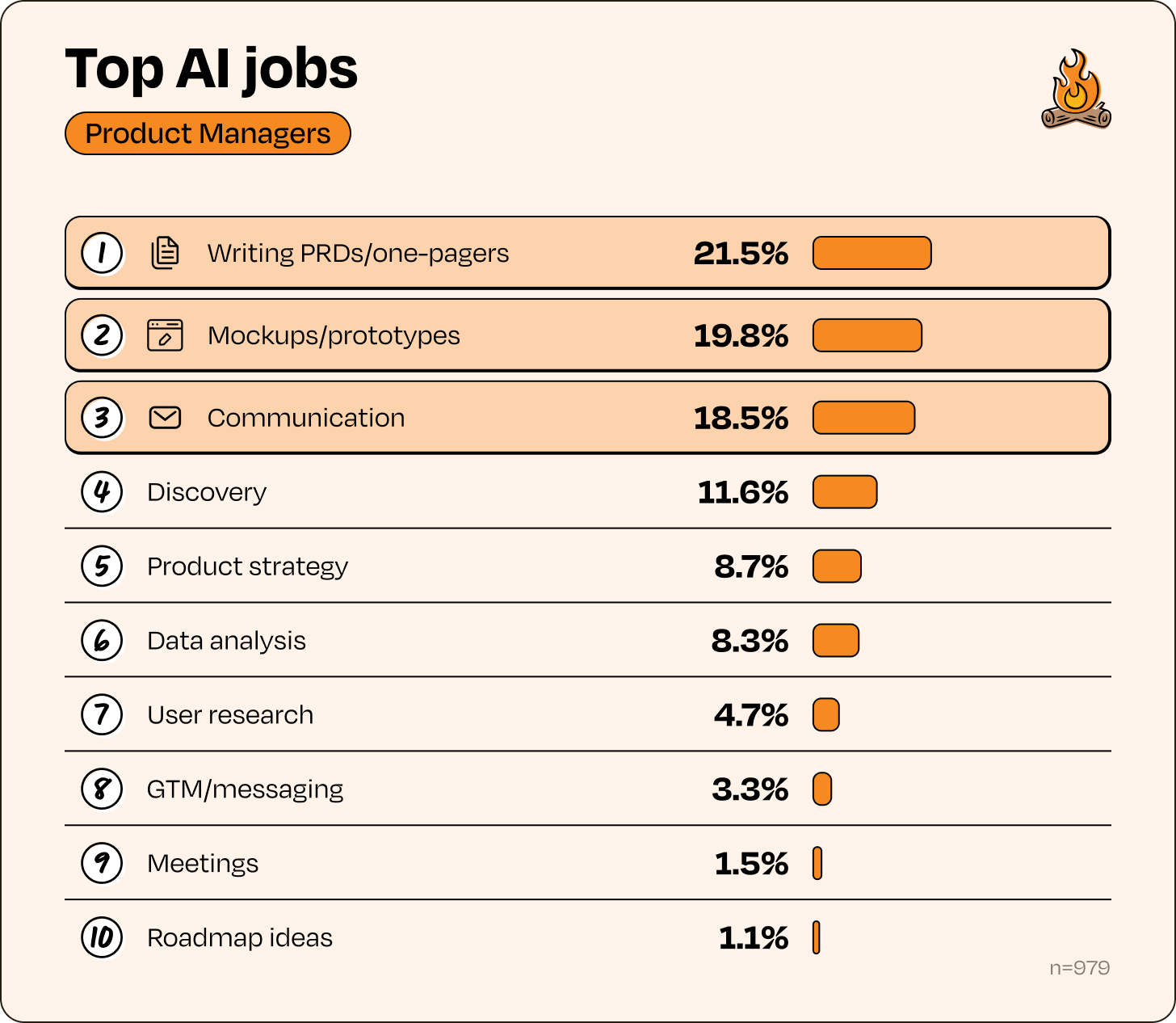
PMs are seeing the most value from AI tools to (1) write PRDs (21.5%), (2) create mockups/prototypes (19.8%), and (3) improve their communication across emails and presentations (18.5%).
Prototyping, at #2, signals one of many role-boundary shifts happening now. With tools like Lovable, v0, and others, PMs are increasingly going from idea to prototype without waiting on design.
But look farther down the list and a pattern emerges: AI is helping PMs produce, but it lags in helping them think. The top jobs are all production tasks (docs, prototypes, comms), while strategic and discovery work sits near the bottom (user research at 4.7%, roadmap ideas at 1.1%). PMs have cracked how to use AI for the “last mile” of getting ideas out of their head, but they still have a big opportunity to embrace AI for the upstream work of figuring out what to build.
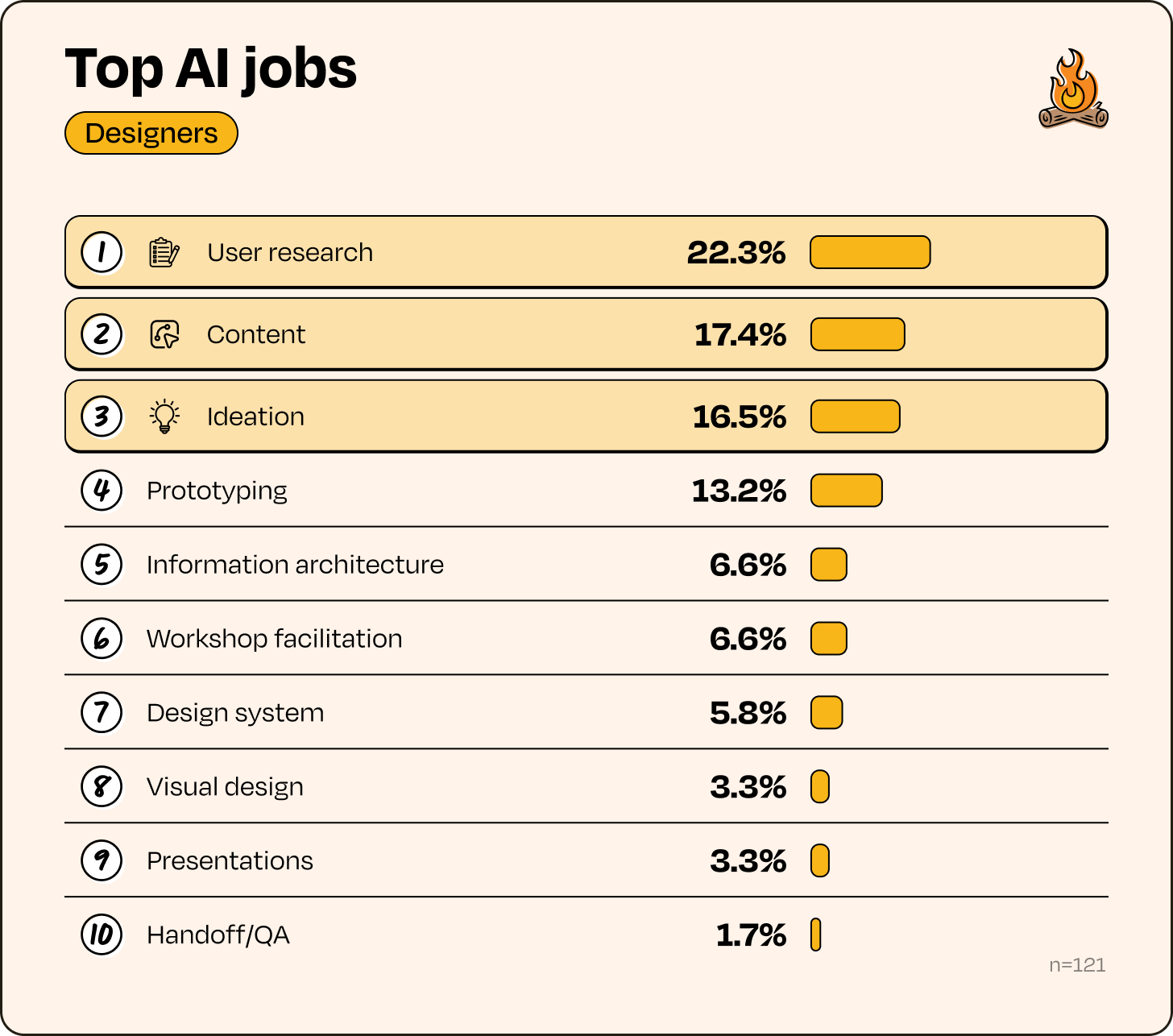
Designers are finding AI most helpful with user research synthesis (22.3%), content and copy (17.4%), and design concepts ideation (16.5%). Visual design ranks #8, at just 3.3%.
AI is helping designers with everything around design (research synthesis, copy, ideation), but pushing pixels remains stubbornly human. Meanwhile, compare prototyping: PMs have it at #2 (19.8%), while designers have it at #4 (13.2%). AI is unlocking skills for PMs outside of their core work (at least in the case of prototyping), whereas designers aren’t seeing the marginal improvement benefits from AI doing their core work.
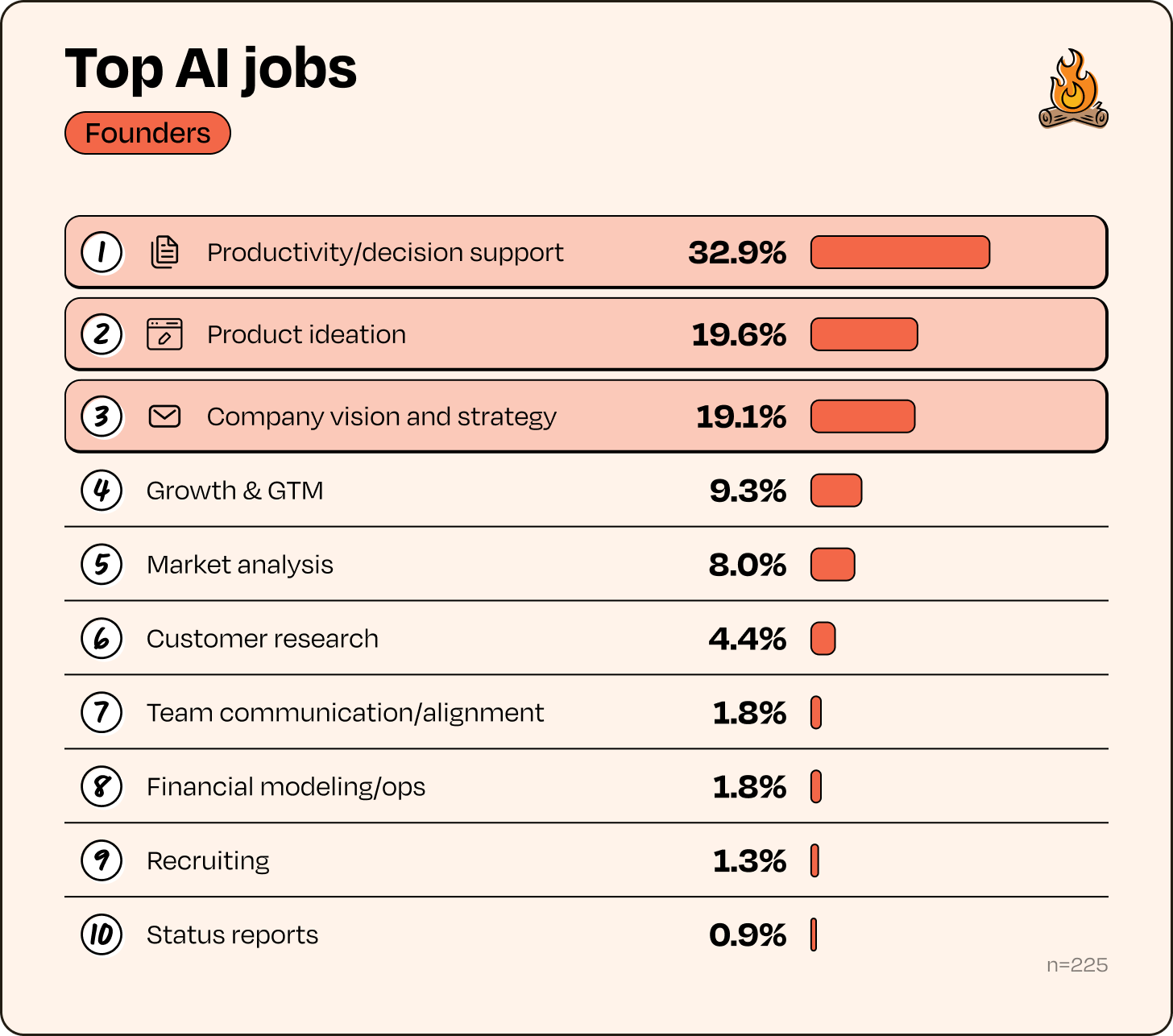
Founders lean heavily toward productivity and decision support (32.9%), product ideation (19.6%), and vision/strategy (19.1%).
Unlike others, founders are using AI to think, not just to produce. The top three jobs are all strategic: decision support, ideation, and vision/strategy. That’s a stark contrast to PMs (whose top jobs are documents and prototypes) and designers (research synthesis and copy). And look at that #1 category: “productivity/decision support,” at 32.9%, is unlike anything else in the survey. No other role has a single use case this dominant. Founders are treating AI as a thought partner and sounding board, not just a tool for specific deliverables. (This tracks with Tal’s excellent post on building AI copilots as long-term thinking partners and Amir’s recent post on building your second brain using ChatGPT.)
The surprise misses: Financial modeling sits at just 1.8%, despite founders living in spreadsheets during fundraising. Same with recruiting, at 1.3%, even though hiring consumes enormous founder time. These feel like opportunities waiting for better tools.
This pattern may explain why founders report the highest satisfaction throughout the survey—they’ve figured out how to use AI for higher-leverage strategic work, not just production tasks.
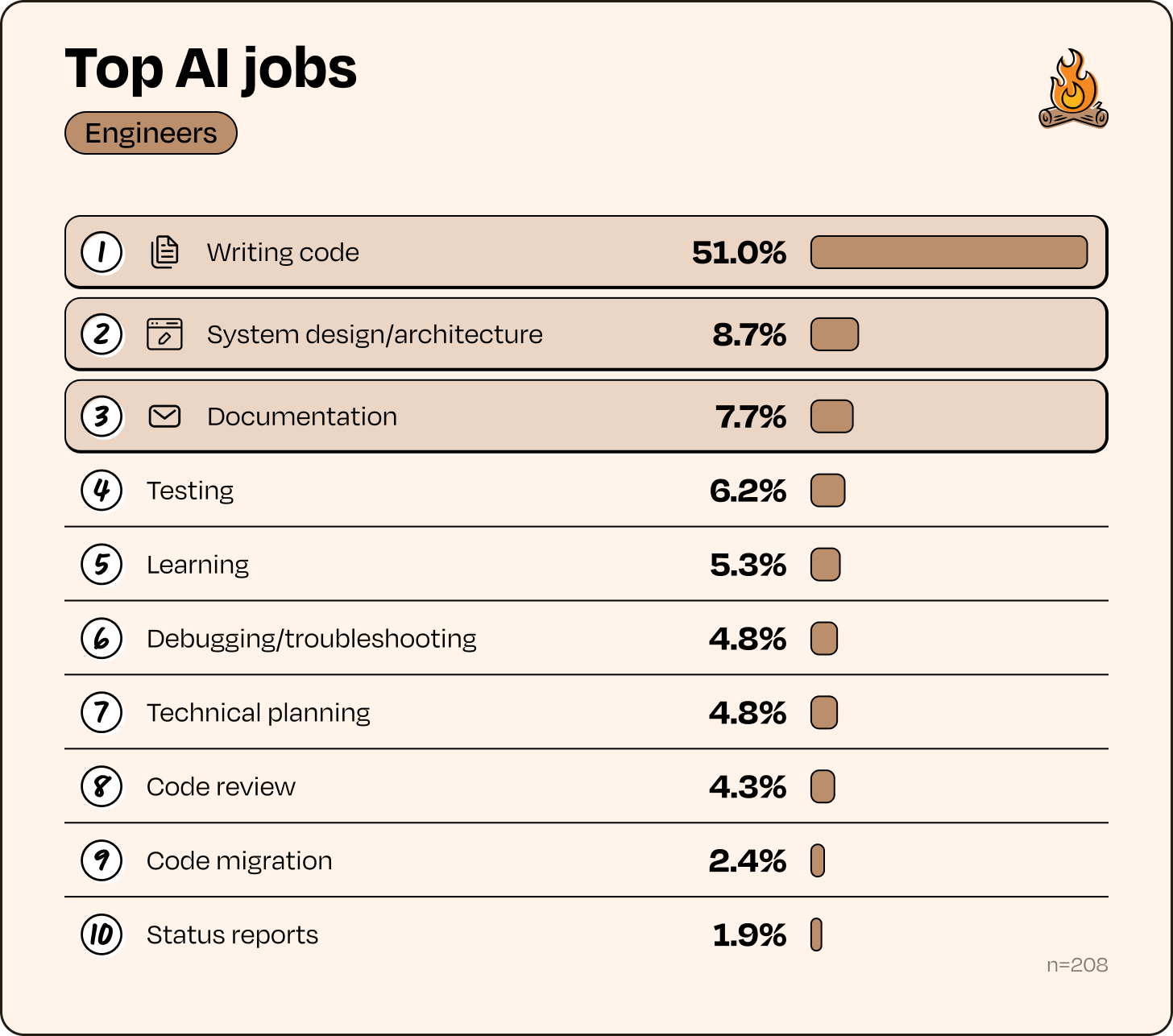
Engineers are the outlier. For them, AI is doing just one big job: writing code, the core engineering task. Whereas for the PMs and designers, AI is helping them with supporting work.
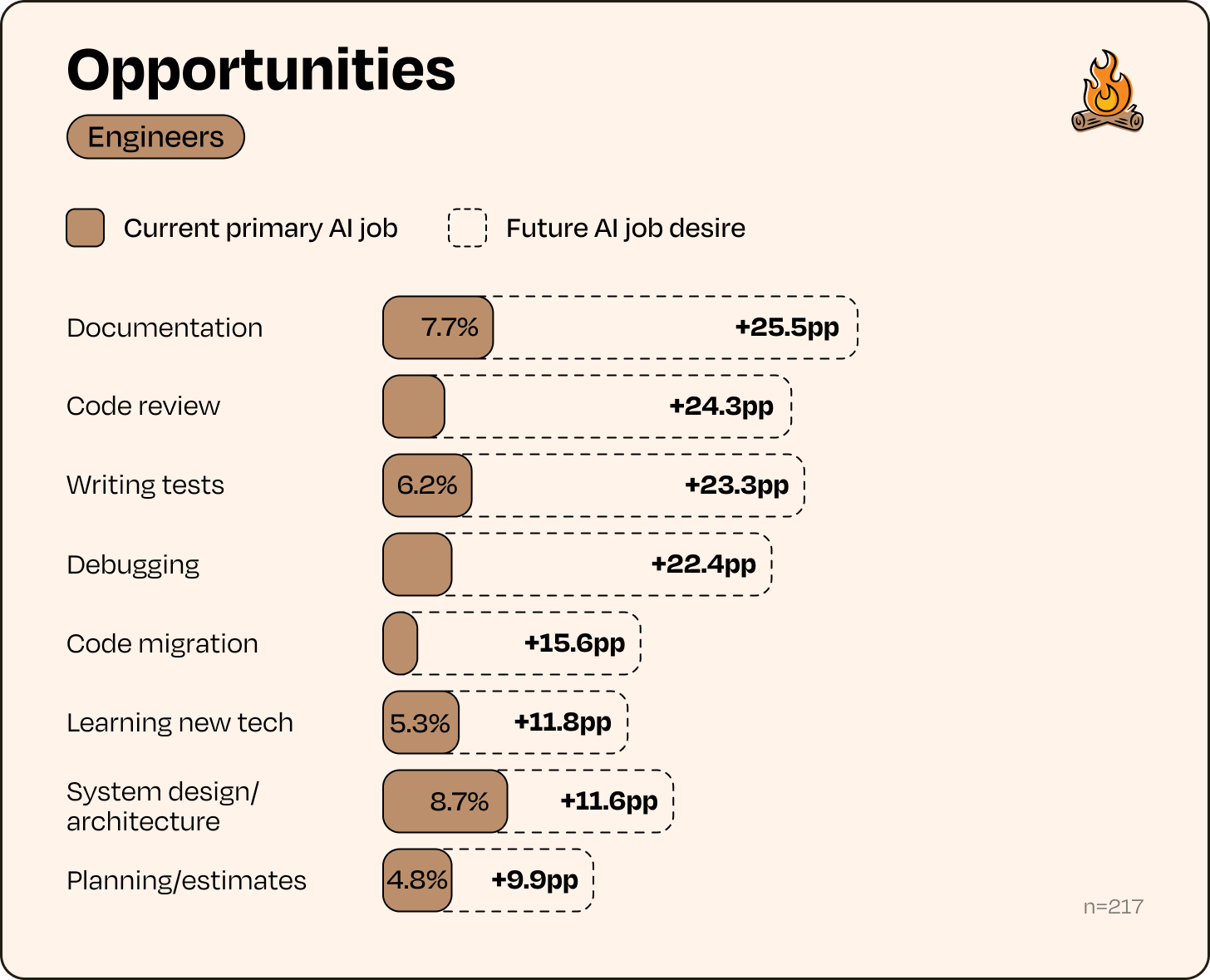
Farther down the list are jobs like documentation (7.7%), testing (6.2%), and code review (4.3%). These are the “boring but necessary” tasks engineers typically dislike. As you’ll see in the opportunities data below, that’s about to change. Engineers have accepted AI as a coding partner; now they want it to handle the tedious work that comes after the code has been written.
One more pattern worth noting: engineers report the most mixed results on quality later in the survey (51% better but 21% worse, the highest “worse” of any role).
Engineers are the only role where ChatGPT isn’t #1
ChatGPT is the #1 most popular AI tool for most roles: 57.7% of PMs, 49.6% of designers, and 72.1% (!!!) of founders use ChatGPT over any other AI tool, with Claude coming in second for those three roles.
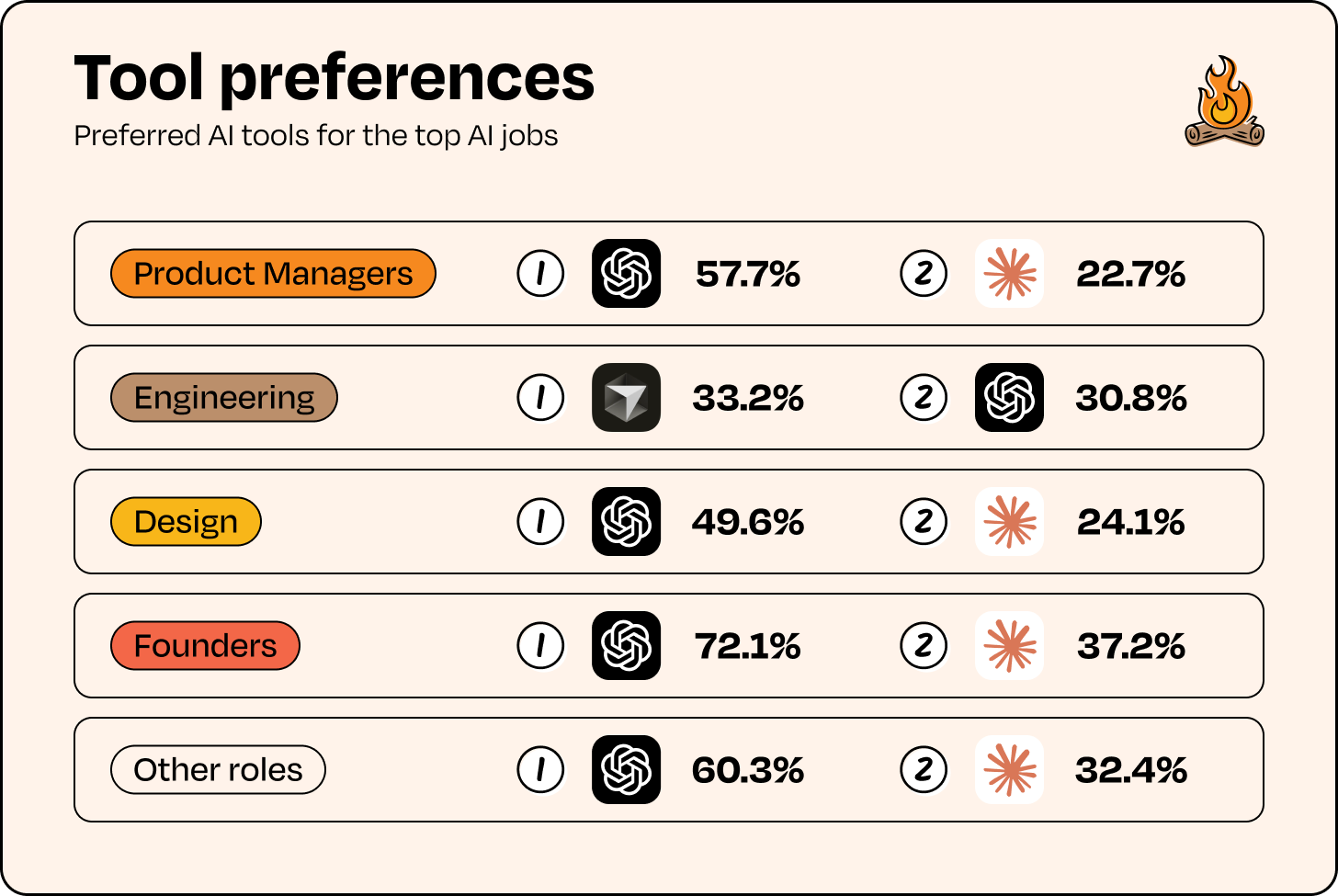
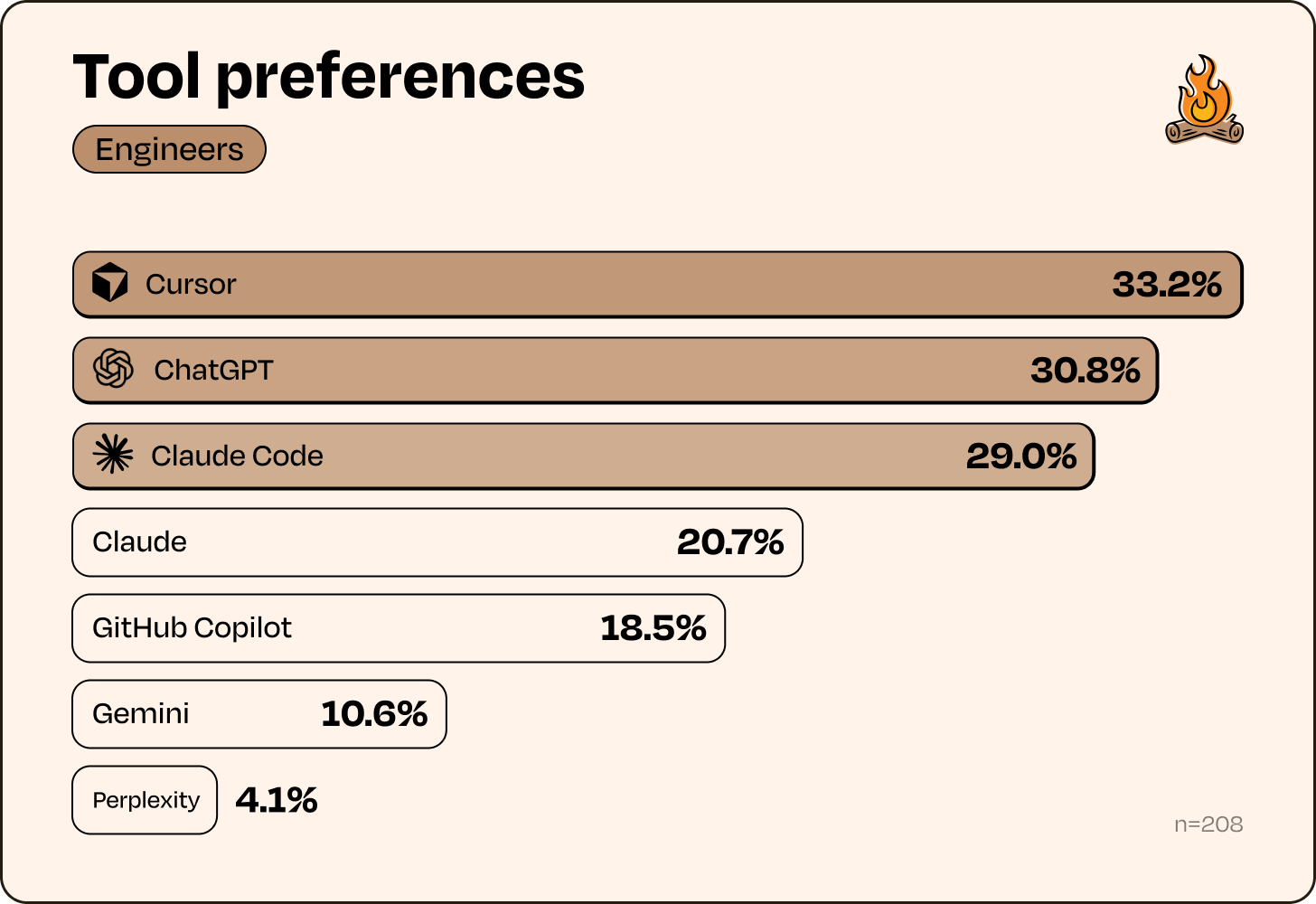
But engineers have a very different behavior. GitHub Copilot was first to market, has Microsoft and GitHub’s distribution muscle, and is baked into the world’s most popular code repository. Yet it sits behind three tools that launched after it. Engineers are choosing newer (better) alternatives over the incumbent.
For engineers, the top three are in a dead heat: Cursor (33.2%), ChatGPT (30.8%), and Claude Code (29.0%) are all within 4 percentage points. This market hasn’t consolidated, and switching costs are low. Also notable: Claude Code (29.0%) outpaces Claude’s chat interface (20.7%). Purpose-built tools are winning, but Claude is also helpful with several core coding-related tasks (e.g. code migration and more) that put it at fourth.
Gemini sits at a distant 10.6%, but a caveat: this space shifts fast. A few strong model releases or product updates could reshape these rankings quickly. What’s true today may look very different in six months.
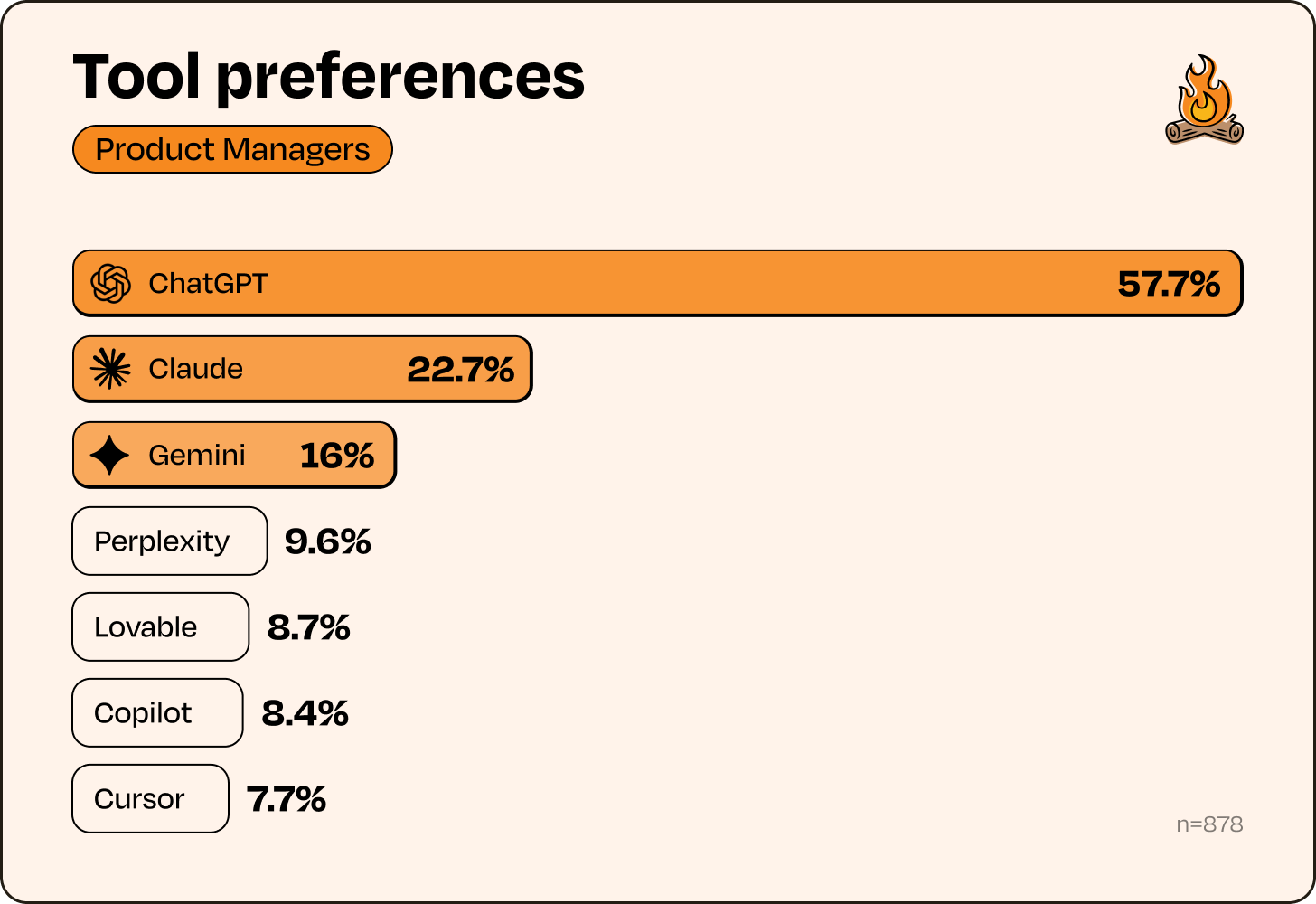
ChatGPT is a far-and-away winner for PMs.
Perplexity is also surprisingly highly ranked, probably due to its strong research capabilities.
However, farther down the list, Lovable (8.7%) and Cursor (7.7%) are cracking the top seven for PMs. This reinforces the pattern we saw earlier: PMs are increasingly building things themselves, encroaching on what’s traditionally design and engineering work. The PM toolkit is expanding beyond documents and decks.
One note: Copilot (8.4%) edges out Cursor (7.7%) among PMs, though the reverse is true for engineers. This may reflect Microsoft ecosystem lock-in at larger companies, or simply that PMs discovered Copilot first and haven’t yet explored alternatives.
AI is driving significant time and quality gains (for most)
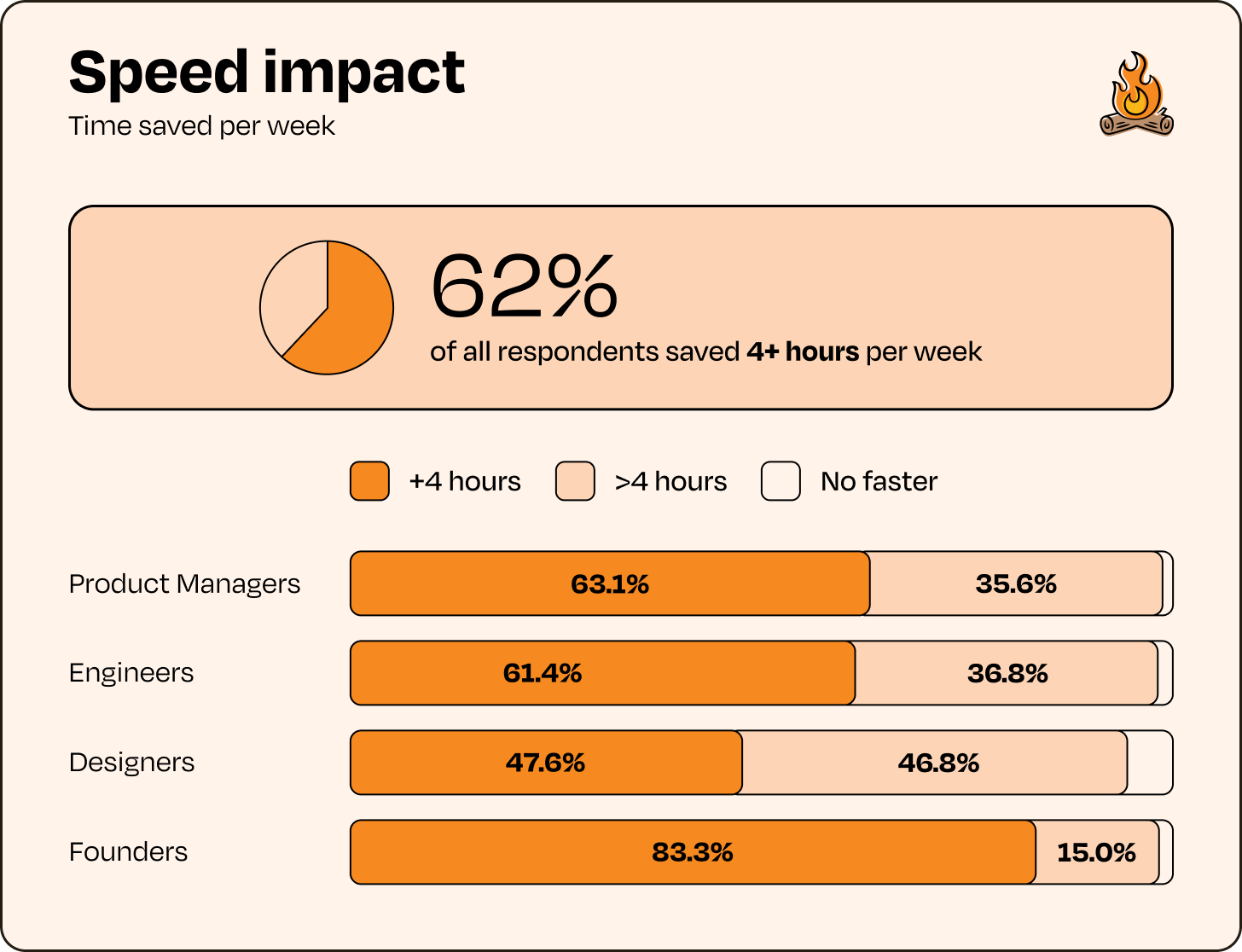
63% of PMs and 83% of founders report that AI saves 4+ hours per week. Even the most skeptical group, designers, still shows 47.5% reporting 4+ hours saved. Only 1% to 5% of respondents across roles say AI is “no faster than manual work.”
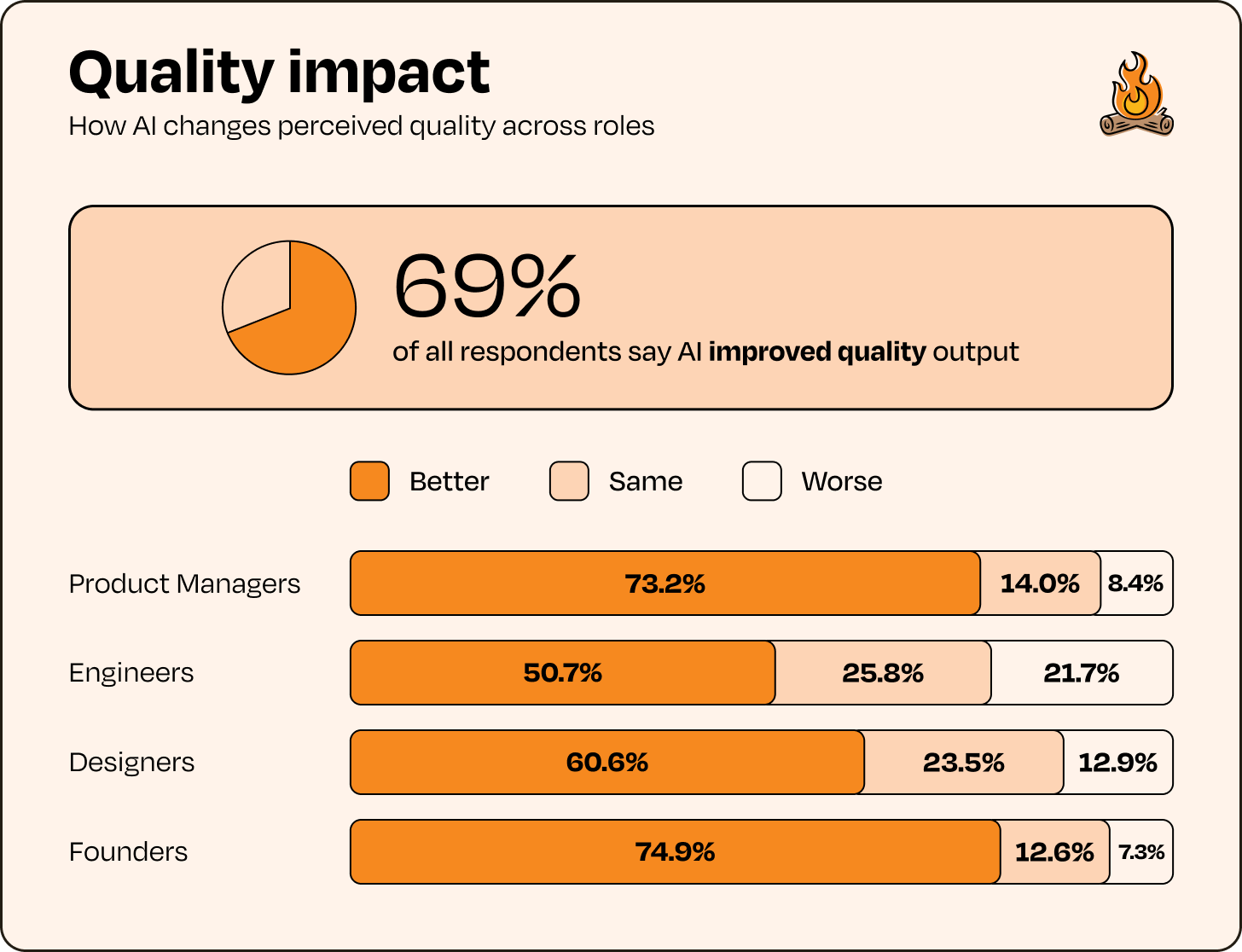
On quality, though, the story is more nuanced. PMs and founders are bullish (over 70% report quality improvements), but engineers are more mixed. 51% of engineers tell us that AI makes the quality of their work better, but 21% say it’s worse. Designers fall in between, at 60% better, 13% worse. The quality ratings among engineers may reflect the higher bar for correctness in code: a “somewhat better” first draft of a PRD is useful; a “somewhat better” but buggy function is not. Also, bad code is easier to spot than a bad PRD.
Where are the opportunities for more AI help?
The gap between where people are using AI today and where they want to use it next reveals a lot about where the opportunities are for founders and startups to jump in and deliver new tools and functions.
For PMs, the biggest opportunity story is research. User research shows the largest demand gap of any task (+27.2pp). Only 4.7% say it’s their primary AI use case today, but nearly a third want it to be. The pattern is clear: PMs have figured out how to use AI for output tasks like writing PRDs and drafting communications, but they’re hungry to apply it upstream, to the messy work of understanding what to build.
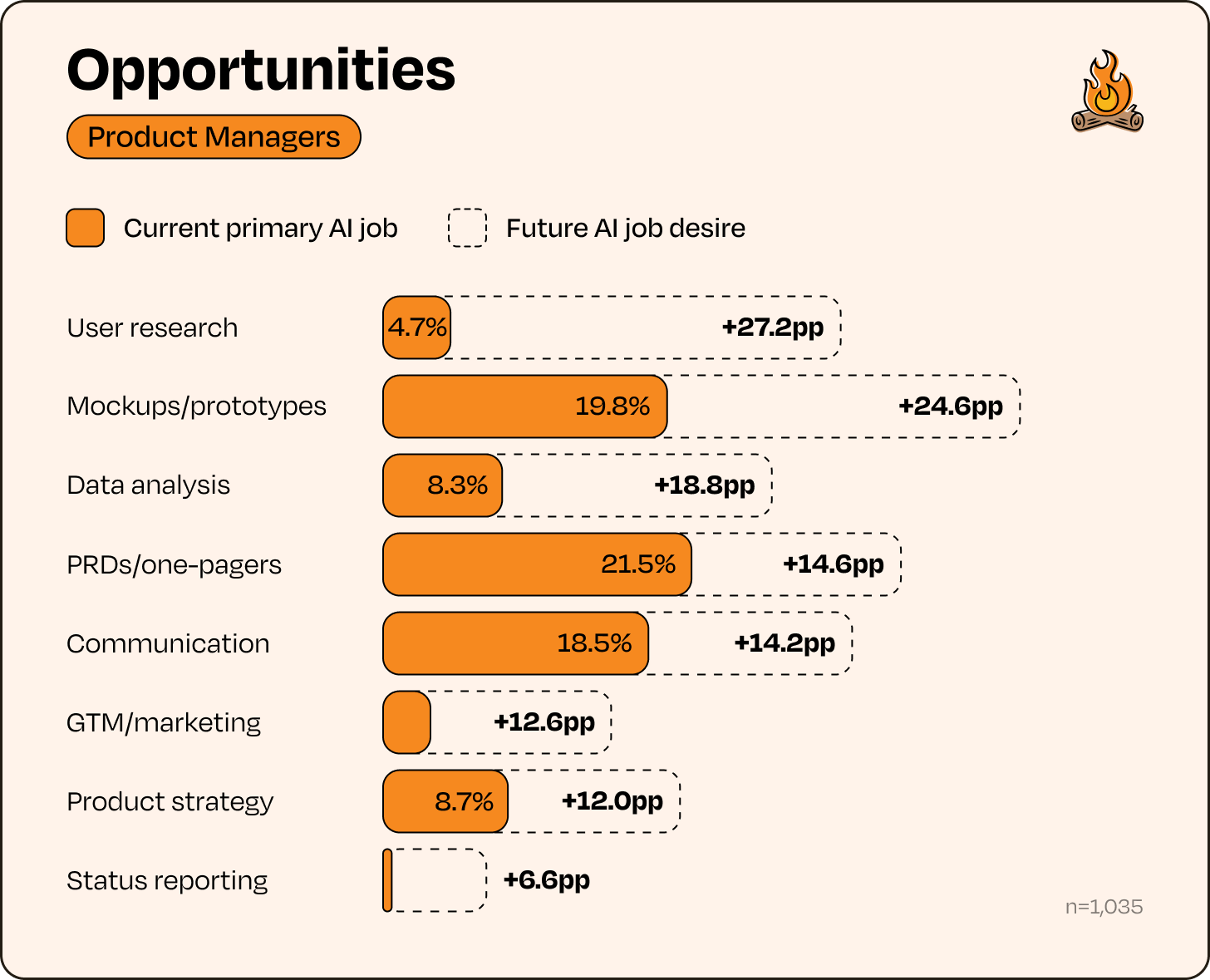
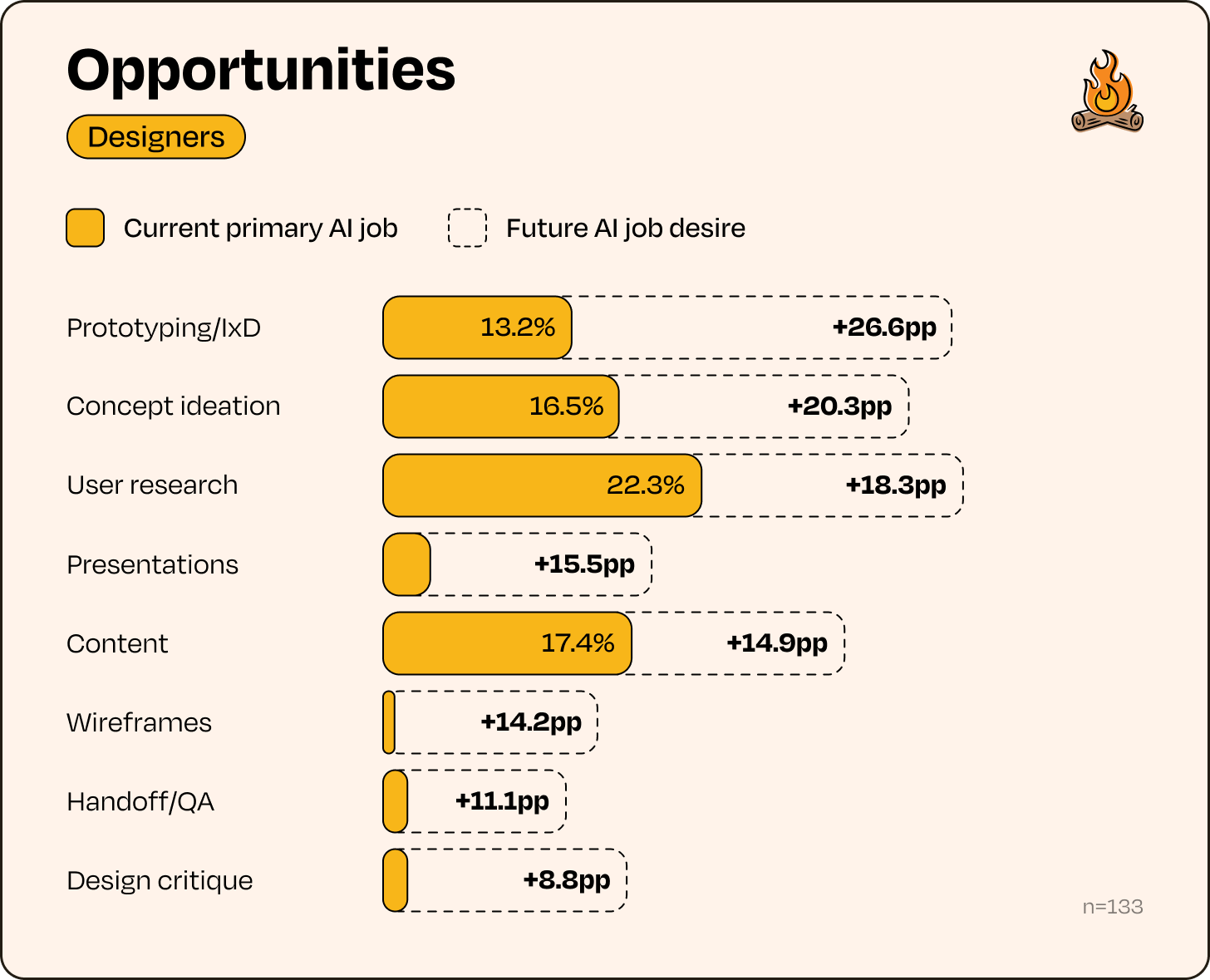
Prototyping is a breakout category. For PMs, “creating mockups/prototypes” jumps from 19.8% (currently using) to 44.4% (want to use next), a +24.6pp swing that makes it the single most-wanted future use case. For designers, prototyping and interaction design show similar momentum (+27.8pp). This tracks with the rise of tools like Lovable, v0, Replit, and Figma Make: people have seen what’s possible and want more.
Engineers are shifting their use of AI to handle work after writing the code. Writing code was by far their most popular use case (51% current), but it has a demand gap of only +5.6pp. However, documentation (+25.8pp), code review (+24.5pp), and writing tests (+23.5pp) all show massive opportunities for growth in engineering AI tooling.
Founders are doubling down on AI as a thinking partner. Product ideation shows massive demand, jumping from 19.6% (currently using) to 48.6% (want to use next), a +29.0pp gap. Growth strategy and GTM planning (+24.7pp) and market analysis (+24.0pp) follow close behind.
Founders already use AI heavily for personal productivity (32.9% currently), but they want to move upstream. They’re looking for a strategic collaborator to pressure-test ideas, explore markets, and think through go-to-market—AI as a co-founder,not just an assistant.
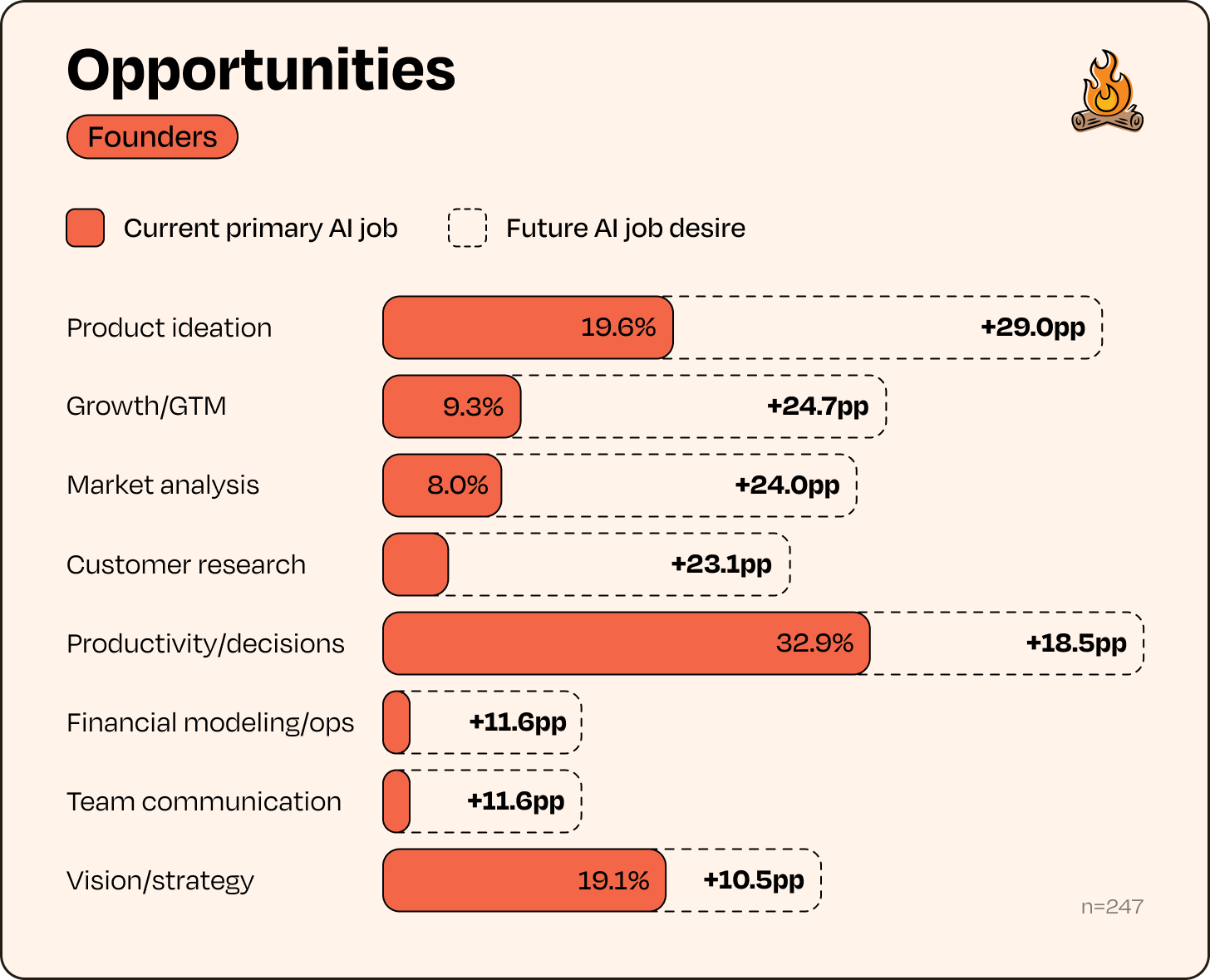
Based on these reported gaps, the next wave of AI adoption will require not just better models but better workflows for human-AI collaboration on fuzzy problems. Writing a PRD has a clear output; competitive research does not. Writing code can be tested; “product ideation” cannot.
Which AI tools have product-market fit?
We asked: “Which AI tool(s) would you be very disappointed to lose access to?” The classic Sean Ellis PMF question. 83.6% named at least one tool, which is itself a remarkable signal of how embedded AI has become in daily workflows. But the relationship between the number of people who regularly use a tool and would miss that tool if it went away tells the story of the products that have truly found product-market fit.
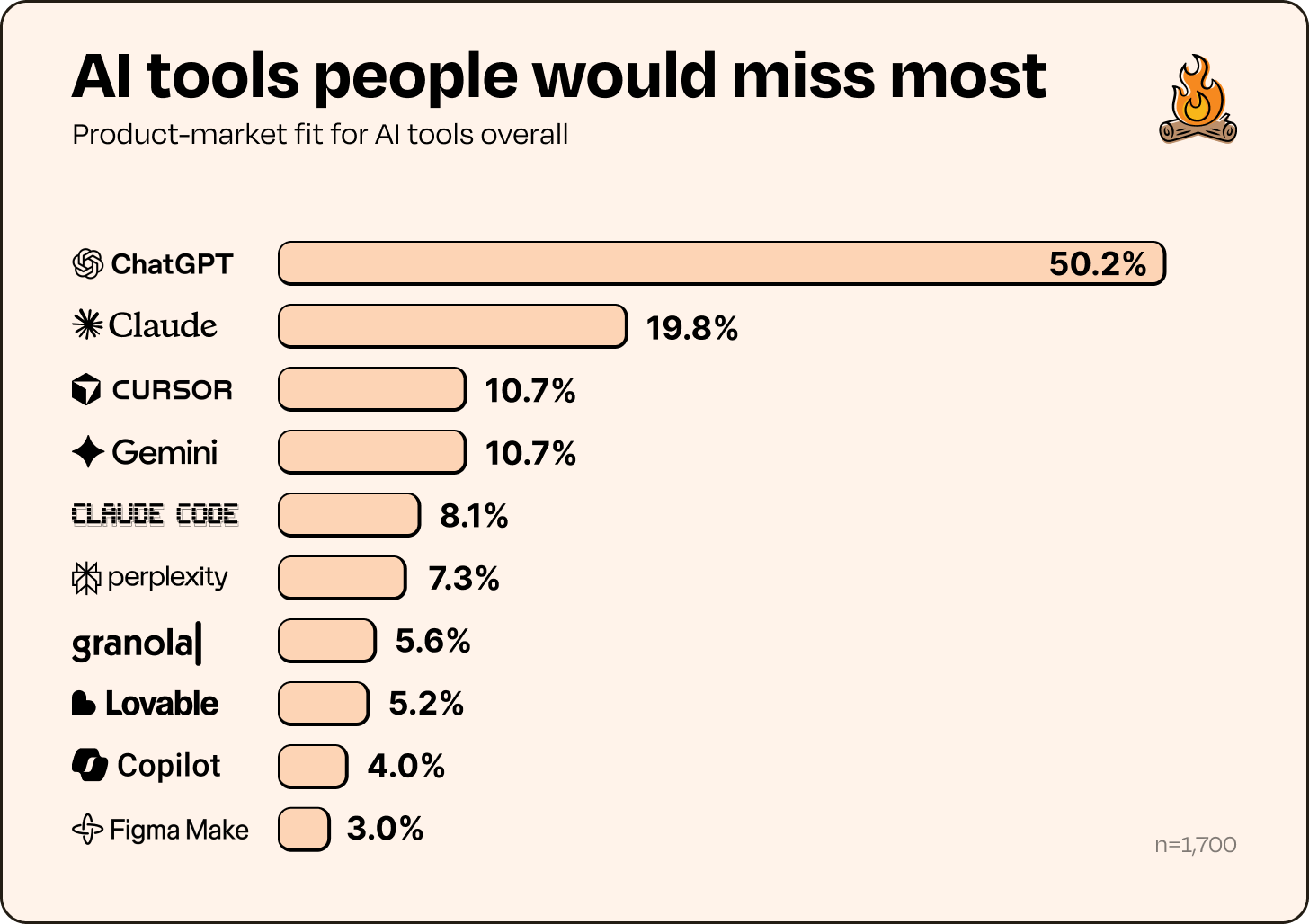
ChatGPT dominates, perhaps only for now. Half of respondents (50.2%) would be very disappointed to lose ChatGPT, but that’s notably lower than the 60% to 75% of respondents across most roles who say they regularly use the tool. This, in part, explains why OpenAI recently declared a “Code Red” as it watches Gemini and Claude begin to erode market share. Switching costs in AI are still very low.
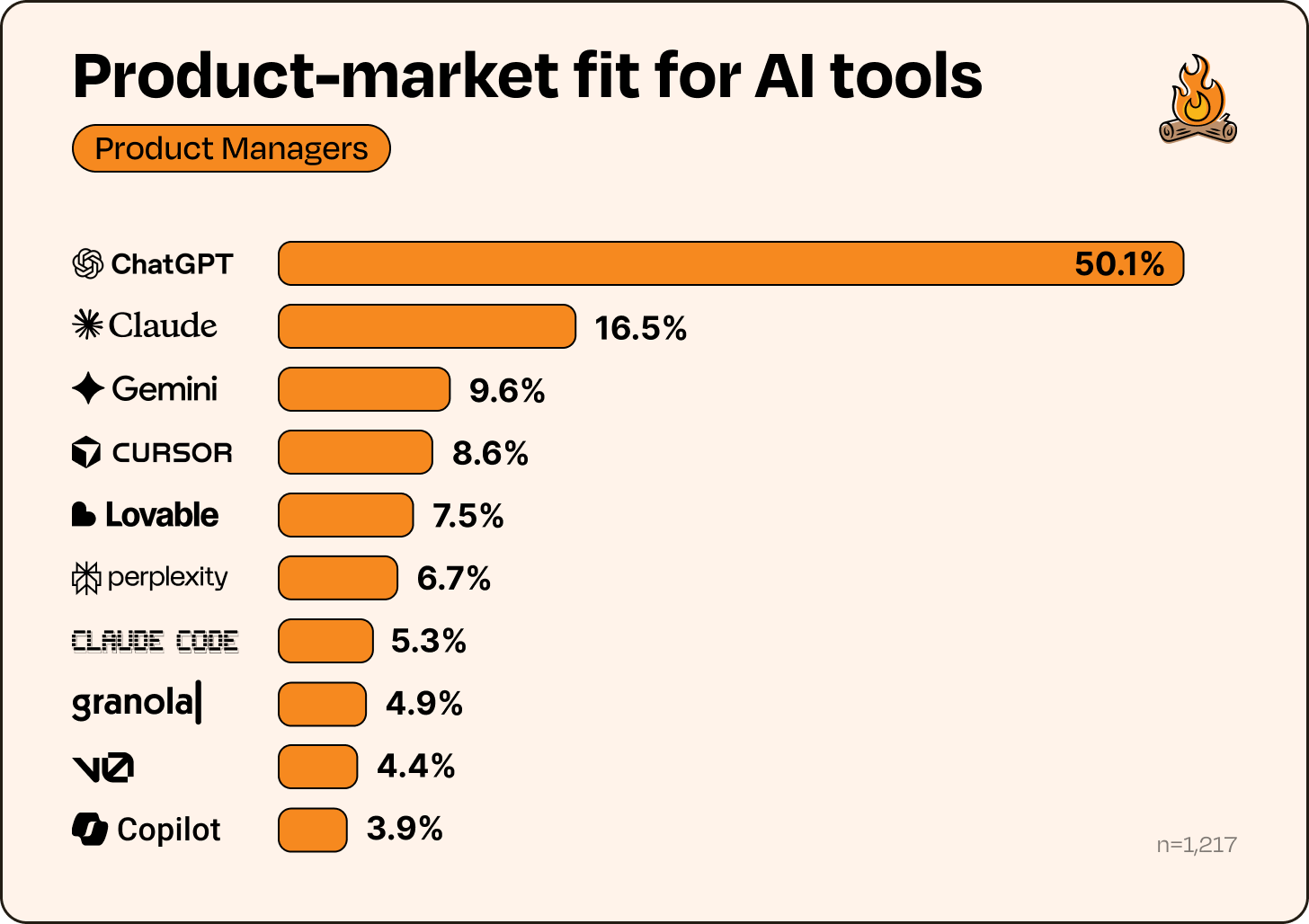
ChatGPT, Claude, and Gemini top the list for PMs—they’re such multi-purpose tools well-suited to the PM job. It’s most interesting to see Cursor right behind Gemini (we wouldn’t expect an engineering tool like Cursor to be so popular among PMs), followed by Lovable (which currently seems to be winning in the prototyping market).
Designers (23.3%) and founders (20.6%) index highest on Claude. The Claude ecosystem (Claude and Claude Code combined) reaches 27.5% overall. This feels like a big win for Anthropic.
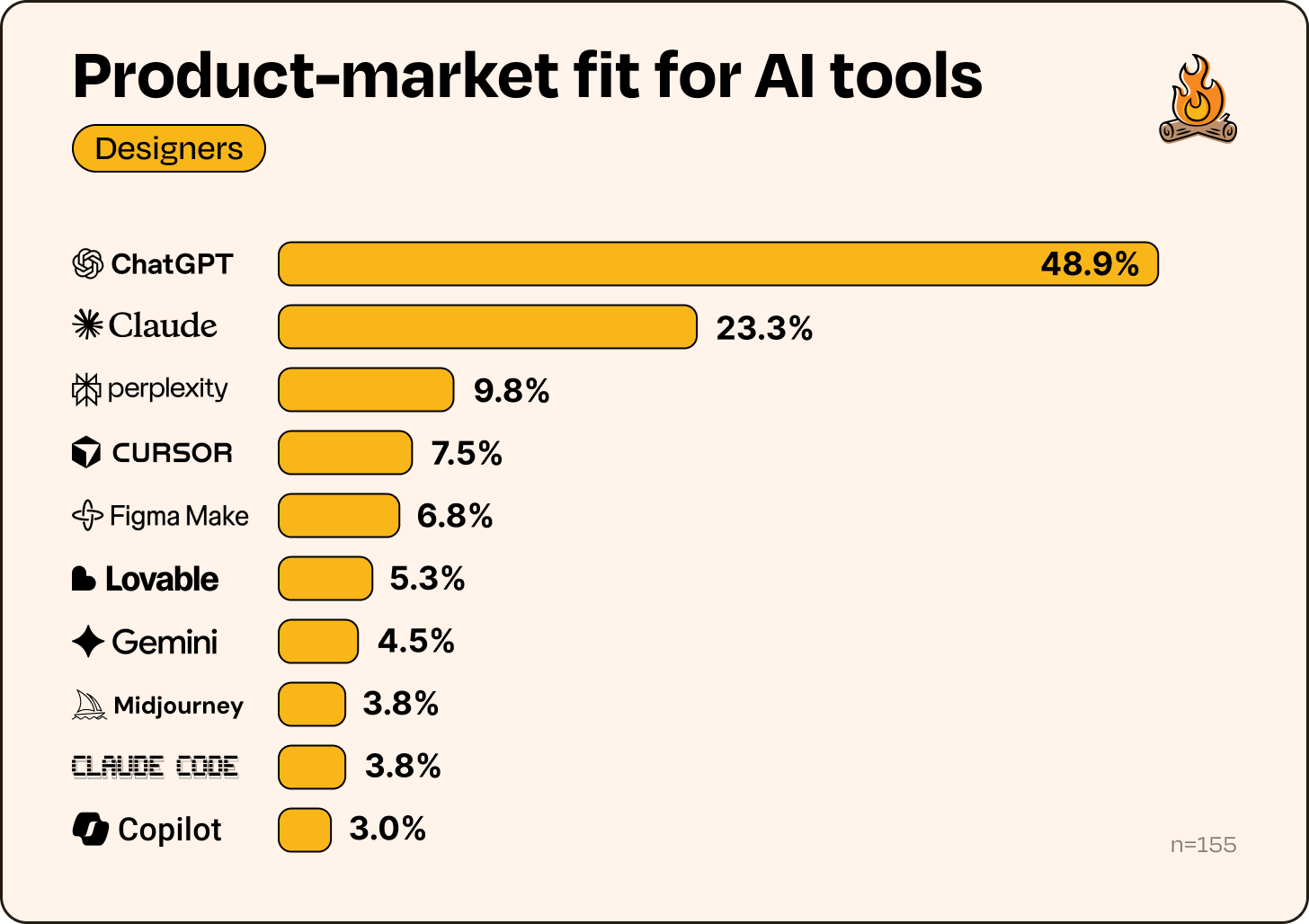
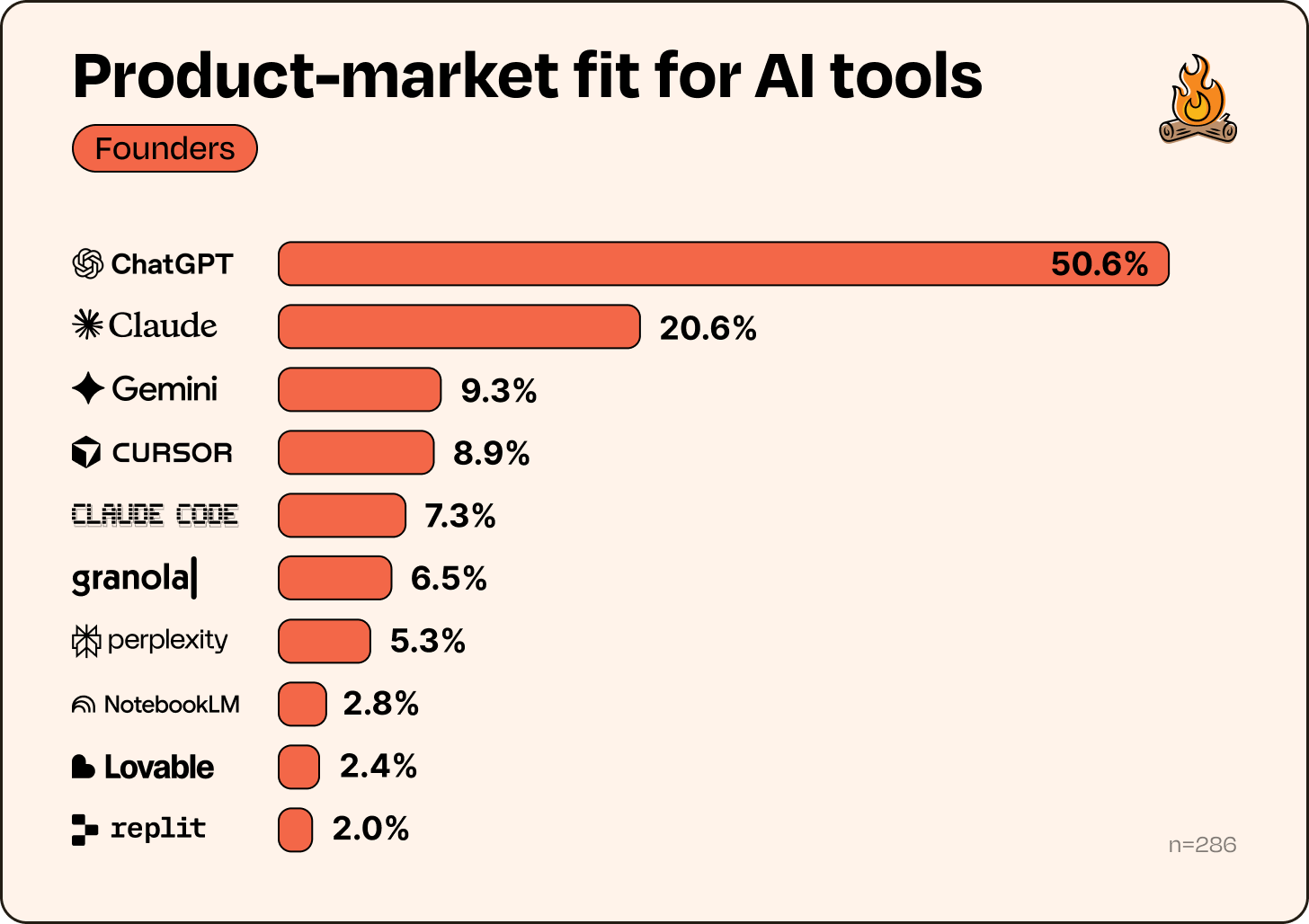
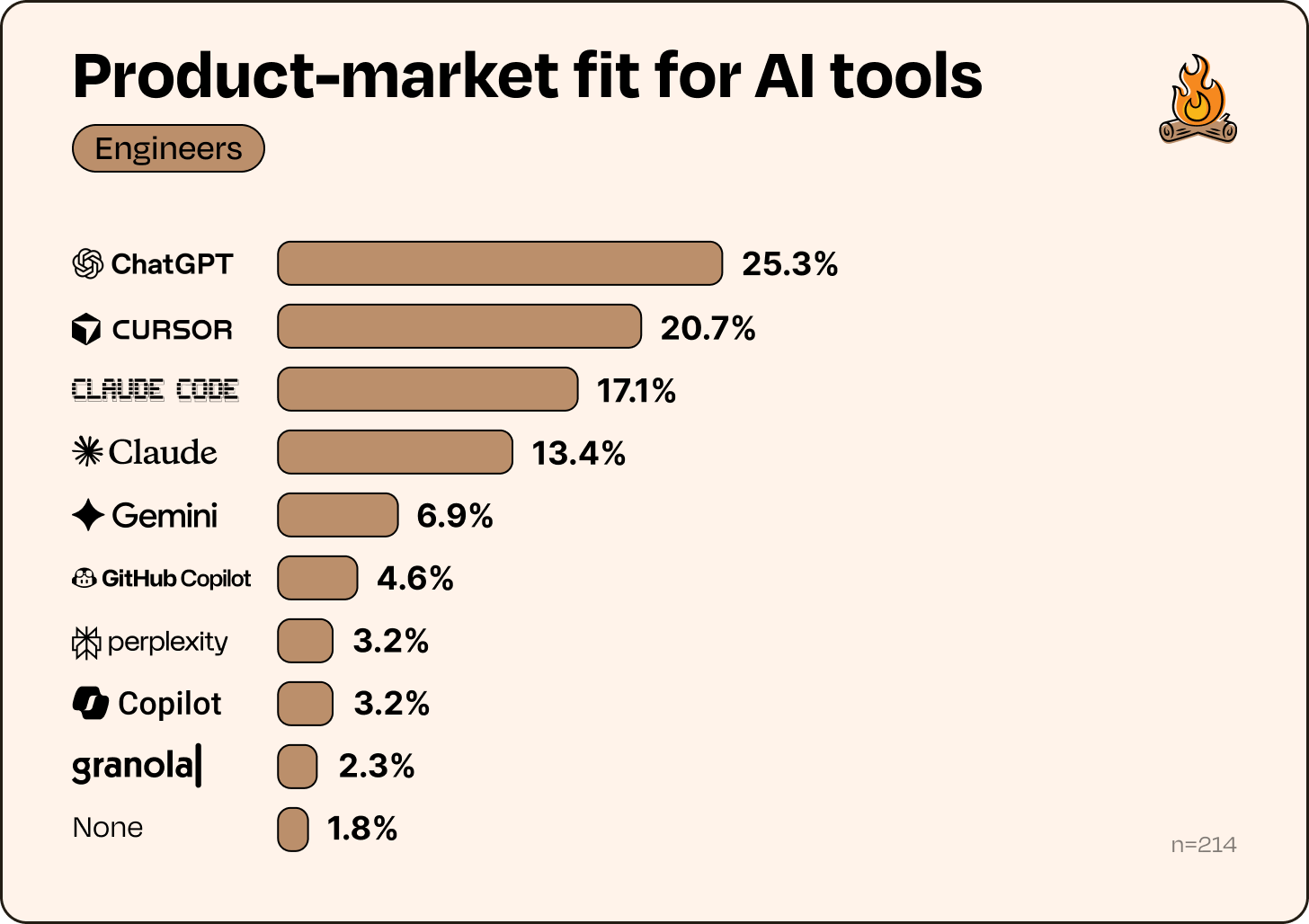
Specialized engineering tools have found loyal users and a clear product-market fit among engineers. For engineers, the PMF leaderboard looks completely different from everyone else: ChatGPT (25.3%), Cursor (20.7%), Claude Code (17.1%), and Claude (13.4%). Three of the top four products they’d miss are coding-specific tools. Engineers have found—and want to hold onto—specialized tools that fit their needs, rather than relying on general-purpose chat interfaces. Cursor’s 20.7% PMF among engineers (vs. 7% to 9% for other roles) shows how deeply it has embedded into coding workflows.
In fact, a handful of role-specific tools are winning their niches.
We can measure how “sticky” a tool is by comparing two numbers: the percentage of people who use it as their primary tool versus the percentage who say they’d be very disappointed to lose it.
If more people would miss a tool than currently use it as their primary, that’s a sign of strong product-market fit. If fewer people would miss it than use it, that suggests the tool is easy to replace.
Granola, the AI meeting notes tool, is a good example. Among PMs, 4.9% say they’d be very disappointed to lose it, while only about 2% use it as their primary AI tool. That’s a roughly 2.5x ratio, meaning nearly everyone who uses Granola would miss it. Compare that with Gemini, where usage outpaces loyalty: more people use it than would miss it if it disappeared.
Beyond the general-purpose LLMs, we see clear category winners emerging:
- Coding: Cursor (20.7% eng PMF), Claude Code (17.1% eng PMF)
- Prototyping: Lovable (7.5% PM PMF), Figma Make (6.8% design PMF), v0 (4.4% PM PMF)
- Meeting notes: Granola (6.5% founder PMF, 4.9% PM PMF)
- Research: Perplexity (9.8% design PMF, 6.7% PM PMF)
The pattern suggests that the AI tools market is bifurcating: general-purpose LLMs (ChatGPT, Claude, Gemini) compete on breadth, while specialized tools compete on depth of workflow integration.
What’s notably absent: Some tools showed minimal PMF: GitHub Copilot (5.1% eng, despite being one of the earliest AI coding tools), Notion AI (1.0% overall), and the various image generation tools (Midjourney at 0.4%).
The downsides of AI productivity
The productivity gains are real, but so are the costs. An overwhelming 92.4% of respondents reported at least one negative effect from AI tools. The average person selected 2.2 complaints, but the survey revealed a near-universal experience of trading one set of problems for another.
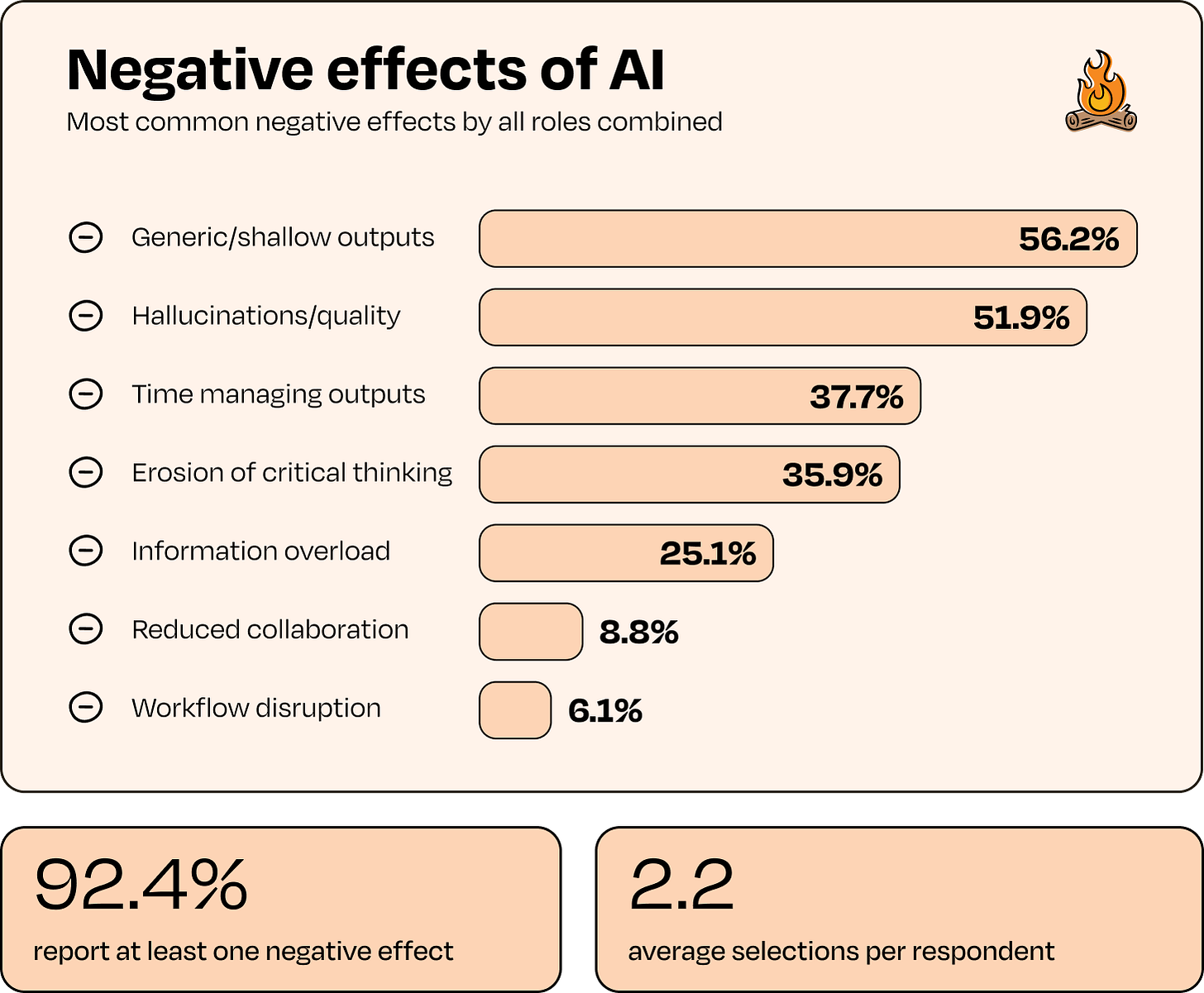
Generic outputs and hallucinations dominate the complaint list. The top two issues are essentially the same problem viewed from different angles: AI produces content that’s either too shallow (56.2%) or factually unreliable (51.9%). More than half of all respondents cited each. The implication is clear—AI outputs require significant human review and refinement, which leads directly to the third-most-cited issue: time spent managing AI outputs (37.7%). The productivity paradox: AI saves time generating content but creates new work reviewing it.
A close fourth (and actually third for the PM role) is a concern that AI tools will erode their critical thinking. Time savings or not, many respondents are worried that their long-term skills may be at risk as AI tools become ubiquitous in their workflows.
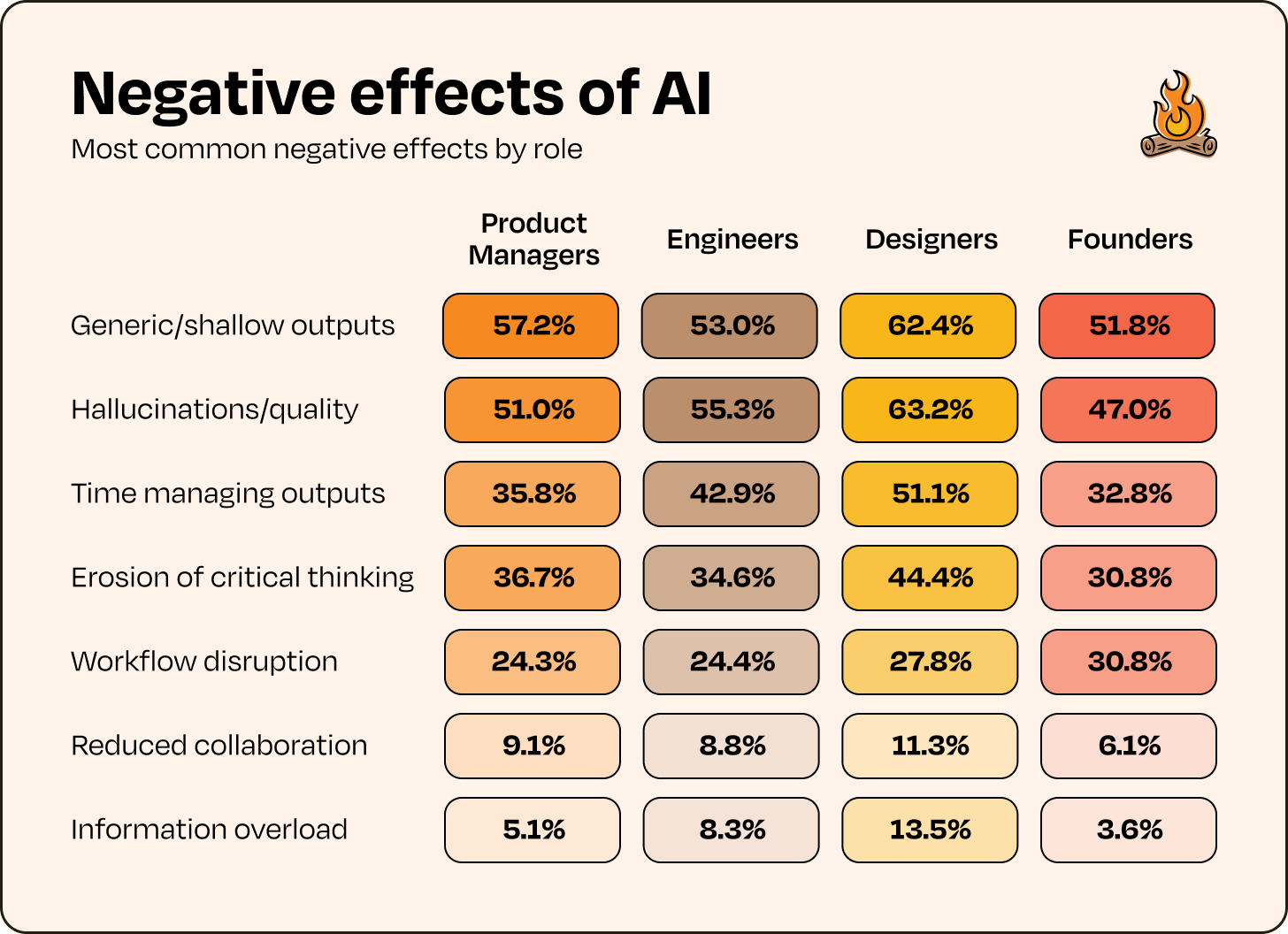
Designers report negative effects at the highest rate; founders the lowest. 63.2% of designers cite hallucinations, 62.4% cite generic outputs, and 51.1% cite time managing outputs. They also average the most complaints per person (2.74 vs. 2.03 for founders). This tracks with our earlier finding that designers report the lowest quality improvements and the smallest time savings. For work that requires precision and originality, AI’s tendency toward “good enough” may be particularly frustrating. Founders, in contrast, show the lowest complaint levels across nearly every category, perhaps because they’re using AI for earlier-stage, more exploratory work, where “directionally correct” is sufficient.
What people don’t complain about is revealing. Only 8.8% cite reduced team collaboration, and just 6.1% report workflow disruption. The fears that AI would atomize teams or break existing processes haven’t materialized at scale. The problems are more prosaic: AI outputs need editing, AI sometimes makes things up, and the meta-work of managing AI tools takes real time.
Bonus: The state of agentic AI: promise outpaces practice
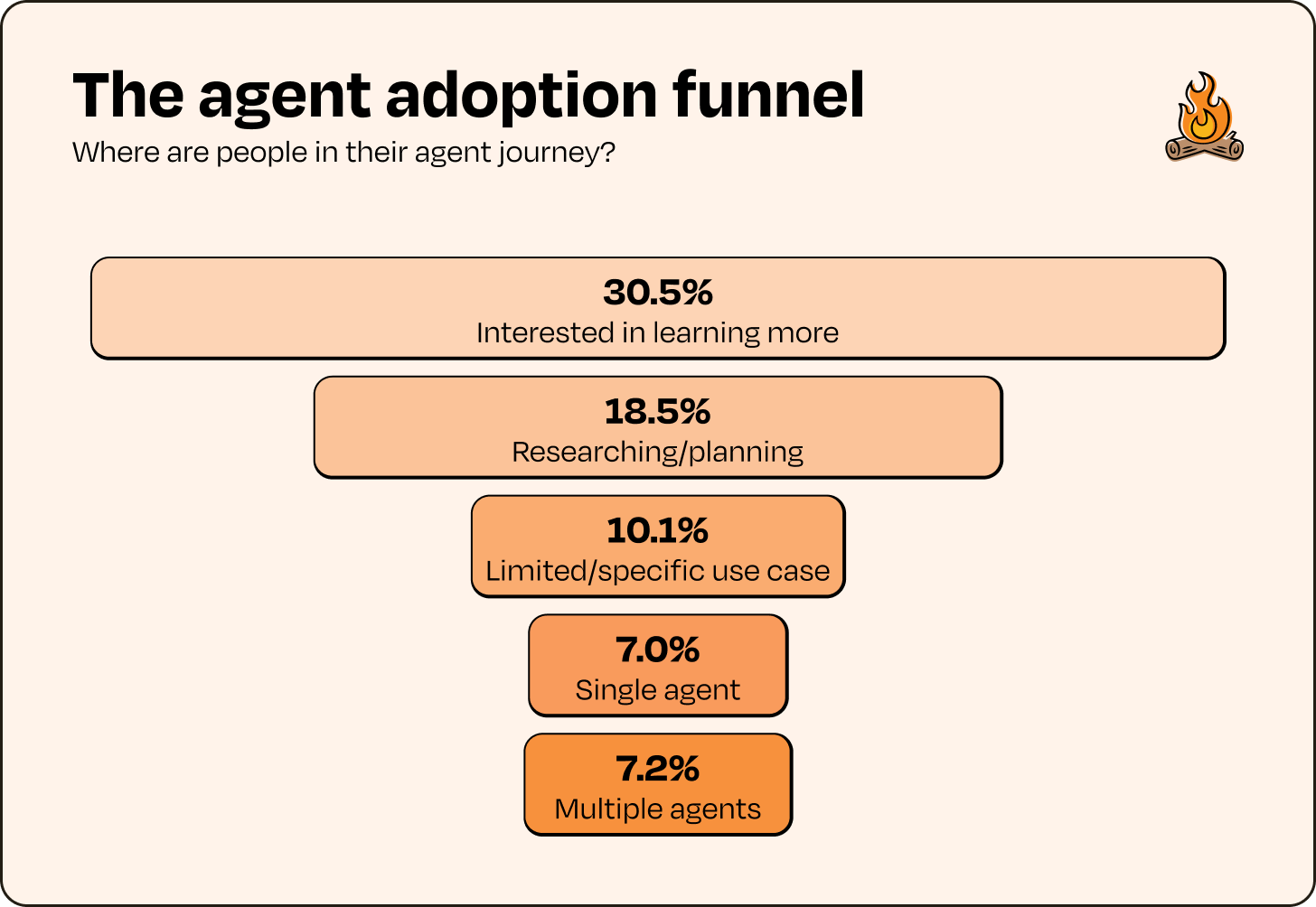
Despite the industry buzz around AI agents that work autonomously, actual adoption remains nascent. Only about 25% of respondents are using agents in any capacity, and just 14% qualify as “active” users (using one primary agentic tool or multiple agentic platforms). Nearly half (49%) express interest or are planning to implement agents—a massive gap between intention and action that signals both opportunity and friction.
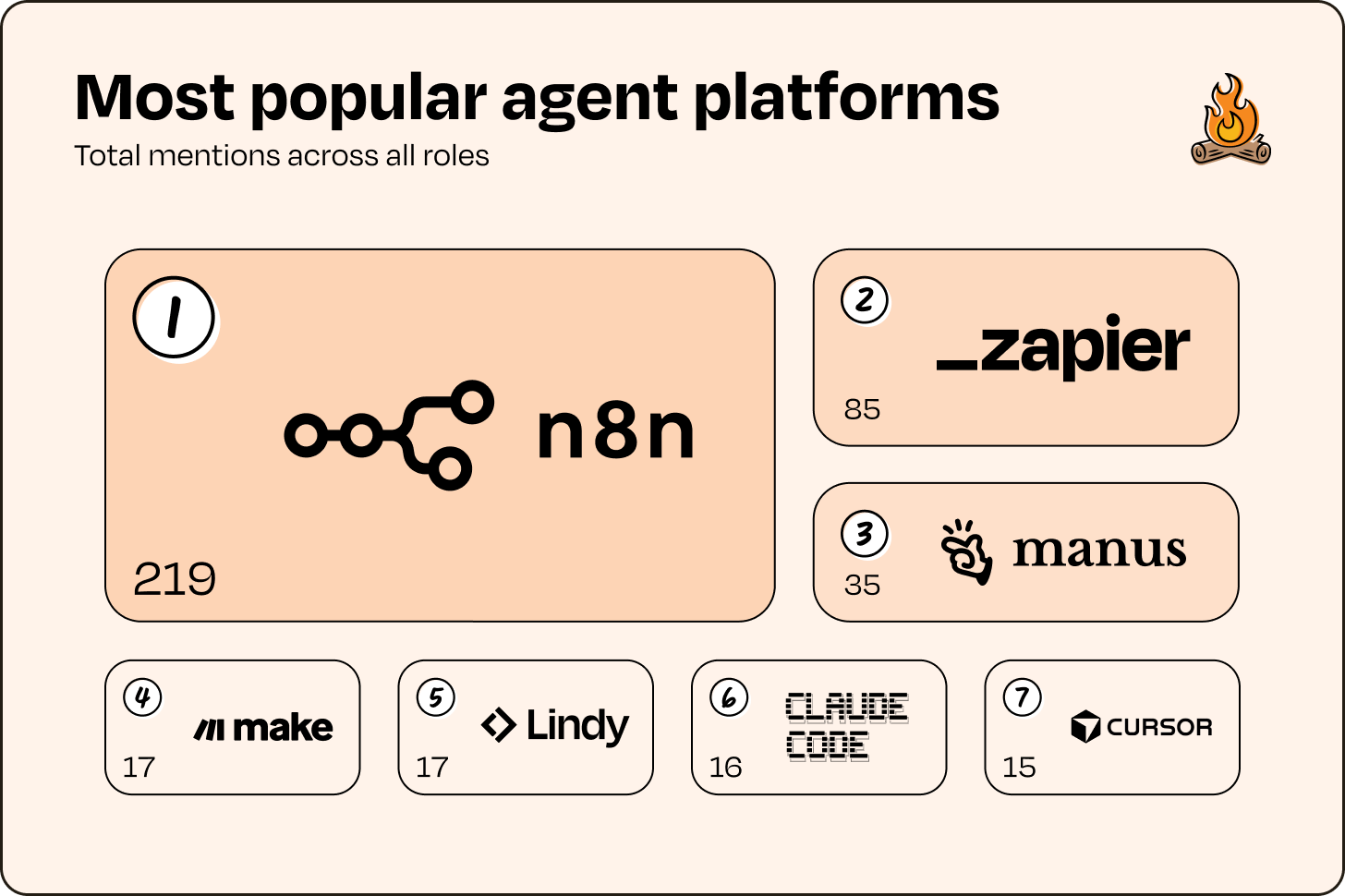
n8n dominates the agent landscape. When we asked which platforms people use, n8n appeared 219 times, more than double Zapier’s 85 mentions. This is surprising given Zapier’s broader name recognition, but n8n’s open source model and developer-friendly approach may resonate with this technically inclined audience. Manus (35 mentions), the newer entrant, is already ranked third, suggesting that the market remains fluid and receptive to new players. Make and Lindy were tied at 17 mentions. Interestingly, Claude Code (16) and Cursor (15) also appear, indicating that some respondents are leveraging “agent” modes within AI-powered coding assistants. We may see this use case go way up in 2026 given Cursor’s, Anthropic’s, and OpenAI’s focus on more agentic user experiences for coding.
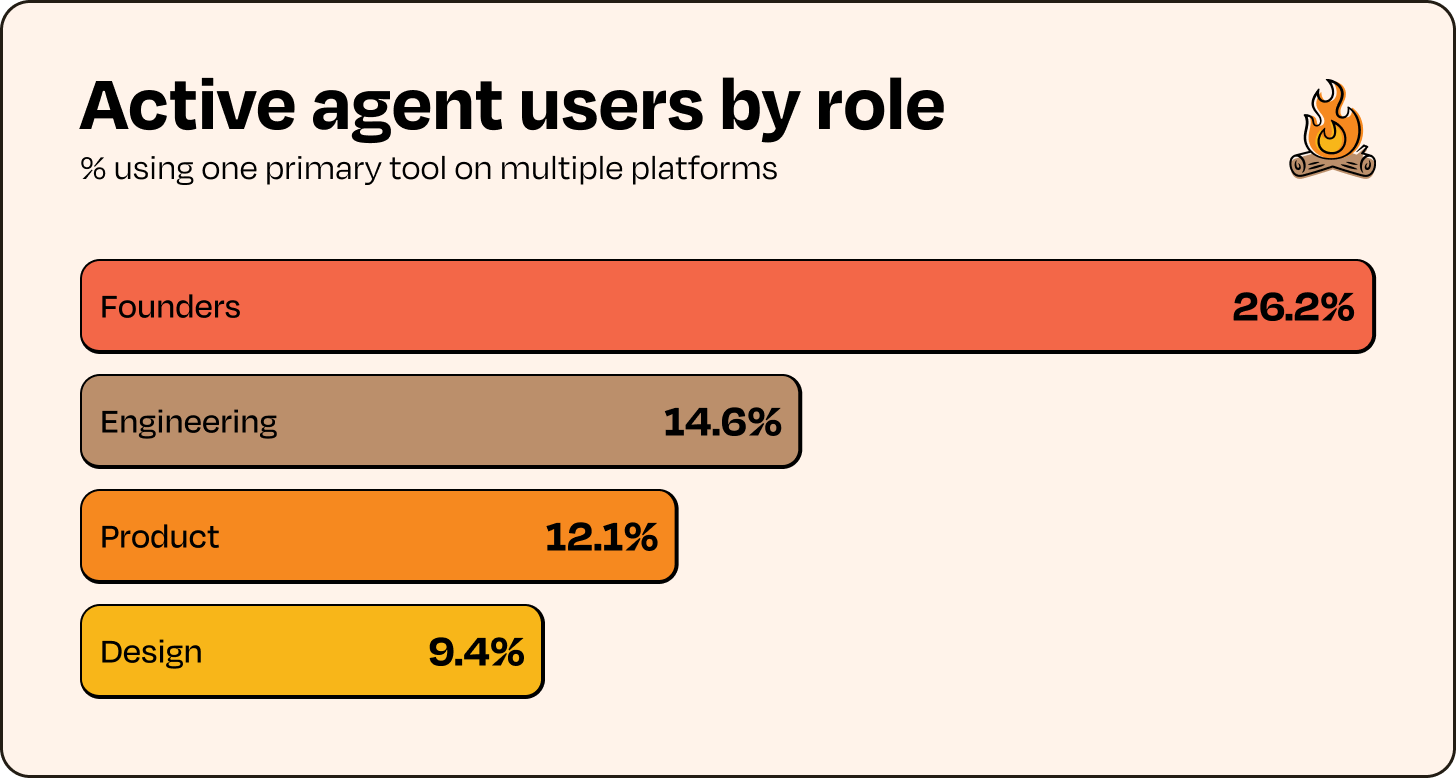
Founders are leading usage; designers are lowest in agent adoption. The founder advantage we’ve seen throughout this survey extends to agents. A quarter of founders (26.2%) are active agent users, nearly double the rate of PMs (12.1%) and almost triple that of designers (9.4%).
Workflows remain overwhelmingly human-directed. Among those who do use agents, the workflows are still heavily assisted rather than autonomous. Nearly half (47%) report being 75% non-agentic, and only 7% report mostly or fully agentic workflows. Even among founders—the most aggressive adopters—just 12.5% are at 75%+ agentic. The vision of AI agents handling complete tasks autonomously is still aspirational; the reality is humans maintaining control with AI assisting at the edges.
The blockers are organizational, not technical. Company restrictions block 8.2% of potential users, particularly in engineering (10.1%) and design (10.5%). Another 7.8% don’t see a current need. Only 4.8% are unfamiliar with agents entirely. This suggests that the adoption bottleneck isn’t awareness or capability; it’s organizational readiness and clear use cases. As policies evolve and as early adopters demonstrate concrete value, the 49% of respondents who express interest may get their opportunity to become users.
What this all means
AI has crossed from toy to workhorse.
The numbers are unambiguous: 55% say AI has exceeded their expectations, and roughly three-quarters of our respondents would say AI has delivered on or surpassed its promise. Only 17.7% report disappointment. By almost any product standard, these are strong numbers.
The time compression is real and dramatic.
When respondents quantified their savings, the numbers were striking:
- PRDs: “PRDs that would take a few days now take less than an hour.”
- Competitive research: “Multi-week research project to a matter of days”; “Cut my time by at least 60%.”
- Prototyping: “What used to take me a month to build and validate is now at most a day. Sometimes max one hour.”
- User research synthesis: “Work in minutes which would have taken a couple of hours before.”
The consistent pattern: between 3x and 10x time compression on knowledge work that previously required either deep expertise or tedious manual effort.
Not everyone is seeing those same benefits right now.
Only 45% of designers report positive ROI, and 31% say AI has fallen below expectations, triple the rate of founders. Three possibilities: (1) design-specific AI tools aren’t at the level they need to be. (2) design work requires precision and originality that AI isn’t yet delivering. or (3) designers have higher standards for output quality.
The answer matters a lot for predicting which roles AI will transform versus frustrate.
And the agentic future everyone’s talking about? It’s still mostly talk. Only 14% are active agent users, and even among them, workflows remain 75%+ human-directed. The gap between “interested in agents” (49%) and “actively using agents” (14%) is where the next wave of adoption and the next wave of products will emerge.
But the tool landscape is rapidly shifting.
The way we track tools needs to be more of a weekly exercise, or monthly at most. An ongoing view of what everyone’s using, how much ROI they’re getting, and their most impactful AI use cases.
And it’s not just about tools. In the AI era, the way we work is evolving dramatically, and our research has to keep up.
That’s why next year we’re launching in-context micro-research within Lenny’s community. Paid members will have the opportunity to participate in short surveys or AI-moderated interviews and share their latest experiences. We’ll publish our insights within the community in a dedicated channel.
People don’t want AI to do the interesting parts of their job. They want it to do the parts they hate.
Look at how engineers want to use AI: documentation, code review, tests. Not the hard stuff. The boring stuff.
Maybe that’s the top framework for thinking about AI adoption. The roles most transformed won’t be the ones where AI is “smartest.” They’ll be the ones with the most tedious busywork. Follow the drudgery, and you’ll find where AI creates the most value.
When “show me” beats “tell me,” role boundaries start to blur.
Roughly 20% of PM examples mentioned code and tools like Cursor. PMs building prototypes. Testing ideas directly in product.
One PM described going “from a thought to testing an idea in our actual product” in 10 minutes via Linear and Cursor.
If demonstrating becomes faster than documenting, what happens to the PRD? To the traditional PM/eng handoff? And on the same note, what happens when designers ship code?
The roles we’ve known for decades may be unrecognizable in a few years.
The people extracting the most value share a few things in common:
- They’ve found their AI jobs-to-be-done. The highest-impact AI use cases are role-specific. For PMs, it’s PRDs and prototypes. For engineers, it’s code. For founders, it’s thought partnership. Trying to use AI for everything means mastering nothing. Pick the task (or limited set of tasks) where AI can save you the most time or improve your output the most, and go deep.
- They treat AI like a collaborator, not a tool. The quality gains people reported were not in polish but in comprehensiveness: AI surfacing considerations they would have missed. As one respondent put it, “AI helps me see each situation from every possible perspective. Therefore, when I analyze a situation or make a decision, I’m confident that I’m considering all points of view and don’t have any blind spots.” The people who approach AI as a thinking partner, rather than a text generator, consistently reported higher satisfaction and better results.
- They’re looking to move upstream. The biggest growth areas aren’t about producing output faster. Rather, they’re about thinking better earlier, in competitive research, user research synthesis, product ideation. The shift from “AI helps me write” to “AI helps me decide what to write” is where the next wave of productivity will come from, if founders and startups step in to fill the market gaps.
- They work with the tradeoffs. 92% of respondents cited at least one negative effect: generic outputs, hallucinations, time spent reviewing. But the people getting the most value aren’t waiting for these problems to be solved. Instead, they’ve built workflows that account for them. They use AI for first drafts, not final drafts. They verify before they ship. They’ve accepted that “good enough to edit” beats “perfect from scratch.”
The people winning with AI are treating it as a genuine collaborator, one that requires context, iteration, and realistic expectations but that rewards investment with compounding returns.
Start with your highest-leverage task. Give AI the context it needs. Accept imperfect outputs as starting points. And gradually build trust through small experiments, not big bets.
The hybrid operators, people who fluidly combine human judgment with AI capabilities, are already outpacing their peers. The gap will only widen from here.
Appendix: Who took this survey?
Company size
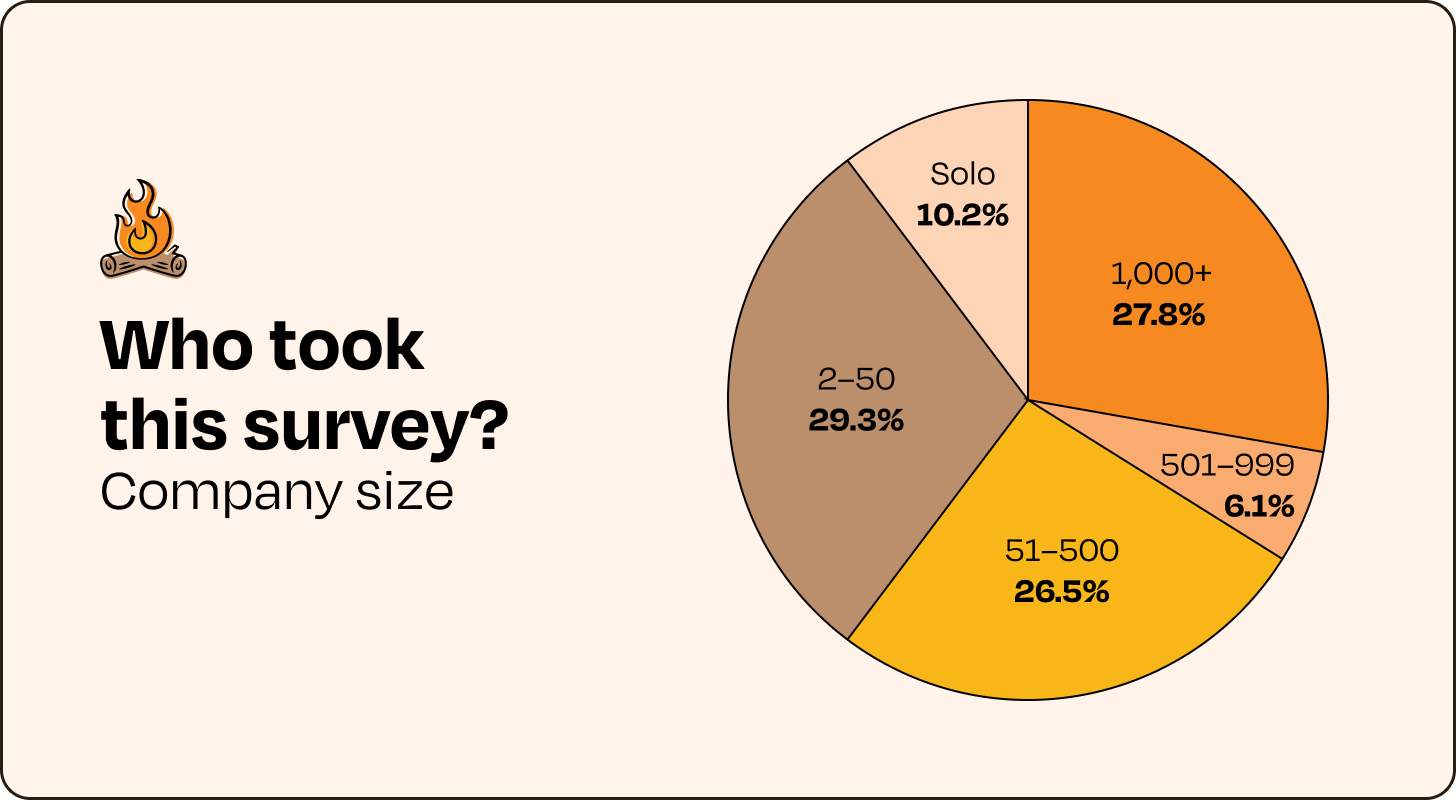
The survey reached a well-distributed audience across company sizes: roughly 40% work at small companies (solo through 50 employees), 33% at midsize companies (51 to 999), and 28% at enterprise organizations (1,000+). The largest single cohort is startups with 2 to 50 employees (29.3%), followed closely by enterprise (27.8%) and growth-stage companies with 51 to 500 employees (26.5%).
Years of experience
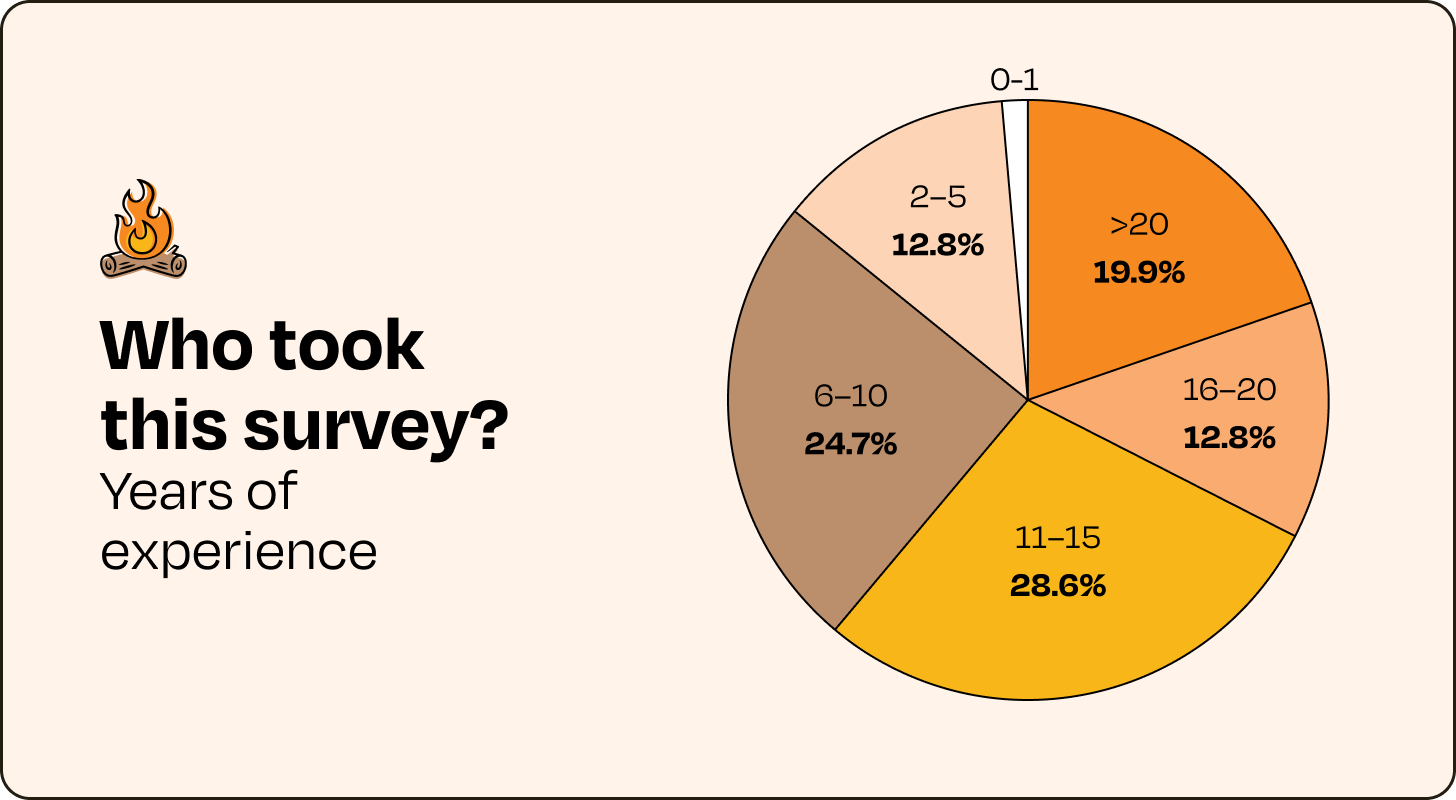
This is a seasoned audience. Over half (53%) have 6 to 15 years of experience, and nearly a third (33%) have 16+ years. Only 14% are early in their careers (0 to 5 years), and just 1.3% are in their first year. Engineers skew particularly senior (51% have 16+ years), while PMs cluster in the mid-career band (59% at 6 to 15 years). The experience level helps contextualize the survey’s findings—these are practitioners with enough tenure to have formed genuine opinions about AI’s impact on their work.
Thanks, Noam! You can follow Noam on LinkedIn and X.
Have a fulfilling and productive week 🙏
If you’re finding this newsletter valuable, share it with a friend, and consider subscribing if you haven’t already. There are group discounts, gift options, and referral bonuses available.
Sincerely,
Lenny 👋