Recently, executive coach Natalie Rothfels has noticed a concerning pattern across all of her co-founder and executive clients: everyone’s angry. Very angry. Below, she shares a guide to identifying and then transforming anger into wisdom that she’s been putting into practice with her clients. It honestly made me well up the first time I read it. This post may completely change your relationship with work.
Before becoming a coach, Natalie spent a decade as a product manager at Quizlet and Khan Academy. She is a certified Internal Family Systems practitioner, a facilitator for Stanford Graduate School of Business’s Interpersonal Dynamics course, aka “Touchy Feely,” and the author of two popular guest posts: Why no productivity hack will solve your overwhelm and On asking for help (even when you really don’t want to. For more from Natalie, follow her on LinkedIn and X.
In the past six months, every one of my coaching clients has been vibrating with anger. Not mild frustration—deep, persistent anger that was depleting their motivation and sense of ownership and making them emotionally exhausted at work. Yet few clients could name or work with that anger effectively.
We have tons of sophisticated frameworks for building product strategy, giving feedback, making decisions, and leveraging AI in the workplace. But when it comes to navigating anger, we’re mostly winging it.
The result? An army of professionals walking around with forced smiles, internally fuming, unconsciously stabbing each other with their emotional swords in the hallways or on Zoom. We’re all feeling angry, no one’s talking about it, and it’s burning us out.
At work, anger most commonly arises when your expertise is challenged, your autonomy is threatened, your values are compromised, or your identity is dismissed. I have been taken over by anger for all of these reasons.
But I’ve learned that anger isn’t something to suppress or feel ashamed of. It’ssomething that we need to be more skillful at owning and engaging with because, while it contains immense wisdom, it can cause harm to ourselves and others if it erupts unconsciously or goes unchecked.
Here’s the process I now use with my clients to help them identify and then transform their own anger into wisdom that they can then appropriately express in a work context. Informed by Buddhist philosophy, Internal Family Systems, and other somatic methodologies, it’s the resource I wish I had earlier in my career for navigating these high-intensity emotions at work.
Anger: an inherently useful emotion
Before we get into the process of transforming anger, let’s briefly touch on what anger is and what it does for us.
Anger is part of being a human. We all have it. And it’s an inherently intelligent and useful emotion.
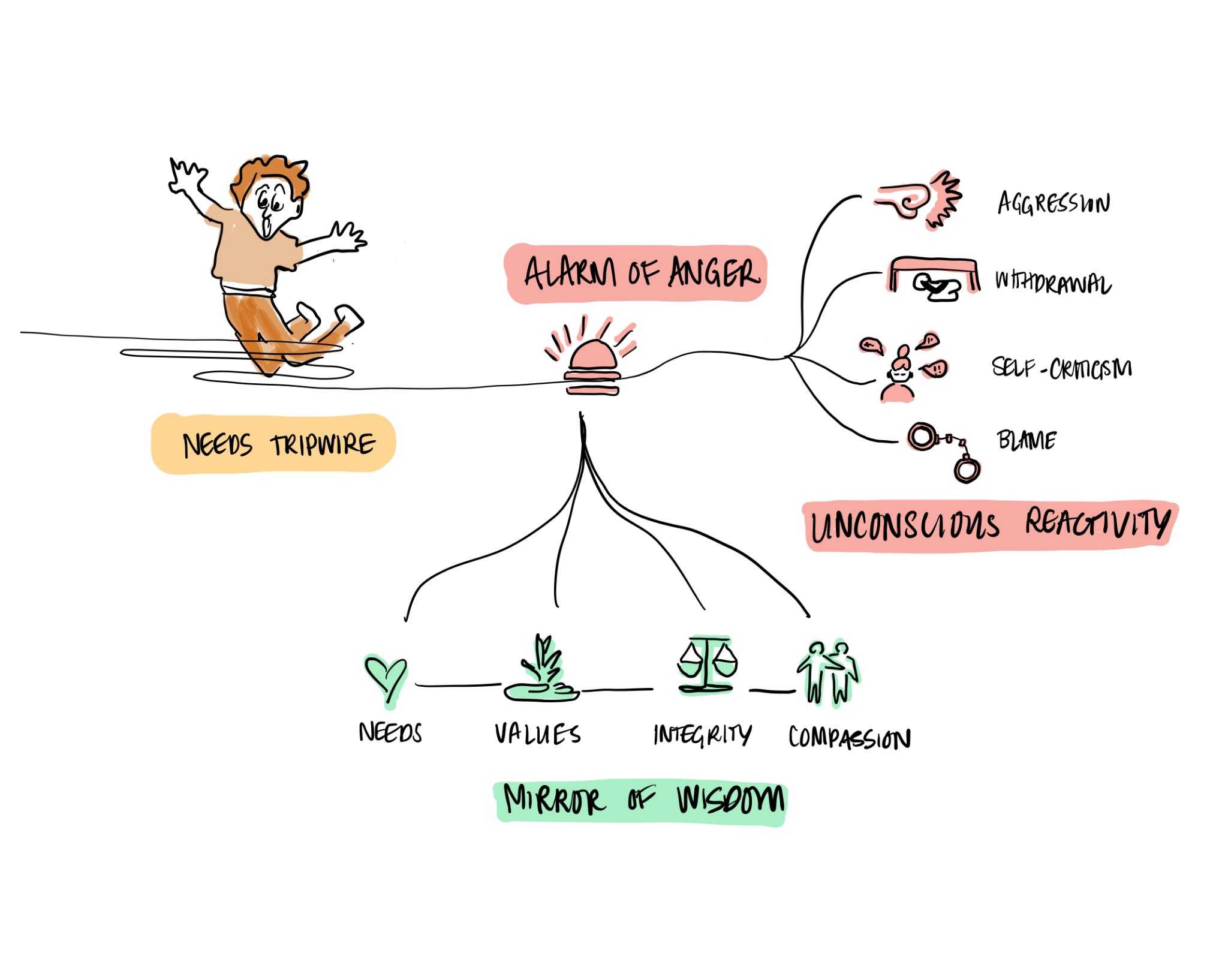
Think of anger as a smoke alarm in your home. When the alarm goes off, the alarm isn’t the problem—it’s doing its job by telling us there might be a fire. If we smash the alarm or ignore it, we risk damage. If we panic and do nothing, the fire spreads. How we respond to the alarm once we hear it determines the outcome of a potentially dangerous situation.
Anger indicates that something we need or care about is under threat—and most often the “fire” is an unmet emotional need.
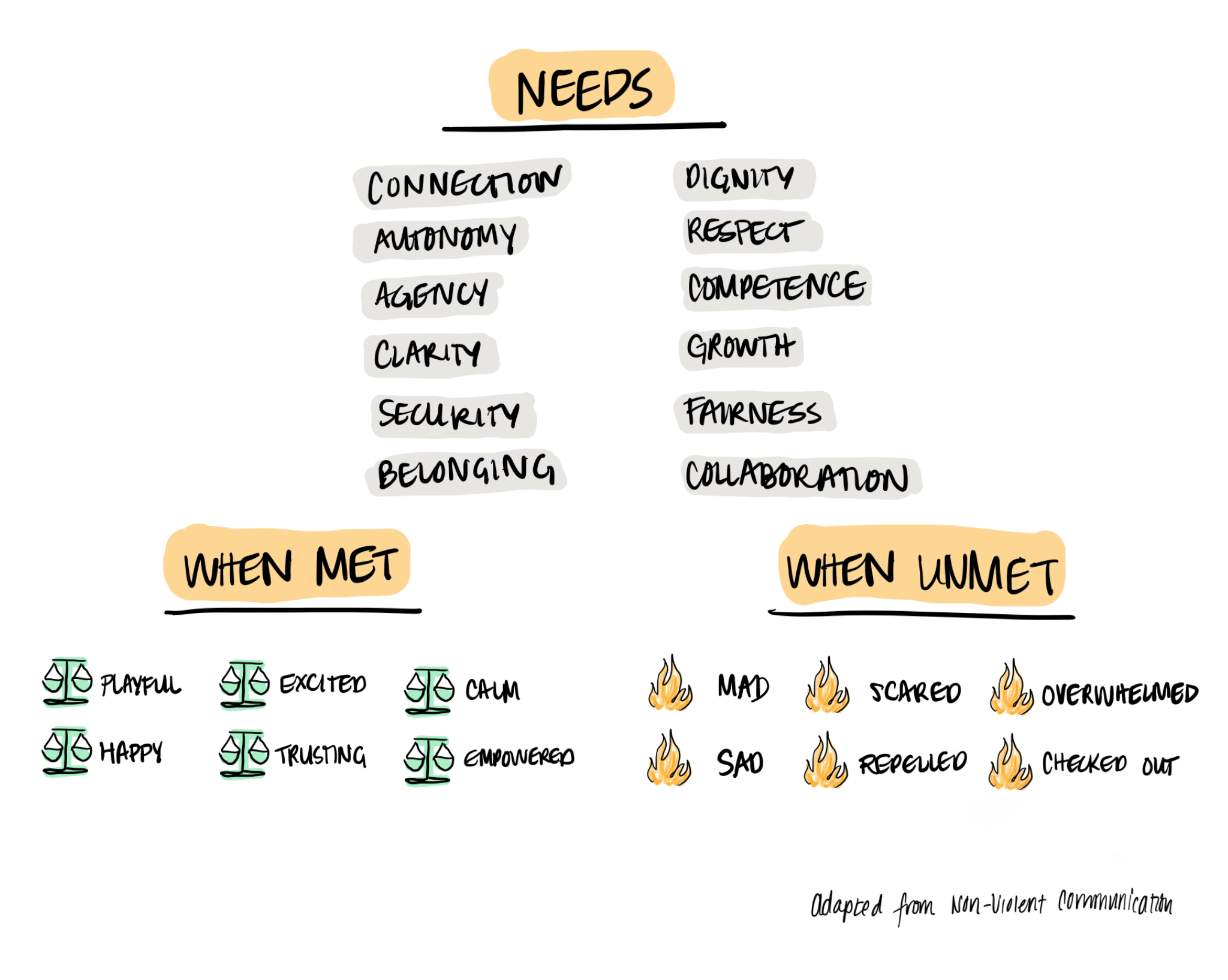
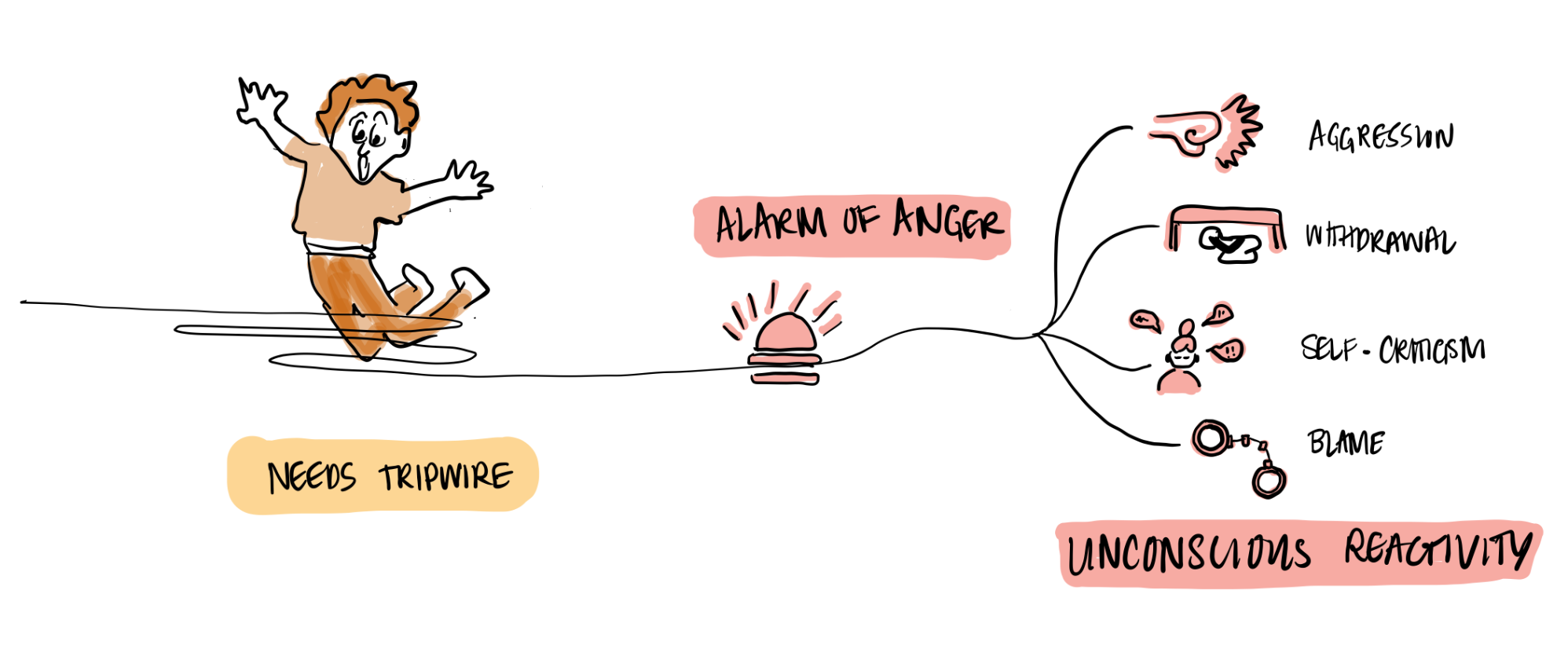
When the anger “alarm” goes off, it triggers different unconscious reactions:
-
Exploding
-
Getting bigger: aggression, control, over-functioning
- Pushing outward: blame, criticism, punishment of others
-
Withdrawing
-
Getting smaller: shutdown, under-functioning
- Turning inward: self-criticism, perfectionism
If we let unconscious reactions take over again and again at work, there can be real costs.
- Exploding leads to conflict escalation, damaged relationships, and lack of trust.
- Withdrawing leads to simmering resentment, passive-aggressive behavior, and burnout.
These reactions happen fast. Here’s an example from my own professional life to illustrate how quickly the takeover happens.
Several years ago, I was facilitating an important meeting with eight cross-functional leaders to make a decision about the launch of a new product line. Differing opinions shot across the room, and I started to notice a pattern as the hour went by. Each time an idea was offered by one of the quieter voices in the room, it was quickly bypassed, shut down, or even criticized by one of the more vocal members of the team.
I noticed myself starting to feel angry after the third, fourth, then fifth instance. I didn’t want to take sides, but the dynamic felt so obvious and unfair to me that my body tensed up. My heart was racing, my hands were clammy, and I was on the verge of saying something I would regret.
And then I did. Raising my voice significantly higher than usual, I firmly stated that I was feeling angry and that I really wanted everyone in the room to stop shutting down the quieter voices. I don’t know how I came across, and I wasn’t even aware of what I was saying. Inside, I was raging. An unconscious reaction had taken over.
The counter-reaction was instant and intense—where was my comment even coming from?! One person raised their voice back at me, another claimed I was judging them unfairly, and a third said I was derailing the conversation for my own personal needs.
So, naturally, I started to feel even more outraged. Before I knew it, the meeting was more about my anger than the team’s goal of making a launch decision. By the time the hour was up, I was nearly in tears, and we were nowhere close to making a call.
Oops.
Feeling angry wasn’t the issue. It was my response to the anger itself that had consequences. I had unconsciously gone into an aggressive reactivity—exploding and sending others on the defense. As a result, the group’s attention was taken away from the real decision and toward managing a heated interpersonal conflict.
It was a painful but pivotal moment to learn about my own boundaries, triggers, default responses, and needs. And it gave me the key to understanding my options for responding to my own anger.
While my anger manifested as exploding in that meeting, we all respond to workplace threats very differently based on our personal history, the situation, and systemic issues. Later, I’ll walk through an example from my client Etienne (who had a different response than mine) so you can get a sense of the range of possibilities.
Anger is the alarm, unmet needs are the fire
If anger is your body’s way of saying “Something important is under threat—pay attention,” it pays to investigate what’s on fire inside you.
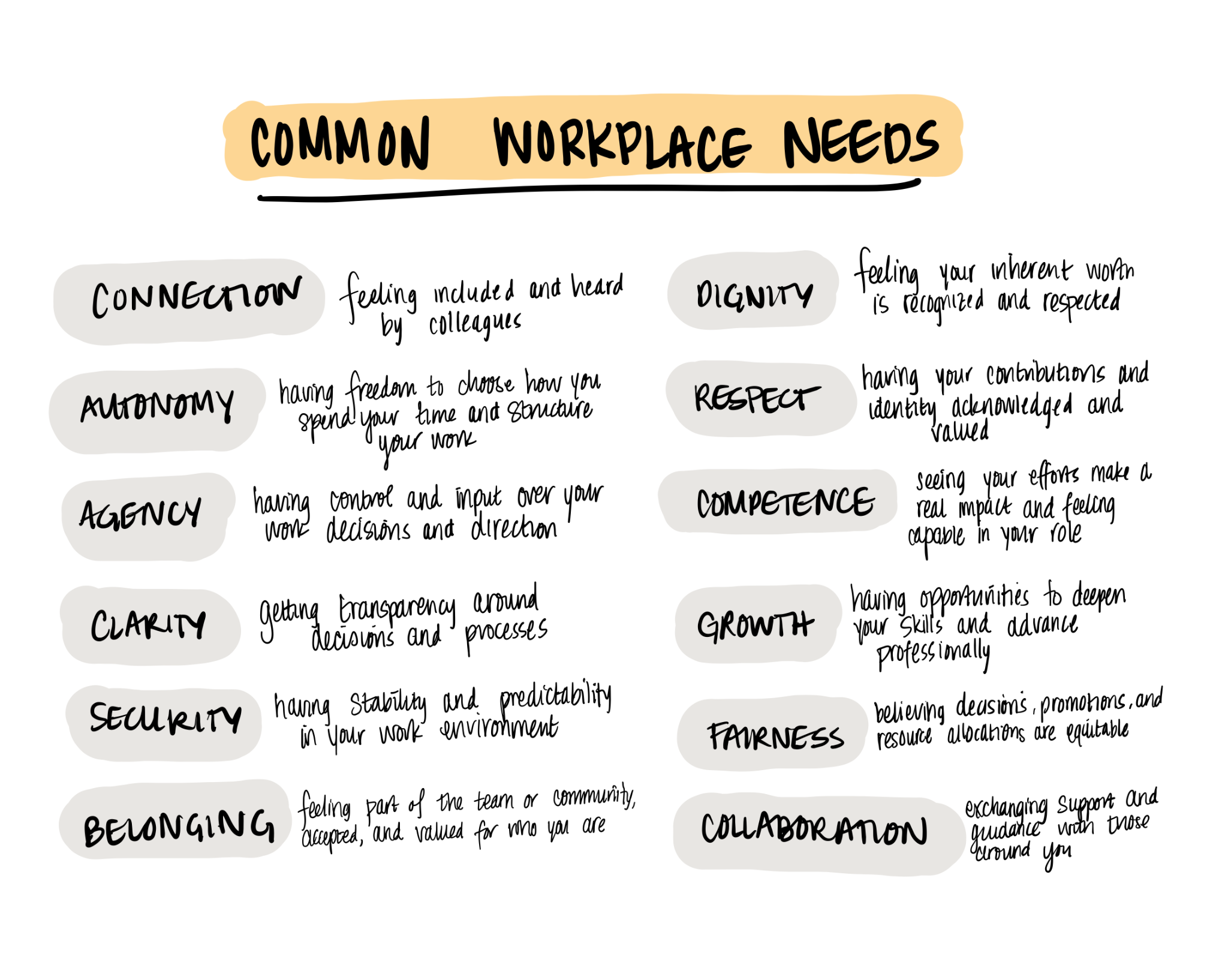
We may think of our time at work as a place of pure logic and practicality, but as humans, we bring emotional needs to every situation and every setting. And when those needs aren’t met—even in the workplace—they can trigger an emotional response in the form of anger. Here are some common and fundamental needs that can set off our alarms when they go unmet:
- Connection: Feeling included and heard by colleagues
- Autonomy: Having the freedom to choose how you spend your time and structure your work
- Agency: Having control and input over your work decisions and direction
- Clarity: Getting transparency around decisions and processes
- Security: Having stability and predictability in your work environment
- Belonging: Feeling genuinely part of the team or community, accepted, and valued for who you are
- Dignity: Feeling your inherent worth is recognized and respected
- Respect: Having your contributions and identity acknowledged and valued
- Competence: Seeing your efforts make a real impact and feeling capable in your role
- Growth: Having opportunities to deepen your skills and advance professionally
- Fairness: Believing decisions, promotions, and resource allocations are equitable
- Collaboration: Exchanging support and guidance with those around you
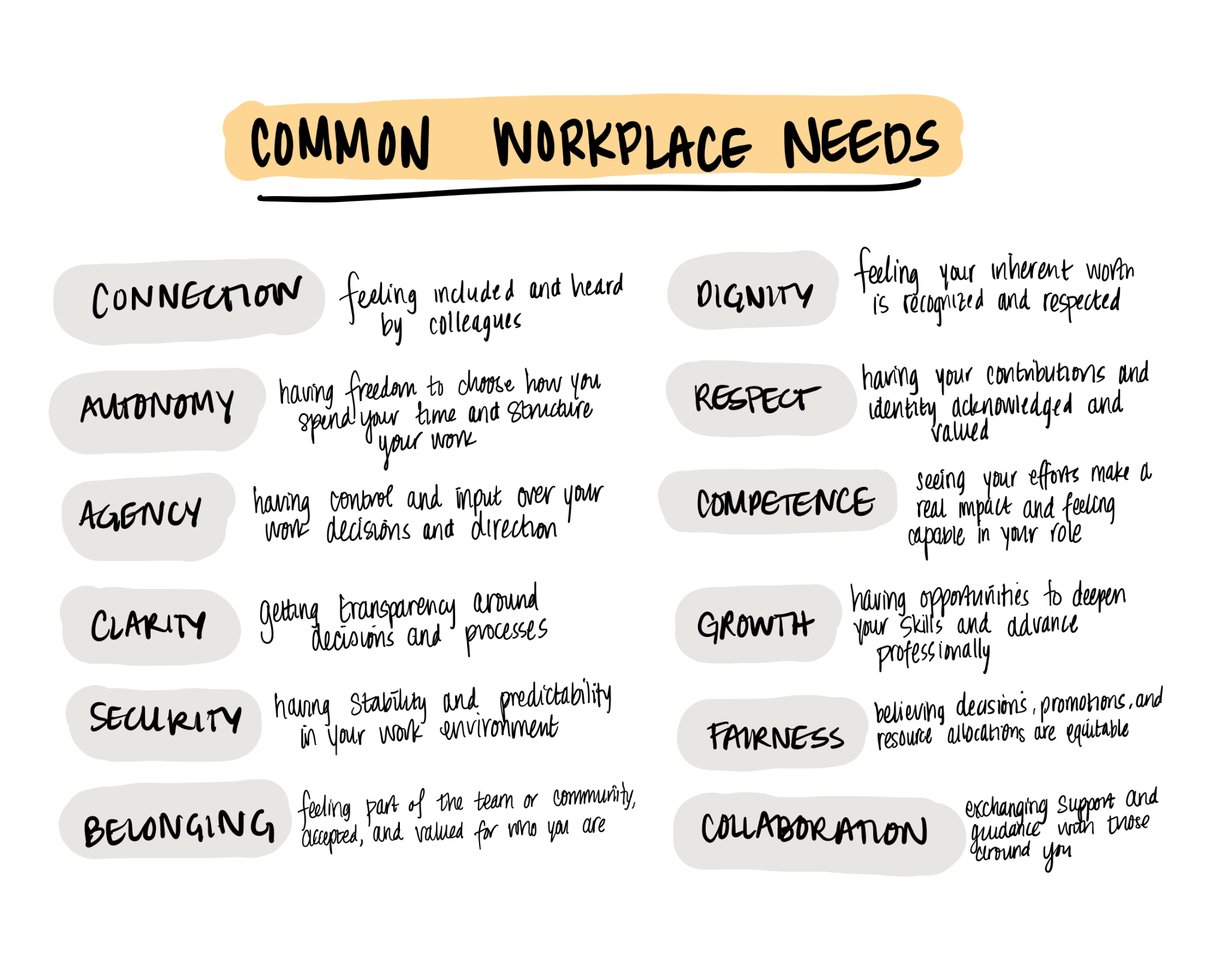
When a fundamental emotional need goes unmet, anger often pops up—and sometimes so powerfully that it overwhelms any other feeling or logical analysis. That’s what happened for me in my earlier example, when I exploded with anger instead of articulating the group’s (and my own) unmet needs for fairness, security, and respect.
I see this dynamic play out across different product teams and levels all the time. Recently, a product leader had her carefully crafted roadmap completely overturned by an executive after they used a competitor’s product and decided to pivot the company’s strategy as a result. She was furious, but instead of naming her need for respect and acknowledgment, she spent two weeks preparing a detailed competitive analysis to prove herself “right,” stalling her team’s work in the meantime. The unmet need festered, and so did the anger.
Four steps to translate anger to wisdom
Below are the four steps I use with my coaching clients (and myself) to transform anger from a destructive force into an opportunity for deeper wisdom and more effective action:
- Recognize your alarm
- Do a U-turn (look inward first)
- Identify the unmet need
- Choose a conscious response
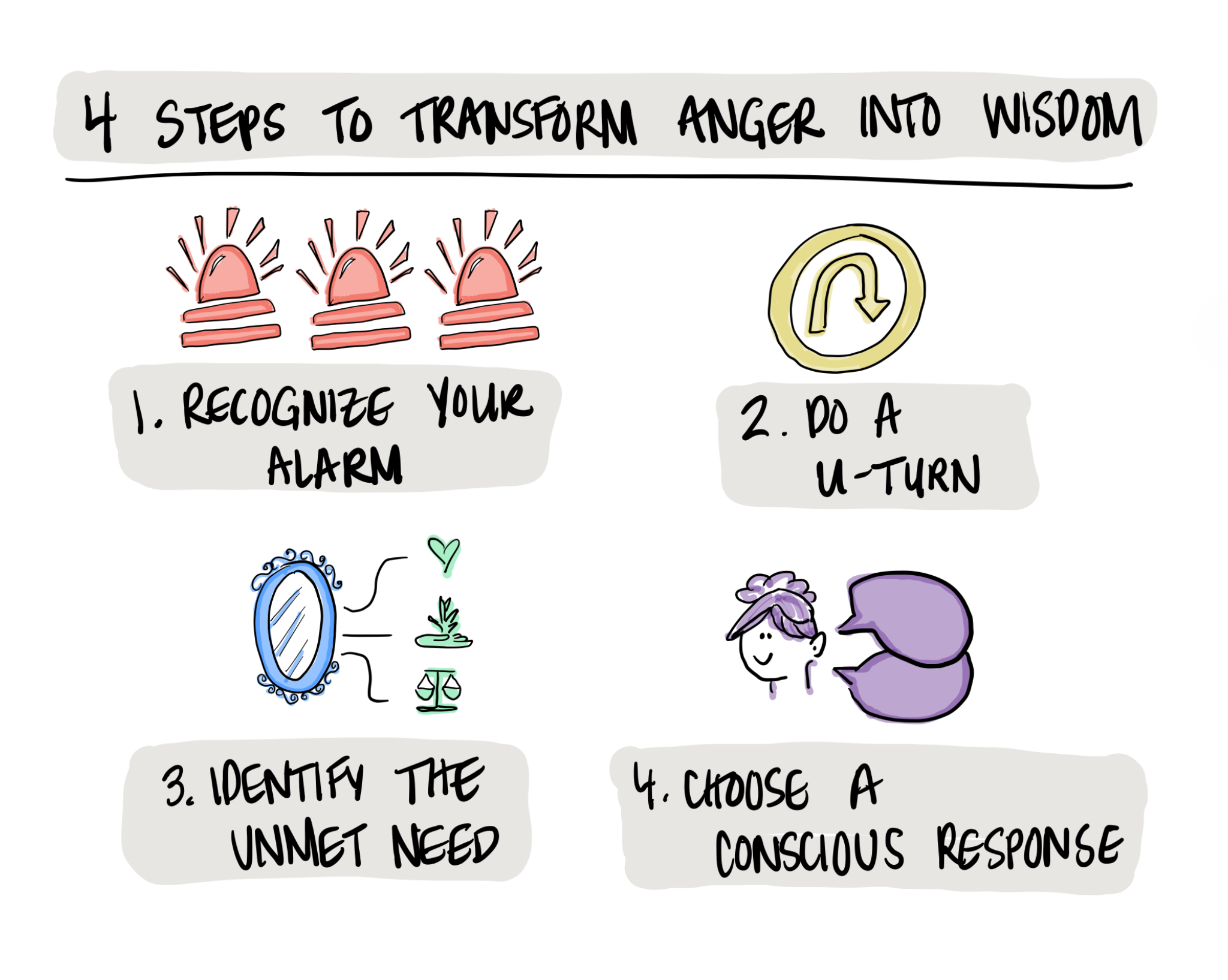
To illustrate how this process unfolds in real time, let’s look at Etienne, one of my clients who found himself battling anger when a new coworker seemed to threaten his sense of being valued on the team.
1. Recognize your alarm
Many of us are so used to labeling anger as “bad” or unprofessional that we avoid even acknowledging we’re experiencing it. The first step is noticing we’re in anger territory.
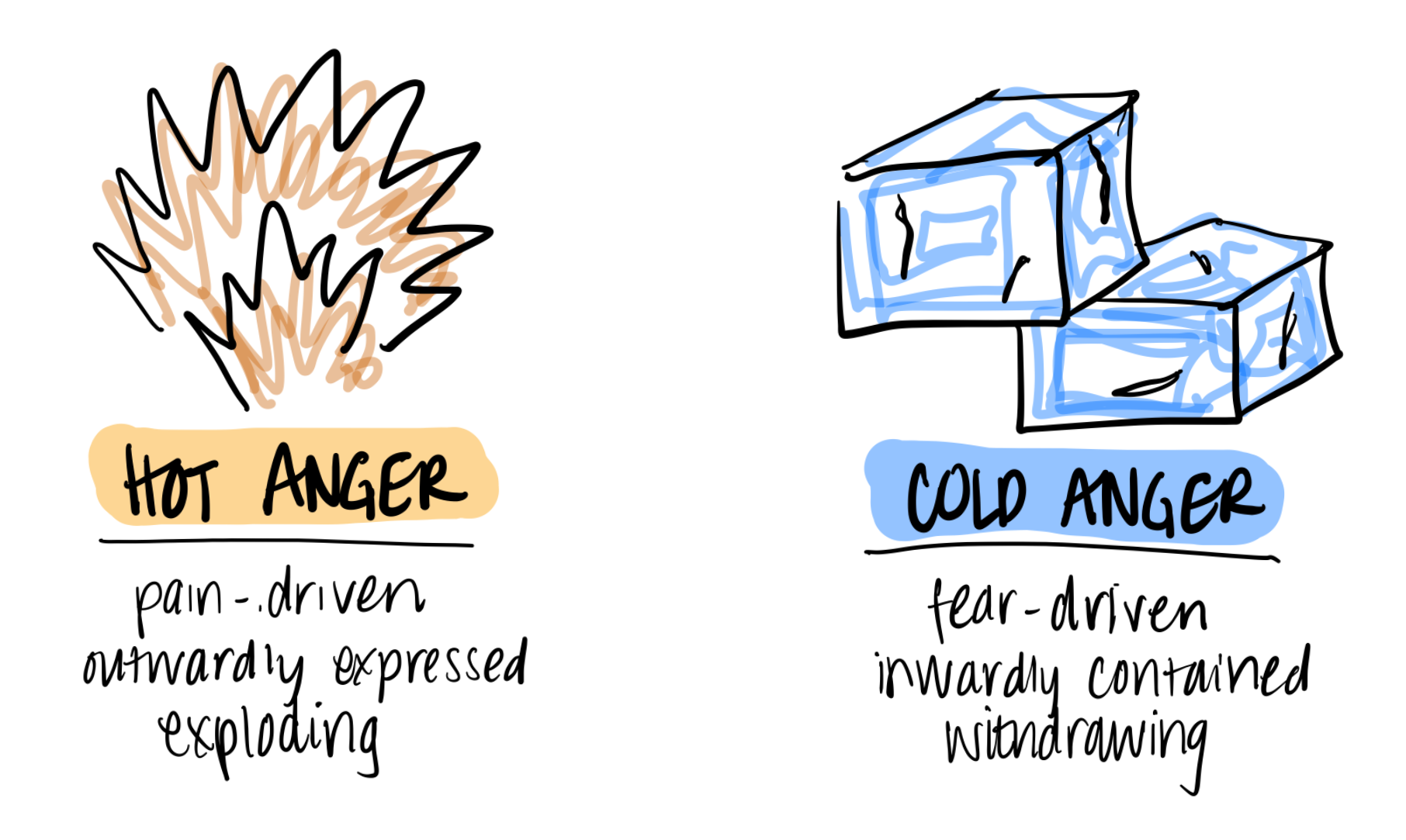
I have found that paying attention to physical sensations is the best starting point. If you’re new to recognizing anger in your body, the Buddhist paradigm of hot and cold anger can be very helpful.
Hot anger feels like urgency, agitation, a pressing need to act or speak now. It is characterized by:
- Physical sensations: constricting or tight chest, warming sensations in your chest or neck, rapid breathing, clenched fists, excessive sweating, or your heart pounding in your ears
- Expression: exploding, going outward
- Protecting: pain, feeling hurt, betrayed, or wronged
Cold anger surfaces as withdrawal, shutdown, or quiet contempt. It is characterized by:
- Physical sensations: goosebumps, a staggered or held breath, slumped shoulders, or a frozen feeling in your extremities
- Expression: withdrawing or going inward
- Protecting: fear of conflict, loss, being too much, or being unsafe
If you run hot, you might need to slow down to access the wisdom.
If you run cold, you might need to make yourself bigger in order to hear yourself more fully. What does that mean?
Imagine your anger alarm as the main character in a play. Bring it to life by first creating a shape with your body that represents this character’s personality. Then have the character verbally or physically express all the things it may never get to express in “real life.” I’ve had clients spontaneously start beating their chests, throwing their arms around emulating a tantrum, or fully fold in on themselves like a crumpled piece of paper.
A skilled product leader known for his behind-the-scenes effectiveness, Etienne came to me struggling to navigate the working style of his new peer Corey.
While Etienne led through quiet competence, Corey was more vocal and politically savvy. Corey knew how to advocate for himself, while Etienne knew how to advocate for his team. Etienne found Corey’s style to be self-serving and threatening, and he was concerned about losing opportunities for advancement for fear of not knowing how to self-advocate like Corey.
When Etienne’s boss, Manuela, suggested that Corey join in to lead one of his projects, Etienne’s anger alarm went off immediately. In our session, I noticed his tight smile (a common deflection when we’re uncomfortable with anger) as he calmly outlined all the operational reasons why Corey shouldn’t join.
When I asked Etienne to check in with his body, he noticed constriction, physical heat building, and a feeling of anxiety. And this was just in reporting the events back to me! Then he would smile and say, “The situation honestly is not that bad.” As we tracked his internal state, his pattern became clear: oscillation between passive-aggressive outburst and complete withdrawal, a mix of hot and cold anger responses.
👉 TRY THIS IN THE MOMENT: When you feel anger rising in real time:
- Take three deep breaths (long exhales)
- Name your physical sensations (“My heart is pounding, my shoulders are tense.”)
- Identify one immediate trigger (“They dismissed my idea. I notice I’m getting defensive about my team’s work.”)
- Write down what you’re feeling rather than saying it
👉 TRY THIS FOR DEEPER REFLECTION: When you’re in a more grounded state:
- Think about the past couple of times you felt angry at work (roadmap presentation to execs? scope negotiation with engineering?). Do you tend to respond to your alarm with hot anger or cold anger?
-
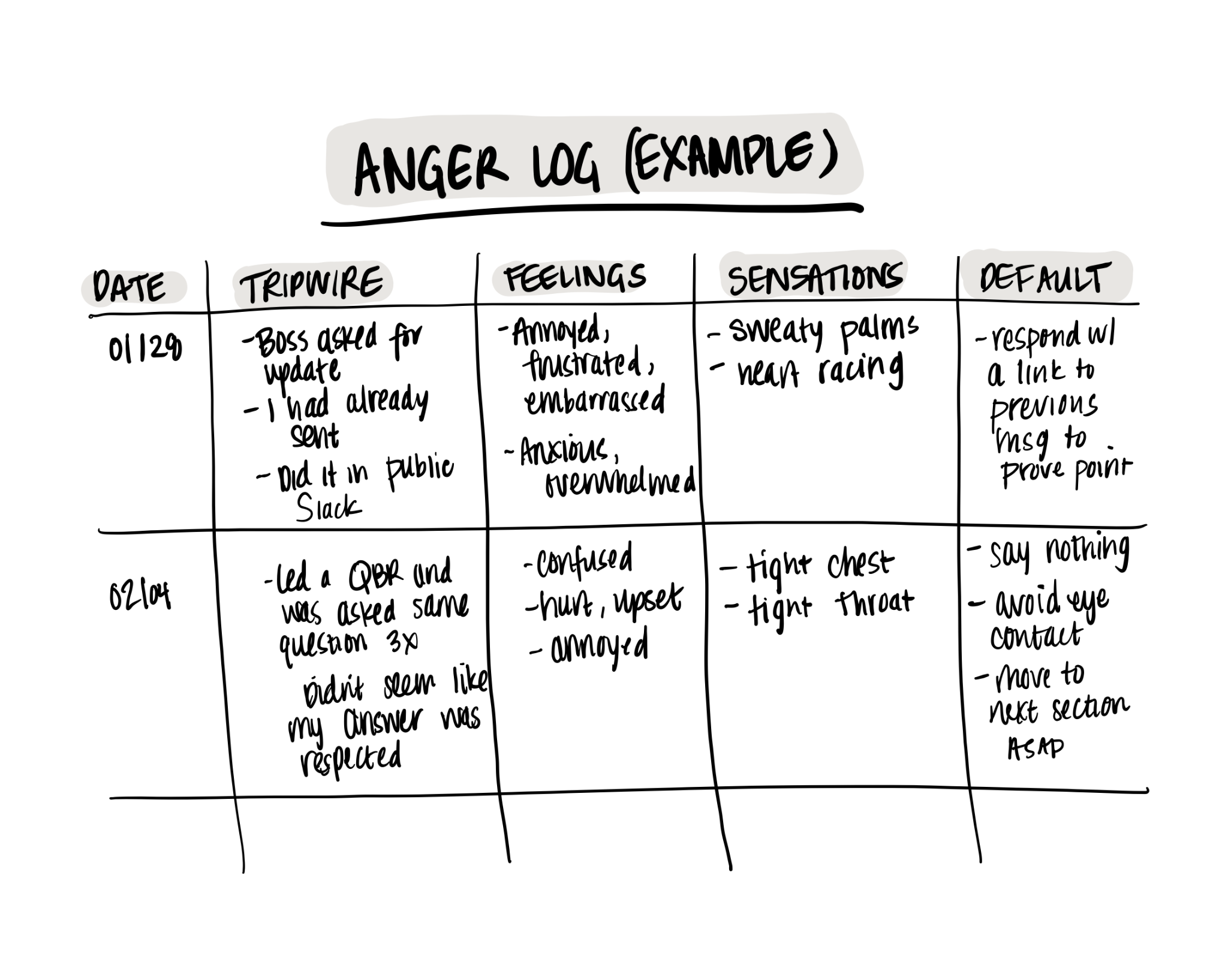
Keep a simple anger log for a week (see example below)
-
What patterns trigger your anger (e.g. scope changes, dismissed research, bypassed processes, boss interrupting you)?
- How does your body signal anger in these situations? Pay attention to your physiology (e.g. clenched fists, tight chest, internal screaming voice).
- What’s your default response pattern in different contexts (e.g. outward expression, inward expression, gossiping, crying, biting your tongue)? Patterns will emerge.
This self-awareness work is difficult and an ongoing practice. I’ve spent decades dissociating from my internal experience and mostly operating from the neck up at work because most workplaces reward that! Maybe you have too. Given that, don’t underestimate the power of this step: recognizing and naming your own anger alarm may be a huge first step toward building a different response. It will get easier over time.
2. Do a U-turn (look inward first)
When anger spikes, some of us often look outward: They’re the problem! And if we have a tendency to withdraw or turn inward with anger, we may be quick to dismiss our own suffering and instead harshly direct it toward ourselves: I’m an idiot!
This is exactly what happened with Etienne. His first instinct was to focus entirely outward, preparing arguments about operational overhead and how much the team would be disrupted if Corey joined. He was building a case against Corey rather than understanding his own reaction first.
The second step is to pivot inward with compassion. What am I actually feeling and why? We do this not to let others off the hook but because we’re the only ones who can truly attend to our own reaction.
When I invited Etienne to turn inward, he could start to see that his reaction wasn’t just about Corey or the project structure. There was something deeper being triggered about his own way of working and his sense of being valued by Manuela, his manager. During our session, I noticed how Etienne’s energy shifted as he moved from listing all the reasons Corey shouldn’t join the project to actually feeling what was happening inside his body. His shoulders dropped, his voice got quieter, and he admitted, “I guess I’m concerned that if Corey joins, my contributions won’t be as obvious anymore.” This moment of vulnerability opened the door to understanding what his anger was really trying to protect.
Doing a U-turn is vulnerable and counterintuitive, especially if you believe you have been wronged. But we cannot see what’s happening beneath the anger—what our alarm is truly signaling us about—if we stay outside of ourselves.
👉 TRY THIS IN THE MOMENT: When you feel triggered in a meeting or conversation:
-
Use Tara Brach’s RAIN system, a super-powerful tool for doing the U-turn.
-
Recognize what’s happening (“I am getting defensive.”)
- Allow it to be as it is (“It’s OK to feel this way.”)
- Investigate with interest (“What’s underneath this anger? What hurts right now?”)
- Nurture with self-compassion (“This is hard, and I’m doing my best.”)
- Focus on your breath and physical sensations. You don’t need to fix or change them. If possible, ask for a quick break to collect your thoughts.
👉 TRY THIS FOR DEEPER REFLECTION: When you have time to process:
- Pick three emotions using the Feelings Wheel.
-
Journal for three minutes each, writing freely without editing
-
“I’m [emotion 1] because…”
- “I’m [emotion 2] because…”
- “I’m [emotion 3] because…”
- Get curious. What need might these emotions be pointing to?
The goal here is to make the intentional move to turn toward yourself and get curious about your experience. This step, much like the first, takes time and practice. The journal prompts are there to help you learn the mechanism for going inside, but once you get more practiced you’ll be able to identify what’s going on internally with more ease.
3. Identify the unmet need
Once you pivot inward, you can see which of your core needs has been violated or threatened.
This is the crucial step where we help anger transform from a blaring “DANGER!” alarm to a clear mirror reflecting your innermost priorities. That mirror is what helps turn anger into functional insights for the future.
Staying with your internal experience, ask yourself: What do I need that is getting expressed through my anger?
Revisit the needs list below or check out the resource section at the end for a deeper list of needs.
For Etienne, having a sense of autonomy on the project pointed to a deeper need. When I asked him, “What does having autonomy give you?,” we found layers: a need for dignity and respect, and a deep need for being seen and valued for his contributions. Working alone had been his way of ensuring that his contributions were clear, visible, and easily attributable to his own unique efforts. The thought of Corey joining threatened this strategy he’d developed for feeling valued at work.
👉 TRY THIS IN THE MOMENT: When you feel anger rising, ask yourself:
- What am I wishing were different right now?
- What feels most important to me in this moment?
- What do I need to feel better about this situation?
👉 TRY THIS FOR DEEPER REFLECTION: When you have space to process:
- Review the list of common needs. Which feel threatened?
- Imagine the perfect scenario. Ask: “If this were perfect, what would I be getting that I’m not getting now?”
- Dig deeper: “What would having that give me?” Continue with that question until you find something that feels tender or vulnerable.
4. Choose a conscious response
With new clarity about your own unmet needs and values, you can decide how to respond rather than letting your anger drive you. That may mean speaking up, setting a boundary, or simply taking a break to process on your own.
Etienne’s clarity about his core need—to feel valued—opened up new possibilities for action. Instead of arguing against Corey joining the project (a reaction driven by anger), he decided to have a different conversation with Manuela about how he experienced recognition and support at work. This wasn’t about preventing Corey from joining anymore; it was about ensuring that his own needs for visibility and acknowledgment could still be met.
Not every work environment allows for the vulnerability of speaking from needs. Still, I love Tara Brach’s advice on this: “Whenever it has a chance of increasing understanding and connection, speak out.” I’d add to that “without the energy of anger.”
👉 TRY THIS IN THE MOMENT:
- Pause and breathe. Ask: “Will this response build or break trust?”
- Try: “I’m noticing myself feeling [emotion], and I think it’s because I need [x] (or my team has done [y]). Could we discuss this so we can find a solution that addresses both of our needs?”
- If you’re leading, pause and ask: “What’s important to each of you here?” This can reset the room and bring everyone’s needs to the forefront.
👉 TRY THIS FOR DEEPER REFLECTION:
-
Journal in two three-minute sessions:
-
Prompt 1: “From my anger, I want to say...”
- Prompt 2: “What I really need is...”
-
Draft two versions of your response: one from anger, one from your identified need
-
Example from anger: “When my roadmap gets changed without consultation, I want to say…”
- Example from identified need: “What I really need in stakeholder relationships is a sense of collaboration and mutual respect.”
- Consider sharing: “I’ve been reflecting on [situation], and I realized I need [x] to do my best work. Could we discuss how to make that possible?”
These exercises help you notice and express your underlying need rather than letting anger hijack the conversation.
Etienne ultimately chose to have a conversation with Manuela that focused on his need for recognition rather than his resistance to Corey. This led to a deeper discussion about what would help him feel valued on the team, including ways his contributions could remain visible even in collaborative projects.
Just like Etienne discovered, the heart of turning anger into wisdom is about pausing to recognize what deeper needs you may have, and then addressing those through a broader or more personal conversation.
Conclusion
Workplace anger doesn’t always announce itself as a fiery outburst. Whenever you feel a trickle or rush of frustration, there’s an opportunity to get ahead of the anger before it gets out of control.
Remember: The goal is not to avoid ever feeling anger (internally or from others). The hope is to transform anger’s energy from something that drives unconscious reactions (like quiet bristling) into a source of clarity about what really matters.
When you feel the alarm ringing, pause. Shift from alarm to mirror by looking inward with compassion. Let that mirror reveal which core need or value is being threatened, then choose a response that builds rather than breaks down trust.
Start small. This week, look for one moment of frustration in a meeting and run it through these four steps. See what you notice. Then reflect on what might change if your whole team had access to this approach.
📚 Further study
- Anger: Wisdom for Cooling the Flames by Thich Nhat Hanh
- Taking Care of Anger by Thich Nhat Hanh
- The Dance of Anger by Harriet Lerner
- RAIN practices by Tara Brach
- When the Body Says No by Gabor Maté
- NVC needs list (to print for reference)
- When Getting Angry Makes You Happy by Lauren Klein
Thank you, Natalie! For more from Natalie, follow her on LinkedIn and X.
Have a fulfilling and productive week 🙏
🏅 Featured role of the week
Bounce is hiring for a Head of Growth based out of San Francisco. As their Head of Growth, you'll be expected to:
- Lead strategy and execution across multiple channels, including product-led growth, SEO, and paid acquisition
- Mix high-level thinking with hands-on execution as you build out Bounce’s growth team
Why I think the company is interesting:
- Bounce is one of the fastest-growing European startups ever.
- They’re now in hypergrowth with a lean and scrappy team. This is an opportunity to join before they really mature.
- They are backed by a16z and a host of tier-one investors. They just raised a Series B and are quickly expanding into a global presence.
- This is not a 0-to-1 role; it’s a 1-to-10 role. Bounce’s growth is already epic, but they need a leader to take it to the next level.
If you’d like to get your profile sent directly to their team, just fill out this quick form. All submissions from my readers get priority (but no guarantees beyond that).
If you’d like to get your role featured here, apply here. If you’re interested in working with my white-glove recruiting service specializing in senior product roles (e.g. Directors, VPs, and Heads of Product), apply to work with us here.
If you’re finding this newsletter valuable, share it with a friend, and consider subscribing if you haven’t already. There are group discounts, gift options, and referral bonuses available.
Sincerely,
Lenny 👋