Last month, I announced our inaugural Lenny’s Newsletter Compensation Survey, and the response was far beyond what I’d hoped for. Readers immediately jumped in to share raw numbers and what matters most to them when it comes to comp—and many told us things I didn’t anticipate.
My aim with this survey series is to create a trusted compensation benchmark for tech roles, while also tracking changes in employee sentiment and priorities around comp. This first analysis focuses on the latter: a deep dive into what tech workers value most in compensation.
With over 5,000 detailed responses, I haven’t seen another compensation survey reach this scale. To help me design and run this survey, I tapped my former colleague Louise Beryl, who recently helped lead the research team at Figma and, prior to that, was managing teams and doing research at Airbnb, Instagram, and Chegg. She’s my go-to advisor on all things surveys, and I’m thrilled to be collaborating on this work with her. Enjoy!

When it comes to evaluating a compensation package, especially in the tech industry, everyone has their priorities. But what really matters to people today when they receive offers and try to negotiate? We analyzed just over 5,000 survey responses from this community (all subscribers of Lenny’s Newsletter, globally!) who are currently employed in full-time jobs (or have been in the past six months) and found clear—and surprising—trends that reveal what truly matters in compensation in 2024.1
What matters most: salary, salary, salary
When evaluating a job offer, the most common priority for tech and other professionals is clear: salary. A significant 75% of respondents selected salary over equity as their top priority during negotiations (n=5,035) [see pie chart below that shows the breakdown of equity vs. salary]. This was surprising, given that in the tech sector, FAANG (aka the Magnificent Seven) stock has historically been lucrative and startup equity has been seen as the path to life-changing wealth. Just 13% of respondents selected equity over salary, while 4% highlighted several other considerations beyond salary or equity (and 8% indicated that the question wasn’t applicable or preferred not to answer). We are also surprised by the strength and clarity of their preference and reasoning, given the diversity among respondent demographic profiles (in gender, geographic location, years of experience, and education level) and professional profiles (industry, company stage, functions).2
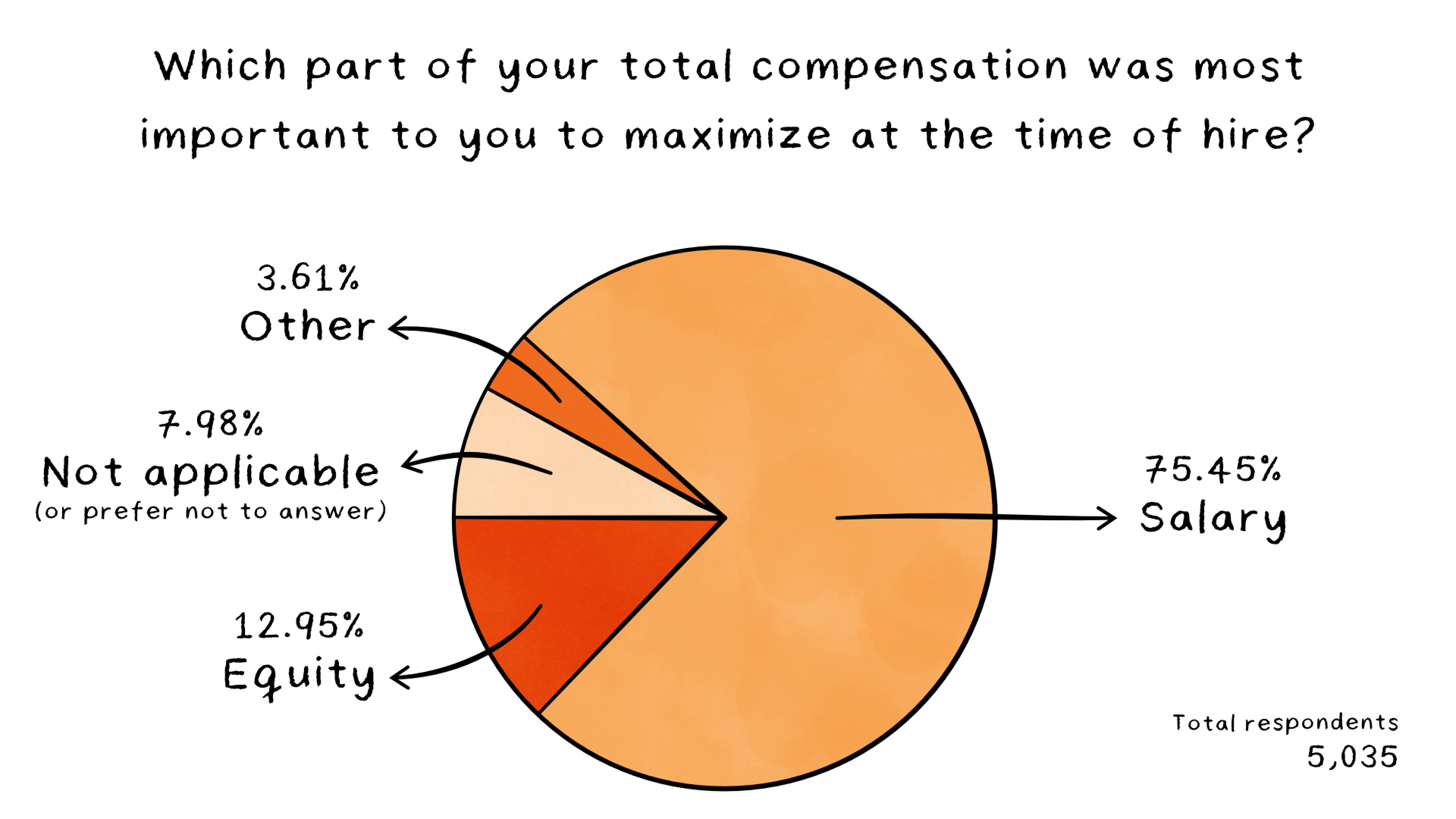
So why did salary dominate this survey? Our takeaway from qualitative answers is that after Covid, years of inflation, and a potential recession, people are ultimately looking for stability. They need to meet the demands of life, and many have experienced setbacks that make them approach compensation offers more practically than we anticipated.
1. Salary = stability
“Cash is king.” This phrase was echoed repeatedly by respondents in explaining why salary was their main priority. The predictability and security of a stable paycheck are vital. “Salary is guaranteed. Equity is not. I need cash to pay the bills,” noted one IC engineer at a late-stage fintech startup. Even an executive in product at a series B company put it, “My base salary is what I use to live life, and bonus/equity/etc. are not guaranteed.”
High cost of living and family responsibilities demand cash flow. For professionals living in high-cost-of-living (HCOL) areas, the importance of salary becomes even more pronounced. As an engineer at a series A startup succinctly put it, “Living in NYC is expensive af!” The need to cover daily expenses often outweighs the potential future gains of equity: “Equity doesn’t pay rent,” a PM at a series B startup explained. The immediate cash flow provided by a solid salary is crucial for these professionals as they navigate the high costs associated with tech hubs like San Francisco and New York.
Life stage also plays a significant role in shaping compensation priorities. For those with families or major financial responsibilities, the need for a guaranteed income often takes precedence over potential future rewards. “I have a family to support, and cash in hand is, well, necessary,” a VP of growth shared, emphasizing the importance of a steady paycheck in managing household costs. A marketing C-suite executive at a bootstrapped company with 100-499 employees said, “I’ve got little kids and need to live in an HCOL for work. I understand the upside of working for equity in a growth-stage company (and have benefited from it), but it doesn’t pay the bills,” highlighting the financial pressures that come with balancing a tech career and family life in expensive cities.
2. Equity skepticism is real
Equity, once considered the golden ticket to long-term wealth in tech, is now viewed more cautiously. Many respondents noted that they have had experiences where equity did not yield the expected returns, leading them to prioritize salary as the safer, more reliable option. A veteran senior director of product with 10-15 years of industry experience reflected: “Never had equity turn into anything in the past but hopes and dreams.” The experience of financial downturns, layoffs, or startups with no liquidity events has led many to prioritize cash, which offers immediate value over future uncertainty.
The sentiment that “equity is a lottery ticket” captures the general mistrust and preference for the immediate, tangible benefits of a strong base salary. “Equity is Monopoly money,” quipped a female VP/head of product at a series C startup in the U.S.

“Equity is Mickey Mouse money and can be an amazing upside in the long term, but we can’t count on it,” echoed a male VP/head of product at a series C startup working from Brazil. And there are some who have stronger opinions: “(Hot take) I believe equity is a scam to get early-career employees to work more for less. Even in the best-case scenario, an IC at a seed startup, [you] might exit with enough to buy a car but not enough to buy a house. The days of becoming a millionaire through equity are few and far between. With a higher salary invested over time, you’ll end up with the same amount,” said a female senior IC working from Canada for a series A startup.
With past experiences of equity failing to deliver returns, some have become skeptical of its potential. Salary offers the reliability needed, particularly in an uncertain economic environment, where equity may be less likely to materialize into tangible benefits.
Is this equity skepticism a new trend? Since this is the first time we ran this survey, we can’t definitively say. However, anecdotally, from our experience in the tech world in the past 10 to 15 years, this narrative feels markedly different from the wisdom we used to hear: “Be a missionary, not a mercenary. Maximize your chance for life-changing wealth and ask for more equity.” Perhaps those with more years of experience in the boom and bust of tech cycles can attest to whether the predominant sentiment is brand-new or just re-emerging. Nevertheless, one thing is for sure: in October 2024, people are craving the stability and predictability of liquid cash compensation. We will continue to follow this prevailing sentiment as we benchmark this data going forward.
Who cares about equity?
Based on logistic regression analyses, several factors emerge as predictors of equity preference. Gender has the strongest statistically significant impact on the likelihood of selecting equity over salary, with men 2.3 times as likely to prefer equity compared with women. Job level also strongly influences equity preference, with senior executives and founders showing a higher preference for equity compared with people managers and ICs. In fact, for each increase in seniority level (from IC to people manager to executive), the likelihood of prioritizing equity over salary increases by a factor of 2.0. When considering years of experience, employees with more experience are more likely to prioritize equity over salary compared with those with less experience. Respondents in the higher-experience groups (4-9 years and 10 or more years) are 1.53 times as likely to prefer equity compared with those in the lower-experience group (<4 years).
Geographic location also has an impact: employees in the U.S. are 1.75 times as likely to prioritize equity as those outside of it. Respondents from Canada, Germany, the U.K., and other non-U.S. countries are statistically significant predictors of a lower preference for equity, with the U.K. having the strongest negative effect (0.44 odds ratio). Also notable, respondents in the European Union are 42% less likely to prioritize equity compared with those in other regions.
Company stage (publicly traded vs. privately owned) also plays a significant role, with employees at early-stage companies (from pre-seed through series D or later) 1.34 times as likely to prioritize equity, while those at publicly traded or later-stage companies tend to prefer salary. And finally, company size is a statistically significant, albeit smaller, predictor of equity preference—as company size increases, the preference for equity slightly decreases (odds ratio of 0.94).
Overall, the interplay between a person’s demographics, experience, location, and company profile significantly drive equity preference.
Beyond salary and equity: reminders of what else matters

Although we asked respondents to primarily consider salary or equity as options, a few respondents (n=182) chose to write in their answer. These serve as a good reminder that there are other options to consider maximizing as part of a total compensation package. Financial options include sign-on bonuses, performance-based bonuses, and 401(k) or pension plans. Similarly, there are benefits (i.e. non-financial levers) to negotiate for, such as asking for more vacation days, certain work-life flexibility, or benefits like insurance or family planning. Moreover, some respondents called out the value of asking for things that help with career growth, including titles, mentoring opportunities, learning and development funds, and opportunities for early promotion. “I was hired a long time ago. What was important to me then, i.e. workplace growth [and] mentorship, did not have a monetary value. . . I prioritised growing my earning potential, as opposed to my compensation, at that point in time,” an executive in Australia noted, reflecting a long-term perspective that goes beyond immediate financial gain.
Bottom line: It’s important to know what’s important to you, as well as what levers are available to pull to your advantage.
Takeaway
For job seekers: Is maximizing salary short-sighted?
If you’re prioritizing salary over equity, you’re not alone—75% of professionals do the same now, and for good reason.With rising costs of living and past disappointments with equity, many value the stability and guaranteed cash that salary provides. But does this mean that you’re sacrificing future financial wealth? Not necessarily.
While some may feel pressure to prioritize equity for potential long-term gains, salary can also serve as a key driver of financial growth. An engineering manager at a publicly traded company making $225K-$250K in the U.S. explained, “Bonuses were structured as percentages of base salary,” highlighting how a strong salary can amplify overall compensation through bonuses and raises. Salary often forms the foundation for other compensation components and can set a higher bar for your next role.
So while maximizing salary may feel like a short-term move, it can actually support long-term financial success. By negotiating a strong base salary now, you’re setting yourself up for future opportunities—whether through bonuses, promotions, or increased leverage in your next negotiation.
In other words, prioritizing salary doesn’t mean you’re missing out on long-term wealth. It can be a strategic way to build it.
For founders: What would make a compelling offer?
If you’re a founder trying to attract top talent, this data reveals that focusing solely on equity might not be enough. A stronger salary offer paired with meaningful equity can strike the right balance. Highlight how your company offers both immediate financial stability through salary and long-term growth opportunities with equity. Demonstrating a clear path to liquidity or how your company is positioned for success can also help turn equity into a more compelling part of your offer.
Regardless of which side of the table you’re on, cash is clearly reclaiming its throne in 2024. Stability and security are at the forefront of most professionals’ minds, pushing salary to the top of the priority list. But the right balance of salary and equity can still create a compelling package for those seeking both immediate and long-term financial growth. Understanding what truly matters to today’s talent is essential for crafting offers that resonate.
What comes next
In our next newsletter post, we’re planning to dive deep into compensation numbers and touch on satisfaction levels and key negotiation levers that could boost your total compensation package. We’re hoping to have this out in the next few weeks.
Thank you to Jennier Sanders, Kate Rusk, and Matt Schulman for providing their wisdom and expertise on this topic and/or analysis, as well as respondents in New York and Austin, Texas, for providing early feedback on the survey.
—
Respondent demographic and professional details
- Gender: 64% male, 35% female, with 0.7% identifying as nonbinary or self-describing
- Geography: 56% of respondents working within the U.S. and 44% of respondents outside of it (including 14% from the EU, 7% from the U.K., and 6% from Canada)
- Function: 62% from product, 9% from engineering, and the rest spread across marketing, design, operations, and other functions
- Company stage: 69% privately held vs. 28.5% publicly traded
- Company size: 53% of respondents are at companies with fewer than 500 employees
- Industry: 14% in fintech; 9% in health and biotech; 7% in social media, e-commerce, advertising, or martech; 5% in gaming, entertainment, and media tech; 5% in ed tech; 19% in other B2B, SaaS, or enterprise; and 41% spread across 34 other sectors
- Experience: 26% having 3 years or less of experience, 28% between 4 and 6 years, and 26% with 10 or more years in their field
- Education: 50% holding a college or university degree and 44% having pursued postgraduate education
Thanks, Louise! For more from Louise, follow her on LinkedIn.
Have a fulfilling and productive week 🙏
Hiring? 👀
I’ve got a white-glove recruiting service specializing in senior product roles (e.g. Directors, VPs, and Heads of Product), where I work with a few select companies to fill their open roles. If you’re hiring, apply to work with us below.
If you’re finding this newsletter valuable, share it with a friend, and consider subscribing if you haven’t already. There are group discounts, gift options, and referral bonuses available.
Sincerely,
Lenny 👋
The results from this survey are primarily generalizable to this community of subscribers. However, given the sample size and the diverse distribution of representation across multiple parameters, these findings offer directional insights into broader trends within the tech sector and beyond.
More details on respondent demographic and work profiles from this dataset are included at the end of this post.