Jules Walter—an illustrious Newsletter Fellow and the author of one of my most beloved guest posts, How to develop product sense—is known for his ability to align difficult stakeholders on the gnarliest projects in record time. He’s developed this skill over his more than 10 years leading products and teams at YouTube, Slack, and Google Gemini, as well as mentoring hundreds of PMs through the Black Product Managers network that he co-founded. Below, Jules demystifies what might be the central skill of great product managers: influence.
Jules Walter is a product leader at Google working on Gemini. Previously he was at YouTube, where he launched Primetime Channels with more than 40 streaming packages, such as NFL Sunday Ticket. Prior to Google, Jules spent four years as a product leader at Slack on their growth and monetization teams. While there, he was a key contributor to Slack’s 10x growth. Jules is passionate about building helpful products at scale and improving inclusion and diversity in the industry. He serves on the boards of CodePath and Black Product Managers, two organizations he co-founded to support underrepresented people in tech. He lives with his wife and two kids in Berkeley, California. Follow him on LinkedIn and X.
As a product manager, or basically any leader, your ability to influence others can move your career forward or keep you stuck. And even though it’s such a critical skill for PMs, there isn’t much practical advice on how to develop it. Through years of trial, error, and mentorship, I got better at influence—so much so that a respected Google leader once told me that I “bend people to alignment.”
At Slack, I successfully navigated a significant and controversial shift in the company’s monetization strategy. Later, at Google, I negotiated across teams to overhaul YouTube’s infrastructure, design, and policies, enabling it to support high-profile TV content like NFL Sunday Ticket. My ability to influence people has impacted not just the projects I’ve landed but also my reputation and career trajectory. And as I’ve advanced in my career, influence has only become more essential.
In this article, I’ll share five proven tactics I’ve used to drive alignment on complex initiatives at Slack, YouTube, and now Gemini, that you can leverage in your own work.
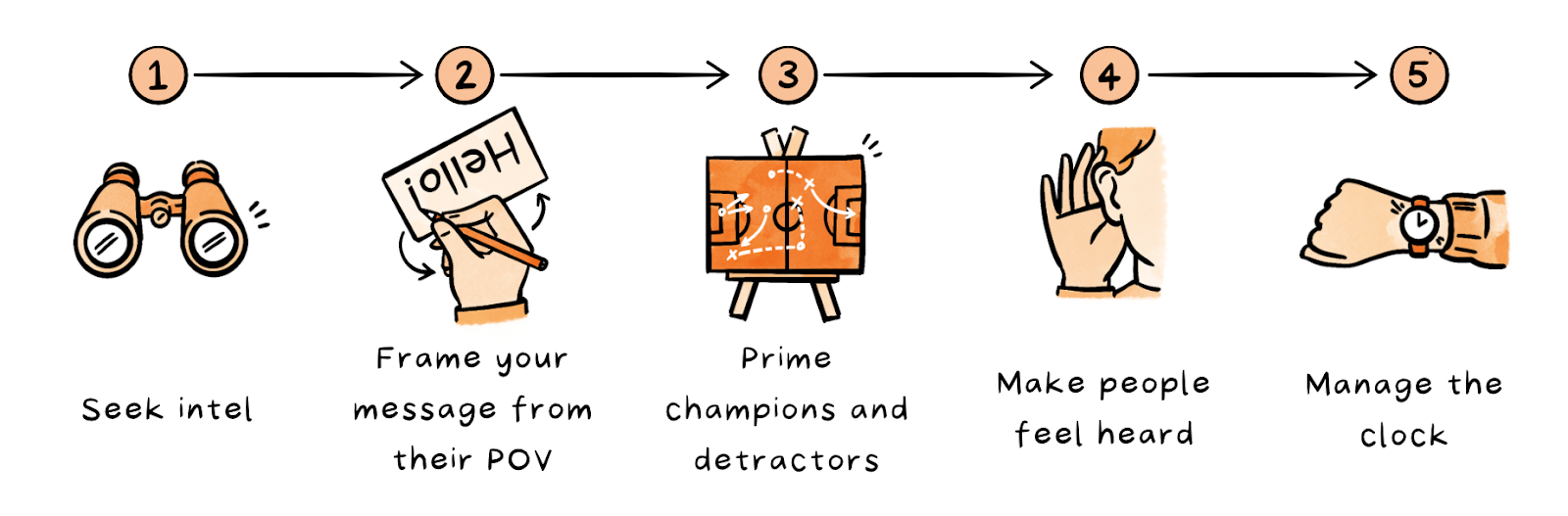
Tactic 1: Seek intel on how each stakeholder makes decisions
To effectively influence stakeholders, the first step is to understand how each person makes decisions––what they value (e.g. goals, incentives), who they consult, and what they’re afraid of. I usually start by setting up one-on-ones with key stakeholders (or people who know them), to understand their POV.
At YouTube, I needed the leads of a critical partner team to prioritize a feature that would otherwise delay my project by at least a quarter. I set up one-on-one meetings with the PM and engineering leads on their team. I explained to them what my project was trying to achieve, but also, more importantly, I asked questions such as:
- What are the top goals and OKRs of your team? (I’ll later need to show how my project might contribute to those goals.)
- What projects do you think will contribute the most to these goals? (These are the top projects I’ll be competing against.)
- What’s your process for deciding what to take on each quarter? (I want to understand the steps I’ll need to go through and key deadlines I shouldn’t miss.)
- Who are the key decision makers? What do they each care about? Who do they listen to? (I need to know which stakeholders to focus on, in what order, and how to approach conversations with them.)
- What concerns do you anticipate them having about my project? (Getting ahead of identifying detractors and their arguments.)
- How might I frame my project to increase the chances they support it? (An ask for advice from people who know the stakeholders the most.)
When having these early discussions, I first focus on establishing rapport. I convey that I’m seeking information at this point and not trying to convince them, because for people to share intel, they need to feel safe. They need to know that I’m here to listen, not argue with them, and that the info they share won’t be used against them at a later point. I start with statements like “This conversation is meant to be an informal chat. I’d like to better understand your world and get your advice as I’m looking to [explain my goals] and make things easier for everyone.”
Another way I find intel on stakeholders, especially executives, is to pay attention to what they say in other meetings and forums. I keep a notes doc where I write down the questions execs ask and the feedback they give. This helps me identify their patterns and anticipate questions and reactions for future discussions when I need their support. Below is what a notes doc might look like.
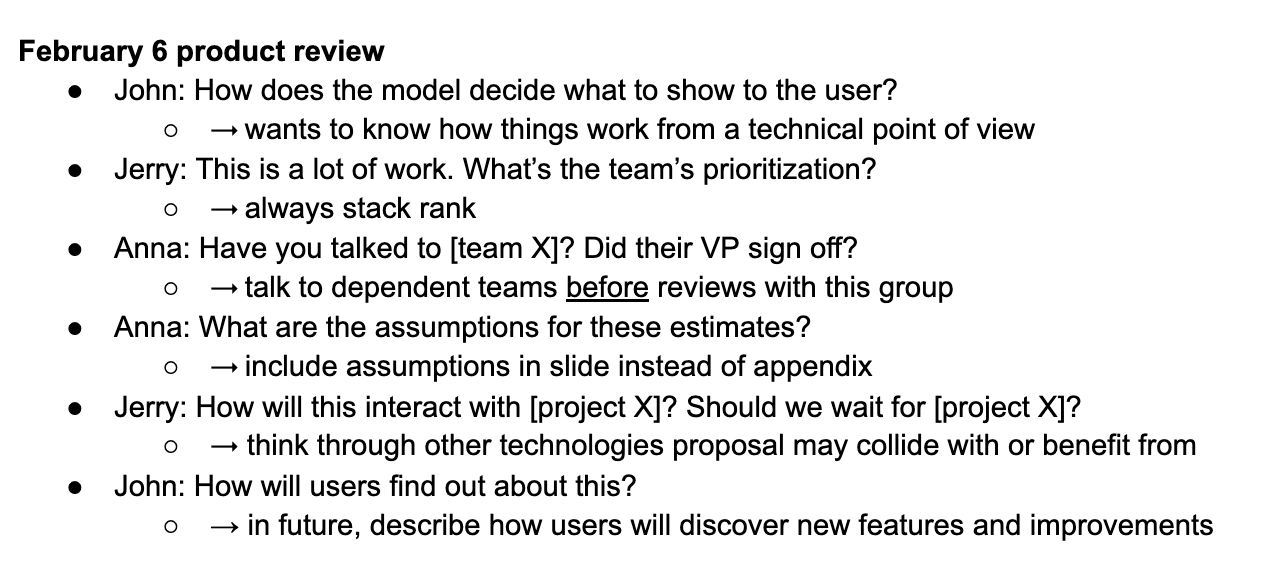
Based on the intel I gathered about the partner team at YouTube, I realized it wouldn’t be enough to emphasize how strategic my project was to the company. The partner team had a long backlog of requests from other teams that I was competing against, and they needed more confidence in my project’s expected impact on a particular metric they cared about. So I decided to walk key folks on that team through my project’s detailed forecast model to show that we would contribute meaningfully to their goals. I also recommended specific projects they could potentially deprioritize. This informed approach made it easier to influence that team, and they decided to support my team’s project, which allowed us to launch on time. This experience was a good reminder that I shouldn’t assume that others will agree that my project is a priority for the business—a tendency we PMs have—and instead be prepared to think through the right framing for my ask and provide impact assessments and other info that can help make tradeoff decisions compared with other projects.
Tactic 2: Frame your message from their POV (not yours)
“Negotiation is the art of letting the other side have your way.” —Chris Voss, author of Never Split the Difference
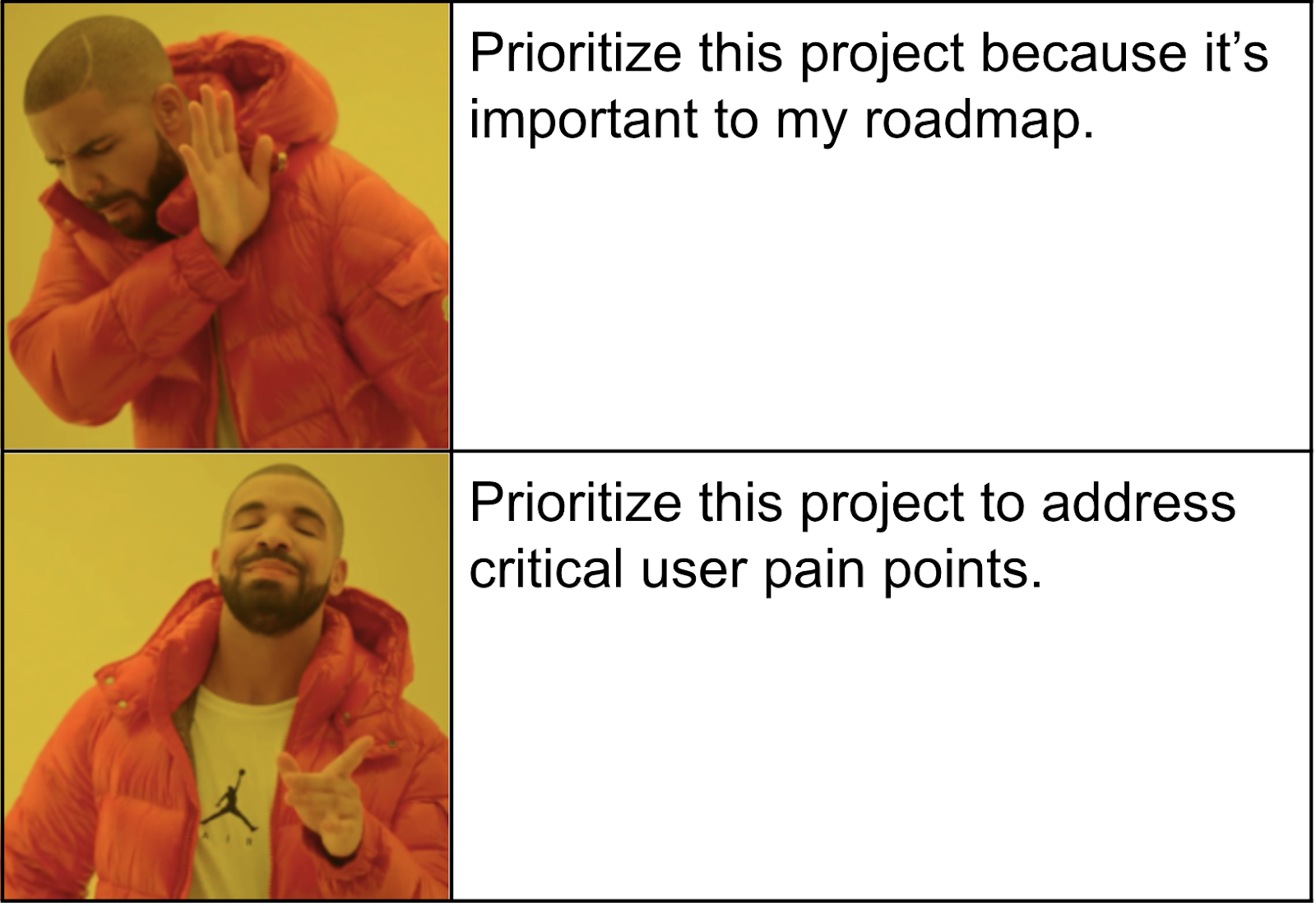
Once I have intel on how stakeholders make decisions, I try to reframe my proposal from their perspective instead of from mine (which is our natural tendency). It’s often more effective to speak their language and demonstrate how my proposal will help them reach their goals, not mine, because stakeholders are focused on their own problems and are more receptive to proposals that address what’s already top of mind for them.
A few years ago, when I was leading Monetization at Slack, we began to encounter diminishing returns in our product iterations, and we needed to take a bigger swing to re-ignite revenue growth. To do that, I spearheaded a controversial project to experiment with a new approach to free-to-paid conversion. The CEO, Stewart Butterfield, had strong reservations about the project. I knew from his previous statements that he didn’t want the company to be thinking about ways to extract value from users, but rather ways to create value for them.
We had scheduled a review with the CEO and a few of his VPs to discuss the proposal. Since he was intensely user-driven, I framed the entire proposal around the benefits it would have for users (the CEO’s POV) rather than emphasizing the revenue impact of the project (our team’s goal). I started the meeting by anchoring the proposal on user-centric insights that we shared in a deck:
- “About 10% of purchases of Slack’s paid version happen from users in their first day on Slack.”
- “Paid users find more value and retain better. Yet we make it hard for people to discover that Slack has a paid version that’s more helpful.”
- “How do we help new teams experience the full version of Slack from the start?”
Once we framed the issue with this user-centric lens, the CEO was more open to our proposal and let us try a couple of experiments in this new direction. This user-centric framing also got the cross-functional team more excited and set an aspirational North Star with clear guardrails, which then enabled various teammates to contribute productively to the project. After we tested two iterations of our monetization experiment, we landed on a version that resulted in a significant increase in revenue for Slack (a 20% increase in teams paying for Slack) and we used what we learned to shift Slack’s monetization strategy into a new, more successful direction.
Tactic 3: Prime detractors and champions alike in the “meeting before the meeting”
Imagine you have a controversial exec meeting coming up. You know that some people in the room are against aspects of your proposal and others have their own reasons for supporting it. If your plan is to just show up and hope the meeting goes well in full view of key decision makers, then you have a high risk of not getting the outcome you want. Instead, I prepare key attendees before the meeting, because my goal is to walk into the room with a coalition of supporters. I do this with both detractors and champions. I see myself as the conductor continuously moving people closer to alignment, even before the decision-making moment happens.
First, I focus on the detractors. If possible, I meet with them ahead of time to deeply understand their concerns and POV. Sometimes I might be able to address those concerns and get them on my side before the meeting. Other times, they might still remain detractors, in which case I can steelman their argument, i.e. identify the strongest possible version of it (see Tara Seshan’s post on How to communicate tradeoffs so leaders will listen), and use that to come up with a rebuttal. Here are sample questions I might ask a detractor:
- “I want to make sure I fully understand your concerns about my proposal. Can you walk me through them?”
- “Are you most concerned about [part A] or [part B]?” (e.g. “Is the issue that this is too much engineering effort or that it’s the wrong strategy?” to disambiguate what exactly they’re concerned about)
Once I understand key arguments from detractors, then I can think through the champions whose support will help the most. I try to meet with champions and ask questions such as:
- “Are you supportive of my proposal? Any lingering concerns?”
- “I’m worried that [person X] might bring [argument Y]. Any chance you could chime in during the upcoming meeting or pre-brief [decision maker Y]?”
When I joined Google, one of my first projects was to write a strategy for a zero-to-one project. The strategy would be discussed at a summit with YouTube execs alongside strategies from various teams across YouTube. In the weeks leading up to the summit, we set up more than 14 meetings with key stakeholders to walk them through our draft and hear their concerns and elicit their support. We identified champions and were able to convert some detractors into supporters, especially when they felt that we incorporated their feedback into the strategy. Our plan was voted top 3 across all of YouTube, and our project was granted significant funding as a result. The work we did to prepare key attendees prior to the meeting played a big role in getting to those outcomes.
Tactic 4: Make people feel heard and validated
Managing emotions in the meeting is another critical aspect to driving alignment. People often won’t listen to you until they feel that you’ve fully heard them. When people don’t think you deeply understand their POV, they often become obsessed with repeating their points more forcefully instead of hearing yours. That’s because psychologically, people who feel dismissed or misunderstood are likely to go into a stress response state (fight, flight, freeze, or fawn) and become more defensive. They are also less likely to let you influence them if they feel you’re not willing to let them influence you (e.g. to listen to their POV). People want reciprocity.
The most common way I try to make people feel heard is by playing back their statements in my own words, especially when they raise concerns. I use statements such as:
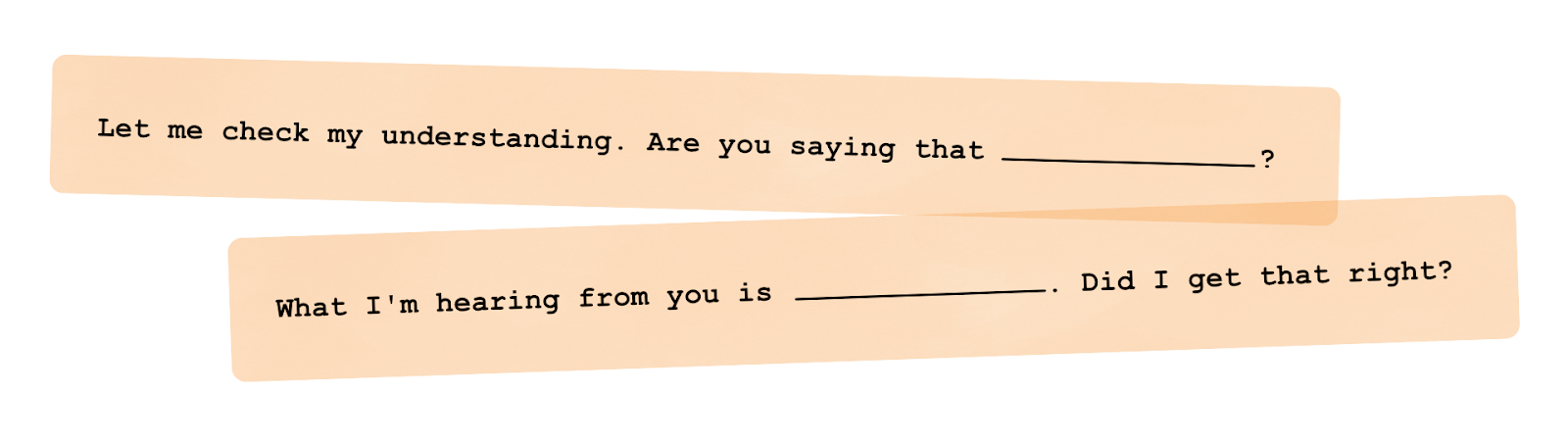
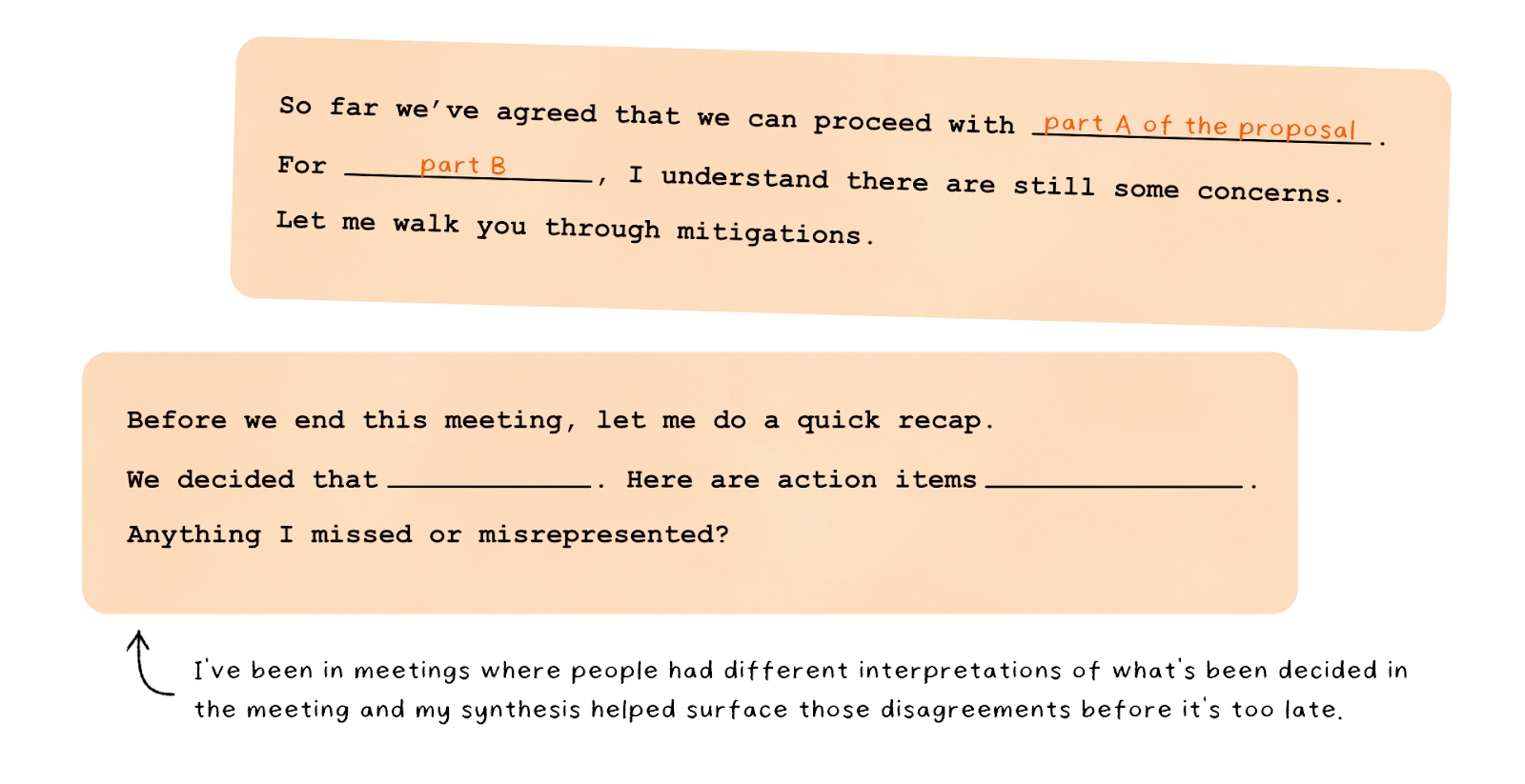
I seek various points in meetings to synthesize the conversation to make various people feel heard and to ensure that everyone is following along and on the same page. I can surface any misunderstandings quickly and bring people back to the crux of the issue so we can make progress. This also helps me secure progressive alignment, which de-risks the decision-making process. Instead of waiting until the end of the meeting to confirm full alignment, during the meeting I might say something like this:
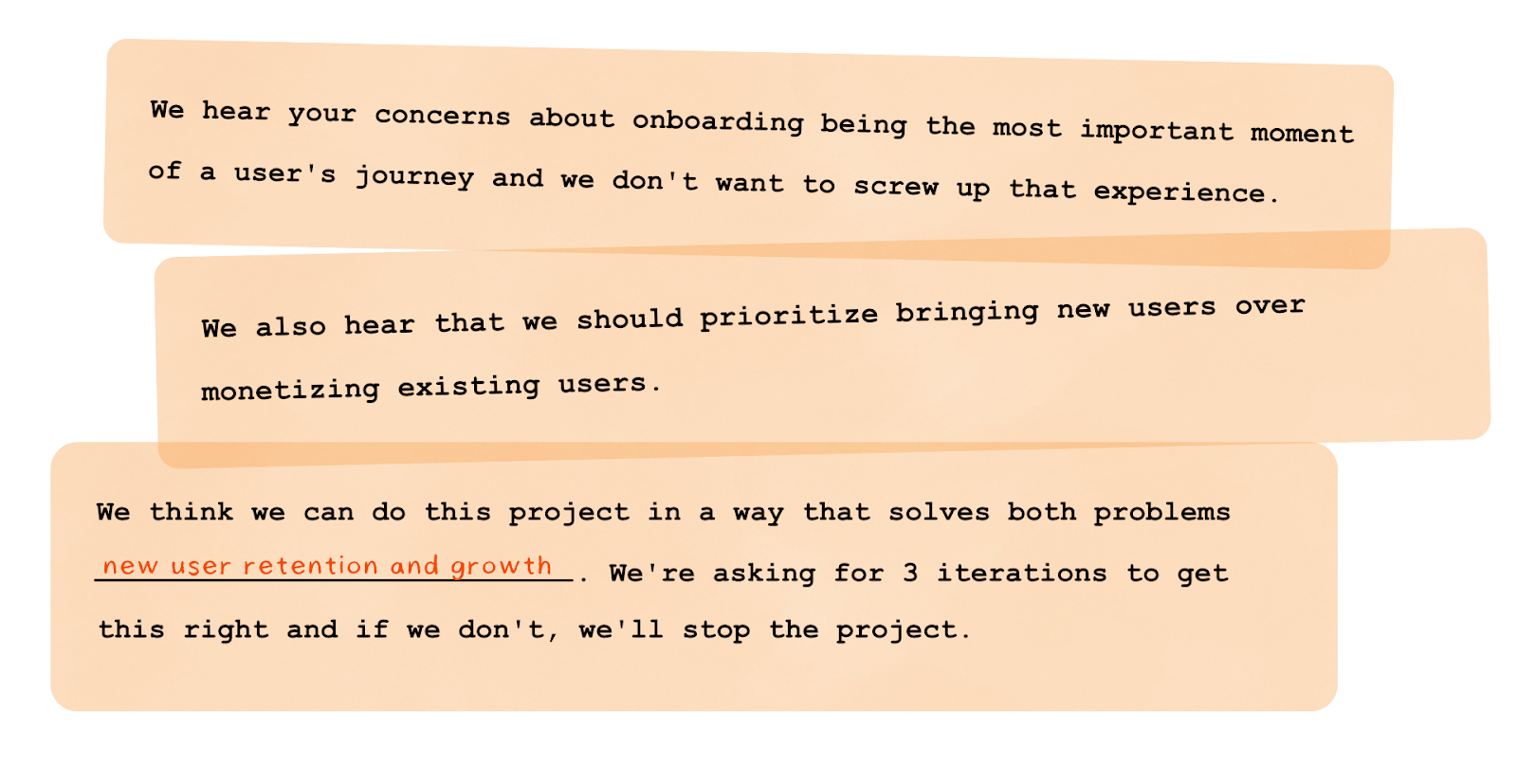
When Slack’s CEO had concerns about my team’s proposal to drive self-serve revenue growth, we made sure he felt heard by acknowledging his feedback through statements along the lines of:
Tactic 5: Manage the clock
One of the most critical but also one of the trickiest elements of getting stakeholders to a decision is managing time in a decision meeting. I aim to be the conductor of the meeting, not one voice among many. Being in control of the clock allows me to ensure that all my points are clearly made and stakeholders feel comfortable making a decision. With senior executives, if you don’t exit the meeting with a decision, you sometimes might not be able to get ahold of them again for weeks or months.
When I start a meeting, I explicitly state a concrete desired outcome up front, such as “Our goal today is to get approval on our go-to-market plan for our upcoming launch.” Having an explicit goal up front gives you more legitimacy later when you need to steer the conversation back to the decisions you need, if the discussion starts digressing.
To help everyone follow along and ramp up on context quickly, I use straightforward and concise language (e.g. as if I’m talking to a teenager with no context in my area). To redirect or pause tangential conversations, I use statement such as:
- “Thanks for bringing this up. I recommend we take that issue offline or come back to it after we get through the critical decisions for today, since we only have 5 minutes left.”
- “Since we only have 8 minutes left, let’s jump to the discussion about [timely issue], which we need to resolve today to avoid delaying launch.”
How I manage the clock changes based on audience and on the topic at hand. During reviews with Slack’s CEO, we would keep attendance as small as possible to enable a more candid conversation and faster decision-making. When presenting to him, I would skip through context slides and get to the crux of the discussion right away, because he processed info really quickly and wanted ample time to debate the proposal before making a decision. At Google, I’ve sometimes used a memo instead of a deck and asked execs to read it and add written questions in the first 10 minutes of the meeting. Then I synthesize and address those for the remaining 20 minutes of the meeting. Every situation is different, but I make sure to pay attention to the clock and plan how I’ll get a decision within the allotted time.
Practice your influencing skill
Mastering the art of influence is crucial for product managers, especially as you become more senior. To get better at it, look for opportunities to practice the tactics we’ve discussed: seeking intel, framing your message from the perspective of decision makers, prepping champions and detractors before the meeting, ensuring that people feel heard, and managing the clock effectively. If some of these tactics feel daunting or outside your comfort zone, find a low-stakes situation to practice them and get feedback from colleagues before trying them out in high-stakes situations later. These tactics have been game changers for me at Slack and at Google, and I hope they are helpful to you as well.
📚 Further study
- The Minto Pyramid Principle (on communicating with executives)
- Pathwise Leadership (group coaching on influence in the workplace)
- Eigenquestions: The Art of Framing Problems
- How to communicate tradeoffs so leaders will listen
Thanks, Jules! For more, follow him on LinkedIn and X.
Have a fulfilling and productive week 🙏
Hiring? 👀
I’ve got a white-glove recruiting service specializing in senior product roles (e.g. Directors, VPs, and Heads of Product), where I work with a few select companies to fill their open roles. If you’re hiring, apply to work with us below.
If you’re finding this newsletter valuable, share it with a friend, and consider subscribing if you haven’t already. There are group discounts, gift options, and referral bonuses available.
Sincerely,
Lenny 👋