Hila Qu is an Executive in Residence (EIR) at Reforge as well as a renowned growth advisor, angel investor, and published author (her book about growth was named one of the top 10 business books of 2018 in China). Previously, she served as the Director of Growth at GitLab, where she implemented and scaled their PLG motion, and VP of Growth at Acorns, scaling them from 1 million to 5 million users.
You can also see the episode transcript and Hila’s references.
What PLG is and why it’s so popular ▶️
PLG is popular due to the shift from sales-driven B2B business models to user-focused, try-before-you-buy tactics: Consumers have become accustomed to testing products before committing, which has led to increased demand for similar experiences in the B2B space. Even if you think of Facebook, there is no one selling it to you to use it, its PLG in motion where your friend invites you.
Why companies should have PLG and sales ▶️
The question is not either or but both and a matter of sequencing. PLG is perfect for lowering the barrier for more people to try the product and broaden the reach. Sales motion is for a very targeted list of big customer for big orders and having a clear hit list for revenue targets.
If you are in a sales motion dominated traditional B2B software industry, you’ll will need to add PLG because competitors will be adding it and gaining an advantage. It is easier to have PLG from early on rather than trying to add it to a pure sales-led company
What makes a company product - led with Zoom as an eg ▶️
- Low barrier to entry: PLG products like Zoom often have a free version or free trial, making it easy for people to start using them without needing approval from their bosses or even knowing much about the product beforehand.
- Self-service checkout flow: PLG products allow users to upgrade to paid plans or access more advanced features on their own, without needing help from a sales team.
- Product spreads on its own: The nature of PLG products encourages organic growth and word of mouth, as people who find value in the free version are likely to share it with others, expanding its user base."
Common pitfalls in adding a PLG motion ▶️
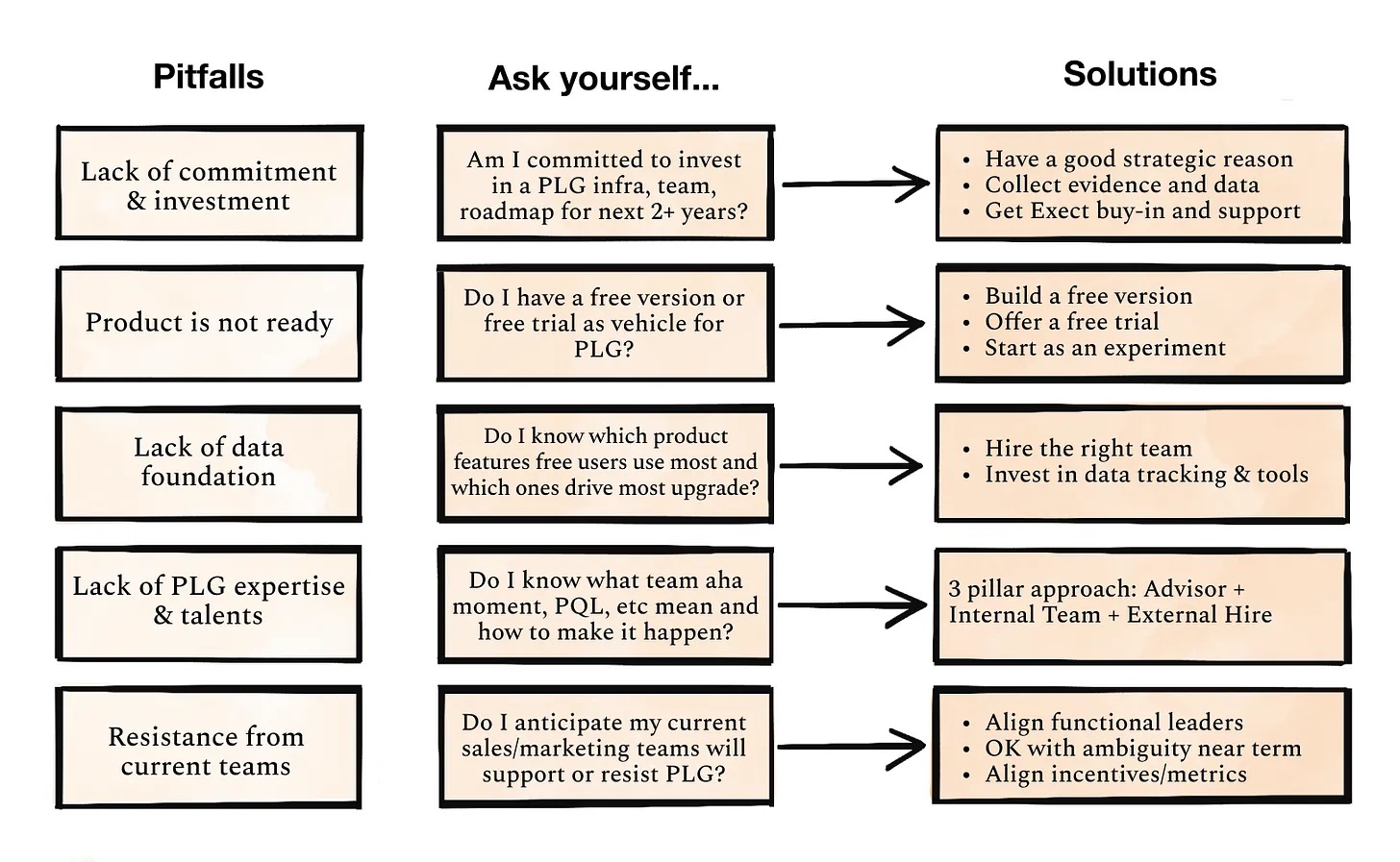
-
Make your product more accessible: A big pitfall for many B2B companies is that the entry point to product-led growth (PLG) is often cut off. Their "biggest CTA is called book demo," which means you have to submit a form before even getting a taste of the product.
-
The first step is you need to either have a free product, free trial, some sort of a low barrier entry for anyone who stumble upon this product to give it a try.
-
Commit to the process: Some companies may think a simple three-month free trial will bring in leads and conversions, but that's not the case.
-
They think the leads will come, conversion will come, self-service revenue will come. It's not that easy.
- PLG is a complete motion that requires commitment and a well-thought-out roadmap, potentially spanning a year or more.
- Don't just go 'free', go 'data-led': Companies that want to do PLG but lack usage data are setting themselves up for failure. When offering a free product, the two returns you want are broader reach and user data. Without that you're basically giving away your product for nothing.
The spectrum of when PLG makes sense ▶️
- Don't equate launching a free version or trial with PLG: Many companies assume that "PLG equals launch of free version or launch of free trial." It's not enough to just open a free trial, you must also consider how to activate users, design an upgrade path, and how this growth team will collaborate with sales and marketing.
- Have a dedicated team: If you're serious about PLG, then a dedicated team is necessary. Assigning just one person to manage all the different stakeholders and parts of PLG won't cut it. Hila notes, "The person needs to be a magician in order to be successful."
-
Consider the fit for your business: It's essential to contemplate if PLG is actually a good fit for your type of business. For example, if your product requires extensive customization for the customer to see value, or if you are targeting only a handful of large companies, then PLG may not be the best approach.
-
…Or defense companies, only three target customer exist in the entire world, you don't probably want to do PLG.
- Remember, PLG is a spectrum: Not every company needs to add a PLG piece, it's a spectrum. However, the majority of B2B software companies fall somewhere in the middle of this spectrum and can benefit from integrating elements of PLG into their growth strategy.
What you need to be successful in a product-led growth strategy ▶️
- Have a Vehicle: A company needs to have a free version, a free trial, an open-source product, or a realistic experience for their product to successfully utilize a PLG strategy. This is the vehicle that will help your product reach potential users and give them a taste of what your product can offer.
- Time to Value: You also need to think about how to provide value to your users quickly. Give users a warm start and helping them get started with your product as soon as possible. This could mean offering sample content or tutorials to help users get started.
- Data Foundation: With the data, you can design a user journey in the product, via email, or through other tools to guide the user to the next step.
The first step to adding a PLG motion ▶️
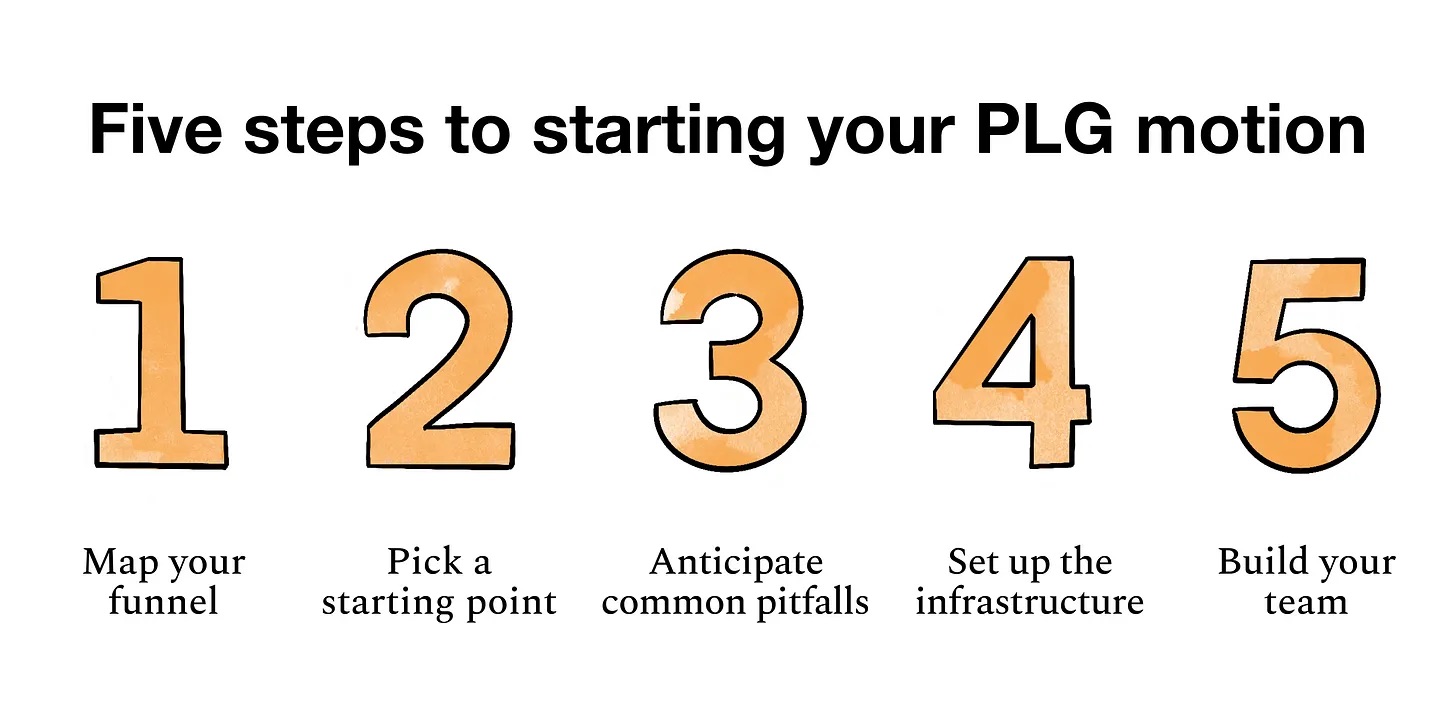
The first step in understanding the difference between the PLG funnel and the sales-led funnel (SLG)
Sales-Led Funnel (SLG): The sales-led funnel begins with the marketing team attracting visitors and turning them into leads. Leads are assessed based on how much they interact with marketing campaigns, like opening emails or attending webinars. A scoring system is employed, and those who reach a certain score become marketing-qualified leads and are handed over to the sales team.
Product-Led Funnel (PLG): This approach mirrors the B2C model more closely. Visitors sign up for a free version, account, or trial of the product, and the aim is to encourage product usage. This becomes the primary success indicator for PLG. Usage can lead to two conversion paths: a self-service purchase or sales team involvement.
- In the self-service purchase route, if the product isn't very expensive, customers may decide to buy it online without interacting with the sales team.
- In the sales team involvement route, if the customer fits the ideal customer profile (like being from a Fortune 500 company), the sales or customer success team may reach out to them to provide personalized service, potentially leading to a larger deal.
Once you understand PLG and SLG funnels, think about the user journey your product needs to have to enable successful conversion in the PLG funnel. Establish the steps necessary for users to convert, utilize the product optimally, and create a revenue-generating pathway.
What GitLab does and how the sales funnel and PLG funnel work there ▶️
Sales-Led Funnel: GitLab's marketing team works on attracting visitors to their website and getting them to sign up for free trials or free accounts. These sign-ups undergo a lead nurturing and scoring process, and the ones that score high are given to the sales team. The sales team, which is divided into SMB, mid-market, and enterprise, then works on closing the deals, which convert into revenue.
Product-Led Funnel:
- An individual, such as a developer, might hear about GitLab, visit their website, and sign up for a free account to use for personal projects. They may use GitLab independently of their company's current solution.
- The company can then sign up for a free trial to test GitLab's more advanced features and use that period to conduct a proof of concept. If they only need a few seats, they might choose to go to the pricing page and buy the product directly.
- However, if this is a large company, the sales team might receive data indicating this company's interest, and reach out to start a sales conversation, potentially leading to a contract.
Hence, the product-led funnel is user-driven and has a more organic growth path, starting with personal use and possibly expanding to enterprise-level usage.
Mapping out the funnel ▶️
Start by mapping out the major steps of how users would interact with your product-led growth motion, such as marketing site, free version, and checkout flow.
- Marketing Site: This is where potential users first learn about the product. The messaging on the marketing site should be designed to encourage free sign-ups.
- Free Version: The product should have a free version that gives users a taste of what it can do. The UX should guide users towards the product's three most important features.
- Checkout Flow: The checkout flow should be smooth and offer various payment options to accommodate customers from all regions.
After mapping out these broad components, the team should then dive deeper to identify the specific details that need to be optimized or maximized in each step of the funnel.
Finding leverage and other next steps ▶️
- Establish the Fundamental Components: After mapping out the product-led growth (PLG) funnel, the first step is to build the foundational components, such as a clear marketing site, a free version or trial of the product, and a smooth checkout process.
- Identify the Starting Point: Choose a part of your funnel to focus on first that will drive the most significant impact. This should ideally be an area where a small investment could yield substantial results.
- Conduct a Full Funnel Audit: Run through the entire user journey from a customer's perspective to understand where potential bottlenecks and pain points exist. This includes the initial website visit, the sign-up process, the initial product use, and finally, the purchasing process.
- Address Pain Points: Be proactive in identifying and addressing issues within the customer journey. Common problems may include confusing checkout forms or unclear paths to reach the product's 'aha moment'.
- Prioritize User Onboarding: Ensure users can quickly reach their 'aha moment' where they realize the value of your product. This crucial step should be a significant focus to prevent user drop-off due to confusion or frustration during the initial product use.
What an aha moment is and conducting an audit ▶️
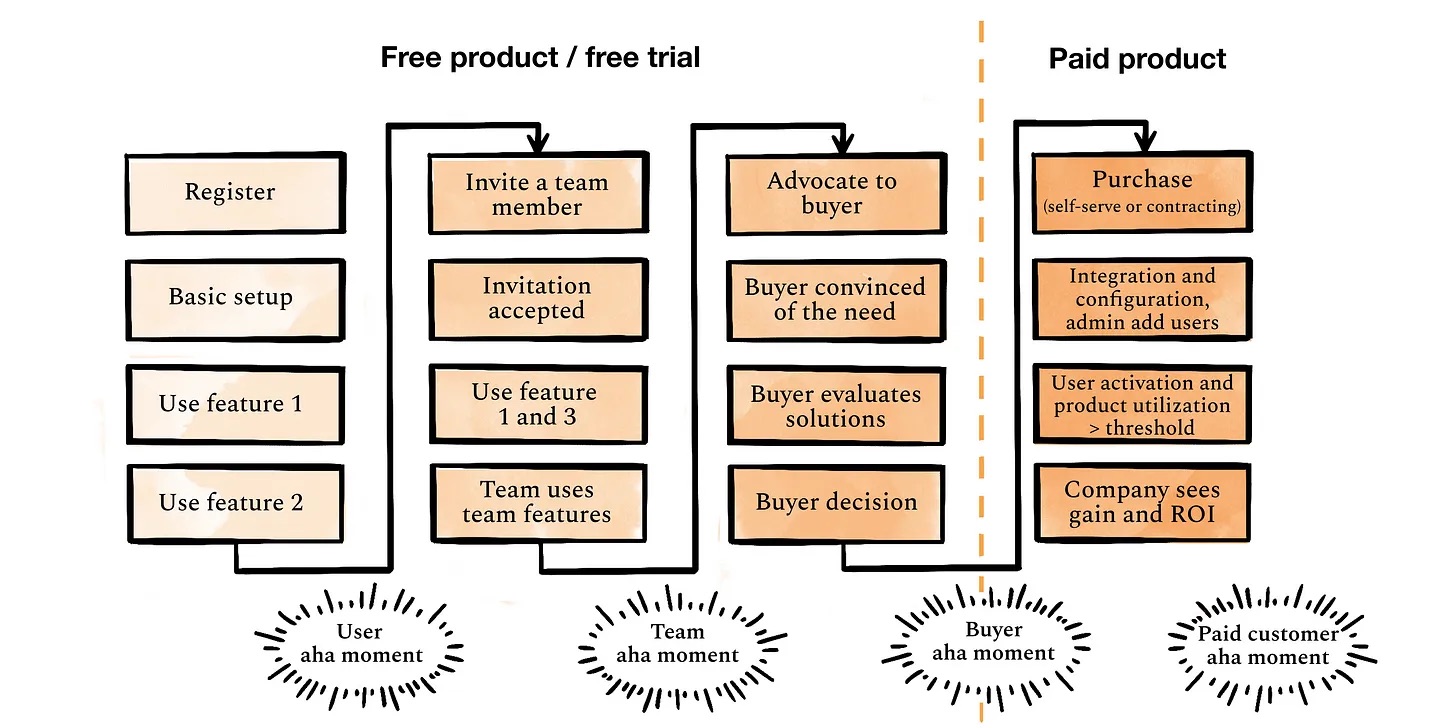
- Data Analysis: Pair the audit with data on how many people are on your website, how many go through the signup process, how many reach the 'aha' moment, and how many are successful in self-checkout. This combination of data and user experience will help identify the most significant areas of opportunity, often activation and conversion.
-
Understand your Product’s ‘Aha Moment’: The 'aha' moment refers to the first time a user experiences value from your product. This concept originated from Facebook's early growth strategy where if a user added 10 friends within 7 days, they were more likely to continue using the platform.
-
GitLab defined their 'aha' moment as "two users using two features within 14 days". This indicates that the initial user found value in the product and was confident enough to invite a coworker, demonstrating the platform's collaborative nature.
-
Validate Your Aha Moment with Experiments: Correlation doesn't imply causation. Just because users who perform a certain action are more likely to convert doesn't mean they will.
-
You just saw people who are doing this are more likely to convert. But it doesn't mean if you get people to do that, they will convert.
- Audit Your Product’s User Experience: Audit your product by assessing the excitement it generates on the landing page, its usability, and if the user can get to the 'Aha Moment' and purchase the product all by themselves. Look at the initial emails sent to the user as well.
-
Use Data to Identify Opportunities for Growth: By mapping out the user's journey and analyzing data at each step, you can spot areas that have the biggest opportunities for improvement. Usually, areas like activation (users taking meaningful action in your product) and conversion are common starting places for growth.
-
Obtain data on website traffic, sign-up rates, aha moment achievement, and self-checkout success to spot the biggest opportunities for growth
Activation and conversion ▶️
- Focus on activation if users are confused on their first interaction with the product: Identify the ideal aha moment metric and design a product experience that leads users towards that goal. Use warm starts by providing templates or samples to reduce friction and engage them immediately.
- Focus on activation: If you're finding that people are initially entering your product but don't know what to do next, then you have an activation problem. To solve this, you need to identify your "aha moment metric and then, design a product experience to help more people together."
- Improve conversion if the checkout process has friction: If your activation is in good shape but your conversion is low, it could be that the checkout process is too difficult or confusing. It could be that users can't even find where to buy your product or they encounter issues during the checkout process that are specific to their region.
- Explore product-led acquisition for collaboration software: If your product is something that encourages collaboration, you could leverage this to help spread the word about your product. Think about how companies like Airtable or Figma encourage users to invite their team members to join the platform.
Why you should start with activation, and who is doing it well ▶️
-
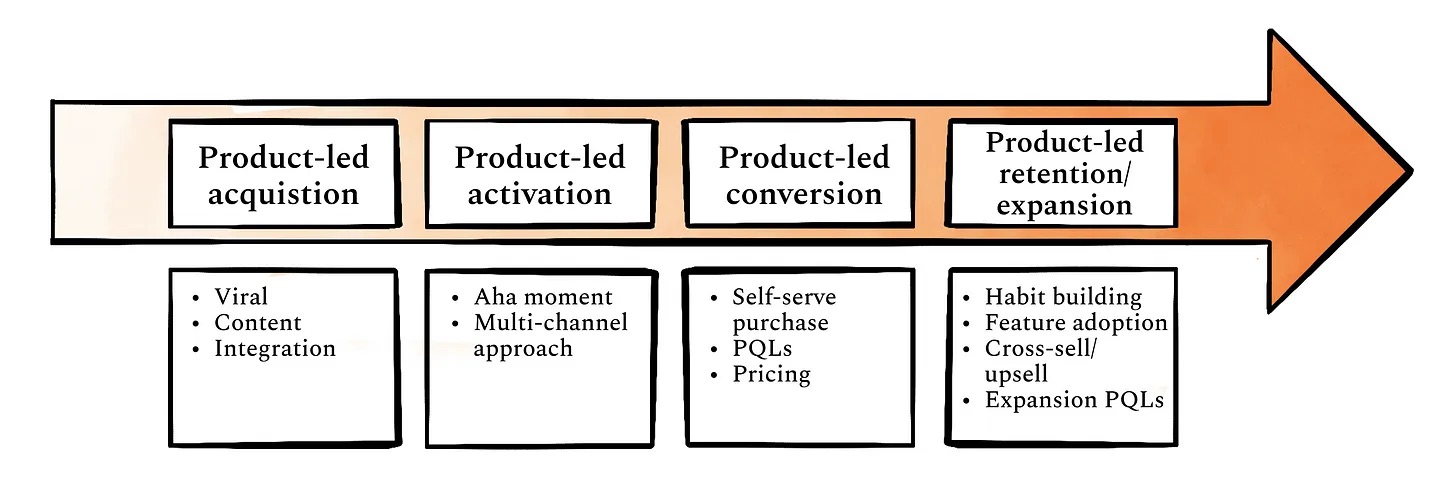
Start with activation: Historically, B2B software hasn't been designed for quick use, but that's changing with successful PLG companies. The speed at which a user can go from signing up to actually using the product (time-to-value) is critical.
-
"Think about Miro, as an example. If you go through their activation experience and sign up to usage, they ask very limited questions, very targeted... they quickly gave you templates to get started."
-
Improve the conversion process: This means making the self-checkout flow as smooth and easy as possible. The goal is to make sure your users don't get confused about pricing or where to find things.
-
"You can actually go to any E-commerce website, like, I don't know, go to Lululemon, go to Amazon, make your conversion process as easy as theirs."
- Invest in PQL/PQA after establishing activation and self-checkout: This is a more complex process and you might want to wait until you have a reasonable number of users and a well-functioning activation and self-checkout process before you invest time and resources into this area.
-
Leverage product-led acquisition if your product encourages collaboration: If your product has inherent, internal viral components (i.e., the product encourages users to invite others to use it as well), investing in product-led acquisition is a smart move.
-
"Think about Figma, think about Calendly even, right? It can spread. This product is so easy. You can build something to allow it to spread on its own."
How Hila made an impact on retention at Acorns
- Focus on activation for retention improvement: Analyze features users need to experience early on for better retention. Hila Qu identified recurring investment as a high correlation with retention at Acorns and experimented with getting more users to set it up
- Adding Higher-Frequency Use Cases: Add features with higher frequency to increase engagements, thus improving retention. For instance, they introduced an Individual Retirement Account (IRA) and a spending account with a debit card. These features inherently encouraged more frequent usage, leading to better retention.
The two buckets of data
- Product Usage Data: It involves tracking and analyzing user behaviors, feature usage, and other similar details. In traditional B2B software sales (primarily sales-led), granular usage data hasn't historically been as crucial. However, in a product-led growth approach, this data is essential for understanding what drives user engagement, retention, and eventually, conversion.
- Customer 360 Database: This refers to a comprehensive view of customer information that integrates data from different sources. It includes not only product usage data but also data from marketing campaigns, customer relationship management (CRM) systems, sales data, etc. The idea is to form a complete, 360-degree picture of the customer journey, from the initial point of contact, through the user's engagement with the product, to eventual conversion.
Tools for implementing a PLG motion ▶️
In terms of tool recommendations for setting up an initial stack for product-led growth, Hila Qu mentions several key pieces: [Add links]
Infrastructure Tools:
- Data Collection/Hub Tool: A tool like Segment allows you to collect, clean, and control your customer data.
- Product Analytics Tool: This is used for understanding how users are interacting with your product. Examples include Amplitude, PostHog (an open-source tool), Mixpanel, and Pandle.
- Experimentation Tool: These tools are used for A/B testing and other forms of experimentation to improve your product based on user behavior. Examples include Optimizely, and Eppo, or Amplitude which has an experimentation component.
- Lifecycle Marketing Tool: These tools are crucial for personalizing your engagement with customers based on their behavior in your product. This is different from lead nurturing tools, which are more focused on engagement with marketing materials, not the product itself.
Additional Tools for Specific Product-Led Growth Areas:
- Data Enrichment Tool: These tools, like ZoomInfo or Clearbit, are particularly important in B2B settings because they provide additional data about the user's company, not just the user themselves.
- Onboarding Tools: Tools like Appcues and User-Led allow for quick and easy creation of onboarding flows without needing substantial engineering resources. These are beneficial for creating and testing different onboarding experiences.
- Conversion Tools: For B2B companies looking to convert product qualified leads or product qualified accounts, tools like Endgame, Pocus, Toplyne, and Pace could be useful. They provide insights and automation capabilities to help improve conversion rates.
Tips to get started, and why you need to have good data first ▶️
- Start with a Product Analytics Tool and a Data Hub: Start with a product analytics tool as it's hard to get it wrong completely. Also, consider adding a data hub, such as Segment, which allows easy integration with many different tools. The flexibility of a data hub allows for trial and error without significant commitment.
- Garbage In, Garbage Out: The effectiveness of a product analytics tool depends on the quality of the data input. If the data input is incorrect or irrelevant, the output will also be flawed.
- Audit Your Data Situation: Do an audit of their data instrumentation situation before implementing a tool. This involves understanding what key actions are in place, if the data formats are correct, and identifying any gaps. This may involve re-instrumentation or reformatting to make the data more useful for product analytics.
How to do a data audit ▶️
- Establish a data dictionary for product analytics: Identify key actions in your product experience and matching these to your data instrumentation to find gaps. Eventually, the goal is to establish a data dictionary that contains all key actions, event names, properties, etc. to standardize understanding and interpretation across the team.
- Data Warehouse: When a business starts gaining data users, it's time to consider setting up a data warehouse and an ETL (Extract, Transform, Load) solution. Early stage companies can get by with basic tools like Google Analytics or Amplitude, but as the business grows, a more robust solution is necessary to avoid fragility and inconsistencies. AWS Redshift is a common and best practice option.
The overarching theme is that businesses need to be serious about investing in their data infrastructure. Data is a key asset in a product-led growth strategy, and a well-structured data infrastructure can ensure this asset is leveraged effectively.
Building a PLG team ▶️
- Tiger Team vs Dedicated Team: There are two different ways to start a growth team. The most common one is to create a dedicated team with a head of growth and resources to support the growth initiatives. However, she also mentions a "tiger team," a cross-functional group assembled for a specific purpose for a period of time. A tiger team may be useful when the initial focus area involves multiple departments, like Product Qualified Leads (PQLs) which involve sales, marketing, and data teams.
- Team Evolution: After the initial growth team is established and has achieved some early wins, it's time to extend and formalize. You need to move from just a PLG team to a PLG organization. This involves having a head of growth product, a head of growth marketing, and a head of product-led sales, each managing different parts of the PLG motion.
- PLG Metrics: Once the PLG organization is established, it is crucial to determine the metrics that each team will own. For example, the head of growth product might focus on usage and activation metrics, whereas the head of product-led sales might focus on conversion rates and revenue.
The core growth squad ▶️
-
Initial Team Roles: The most critical role for an MVP PLG team is the growth PM (Product Manager) who leads the team. A growth PM is similar to a traditional PM but is more focused on analytics, experimentation, and data-driven decisions.
-
In addition to the growth PM, she recommends hiring a data analyst as one of the very first hires for the team.
- Engineers and designers are also necessary, although designers may not need to be dedicated full time in the early days.
-
Internal vs External Hiring: Hire internally if possible, as individuals already within the company might have a better understanding of its systems, culture, and products. This could be a PM who wants to focus on growth, an analyst who wants a more product-oriented role, or even someone from a different department who has strong analytical skills.
-
If internal hiring isn't feasible, she suggests finding an external hire with experience related to the company's initial growth focus area, be it activation, conversion, or acquisition.
Lightning round ▶️
-
Recommended Books:
-
"The Almanack of Naval," which she found life-changing and helped her understand the importance of leverage in life and business.
- "How Women Rise," which she found very educational and often gifts to her female team members.
- The last one is her own book, currently only available in Chinese, which is reported to boost email campaign conversion rates just by its presence.
- Favorite Movie or TV Show: A Chinese sci-fi movie, "The Wandering Earth 2," written by Cixin Liu, the author of the "Three Body Problem" series.
- Favorite Interview Question: When interviewing growth PMs or analysts, she likes to ask, "What is an experiment you launched that had a very unexpected result? And what did you do after that?" The answers to this question reveal the depth of their thinking, their understanding of customers, and their approach to failure or unexpected results.
- Favorite products: ChatGPT and Lululemon yoga pants.
- Product dev process improvement: Adding a section in the ticket stack where PMs write the success metric ahead of time and specify which growth lever the feature will help. This forces them to think deeply about the purpose of the feature.
- Favorite children’s books: "Someday" is her favorite children's book.
- Favorite growth concept: North Star Metric. This concept helps her think long term and evaluate what's valuable not just in her work, but in personal areas such as career and child upbringing.
This is a human edited summary of the podcast episode with Hila, by Gaurav Chandrashekar (@cggaurav, productscale.xyz). To listen to the full episode, go here.