Photos from recent reader meetups 🥰
If you’d like to attend (or host!) a meetup, join our paid subscriber Slack and find your local city channel. Learn more here.
People sometimes believe that asking for help will make them look weak, or even incapable of doing their job. But in fact, it’s the complete opposite. Every successful person you know became successful because they were skilled at asking for help. What I’ve heard repeatedly from the many leaders I’ve met, and have found to be true in my own career, is that knowing when and how to enlist support is a career unlock. You’re slowing your trajectory if you don’t build this muscle.
In her phenomenal inaugural guest post, Newsletter Fellow Natalie Rothfels shares a step-by-step guide for when, who, and how to ask for help, including how to get over your fears about asking for help, practical templates, example scripts, and tactical advice—rooted in her coaching practice and personal experience.
Natalie is an executive coach who works with co-founders and executive teams, helping them build interpersonal skills to become more effective leaders. She spent a decade as a product manager building educational tools at Quizlet and Khan Academy and now helps leaders build their emotional intelligence, influence, relationships, and ability to navigate conflict. She is a certified Internal Family Systems practitioner and a facilitator for Stanford Graduate School of Business’s Interpersonal Dynamics course, aka “Touchy Feely.” She also recently launched The Ripple Deck, a facilitation tool for building connection. You can follow her on LinkedIn and Twitter.
In late 2021, after pushing myself to the edge of burnout, I made it a goal to ask for help at least once a week.
I requested testimonials from clients who had ghosted me after months of work together. I asked strangers for financial support on multiple Kickstarter campaigns. I solicited words of affirmation from peers to help boost me up. I even asked some of my family to quietly listen while I expressed anger about my childhood.
None of this came naturally to me. I’ve prided myself on being independent, hyper-resourceful, and not “needing” anyone, especially in a professional context. Being dependent on others felt vulnerable and risky. And because of that, I was willing and able to work 10 times harder to avoid the vulnerability of asking for the help I needed and deserved. When my body and my brain gave up, I lost joy for a job that was otherwise a perfect fit. My previous strategy was no longer an option.
Three years later, I can say that learning to effectively ask for help has been the biggest transformation in my personal and professional life. I can sleep at night without the burden of chronic overwhelm and rumination. I have healthier, reciprocal relationships that both challenge and support me. My work is more focused and productive than ever before.
Since learning that lesson for myself, I’ve spent hundreds of hours coaching product leaders, founders, and executives to incorporate this skill into their lives too. Most clients logically understand the upside of asking, but few can anticipate how much emotional energy it unlocks.
Take it from my client Meena (not her real name):
“The exhaustion of subconsciously assuming I have to do everything on my own robbed me of agency, joy, and so much energy in my work. Shifting this has been radical for me in terms of my relationship to myself and to my work.”
This tendency to hold onto everything can be especially salient among product managers, who are lauded for their “ownership” of problems. It’s hard to be high-agency, take radical responsibility, be everyone’s unblocker, build great products—and do it alone. When done well, asking for help does not diminish your ownership or credibility. It increases your agency, builds higher-trust relationships, and models a willingness to put your vulnerability aside for the sake of the work. That can also help your peers and reports, who will see you modeling a practice that keeps a team psychologically safe and sustainable to work in.
I’m writing this post now to share everything I’ve learned about asking for help so far. I’ll help you navigate the fears associated with asking and give you a toolkit for making your asks more effective, including template scripts you can start using today, based on the ones I created for myself and my clients.
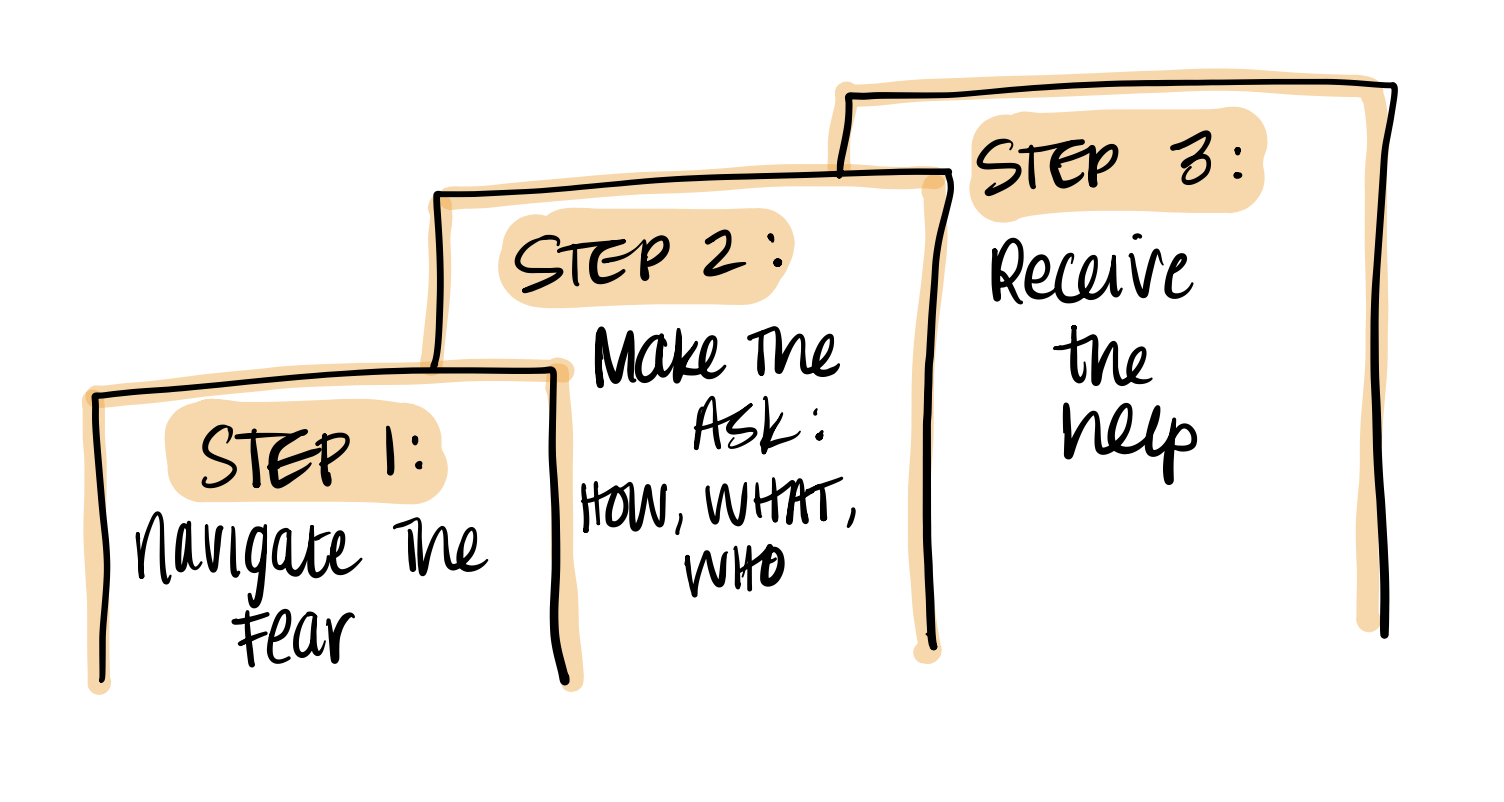
Step 1: Navigate the fear
Making an ask is vulnerable for everyone, and can provoke fear, anxiety, and stress. One client just this week expressed the fear in a way that I’ll never forget:
“Asking for help is a sign of weakness, and weakness is a sign of death.”
These emotions can be paralyzing, preventing you from seeking the support you desperately need to unblock your work.
My client Meena’s story is a great example:
Meena is a Group Product Manager with 10 years of experience, currently working at a 300-person Series C SaaS startup. She came to me struggling with an overwhelming workload and on the brink of burnout. As a player-coach, she manages PMs, has her own IC growth work, and supports the hiring and onboarding process for new talent.
I noticed immediately that Meena was spending her whole day helping her teammates and putting her own priorities last. Her “real” work didn’t start until after 5 p.m., when she was finally done with meetings. It wasn’t just a matter of poor time management. She was subconsciously avoiding her product work; it felt more ambiguous than the clear needs of her team, and she didn’t know the “answers” to the problems she was supposed to own. Rather than putting some draft ideas to paper and gathering initial feedback, she refused to share anything half-baked out of concern that others might see her as incompetent or dumb. She’d sit for hours at a blank screen while her inner critic repeatedly said, “This is your job. You’re so bad at this. You’re going to get fired if you don’t finish this tonight.”
The reality was that she actually was good at her job—great, even! But when she was in that state of fear, she couldn’t see her own skills and agency clearly. No agency, no action. She was blocked.
When I asked Meena when the last time was that she’d asked for help at work, she looked at me with confusion. She had never even imagined the possibility. Her fears of looking inadequate obfuscated the choice.
To be fair to Meena and all of us, these fears can absolutely be well founded. There are times when asking for help can lead to degraded trust or, in the worst case, being fired. But if done with consideration and skill, you are more likely to encounter the best case: you get the help you need, and your boss and your team get their needs met too.
From my own experience and from working with countless clients, I knew asking for help could open a world of possibilities. Spoiler alert: it ended up working for Meena too. She experienced a noticeable and lasting shift in stress and overwhelm. Her team relationships became more reciprocal and less stuffy. Once she got past her fears, she was even asked to expand her leadership to two more teams. And she could take on the new scope sustainably—good for her career, good for the company.
Meena’s case may seem extreme, but she’s not alone. Most of my clients have fears come up when I ask this same question.
Boiled down, the fears sound like this:
- Fear of being a burden: “If I ask for help, I’ll be imposing on others who are also busy.”
- Fear of appearing incompetent: “If I can’t handle this on my own, they’ll think I’m not qualified for my role.”
- Fear of rejection: “If I ask for help, they’ll just say no.”
- Fear of losing control: “If I involve others, I might lose autonomy over my projects.”
- Fear of uncertainty: “If I ask for help now, it might negatively impact my future opportunities or relationships.”
- Fear of the cost: “If I ask for help and it doesn’t solve my problem, I’ll have exposed my vulnerability for nothing.”
In Meena’s case, she was most afraid of appearing incompetent to her manager. Her manager had given her increasingly more responsibility during Meena’s two-year tenure and she didn’t want to be seen as a failure.
But the starting point for learning this skill is not running to your boss with your arms flailing. It’s befriending your fear enough that you can begin by making any ask at all—usually first to a friend or peer. It really helps to have someone to process with, but here are a few steps you can take on your own to address your fears.
Phase 1: Increase awareness of your emotions
Your body is likely sending you all sorts of signals that say, “I’m scared.” Become familiar with your body’s vocabulary of fear. If you are unattuned to how fear shows up, it’s difficult to work with it. I often tell clients to create an “emotion log” (here’s a template!) to start increasing their awareness of when and how the emotion shows up, what triggered it, and what its supportive function is.
Example: Meena’s fear lived in her chest and would send constriction all the way up her neck, making it hard to speak. She noticed it most acutely when she had said yes without knowing whether she had the capacity (skills or time) to succeed at the task.
Phase 2: Allow the fear without changing it
All fears are valid, even if they’re not true. Name it to tame it. Articulate what you’re afraid of. Acknowledge how the fear serves and protects you, and allow it to be present without making it wrong.
Sometimes we are even scared of acknowledging our fear! This extra layer of fear can make it difficult to fully acknowledge how scared you might be, so be compassionate and allow yourself the time you need at this step.
Your goal is to really hear the story that your fear has, without second-guessing it, debating with it, or overriding it. I often ask my clients to imagine the fear as a little character sitting atop their hand that we can have a conversation with. Hear out your fear.
Example: Meena eventually acknowledged something like “I’m afraid that if I ask for help, my manager will think I can’t handle the responsibility they’ve given me. My fear helps me stay small and play it safe so I ensure I won’t feel like a failure.”
Phase 3: Offer yourself security by shifting the narrative
Cognitive reframes aren’t always effective for transformational work, but they can be enough to shift us in the moment toward possibility rather than pessimism.
At this step, the goal is to offer yourself internal security. Try these shifts:
- “Asking for help makes me a burden” → “People really appreciate being asked and valued for their expertise.”
- “Asking for help makes me look weak or incompetent” → “Demonstrating that I know what I don’t know is a key leadership competence.”
- “People will think less of me if I ask for help” → “People respect and appreciate my vulnerability, and expressing my needs will allow them to do the same.”
- “My boss will be annoyed that I can’t do it alone” → “Leaders want my work to succeed and need to know when that’s at risk.”
These narratives are not just mental gymnastics. You have firsthand experience to draw on, too. How often do you perceive someone as burdensome, incompetent, or weak when they make a thoughtful, unentitled ask? Probably rarely.
Phase 4: Design and enact an experiment
We expand the edges of our fear through experimentation and data gathering, not just self-awareness.
As I worked with Meena to peel back the layers of fear and stress, we uncovered some key issues: Meena was heavily overcommitting herself, not involving her peers early enough in her thinking process, and assuming her team couldn’t step up more. She was slow to produce work, and she made reactive decisions based on fear and urgency.
I asked her to design an experiment that could yield real data that might challenge her mental models (namely, “I must do this alone or I will be seen as ineffective”).
Her first experiment was designed to verify whether her PM and engineering peers perceive her as ineffective or burdensome when she asks for help. (They did not. She was brave enough to reveal her insecurity, and they both empathized with it.)
It pays to practice these strategies early and often. As you grow in your career, you’ll encounter more projects that you don’t immediately know how to tackle. New, bigger, and more ambiguous projects often feel more threatening because you’ve never successfully done them before! With enough practice, you’ll shift away from the fear of asking to proactively anticipating where you might get stuck and who you can ask well before you ever need it.
Step 2: Make the ask
Once you’ve navigated the fear, the next step is the big one: making the ask. This starts with structuring your ask effectively. Then, we’ll determine what help you need and who you can ask, using Meena’s situation as an example.
a. How to ask
Start with this template. You don’t need to use all of its parts, nor in this exact sequence, nor with these specific words. Treat it as an example, and modify it based on the strength of the connection, overlap in your goals, and expertise of the recipient.
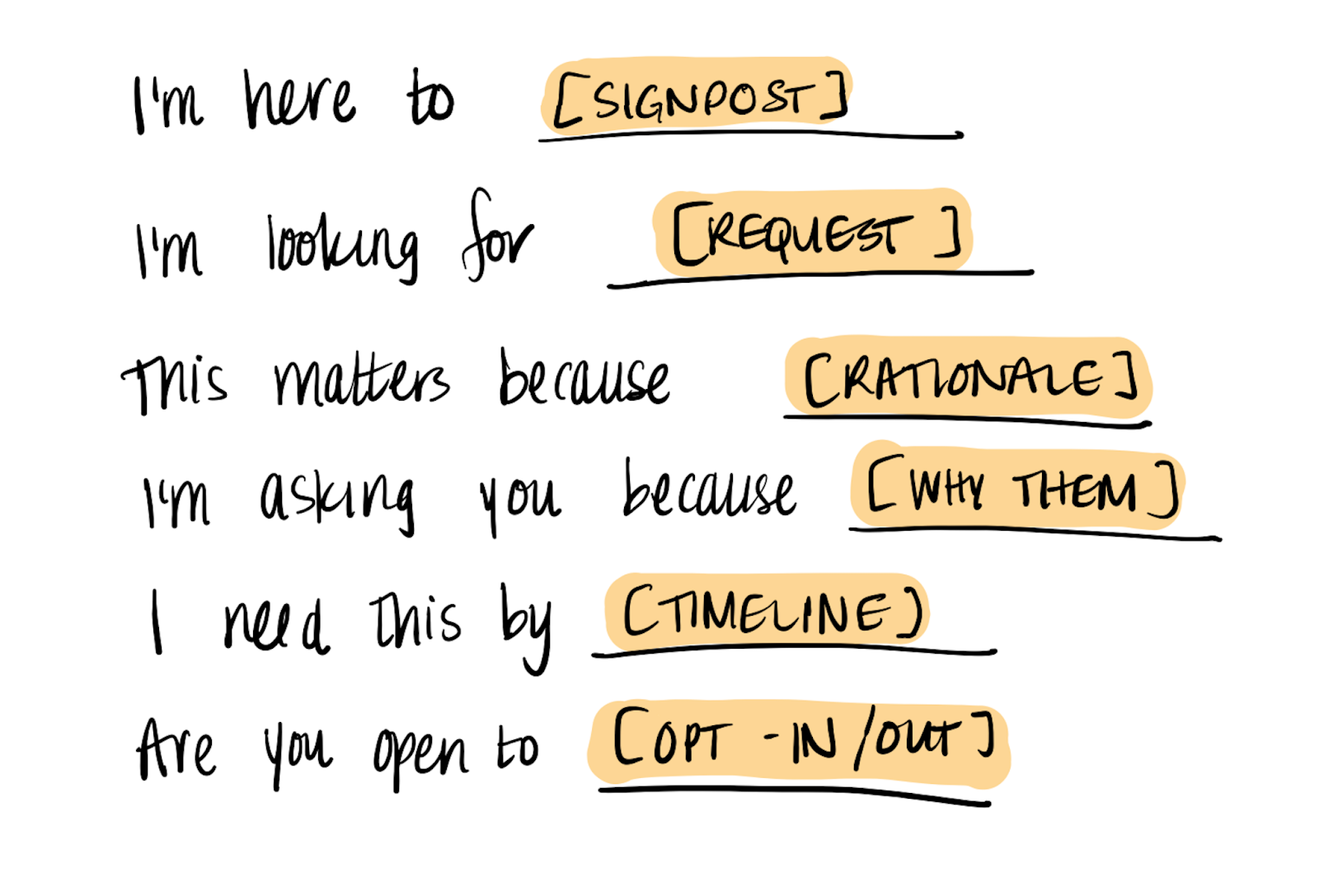
- Signpost: “I’d like to ask for your help with something.”
- Clear request: “Specifically, I need [type of help] with [specific task/problem].”
- Rationale: “This is important because [reason].”
- Why them: “I’m asking you because [specific reason].”
- Timeline: “I’d need this by [date/time].”
- Opt-in/out: “Is this something you’re able to help with?”
Let’s walk through an example from Meena to her manager, the CPO:
“I’d like to ask for your help with something [signpost].
Specifically, I need your support in prioritizing work across our three product teams [request].
Our current workload is unsustainable, and I’m causing bottlenecks that will impact our ability to hit our targets [rationale].
You do this all the time at the org level, so I’d really like to share my existing prioritization and have you pressure-test it based on your experience [why them].
I’d like to discuss this in our next 1:1, if possible [timeline]. Is this something you’re able to help with [opt-in]?”
Making it compelling
Your goal is to make it as easy as possible for them to say yes.
To do so, first create a relational connection. This doesn’t have to be big, and it doesn’t have to take a long time.Find or create an overlapping goal, highlight that you’ve done your homework, talk about shared experiences, disclose something personal about yourself, invite them to share something personal, talk about your weekend, express interest in their team’s recent success.
Then, make your request as small, easy, and clear as possible. Incrementing asks is a lot easier once there is momentum in a conversation. Once Meena has her manager in the room and shares her prioritization, it’s easier to then open up to bigger asks around headcount, how to navigate the CEO effectively, etc.
The specificity and degree of thoughtfulness in your ask will contribute to an easier yes. Frame your ask around their goals, not just your needs. Remember that there are cultural and interpersonal considerations to take into account. How power and hierarchy functions in your org should inform who you ask, and for what. If your team functions asynchronously in a remote environment, that will likely change the tone and medium of your asks. Don’t make asks of people whose asks you have not met! Use good judgment.
b. What to ask
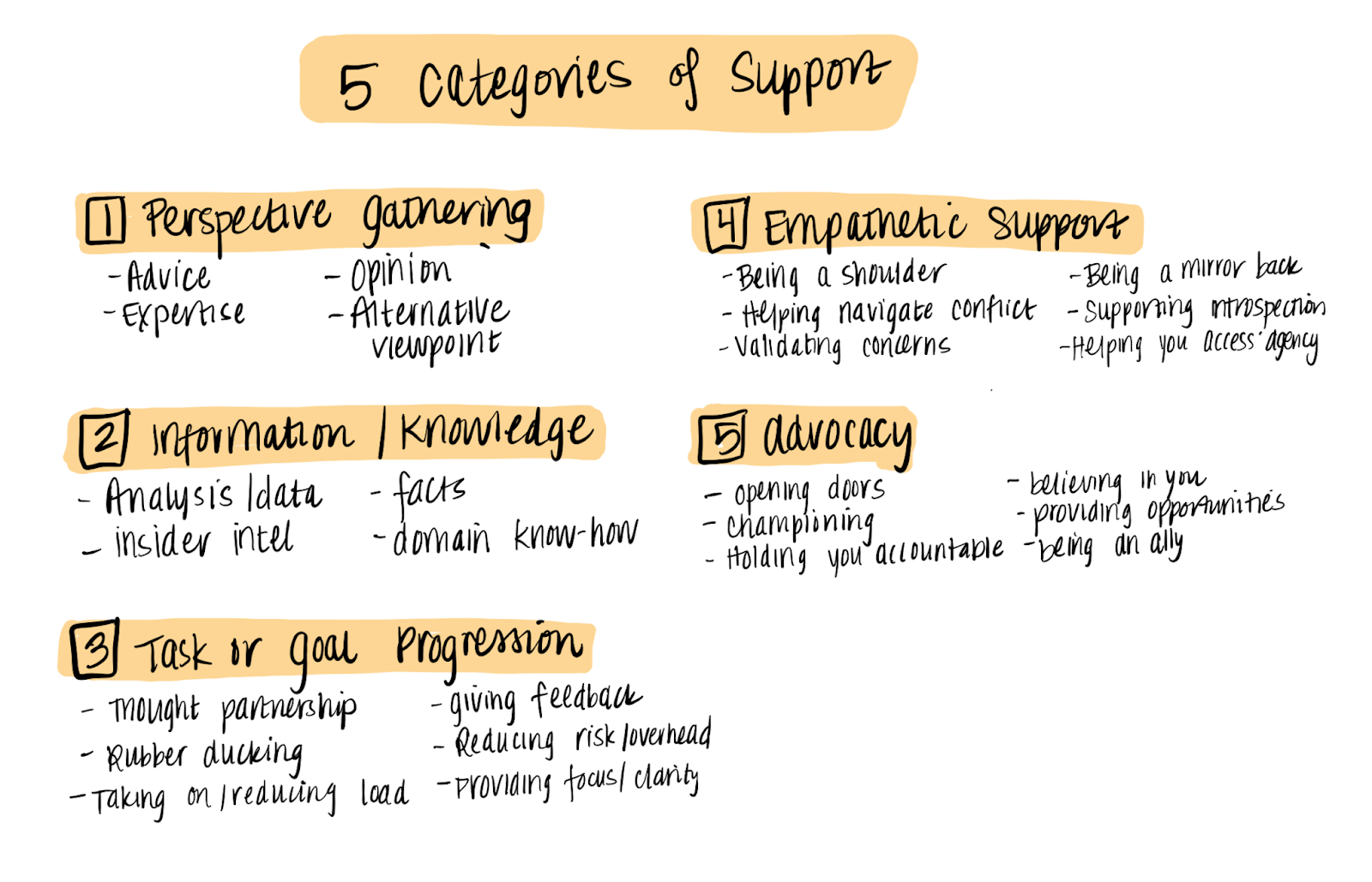
Now that we’ve covered how to structure your ask, you need to clarify what type of help you’re seeking. I’ve built out this menu to make the choice easier, as it can be hard to know what help you want or need.
- Perspective gathering: Advice, expertise, opinion, alternative viewpoints. Think of this as a simulator of someone else’s brain.
- Information/knowledge: Analysis, data, insider knowledge, facts, domain know-how. Think of this as a database download.
- Task or goal progression: Thought partnership, rubber-ducking, taking on a task or reducing the load, giving feedback on work, reducing risk or overhead, helping to clarify/focus/prioritize. Think of this as the conveyor belt moving forward.
- Empathetic support: Being a shoulder to lean on, providing supportive challenge, helping you access your own strengths or resourcefulness, being a mirror and reflecting back, mitigating interpersonal conflict. Think of this as a ship to help you navigate the stormy seas.
- Advocacy: Opening doors, championing you, holding you accountable, celebrating your wins, believing in you, providing new opportunities. Think of this as a propeller or catalyst.
Meena benefited from seeking multiple types of help at once. She needed a combination of task progression (help with prioritizing work across teams) and advocacy (support in securing additional resources). Throughout our coaching, she also leaned on our sessions for emotional support to navigate the stress. As that became more comfortable, she started to seek additional support across her peers. It turned out that Meena was not the only one feeling the overwhelm. She enjoyed providing support for her peers as well, which reminded her how good it can feel on the other side of being asked.
Notice that not all asks need to be grandiose. Small things are still very worth asking for, and often easier to start with because they’re also easier to fulfill! This is why a meal train is so popular for new parents: it’s an easy yes for asker and giver alike.
c. Whom to ask
There are a ton of different factors for selecting the person to ask. Here are the few I most frequently turn to:
- Connection: How strong is our relationship?
- Goals: How overlapping are our goals?
- Expertise: How relevant is their skill set?
- Seniority: How much more positional power do they have?
- Ease: How convenient is it for me, and for them?
- Reciprocity: How much have I already supported them?
It’s significantly easier to ask for help when you have an existing relationship or overlapping goals. It’s much more effective to ask someone who has the expertise you need and the power to provide it. It’s substantially safer to seek support from a peer rather than your CEO.
Of course, there are times when you don’t know the right person to ask, you have no relationship with them, you share no overlapping goals, they’re more senior, or it’s not convenient to ask. Don’t let that stop you!
My heuristic is simple: could my ask be at all compelling to this person? If not, it might not be the right type of ask for the right person. Or you haven’t done the legwork to identify what would make it compelling.
It’s a trap to think you need to have some profound relationship first before asking. You can build the relationship while asking by making it significantly more compelling. The level of intention you put behind your request is palpable. Say whatever will motivate them to help you. This requires upfront work to consider why they should care. Your thoughtfulness will show.
Example scripts
With each subsequent ask, Meena progressively had more and more data that disconfirmed some of her fears. In fact, her manager was giving her positive feedback about how much more confident and engaged she seemed.
I encouraged Meena to start with asks that felt less risky and then expand from there. Below you’ll find some scripted examples with all of the elements from our template. Remember that you can cut many pieces from the template based on the strength of your connection and shared goals, and inject your own personality.
1. Asking a peer PM on another team (existing strong relationship), chat via Slack
Hey Taylor, quick question [signpost].
I’m trying to prioritize work across my three teams [rationale].
I honestly don’t know how you manage to do this [why them].
Looking for a brain buddy on this—I have 3 questions [specific ask].
Are you open to answering inline or finding 15 minutes to chat live by the end of this week [timeline, opt-in]?
I don’t want to make an avoidable error in how I’m thinking about this.
Notice that Meena need not be as formal or concrete with a peer here.
2. Asking the CEO in a 1:1 they scheduled to talk through a new project idea
I’m glad you want me to own this. I want to say yes, but I don’t feel confident I can deliver it and need some support from you [signpost].
My top goal right now is to drive expansion within the Big Bad Customer account by moving it to multiplayer. To do that well and also take this on, I’d need us to either deprioritize the other initiative or staff up the new project for success [rationale].
Is there another possibility you see or other relevant context that you have that I’m missing [opt-in]?
Notice that we don’t need to be heavy-handed with the why them or timeline because we’re in a conversation, live. The signpost still helps because it sets the person up to receive more about your intent, not just your message.
3. Asking a stranger who’s written about this topic
Hi, Tomas.
I read your post about saying “no” more, and it sparked a whole chain of events for me: I realized how much I’ve been people-pleasing, and it’s exhausting, but I’m so grateful for the tools you shared because I do feel some relief too [why them].
I’m wrestling with one piece that I’m hoping you can help with [signpost]: I feel a profound guilt after I say no, and I ruminate on it for days after.
Do you have 1-2 tips you can share via email about how you navigate the aftermath?
Or I’d be happy to pay for a session with you to talk more about it live if you’re open to sharing your calendar link [opt-in].
Notice that, without any relational connection, Meena tries to create one by sharing more about herself and more about the impact of reading Tomas’s work. She does this before making the request, and her ask is hyper-specific and starts small. She can certainly grow to ask more once she’s on a call.
Step 3: Receive the help
How you receive help is just as important as how you ask for it. It’s another opportunity for relationship building and can influence future interactions. Let’s explore how to handle different outcomes when you’ve made an ask.
When it helps
Express authentic appreciation. Follow up and share the impact of the help, as it positively reinforces the behavior. Then offer reciprocity.
Meena might say to Taylor, her peer:
🙏🙏🙏 Your backup with prioritization stuff helped me regain my sanity and actually figure out what work to do with my team. I feel a million times better, thank you for that! Anything you need help with so I can return the favor?
When “help” doesn’t help
Try to find an iota of what’s helpful in what’s been offered. Then politely redirect back toward your original ask or eject early from the conversation. Avoid giving real-time feedback about how unhelpful they were. You’ve just asked them for help and they tried their best!
Meena might say to her manager:
The bigger org context is helpful. I’m specifically looking for your help on which of these three priorities I should drop this week or if you have other ideas for how I can tackle all three simultaneously.
When they can’t or won’t help
Often a no has more to do with the other person’s circumstances and capacity than you or your request. Avoid taking it personally. Keep the door open, and seek alternative support.
Meena might say:
Not an issue, I get it. Anyone else you would recommend I ask?
The impact of asking well
In the depths of my own burnout, I felt overwhelmed by carrying the weight of my entire team. And I felt hurt that I had to go it alone. But the great irony was that I was refusing to let anyone hold the weight with me. I worked emotional overtime to avoid the vulnerability of asking for help, and then worked another shift of overtime doing it all alone.
That was a disservice to myself, the team, and the work.
When I learned to befriend my fear and negotiate with my ego, the doors opened up to what felt like another reality. I was shocked by how many people wanted to help and support me.
I haven’t stopped feeling vulnerable when I make an ask. Sometimes I’m clumsy in the moment and waffle around what I really need. But I have a lot of data now that makes it easier to take the risk. People want to help, and when I ask thoughtfully, they will and we’ll all benefit.
I know the same is possible for you.
📚 Further study
- Here’s an exercise to process your fear using Internal Family Systems.
- Learn about David Rock’s SCARF model. Asking for help triggers threat responses for many of us. We are all wired to move away from interpersonal threats, but the good news is that we can help ourselves move toward rewards once we know what’s so threatening to us.
- Ed Batista’s article on the importance of safety, trust, and intimacy, the foundation for risk-taking and experimentation.
Thanks, Natalie! For more, check out her website and The Ripple Deck, and follow her on LinkedIn and Twitter.
Have a fulfilling and productive week 🙏
👀 Hiring? Or looking for a new job?
I’ve got a white-glove recruiting service for senior product roles, working with a few select companies at a time. If you’re hiring, apply below.
If you’re exploring new opportunities yourself, use the same button above to sign up. We’ll send over personalized opportunities from hand-selected companies if we think there’s a fit.
If you’re finding this newsletter valuable, share it with a friend, and consider subscribing if you haven’t already. There are group discounts, gift options, and referral bonuses available.
Sincerely,
Lenny 👋