When I see billboard ads as I drive around the Bay Area, I often wonder about the ROI behind these investments. As someone who’s always worked on product-oriented growth, I’ve never had a chance to understand the logic behind advertising out in the real world, and what kind of impact startups see from these levers. So when I came across Reed McGinley-Stempel (CEO and founder of Stytch) sharing his experience of running billboards for his startup, I immediately pinged him to see if he’d be up for expanding on his lessons.
Not only did Reed share many in-depth details (and numbers) from his company’s experience, he also reached out to marketing leaders at basically every other startup with billboards in the Bay Area for theirs.
Below, you’ll find a synthesized set of lessons about how to successfully leverage billboards to grow your product, including insights from Ramp, Notion, Vanta, Rippling, Canva, Brex, Writer, Bland, Statsig, and Stytch. With every post in this newsletter, I try to offer the most definitive advice on a topic, and I believe this is that for billboard advertising.
Reed McGinley-Stempel is the co-founder of Stytch. For more from Reed, follow him on LinkedIn and X.
Every two years, our team at Stytch runs a large out-of-home (OOH) campaign in San Francisco—physical or outdoor advertising such as billboards, bus ads, airport takeovers, or cyber-truck wraps. “Is it worth it?” is one of the most common questions I get from B2B SaaS founders and go-to-market leaders.
It may seem counterintuitive to advertise modern software on a medium as old-school as a bus ad. But we’ve found the real world to be one of the most effective channels to grow and establish our brand.
The value and strategy vary widely depending on the company or product profile, so to give you a holistic perspective on when and how to run a successful OOH campaign for a B2B software product, I asked leaders at Brex, Ramp, Notion, Vanta, Rippling, Canva, Writer, Bland, and Statsig about their lessons from running similar campaigns.
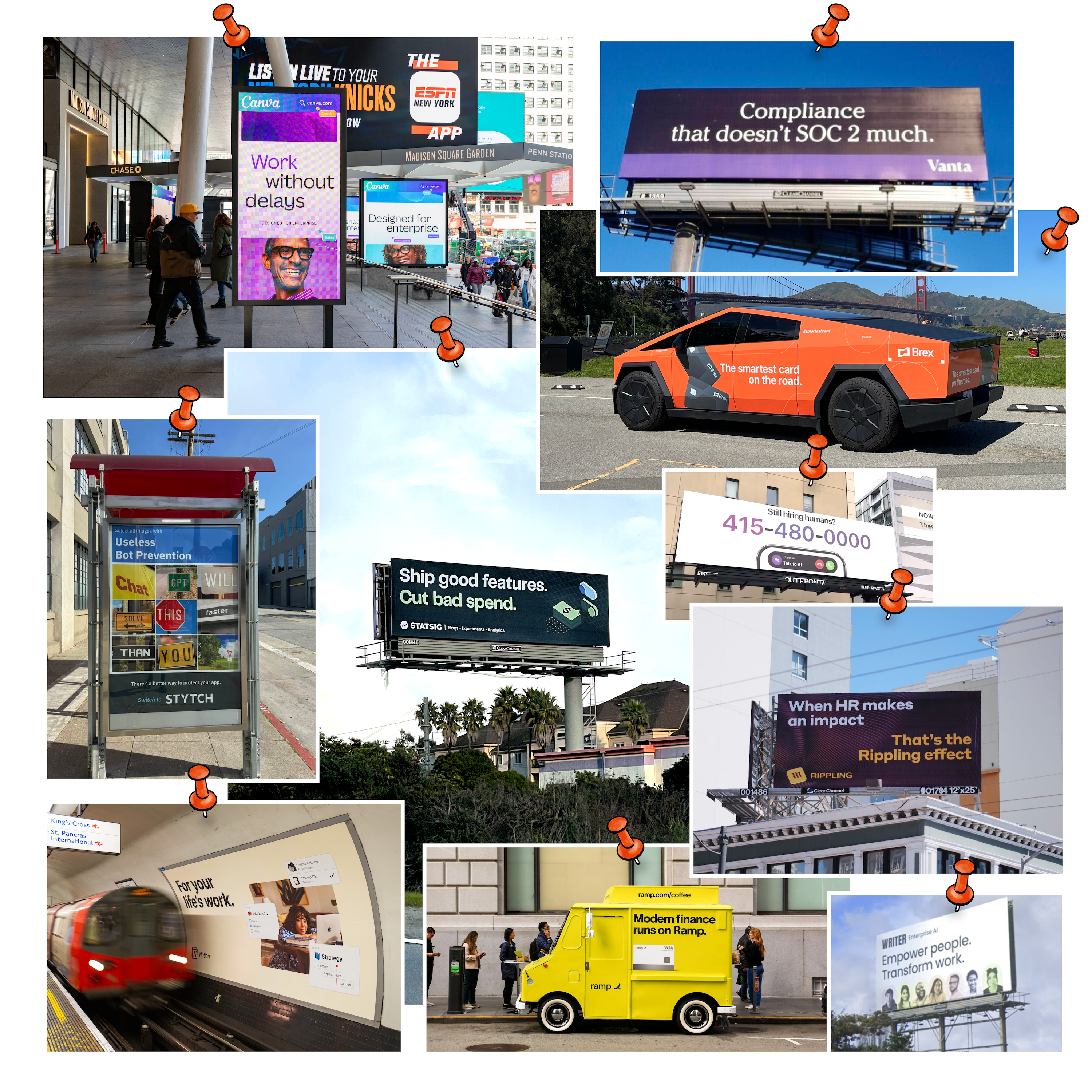
Huge thanks to Michael Burke from Bland, Brandon Camhi from Rippling, Lisa Ferragano from Canva, Elizabeth George from Statsig, Kira Klaas from Notion, Kasper Koczab from Brex, Cody Morgan from Ramp, Andrew Racine from Writer, and Sarah Scharf from Vanta for sharing their insights in this piece, and to MB, Gedney, Aiden, and Robert for their help on the Stytch side.
Evaluating ROI: How can I decide if it’s “worth it”?
When I get asked this, SaaS startup leaders and founders are often thinking about sales pipeline and revenue. These are important, but the ROI question for out-of-home is much more nuanced.
Stytch’s most recent OOH campaign ran for a month in San Francisco in April 2024. For that campaign, we bought 80 bus ads, 130 bus and transit shelter ads, eight billboards on SF city streets, and, yes, three billboards on Highway 101. We used those billboards to sell our B2B SaaS product—in our case, authentication APIs—but also to communicate what Stytch is and establish our brand among the city’s high concentration of software engineers.
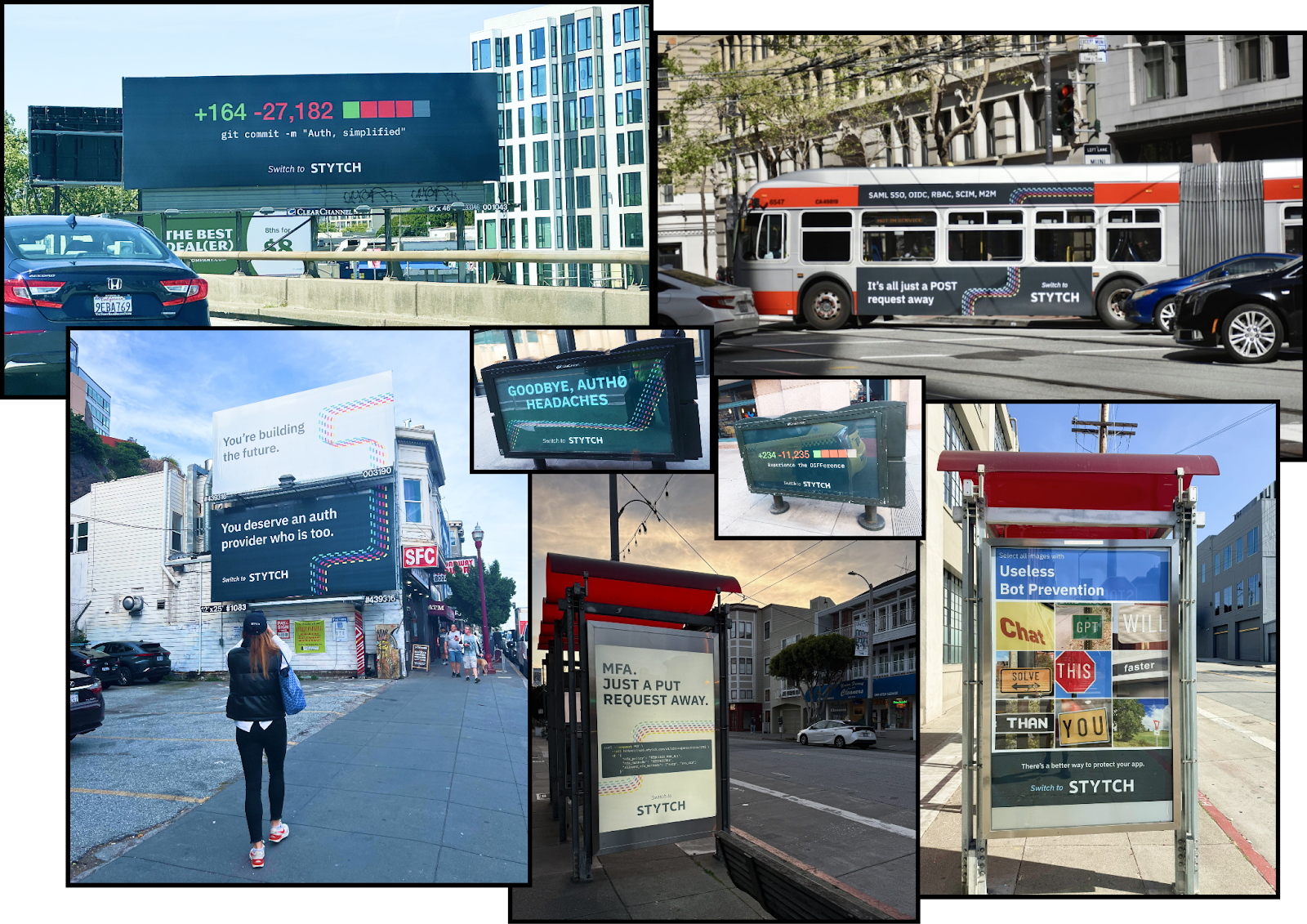
And it worked! During the campaign, we saw a more than 25% uplift in branded search traffic and an over 70% increase in branded search clicks globally (social media is powerful!). We also sustained a 10% to 15% uplift after the billboards came down.
Further down the funnel, more than 10% of our sales opportunities created since the campaign have explicitly cited billboards or bus ads as a factor in exploring Stytch. And employees have posted hundreds of pictures to our internal #billboard-spotting Slack channel (on average, 2.1 per employee)—so it’s pretty good for team morale too!
It’s important to remember that billboards and other OOH spots are broad-stroke mediums, so they work best for high-level brand awareness, rather than immediate pipeline generation. For B2B businesses especially, the reality is that only a fraction of your ideal customer profile is actually in the market right now. An OOH campaign aims to make your audience feel somethingnow so that they remember your brandin the future.
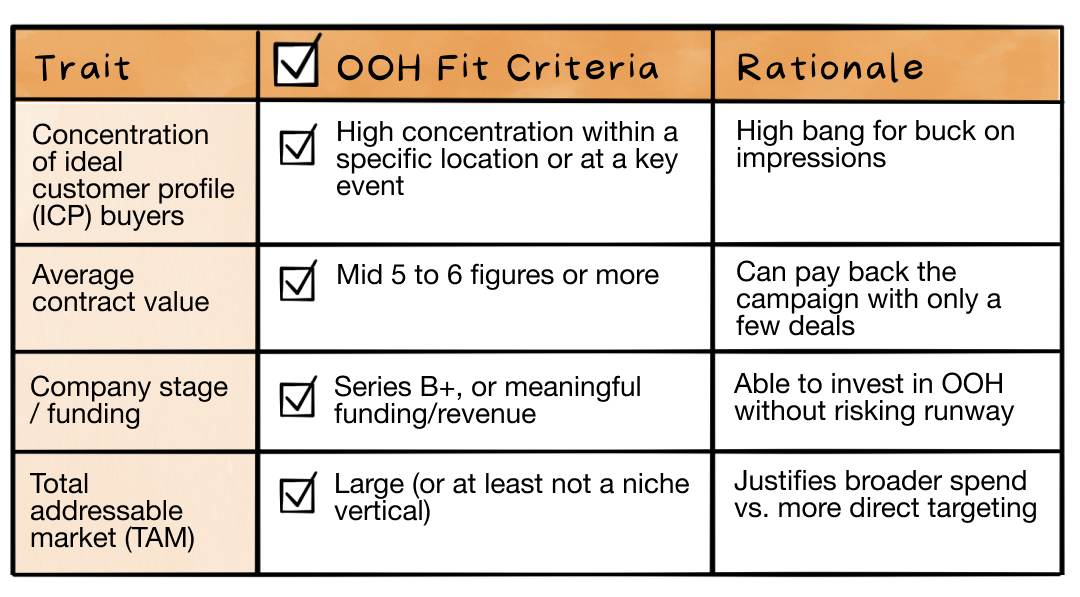
If the following traits match your B2B SaaS company, an out-of-home campaign is a no-brainer to my mind:
Unlike with digital demand generation (think: Google Ads), where there are tracking pixels, UTM tags, and a clear view of money in versus money out, attribution for physical ads is murky and imperfect. You may never get a big final number to share in your board presentation, and that’s OK.
Instead, brand awareness from OOH affects a range of metrics up and down the funnel, which combine to make the investment worth it. I heard from other startup leaders about the impact they’ve seen from their campaigns:
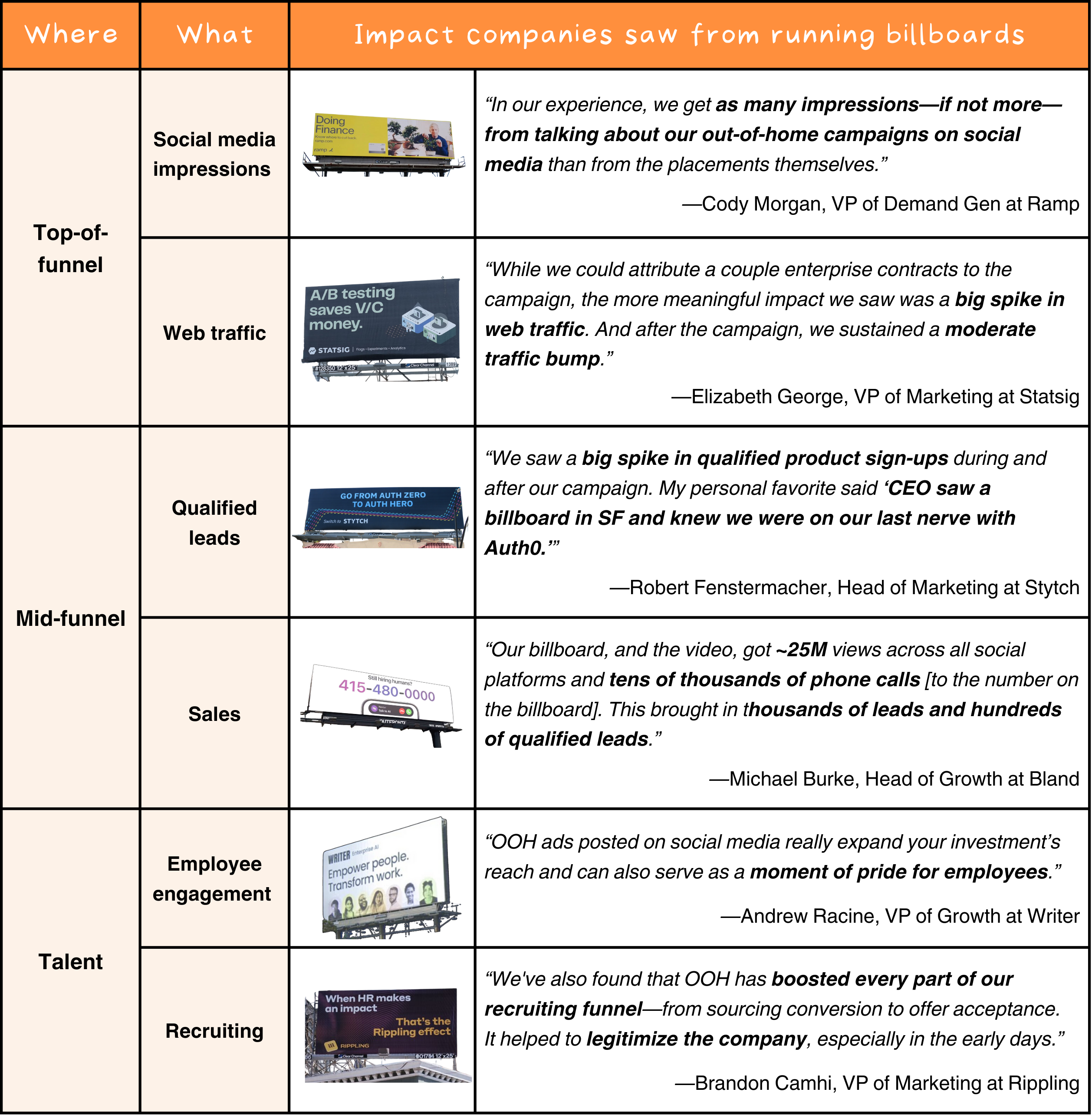
To quote Brandon Camhi from Rippling, “With out-of-home advertising, you should make the investment because the logic makes sense. While you should try to get a directional read on OOH impact, you also have to use your best judgment around where your audience is and what message they respond to. Intuition can carry you far in marketing.”
And for Stytch, and almost every other company I spoke with, the logic is there when you want to grow brand awareness, you have the money to invest now to see impact later, and you believe you can create a compelling enough message.
Making an impression: How do I ensure my campaign is memorable?
It’s important to acknowledge that the value of out-of-home is contingent on making a lasting impression. Kira Klaas from Notion offered a great framework for how to think about what makes OOH advertising memorable:
“Effective OOH is about frequency (how often it’s seen) and resonance (‘this feels relevant to me’), both of which help with recall.”
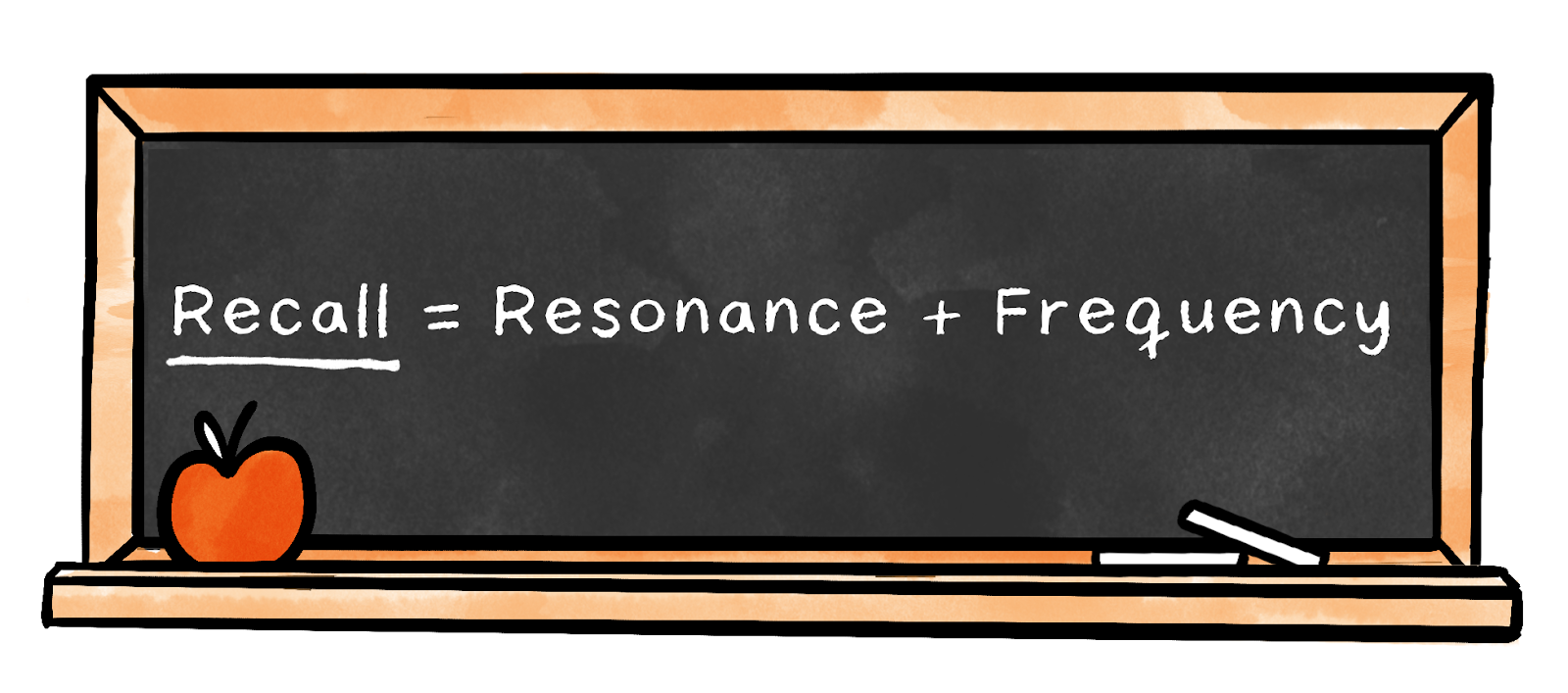
In other words, you need either a lot of placements, a killer message, or a mix of both.
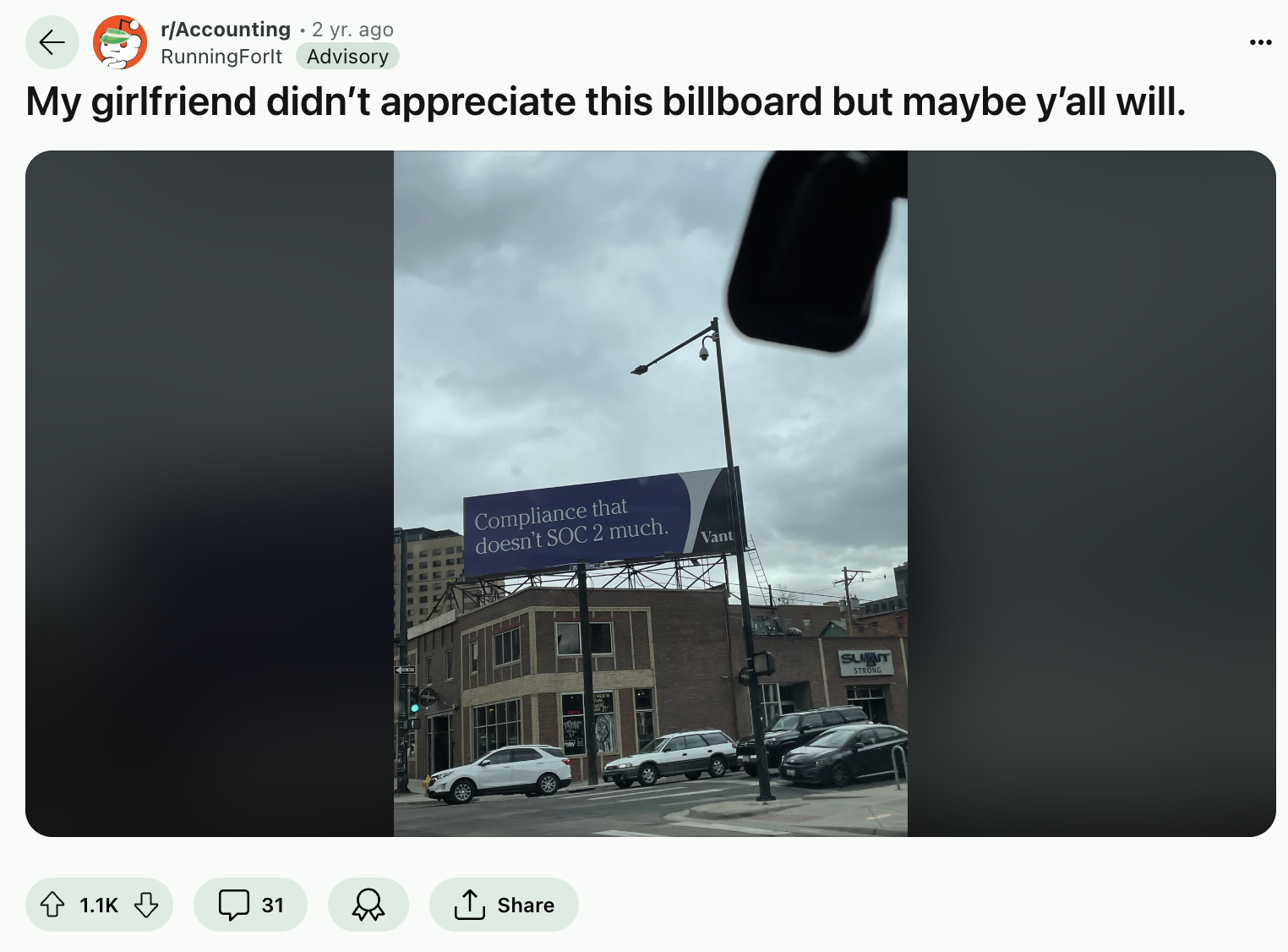
A single billboard can work, but for it to work, it has to be extremely resonant—so resonant, in fact, that it goes viral. Here are two examples of extremely resonant billboards:
Vanta’s SOC 2 billboard garnered thousands of upvotes on Reddit (running an ad with any upvotes on Reddit is an achievement; getting 1,000 upvotes organically is next-level) and helped them land their biggest enterprise customer.
Bland’s billboard demo video garnered 25 million views, tens of thousands of phone calls, and hundreds of qualified leads.
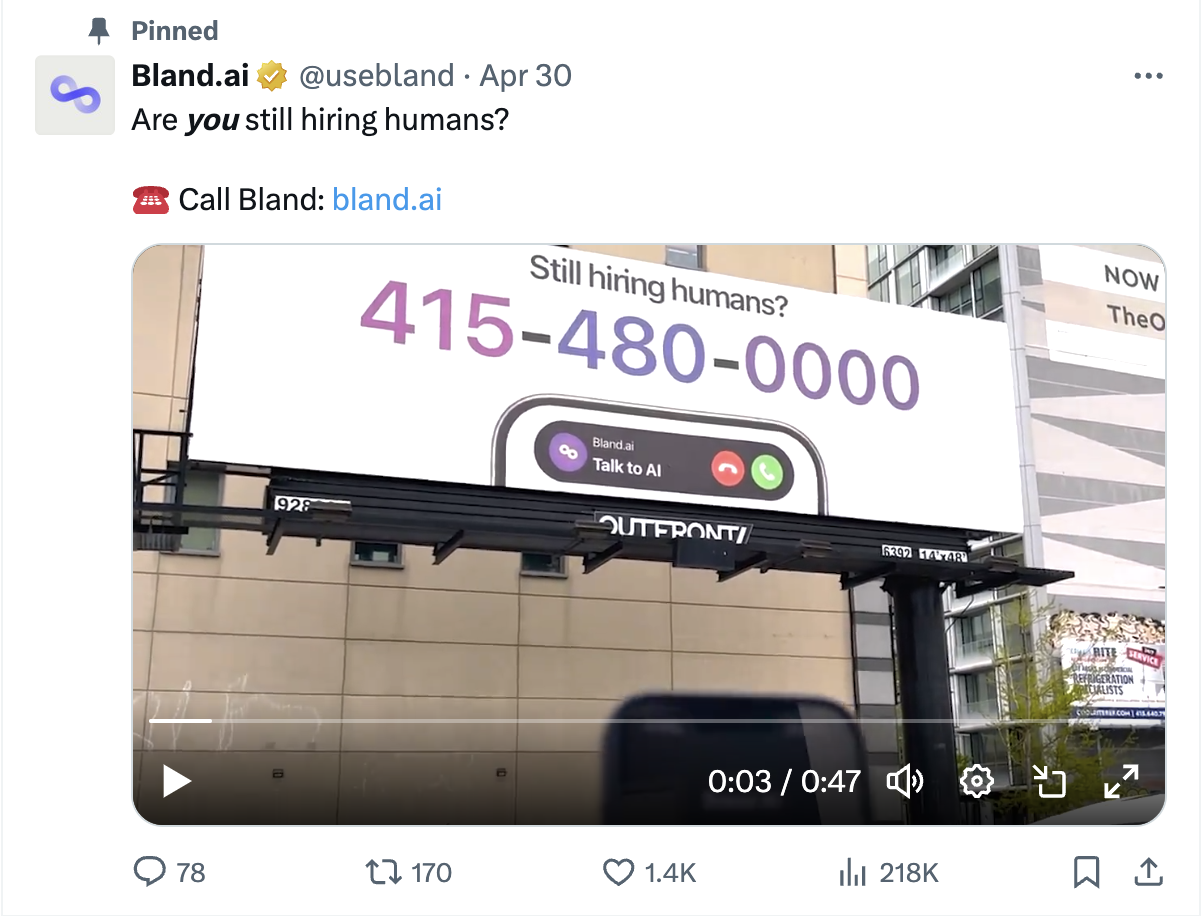
For Michael Burke from Bland, the key to virality was sparking some controversy and then seeding virality with a clever video too:
“To go viral, I’ve found that something has to be new and slightly controversial. Traditionally, billboards often have a phone number—replacing it with an AI number is novel. Asking the question ‘Still hiring humans?’ was concise yet slightly controversial. The billboard was inherently interesting, but our video is what went super-viral. This allowed us to have the billboard as the hook at the start of the video, the CTA at the end, and we could sandwich a demo in between.”
And for Sarah Scharf from Vanta, the most essential elements were simplicity and humor:
“The most important thing is a simple and compelling creative concept—ideally one that elicits an emotional response. It doesn’t have to be humor (as we typically lean into), but it has to be easily understood and memorable.”
More likely, though, a single billboard won’t have a Vanta or a Bland outcome. And so a more immersive campaign, where users might have two to seven impressions in a city on a given day, is more likely to leave a lasting impact.
In practice, what that means for us at Stytch is that we:
- Pick ad copy that will resonate with our core demographic (software engineers)
- Aim for high frequency within a relevant time and space (San Francisco, during peak developer conference season)
- Buy a mix of different ads—billboards, bus ads, bus shelters, newsstands—to maximize impressions
- Make OOH into a broader marketing moment, with amplification efforts that span physical and digital, organic and paid
One of the brands I’ve seen excel at having a holistic approach to OOH and online marketing is Notion. According to their former VP of brand and marketing, Kira Klaas, their success has a lot to do with taking full advantage of what a physical, in-person advertising format has to offer and leveraging it further on digital channels:
“We don’t just think of OOH as ads; we think of them as experiences. The more you integrate your OOH strategy with complementary channels, frequency and resonance go up—and the more effective each can be…
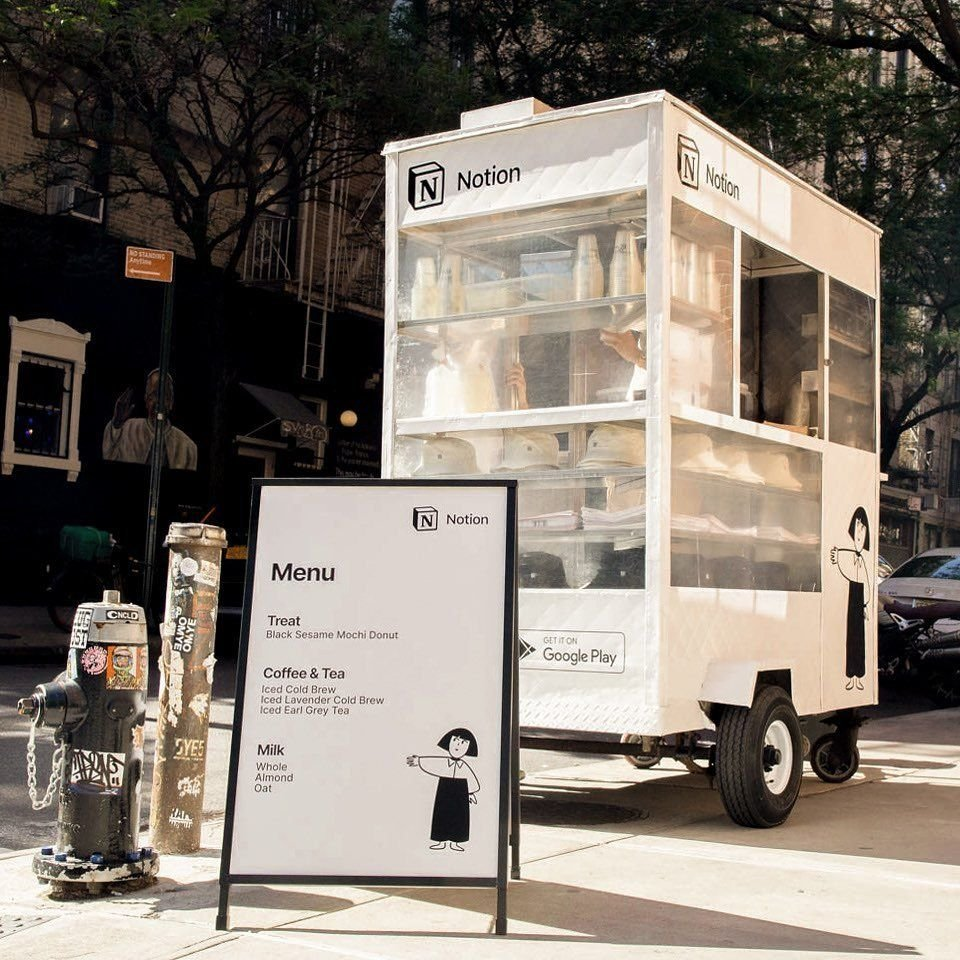
… As an example, Notion’s global pop-up series was a set of community-centered experiential marketing plays that focused on some of our top metropolitan cities. For each city, we chose a popular destination (e.g. where our target demographic lives or hangs out, where startups are based, which areas get high foot traffic) to host a Notion pop-up, orchestrating community meetups and driving both customers and prospects to stop by for a free treat and a chat with the team or an enthusiastic community member. Community leads from around the world organized their own complementary meetups and after-parties. We drove buzz on our own social channels and with partner influencers, and used limited swag giveaways to drive urgency—and, last but not least, we surrounded each city with OOH creative that created familiarity ahead of each activation and the feeling that ‘Notion is everywhere!’”
At the very least, if you buy a billboard, share it on social media, a lot.
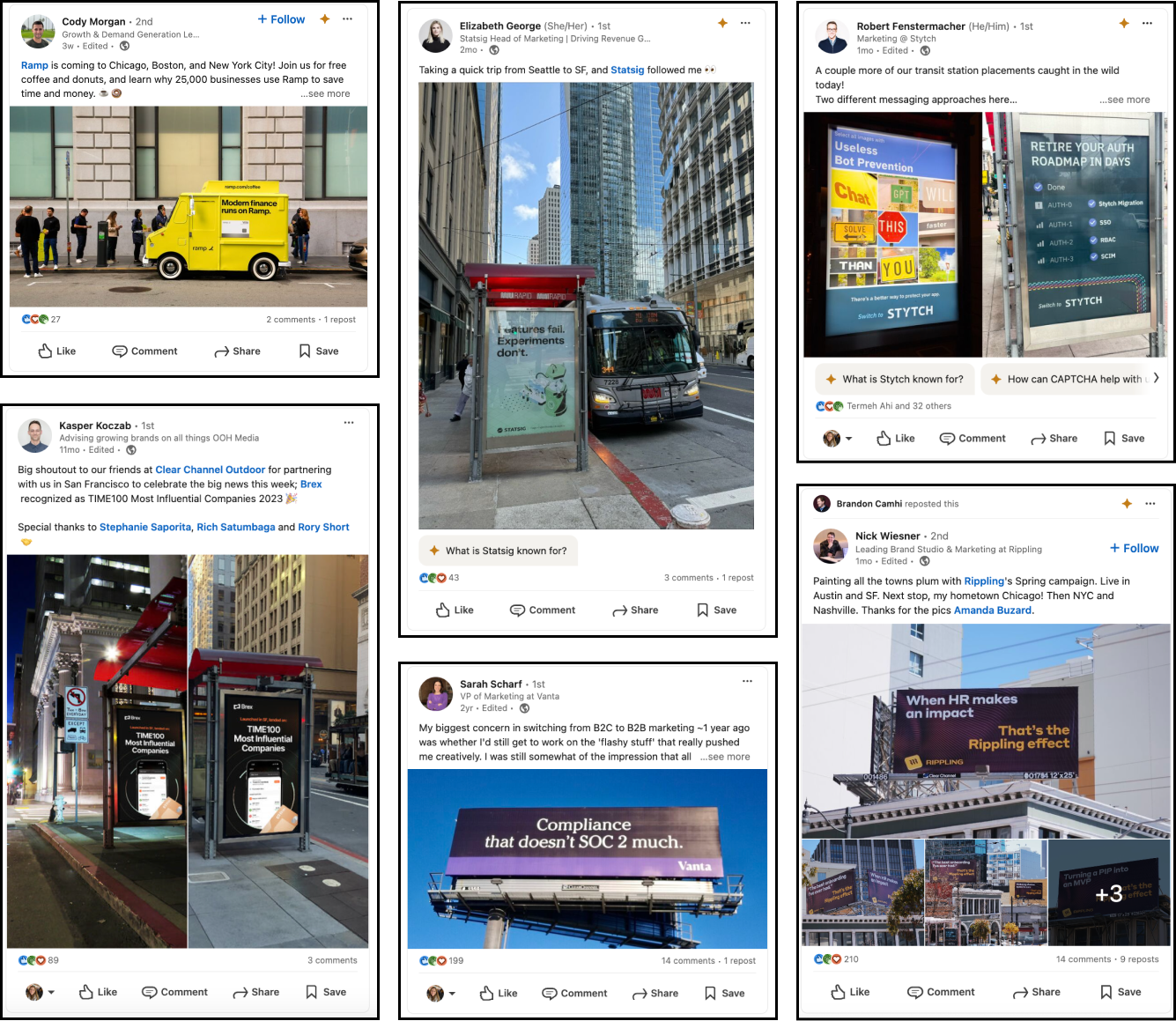
Cody Morgan, VP of demand gen at Ramp, offered this advice:
“The best tip I can give someone planning to invest in OOH for the first time is to get loud on social media when the campaign goes live. Hire a professional photographer to take photos of the placements to make it easy for team members, investors, and friends and family to post on social media.”
Put all together, combining ad frequency and resonance leads to good recall—and nice boosts to metrics across the funnel.
Getting tactical: So how do I actually do this?
At this point, we’ve talked about the “why” of out-of-home advertising. But there’s quite a bit of tactical work required, so I want to touch on that too.
Here are a few grounding questions when you’re considering how to approach your campaign:
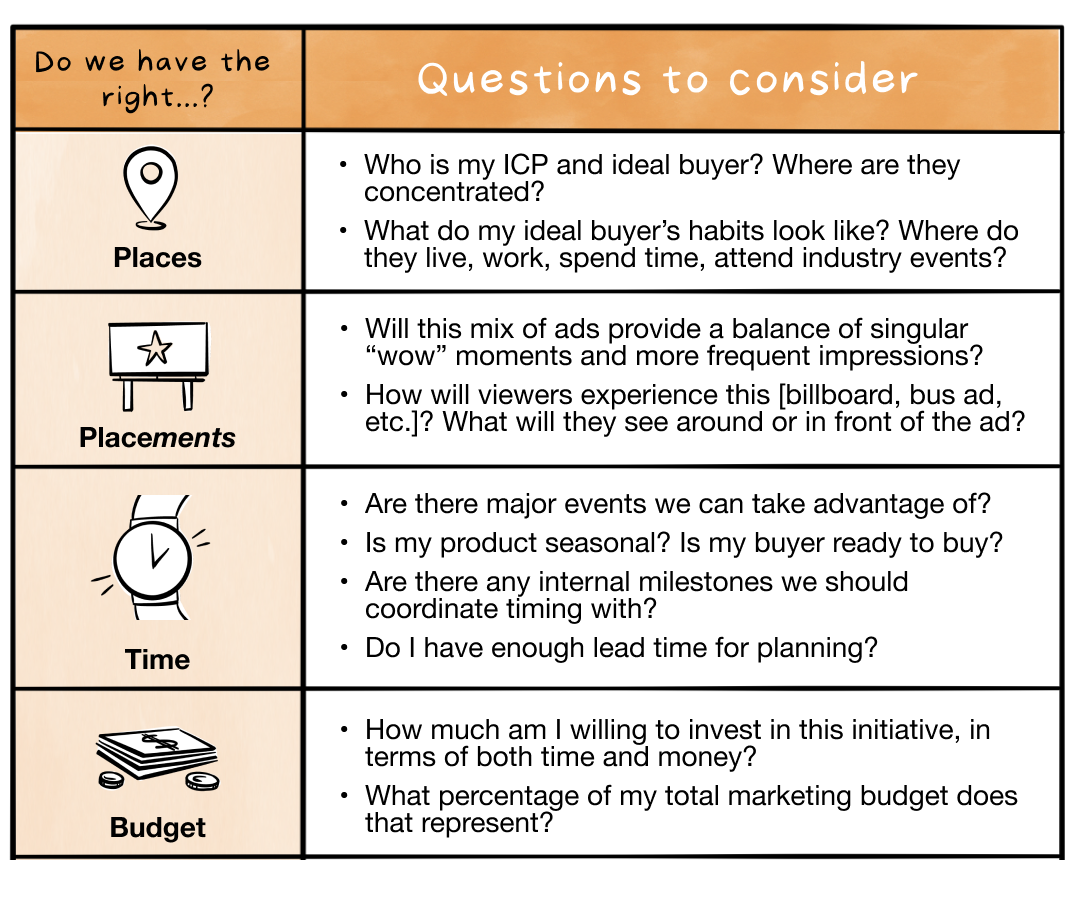
Right places
For out-of-home, it’s not enough to know who your ideal buyer is; you have to understand their physical habits—where they live, where they work, and how they move back and forth.
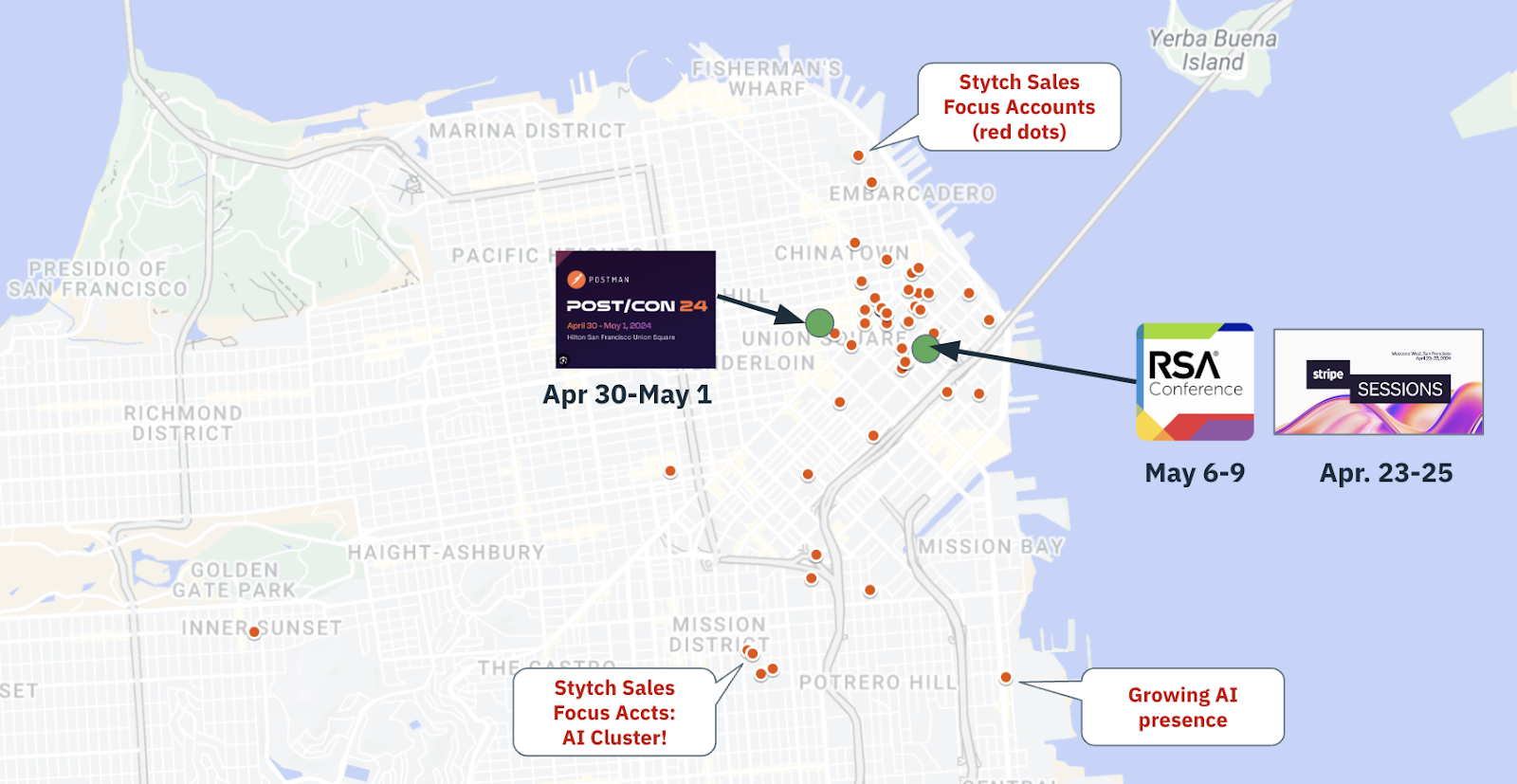
For us at Stytch, we knew we wanted to target software engineers and tech workers, and we found that those people were heavily concentrated in San Francisco, or would at least visit for conferences. We mapped our target Sales accounts, typical commuting routes, and conference venues, then picked ad locations to maximize impressions near those locations.
Lisa Ferragano, Canva’s Americas brand media lead, echoed this approach to targeting:
“We geo-target our OOH around regions with a high concentration of our target audiences, around specific events, and in downtown areas with a high concentration of large organizations that could benefit from utilizing Canva in the workplace.
OOH allows us to reach decision makers in a context they might not expect, like on their commute or while they’re away from their desks. We’re taking B2B off LinkedIn and into the real world.”
Right placements
Once you’ve decided on a geographic location to target your ICP, you also need to think about individual placements. In out-of-home advertising parlance, that’s your “media.” At Stytch, we were fortunate to learn from the best in Kasper Koczab, who leads OOH at Brex. Here’s his advice:
1. Mix different types of ads to maximize both resonance and frequency.
“When entering a new market, we aim to have a good balance of high-profile units (usually units that people literally have to look up to see), along with a format that offers a wider footprint (street furniture or transit, for example) in order to deliver frequency. While folks might only recall the big unit on the sales call, the smaller formats that deliver frequency play a crucial role in driving recall.”
2. Every placement is different. Consider the viewer experience for each ad.
“Market rides with an ethnographic eye are central to designing a campaign that stands out. Is the highway littered with billboards one after the other to the point where no one is paying attention, not to mention remembering what they saw? Are the newsstands facing the street targeting the drivers, or are they better suited for the pedestrians who are two to four lanes on the other side of the street from the poster box? If the latter, then are my font, contrast, and graphics appropriate for easy legibility from the viewing distance?”
To demonstrate why thinking holistically about placements matters, here are two examples of billboards partially blocked by trees. Which one is more compelling?
If you run an out-of-home campaign, this means you’ll likely spend a lot of time on Google Street View and/or running around a city taking pictures. It’s worth the time investment to get it right.
Right time
Timing-wise, there are a few factors to consider:
- Lead time: Design and production require at least a few months; Cody Morgan from Ramp recommends planning further out (at least six months) to get the best ad inventory.
- Major events: Are there any conferences or industry events you can target?
- Seasonality: When is your buyer in the market, with a budget to spend?
- Internal milestones: Do you have any upcoming company launches or milestones that OOH could help amplify?
At Stytch, we lined up our most recent successful OOH campaign with three developer conferences (RSA, Post/Con, and Stripe Sessions) and an internal product launch.
At Brex, one of their early OOH activations was tied to a major product announcement at TechCrunch Disrupt. They timed the billboard creative all across San Francisco to change—mid-speech—from a teaser message to the new product announcement.
This creative use of timing paid off: they exceeded their qualified sign-ups goal by 300%, and the campaign was picked up by 75 industry news outlets and by local TV stations.
Right budget
Last but not least, an out-of-home campaign is not cheap; it requires an investment of both time and money to do well.
To offer a directional sense, a billboard on Highway 101 in San Francisco is probably about $20,000 at minimum for a month. Larger billboards in high-profile locations (or locations where viewers sit in traffic!) might go for more like $50K to $80K. At 400,000 to 1 million impressions per week, this is actually a relatively affordable CPM, particularly if you amplify your OOH campaign across digital ads, socials, and more.
However, it’s ultimately an investment in awareness. It shouldn’t be the majority of your marketing budget (Andrew Racine from Writer offered a maximum of 20% as a rule of thumb) and it isn’t a replacement for traditional demand gen—but it can be a powerful amplifier.
One tactical tip when making your budget: consider setting aside funds to “protect your brand” by buying paid search ads related to your company name or advertising themes. After people see your ad and search you to learn more, you want to make sure they find you and not a wall of ads from competitors (we were reminded of this the hard way at Stytch!).
A final note on planning
In addition to this post, there are plenty of other resources to help.
Two great ones that are worth mentioning:
- Kira Klaas has a public template that she used to plan large-scale OOH campaigns while at Notion, along with her campaign brief to share with media owners or agencies: www.notion.so/templates/out-of-home-planning
- There are also lots of agencies and partners out there that can make this easier. At Stytch, we worked with Division of Labor on creative and with Kasper from Brex Rewards to help pick out our ad placements. Their expertise has helped us maximize the impact of our spend and avoid potential pitfalls.
The TL;DR
In summary, my high-level answer to “should you do out-of-home” is usually yes, if your budget allows and you bring a thoughtful approach.
Whether it’s a single, resonant billboard that makes a big impression on a conference, like Vanta’s SOC 2 billboard did at SaaStr, or a holistic campaign experience like Notion’s global pop-ups, or a city domination like Statsig’s SF takeover, billboards are a powerful medium to establish a brand identity and relate to your target audience, with ROI that continues to grow over time.
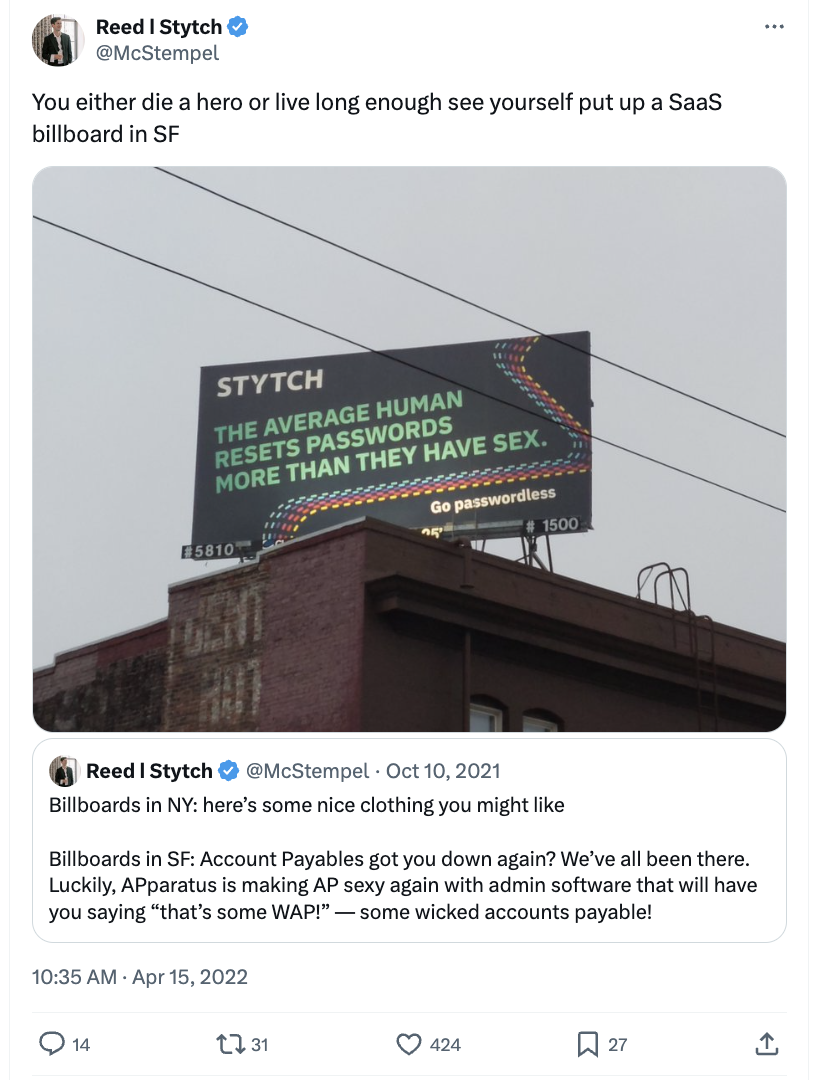
It’s also really fun! As a founder, it’s unbelievably cool to get to see billboards or bus ads for Stytch on my way to work. So just think, this could be you someday too:
Bonus tips
The startup leaders I spoke with had tons of amazing tactical advice—too much to fit into one post. Here are a few more suggestions for how to plan and execute a B2B billboard campaign:
On brand design (and not putting your software UI on a billboard):
“In advertising, as brands mature, you’ll likely see the fidelity of the product depiction becoming less literal and more abstract—more inspiring. For tech brands advertising on OOH, your software UI isn’t going to be the most memorable aspect of your ad, and it’s probably too complex to convey much value in the OOH ad format. Being clear on who you’re for and how you want to make people feel is the most important creative consideration behind designing OOH ads.”**
—Kira Klaas, Former Global Head of Brand Marketing and Campaigns at Notion
On knowing if your ad will resonate:
“Emotion takes buyers from awareness to action. There are three questions we ask ourselves at Vanta to make sure our marketing is hitting the mark:
- Will it make them smile?
- Will it make them nod their head?
- Will it make them tell a friend?”
—Sarah Scharf, VP of Marketing at Vanta
On controversy as a good thing:
“Even the most daring digital ads don’t get discussed much, whereas billboards are shared, reposted, and debated. If your product introduces a new way of thinking or is defining a new product category—good luck explaining that in a digital ad. Advocating for this way of thinking on a billboard, however, creates a stir, and if you’re lucky, you’ll have personalities from your industry writing articles agreeing or disagreeing with you.”
—Elizabeth George, VP of Marketing at Statsig
On testing and learning:
“Certain placements will dramatically outperform others, and finding the right mix of placements takes a few iterations. There’s no way to know what works best from the start—it’s best to test and learn along the way.”
—Cody Morgan, VP of Demand Generation at Ramp
On referencing competitors:
“Taking jabs at your competitors in digital advertising can seem classless or petty, but in out-of-home it’s playful and daring. It’s best if you’re ‘punching up’—if you’re trying to disrupt a giant, billboards are a fantastic way to get the word out. This was especially fun for us given that we’re based in Seattle, taking it to our competitors’ doorstep in San Francisco. We even got word that we (accidentally) put one right outside our main competitor’s COO’s apartment—which was great for office morale.”
—Elizabeth George, VP of Marketing at Statsig
On connecting physical and digital experiences:
“One important goal of an out-of-home campaign is to generate organic and direct website traffic, as people see billboards and want to know more about your brand. To maximize the value of this traffic, it’s important to make sure that your website experience is dialed-in and acts as an extension of your billboards (especially on mobile!). For us, this involved revising design and content to align with the campaign creative, revisiting information architecture to optimize visitor journeys, updating the sign-up and onboarding flow, optimizing CTAs, and improving how we identify attribution sources at sign-up. This investment ensured visitors had a cohesive experience and were more likely to stay on our site and try our product.”
—Robert Fenstermacher, Head of Marketing at Stytch
Don’t hesitate to reach out if it’s ever helpful to chat more about our experience at Stytch—or if you have tips for out-of-home that you think other startup leaders should know!
Thanks, Reed! For more from Reed, follow him on LinkedIn and X.
Have a fulfilling and productive week 🙏
👀 Hiring? Or looking for a new job?
I’m piloting a white-glove recruiting service for product roles, working with a few select companies at a time. If you’re hiring for senior product roles, apply below.
If you’re exploring new opportunities yourself, use the same button above to sign up. We’ll send over personalized opportunities from hand-selected companies if we think there’s a fit. Nobody gets your info until you allow them to, and you can leave anytime.
If you’re finding this newsletter valuable, share it with a friend, and consider subscribing if you haven’t already. There are group discounts, gift options, and referral bonuses available.
Sincerely,
Lenny 👋