P.S. Check out my PM recruiting service (helping you hire Sr. PMs and VPs), Lennybot (an AI chatbot trained on my newsletter posts, podcast interviews, and more), and my swag store**(great gifts for your favorite PM, or yourself!).
Today’s post, by returning collaborator Kyle Poyar, is one of my new favorite guest posts ever. It’s for anyone starting a new job, or simply looking for ideas to make an immediate impact at their company. I guarantee you’ll find at least one quick win you can implement this week that’ll make a big impression.
Kyle has spent the past 14 years working with and advising top startups as a consultant at Simon-Kucher turned VC operating partner at OpenView. He shares tactical insights about how to grow faster in his newsletter, Growth Unhinged, and on LinkedIn.

Your first 90 days at a new job have an outsize impact on your next one to two years at that company. It’s your chance to establish trust, influence, and build a reputation within the org. To do this well, you want to show quick wins: low-effort, high-impact changes that create a sense of “Holy shit, this person is amazing.”
To help you do just that, I asked the sharpest tech operators I know about their most effective early quick wins. These operators have a track record of significant impact and rave reviews from their colleagues, at well-loved brands like Asana, Calendly, Canva, Dropbox, Linktree, Ramp, and Wiz.
Even if you’re not starting a new job, most of these ideas can be implemented anytime. A surprising commonality that came through as I was collecting them is that these ideas are typically hiding in plain sight—a beginner’s mind and a new way of analyzing the funnel can unlock missed growth opportunities and potential revenue that’s gone unnoticed.
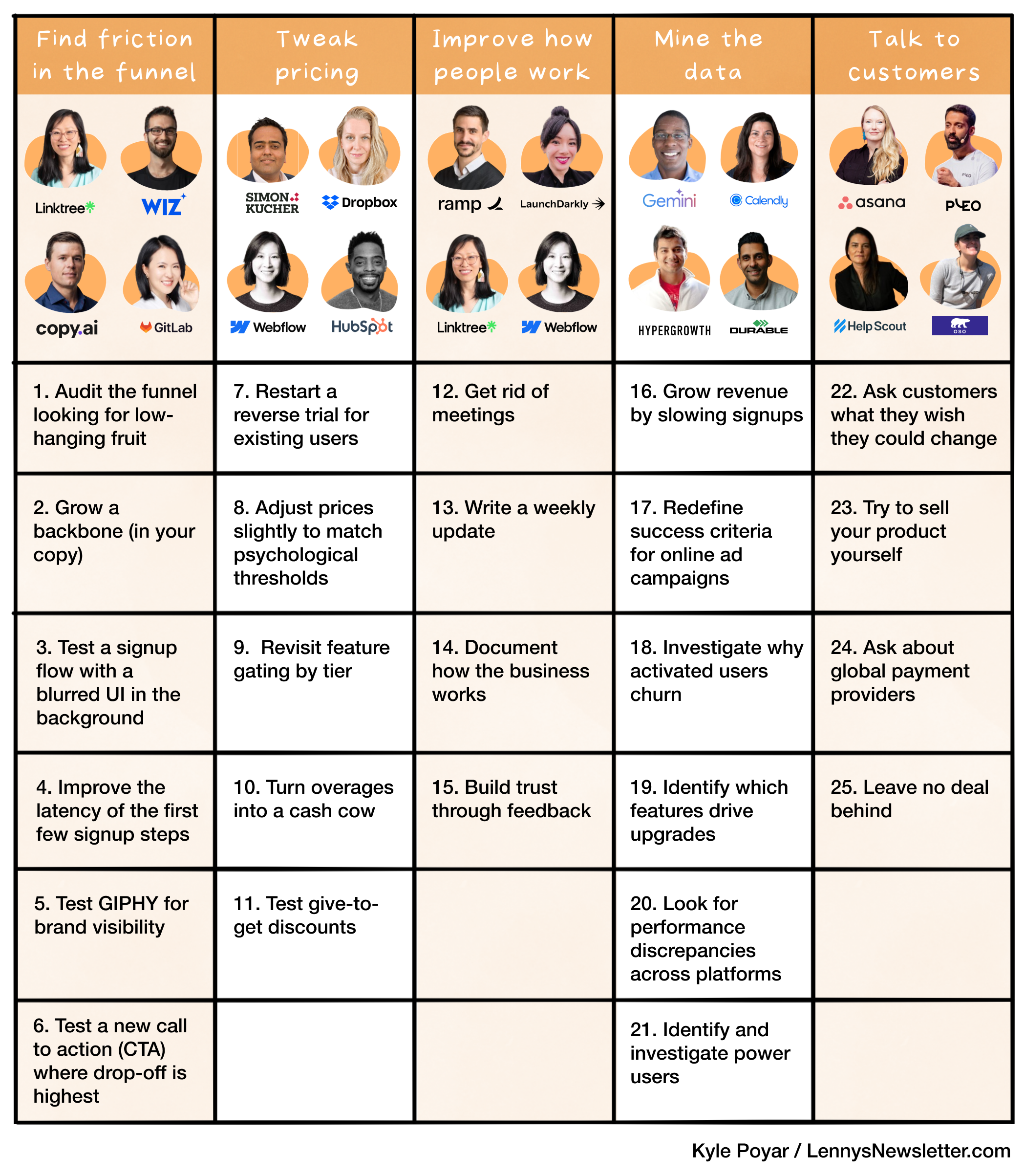
Find friction in the funnel (and fix it)
Hunt for unnecessary friction points—especially during signup and onboarding—and implement best-practice fixes. There’s always something lurking here that people have overlooked.
1. Audit the funnel looking for low-hanging fruit
“When I came into Linktree, I worked with the team to audit the funnel, looking for low-hanging fruit. A small tweak like turning the Linktree logo at the bottom of a Linktree to a ‘Create a Linktree’ CTA has almost doubled signups.
Also, look for opportunities that might turn pre-existing assumptions on their head. The team was optimizing traffic coming from paid marketing channels because they’ve historically converted better. Yet, the bigger opportunity is in profile referrals. It was uncomfortable at first for the team to focus on this because the channel is much lower intent, but it’s a channel with 5x improvement opportunities.”
—Jiaona Zhang, CPO at Linktree
“The website is almost always an opportunity. Doing an audit usually exposes low-hanging fruit that will quickly improve conversions and deliver a quick boost to the top of funnel.
With the changes in keyword searches happening from AI, take a look at your YouTube channel—at any startup, it could probably use some love, and when you are competing in an early market where buyers are still learning, it’s a great place to dominate.”
—Cate Lochead, CMO at Snorkel AI
2. Grow a backbone (in your copy)
“My favorite quick win is to help the company grow a backbone. Develop a provocative point of view. Create thought leadership that changes how people think. Take an unpopular stand and challenge the status quo. Reframe your value props to hit on C-level problems. Market the hell out of those problems. Take a hard look at messaging, value props, and customer perceptions. I can pretty much guarantee (especially at PLG companies) that they’ll be very feature-oriented.
‘Safe’ marketing and positioning kills companies. ‘Consensus’ messaging created by committees is never any good. Be the forcing function to grow a backbone, stand for something, and make a splash in the market.”
—Kyle Coleman, CMO at Copy.ai
3. Test a signup flow with a blurred UI in the background
“Instead of the usual white background, place your signup form over a blurred or dimmed version of your product. Populate the UI with fake data—it’s unclear anyway. Make it feel like the final step.
It creates a ‘peek behind the curtain’ effect, making users want to see what lies beneath. Form-over-UI taps into the curiosity bias, increasing conversion rates.”
—Tom Orbach, head of growth marketing at Wiz and author of Marketing Ideas
4. Improve the latency of the first few signup steps
“In a freemium product, you can lose a lot of users in the first few minutes before and after account creation. Even before a user can make an assessment of your product’s core value, they are immediately making assessments of product and service quality based on things like how long it takes for a page to load. Early latency can send the signal that your product might not be able to perform in the times your customers need it most.”
—Christopher Miller, VP of product, growth, and AI at HubSpot
5. Test GIPHY for brand visibility
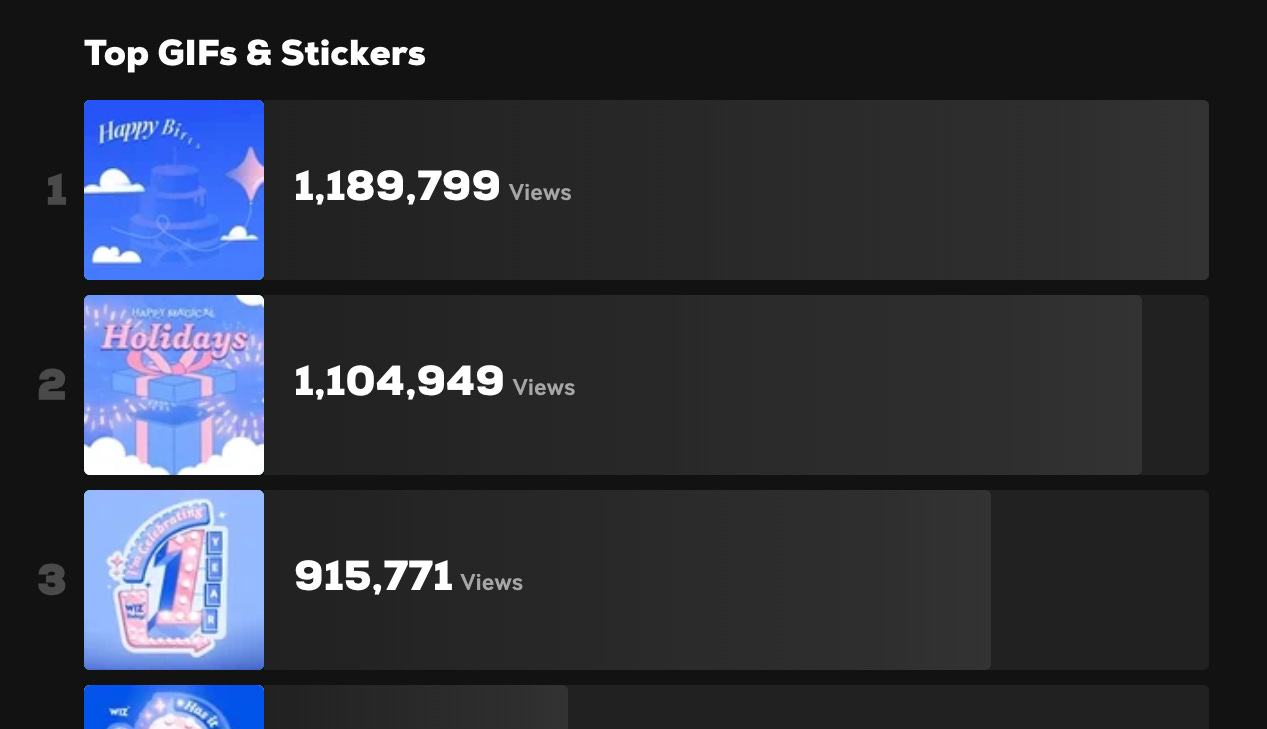
“Upload your existing branded GIFs (that you created in the past) to GIPHY, the world’s largest GIF search engine. Clever keyword tagging can land your logos in millions of views (literally!). It’s free brand exposure on a massive scale.
We did it at Wiz, and the Happy Birthday, Happy Holidays, and 1 Year Anniversary GIFs with our logos have around 1M views each. Not bad for 20 minutes of work!”
—Tom Orbach, head of growth marketing at Wiz and author of Marketing Ideas
6. Test a new call to action (CTA) where drop-off is highest
“Identify the highest point of leverage where there’s drop-off in the funnel and check to see whether there are obvious calls to action (CTAs). If the product has a large free user base but there isn’t an obvious ‘Upgrade’ CTA in the free product user interface, start by adding that to drive monetization awareness. If a marketing site has good traffic, test clearer CTAs on the page with an eye to reduce the time to value. A client of mine changed ‘Contact Sales’ to ‘Book a demo’ with a booking page connected, and that simple change generated way more leads.”
—Hila Qu, growth advisor and former director of growth at GitLab
Tweak pricing
Pricing improvements are often the fastest path to new revenue, and there’s rarely a dedicated owner. Try some of these low-hanging fruit ideas.
7. Restart a reverse trial for existing users
“Restart a paid trial for your existing user base on a predetermined date, providing access to premium functionality at no cost for a limited time. And no, it’s not just about making users simply eligible; it means actually restarting the trial.
That’s right—trials shouldn’t be reserved just for new signups. There’s a lot of value in offering them to your existing users too. Let’s be honest: your product is (or should be) constantly getting better. So why not give your existing users a taste of the latest improvements?
The goal? To instill a sense of urgency (the trial begins now!) and enhance the perceived value of paid plans (by driving usage) to trigger an upgrade.”
—Elena Verna, interim head of growth and data at Dropbox
8. Adjust prices to match psychological thresholds
“Stop using price points that make people overthink. Instead, move prices to just below ‘psychological thresholds’ that correspond with budgets like $75, $100, or $300. If the price is $273.43, it makes people stop and think before buying. If you push the price up to $299, most people see that as only $25 per month and it feels reasonable.
When you publish pricing, lead with the monthly price point on an annual deal. It’s an easy hack—but I still see companies not doing it.”
—Madhavan Ramanujam, senior partner at Simon-Kucher
“Emphasizing the monthly price on an annual deal not only improves conversion, but is also one of the easiest and most impactful growth hacks to improve retention and LTV. This single initiative of driving more annual plans was one of the biggest churn reducers at Canva.”
—Melissa Tan, former head of growth at Webflow and Dropbox
9. Revisit feature gating
“Audit pricing and packaging. Are you gating features users need to experience to unlock your product’s core value?
Feature packaging can be a pain, but if there are features that are completely gated behind a paywall, aren’t driving meaningful monetization, and aren’t heavily used by paying customers, then it might make sense to consider making them free, especially if they help users unlock core value. This is also an area where putting a usage limit in place can make a lot of sense.”
—Christopher Miller, VP of product, growth, and AI at HubSpot
10. Turn overages into a cash cow
“Let users get a taste of your premium features on a free plan or upgraded plan for free, especially in a consumption-based pricing model. Then focus on overages for both feature use and usage/consumption. At Heroku, we allowed users to use most of the product features and plans for free and generated an upsell and cross-sell motion from the overages. We closed several million in ARR just in one quarter by having a sales motion to not just top off what they are using but also sell more products with their growing needs.”
—Rajan Sheth, general partner and go-to-market advisor at HyperGrowth Partners
11. Test give-to-get discounts
“Many sellers are just giving a discount and not getting anything back for it. What are the list of concessions that you can get back when you offer a discount? Do you get references, product feedback, a longer commitment? A no-brainer concession is an annual price escalator where the price ‘automatically’ increases at renewal. At the very least, set up tracking for the most common ‘gets’ for every sales discount.”
—Madhavan Ramanujam, senior partner at Simon-Kucher
Improve how people work
Companies get stuck in operating rhythms that no longer work for the team. Fresh eyes can be a great opportunity to identify obsolete processes that almost always lead to an easy win.
12. Get rid of meetings
“Figure out the meetings that are happening that people hate. Get rid of them or change them around to be meaningful. At Linktree, I axed 50% of meetings to create more maker time and consolidated around just a few key rituals.
To solve for higher shipping velocity, I introduced Demo Power Hour, which helped everyone feel ownership and pride in their work. To solve for transparency and accountability, I introduced Scorecard. And to solve for alignment and working more closely with founders, I introduced founder jam sessions with PMs, designers, and engineering leads.”
—Jiaona Zhang, CPO at Linktree
13. Write a weekly update
“I immediately start sending a regular (weekly) written update on observations, personal areas of focus, and kudos that allows you to scale leadership visibility in an async way. This is a great way for new leaders to quickly get visibility and build trust (which is much harder to do in a remote world).
I also like to build a ‘personal’ data dashboard of metrics that matter to your success. This helps you learn the data tools, think about your goals, and get in the habit of looking at performance regularly.”
—Claire Vo, CPO at LaunchDarkly
14. Document how the business works
“I like to put together two documents right after I join:
- A mind map of the domain: Inputs and outputs of the business equation. This helps the individual learn the space by dissecting it, but also gives a win to the team in terms of documentation. You can then easily pin existing projects to this map and plan for the future.
- A clear document about what the highest priorities are for the team:Writing this forces you to understand the space, pull information from people’s heads, and synthesize well, but, most importantly, align the team. Often people are too busy to write such a document. This helps people verify you understand, helps you clarify your thinking, and ensures you are now rowing with the team in the same direction.”
—Geoff Charles, VP of product at Ramp
15. Build trust through feedback
“Building trust is critical in the first 30 days. Without it, you can’t be effective. With it, you have the power to unlock the largest opportunities. The fastest way to build trust is through feedback.
- Receiving feedback: Ask for feedback to not only get input, but also establish that you want to hear from others. If you are not getting any substantive feedback it’s not because you are perfect–most likely it’s that others don’t trust you yet to share it.
- Giving feedback: Be brave. Someone has to start giving honest feedback and, when done thoughtfully, you will elevate your relationship.
In growth, everyone needs to be rowing in the same direction and they need to get into formation ASAP. At Dropbox and Webflow, some of the strongest rapports I built happened when I shared feedback in the first week of working together. It established from the outset that I was transparent, invested in their success, and wanted us to win together.”
— Melissa Tan, former head of growth at Webflow and Dropbox
Mine the data
Even the most data-driven operators steadily become blind to what’s going on in their product. Bring a fresh way of looking at the data to unlock overlooked insights.
16. Grow revenue by slowing signups
“Every time I have a first conversation with a CEO, they’ll say: our top of the funnel is getting thousands of signups every month, and we need to scale it even more as our inbound motion is working really well and we can see proportional growth in pipeline/monetization.
All signups are not created equal. Yes, it’s good that your CEO cares about marketing, but it’s our job to drive non-linear growth in the business metrics. Only 20% to 30% of the signups actually matter in most products. Find out which segment of signups is driving or may drive revenue, and hyperfocus on growing that cohort, even at the expense of overall signup volume going down. You’ll be able to drive so much efficiency and put your budget and team in the right areas, versus trying 100 things to grow top of the funnel.”
—Rajan Sheth, general partner and go-to-market advisor at HyperGrowth Partners
17. Redefine success criteria for online ad campaigns
“When you’re looking at ROI from ads and other marketing activities, look beyond signups and even conversions, all the way to retained customers. PLG customers tend to have higher churn, so if you ignore retention, you could be paying for customers that convert quickly but also churn quickly.”
—Jessica Gilmartin, CRO at Calendly
18. Investigate why activated users churn
“As a general rule of thumb, 50% of signups will not activate (meaningfully use your product even once), and 40% of users who activate for the first time will drop within seven days. Focus on that 40% churn first. Don’t go after volume or non-actives. They have made the effort to use the product and you have more information about them, and there will be two or three common drop-off reasons which you can experiment around quickly.”
—Rajan Sheth, general partner and go-to-market advisor at HyperGrowth Partners
19. Identify which features drive upgrades
“Run a simple correlation analysis for customers who grew their usage—by going on higher plans or adding users—to identify which features drove that. This analysis can then be used for sales conversations, as well as how you bundle your pricing plans.”
—Haresh Bajaj, VP of product growth at Pleo
20. Look for performance discrepancies across platforms
“When I start a new role, I typically look for quick ways to improve the product experience. For example, in my first months at Slack, I realized that user onboarding on mobile performed worse than on web, resulting in hundreds of thousands of people who were signing up without experiencing Slack’s magical value of seamless team communication. So I identified opportunities to simplify the mobile onboarding flow and shipped a quick experiment that increased user activation.”
—Jules Walter, product leader for Gemini at Google
21. Identify and investigate power users
“Build a working definition of your power users. Start with a cohort of your best-retained users and search for trends in their product usage that tell a story. Tack on some qualitative research to create a demographic and behavioral profile to match the data. Even a rough power user profile makes your PLG strategy significantly easier.
Overshare this profile with your marketing and product leaders—the fastest path to better conversion, higher monetization, and stronger retention is focusing acquisition and product optimization efforts on the segment of your users that naturally fit your product best; as you run experiments to further activate and engage this group, the results will compound.”
—Amaan Nathoo, head of growth at Durable
Talk to customers
Regardless of your role, fresh intel from your customers will drive better decision-making and more customer empathy. Even better, talk to someone who could become a customer.
22. Ask customers what they wish they could change
“Talk to a few customers directly right away (or even before you join). A question I love to ask is ‘If you had a magic wand, what would you change about [product]?’
You’ll find the answers often break out from feature gripes and into the problems customers are facing that they wish you were solving better. Armed with this intel, you can confidently share firsthand insights with the team (during a time when you are otherwise operating with minimal data) and role-model customer-centric behaviors and curiosity for your team.”
—Paige Costello, head of AI at Asana
23. Try to sell your product yourself
“Nothing beats going out into the field, talking to prospects—even cold-calling—and existing customers to understand their pain points, what is working and not working to solve these pain points, and making the sale happen yourself. This way, you understand how to tailor your acquisition efforts across all touchpoints, like ads, email marketing, website, sales pitch, partners, SEO, etc.”
—Haresh Bajaj, VP of product growth at Pleo
24. Ask about global payment providers
“If you have a global user base, you will need to offer different payment providers for your self-serve customers. Implementing the new payment providers will take time, but you can quickly learn which payment providers your users prefer.
My quick win is to add a survey to your checkout flow to get context on which payment providers your users want to pay with. This data will help build a case to present to the infrastructure and billing team.”
—Francesca Krihely-Price, head of marketing at Oso
25. Leave no deal behind
“Improving our win rate is a company key result. While product continues to build features that support that, our sales and marketing teams work on initiatives to make sure no deal is left behind. This includes campaigns like engaging those previously lost to competition, those with high product-led growth scores (high product usage) that didn’t convert, and trial cancellation emails to ask what we could have done better.”
—Andrea Kayal, CRO at Help Scout
Final words of advice
In a new role, it’s almost inevitable that you’ll feel like you’re falling behind or you’re missing out on context that everyone else takes for granted. Remember that your beginner’s mind has its advantages. You can revisit areas like the website or the product experience and catch issues that others have become blind to. You can ask the questions that others might have been afraid of, and then use the answers to try a different approach.
The trick is to be intentional—you are in the driver’s seat of your onboarding. Keep an eye out for potential improvements, assess which of those improvements are indeed quick wins, and then advocate to give them a try. The faster you drive improvements, the faster you integrate into the team. Soon enough, you’ll be trusted to take on even more.
Be sure to pick your battles wisely. Just as making an impact quickly puts you on a fast track, driving disruptive changes that don’t pay off can alienate others and erode trust. A final word of advice comes from Zach Kitschke, chief marketing officer at Canva:
“One of the biggest pieces of advice we give folks starting at Canva is to take the time to just be new. Soak it all in, ask questions, build relationships, but don’t try and ‘do’ too much early on. People often feel like they need to immediately deliver results, but the first few months are a period of transition you only get once. That space to think, gain context, and the relationships built are what set you up for the long haul.”
—Zach Kitschke, chief marketing officer at Canva
Thanks, Kyle! For more from Kyle, don’t miss Growth Unhinged and his LinkedIn.
A huge thank-you to Amaan Nathoo (head of growth at Durable), Andrea Kayal (CRO at Help Scout), Cate Lochead (CMO at Snorkel AI), Christopher Miller (VP of product, growth, and AI at HubSpot), Claire Vo (CPO at LaunchDarkly), Elena Verna (interim head of growth and data at Dropbox), Francesca Krihely-Price (head of marketing at Oso), Geoff Charles (VP of product at Ramp), Haresh Bajaj (VP of product growth at Pleo), Hila Qu (growth advisor), Jessica Gilmartin (CRO at Calendly), Jiaona Zhang (CPO at Linktree), Jules Walter (product leader for Gemini at Google), Kyle Coleman (CMO at Copy.ai), Madhavan Ramanujam (senior partner at Simon-Kucher), Melissa Tan (former head of growth at Webflow and Dropbox), Paige Costello (head of AI at Asana), Rajan Sheth (general partner at HyperGrowth Partners), Tom Orbach (head of growth marketing at Wiz and author of Marketing Ideas), and Zach Kitschke (CMO at Canva) for contributing to this post. Art by Natalie Harney.
Have a fulfilling and productive week 🙏
🔥 Featured open role: Product Manager of Collaboration @ Notion
We recently partnered with Notion to help them scale their PM team. One role that’s particularly interesting to me is an opportunity to own the asynchronous collaboration experience within Notion. If you’d like to get referred directly for this role, follow this button:
If you’re hiring and want to work with us, apply here. Our team will reach out if we think it’s a good fit. Note, we primarily work with fast-growing U.S.-based startups.
If you’re finding this newsletter valuable, share it with a friend, and consider subscribing if you haven’t already. There are group discounts, gift options, and referral bonuses available.
Sincerely,
Lenny 👋