Q: What are your favorite decision-making frameworks?
Companies live and die by the quality of their decisions. One better decision can change the trajectory of your business. Yet important decisions often get mired in head-banging meetings, debates, and consensus seeking. And as your company grows, you’ll inevitably run into decision-making challenges.
Below I’ll share several battle-tested decision-making frameworks that are designed to help you make better decisions more quickly and with less drama. Although no framework will make hard decisions easy, having a framework can significantly cut down on the head banging.
First, a few caveats:
- Prioritize trust: If your team is asking you to use a decision-making framework on many decisions, it could be a sign they don’t super-trust your judgment. Before running every decision through a framework, dig into this potential issue. You’re better off long-term getting things done through influence and trust, versus jumping to a framework. That being said, as your company scales and the number of stakeholders grows, even with high trust there’s often a need for a structured process to make sure everyone’s voice is heard.
- Save frameworks for big (one-way-door) decisions: AsGokul Rajaram put it, “[A decision-making] framework isn’t meant for every situation. It’s meant for hard decisions. Things that would have real consequences for a company or group. Not all decisions are important. At Square, we used to jokingly call this the ‘kombucha scale,’ which captures two variables: importance and urgency. If the choice is as simple as selecting a flavor of kombucha, everyone can save the time and effort spent on a thorough decision-making process.”
- Make these frameworks your own: Don’t assume the way the framework is set up is the only way it can work. Tweak it to work for you and your company. Make your own decision-making framework that I could include in a future edition of this post!
To help you evaluate these frameworks, and your decision-making process broadly, Brian Armstrong came up with a great set of attributes to aim for:
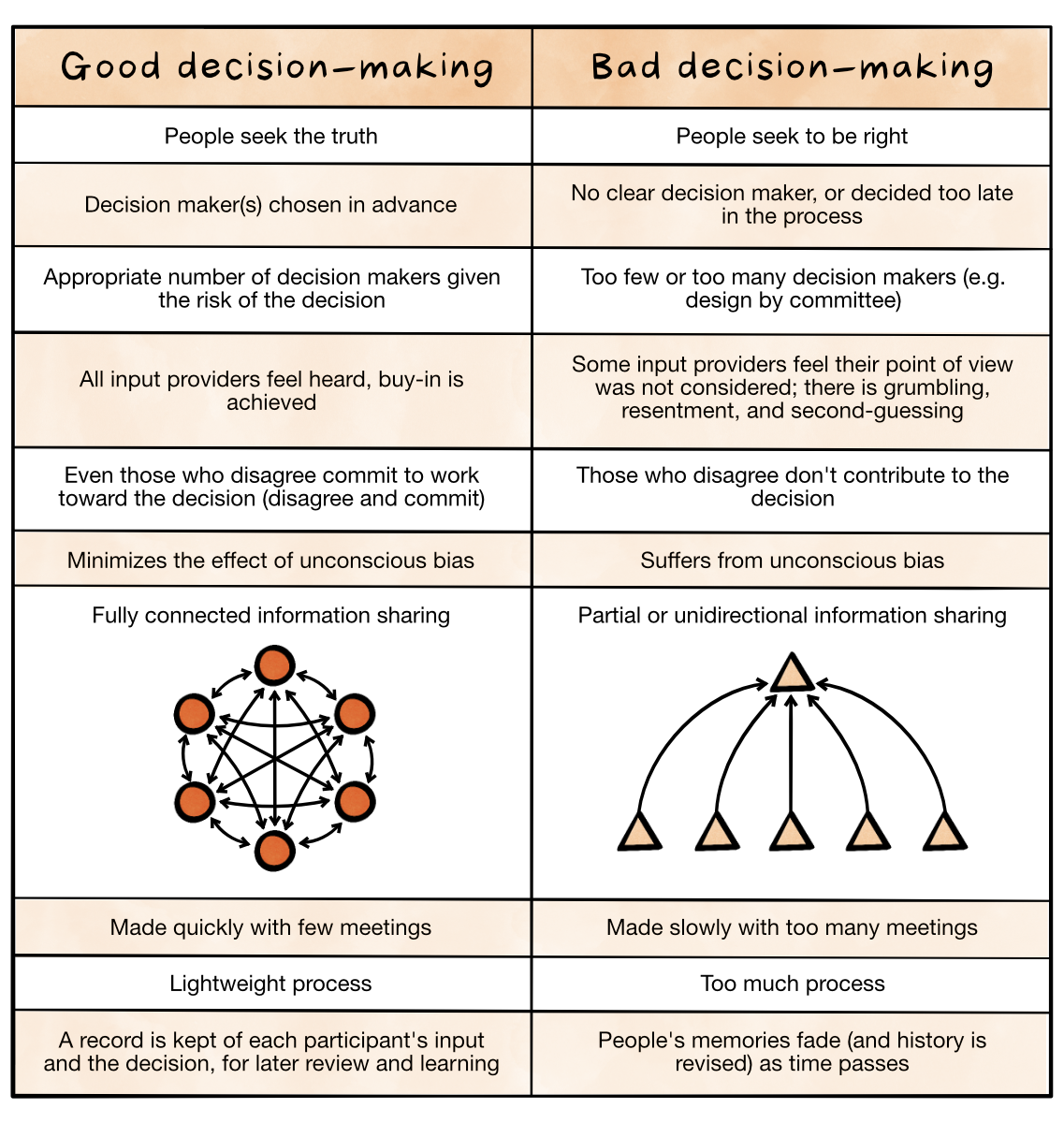
Keep in mind as you work on your decision-making process, as Jeff Bezos said in his conversation with Lex Fridman, that “humans are social animals. Not truth-seeking animals. Important truths can be uncomfortable and make people defensive. Any high-functioning organization has to have mechanisms and a culture that supports truth-telling. You have to talk about that and how it takes energy.”
To help you get to truth, here are my favorite (relatively lightweight) decision-making frameworks, in descending order from most structured to least.
1. S.P.A.D.E
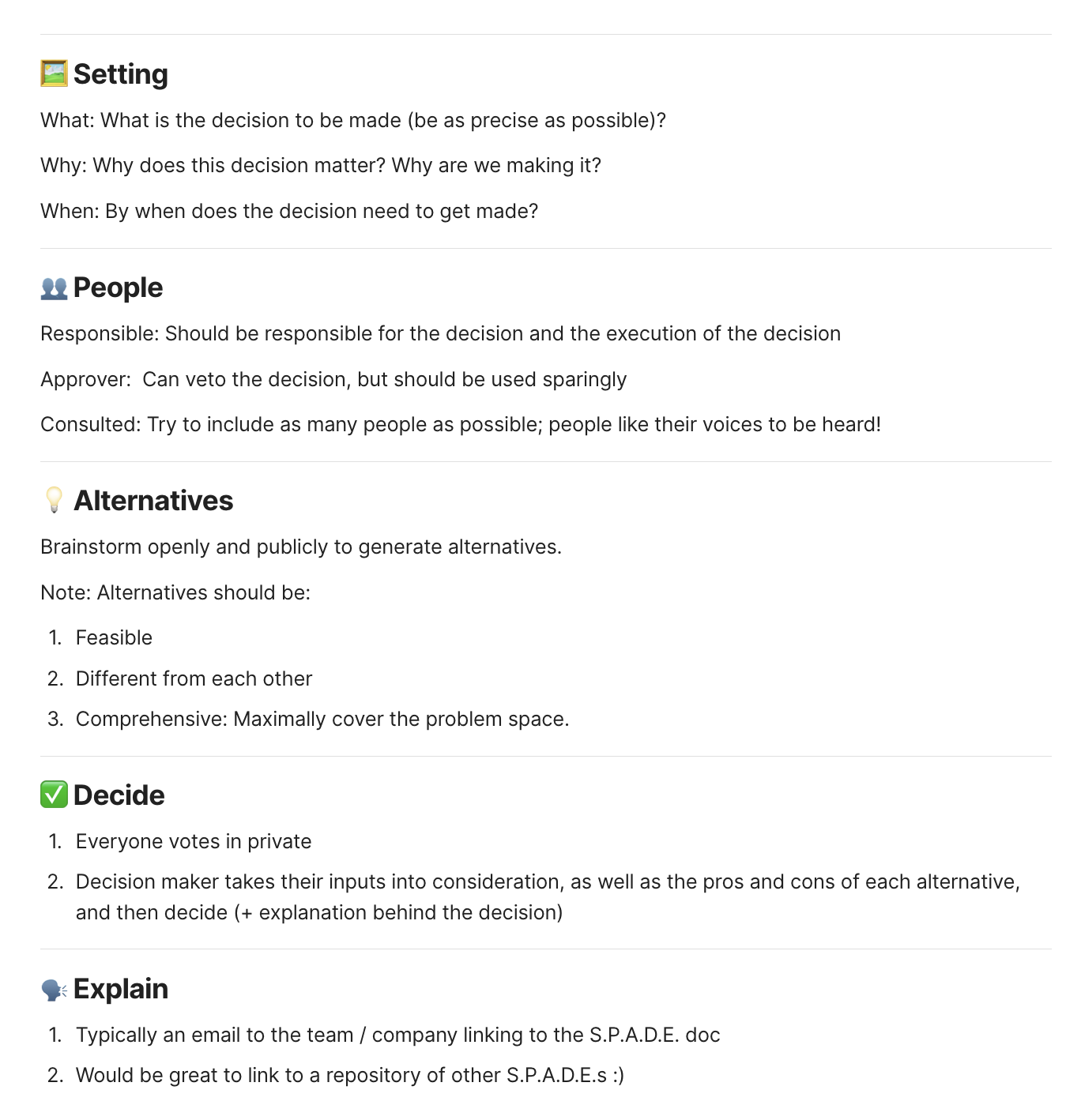
This popular framework, by Gokul Rajaram, finds a nice balance between structure and simplicity. It forces you to clarify the problem, identify roles, lay out timelines, and explore all possible alternatives, without making the process too rigid. Most importantly, it helps you avoid consensus thinking while also making sure that the person who makes the final decision is also accountable for the end result.
“A lot of forward-thinking companies practice consensus. Google is famous for it. But consensus is impractical and ineffective for one clear reason: consensus means no ownership. What is important isn’t that everyone agrees, it’s that everyone is listened to. And then the right person makes a decision, communicates it clearly, and rallies everyone around it.
When I started at Square, the company surveyed employees about their number one frustration. They said decision-making. And I bet if you survey any company in the Valley, or even the country, you’d see similar answers. It’s not the decisions themselves employees are frustrated with, it’s the lack of transparency around how decisions are made. And employees crave transparency.
A couple Square colleagues and I decided to come up with a new decision-making framework, an alternative to consensus built on accountability and clarity, where the person responsible for executing the decision would be the one who decides.”
Here’s a template, instructions, and an example. This framework is best used when making a major decision, at the company or strategy level.
2. Coinbase’s decision-making framework
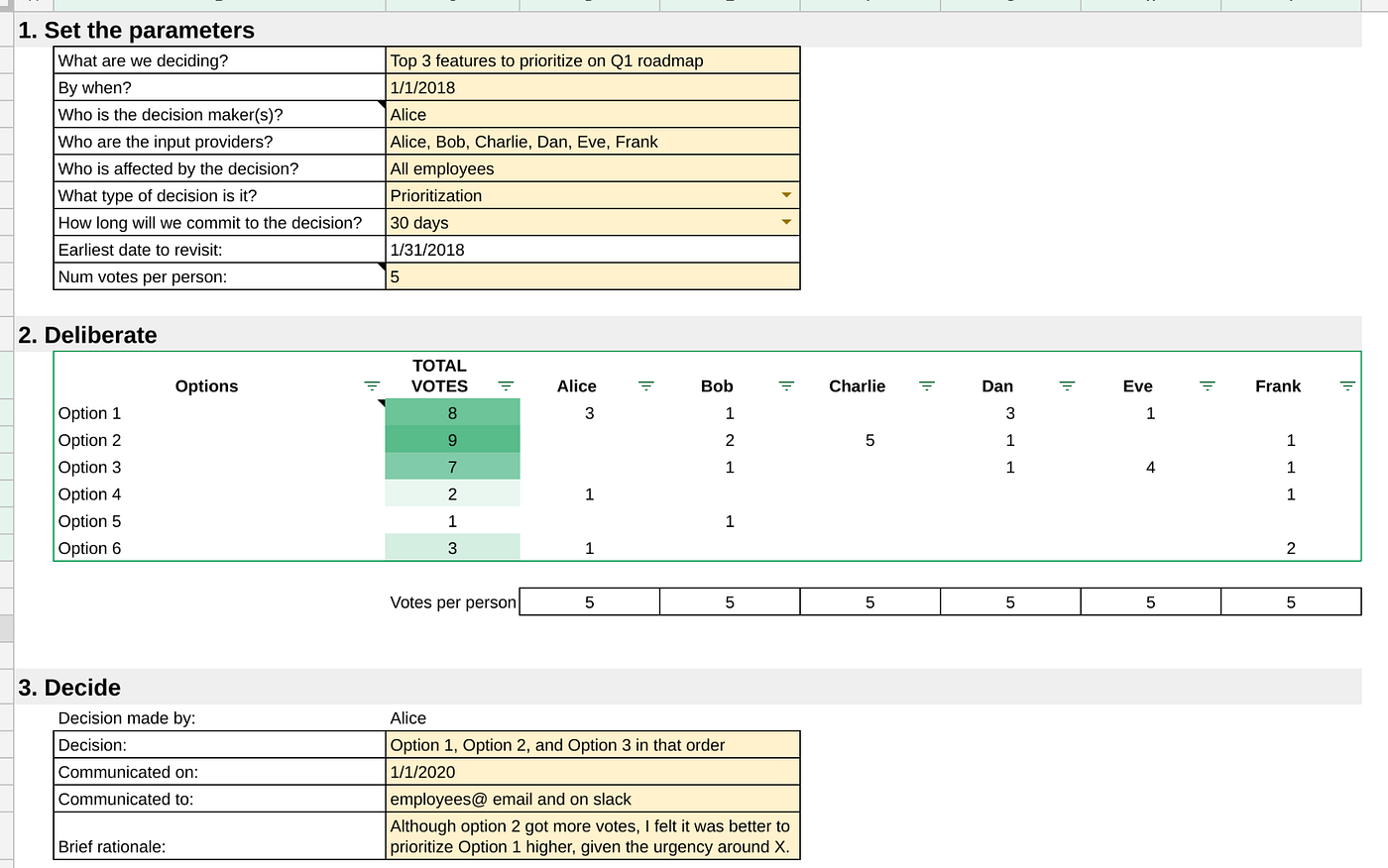
This framework is very similar to S.P.A.D.E. but is more compact (everything fits inside a single Google Sheet) and includes some unique attributes, like allowing multiple deciders and giving the decision an expiration date. Since it’s so simple and compact, it can flex across most decisions.
“I’ve seen it run from start to finish in under 15 minutes, live during a meeting, but it can also be used over multiple weeks for bigger decisions.
The vast majority of decisions in a company are low-risk and should be made unilaterally by the owner of that area (e.g. should we move the standup meeting from Mon. to Tues. this week?).
A decision-making framework is only needed when there is lack of clarity about a decision that is higher-risk. Higher risk can mean that the decision has long-term implications or that it can be costly to unwind if the wrong decision is made.”
Here’s a template, and instructions for how to use it. This framework is best used when you need a framework that you can apply to both big and small decisions.
3. Dory and Pulse
This is a two-part meta-framework developed by Shishir Mehrotra (CEO of Coda) that dozens of companies have integrated into their daily workflows. It’s especially good at making sure everyone’s voice is heard, and flexing to all kinds of use-cases.
“I did some quick math, and in the past year I’ve used Dory/Pulse over a thousand times. It’s a simple yet impactful ritual for supercharging decisions by equalizing voices and removing groupthink in meetings.
I decided to catalog the many different ways I’ve seen teams use Dory/Pulse. As I polled teams, this list quickly grew from a handful of variations to 14. You can see the full set in my post 14 ways to Dory/Pulse.
In each case, a team was solving a slightly different problem and thus arrived at different solutions. For example:
- Teams scaling their company all-hands were drawn to techniques like Unbiased Dory and Anonymous Dory
- Teams focused on product/design proposal reviews invented Sentence Starter Dory and Pick an Option Pulse
- Teams struggling with hard prioritization choices landed on $100 Voting Pulse and Ranked Choice Pulse
- Teams challenged with moving beyond ‘majority rules’ consensus-driven decision-making landed on Role-centric Pulse and Conviction, Disagree, and Commit Pulse
- and so on...
Many teams mix and match these techniques, so feel free to take a read and select the best parts for your specific situation.”
Here are templates and instructions. This framework is best used when you are looking to make decisions in real time (i.e. during a meeting).
4. RAPID
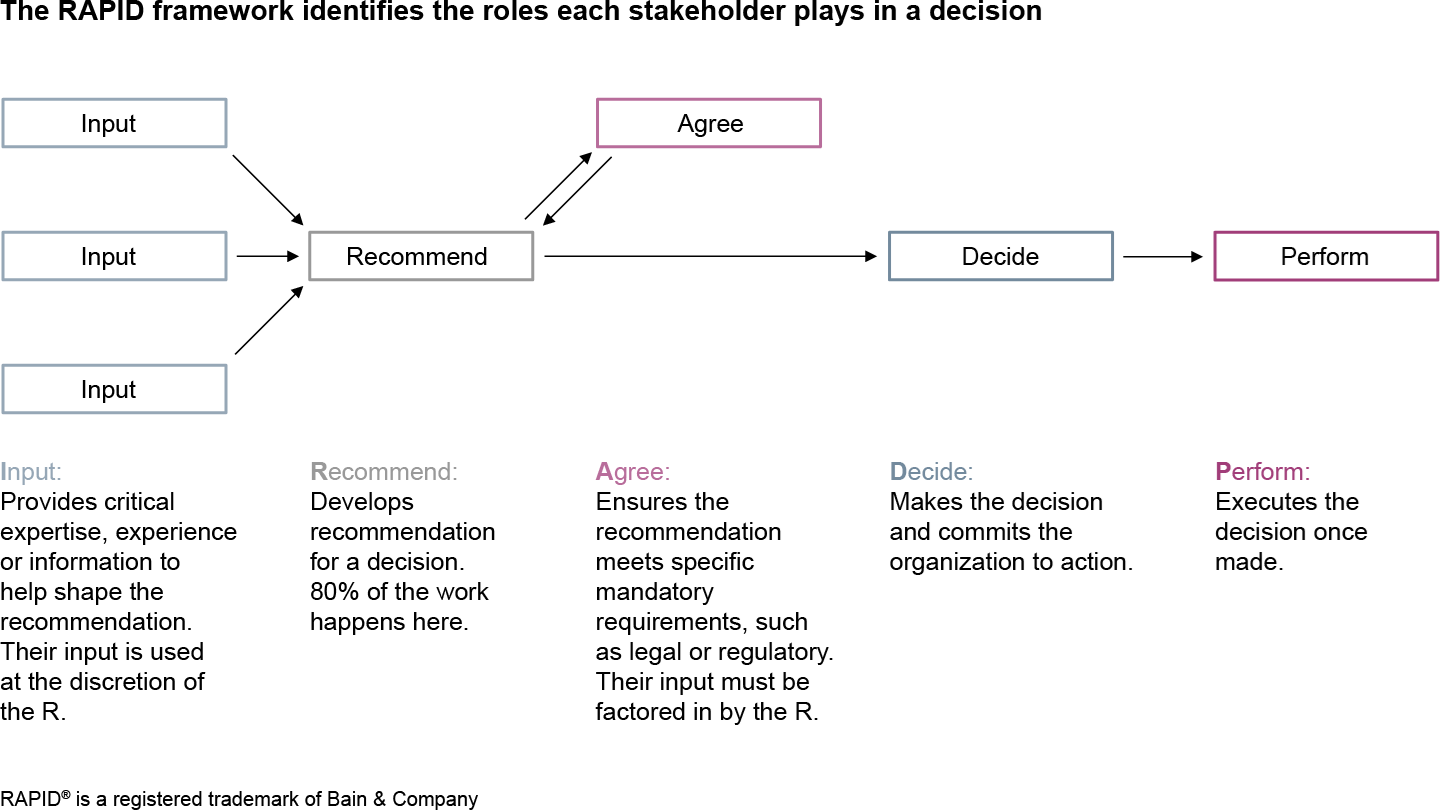
This framework was developed by Bain & Company, and builds on the classic RACI and DACI frameworks. Instead of simply assigning roles for a project, RAPID is designed to help you make decisions. The acronym stands for “Recommend, Agree, Perform, Input, and Decide.”
“Not every decision requires the level of effort and investment that goes into creating explicit RAPID roles. Successful adopters start by applying RAPID to high-value or high-frequency decisions. They create positive and visible impact on priority decisions while enhancing decision-making skills across the organization. Over time, the RAPID framework becomes intuitive and easy to use wherever decision-making roles are not clear. ” —Bain & Co.
Here’s a template, instructions, and an example, courtesy of Matt Mochary (who’s a big proponent of RAPID). This framework is best used when you mostly just need to clarify people’s roles in the decision-making process, versus needing a full plug-and-play decision-making process.
5. Eisenhower Matrix
Finally, the most widely adopted decision-making framework in product is likely the Eisenhower Matrix, first developed by Stephen Covey and inspired by Dwight D. Eisenhower. It’s a simple tool to help you prioritize tasks, using a 2x2 grid. It has you map all of your options into quadrants based on how urgent and important the task is and, through this simple process, helps you identify what’s truly important (not just urgent).
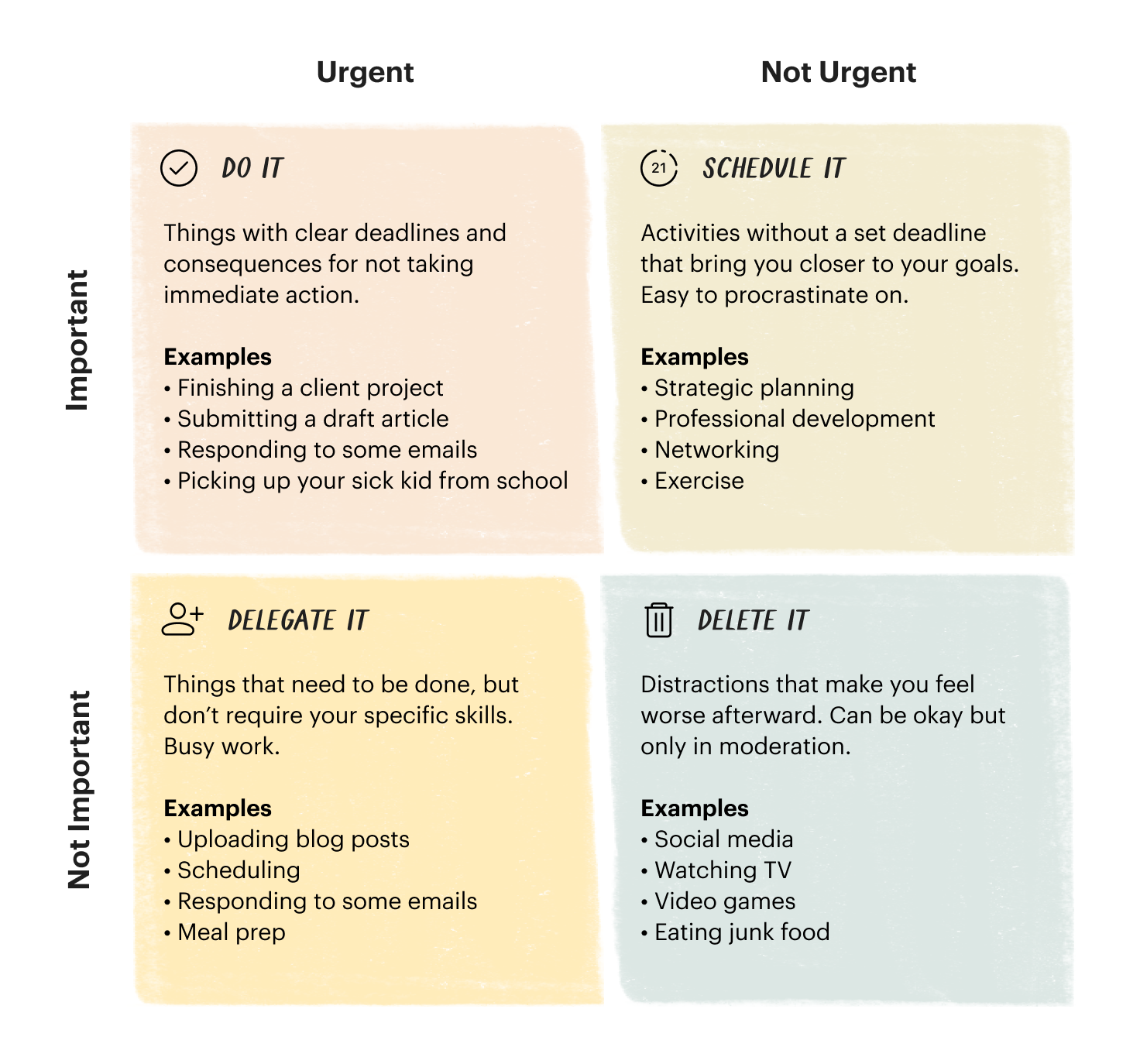
Here’s a template and instructions. And here’s a handy video walking you through it:
Use this framework when you need help prioritizing tasks/projects/investments.
📚 Bonus: Mental models to help you make better decisions
For extra credit, skim this additional reading to level up your decision-making powers.
-
See the problem more clearly
- One-way-door vs. two-way-door decisions (aka Type 1 vs. Type 2 decisions) by Jeff Bezos
- Cynefin Framework (pronounced ku-nev-in) by Dave Snowden
- A Leader’s Guide to Deciding: What, When, and How to Decide by Steven Sinofsky
-
See the opportunities more clearly
- McKinsey’s 7S Model
- Thinking in Betsby Annie Duke
- The 10-10-10 decision-making technique by Suzy Welch
- The Regret Minimization Framework by Jeff Bezos
✅ Once you’ve made a decision
- Celebrate 🎉
- Communicate your plan using the Minto Pyramid Principle and the SCR Framework
- Learn to get better at getting buy-in
- Build your influence muscle
Have a fulfilling and productive week 🙏
👀 Hiring? Or looking for a new job?
I’m piloting a white-glove recruiting service for product roles, working with a few select companies at a time. If you’re hiring for senior product roles, apply below.
If you’re exploring new opportunities yourself, use the same button above to sign up. We’ll send over personalized opportunities from hand-selected companies if we think there’s a fit. Nobody gets your info until you allow them to, and you can leave anytime.
If you’re finding this newsletter valuable, share it with a friend, and consider subscribing if you haven’t already. There are group discounts, gift options, and referral bonuses available.
Sincerely,
Lenny 👋