👋 Hey, Lenny here! Welcome to this month’s ✨ free edition✨ of Lenny’s Newsletter. Each week I tackle reader questions about building product, driving growth, and accelerating your career.
If you’re not a subscriber, here’s what you missed this month:
- What to do if your product isn’t taking off
- First-principles thinking
- Inspiration for the year ahead
Subscribe to get access to these posts, and every post.
Every business can be distilled into a simple equation.
And until you can express your business as one, you don’t fully understand it.
Figuring out this equation forces you to think about the inputs that drive your business, the outputs you want to prioritize, and how these variables interact. It also gives you a map for understanding which metrics you need to track, what factors drive the growth of your business, and, most importantly, where you have the most leverage to drive an outsize amount of impact (and thus where to assign your precious people and resources).
To help you flesh out your own business equation, Dan Hockenmaier and I put together example equations for the most common tech business models:
-
B2B SaaS
-
Bottom-up B2B SaaS with seat-based pricing
- Bottom-up B2B SaaS with usage-based pricing
- Top-down B2B SaaS
-
B2C/consumer
-
B2C subscription (trial or freemium)
- B2C free (ads)
-
Marketplaces
-
B2C marketplaces
- B2B marketplaces
- DTC/e-commerce
First, a few disclaimers:
- This won’t be easy. These equations and concepts can be some of the most divisive within your company, particularly between your product, GTM, finance, and sales teams. But once the equations are defined, your teams are aligned, and the equations operationalized, you’ll experience a huge force multiplier—because everyone will be focusing their energy on the same (high-leverage) levers.
- This won’t be perfect. While we lay out the different “recipes,” every business is unique. Thus, the equations will require some adapting to match your business. Please send us feedback (or leave a comment below) on anything you think we’re missing, or anything unique about your business that caused you to modify the equation you use. We’d love to hear it.
- We focused on ARR and revenue. All of these equations output revenue or ARR. If your business has high gross margins (e.g. >80%-90%), like some SaaS businesses, you may be able to stop there. But for any business with meaningful cost of sales, such as DTC and most marketplaces, you’ll want to instead output a metric like contribution margin. For these cases, see the section at the end of the post on adding margin to your equation.
- Business equations don’t cover every important metric. One key metric for every business is customer acquisition payback period. This is related to but not directly captured in the equations below. See the section at the end on how to calculate your payback period.
How to make the most of this post
- Create your own business’s math formula, with inspiration from a formula below
- Have a discussion with your team about how your business grows through the lens of this formula
- Identify the highest-leverage lever(s) within your formula, and put more resources behind it
- Identify one new lever you haven’t invested in, and experiment with it
- Turn the formula into a full-fledged growth model (something we’ll explore in a future post)
A huge thank-you to Abi Noda (DX), Alex Bilmes (Endgame), Alexa Grabell (Pocus), Barry McCardel (Hex), Boris Jabes (Census), Christina Cacioppo (Vanta), Colin Dunn (Visual Electric), Dom Wong (Pogo), Emily Kramer (MKT1), Jeremy Cai (Italic), May Habib and James Lee (Writer), Merci Victoria Grace (Panobi), Nels Gilbreth, Peter Kazanjy (Atrium), Reed McGinley-Stempel (Stytch), Rujul Zaparde (Zip), Whitney Steele (Descript), William Hicks (Magic Mind), and Zach Grannis for sharing feedback and advice on this post 🙏
Also, don’t miss Dan Hockenmaier’s newsletter, which is a must-read for anyone working on growth and marketplaces.
B2B SaaS equations
A B2B SaaS business sells cloud-hosted software on a subscription basis (that’s what makes it software as a service—SaaS) to other businesses (that’s what makes it B2B). Examples include Snowflake, Slack, and Jira.
B2B SaaS businesses typically monetize in one of two ways—per seat (e.g. Slack) or by usage (e.g. Datadog)—and grow in one of two ways—through a bottom-up motion (i.e. individual employees within a company discover the product on their own, as with Figma and Notion) or a top-down motion (i.e. salespeople sell the product into company leaders, as with Salesforce and Box). And though not exactly the same thing, a bottom-up growth motion is, in practice, essentially the same as a “product-led growth” (PLG) motion.
Below, we’ll look at the three most common B2B SaaS business models, sharing both a simplified version of each business equation (as an image) and the full equation in the text under it.
1. Bottom-up B2B SaaS with seat-based pricing
Examples: Figma, Slack, Zoom, Adobe Creative Cloud, Asana, Jira.
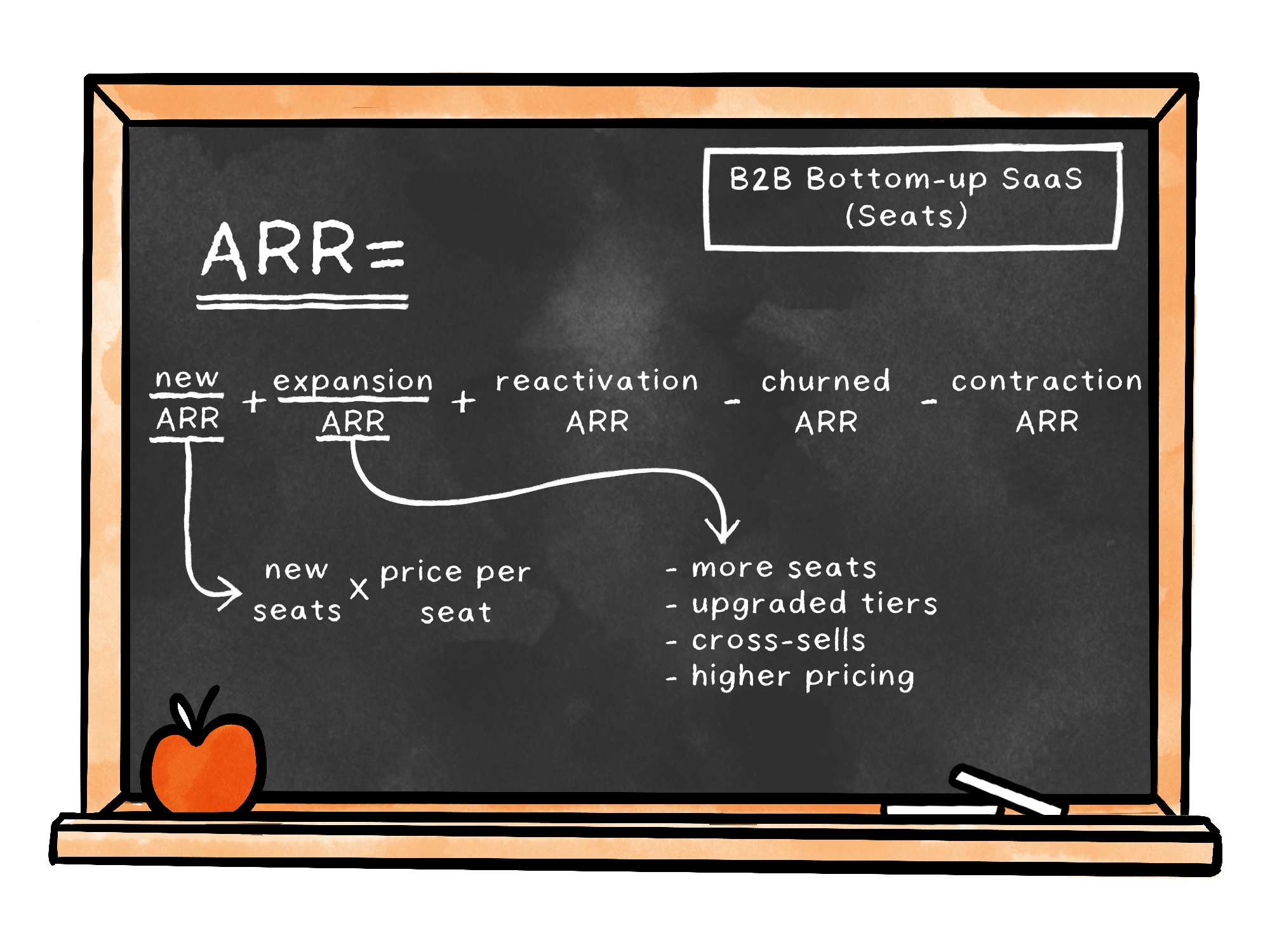
ARR = New ARR + Expansion ARR + Reactivation ARR – Churned ARR – Contraction ARR
-
New ARR = New seats * price per seat
-
New seats = Visitors * conversion to trial/freemium * conversion to paid * seats per account
-
Visitors
-
Paid ads
- SEO
- Direct (e.g. word of mouth, virality)
- Referral (e.g. G2, social, articles)
- Turbo boosts
- Conversion to trial/freemium
-
Visit to CTA
- CTA to signup
- Signup to activation
- Conversion to paid
-
Awareness of paid plan
- Starting the purchase process to completing the purchase process
- Value of product
- Lead nurturing
-
Expansion ARR = Accounts upsold * average price increase
-
Accounts upsold
-
In-product upsells
- Outbound
- Hitting limits
-
Average price increase
-
Seat growth
-
Headcount growth
- Internal virality
-
Colleague invite rate - Invite conversion rate
- Cross-sold products (e.g. Figma -> FigJam)
- Hitting more expensive tiers
- Raising prices
-
Reactivation ARR
-
Reactivated logos
- Reactivated seats
-
Churned ARR
-
Churned logos
-
Contraction ARR
-
Seat contraction
- Downgrading tiers
- Stopped using additional products
2. Bottom-up B2B SaaS with usage-based pricing
Examples: AWS, Datadog, Twilio
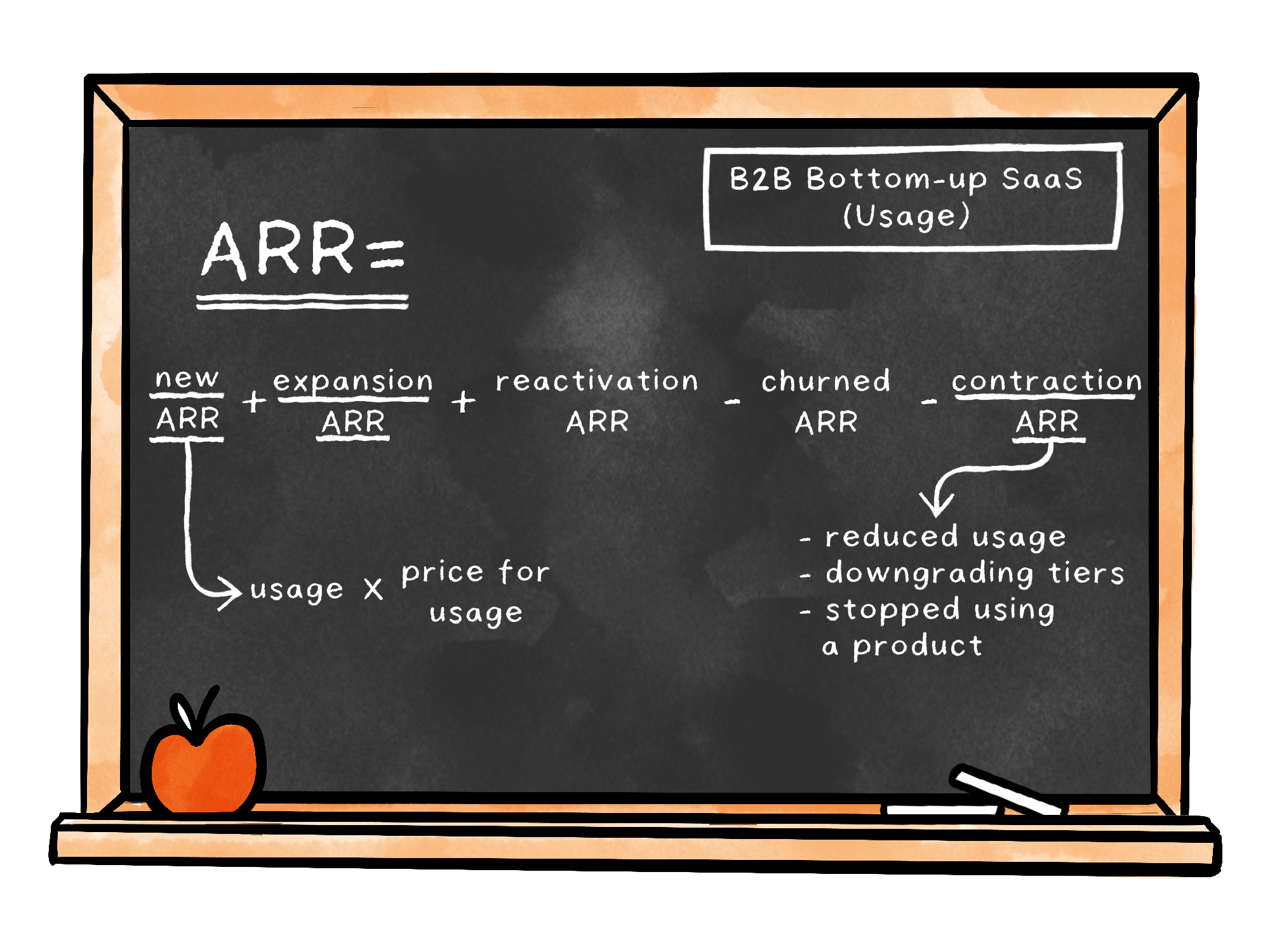
ARR = New ARR + Expansion ARR + Reactivation ARR – Churned ARR – Contraction ARR
-
New ARR = New usage * price for usage
-
New usage = Visitors * conversion to trial/freemium * conversion to paid
-
Visitors
-
Paid ads
- SEO
- Direct (e.g. WOM, virality)
- Referral (e.g. G2)
- Turbo boosts
- Conversion to trial/freemium
-
Visit to CTA
- CTA to signup
- Signup to activation
- Conversion to paid
-
Awareness of paid plan
- Starting the purchase process to completing the purchase process
- Value of product
- Inbound sales/account managers nurturing leads
- Price for usage
-
Expansion ARR = Accounts upsold * average price increase
-
Accounts upsold
-
In-product upsells
- Outbound
- Hitting limits
-
Average price increase
-
Usage growth
-
Headcount growth
- Internal virality
-
Colleague invite rate - Invite conversion rate
- Data/customer/use-cases growth
- Cross-sold products (e.g. Figma -> FigJam)
- Hitting more expensive tiers
- Raising prices
-
Reactivation ARR
-
Reactivated logos
- Reactivated users
-
Churned ARR
-
Churned logos
-
Contraction ARR
-
Reduced usage
- Downgrading tiers
- Stopped using additional products
3. Top-down (sales-led) B2B SaaS
Examples: Snowflake, Box, Salesforce, Workday, Looker
This category includes both seat-based and usage-based pricing and normally ends up as a predetermined negotiated annual contract.
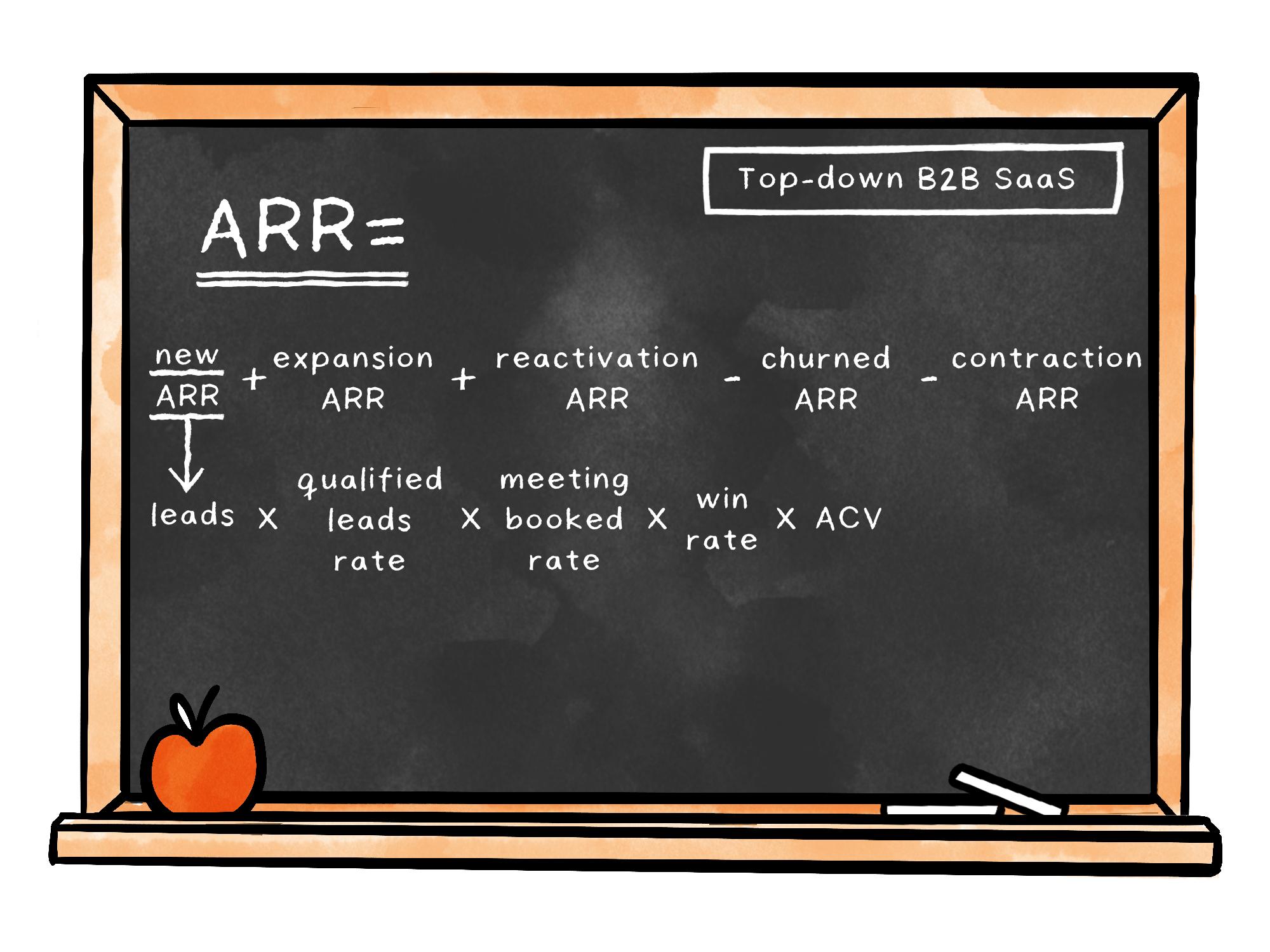
ARR = New ARR + Expansion ARR + Reactivation ARR – Churned ARR – Contraction ARR
-
New ARR = Leads * qualified leads rate * meeting booked rate * win rate * ACV
-
Leads = Direct + indirect
-
Direct = Outbound + inbound
-
Outbound
-
Cold emails - Cold calls - Cold DMs - Events
- Inbound
-
Paid ads - SEO - Referrals (e.g. G2, backlink, social mentions) - Direct (e.g. signs up for demo on website) - Turbo boosts
- Indirect
-
Channel partnerships
-
Number of partnerships - Leads per partner - Conversion rate
-
Expansion ARR = Accounts upsold * average price increase
-
Accounts upsold
-
In-product upsells
- Sales nurturing
- Hitting limits
-
Average price increase
-
Seat/usage growth
-
Headcount growth
- Internal virality
-
Colleague invite rate - Invite conversion rate
- Data/customer/use-cases growth
- Cross-sold products (e.g. Figma -> FigJam)
- Hitting more expensive tiers
- Raising prices
-
Reactivation ARR
-
Reactivated logos
- Reactivated users
-
Churned ARR
-
Churned logos
-
Contraction ARR
-
Reduced seats/usage
- Downgrading tiers
- Stopped using additional products
B2C/consumer equations
Consumer businesses make a software product for individual consumers. Examples include Netflix, TikTok, and Google.
Consumer products typically monetize in one of two ways—subscriptions (e.g. Duolingo, Spotify, Tinder) and ads (e.g. Instagram, Snap, YouTube). Below, we’ll look at these two models.
4. B2C with subscription-based pricing (trial or freemium)
Examples: Duolingo, Spotify, Tinder, Calm, Strava, MyFitnessPal
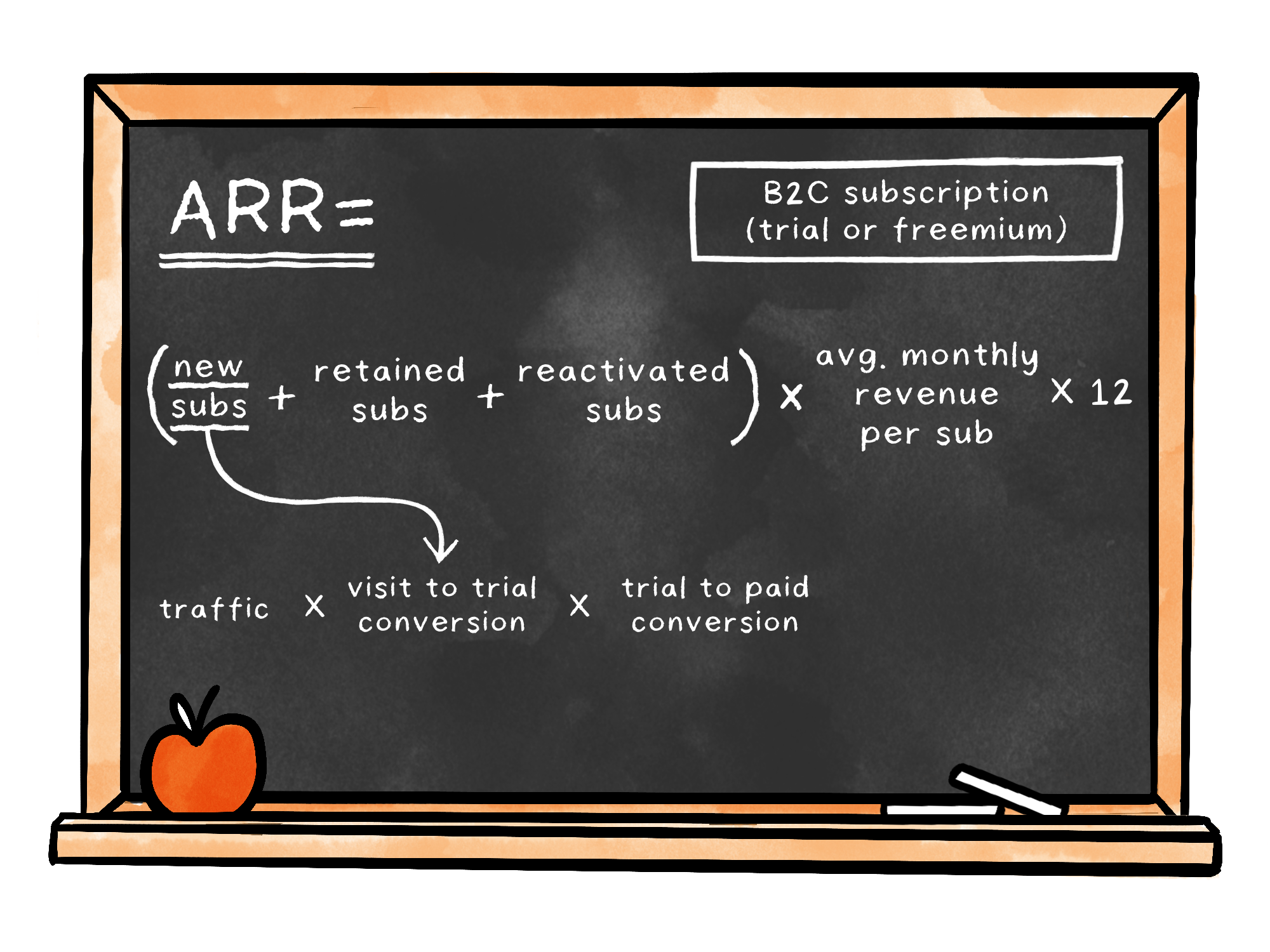
ARR = MRR x 12 = (New subs + Retained subs + Reactivated subs) * Average monthly revenue per sub * 12
-
New subs = Traffic * visit to trial/freemium conversion * trial to paid conversion
-
Traffic
-
Paid ads
- SEO
- Direct/WOM
- Referrals (i.e. invites)
- Turbo boosts
-
Visit to trial/freemium conversion
-
Visit to onboarding
- Onboarding to activation
-
Trial to paid conversion
-
Awareness of paid plan
- Starting to purchase to completing purchase
- Retained subs
- Reactivated subs
-
Average monthly revenue per sub
-
% annual vs. monthly subs
- % premium vs. basic subs
5. B2C with ads (i.e. free for the user)
Examples: Instagram, Google, TikTok, Meta, Snap, Twitter
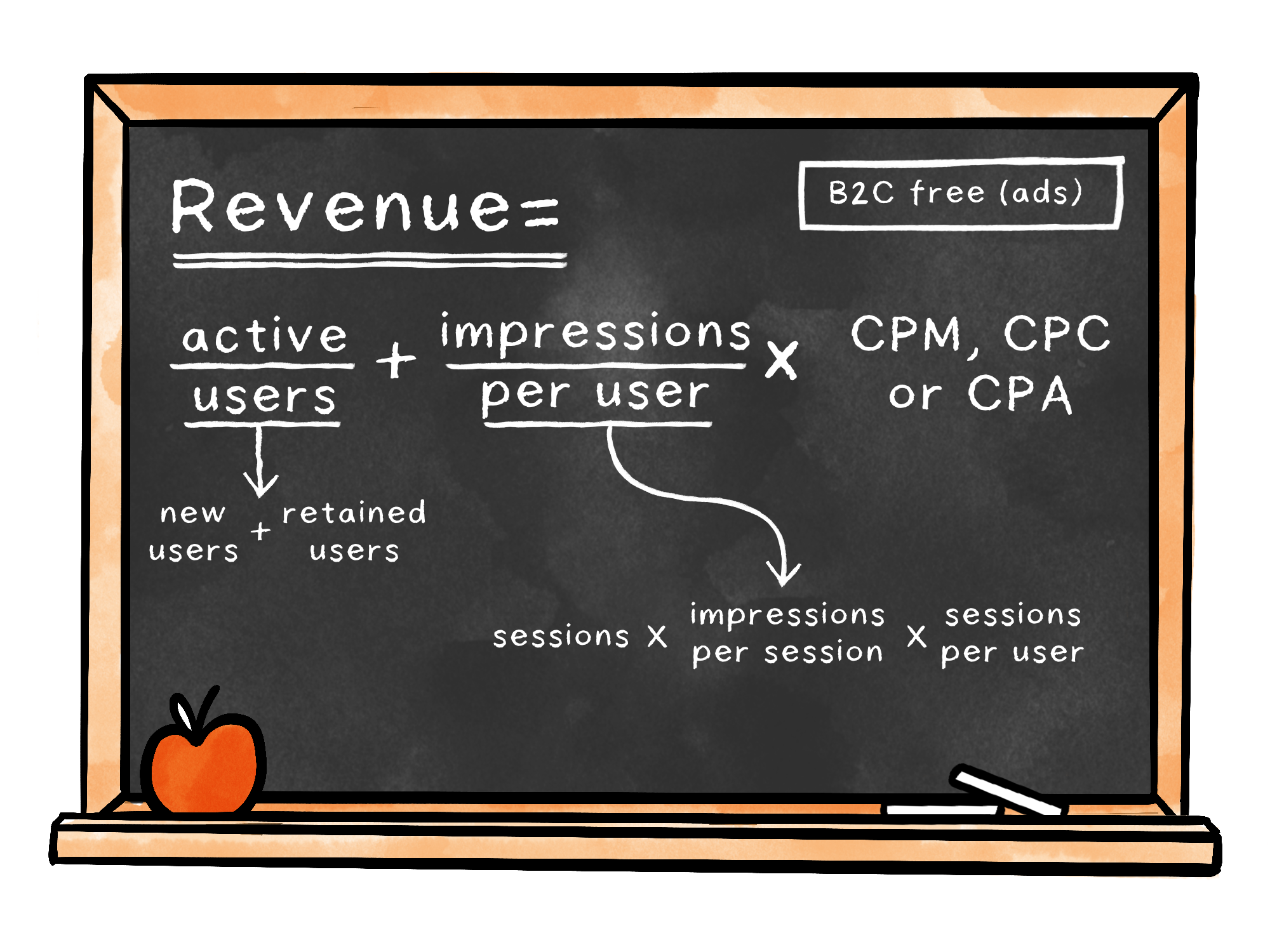
Revenue = Active users * Impressions per user * CPM/CPC/CPA
-
Active users = New users in period + retained users from prior periods
-
New users = Traffic * conversion
-
Traffic
-
Paid ads
- SEO
- Direct/WOM
- Organic social
- Referrals (i.e. invites)
- Turbo boosts
- Conversion
-
Visit to onboarding
- Onboarding to activation
-
Retained users from prior period
-
Quality of product and experience
- Re-engagement (upsell/cross-sell)
-
Impressions per user = Sessions * impressions per session * sessions per user
-
Sessions
-
Pulling user back
-
Impressions per session
-
Ad load
- Sessions per user
-
CPM/CPC/CPA
-
User quality
-
Geo
- Income
- Profession
- Conversion rate from click to purchase
Marketplace equations
A marketplace business facilitates transactions between buyers and sellers. Examples include Airbnb, DoorDash, Uber, eBay, and Faire.
These businesses don’t own the supply (e.g. the homes, the cars, the restaurants) but instead make it easy for customers to find and purchase from these sellers.
Marketplaces monetize primarily through a transaction fee and occasionally through a subscription fee.
There are two types of marketplaces—B2C marketplaces, which cater to individual consumer customers (e.g. Airbnb, Uber), and B2B marketplaces, which cater to business customers (e.g. Faire, Pachama).
6. B2C marketplaces
Examples: Airbnb, Uber, DoorDash, Etsy, eBay
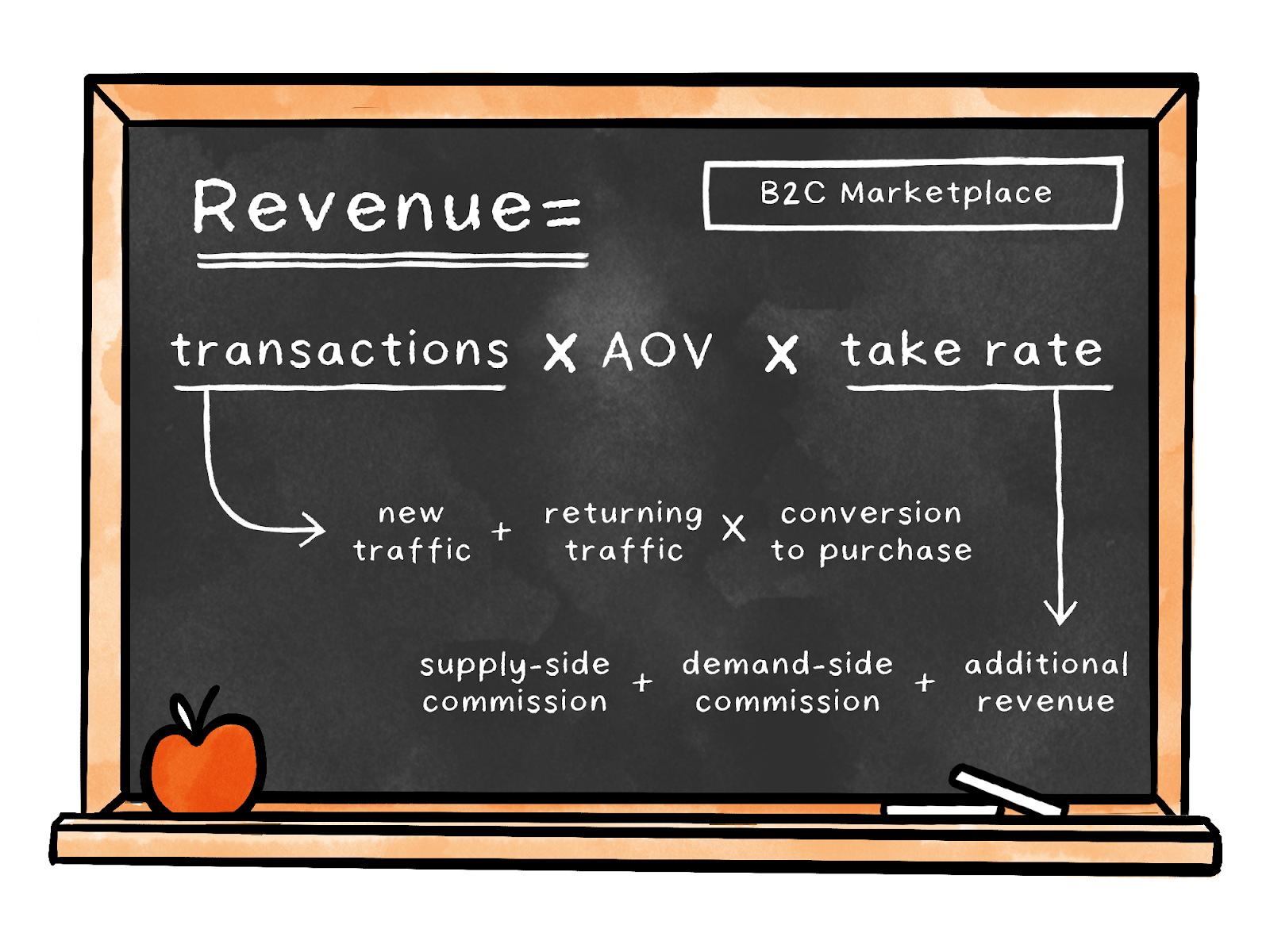
Revenue = Transactions * AOV * Take rate
-
Transactions = (New traffic + returning customers) * conversion to purchase
-
New traffic
-
Paid ads
- SEO
- Direct/WOM
- Referrals (i.e. invites)
- Turbo boosts
-
Returning customers
-
Quality of product and experience
- Re-engagement (upsell/cross-sell)
-
Conversion to purchase
-
Visit to search
- Search to product page
- Product page to start checkout
- Start checkout to complete purchase
-
AOV
-
Take rate
-
Supply-side commission +
- Demand-side commission +
-
Additional revenue per transaction
-
Subscriptions
- Financing fees
7. B2B marketplaces
Examples: Faire, Amazon Business, Pachama, Novi
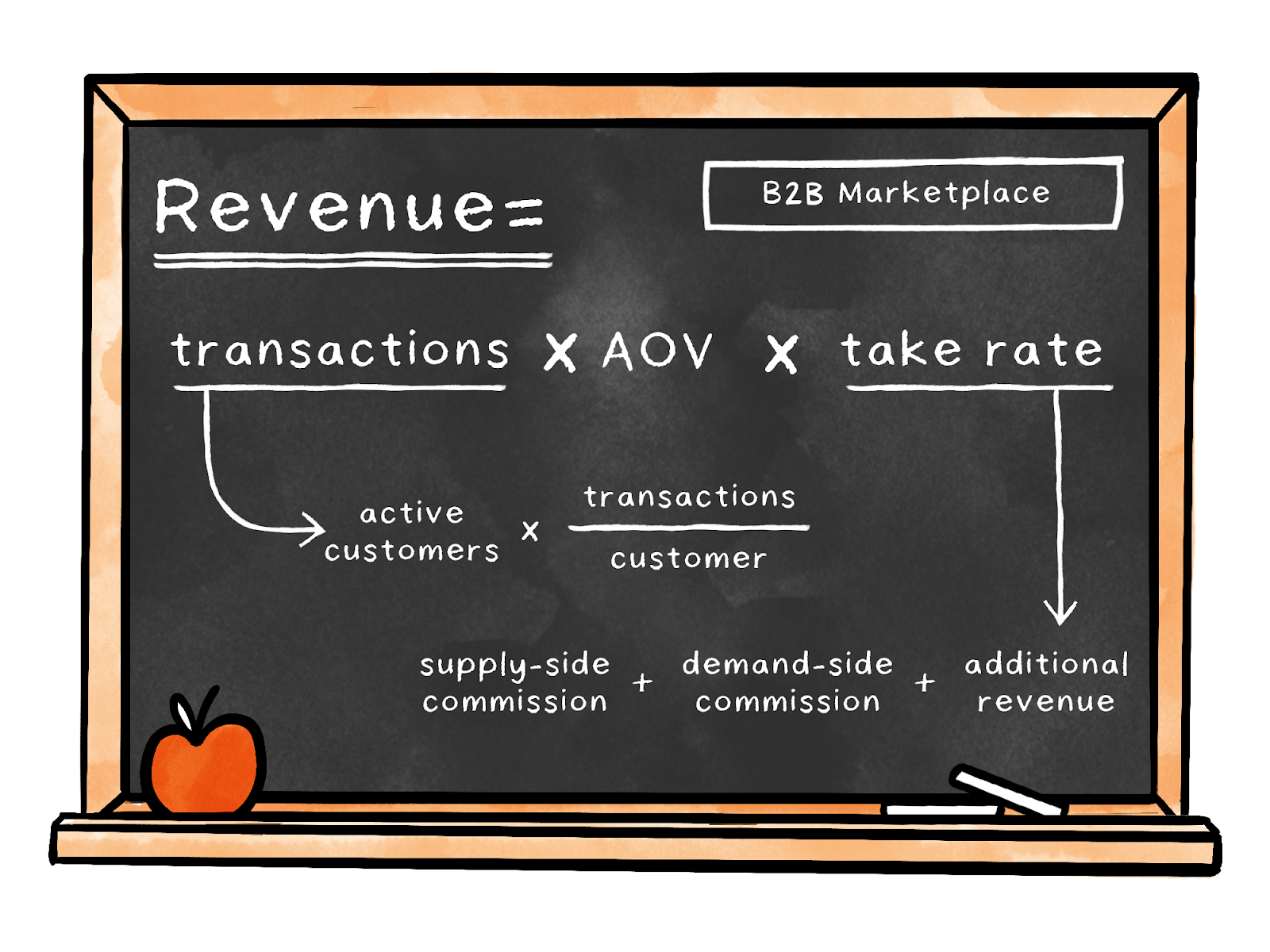
Revenue = Transactions * AOV * Take rate
-
Transactions = Active customers * transactions/customer
-
Active customers = New activated customers + retained customers
-
New activated customers = Signups * conversion from signup to activation
-
Signups
-
Inbound
-
Paid ads - SEO - Direct/WOM - Referrals (i.e. invites) - Turbo boosts - Outbound
-
Calls - Emails - DMs
- Conversion from signup to activation
-
Visit to search - Search to product page - Product page to start checkout - Start checkout to complete purchase
- Retained customers
-
Conversion of new to retained customers +
- Resurrection of previously active customers –
- Churned customers
-
Transactions/customer
-
Quality of product and experience
- Re-engagement (upsell/cross-sell)
- AOV
-
Take rate
-
Supply-side commission +
- Demand-side commission +
-
Additional revenue per transaction
-
Subscriptions
- Financing fees
8. DTC/e-commerce equation
Finally, we have direct-to-consumer (DTC) and e-commerce businesses, which sell a physical product to individuals. This includes companies like Warby Parker, Casper, Glossier, and Dollar Shave Club.
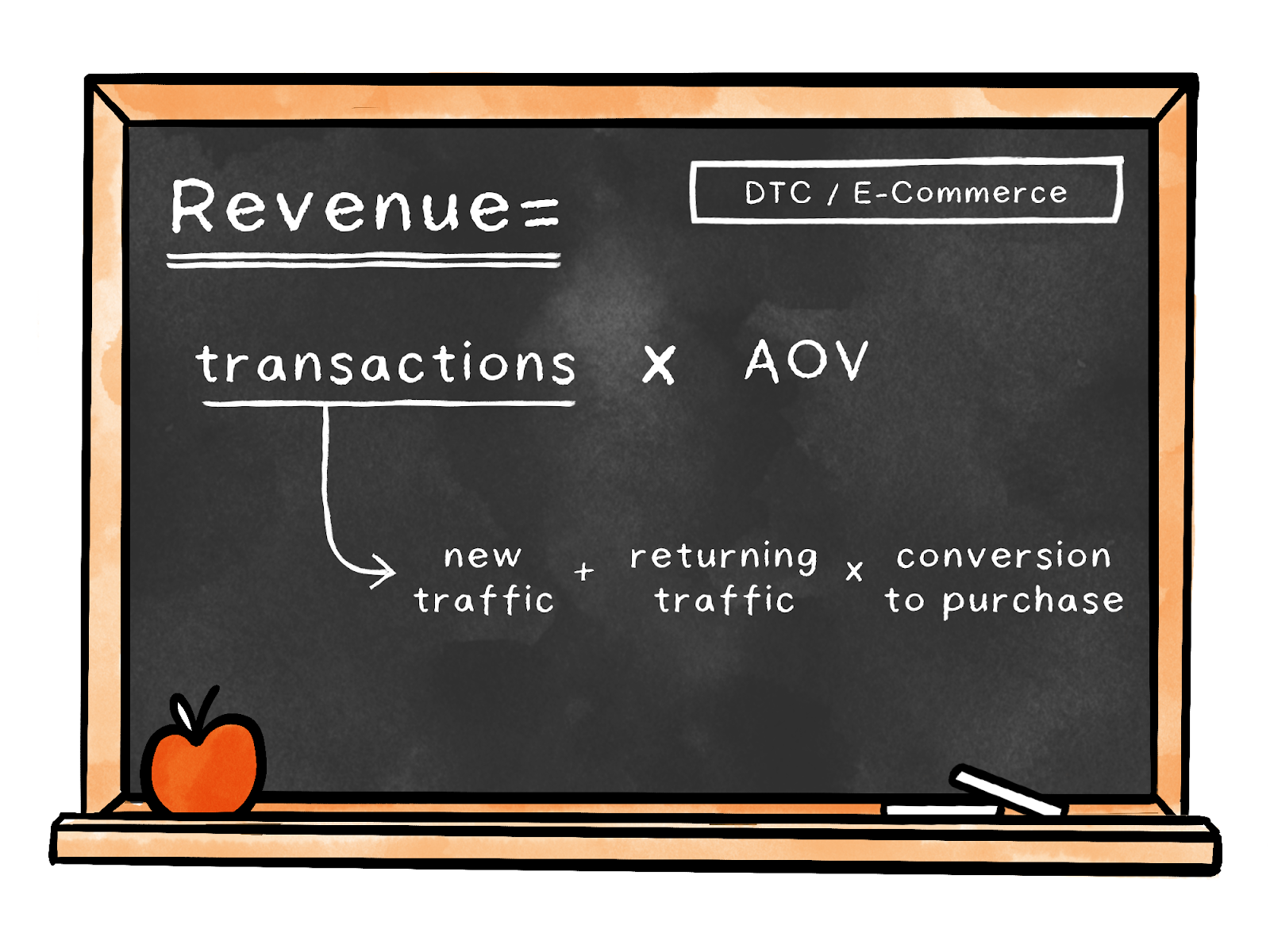
Revenue = Transactions * AOV
-
Transactions = Traffic * conversion rate
-
Traffic = New traffic + returning traffic
-
New traffic
-
Paid ads
- SEO
- Direct (e.g. WOM, virality)
- Turbo boosts
- Returning traffic
-
Quality of product and experience
- Re-engagement (upsell/cross-sell)
-
Conversion rate
-
Visit to search
- Search to product page
- Product page to start checkout
- Start checkout to complete purchase
- AOV (average order value)
Adding margin to your business equation
For any business with sufficiently high cost of sales, you can’t stop at revenue. What you’re really optimizing for is contribution margin, or what is left over after you take out all variable costs of a transaction.
This is a key metric because it describes how much you have left over to reinvest in the business. It’s also how more margin-intensive businesses will typically ultimately be valued, as opposed to high-margin businesses, like SaaS, which are often valued on multiples of ARR.
To apply margin to the equations above, all you have to do is calculate your average contribution margin rate (CM%) and multiply it by revenue. So for a DTC business, the formula would be:
Contribution margin = Transactions * AOV * CM%
There are two big components of cost to consider. Deducting only the first would give you a gross margin, and including the second gets you to contribution margin.
Direct variable costs: These are costs that are directly driven by a transaction and are easy to attribute. For DTC models, this would include things like cost of goods sold, incentives, and shipping. For marketplace models, it would include things like payment processing fees, incentives, and defaults.
Indirect variable costs: These are costs that are not directly driven by transactions but tend to increase as transactions increase, and include things like marketing and customer support.
Calculating payback period
For every business model here, one of the most important metrics that is not directly covered in these equations is customer acquisition payback period, i.e. the amount of time it takes for you to recoup the costs of customer acquisition. This is a better measure than LTV/CAC because it tells you how quickly you can invest in driving more growth.
At the highest level, you can calculate payback period as CAC divided by annual contribution margin per customer. For example, if you have a CAC of $100 and an average annual contribution margin per customer of $120, your payback period would be 0.83 years, or 10 months.
For certain business models, especially marketplaces, this equation gets more complicated. See “problem #2” in this essay for an explanation of how to calculate payback periods for marketplaces. Also, here are handy benchmarks for good and great payback periods.
📚 Further study
- The ultimate guide to product-led sales, with Elena Verna
- The SaaS Metrics That Matter, by David Sacks
- The Burn Multiple, by David Sacks
- Drive Growth by Picking the Right Lane—A Customer Acquisition Playbook for Consumer Startups, by Dan Hockenmaier and Lenny Rachitsky
- How to kickstart and scale a consumer business
- How to kickstart and scale a marketplace business
- How to kickstart and scale a B2B business
Have a fulfilling and productive week 🙏
👀 Hiring? Or looking for a new job?
I’m piloting a white-glove recruiting service for product roles, working with a few select companies at a time. If you’re hiring for senior product roles, apply below.
If you’re exploring new opportunities yourself, use the same button above to sign up. We’ll send over personalized opportunities from hand-selected companies if we think there’s a fit. Nobody gets your info until you allow them to, and you can leave anytime.
If you’re finding this newsletter valuable, share it with a friend, and consider subscribing if you haven’t already. There are group discounts, gift options, and referral bonuses available.
Sincerely,
Lenny 👋