P.S. Don’t miss Lennybot ✨ (an AI chatbot trained on my newsletter posts, podcast interviews, and more) and my new Swag Store (great gifts for your favorite PMs, or yourself!).
Q: I’ve heard your podcast guests occasionally mention “first-principles thinking.” What exactly is first-principles thinking, and how do I use it in my work?
First-principles thinking, or thinking from first principles, sounds a lot more complicated than it is. It’s simply a technique for approaching problems with a beginner’s mind. Instead of working within assumptions and what people around you “know” to be true, you do the hard work of figuring out what’s actually true and, thus, what’s truly possible.
There are many ways to apply the technique (which I’ll share below), but essentially you do this by asking questions, challenging people’s assumptions, digging further than other people, and going directly to the source to find out for yourself.
The concept of thinking from first principles comes from physics, is also known as ab initio, and encourages one to “start directly at the level of established science and not make assumptions based on existing models.” Aristotle phrased it as “the first basis from which a thing is known.”
Any talk of first principles must include a quote from Elon Musk, so let’s get it out of the way:
“We get through life by reasoning by analogy, which essentially means copying what other people do with slight variations. And you have to do that. Otherwise, mentally, you wouldn’t be able to get through the day. But when you want to do something new, you have to apply the first-principles approach.” —Elon Musk
Before we go further, it’s important to know that this technique takes a lot of effort. As Ozan Varol (former rocket scientist and best-selling author) explained in this interview with Farnam Street:
“The primary downside [to first-principles thinking] is it’s really difficult. […]
Reasoning by analogy, or copying what others are doing, is sort of like being a cover band where you’re playing somebody else’s music. Whereas with first-principles thinking, you go back to the fundamental raw materials of music, which are the notes, and then you build an original song from scratch. That is first-principles thinking.
It’s really difficult to do because a lot of what we do in life is informed by what we’ve done before, and also by what others are doing around us.
First-principles thinking, if you take it to an extreme, can be really inefficient, because we learn by emulating other people—[everything] from learning how to walk, learning how to talk, comes from copying others and modeling others.
Part of the difficulty comes from picking what to question, because you can’t go through life questioning every single thing you do. Picking what to question and also using knowledge in a way that will inform, not constrain, you.”
That being said, many of history’s biggest breakthroughs came from someone making the effort to think from first principles. This includes the classic examples of SpaceX and Tesla, the breakthrough that led to the transformer architecture driving today’s AI revolution, the invention of human flight, the discoveries of nuclear energy and general relativity, and so many more. It’s not an accident that history’s most important scientists come at problems in this way—with a beginner’s mind:
“I have no special talent. I am only passionately curious.” —Albert Einstein
“The greatest enemy of knowledge is not ignorance; it is the illusion of knowledge.” —Stephen Hawking
“Be less curious about people and more curious about ideas.” —Marie Curie
“Every sentence I utter must be understood not as an affirmation, but as a question.” —Niels Bohr
“To myself I am only a child playing on the beach, while vast oceans of truth lie undiscovered before me.” —Isaac Newton
“The task is not so much to see what no one has yet seen, but to think what nobody has yet thought, about that which everybody sees.” —Erwin Schrödinger
To make this even more concrete, let’s look at a bunch of examples across tech startups.
Examples, big and small
As you read through the examples, notice the way people go about thinking from first principles in practice. Essentially, they figure out what problem they want to solve, identify the levers that are keeping them from getting there, question every assumption about what’s possible within each lever, do the legwork to find out facts on the ground, and then act.
Example 1: Building the Square Cash Card—Ayo Omojola
Watch this five-minute clip and notice Ayo’s approach to problem-solving:
- Notice something important that isn’t good enough
- Go to the source (e.g. the factory) and talk to people to understand why
- Keep asking questions until you “get to the end”
“And so what happens is you go ask somebody something, and they would give you an answer which is the thing that they believe to be true. They’re not lying and it’s not malicious, but it’s just wonk.
So you just have to keep pushing until you get to an answer. I don’t really know the right way to articulate this all the way, but basically, you can’t stop until you get to the end.” —Ayo Omojola, CPO at Carbon Health
The way that I apply this today—and I’m sure people at Carbon Health will tell you this—is I end up asking lots of questions that people think don’t matter. Because I’m like: hey, we’re trying to optimize something. And when you’re trying to optimize something for the first time, you have to look at it like 15 different ways. And then every time two things are incongruent, you have to go and figure out why. It’s just tedious work.”
Example 2: Building OpenAI—Ilya Sutskever
Watch this two-minute clip and notice that the breakthrough that led to GPT (possibly the biggest breakthrough in software history) was rooted in experimenting with an idea that “everyone” knew wasn’t going to work.
“Everybody knew that you cannot train deep networks. It cannot be done. Back propagation is too weak. You need to do some kind of pre-training of some sort and then maybe you’ll get some kind of an oomph. […] Today we take deep learning for granted. Of course a large neural network is what you need. You shove data into it and you’ll get amazing results. Everyone knows that. Every child knows that. How can it be that we did not know that? How could such an obvious thing be not known? People were really focused on machine learning models, where they could prove that there was an algorithm which can perfectly train them, but whenever you put this condition on yourself, and you require to find a simple elegant mathematical proof, you really end up restricting the power of your model.”
For more, here’s another video of Ilya sharing this same lesson.
Example 2b: The key to Stripe and OpenAI’s success—Greg Brockman
In this one-minute clip, notice how a company like Stripe, one of the most valuable tech startups today, didn’t do anything that special. They just built a much better product than was previously available, simply by “not being locked into the way that people had been doing it” before, by thinking about every single piece of what they were doing from the ground up.
“A lot of how we approached Stripe was thinking from first principles. I remember when we were pre-launched and we had some buzz going because we had some early customers, and one of my friends took me out to lunch. He was a VC, and he was like, ‘All right, look, I’ve been hearing about this Stripe thing. What’s your secret sauce?’ I was like, ‘I mean, we just make payments really good.’ And he’s like, ‘No, no, come on, you can tell me, what’s the secret sauce?’ And that really was the secret sauce. We rethought every single piece of what we were doing from the ground up, from first principles. Not locked into the way that people had been doing it. We asked how should it be? Where’s the pain and does it need to be there?
In AI, we did much the same thing. We thought about, OK, there’s this field that we’re entering and that we hire a lot of people who had been in the field, but a lot of us also hadn’t been in the field, and we came to it with beginner’s eyes. That approach of just not being beholden to all the ways people were doing it, but also becoming expert in the way that things have been done. Because if you just throw everything out, you’re also just going to be starting from scratch, in a not-helpful way.”
Example 3: Julia Child learning to cook

Though not a tech example, I truly loved this story of first-principles thinking from Julia Child:
“Learning to cook at the Cordon Bleu meant breaking down every dish into its smallest individual steps and doing each laborious and exhausting procedure by hand. In time Child could bone a duck while leaving the skin intact, extract the guts of a chicken through a hole she made in the neck, make a ham mousse by pounding the ham to a pulp with a mortar and pestle, and turn out a swath of elaborate dishes from choucroute garnie to vol-au-vent financière. None of this came effortlessly, but she could do it. She had the brains, the considerable physical strength it demanded, and her vast determination. Most important, she could understand for the first time the principles governing how and why a recipe worked as it did.” —Laura Shapiro, Julia Child: A Life
Example 4: Becoming the #1 YouTuber—Mr. Beast
In this one-minute clip, notice the approach of working backward from simple fundamental facts and building your strategy from the ground up from there. It sounds simple but is rarely done.
“When you really boil it down,just think about it.What do you think YouTube wants? I think YouTube just wants people to click on a video and watch it. I mean, that’s how they get their ad revenue. That’s how they keep viewers happy. I’m sure comments matter, but at the end of the day, they want you to click and watch a video. Click and watch a video and just do that as long as possible. So to me, what’s important is click-through rate (getting people to click on your video) and then average retention average, or just relative retention. If people are clicking your video more than they click other videos, and they’re watching it longer then they watch other videos, as simplistic as that is, that’s what YouTube wants, and I think that’s how you be successful.”
Example 5: Anne Wojcicki rebelling against what the science community thought was possible to build 23andMe
Watch this two-minute clip and notice the tool she uses around making your identity about rebellion, and doing what others think is impossible. This can help you throw out assumptions and expectations and push through failure.
“23andMe came out of a rebellion. In some ways we’ve always meant to be a rebellious brand. It was always about ‘I want to change the whole system,’ and the beauty of Silicon Valley is that you can be totally unrealistic with your expectations of what you can do. I tell people at the company all the time, we really can topple a $3 trillion industry. It’s going to be amazing. Little ol’ 23andMe. We’re trying to start a revolution.
We came out of that sense of, I was super-frustrated with the industry. I was very clearly seeing that the consumer has no power, that there’s a potential for crowdsourcing, and I was fortunate to have the Stanford upbringing in this Silicon Valley community that was really supportive of thinking crazy thoughts and following your passions. And it’s OK to fail. Everyone fails at different times. Do it.”
Example 6: James Dyson inventing a 10x better vacuum
Speaking of failure, here’s a clip of James Dyson sharing his experience of trying to convince people that a better solution was possible (which now makes over $7 billion a year in revenue):
And his advice for discovering something new, from an interview with Fast Company:
“We’re taught to do things the right way. But if you want to discover something that other people haven’t, you need to do things the wrong way. Initiate a failure by doing something that’s very silly, unthinkable, naughty, dangerous. Watching why that fails can take you on a completely different path. It’s exciting, actually. To me, solving problems is a bit like a drug. You’re on it, and you can’t get off. I spent seven years on our washing machine [which has two drums instead of one].”
Example 7: Building Wise—Nilan Peiris
In this three-minute clip, notice how Nilan approaches the problem he’s faced with, of getting money transfer fees lower than anyone else. How does one offer a money transfer experience that’s 10 times better than the competition? His approach:
- Break down the problem into individual levers (i.e. what could allow us to cut fees?)
- Explore each lever in depth (i.e. send a team to Singapore to set up a local bank)
- Do it the hard/unscalable way and make sure it works
- Commit, and scale
“If you look at our P&L, there are just three costs per transaction. You’ve got people costs, you’ve got the cost of risk, and then you’ve got partner fees.
If you’ve got this mission of moving the world’s money for almost nothing, or as close to zero as you can, and we’re trying to do this 10 times better than anyone else, how do you really change each of these?
Let’s do the risk one first. There are two risks we have. We have FX [foreign exchange] risk. You come to Wise and you see your rate, and then you may send us the money a little later. The rate’s locked and it could move against us, so we’d lose some money. If you look back, we’ve halved that cost over the last few years, and you can imagine through understanding the bits of the product, they generate exposure, and limiting it, and a bunch of algorithms behind that. But the more inspiring stuff is the people costs, and the partner costs, go through each of these one at a time.
The people costs are our customer service team and operations teams. But I like to think of that as the cost of poor quality. So you bring up customer support if the products are clear; you hire lots of people in the back office. If you haven’t automated it. We get like 20% improvement year on year as we’re doing that. But to come back to your question, how do you step-change that? How do you do a 10x better experience?
I’ll share with you a story from Singapore. It’s quite a fun one. Because we went to Singapore about six, seven years ago and we asked for a [bank] license. We had 20,000 people or so on the waitlist, saying, ‘Wise, please come to Singapore.’ And we went there and we asked the regular, ‘Hey, can you give us a license?’ They gave us the license, but they said, ‘You have to physically meet every single customer.’
Face-to-face. And this happens, this is... Remember, they’re banks that people use. So people go into banks usually, and you get face-to-face verified when you open a bank account. We’re like, ‘You don’t need to do this in Australia, in the U.K., in other countries around the world.’ They’re like, ‘In Singapore, for your license, you need to do this.’ So we sent a small team out to Singapore, and we opened an office there, and got customers. You went through this really slick flow, and then you got invited in to come see the team. And customers hated it, and it was really expensive, obviously.
But the magic was we got the customers not to complain to us, but to complain to the government. And it took a year of lobbying, and a year of building, doing something unscalable effectively, before we got the world’s first eKYC license in Singapore. So you could take a selfie, a picture of your ID, and then you could get verified.
And that’s what I call a 10x better experience than anyone else in the market, and that led to advocacy and word of mouth off the back of it. And that loop of getting your customers to help was also one of the learnings of word of mouth.”
Example 8: Brian Chesky on designing a 10-star experience
In this five-minute clip, notice how Brian keeps asking “what if” questions:
“The moment of truth on Airbnb is when you check in, right? You’re like, is this going to be what I think it is? And there’s a really bad version of check-in, like the host didn’t show up. And there’s a good version of a check-in; they showed up. But we wanted to think to ourselves: what would make the experience something people love?
And so we created this exercise. We thought, you know when you go on Airbnb—and it’s also true on Uber—a five-star mostly means nothing bad happened. And we thought, well, what if there was like a six-star [experience]. What would that be when you check into Airbnb? And the six-star is you get to your Airbnb and, you know, there’s like a bottle of wine waiting on a table and there’s some fruit and they have a handwritten note to you. OK, that’s really nice. And then I thought, well, what would a seven-star experience be? A seven-star experience is they get a limo, they pick you up at the airport, and there’s this whole curated experience. You get to the house, and they know you like surfing and there’s a surfboard there waiting for you and all that stuff. So then I thought, what would an eight-star experience be like? An eight-star experience: you get to the airport, there’s a giant elephant and you get on the elephant and there’s a parade in your honor and you go to your Airbnb. So what would a nine-star experience be? The nine-star experience is the Beatles check-in. You land and there’s 5,000 teenagers cheering your name, and you get to your Airbnb, you have to do a press conference in the front lawn. So what’s a 10-star experience? A 10-star experience, you show up and Elon Musk says we’re going to space. And you do get back eventually.
The point of this story is that you maybe can’t make an 8-, 9-, or 10-star experience. But most people try to design something that’s just good enough. But if you can add that 6th or 7th star—if you can design something really amazing and you use the part of your brain, the handcrafted part of your brain, to create that perfect experience—then you can reverse engineer how to industrialize this millions of times over and over. And what happens is people love your product and they tell everyone else about your product.”
Example 9: Elon Musk on Tesla
In this 2.5-minute clip, notice Elon’s willingness to question everything he’s ever heard about what’s possible, instead going to the source to find out what physics would allow one to do and then figuring out what’s stopping him from doing that. As it turned out, nothing (other than a hell of a lot of work).
“For batteries, [people] would say, oh, it’s going to cost you—historically, it cost $600 per kilowatt-hour, and so it’s not going to be much better than that in the future—and say no. OK, well, what are the batteries made of? Thinking from first principles, you would say, OK, what are the material constituents of the batteries? What is the market value of the material constituents? OK, it’s got cobalt, nickel, aluminum, carbon, and some polymers for separation. And steel. So break that down on a material basis and say, OK, what if we bought that in the London metal exchange, what would each of those things cost? Like, oh geez, it’s like $80 per kilowatt-hour. So clearly you just need to think of clever ways to take those materials and combine them into the shape of a battery cell, and you can have batteries that are much, much cheaper than anyone realizes.”
Example 10: Elon Musk on SpaceX
In the most quoted example of all, here’s a one-minute clip of Elon explaining his first-principles thinking that led to SpaceX—the first private company to successfully launch and return a spacecraft from Earth orbit, now valued at $180 billion.
“Historically, all rockets have been expensive, so therefore, in the future, all rockets will be expensive. But actually that’s not true. If you say, what is a rocket made of? It’s made of aluminum, titanium, copper, carbon fiber. And you can break it down and say, what is the raw material cost of all these components? And if you have them stacked on the floor and could wave a magic wand so that the cost of rearranging the atoms was zero, then what would the cost of the rocket be? And I was like, wow, OK, it’s really small—it’s like 2% of what a rocket costs. So clearly it would be in how the atoms are arranged—so you’ve got to figure out, how can we get the atoms in the right shape much more efficiently? And so I had a series of meetings on Saturdays with people, some of whom were still working at the big aerospace companies, just to try to figure out if there’s some catch here that I’m not appreciating. And I couldn’t figure it out. There doesn’t seem to be any catch. So I started SpaceX.”
How to practice first-principles thinking
- Describe what you want your team or company to achieve (e.g. “Build a 10x better way to buy books”)
- Identify each lever/component that is keeping you from achieving this goal/vision (e.g. lowest prices, fastest delivery, highest selection)
-
Systematically question every assumption that you and your colleagues have about what is keeping you from moving these levers
-
Ask fertile questions
-
Confirming questions: “Are we sure that’s true?”
- What-if questions: “What if this were possible?”
- Possibility questions: “What would need to be true for this to be possible?”
- Confidence questions: “How confident are you in that conclusion?”
- Evidence questions: “What evidence do you have for that conclusion?”
- Why questions: “Why is that?” ← You can repeat this multiple times
- Dumb questions: “Can you explain this to me?”
- Clarifying questions: “Can you clarify what you mean by that?”
- Example questions: “Can you give me an example of that?”
- Certainty questions: “What do we know to be absolutely true?”
-
Go to the source
-
Visit the factory
- Read the primary research
- Talk to the people making the raw ingredients (or APIs)
- Push back on gatekeepers
- Question “authority”—remember that we have a bias to trust authority
-
Try it before you conclude it’s not possible
-
Run a quick experiment
- Crunch your own numbers
- Put together a skunkworks team to give it a shot
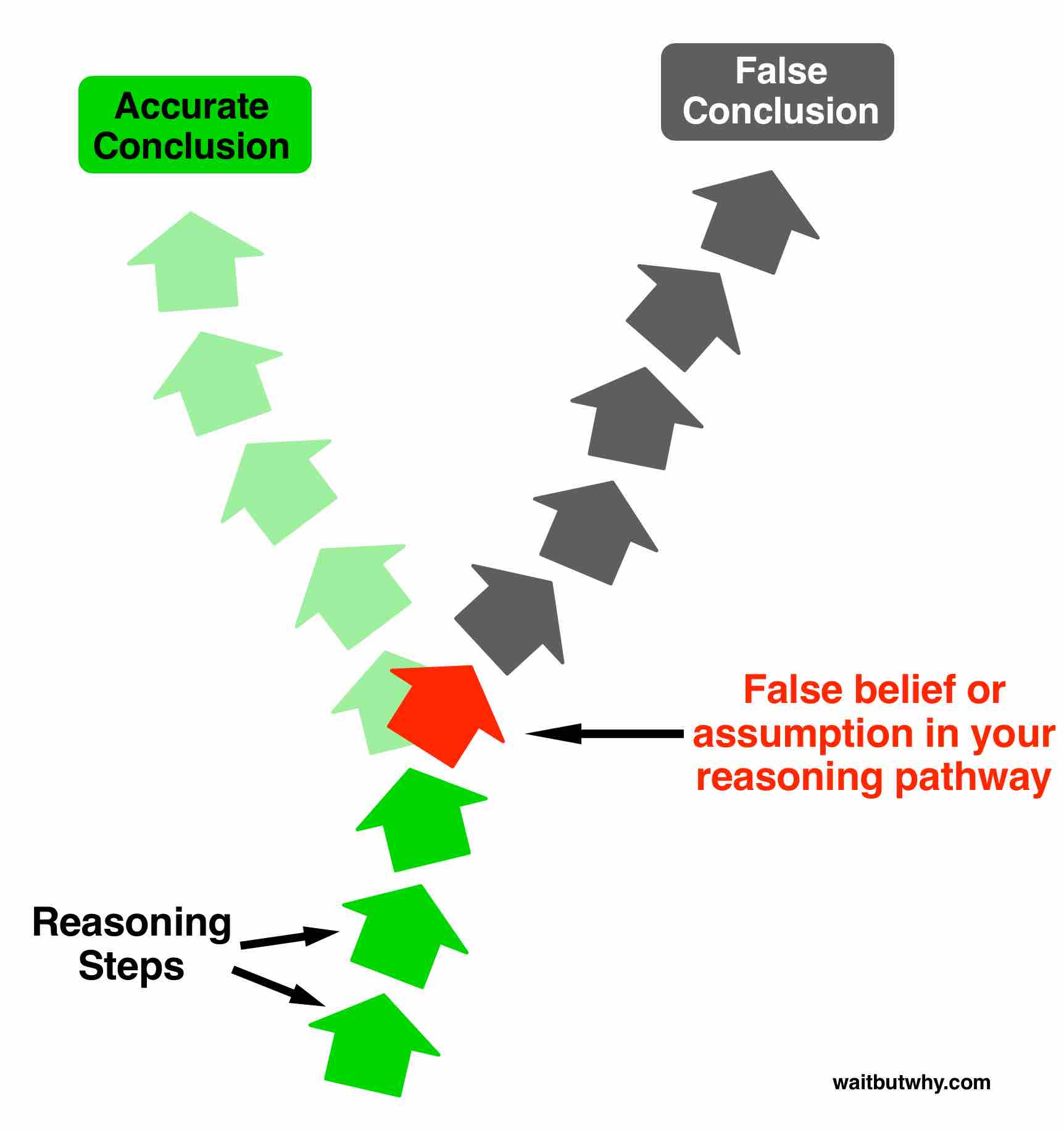
“With each of these questions, the challenge is to keep asking ‘why’ until you hit the floor.” —Tim Urban, The Cook and the Chef
Inspiration: Steve Jobs’s frame of mind
“Everything around you that you call life was made up by people that were no smarter than you. You can change it; you can influence it. You can build your own things that other people can use. The minute that you understand that you can poke life, and if you push in, something will pop out the other side—that you can change, you can mold it—that’s maybe the most important thing. To shake off this erroneous notion that life is there and you’re just gonna live in it, versus embrace it, change it, improve it, make your mark upon it. […] Once you learn that, you’ll never be the same again.”
Inspiration: Albert Einstein’s frame of mind
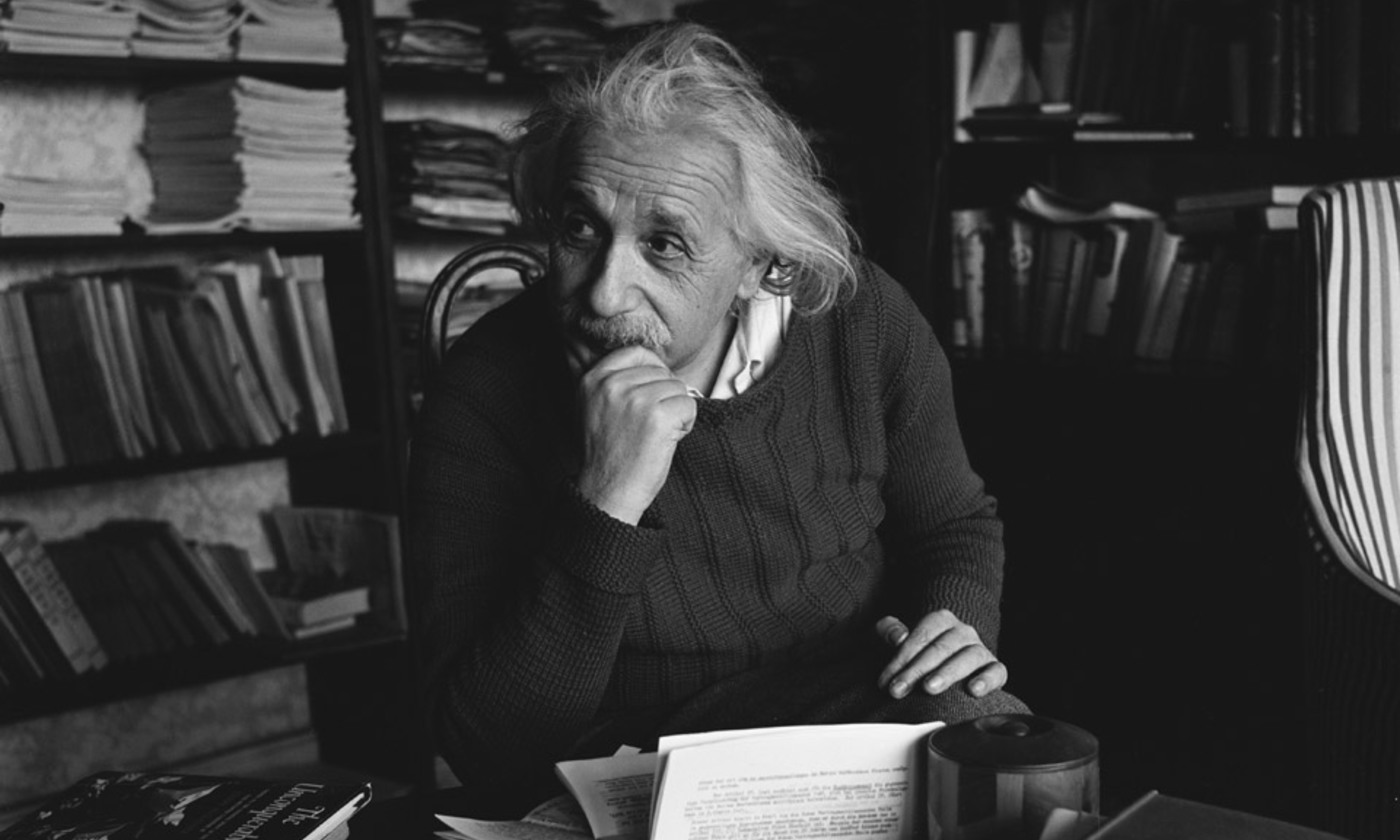
“It’s worth asking why Einstein discovered a new theory and his contemporaries did not. Both Lorentz and Poincare had already come up with many of the components of Einstein’s theory. […]
Both men, the physicist Kip Thorne says, ‘were groping toward the same revision of our notions of space and time as Einstein, but they were groping through a fog of misperceptions foisted on them by Newtonian physics.’
Einstein, by contrast, was able to cast off Newtonian misconceptions. ‘His conviction that the universe loves simplification and beauty, and his willingness to be guided by this conviction, even if it meant destroying the foundations of Newtonian physics, led him, with a clarity of thought that others could not match, to his new description of space and time.’ ”
—Walter Isaacson, Einstein: His Life and Universe
Tl;dr: Think different.
📚 Further study
- The Cook and the Chef, by Tim Urban
- Patrick Collison’s advice to teens
- First principles thinking explained | Lex Fridman and Elon Musk
- Where Good Ideas Come From by Steven Johnson
-
Listen to folks who’ve come on my podcast who think very differently:
- Jason Fried
- Karri Saarinen
- Claire Hughes Johnson
Have a fulfilling and productive week 🙏
👀 Hiring? Or looking for a new job?
I’m piloting a white-glove recruiting service for product roles, working with a few select companies at a time. If you’re hiring for senior product roles, apply below.
If you’re exploring new opportunities yourself, use the same button above to sign up. We’ll send over personalized opportunities from hand-selected companies if we think there’s a fit. Nobody gets your info until you allow them to, and you can leave anytime.
If you’re finding this newsletter valuable, share it with a friend, and consider subscribing if you haven’t already. There are group discounts, gift options, and referral bonuses available.
Sincerely,
Lenny 👋