I suck at selling. I bet you do too. But if you’re building a startup, or leading a product team, you need to build this muscle. We saw in last week’s post how important founder-led sales is in the early days of a startup, and as we’ll see in next week’s post, it only gets more critical as your product grows. Thus, I’m always on the lookout for actionable advice on how to get better at sales. When I heard that April Dunford (frequent collaborator, and author of the amazing bestseller Obviously Awesome) was working on a new book about sales, I knew it would be outstanding (it is). So I convinced her to write a guest post sharing some of the best advice from the book. Per usual, she overdelivered. I suspect this post will transform how you pitch your product.
Below:
- Why buying software is surprisingly harder than selling it
- Why your real competition isn’t competitors, it’s the buyer’s “no decision”
- How and why you’re getting your sales pitch wrong
- A two-part sales pitch structure that’ll transform your sales process
- A bunch of examples and frameworks you can apply today
For more from April, do not miss her new book, Sales Pitch: How to Craft a Story to Stand Out and Win—it just came out this week! April also has a new podcast, where she shares bite-size lessons on positioning, marketing, sales, and standing out from the competition, and you can follow her on LinkedIn and X.
In Matthew Dixon and Ted McKenna’s new book, The JOLT Effect, they analyzed over 2 million sales calls looking for patterns that could teach us what works and doesn’t work in successful sales processes. One of their key findings was that 40% to 60% of B2B purchase processes result in “no decision.” And in the majority of the cases, the company didn’t decide to stick with the status quo because they decided it was better than other options. They failed to buy because they couldn’t figure out how to confidently make a decision. In B2B software, it turns out buyers are more worried about messing up than they are about missing out. Let’s understand why, and what we can do about it to significantly improve your sales success.
Selling is hard, but buying is harder
Rather than focus on sales from our perspective as vendors, I’d like you to imagine what it’s like for a buyer. I think today, buying is harder—particularly if we are talking about B2B software.
I’ve had folks laugh at me when I say that. They say things like, “April, that’s called shopping, and that’s not hard. I wish it was my job to buy stuff all day!” I get it—some things are fun to buy. I like shopping for shoes or T-shirts. But there are many things that are definitely not fun to buy. Have you ever bought insurance? How about a house? These are stressful purchases! Most of the things we love shopping for are low-stakes decisions, where there isn’t much of a problem if we make a poor choice. If I buy the wrong pack of mints at the convenience store, it’s not a big deal; I just won’t buy that one again. Insurance, on the other hand, is different. There are complex options to consider and, often, other people involved who could be impacted by the decision. If I make a poor choice, really bad things could happen.
Many of the decisions that B2B technology buyers make are difficult because the stakes are high. A bad decision could lead to bad things for both the company and the buyer personally. Let’s look at a typical purchase process for an enterprise B2B product.
A typical B2B purchase process
Janet, the VP of Finance, has been struggling through an audit. She decides the company has outgrown its accounting software and they need to look at new options. Does she go looking for new accounting software to buy? Nope, she’s got an audit to deal with. She calls her controller, Joey, and says, “I need you to find us a new accounting software. Come back to me with a recommendation, and I will sign off on it.”
How’s Joey feeling at this moment? He’s pissed! And a bit stressed. He doesn’t know much about accounting software. Sure, he uses the current platform, but he doesn’t know which the best accounting software vendors are or what the state of the art of accounting software is. He’s never purchased accounting software before in his life.
Joey turns to the internet for help. He researches accounting software and finds hundreds of products, each with similar-sounding features and each claiming to be “The world’s best accounting software.” Comparison sites like G2 list a dozen “leading” software packages. There are hundreds of features to consider—some he understands, many he doesn’t. He signs up for a handful of trials, but he’s got questions that a trial can’t answer. How will this work during an audit? Will it integrate into our current IT stack and meet our security requirements? What about support for international offices?
He books a demo with a shortlist of vendors, looking for answers. In each call, the sales rep asks Joey a bunch of questions about his requirements, his biggest challenges, and what he’s looking for. Joey answers as best he can, but he’s worried he doesn’t really know the answers. Are there other requirements he should be thinking about? The rep does a detailed product walkthrough demo, showing Joey dozens of product features. Joey’s not sure how important any of these are for his business and whether or not every new accounting package has them.
At this point, Joey’s stress is peaking. What if he recommends a product to his boss and she hates it? What if the accounting team hates it and blames him for picking it? What if the product doesn’t have the audit capabilities needed and the company fails the audit? Joey could get passed up for a promotion. Heck, he might get fired.
What is the easiest decision for Joey to make at this moment? The easiest thing for him to do is to go back to his boss and say, “Hey, now’s not a good time to switch accounting platforms; we have an audit to worry about, after all. What we have now isn’t perfect, but it’s fine. Let’s delay the decision until next year.” Delaying the decision gets Joey off the hook, and next year maybe he won’t be picked to figure out what package to buy.
The origins of a better pitch structure
Many of the B2B companies I work with use a pitch structure that is essentially a feature walkthrough. The sales rep logs in to the product and methodically takes the customer through as many features as they can cover in the time they have. There is little talk about which features are unique to the product and which are common to every solution on the market. It is left to the customer to determine why the features matter. There is rarely any talk about other potential approaches to the problem. In short, many sales pitches don’t do a great job of helping a prospect decide why they should choose your product over the alternatives.
In the early days of my product marketing career, similar to Joey’s experience, I built pitches that were essentially detailed product walkthroughs. Sometimes we would throw in a company background slide, a case study, and sometimes a customer logo slide. If we were being really fancy, we would start with a “problem” slide before we moved to the product walkthrough (and in general, that problem was so vague, any of our competitors could also say they solved it).
My perspective changed when I landed at IBM and had to build a sales pitch deck using their pitch structure.
At IBM, our pitch structure was very specifically designed for IBM deals (which were gigantic, highly technical, and took an eternity to close), and some of the components were heavily influenced by The Challenger Sale. Not everything in the structure made sense for other companies, but there were two key things I thought could work anywhere. First, the pitch always started with IBM’s unique insight into the market, and, secondly, we never talked about features outside of the context of the value those features delivered for customers. The pitch was never about “pushing” our products on buyers. It was always about helping customers make confident purchase decisions.
When I left IBM to join another startup, I stole these ideas and built a “startup-ified” pitch structure I could use to map positioning to a sales pitch. The new pitch dramatically improved revenue (and, ironically, led to us being acquired by IBM).
I have now successfully used an evolving version of this pitch structure with over 200 B2B technology companies ranging in size from seed-stage startups to big companies like Google and Epic Games. I think it could help any company thinking about improving the way they communicate in sales meetings. Let’s dive in.
A better sales pitch structure
The pitch structure is composed of two main parts: the setup and the follow-through. The setup is where we give customers a way to think about the entire market and get them aligned with our point of view. The follow-through is focused on our differentiated value and how we deliver that.
At a very high level, the structure looks like this:
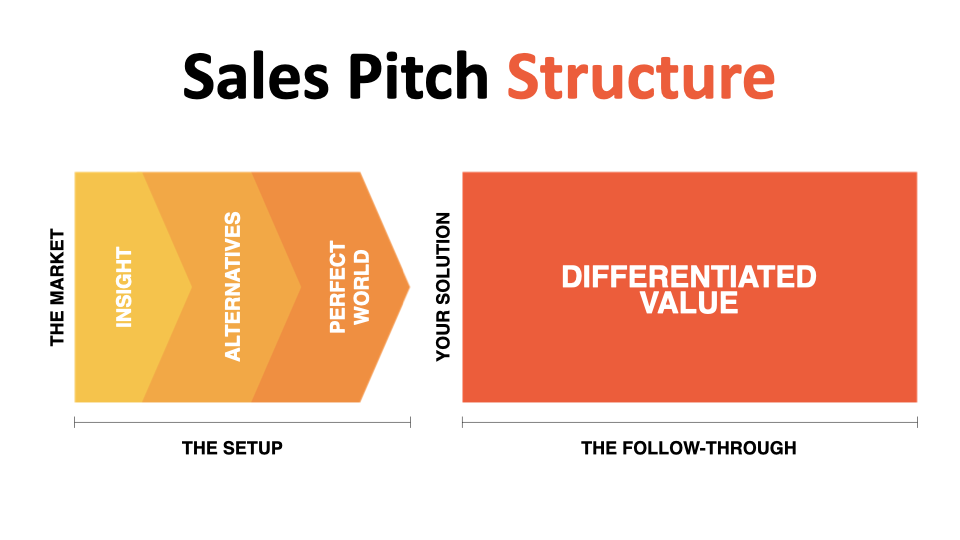
The “market insight” stage gives customers a way to think about the entire market so they can understand the trade-offs associated with different approaches and confidently make better decisions. Differentiated value (the value we can deliver to a customer’s business that nobody else can) is the core of our positioning, so it makes sense that it should form the core of our sales pitch.
Let’s look at an example where we contrast a typical feature walkthrough with a more positioning-oriented pitch.
Help Scout example
Background
Help Scout provides a customer service solution for modern digital businesses. Their point of view is that customer service is a growth driver, not a cost center. Traditional help-desk software treats service as a cost center and focuses on reducing time spent with agents. Help Scout was built for online businesses that do not have physical stores or salespeople, so support is one of the few places where customers interact directly with the company. For these businesses, delivering a great experience can strengthen customer loyalty, driving repeat purchases and revenue growth.
Looking at the competitive landscape, many of Help Scout’s customers started by simply using a shared email inbox for support. As their business grows, these customers need a solution with more advanced features, like prioritization and assignments, leading them to look at traditional help-desk vendors.
Let’s contrast a typical product walkthrough pitch with a pitch that mirrors Help Scout’s differentiated value.
Feature walkthrough pitch for Help Scout
A feature walkthrough would flow like this:
- Log in
- Show the shared inbox
- Show some advanced features—assignments, prioritization, etc.
- Show how customers can choose any interaction channel
- Show how customers are not assigned “ticket” numbers
- Etc., etc., until we run out of features
The problem with this is that it appears there is a lot of overlap in the features that a shared inbox has and the features that a traditional help-desk solution has. Why pick Help Scout over the alternatives? It’s not entirely clear.
A better sales pitch for Help Scout
Using the improved sales pitch structure, the flow would look more like this:
- We know from working with e-commerce businesses like yours that customer service can drive brand loyalty and growth.
-
You have choices in the approach you take to customer service. Here’s what we have seen with our customers:
-
Use a shared inbox: Service users love it because it’s easy to get started. The downside is, as you grow, you will want more advanced service features, like assignments and prioritization, and you will have to move to something else.
- Use a traditional help-desk tool: This gives you all the features a growing customer service group needs; unfortunately, it’s a lot harder for the team to use. The bigger issue here is that these tools were designed to reduce costs—by driving customers to lower-cost channels and minimizing their time with agents—not to give customers an amazing experience.
- We think what e-comm businesses really need is an easy-to-use tool that has advanced features so they never outgrow it, but was designed from the ground up to provide an amazing customer experience. Would you agree with that?
-
Let me show you how we do that (this is the follow-through and can be a demo):
-
Show how easy it is to use
- Show the advanced features, emphasizing that you won’t outgrow it
- Show the features oriented around giving a great customer experience—a customer chooses the channel, is not assigned a “ticket” number, etc.
- Show case study examples that demonstrate the improvement in customer loyalty and revenue
This version of the pitch is entirely oriented around answering the question “Why pick us versus the other approaches?”
Done well, the setup should take only a few minutes, but it is a crucial few minutes that helps to set the context for why our differentiated value matters to them.
The setup phase should be a conversation with the prospect. At each step we are asking: Does this resonate with you? What are you folks using today? Have you considered other options? In sales, we call this discovery, and it is a critical point where the sales rep is getting a deeper understanding of the prospect’s situation and understanding of the market.
A more detailed look at the setup
Let’s break the setup down into the smaller components and then walk through another example:
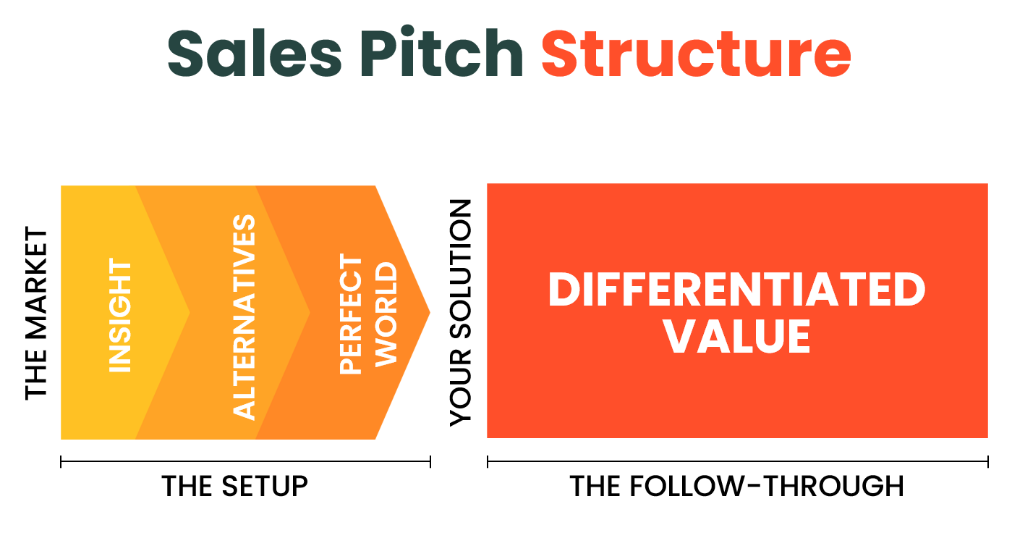
The setup comprises three components: insight, alternatives, and “the perfect world.”
1. The insight
This is the most crucial step and also the hardest. Our insight underpins our point of view on the market. I like to think of it this way—what does a customer need to know in order to understand why our differentiated value is important? For Help Scout, it’s “Customer service is a growth driver, not a cost center.”
Insight is the key to a great sales pitch. I’ve seen companies attempt to frame a pitch using “the problem” or “the change in the world” or a trend. But any company in the space could also claim to solve that problem or take advantage of that trend. There is nothing differentiating about those. Insight, on the other hand, gives us a way to start the conversation in a clearly distinct and differentiated way. It’s your point of view on the market—and by definition, it’s different from how your competitors look at the job your prospects are attempting to do.
2. Pros and cons of alternative approaches
In this step, we look at alternative approaches to the problem and the advantages and disadvantages of each. In general, we aren’t picking on individual products but rather the approaches to the job. For Help Scout, we are lumping competing solutions into “shared inbox” and “traditional help desk.” We are also explicitly teaching customers the pros and cons of each—“easy to use, but you might outgrow it” and “full-featured but difficult to use and doesn’t give customers a great experience.”
This step is the cure for customer indecision. Here we are teaching customers about the entire market, not just our stuff. Put another way, we are actively positioning every alternative approach they could take, including the status quo. This step is also the perfect place for our reps to do discovery while simultaneously building credibility with the prospect.
3. The perfect world
This step is the conclusion of the discussion in the previous step. “Knowing what works and doesn’t work with the alternative approaches for a customer like you, what would a perfect solution look like?” Done well, there is a bit of magic that happens in this step. If the prospect agrees with us that a perfect solution should have this list of things, the sale is ours. All we have to do is prove that we can deliver those things. If the prospect does not agree, we should disqualify them, because we literally have nothing to sell them.
For Help Scout, this happens when they say, “We think what e-comm businesses really need is an easy-to-use tool that has advanced features so they never outgrow it, but was designed from the ground up to provide an amazing customer experience. Would you agree with that?” If the customer says yes, all we have to do is show how we do it. If the customer says no, we should disqualify them, because we have nothing they want.
Postman example
Let’s walk through one more example of how this works.
Background
Postman has a free version that individual developers can use to develop and test APIs. The full Postman product, however, is a complete platform for managing the entire API lifecycle, including development, testing, documentation, and distribution. Postman has a sales team that sells the full platform to executives who want to deploy it across the broader organization.
Postman’s platform competes with a wide range of individual tools, each serving a specific purpose across the API lifecycle. The company’s point of view is that having teams hand off and work with so many different tools is incredibly inefficient and results in APIs that are buggy, poorly documented, and difficult for API users to consume. If we believe APIs are critical to our business, we need to adopt an “API-first” mindset, along with a platform that can help us seamlessly work across the entire API lifecycle to deliver better APIs, faster.
Again, let’s contrast two styles of sales pitch for Postman.
Feature walkthrough pitch for Postman
A feature walkthrough would flow like this:
- Log in
- Show the development and testing features
- Show the documentation features
- Show the collaboration features
- Show how to organize APIs
- Show how the governance features work
- Show how integrations work
- Etc., etc., and there are a lot of things to show…
The obvious pushback you would get from an executive would be, “We produce APIs today and we have tools to do this. Why rip that all out and use Postman?” There are also other, less obvious questions: Does this mean Postman is like an API gateway? What do we replace and what do we keep, if we adopt this? How on earth would we measure the ROI on this investment?
A better pitch for Postman
Using the improved sales pitch structure, the flow would look more like this:
- APIs are a critical way in which applications interact with each other. Low-quality and difficult-to-consume APIs are putting customer experience and revenue at risk. Companies must quickly deliver high-quality APIs that are easy to consume. [insight]
- Today, APIs are built, managed, and distributed using a siloed set of tools, each used by separate teams across the API lifecycle, which allows individual teams to choose a tool that is specific to their task. This siloed approach, however, makes it impossible to govern API quality across the lifecycle. This often leads to APIs that are badly designed, inconsistent, and poorly documented, resulting in their being difficult to use and understand. [alternative approaches]
-
If we believe APIs are important to our business, we need to take an API-first approach—one that would:
-
provide an integrated set of tools across the entire lifecycle to improve API quality
- allow teams to efficiently collaborate to solve problems quickly
- provide a repository for APIs with documentation, test cases, and anything else consumers need to make it easy for customers to use and consume the APIs
- Would you agree with this? [perfect world]
-
Let me show you how we do that [differentiated value]:
-
Show the integrated toolset, including what gets replaced and what Postman integrates with. Show how governance allows for higher-quality APIs
- Show collaboration and how that allows teams to ship faster
- Show collections and the experience for API consumers
- Show case study examples and call out the ROI achieved and impact to the business
Again, the improved sales pitch is not designed to highlight every feature—it is designed to answer the question “Why pick us over the alternatives?”
A structured approach to building a sales pitch can be a great way to bring sales, marketing, and product together
I’m a big believer in cross-functional teams working on positioning together. We get much better results when we have product, sales, and marketing in the room, each contributing what they understand about the product, customers, and the market.
I’ve seen many marketing and product teams do the hard work of creating solid positioning, only to have that story die the moment it makes the transition to sales. Having a good sales pitch structure gives us a starting point for the teams to collaborate and create a story that is more consistent across the buyer’s entire journey.
I’ve recently released a book, called Sales Pitch, that dives into the details of how a team might use this structure. It builds on the positioning process I describe in my first book, Obviously Awesome, which was designed to help teams determine their product’s differentiated value. Taken together, the two books give teams a way to tighten up their positioning and then translate that into a sales pitch that helps you stand out and win business.
Thank you, April!
Have a fulfilling and productive week 🙏
If you’re finding this newsletter valuable, share it with a friend, and consider subscribing if you haven’t already. There are group discounts, gift options, and referral bonuses available.
Sincerely,
Lenny 👋