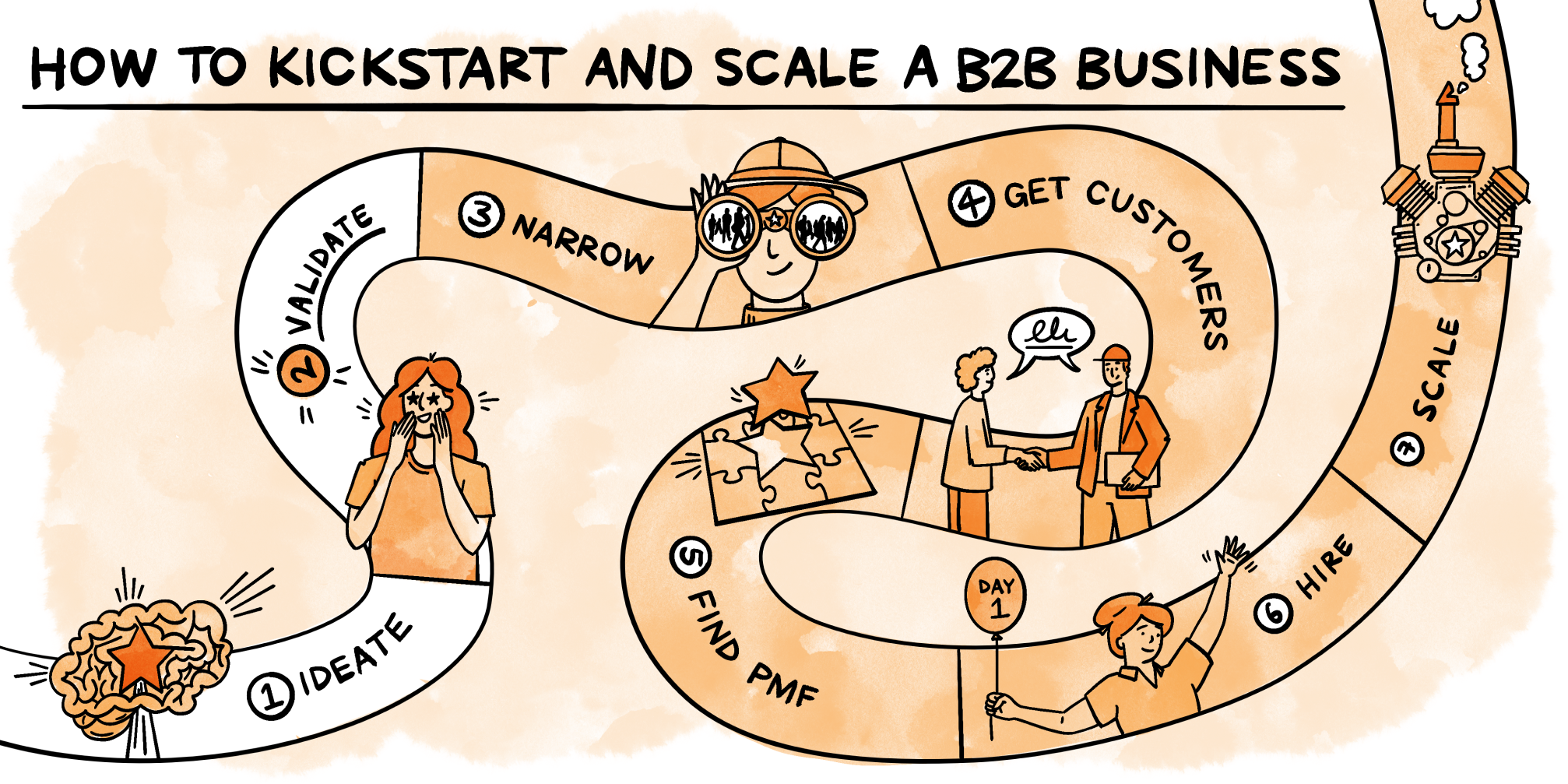
Welcome to part two of kickstarting and scaling a B2B business. Here’s where we’re at:
- Part 1: How to come up with a great B2B startup idea
- Part 2: How to validate your idea ← This post
- Part 3: How to identify your ICP
- Part 4: How to find and win your first 10 customers
- Part 5: How to find product-market fit
- Part 6: How, and when, to hire your early team
- Part 7: How to scale your growth engine
Let’s get into it.
A huge thank-you to Akshay Kothari (COO of Notion), Ali Ghodsi (CEO of Databricks), Barry McCardel (CEO of Hex), Boris Jabes (CEO of Census), Calvin French-Owen (co-founder of Segment), Cameron Adams (co-founder and CPO of Canva), Christina Cacioppo (CEO of Vanta), David Hsu (CEO of Retool), Eilon Reshef (CPO of Gong), Eric Glyman (CEO of Ramp), Guy Podjarny (CEO of Snyk), Jori Lallo (co-founder of Linear), Julianna Lamb and Reed McGinley-Stempel (co-founders of Stytch), Mathilde Collin (CEO of Front), Rick Song (CEO of Persona), Rujul Zaparde and Lu Cheng (co-founders of Zip), Ryan Glasgow (CEO of Sprig), Shahed Khan (co-founder of Loom), Shishir Mehrotra (CEO of Coda), Sho Kuwamoto (VP of Product of Figma), Spenser Skates (co-founder and CEO of Amplitude), and Tomer London (co-founder and CPO of Gusto) for contributing to this series. Art by Natalie Harney.
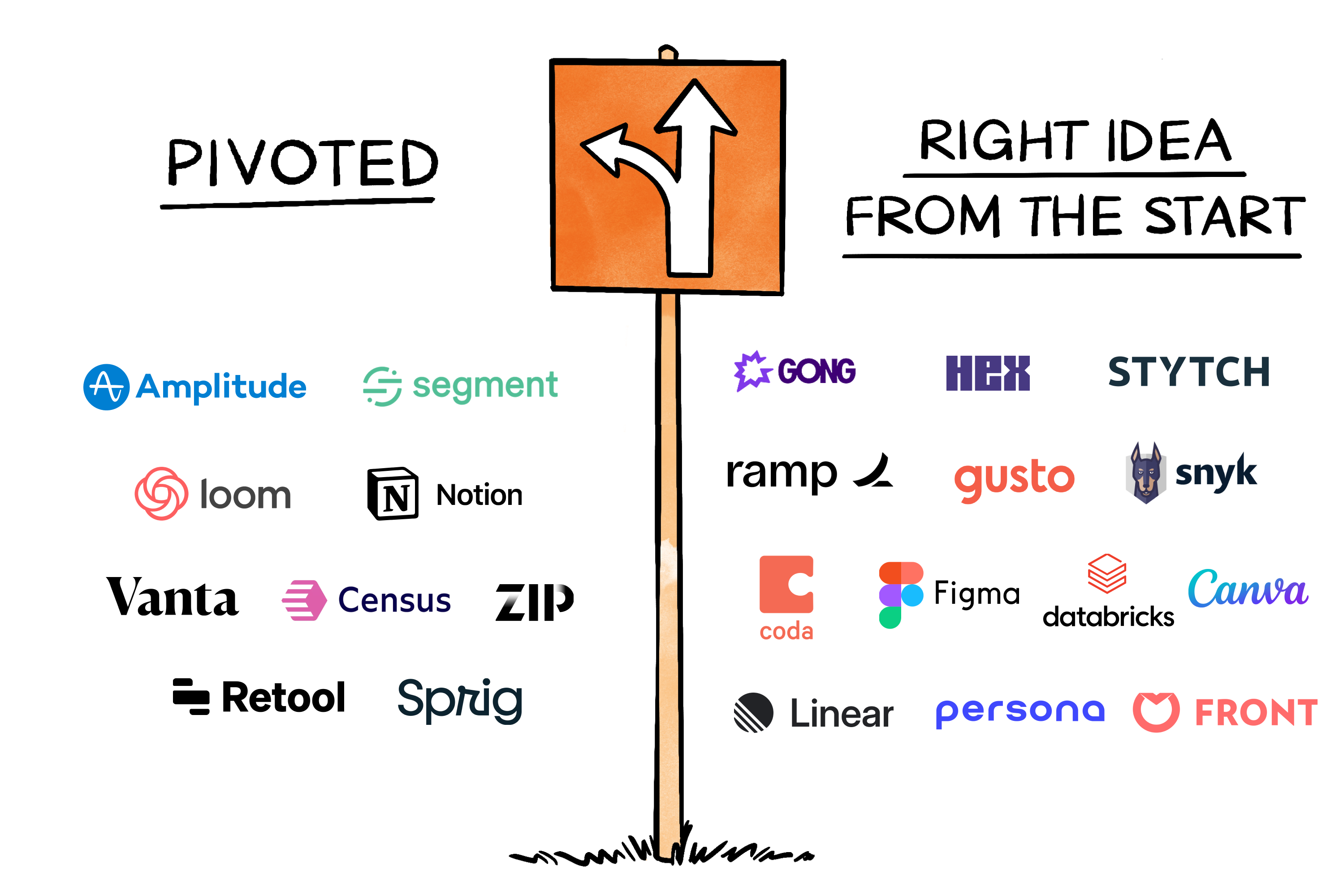
Forty percent (nearly half!) of the companies I spoke with went through at least one failed idea before discovering something that worked. Some went through 10. As Christina Cacioppo eloquently put it, “Our first couple of ideas were just total crap.” Many shared the same sentiment. Here’s how some of today’s biggest B2B startups began:
- Retool started as Venmo for the U.K.
- Amplitude started as a voice recognition application that allowed you to send and receive text messages by talking to your phone
- Segment started as a university classroom lecture tool
- Vanta started as B2B Alexa
- Notion started as a no-code website builder
- Loom started as a marketplace for companies to hire subject-matter experts
- Slack started as a game called Glitch
- Box started off as a “box” to put photos and content in on Facebook
The question we’ll be tackling in today’s post is this: Once you have your startup idea, how do you know if it’s a big idea or . . . total crap? Below, I’ll share:
- How the best founders validated their idea
- What specifically convinced them to go all-in
- How many people they spoke to before committing to the idea
- What true pull looks like
- Which companies pivoted and which had the right idea from the start
Some of my biggest takeaways and surprises:
- Founders spoke to a median of 30 potential customers before feeling like their idea was solid.
- Outbound sales is consistently the best signal for validating your idea (versus friends using your product, incubator batch-mates, or investor leads).
- Only about a third worked with design partners.
- There are four ways to validate your startup idea—and it’s fairly clear which path you should take depending on your product and your experience in the problem space.
-
There are four signs your idea has legs:
-
People pay you money: Several people start to pay for your product, ideally people you don’t have a direct connection to
- Continued usage: People continue to use your prototype product, even if it’s hacky
- Strong emotion: You’re hearing hatred for the incumbents (i.e. pain) or a deep and strong emotional reaction to your idea (i.e. pull)
- Cold inbound interest: You’re seeing cold inbound interest in your product
- Every prosumer collaboration product, including Figma, Notion, Coda, Airtable, Miro, and Slack, spent three to four years wandering in the dark until they stumbled on something that clicked. I’ll share these stories below.
- As I mentioned, about 40% of startups pivoted at least once before landing on their winning idea—oftentimes more than once. This rate is a lot higher than in B2C, where it’s closer to 20%.
Four strategies for validating your B2B startup idea
Across two dozen interviews, I noticed four distinct paths to effectively validating a startup idea:
- The do-it-manually path: Don’t build anything—solve the problem manually first, for a small number of companies
- The listening path: First talk to tons of potential users, and then start building
- The prototype path: Start building a prototype and then co-create it with a small number of design partners
- Just launch and see how it goes
If you look closely, all four paths are just different ways to validate the same things we focused on in part 1—pull and pain—with varying degrees of up-front investment. Here’s what pain and pull look like in practice:
- People pay you money: Several people start to (or offer to) pay for your early product, ideally people you don’t have a direct connection to.
- Strong emotion: You’re hearing hatred for the incumbents (i.e. pain) or a deep and strong emotional reaction to your idea (i.e. pull).
- Cold inbound interest: You’re seeing cold inbound interest in your product.
- Continued usage: If you’ve got a prototype running, people continue to use your product even if it’s bad.
1. The do-it-manually path: Solve the problem manually for a small number of companies
This path is a great choice for founders who are unclear whether the problem they are going after is important, or even solvable. Though it was the least common path, when done right, it can unlock huge lessons with very low up-front investment.
In the case of Vanta,Christina Cacioppo sensed there was a big opportunity in the compliance/security space but wasn’t confident the pain was that bad. So she manually created compliance reports for a few companies and noticed (surprisingly) that they all found them very valuable:
“There was about a six-month process before we started coding where we talked to about two dozen companies. Initially I simply answered security questionnaires for a company myself. They sent me their old questionnaires and they would send me new ones, and I would manually do the copy and paste.
At the time, no one really got SOC 2 certifications, and we didn’t know anything about them. I went and read two dozen SOC 2s and then went to a company and did a readiness assessment for them. We made them a SOC 2 report card in a spreadsheet, interviewed all their people, and wrote out, ‘Here’s all the stuff you have to do for a SOC 2.’ And the test there, honestly, was: one, would they spend time with us, and two, would they believe us? Would they think the spreadsheet was useful?
We did this first with Segment, and they really liked it. We were like, ‘Wait, really? Are you serious?’ Then we went and took our spreadsheet to Front, and we basically gave it to Front. We did a find-and-replace in the doc from ‘Segment’ to ‘Front.’ And that was a test of whether that’s useful to Front. Can we standardize this? And that actually was useful to Front.
And then we got an email from an old Dropbox colleague who was like, ‘I hear you guys have become SOC 2 consultants. That’s super-weird. I thought you were going to do other things with your life. But also, can you come do this for my company?’ And that’s when it was like, no, but I’ll start writing code. That was the validation process for us.”
—Christina Cacioppo, founder and CEO
The founders of Ramp did the same thing with savings reports:
“We came at it with this theory of: We’re experts in savings, and we’re really interested in this idea of a credit card that would save your business money. We think we can save you money, but we want to prove it to you.
So we did these things we called ‘Savings reports,’ where we would ask founders for the last 90 days of their credit card purchases or ACHs and—manually, but they didn’t know it was manual—come back to them with ideas to save their business money.
One of the early aha moments there was a company that was legitimately spending money on seven different project management tools. They were growing so fast that they had forgotten to cancel the subscriptions. They had adopted Basecamp and Trello and Asana and Smartsheet, and all these things that they later abandoned. I think it was a hundred grand on software they weren’t using. We came back and were like, ‘There’s $200,000 in savings. You don’t have to use us, just go and enjoy this tip. But by the way, this is what our software does, and we can do this for you ongoing and automatically.’”
—Eric Glyman, co-founder and CEO
2. The listening path: First talk to tons of potential users and then start building
This path should be your default, unless you have a clear sense of what you need to build. Go this route with the goal of speaking with around 30 potential customers, looking for pain and pull (see above what that means).
The founders of Zip spoke with 75 potential users before committing to their idea:
“We did a lot of interviews with CFOs, heads of procurement, heads of finance (I think the exact number is around 75), and over the span of two to three weeks. It really helped refine that idea. We had like 110 pages of notes or something in those two or three-ish weeks. Turns out the response rate is pretty good on LinkedIn when you just want advice.
We would be like, ‘All right, we had these three ideas. These two suck, but maybe we should tweak this idea because of what these two or three people said.’ And so we’d keep honing it down, honing it down, honing it down, iterating every day.
We also had a very stringent list of, I think, 16 criteria for the idea we were going to work on. And this idea actually met all of them.
But we were very honest with ourselves. We worked on a bunch of terrible ideas before, and if there’s anything we had learned, it’s that today will be the easiest day to kill the idea and do something better. It’ll always be harder tomorrow because you’ll have more customers if you’re fortunate (or unfortunate). You’ll be more emotionally attached to it; you’ll have more sunk cost.”
—Rujul Zaparde and Lu Cheng, co-founders
The founders of Stytch spoke with about 30 people and noticed there was universal hatred (i.e. pain) for the existing solution. Then they started building, and launched quickly, per the advice of their lead investor:
“We talked to about 30 people over the course of a few months, mostly fintech developers, but also friends that weren’t in the fintech space that know how to build authentication. We asked them what they used for authentication and what they thought of it. For most of them, it was either Auth0, Google Firebase, AWS Cognito, or in-house. And pretty universally, everyone hated whatever they were using. It turned into a snowball of momentum, where at a certain point it just seemed inevitable that we were going to do this.
We specifically didn’t go the design partner route, and instead focused on getting a self-serve product out as soon as possible, specifically an email magic links product.
Chetan (our lead investor at Benchmark) gave us advice that selling authentication to large companies would take a long time, since they’d need a lot of features. The advice we had gotten was if they really want just this one product, that’s great. Let them be a design partner and partner with you. More likely, they’re probably going to keep asking for things that aren’t in your ability to serve them right now. So see what you can do to serve that broader long tail of the internet with your wedge and see if you can get that going. If really we had built for only one of those, we probably would’ve waited another year to launch.”
—Julianna Lamb and Reed McGinley-Stempel, co-founders
The founders of Gusto had an extremely similar experience, both in terms of finding real hatred for the existing solution and also talking to exactly 30 potential customers:
“I had 30 people I talked to about the original idea. This is before we wrote a single line of code and before we actually committed to the payroll idea. We had a list of 30 people that Josh [Reeves, co-founder] and Eddie [Kim, co-founder] and I knew one way or another—some from Stanford, some from other networks—and I asked them for the names of friends who had small businesses. And for every call we did, we asked them, ‘Who are your friends who have small businesses?’ I literally was calling people out of Yelp.
Over time, if you look at the first call transcript and compare that to the 30th call transcript, it’s a very different call. In the beginning, you’re very open, exploratory, lots of different ideas and options. In the end, it was really mostly validating what you’re seeing.
The thing I was looking for in retrospect is emotional reaction. When you talk with a customer and you’re like, ‘Hey, here’s a new type of mint. The reason why it’s different is because it’s organic and it’s local,’ and then the person says, ‘Oh yeah, that’s cool.’ You say, ‘Would you buy it?’ They’re like, ‘Yeah, yeah, I may buy it.’ That’s not the feedback you’re after. That basically means that, no, they’re not going to buy it. They’re just being nice.
What you’re looking for is really, really deep emotion. So, what I heard from people was extreme frustration with their current payroll providers. The moment you just asked them the simple question of ‘What do you feel about your current payroll provider, your payroll system?’ they started cursing, literally. More than half of people just started cursing and being really upset. When you hear that strong emotion, then you know you have something.”
—Tomer London, co-founder and CPO
Guy Podjarny, the co-founder of Snyk,spent time talking to dozens of potential users before building anything, not so much to validate the problem (it was obvious) but to make sure that if he built the solution, companies would embrace it:
“The value in getting security built into the development process was already well recognized, so I didn’t need to validate the idea. What I needed to firm up was whether if I built the solution, developers would actually embrace it. Therefore, my early conversations were not with security people but rather with developers and entrepreneurs, especially founders of companies in the DevOps space.
I had several dozen such conversations in the opening days, and focused not on finding potential customers but rather on deeply understanding what it means to build a dev tooling company, and how it differs from a cybersecurity one.
DevOps founders were quite supportive of the idea, and agreed with both the need and the opportunity. They’ve all seen or run companies that disrupted incumbents by embracing a DevOps approach. The few security people I spoke to were skeptical, agreeing it’d be valuable but not believing it possible. This firmed up my conviction that this was the right problem to tackle. I thought, ‘It’s hard, but if I pull it off, it’ll be big.’”
—Guy Podjarny, co-founder and CEO
The founders of Ramp spoke to more than 100 potential users before jumping in and building anything (even before building their manual solution):
“Before we shipped a single card, we talked to over 100 finance and founder teams. We’d reach out to old YC batch-mates, or old friends who left companies and went to other companies; also the founders in the New York tech ecosystem.”
—Eric Glyman, co-founder and CEO
You may think you’ve talked to enough people, but don’t stop until you’re seeing evidence of real pull (e.g. money, usage, strong emotion, cold inbound). Spenser Skates, the founder of Amplitude, stopped at 30 conversations and later realized he should have talked to more:
“We did not talk to nearly enough. We talked to 30 different companies within a month. I should have aimed higher, like 50 companies in a month. But we talked to 30 in a month before building anything at all just to see, ‘Hey, is this something potentially interesting?’
And out of that group, there were probably 10 folks that we identified that could potentially use this, and then five that had so much of a need they might pay money. Out of that group of 30, how many ended up being paid customers? A grand total of zero. We knew there was a need, but we made the mistake after that month of going straight to building, because we were like, ‘Well, instead of having all these speculative conversations, we actually want to have something to show people.’
Some of them used it, but were they interested in paying money? Hell, no. I think in retrospect, I should have continued dedicating half of my time to going out and talking to customers. But that’s in retrospect. In the end, though, it worked out.”
—Spenser Skates, CEO and co-founder
3. The prototype path: Create a prototype and co-create with a small number of design partners
The next step up is to go straight to building a prototype, and then evolve the product based on ongoing feedback from a select set of early users. This path is most appropriate for founders who have experience in the space and come into it with a somewhat clear sense of what to build. This includes companies like Gong, Retool, Linear, Sprig, Zip, and Hex.
David Hsu at Retool relied on his past experience building internal tools at multiple companies, but still wanted to validate his thinking along the way:
“Since we’ve built this product in the past at other companies, we basically just built the first version of Retool for ourselves. We thought, ‘Are we going to use it?’ and we did. So then we tried finding more people like us.
At that point, Retool was at YC and we were this tiny company, and so we just tried finding other tiny companies that had product-market fit and needed internal tools. Out of 200 YC companies, we identified maybe five. So we approached them, and they wanted to use it. And then they actually started using it. And so that was the main thing for us to know it was working—there was usage.”
David also explained why outbound sales was the best signal to find true pull:
“We realized when you sell to YC batch-mates, or people that you have some relationship with, it’s very easy to delude yourself into thinking that you have product-market fit, because everyone is always kind of interested. It’s like, ‘Oh yeah, that sounds cool. Let me try it out.’ But no one is actually willing to put money down. So I realized the best signal of this being real is to do cold outbound sales. It’s just much purer, basically: just pure outbound with your pitch and the value prop, with no other incentives attached. So at Retool, we started doing sales early on. You cannot fool yourself and be deceived anymore. You can get an accurate grasp of reality. That’s actually how we landed DoorDash, as customer number five.”
—David Hsu, founder and CEO
The founders of Zip highlighted this same lesson as well.
“We made an active decision to focus on cold outbound, versus friends. We wanted to know if this was a shitty idea or a good idea. And if we sell to friends, they might buy it because they feel bad or whatever. It’ll confuse us. So we have to get the first 10 essentially cold. They shouldn’t owe us anything. They should buy it because they see value in it, and that’s how we’ll know it’s a good idea.”
—Rujul Zaparde and Lu Cheng, co-founders
Like Retool, the founders of Linear came into the space with strong opinions of what the product needed to be—essentially building it for themselves—and then, slowly but surely, started sharing their prototype with similar-minded small startups to validate their thinking.
“We started by, ‘Let’s just build something we want to use ourselves.’ On the weekends, let’s build something we want to use. Then let’s build something that the small startup of two to five people can use, and not try to jump ahead. Let’s go in stages. Let’s just be very focused on these small startups, putting aside any request that might come from a larger customer so that we know we can serve them.
We did talk to a lot of our friends at a time when we were starting working on it, chatting to them about this: ‘Hey, do you have this need?’ It was, interestingly, very binary how well it clicked. Some people got it immediately. They’re like, ‘I hate product X, and I would love there to be something better.’ And other people are like, ‘We’re completely happy using GitHub Issues. There’s nothing wrong about it.’ They just completely ignored our ideas—which is hard to hear.
But then once you hear both sides so often, you start to realize there’s no way of convincing the people who don’t feel the pain to overcome that unless they overcome it themselves. So let’s just focus on the people who feel the pain and serve them.”
—Jori Lallo, co-founder
Same story with the founders of Gong,who had a lot of experience in sales but who still worked with a small set of design partners once they had a prototype ready. They knew their idea had legs when all but one design partner was ready to buy their product:
“We ended up with 12 design partners. We gave them the software in January. In May, we made a decision to tell them the beta was over and that we were going to start charging for it. Out of the 12 companies using the beta, 11 ended up buying.
During the beta process, we had a bunch of systems that recorded the users’ screens using Gong. And we were watching these like maniacs, every day. I would probably spend two hours watching people interact with the system, reverse engineering them based on their role or what they were trying to do, and then go on thinking, ‘So this is what this person is doing?’ And if needed, I would give them a call. This approach is an underutilized product management tool, because in some areas it gives you more information than a quantitative survey or a discussion, because this is what the person actually does versus what they tell you and what they think they’re doing.”
—Eilon Reshef, co-founder and CPO
With Sprig,Ryan Glasgow worked with just four companies that were immediately excited—and again, paid the most attention to cold outbound as a signal of true pull:
“It was about getting as many meetings as I could get, sharing the roadmap, and asking, ‘What do you want us to build next?’ Effectively co-creating.
We ended up working with essentially four companies—Plann (they’re in Australia), Thunkable, and then Square, and then Robinhood. They all had millions of users, and they all cared about their user experience. Because they were a similar scale, I wasn’t getting pulled in different directions; they all wanted a lot of the same stuff.
The real test for me was ‘Can I find customers with cold email?’ Because where a lot of founders make a mistake is that they sell to their friends—like YC, you sell all your YC batch-mates and everyone uses your product. But I actually wanted to try cold email and confirm that I could get meetings if people still use the product.
I got a meeting with Thunkable. They came over to our office, I did a demo, they installed our SDK. A week later I came back and they wanted help figuring out all these issues, and usability, and how much it costs, and they ended up being the first customer that I had no connection to. That gave me confidence that this idea could work.”
—Ryan Glasgow, founder and CEO
With Hex,Barry McCardel also had a strong sense of what needed to be built, because of his previous experience, and was able to validate it quickly with just two design partners:
“We had two design partners, and I always joked that two is the exact right number of design partners, because it’s the minimum number that’s more than one. You want it to be the minimum number so you stay focused. This is a place people will get tripped up. They’ll try to go and work with a ton of different customers, and they wind up losing focus. You won’t be great for anyone. Just get the thing to be really damn useful for one customer.
It was one customer for us in particular that early on started using it for real. When they started sharing stuff and asking for features proactively from us—that’s when I knew we were on the right track. I wasn’t so worried about like, ‘Oh, I need to go validate this feature request with 10 other people’—in part because we knew this space pretty well, and I think we had a good sense for what was generic versus esoteric.”
—Barry McCardel, co-founder and CEO
4. Just launch and see how it goes
A final, and surprisingly common, path to validating an idea is simply to launch it and see how the market responds. This path is most appropriate for two situations:
- Founders who are getting desperate and need to just try stuff out (e.g. Segment, Loom)
- Founders who have a crystal clear vision of what needs to be built (e.g. Canva, Databricks)
In the case of Segment, the founders didn’t actually expect the product to take off:
“We basically did the opposite of the design partner approach. We just launched and put the product out there, partly since we didn’t actually expect this idea to work.
What was interesting is that prior to launch, we had spent about nine months trying to build products for design partners we were talking to. The overlap between the design partners we were talking to and the new users was near zero.
This was really surprising to me. In general, I think users are much better at finding products than founders are at finding design partners. There are exceptions to this rule, but if you have very little in the way of network (like we did), then it’s probably worth launching.
What convinced us to commit, frankly, was desperation. We were running out of money and ‘would have to find real jobs’ in the next few months if this didn’t work out. We decided to launch and give it our best shot. Our backup plan was to try and launch a group-trip-planning idea (which, for the record, would’ve been a disaster).”
—Calvin French-Owen, co-founder
Loom followed a similar story—launch, and then start iterating:
“We launched on Product Hunt and had thousands of people who downloaded the extension by day’s end. That made it clear to us that we should double down on this new direction, and we’ve never looked back.
Once we launched, every new sign-up was prompted with a welcome email coming from one of us founders. We were so eager to talk to anyone who was using Loom. We closed out our first month with around six to eight thousand users, and for our first year live, all customer support conversations were had with any one founder.”
—Shahed Khan, co-founder
With Canva,the founders had a very clear sense of what needed to be built, so they simply built it:
“We had a very strong vision of where we wanted to go, based off experience and qualitative data from interacting with people, understanding their struggles with design, and being able to envisage this future where design was immediately accessible for anyone in the world.
I’d say our product was probably driven by 70% vision and 30% user feedback along the way. We were strongly building towards our vision, but as we had prototypes, we would put them in front of people and get their reaction. Once we had a fairly complete production product, we started user testing to see how people reacted to it, what they could achieve with it, whether we needed to tweak our onboarding process, whether we had the right feature set, etc. And that shaped our product in the later stages, as we were getting ready for launch and as we were thinking about how to communicate the product to people.”
—Cameron Adams, co-founder and CPO
The Databricks team initially launched their product as just an open source project, without intending to turn it into a business:
“We were in the special category, different from most companies, which is the open source category. Open source companies have intrinsic advantages and disadvantages. The advantage of open source companies like ours is that by the time we started, the open source technology already had a significant number of downloads and people using it. It wasn’t a worldwide phenomenon, but it was enough. It had thousands of people using it. That was already enough to know that this was something that people find useful, but it wasn’t getting the breakthrough that we really thought it deserved. Open source companies often have that, right? You have an open source project. It already has mindshare and people are liking it, but you don’t really have a business around it. We were in that category. Whereas many other companies, they start from scratch and they have nothing.”
—Ali Ghodsi, co-founder and CEO
To summarize:
Four ways to validate your idea in B2B:
- The do-it-manually path: Solve the problem manually for a small number of companies
- The listening path: First talk to tons of potential users and then start building
- The prototype path: Create a prototype and co-create with a small number of design partners
- Just launch and see how it goes
Strong signals your idea has real pull:
- People pay you money: Several people start to pay for your product, ideally people you don’t have a direct connection to
- Continued usage: People continue to use your prototype product, even if it’s hacky
- Strong emotion: You’re hearing hatred for the incumbents (i.e. pain) or a deep and strong emotional reaction to your idea (i.e. pull)
- Cold inbound interest: You’re seeing cold inbound interest in your product
Bonus: Prosumer companies wandering in the dark
One of the most interesting takeaways from this phase is how every prosumer collaboration product spent two to four years looking for an idea that worked. Here are their stories.
Notion
“To be brutally honest, for the first four years it didn’t go anywhere. Very few people used it, the feedback was not great. The retention was not great. It was very buggy. The company almost ran out of money. Well, actually it did run out of money, and Ivan [Zhao, co-founder] had to borrow some money from his mom to keep it going.
The final shot at it was essentially that Ivan and Simon [Last, co-founder] moved to Japan for a few months and rebuilt everything from the ground up. And they did that because they kept their burn very low. Funny enough, they were able to get an Airbnb in Japan, in Kyoto, which was cheaper than their S.F. office and apartment on Airbnb. So they were net making money by putting their office and apartment on Airbnb and working from the Kyoto Airbnb.”
—Akshay Kothari, co-founder and COO
Figma
“When I joined, they were still in stealth mode and the company had existed for three years at that point, building in the dark. I was like, dude, you can’t be in stealth mode for three years. People were getting stressed and going crazy, and that’s what happens when you don’t ship something for three years. Whether they were fortunate or had great product taste, I don’t know, because three months later, we launched our first private beta, and then a year later our first public beta, and it worked out just great.”
—Sho Kuwamoto, VP of Product
Coda
“From inception to Coda 1.0, it took us four and a half years. Longer than Figma. You’re going to have to extend all your charts for us. It’s what we expected right from the onset. Coda is displacing a set of legacy productivity surfaces that have been around for about 50 years and reimagining them from the ground up—so the bar is quite high.”
—Shishir Mehrotra, co-founder and CEO
Airtable
“In the frenetic world of tech, where the ruling ethos is to move fast and break things, Howie Liu moves at a glacial pace. With Andrew Ofstad and Emmett Nicholas, he launched Airtable in 2013. They wanted to create a spreadsheet with the power of a database. Then they spent three years building a prototype. ‘Instead of trying to rush a new product out the door, we introduce a period of forced delay, so people have a chance to sleep on an idea,’ he says. ‘It’s a concept we call the simmer.’”
Bonus 2: How they knew it was time to go all-in
Another big question many founders face is knowing when to commit to that one idea and go all-in. Beyond the signs of pull and pain we looked at above, I asked each founder what moment convinced them to go for it. Here’s what came up.
Pattern 1: The right people agreeing to join the company
“I always tell people, when you’re deciding to start a company, the two main litmus tests are (1) Do you have an idea you can’t imagine not working on? and (2) Do you have a person you can’t imagine not working with?
Usually I’ll meet people and I’ll ask them that question, and they’ll have one but not the other: ‘Oh, me and my buddy are going to start a company.’ I ask what’s it going to be about, and they’re like, ‘We don’t know, but we really like each other, so we’re going to start this company.’ And I have to say, that works sometimes, but not often.
Or the other way is: I’ve got this great idea, but have you convinced anybody to do it with you? And they’re like, ‘No, not really.’ I bet it’s not that great an idea then. Usually you kind of need that test.
In our case, Alex [DeNeui] and I had a quite high bar for committing to an idea, because both of us had reasonably high opportunity costs, plenty of other things to go and do. But actually the thing that probably pushed us over the edge is we made a list of the people we wanted to hire and we said, ‘Here’s the first four people we want. And if all of them say yes, we’re starting the company.’ And it was kind of our next level of commitment. They all said yes.”
—Shishir Mehrotra, co-founder and CEO of Coda
Pattern 2: An impactful conversation
Gusto:
“We had two commitment moments. The first commitment moment was to commit to each other, and that was before we knew exactly what we would work on. I don’t hear a lot of people talk about that—the team stuff. The three of us had previous startups, and none of them are as successful as Gusto, but we had enough mileage to know what a good and what a bad co-founder would look like. I think we’re just very lucky to have found one another. It’s kind of like a marriage, a partnership. I think what we did—that was not just luck but the good judgment to know that this is it, so we committed.
I remember Josh sending an email out of blue, literally saying, ‘I quit my job and we’re going to go full-time. Can you join me?’ I was like, ‘Holy shit! He’s being real.’ That’s moment number one.
Moment number two was committing to this idea of paying people electronically. We had variations of this idea. One of the first things we looked at was a payroll API, and then the thing that sold us on this idea was a meeting with one of our potential customers.
This person was the accountant of the company called Bump back in the day. We sat down and ate Thai food in Mountain View, and we just said: ‘We’re thinking about building a new payroll product, a new payroll company.’ We didn’t even start telling her what we would do or why what we would do is different, and she just went on for 30 minutes, telling us all the opportunities and how all the systems are broken and how ‘Gosh, I just can’t wait to have something new,’ and we came out of this meeting, and I remember—I think sometimes there are moments that sit in your brain—we exited the restaurant, said goodbye, walked just around the building to the parking lot, then we looked at each other, like: We’re doing this, right? We’re building a payroll solution for small and medium businesses, right? Yeah, we’re doing this. Yeah, okay, cool, we’re doing this. That’s it. It was literally on the spot. It was very clear that the energy from customers was there. So that was that second moment.”
—Tomer London, co-founder and CPO of Gusto
Census:
“There were two conversations that made me go, ‘Holy shit, this problem is a big deal for me. I’m willing to spend a lot of my life on this, and we should raise money to do that.’
The first epiphany came from working with our first user, a brilliant operator. They knew how to model their business, but they lacked not just the tool but even the process—the thinking. When they talked about moving data and integrations, it was about connecting stuff. I told them, ‘Your work wasn’t connecting—this is about deploying. You should think about your workflow as a piece of code that you version, ship, and monitor. These are tied to a clean set of entities that model your business, which change over time.’ None of these concepts were familiar to them or almost anyone in their discipline. I looked and them and felt, ‘Oh, you are super-underleveraged.’ So that was epiphany number one.
Epiphany number two came from a friend, an old buddy of mine from Microsoft who led a team at Amazon. I asked him about this stuff: ‘How do you guys do this? You’re the pros, right? How do you deal with these data pipelines for the sales team etc.?’ I figured he was going to describe to me a Rolls-Royce. Instead he said it was a terrible, terrible piece of infrastructure and they lose leads all the time. My response was: ‘What? This is crazy.’
These two conversations weren’t PMF, in that we can build a business, but for me, it was founder-motivation fit. I know these people can be more empowered, and they’re only going to get there if we bring it to them. It’s going to take a long time, but I was like, ‘We have to do it.’”
—Boris Jabes, co-founder and CEO of Census
Pattern 3: Momentum
Stytch:
“The way I articulate it to people is that it was just this snowball of momentum, where at a certain point it just seemed inevitable that we were going to do it. There were a lot of conversations leading up to that of being in my head, like, ‘Do I do this?’ Talking to my friends and family and being like, ‘Do I do this? I don’t know.’ And then, obviously, Reed and I decided together to some degree, but it felt like we actually made the decision late, if that makes sense. It felt like we had a lot of momentum with feedback on the idea and formulating the idea, so by the time I think the two of us consciously talked about it, it felt like it wasn’t a decision that we were making.”
—Julianna Lamb, co-founder and CTO of Stytch
Front:
“For me, it was just a leap of faith. I did not allow myself to doubt too much. I think I had enough conviction that it was a problem worth solving, through people signing up to the landing page and conversations with potential customers.”
—Mathilde Collin, co-founder and CEO of Front
Pattern 4: Companies giving you time
“I knew it was time to commit when Segment allowed us to be a ‘SOC 2 consultant’ and spend time with their engineering team to put together a gap assessment for them.”
—Christina Cacioppo, founder and CEO of Vanta
Pattern 5: Desperation
“Frankly, it was desperation. We were running out of money and would have to ‘find real jobs’ in the next few months if this didn’t work out. We decided to launch and give it our best shot. Our backup plan was to try and launch a group-trip-planning idea (which, for the record, would’ve been a disaster).”
—Calvin French-Owen, co-founder of Segment
Pattern 6: Cosmic coincidence
“It was a weird cosmic coincidence that my co-founder [Glen Takahashi] and I both were going to have to move to support our significant others’ jobs. We were both living in New York, and both of our significant others had gotten really cool jobs in San Francisco that we couldn’t say no to. And so we were moving anyway, and we were going to have to find new jobs anyway. It kind of threw us off the cliff a little bit. And honestly, I wonder sometimes if we had stayed in New York and we were just at our old jobs, if we would’ve done it, because we were reluctant. Not that we didn’t think we’d be good founders, just we only wanted to do something if it really felt right. It was one of those things where the universe was kind of telling us we have to do this. We’re like, ‘Fuck it. I guess we have to.’”
—Barry McCardel, co-founder and CEO of Hex
Pattern 7: They were already certain they were going to start something
Figma:
“As soon as Dylan [Field] and Evan [Wallace] got the Thiel Fellowship, they were like, ‘Hey, we’ve got this money that gives us a runway to try stuff. So let’s just try stuff.’ They were committed to building a company from the beginning.”
—Sho Kuwamoto, VP of Product of Figma
Amplitude:
“I actually was committed to doing a startup before Sonalight and before Amplitude. I graduated from MIT in 2010, and as part of it, I had done Battlecode, which is this month-long coding competition—the largest coding competition at MIT. Over 1,000 people participate, and a lot of the people who compete in that end up going on to found amazing companies. So the founders of Dropbox came from that. Benchling came from that. Obviously now we’re part of that group too. But lots of amazing startups and companies come out of that.
It made me realize starting a company was a viable path after graduating from college. And so I spent about a year studying companies, figuring out, ‘Am I capable of doing this?’ I read Paul Graham’s essays, talked to founders—I went through Founders at Work, just to understand.
And one of the things that really stood out to me going through that process of studying companies was that most companies went through a period where about a year, maybe a year and a half, in, the founders rationally probably just should have given up because they weren’t getting any traction. Airbnb’s story is famous for that. All sorts of false starts. For whatever reason, they didn’t give up. And they decided to keep at it. And then they ended up going on to find massive success. And that is true in almost every single founding story you can find out there.
And so that was a huge thing to us. To me that was like, look, if you’re going to do it, you’ve got to commit for multiple years and not quit on this thing no matter how bad the thing gets. And if you do, it’s likely you’ll find some sort of success. Whether that’s an acquisition or whether that’s a scalable company or whether that’s some other opportunity. You don’t know, but you’ll find something by sticking to it. And so that was the thing for me. I was like, ‘All right, I’m going to go do this, and I will do this for a minimum of two years no matter what happens.’
I pitched tons of folks and my classmates at MIT to try to come start the company with me. None of them wanted to do it.
To Curtis [Liu]’s credit, my co-founder at Amplitude, he was like, ‘I want to do it, but I want to stay at Google for a year first.’ I’m like, ‘If he goes to Google, he’s never coming out of that thing.’ So, we’d worked together on side projects on nights and weekends. Other people would be part of that and come and go, but he was the one who stuck through it. We ended up starting Sonalight. Nine months in, it didn’t work. No question we were going to continue to go after this thing. Yes, both of us full-time; we added Jeffrey [Wang] after that. And the three of us started Amplitude together. And then after a year of work on that thing, it really started to take off.”
—Spenser Skates, co-founder and CEO of Amplitude
Snyk:
“My first decision was to leave Akamai and start another company. I loved the startup experience, and I wanted to prove to myself Blaze wasn’t a fluke and that I can do it again. Moreover, I wanted to build something bigger than Blaze, which was a successful but quick outcome. I resigned, with the intent of taking a year off before starting another thing, but once the idea for Snyk took hold, I couldn’t wait. It felt like I was uniquely positioned to take this challenge on, and that now was the time to act. I ended up incorporating Snyk eight days after my final day at Akamai.”
—Guy Podjarny, co-founder and CEO of Snyk
Next: How to identify your ideal customer profile (ICP)
Have a fulfilling and productive week 🙏
📣 Join Lenny’s Talent Collective 📣
If you’re hiring, join Lenny’s Talent Collective to start getting weekly drops of world-class product and growth people who are passively open to new opportunities. I hand-review every application, and accept less than 10% of candidates who apply.
If you’re looking for a new gig, apply to join! You’ll get personalized opportunities from hand-selected companies. You can join anonymously, hide yourself from companies, and leave anytime.
If you’re finding this newsletter valuable, share it with a friend, and consider subscribing if you haven’t already. There are group discounts, gift options, and referral bonuses available.
Sincerely,
Lenny 👋