✨ Special edition: This is a companion piece to today’s First Round Review ✨
My friend Dan Hockenmaier and I published an essay on consumer business growth strategy in today’s First Round Review:

For the piece, I interviewed Arthur Kosten, CMO of Booking.com from 2003 to 2012. A number of fascinating insights had to be cut from our chat (for brevity’s sake) and instead of leaving them on the cutting-room floor, I’m sharing them in this exclusive companion post. I hope you find this as fascinating as I did.
An inside look at Booking.com's early growth strategy

Booking.com has been a fascinating company to watch, particularly for someone working on growth at Airbnb (aka me). Not only did they grow from a tiny startup in the Netherlands to one of the greatest acquisitions of all time, they’ve also always been world-class at one central skill: performance marketing.
Booking.com (now part of Priceline) has grown to become nearly an $80B business mostly on the back of performance marketing. They often rank amongst Google’s biggest advertisers, spending somewhere around $4B per year on Adwords, and ~15 years later continue to innovate in the space.
As an outsider, I’ve always wondered how they did this. I was fortunate to get in touch with Arthur Kosten, Booking’s CMO from 2003 to 2012, who generously agreed to sit down for an interview. Below are my top five favorite insights.
🤯 Top 5 most interesting things about Booking.com’s early growth strategy
1. The performance marketing team drove the supply strategy
“When paid marketing is just a function, optimizing campaigns in a cubicle, it doesn’t inform the rest of the business and the funnel doesn’t work. There just isn’t much you can do to optimize paid ad campaigns.
Instead, our supply organization was fully aligned behind what the demand was looking for. If we had enough customers coming in on queries that were high intent, we would want to (eventually) be #1 on those keywords. Our goal was to find out why we were losing in the paid ads auction — was a competitor doing something better, or are we missing supply.
Our process was: Do we have demand? → Do we have inventory? -> Is it the right inventory? → Do we have availability? -> Do we have conversion?
If we were losing on supply, we figured out what we needed to improve: Different supply? Cheaper supply? Different rank order? Better product content? Availability at other dates? Something else?
The team never wanted to believe they were losing a keyword because our competitors are being irrational. You cannot be irrational for too long because it’ll put you out of business. So if someone else was winning, they were doing something else better. Nothing was sacred.”
2. The performance marketing team was only two people, even past $100m/year spend
“It was actually only two guys: one banker and one coder.
Peter (the banker) was extremely competitive. He would scream and shout when he was losing his #1 position. He had a simple success criteria: win the auction for all of the important words, and make money on it.
The coder was very experienced, entrepreneurial, creative and a data geek. With another coder the magic wouldn't have happened. It was the combination of Peter with the coder having excellent data skills (i.e. he built tools for supply to align with the paid search team) that made it work in the beginning.
I always believed that the secret to our success was that we were not heavily automated for most of our early spend.
Probably from 2004 to 2010, Peter was leading all of this, doing almost half the spend personally. Our Google rep was shocked that we had just one person running this, and a PhD engineer at Google even tried to replicate his brain, but they couldn’t.
Around 2006, new people joined the team and built new screens and dashboards which informed the supply team's efforts, but mostly to help Peter spend his time more efficiently.
This small team continued to run the program even past $100m in spend. Eventually, this team split into two teams: (1) Peter’s team focused on top to mid-tier markets, (2) a high-tech product tech team going after long-tail markets.”
3. They obsessed over Product-Channel Fit
“People talk about Product-Market Fit. We realized we needed Product-Channel Fit. And it became clear Google AdWords was that for us.
Initially, SEO was the primary growth driver, but eventually, growth started to level off because we were doing some gray-hat stuff and Google started to penalize us. So we began exploring new ways to grow.
At the time, Google was taking off like a rocket ship, and the searchers had so much purchase intent. We thought, if we could get good at Google, we’d do really well. We thought, what if we try AdWords?
In 2004 we started paid search, and in 2008 it was the biggest source of growth.
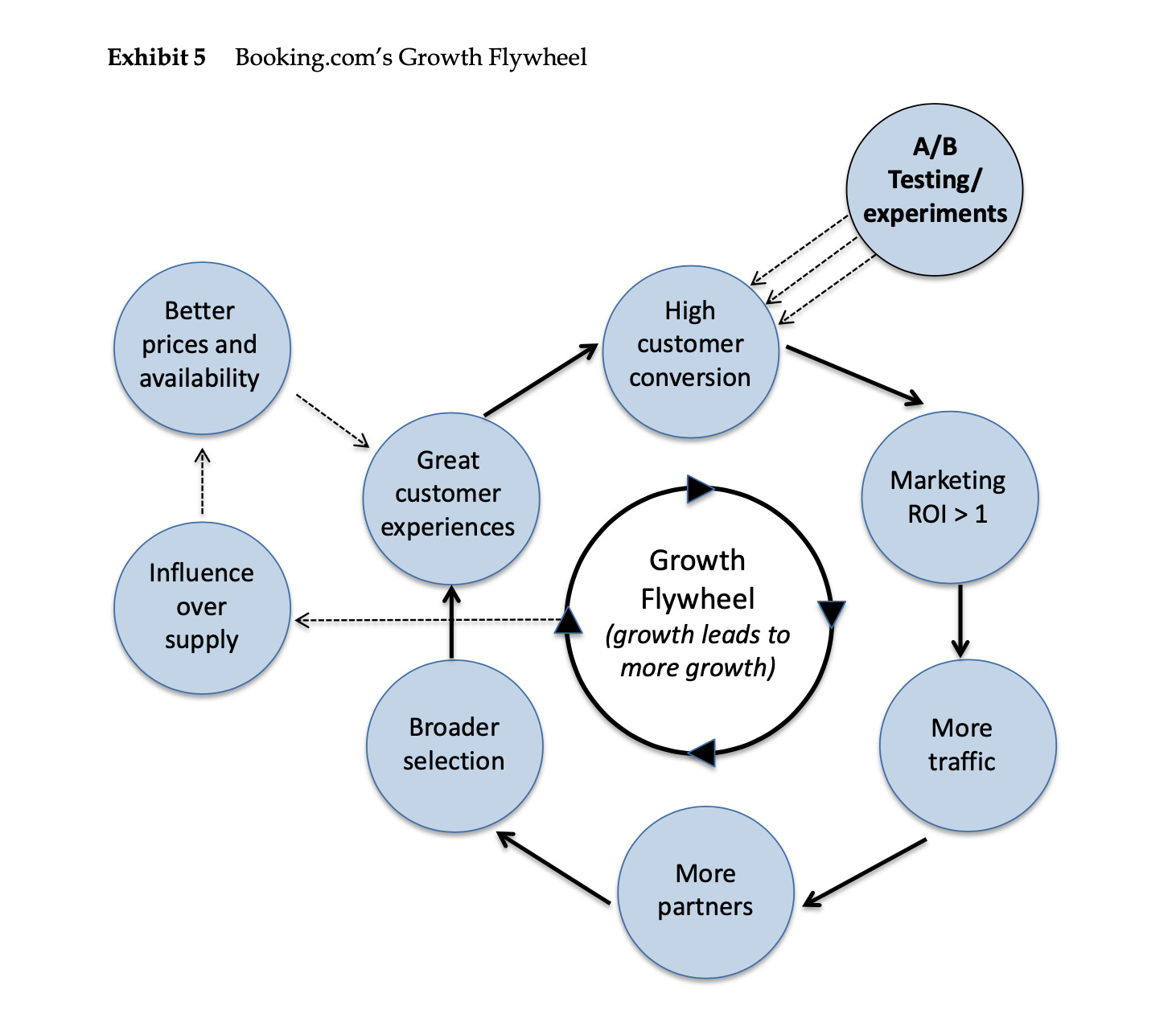
Critical to getting this Product-Market Fit right was our obsession with conversion improvements and A/B testing. Each A/B test that increased bookings, or monetization, increased the performance of marketing campaigns. Conversion improvements made unviable campaigns viable, improved competitiveness of existing campaigns, and further improved ROI on campaigns where we already were #1 — allowing us to invest those margins in new frontiers for the business.
Source: HBR
When I left in 2012, we were running more than 100 concurrent experiments any given time, and incredibly fast paced. Anybody in the product team could still have and idea in the morning and have it running live on customers in the afternoon.
Think about product-channel fit: How can you create a product / company / organization that the machinery of the org was built to fulfill the needs of the customer from that channel?”
4. They turned disadvantages into advantages
“Unlike our competitors (e.g. Expedia, Orbitz), we didn’t have access to chain hotels in big markets, so we focused on long-tail markets early-on.
We build inventory in secondary and tertiary destinations, where the other players didn’t have hotels. They couldn’t compete with us there so we ended up getting a virtual monopoly.
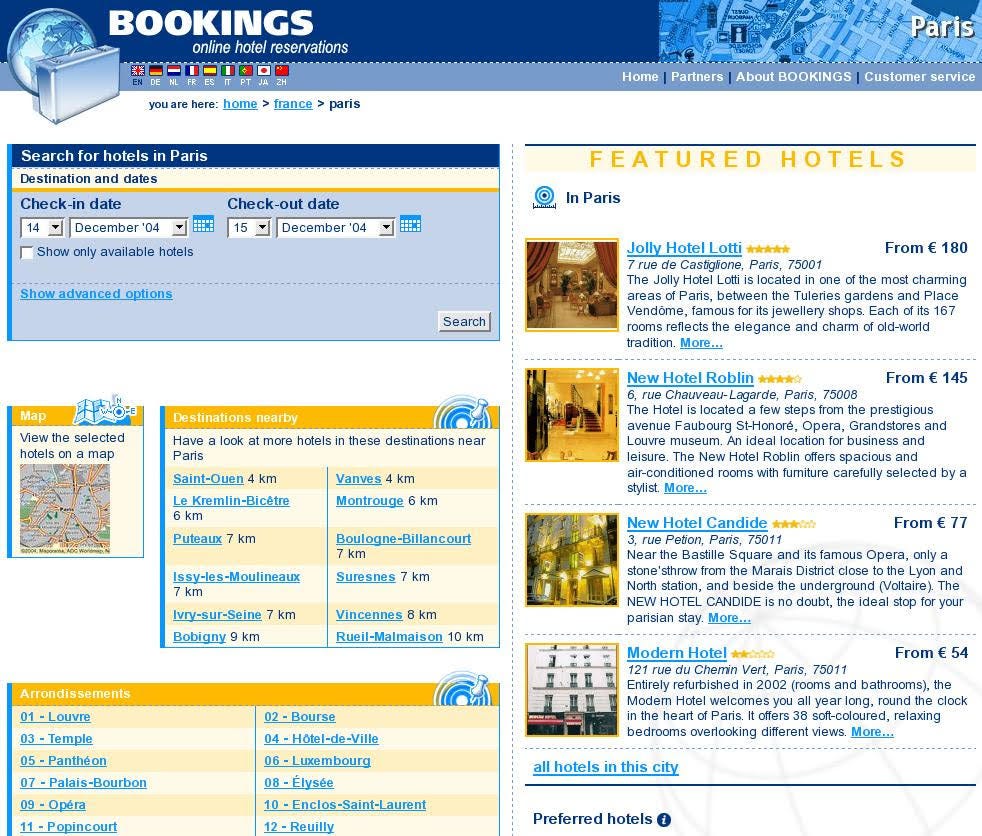
This also led to our successful landing-page strategy, where we created bounding boxes pulling all of the nearby hotels, along with a map of the area, the POIs, and a search box. We constrain the marketplace and made it look like we had a lot more supply than we did.
We also translated the pages into many languages, with hundreds of translators on the payroll at one point. So in places where we might not be able to compete geographically, we could compete on Japanese, Korean, Russian, Arab, etc queries.
At this time Expedia was 100x bigger than us, but with this approach we could pretend we were a big company in each of these specific cities, because no one knew we didn't have any supply anywhere else. When people land on one of our landing pages, they were like wow, so many hotels in this city!”
5. They used Google Translate for localization
“The localization for our ad copy was done by Google translate, even when we got really big. A lot of team members were upset with our ad copy sometimes, so we asked them to give us better copy, which we A/B tested, and the Google translated copy often won. We would keep what worked regardless of what would be better according to local speakers.”
For much more from Booking.com, along with insights from Thumbtack and Airbnb, make sure to read the full First Round Review piece.
Till next week!
A HUGE thank you to Arthur Kosten for being generous with his time and sharing these incredible stories with us 🙏 🙏 🙏
🔥 Job opportunities
- Product: Cerebral, Chime, ClassDojo, Hipcamp, Product Hunt
- Growth: Coda, Instrumentl, Levels, Shef, Wren
- Design: Pachama, Office Hours, Runway, Stytch, Watershed
- Engineering manager: Cerebral, Chime, Snackpass
- Frontend engineer: Cascade, Levels, Runway, Transform
- Backend engineer: Coda, Sourcetable
- Fullstack engineer: Centered, Coda, Icebreaker, Iggy, Runway, Snackpass
- iOS engineer: Pairplay, Vori
🧠 Inspiration for the week ahead
- Read: The Observer Effect with Daniel Ek by Sriram Krishnan
- Listen: Marc Andreessen and Dylan Field talking about the future of education
- Watch: Humanity trying to ride out 2020
These paid editions are intended for a single recipient, but occasional sharing is totally fine. If you would like to order multiple subscriptions for your team with a group discount just reply to this email.
Sincerely,
Lenny 👋