👋 Hello, I’m Lenny, and welcome to a🔒 subscriber-only edition 🔒of my newsletter. Each week I tackle reader questions about product, growth, working with humans, and anything else that’s stressing you out at the office. Send me your questions and in return I’ll humbly offer actionable real-talk advice 🤜🤛
Q: Our startup is growing quickly. When should we hire our first Product Manager?
Some people will have you believe that you don’t ever need a PM.
I disagree. In my experience, good PMs always make product teams better, more productive, and happier. If your team doesn’t like their PM, find a better PM.

Here’s the thing: Whether you hire a full-time PM or not, someone on a product team will need to do the jobs of a PM:
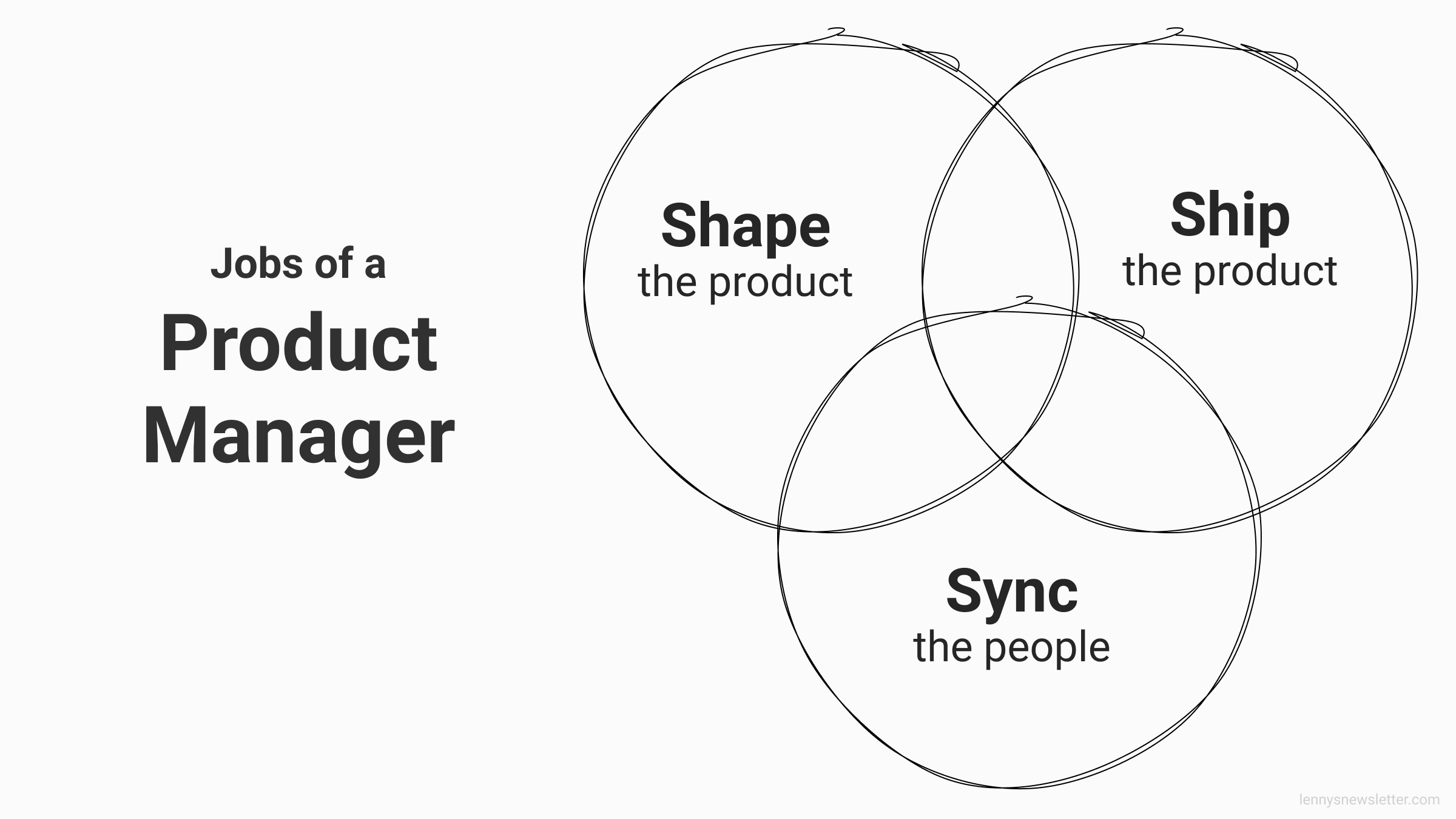
The jobs of a product manager:
- Shape the product: Harness insights from customers, stakeholders, and data to prioritize and build a product that will have optimal impact on the business
- Ship the product: Ship high-quality product on time and free of surprises
- Synchronize the people: Align all stakeholders aligned around one vision, strategy, goal, roadmap, and timeline to avoid wasted time and effort
From what I’ve seen, the evolution of the PM function at most companies goes like this:

If you don’t want to hire a PM yet, the question becomes whether you have the right combination of people to fill these roles. Specifically, are the people good at these jobs, and do they want to do these jobs? If so, great! If not, you’re better off hiring a full-time PM.

Signs you may need a full-time product manager
So how do you know if it’s time to hire your first product manager? I believe there are three signs:
- 🐌Frequent bottlenecks
- ⚔️ Frequent misalignment
- 💡 A burning need to go deep on a problem (post PMF)
Let’s look at real-world examples of each.
1. 🐌 Frequent bottlenecks
It may be time to hire a full-time PM if: You find that team members (usually engineering and design) are frequently unable to ship because of you.
“We should have hired a PM sooner at Product Hunt so that I (as CEO) was no longer a bottleneck.”
More of the same from Lyft and others:
2. ⚔️ Frequent misalignment
It may be time for a full-time PM if: You find that team members are frequently out of sync on priorities, timelines, or the problem you’re solving.
“At Microsoft, Product Management came when there was a realization that developers were writing and rewriting code because ideas had not been thought through and connected across the (even small) team.
The realization came came from a person hired from marketing who created PM for Excel. Prior to that, Bill’s old college roommate (who went on to be a leader in developer evangelism) tried to keep products consistent and aligned.”
Look for mistakes:
Conflict:
And general misalignment:
3. 💡 A burning need to go deep on a problem (post PMF)
It may be time to hire a full-time PM if: You’ve found PMF and you need to get ahead on a key initiative.
“Once we found some product/market fit, there was a lot of opportunitistic PM work like customer interviews, data exploration, new product/feature research.”
At both Twitter and Snapchat, monetization became a burning need and so they each hired their first PM to lead those efforts, for example at Twitter:
At Zimride, hiring their first PM gave the founders a chance to invent…Lyft:
But be careful of hiring a PM too late — or too early
As I was putting this post together and collecting stories, I got private messages from both sides of the spectrum — MANY companies who hired PMs too late, and also a few who hired them too early.
First, the case of too late:
And less common, too early:
“When do you go from PM Zero to PM One? Many of the founders I’ve worked with are surprised when my recommendation is often not yet. Usually I discourage them from hiring until they’ve found product/market fit. But even when you’re hitting your growth phase, the danger of having too many cooks in the kitchen exceeds the cost of being overworked. A starvation diet when it comes to PMs is preferable to being overstuffed.”
— Ken Norton (early PM at Google)
When successful companies hired their first PM
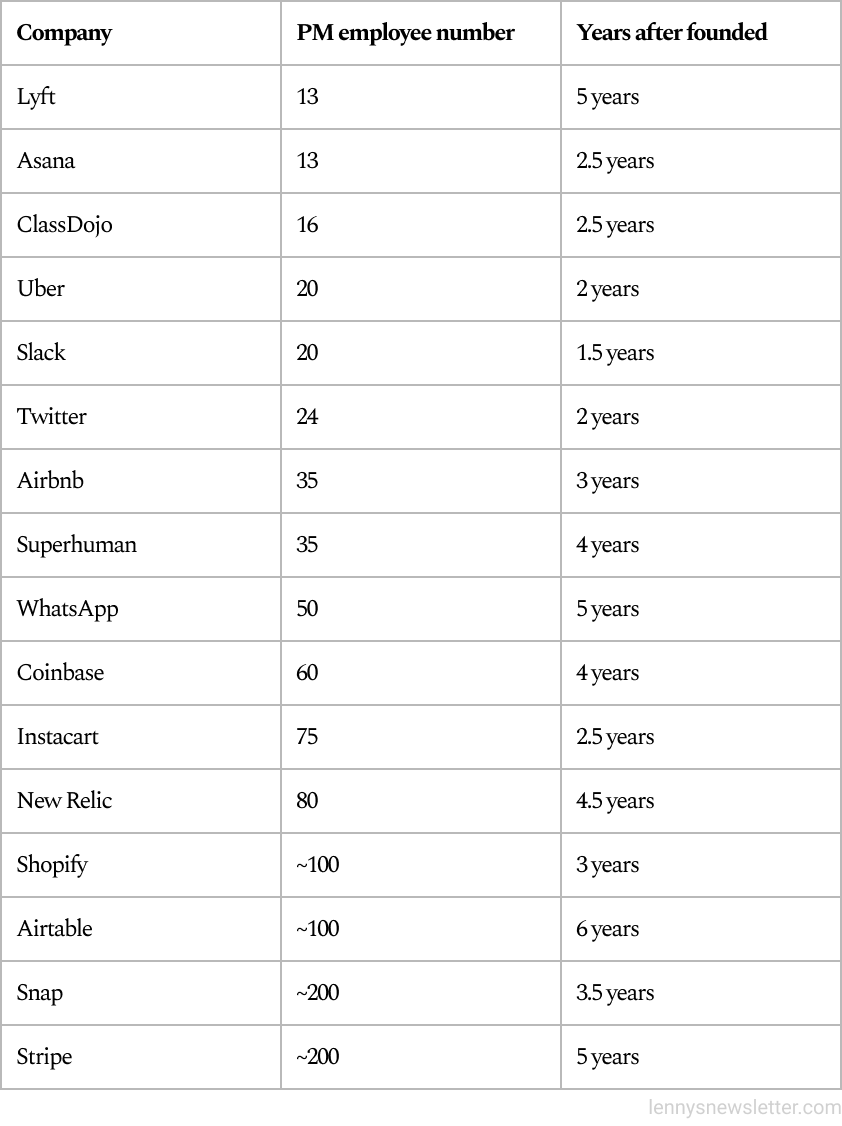
Below is a list of when some of today’s most successful companies hired their first PM. Based on this small sampling, the first PM is generally hired as the 15th - 100th employee, and 2 - 4 years after founding. Note, this doesn’t mean this is the optimal time to hire your first PM — just that that is when these companies chose to do so.
Three factors seem to contribute to waiting longer to hire your first full-time PM:
- Founders with deep product sense (e.g. Shopify)
- Building a product that isn’t primarily user-facing (e.g. Stripe)
- Long early beta period (e.g. Airtable)
BTW, if you have any other information, or if I got anything wrong, please tell me.
You can find many more examples of when companies hired their first PM in this Twitter thread.
What to look for in your first product manager
Three of my favorite reads about finding your first product manager:
- Product management conversion and training by Elad Gil
- Hiring your first Product Manager by Gokul Rajaram
- When and How to Make Your First Product Hire by Jonathan Golden
Tips for being successful as the first product manager
Finally, check out my previous post on how to be successful as a first product manager, and if you’re so inclined, how to get into product management.
“The amount of ambiguity facing a 1st time PM is tremendous. Often the founders/execs are still extremely hands on and aren’t comfortable sharing ownership. So there’s a lot of tension. Your job is to bring clarity and focus (i.e. decrease ambiguity) yet stay extremely flexible to changing things all over again every six months. PMs help get ambiguity under control in critical areas + let it exist in others.”
ー Ben Erez
That’s it for this week!
Thank you Helen Sims, Dennis Yang, and Dan Hockenmaier your feedback on this post, and to everyone else who contributed tweets, stats, or general feedback <3
🔥 Job opportunities
- Sponsored job of the week: ✨Senior Frontend Engineer at BodyBlock AI ✨
- Product: KUDO, Product Hunt
- Growth: Cerebral, Hipcamp, Instrumentl, Levels, Shef
- Design: Huddle, Pachama, Office Hours, Runway, Stytch, Watershed
- Engineering lead: Cerebral, Snackpass
- Frontend engineer: BodyBlock AI, Cascade, Levels, Runway, Transform
- Backend engineer: Sourcetable
- Fullstack engineer: Centered, Icebreaker, neo.tax, Runway, Shuffle, Snackpass
- iOS engineer: Pairplay, Vori
🧠 Inspiration for the week ahead
- Read: Your startup is a movement by David Sacks
- Watch: The Social Dilemma on Netflix
- Listen: Guy Raz on Tim Ferris — Traits of Successful Entrepreneurs, The Story of ‘How I Built This,’ Overcoming Anxiety and Depression, and More
These paid editions are intended for a single recipient, but occasional sharing is totally fine. If you would like to order multiple subscriptions for your team with a group discount (min 5) just reply to this email.
Sincerely,
Lenny 👋