Hello, I’m Lenny and welcome to a🔒 subscriber-only edition 🔒of my newsletter. Each week I tackle reader questions about product, growth, working with humans, and anything else that’s stressing you out at the office. Send me your questions and in return, I’ll humbly offer actionable real-talk advice 🤜🤛
Q: It'd be great if you can share some advice about increasing retention. Also, please some companies who are doing this very well.
If you read my previous post about what good retention looks like and came away thinking “On no, my retention is too low! What should I do?” – this post is for you.
Below I’ll share an exhaustive set of strategies to increasing your product’s retention, including dozens of examples from companies big and small. Here’s a preview:

Be warned though — significantly increasing retention is hard.

Why is that? Well, because people are busy and don’t want to spend more money. As Marc Andreesen once said, “people’s time is already fully allocated.” This is why most startups fail – they simply don’t end up creating something enough people want badly enough. And if they do happen to find something people sort-of-want, it’s difficult to make them want it significantly more. Nevertheless, this doesn’t mean you shouldn’t try. As Brian Balfour pointed out, “if you have poor retention, nothing else matters.” As you’ll see in the examples below, it is certainly possible to increase retention, and when you can pull it off it’s often the biggest lever you have to grow your business. For early-stage companies, it’s the single most important growth metric to get right.
So let’s dive in.
First, how does one measure retention?
The easy (but less useful) way to measure retention is by looking at the percentage of active users that are no longer-active a month/week/day later, e.g. “5% of our users churn each month.” Though useful, this approach blends old and new users, and thus hide a key piece of information about the health of your business: how many of your users stick around long-term.
Instead, I suggest looking at what’s called cohort retention: What percentage of new users are still active X months/weeks/days later? e.g. “30% of users are still active after 3 months.” This allows you to look at the long-term stickiness of your users, vs. just a snapshot of all users in time.
The best way to understand cohort retention is to make a chart like the one below (in this case weekly cohort retention). In this case, only 14% of users who joined the week of May 5th are still active ten weeks later. Not good.

With his one chart, you can quickly tell three important things about your business:
- Whether your retention is increasing or decreasing over time — just skim down any column and see if the numbers are trending up to down. In this example, retention is trending down 😭
- Whether something went very wrong, or very right, for a cohort — in this example, something good seems to have happened the week of May 19th, which is worth exploring (and repeating).
- Most importantly, whether your retention rate flattens — if it flattens, or stops decreasing over time, that means there is a group of users who continue to find value in your product. This is important because it happens to be the best measure of product-market fit.
To make it easier to look for this flattening, you can use a line chart of the same data, with a different line for each cohort (note, this is different data from above):

In this case, the curve flattens at about 10%, which means only 10% of your users stick around long-term. This is generally a bad retention rate. But at least it flattens. And if you look at the newer cohorts (the short blue line, and the purple line below it), retention seems to be increasing over time, which is great. Though for some reason, every cohort eventually drops to 10% around the 7-week mark — a mystery for another time.
If you use popular analytics tools like Amplitude, Mixpanel, Google Analytics, or Mode, this functionality is built-in and you can get these two charts for free. Otherwise, you can find some plug-and-play templates here, here, or here.
Now that you know your retention rate, I’m guessing it’s lower than you’d like. Let’s work on that.
How does one improve retention?
Coming at this question from first principles, what does it tell you when someone stops using your product? Well, it means that they no longer find enough value in your product. Your task is to change that.
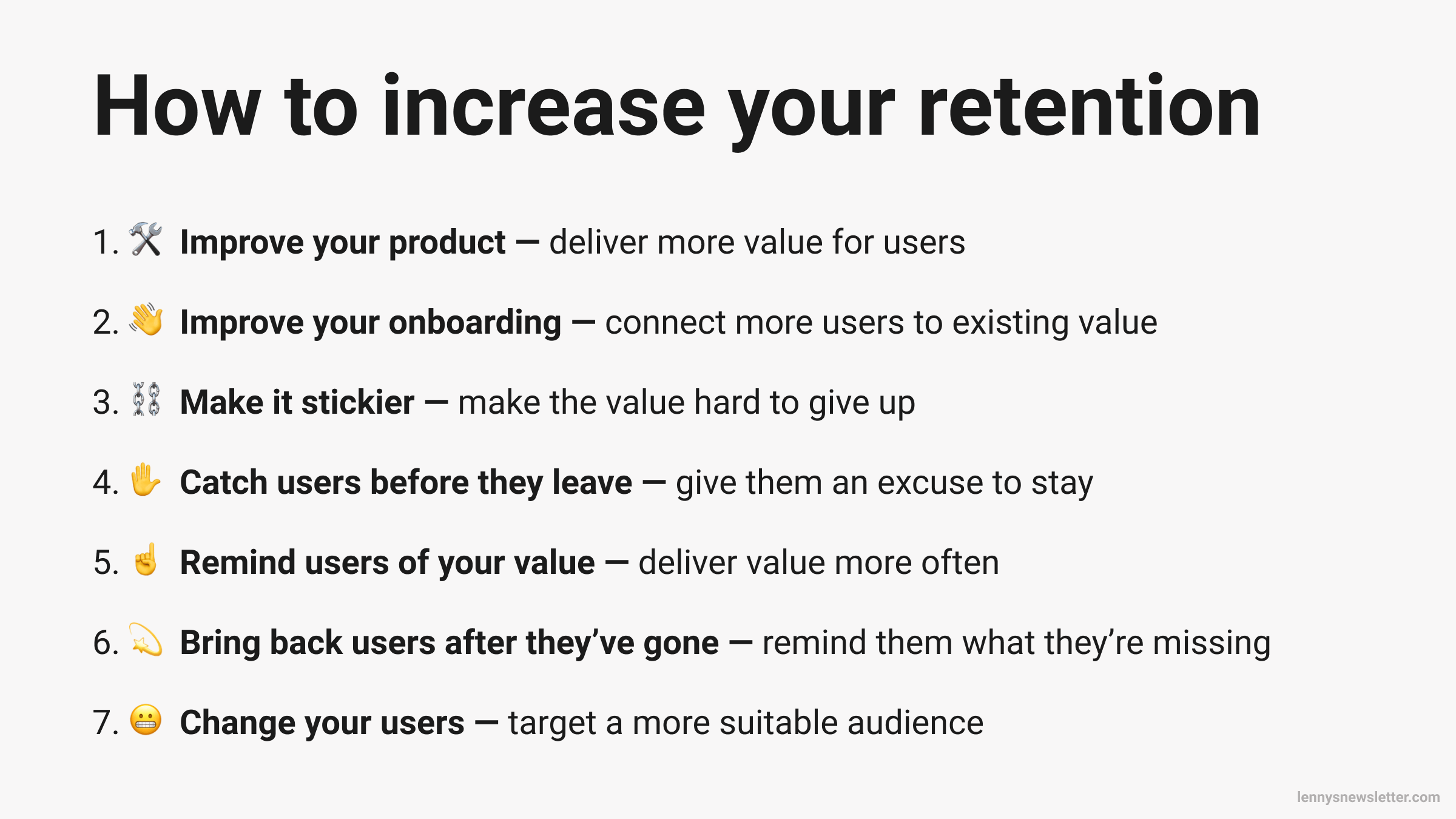
Here are the seven ways increase the rate of new users finding value in your product, and thus increase retention, ranked roughly in order of expected impact:
- 🛠 Improve your product — deliver more value for users
- 👋 Improve your onboarding — connect more users to existing value
- ⛓ Make it stickier — make the value hard to give up
- ✋ Catch users before they leave — give them an excuse to stay
- ☝️ Remind users of your value — deliver value more often
- 💫 Bring back users after they’ve gone — remind them what they’re missing
- 😬 Change your users — target a more suitable audience
Though not totally accurate, here’s a metaphor for what you’re trying to do:
Let get this party started and dig in.
1. 🛠 Improve your product
This is at the very heart of retention. If you’re just starting out, much of your time should be spent here. “Build something people want”, as they say. Here are a few ways you can increase the value you providing to your users:
1. Solve your customer’s problem significantly better
Obvious, but important. How might you solve your customer’s problems 10x better? What are your users trying to do that you can make 10x easier? What would a customer’s ideal solution look like? Work backward from that.
2. Solve more problems
How might you expand the breadth of the problem’s your solving for your customers? e.g. Uber launching many types of car services, Instacart adding Walmart, and Instagram adding Stories
3. Make your product cheaper
How might you increase the ROI of your product?
4. Make it faster and more reliable
How might you make the user experience act (or feel) significantly better?
5. Wait for network effects to kick-in
In businesses with network effects, like marketplaces (e.g. Airbnb) and social networks (e.g. Snapchat), the “product” becomes more valuable as more people use it. How might you bootstrap your network to get there more quickly for each user?
6. Wait for the world to change
Sometimes it’s better to be lucky than good.

7. Pivot to solving a different problem
And finally, you may be better off pivoting to a different solution (or problem) if you can’t budge retention enough.
But note:
“The standard advice of listening to long-term customers who are already retained, and adding features for them— that doesn’t work. But that’s where most product teams spend their time. In my experience, the real levers to improve retention dramatically are in the experience for new users.”
— Andrew Chen
With that, let’s explore the lever that usually ends up being the most effective: onboarding.
2. 👋Improve your onboarding
As Andrew points out above, and as I’ve myself experienced, you’re more likely to have an impact on retention when improving the new user experience, vs. improving the product. Why? Because, again, it’s very hard to invent (sustainable) new customer value — you’re lucky if you found one thing that people like. It’s much easier to get more people to experience the value you’ve already created.
Here are a handful of ways to improve onboarding:
1. Manually onboard new user
Superhuman is famous for their 1:1 onboarding strategy, but in reality, many companies (particularly B2B) start with a hands-on onboarding. Why? Because it’s a lot easier to get your message across person-to-person vs. through the product. Here’s an example from Airtable:
2. Make sure new users experience your value
How much work, and how long, does it take for new users to experience the value that you provide? What keeps these users motivated to keep going? How could you cut that time down and keep their motivation up, without sacrificing the experience?
“The first principle we learned at Pinterest is that we should get people to the core product as fast as possible — but not faster.”
— Casey Winters, former head of growth at Pinterest
Some examples:
3. Increase the odds new users have a great time
What are all of the ways that your users set themselves up for failure? How can you proactively help them avoid this?
“The users of your product don’t want to make choices, especially when they are in the first mile. The default options you provide, like which tab they land on and pre-populating fields with suggested selections, make all the difference in pulling new users through the first mile.”
A few examples:
4. Get more users through the flow
And finally, you can’t retain users if they don’t make it through your onboarding, so look for ways to reduce friction, reduce distractions, and increase motivation. For example, a ✨ can go a long way:
3. ⛓ Make it stickier
The next most common tactic to increasing retention is make your product hard to give up. Some approaches:
1. Build habits
Give users an extra nudge to revisit the value you’re creating. Long-term though this only works if you are creating real value for people.
2. Create incentives to come back
Amazon Prime and loyalty programs are also great examples of this lever in action because they give your customers an incentive to continue using your product over other options.
3. Sign annual plans
“One portfolio company spent years trying to improve churn. The most important lever was shifting 70% of new cohorts to annual.”
— Kyle Poyar, VP, Growth at OpenView
4. Deeper integration
The more integrated your product is into a person life, or an organization’s workflow, the harder it is quit. For example, Slack (just try taking it away), AWS (just imagine the switching costs), and WhatsApp (all your friends are there!).
No matter how sticky you make your product though, users will still leave. Next, let’s look at ways to catch them before they do.
4. ✋ Catch users before they leave
Though often done badly…
…it’s worth spending some time on your de-activation flow. Some users may not actually want to quit forever or have an issue that you can solve before they call it quits. Here are some of the more effective ways to keep your users from leaving.
1. Let users “pause” or “snooze” instead of cancel
One of the more successful experiments we ran at Airbnb to reduce host churn was to give hosts a way to “pause” their listing, instead of removing it. This gave them time to deal with whatever they needed to deal with and then easily come back when they were ready. Here’s another example of this with Hulu:

2. Give users an incentive to stay
Sometimes a short-term cash crunch is forcing a customer to leave, and a bit of leeway there keeps them as a customer.

3. Ask users why they’re leaving, and offer a solution
See if you can address the issue in-line.

4. Remind users of the value they’ll lose
There’s a reason your users decided to join — this is a good time to remind them of what they’ll miss. But, be thoughtful in how you approach this. It’s easy to go too far.

5. Predict churn and try to avoid it
And finally, the holy grail of retention – predicing and avoiding churn. I haven’t personally seen anyone successfully do this in practice, but it’s worth exploring if you can find some strong indicators of dissatisfaction.

5. ☝️ Remind users of your value
Even when you do provide great value to your users, they may not actually find or remember it. Look for ways to remind them. This can be over email/SMS, in-product, or an occasional call.
Some examples:
6. 💫 Bring back users after they’ve gone
Though rarely a huge lever, it’s worth thinking about ways to pull back users who at one point found your product interesting. You can do this with ad retargeting, calls, or email/SMS, for example:
7. 😬 Change your users
And lastly, an often-overlooked element of retention rate is the quality of the users you’re bringing in. These users can have little-to-no intent to purchase, or can simply be the wrong audience for your product. Shifting either one of these could have a profound impact on your retention rate metric.
For example, paid users (e.g. FB ads) are notoriously the lowest intent traffic. Cutting back on paid traffic will increase your retention. Obviously, this won’t automatically translate to a much healthier business BUT it will impact your economics and thus it’s important to look at.
Along the same lines, you may also find that your early target users/customers just don’t need your product badly enough. It happens. Instead of giving up, zero in on the users who do retain. What makes then different? What do they find valuable? How do you go find more of those types of users, and build for them? This story about Superhuman’s search for PMF is an excellent example of this in action.
In summary
I hope the list of seven strategies above gave you some new ideas to improve your own retention rate. Though this is not an easy road, it’s a trek worth taking. For reference, here’s a summary again of the tactics to explore:
Recommended reading
- Do You Have Product-Market Fit? It's All About Retention by Casey Winters
- Why Retention Is The Silent Killer by Brian Balfour
- What Is Good Retention: An Exhaustive Benchmark Study with Lenny Rachitsky by Casey Winters
- Retention is King by Jamie Quint
- Crafting The First Mile Of Product by Scott Belsky
- Why Onboarding is the Most Crucial Part of Your Growth Strategy by Casey Winters
- From conversion to retention: industry experts on improving your onboarding
If you’ve found other tactics to be effective in your product or business, I’d love to learn about them. Just leave a comment or reply to this email.
See you next week!
🔥 Job opportunities
- Product: KUDO, Uptime2020
- Growth: Cerebral, Hipcamp, Levels
- Design: Cascade, Invest Like The Best, Pachama, Runway, Sourcetable, Stytch
- Engineering leader: Cerebral, Snackpass
- Frontend engineer: Cascade, Levels, Runway, Transform
- Backend engineer: Sourcetable
- Fullstack engineer: Centered, Icebreaker, Invest Like The Best, Runway, Snackpass, Wren
- iOS engineer: Pairplay, Vori
- Sales/BD: Cerebral, KUDO, Swayable
- Ops: Levels
- Community: Outschool
- Content: Levels
- HR: Cerebral
🧠 Inspiration for the week
- Watch: Try not to smile
- Read: Anxiety Is the Dizziness of Freedom by Ted Chiang — One free chapter from his incredible book Exhalation
If you’re finding this newsletter valuable, consider sharing it with friends, or subscribing if you aren’t already.
Sincerely,
Lenny 👋