If you find this newsletter valuable, consider sharing it with friends, or subscribe if you haven’t already 👇
Q: I loved your post about how B2B companies found their early users, but how did they turn these early users into paying customers?
“Frederic (my co-founder) and I personally sold them. Really it was looking then in the eye and getting them to trust us that it would work and be valuable. It was hard. A real grind in the beginning.”
— Todd McKinnon, CEO and co-founder of Okta
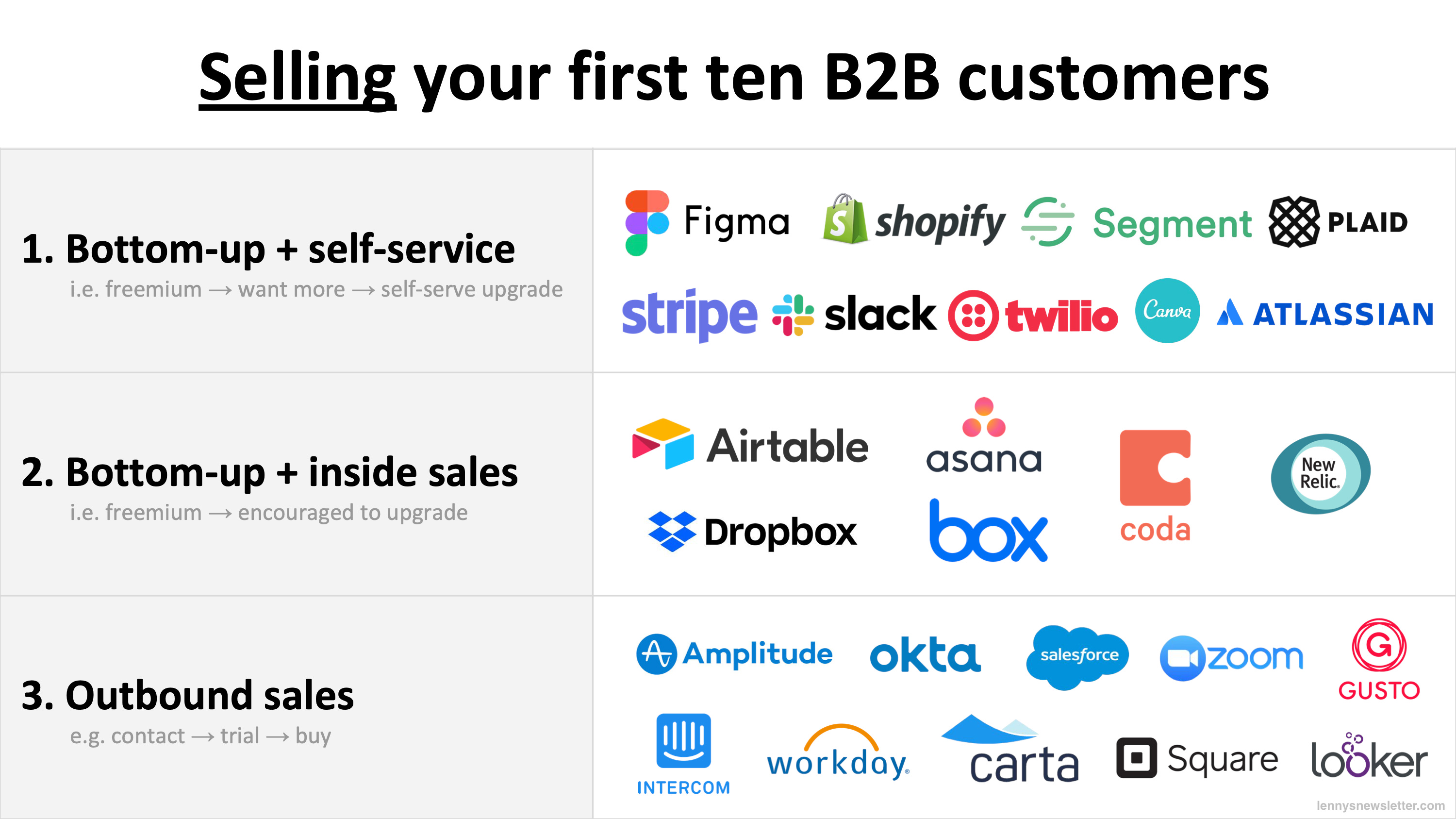
Once you’ve found your early users, how do you get them to pay? I’m dedicating this post to the strategies that today’s fastest-growing B2B businesses relied on to sell their first handful of customers. It turns out there are just three strategies early-on:
- Bottom-up + self-service: Users discover your product, sign up for a free plan, love it, and upgrade themselves in order to get more functionality.
- Bottom-up + inside sales: Users discover your product, sign up for a free plan, and then are either encouraged by a sales rep (or pro-actively reach out) to upgrade for more functionality.
- Outbound sales: Founders or early sales hires reach out to leads, help them trial the product, and then sign them up for a paid plan.
Here’s how the companies I looked at map to these three strategies:
My biggest surprises and takeaways:
- 100% of companies ended up building a sales team, including every bottom-up driven business
- Most companies kick-started growth with founder-led sales
- If you’re going bottom-up, you don’t need to launch with a paid plan. Seven of the twenty-five companies I looked at (including Segment, Figma, and Airtable) had no paid plans when they launched. They then worked with their power-users to figure out what the paid plans should be.
- You can adjust your sales strategy down the road — Zoom and Amplitude started sales-driven and later became bottom-up-driven. Box and New Relic did the reverse.
- Nearly company offered a free plan from the outset — usually a freemium tier, and occasionally a trial period.
- There are four options for charging B2B users: a flat monthly fee, a per-seat monthly fee, a usage-based fee, or a transaction fee. Most of the companies I looked at charge a monthly per-seat fee, and sometimes include multiple changes (per-seat + flat monthly fee, or usage-based + flat monthly fee).
- Sales-driven companies love blue logos
Let’s dive in!
1. Bottom-up + self-service
Segment
- Initial strategy: Bottom-up, self-service
- Eventual strategy: Bottom-up, alongside a sales team
- How they charge today: Monthly flat-fee plus usage-based fee
- Free tier: Freemium
“We initially launched with a free plan for the client-side only, then added pricing pages about a month later. We didn't actually build out a real self-service system and start charging users until something like nine months after launching. The first thing we were trying to do was nail product-market fit!
I think this helped us quite a bit. We first had to nail the onboarding experience and value users might get from the product before spending a bunch of time on building out the billing systems.
It also helped us when it came to understanding how to price the v1. We sent our users the Van Westendorp survey to get a good feel for what they thought was a fair price for Segment. It essentially gives you these 4 pricing curves, and you can plot out what makes sense for most of your users. This was the email we sent back in 2013...
In terms of getting early customers to pay, we worked with our enterprise customers to onboard them, but for the early users we made it all self-service. We sent out some sort of form or link to enter a card in Stripe, before turning it into a real self-service flow down the road.”
— Calvin French-Owen, CTO


Figma
- Initial strategy: Bottom-up, self-service
- Eventual strategy: Bottom-up, alongside a sales team
- How they charge today: Per-seat monthly subscription
- Free tier: Freemium
“We initially started without any paid plans. Our thinking was that it'll spread faster if we don't charge. Eventually though, not paying became the barrier for companies to adopt it, so we started charging.
Timeline wise, we launched a closed beta in December 2015, general availability in October 2016, and we didn't charge until 2017. At the end of 2016, we started hearing from customers "Hey, why aren't you charging, you idiots? I want to pay so that you don't go away." So then we launched our paid plan.
Going from free to paid was fully self-service. I'm sure we were on the phone with some key customers, but I don't remember that as a meaningful part of the conversion process.”
— Dylan Field, CEO

Slack
- Initial strategy: Bottom-up, self-service
- Eventual strategy: Bottom-up, alongside a sales team
- How they charge today: Per-seat monthly subscription
- Free tier: Freemium
“Slack launched a freemium plan from the start, including a self-serve paid plan. No sales to start, only self-service. They actually launched with roughly the same plans they have today, but with the Enterprise plan ‘coming soon’.
No inside sales at all, but relatively early on they did add some account execs to manage larger accounts, take invoicing, etc.”
— Fareed Mosavat, early growth PM

Shopify
- Initial strategy: Bottom-up, self-service with some founder-led sales
- Eventual strategy: Bottom-up, alongside a sales team
- How they charge today: Monthly flat-fee plus transaction fee
- Free tier: Trial
“Shopify was percent-of-sale only for the first year (3.75%!). Totally didn’t work. We switched it to the now common 3-plan monthly SaaS pricing in 2007 or 2008.
That saved the company.”
— Tobi Lütke, CEO

Stripe
- Early growth strategy: Bottom-up, self-service with some founder-led sales
- Eventual growth strategy: Bottom-up, alongside a sales team
- How they charge today: Transaction fee
- Free tier: None
“It very much spread through a word of mouth process. That was surprising to us because it’s a payment system not a social network so it’s not something you’d think would have any virality whatsoever. But it became clear that everything else was so bad and so painful to work with that people actually were selling this to their friends.”
— Patrick Collison, CEO (source)

Atlassian
- Initial strategy: Bottom-up, self-service with some founder-led sales
- Eventual strategy: Bottom-up, alongside a sales team
- How they charge today: Per-seat monthly subscription
- Free tier: Freemium
“JIRA was paid from the very start. The only free carveout initially was non-profits, academics, and open source. So that helped seed, but it had to be paid commercially (using license keys, since back then it was 100% on premisis).”
— Early user

Canva
- Initial strategy: Bottom-up, self-service
- Eventual strategy: Bottom-up, with an inside sales team
- How they charge today: Per-seat monthly subscription
- Free tier: Freemium

Twilio
- Initial strategy: Bottom-up, self-service
- Eventual strategy: Bottom-up, alongside a sales team
- How they charge today: Usage-based
- Free tier: Freemium

Plaid
- Initial strategy: Bottom-up, self-service with some founder-led sales
- Eventual strategy: Bottom-up, alongside a sales team
- How they charge today: Usage-based
- Free tier: Freemium

2. Bottom-up + support from inside sales
Dropbox
- Initial strategy: Bottom-up self-service, with some help from inside sales
- Eventual strategy: Bottom-up, alongside a sales team
- How they charge today: Per-seat monthly subscription
- Free tier: Freemium
“Our Dropbox for Teams coming out party started with a basic HTML landing page that was being hosted out of my Dropbox folder. It primarily highlighted our MVP features, like central billing, more storage, uncapped version control.
This was first put out in the wild using our very popular user forum, which was mostly comprised of our most vocal fans and evangelists. As you can imagine, awareness spread like wildfire after this.
All interested prospects had to chat with me because the early product had config challenges that hindered our ability to allow self-serve (i.e. you had to change your email address to a placeholder so I could manually invite you and all your teammates to a biz account... super hacky!)
Once we worked through the kinks and felt good enough to launch self-serve, that's when we launched a split test to throttle demand. The first 1k-ish customers either signed up through me or self-serve (routed to me if they had questions; we also had to create a B2B TOS).
The first 10 customers were all inbound and mostly SMB or business unit within a larger enterprise (i.e. one of our early customers was the core design team for Mint via Intuit). I believe our very first customer was Queen Mary University of London.”
— Cailen D'Sa, first business hire

Asana
- Initial strategy: Bottom-up, with inside sales converting early customers
- Eventual strategy: Bottom-up, alongside a sales team
- How they charge today: Per-seat monthly subscription
- Free tier: Freemium

“In the early days, we engaged in a lot of customer development. So, while we aimed to convert, at the same time we optimized to learn (and tweak) our purchase flow (e.g., where to place "sales" vs. where to push "self-service").
We first ran a beta of the premium product, where some friendly companies that gave early product feedback received X months of our premium product for free, but had a handshake agreement to officially convert at some later date.
When we officially launched the premium version, I managed all inbound interest.
Self-service was possible, and was probably 70/30 of the first few initial purchases.”
— Michael Spradlin, first sales hire
Airtable
- Initial strategy: Bottom-up, with inside sales converting early customers
- Eventual strategy: Bottom-up, alongside a sales team
- How they charge today: Per-seat monthly subscription
- Free tier: Freemium
“We always technically had paid plans and the ability to put in a credit card, but they were super buried and we didn't think anyone would find them. But folks literally hunted that very-hidden menu down because they wanted to support the product. We didn't build the ability to charge credit cards until we realized people had been putting them in.
At the same time, we did a lot of proactive outreach to early active users with the goal of making sure they were super successful and building our mental model of what use cases were both great fits for the product and also solved a truly urgent and valuable unmet need (we had hypotheses, but the joy of a horizontal product is that our users regularly did things we never expected and had way better ideas than we did).
Many of those long term relationships and deep engagements with those users naturally evolved to them asking when they should pay us.
Our first money was from a fire department that wanted to mail a check, at which point we set up invoicing.
From there, we evolved a sales motion.”
— Early employee

Box
- Initial strategy: Bottom-up, with inside sales converting early customers
- Eventual strategy: Sales-driven, land and expand
- How they charge today: Per-seat monthly subscription
- Free tier: Freemium
“Box had a dichotomous user footprint early on, consisting of both consumer & professional (eventually pivoted years later to B2B).
Similar to Dropbox, we mostly mined our early individual accounts to parse for business domains (i.e. johndoe@ford.com). We engaged with these folks to learn why they came to Box vs using IT-sanctioned tools like FTP. This was circa late 2007/early 2008, so most of the alternatives back then were online backup tools like carbonite, mozy and not focused on sharing/collaboration
The first 10+ customers mostly came from inbound efforts, but given our aggressive growth goals and interest in going up-market early, we spent most of our time going outbound.”
— Cailen D'Sa, early sales hire

New Relic
- Initial strategy: Bottom-up, with inside sales converting early customers
- Eventual strategy: Bottom-up, alongside a sales team
- How they charge today: Per-instance monthly subscription
- Free tier: Trial
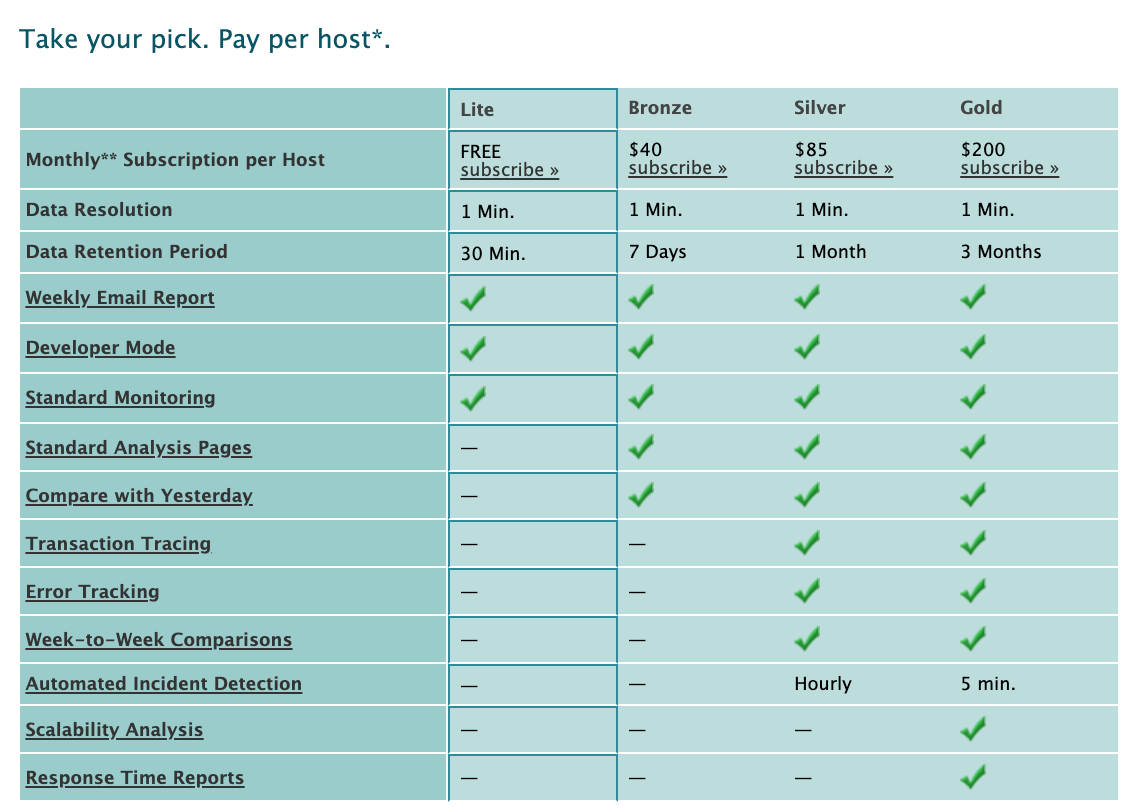
“New Relic has always had a free, feature-limited product along with paid tiers. In the early days the paid tiers were Bronze, Silver, and Gold versions, almost always closed by an inside sales (vs self service) that utilized volume discounting to incentivize deals. The main driver for upgrading to paid was access to a couple killer features, particularly Transaction Traces.
What set New Relic apart from many freemium SaaS businesses of the era was its early success at business development by offering an otherwise paid tier (Standard) as free when obtained through a partner, such as Heroku. It created a nice win-win between New Relic (who got more freemium leads to close) and the partner (who got to offer a thing of value to their customers).
Eventually, in a addition to having a large inside sales team, they added a classic enterprise field sales team, right around IPO.”
— Early user
Coda
- Initial strategy: Bottom-up, with inside sales converting early customers
- Eventual strategy: Bottom-up, alongside a sales team
- How they charge today: Per-seat monthly subscription
- Free tier: Freemium
“We launched Coda 1.0 in February 2019 as our first generally available release, but we kept the product free for all users. We worked on our monetization model as part of our Coda 2.0 release eight months later (”a new doc for teams”). Because of this, our first paid users had already been using the product for months for free. We started with our largest customers (which in some cases had grown to thousands of users) and worked through our monetization model with them in the same way we iterated on our product ー discussing ideas and incorporating feedback. Based on this, we landed on a model called “maker billing” (we only charge for doc makers, all editors and viewers are free), and thankfully all our top customers converted.”
— Shishir Mehrotra, CEO
3. Outbound sales
Zoom
- Initial strategy: Founder-led outbound sales (along with early VP of Sales hire)
- Eventual strategy: Bottom-up, alongside a sales team
- How they charge today: Monthly subscription
- Free tier: Freemium
“Our first deal was Stanford Continuing Studies Group, even before our solution was ready. That gave us huge confidence. At that time, we had no sales team, no marketing team, just the engineers.
To get the first one million ARR is very difficult because nobody knows you. We only had an engineering team. We did not have a marketing team. We did this on purpose. Before we reach one million, we did not want to create a marketing team. Only a sales team.
After our founding team we closed several deals, we hired a VP of Sales and he hired a bunch of the sales guys.
Again, our lead generation I think primarily coming from our organic leads. Our existing happy customers refer to other customers. A lot of freemium product also gives a lot of qualifying leads.”
— Eric Yuan, CEO (source)

Carta
- Initial strategy: Founder-led outbound sales
- Eventual strategy: Sales-driven, land and expand
- How they charge today: Monthly subscription
- Free tier: None
“When we launched eShares, we were not a SaaS business. We couldn’t get companies to pay us a subscription. Why would you? Your cap table doesn't change all the time.
What resonated initially is that we'd charge you per certificate issued. Every time you issue a preferred stock certificate, we'd charge you $20. Common shares were free. So we only got paid when they were doing around of financing or occasionally hiring an employee.
What we learned was that this was not a good business model. So we shifted to subscription. It was ton of work to move people to this model, we had over 2000 customers around that time. And we lost few in the process.”
— Joshua Merrill, ex-CPO

Amplitude
- Initial strategy: Founder-led outbound sales, alongside an early sales hire
- Eventual strategy: Bottom-up, alongside a sales team
- How they charge today: Monthly subscription
- Free tier: Freemium
“Christine Yang, Amplitude’s first sales person, was employee #3. We had sales and success people involved with customers from the very early stages. Philosophically, the founding team wanted users to be able to test out the product for free, and startups to use it for free, but Product Analytics was a new category and building an event analytics taxonomy correctly is an involved process which required guidance — even for teams switching off of Mixpanel. Having that early sales and success involvement was a huge driver of future adoption and retention in the product.”
— Tai Rattigan, ex-Head of Partnerships

Okta
- Initial strategy: Founder-led outbound sales
- Eventual strategy: Sales-driven, land and expand
- How they charge today: Per-seat monthly subscription
- Free tier: Freemium
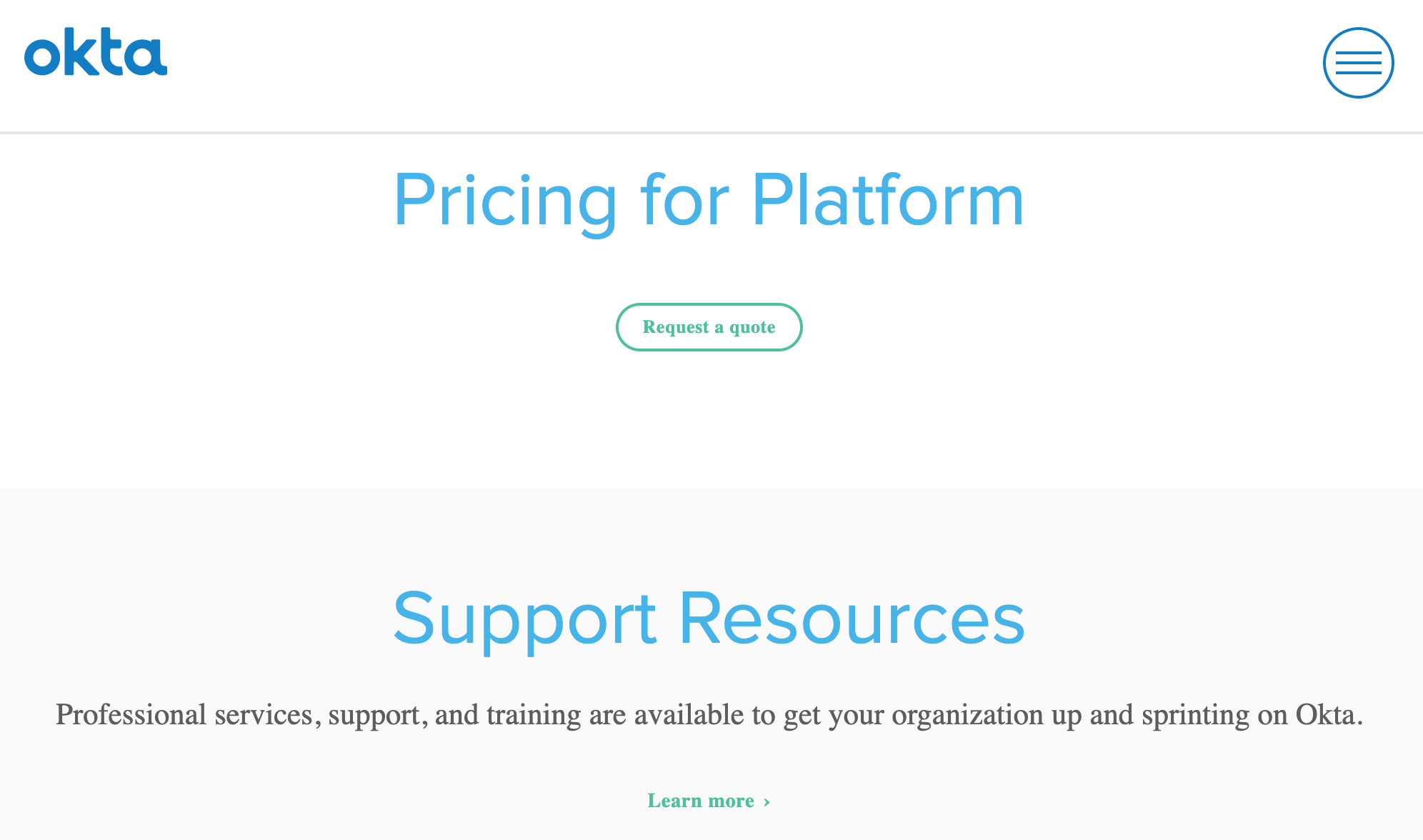
“Frederic Kerrest and I personally sold them. Really it was looking then in the eye and getting them to trust us that it would work and be valuable. It was hard. A real grind in the beginning.”
— Todd McKinnon, CEO
Intercom
- Initial strategy: Founder-led outbound sales
- Eventual strategy: Sales-driven, land and expand
- How they charge today: Monthly subscription
- Free tier: Freemium
“Every day I’d email people to tell them about Intercom, show them what Intercom might look like for them, and hear their feedback. I did this 100% by hand and if I was to do it all again today I’d still do it by hand. Honestly.”
— Des Traynor, CSO and co-founder (source)

Gusto
- Initial strategy: Founder-led outbound sales
- Eventual strategy: Sales-driven, land and expand
- How they charge today: Monthly base + per-seat monthly subscription
- Free tier: Trial
“Gusto's first 10 customers came from friends we knew who were just starting their businesses in CA. Mostly new tech startups from our YC batch, but also non-tech small businesses (like a children's swimming camp) that we happened to know through family and friends. We basically (three founders) went around telling everyone we knew that we're building a modern delightful payroll and HR system and asked if they'd know someone who'd be interested in trying it out.”
— Tomer London, CPO and co-founder

Square
- Initial strategy: Founder-led sales, alongside bottom-up
- Eventual strategy: Sales-driven alongside bottom-up self-service
- How they charge today: Transaction fee
- Free tier: None
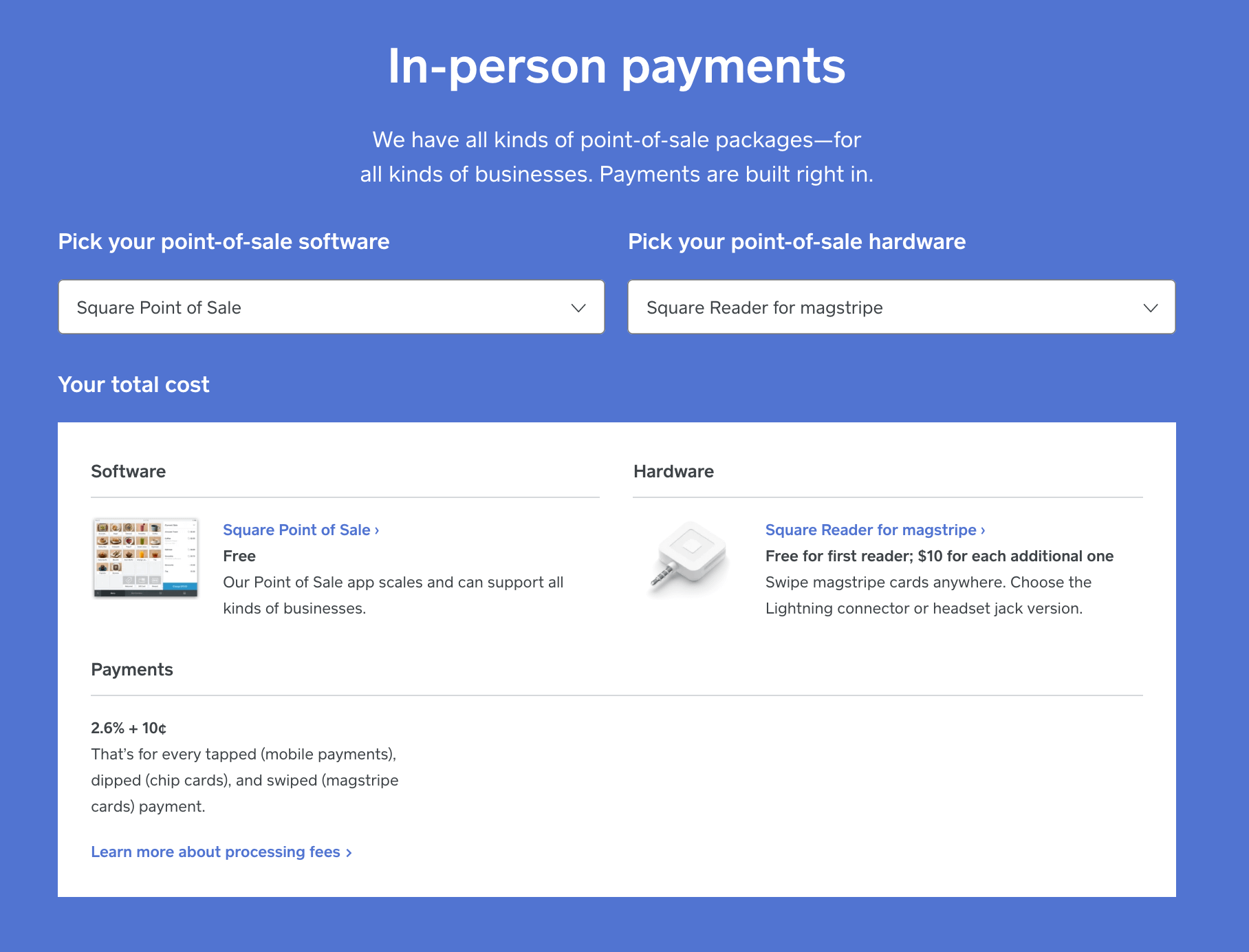
“Jack 100% tapped his personal network to get ‘Clubhouse’-type people on Square, but they didn't really create repeat usage or become real customers. Cheri Mims of Lillybelle Flowers and Sightglass Coffee were actual merchants we could walk to and speak with. They were our first real every-day-use customers. We could visit them multiple times per week to see what worked and what didn't, allowing us to refine the product. We continued to reach out to local businesses we patronized and convinced some of them to use Square when we were still quite young.”
— Cameron Walters, Square founding team
Looker
- Initial strategy: Founder-led outbound sales
- Eventual strategy: Sales-driven, land and expand
- How they charge today: Per-seat monthly subscription
- Free tier: Trial
“The initial customer strategy at Looker was not to maximize revenue, but maximize usage in customers that would give us the best early data to shape the product & the company. We also wanted to have some initial indicators of our pricing strategy — premium priced, user based annual subscriptions tested as well.
We removed as many factors as possible to optimize our conversion rate & usage (within some bounds of our pricing strategy). So we went with a low flat monthly price for unlimited users. This helped us see how analysts could build in Looker & successfully roll out the products across the entire organizations. We did that for the first 8-12 months before scaling our sales team & adjusting our pricing to closer to what it is today (per-e).”
— Keenan Rice, early employee and VP Strategic Alliances at Looker

Salesforce
- Initial strategy: Founder-led outbound sales, with the help of the entire team
- Eventual strategy: Sales-driven, land and expand
- How they charge today: Per-seat monthly subscription
- Free tier: Freemium
“That first [customer] came in the form of Blue Martini Software, one of the small software companies in which I had previously invested. I knew I was asking for a favor when I called the founder, Monte Zweben, but I also knew I was offering something that he really needed.
We did not have a formal sales organization at this time so in our quest for early customers, everyone on the salesforce.com team was encouraged to contact anyone he or she knew in any industry, or at any start-up. Diane Mark, our product manager, won our second client while she was standing in line at the local market, Mollie Stone’s. She ran into a former colleague who was working as a sales manager at iSyndicate, a company that sold syndicated content over the Web. She asked him what the company used to manage its sales process. “ACT! And Excel,” he replied. “It’s a mess.”
— Marc Benioff, CEO (source)

In summary
The three strategies to sell your first ten B2B customers:
- Bottom-up + self-service
- Bottom-up + inside sales
- Outbound sales
Key questions to ask yourself:
- Do I plan to grow bottom-up or through outbound sales?
- In either case, what’s the best way to kick-start growth — sales or bottom-up?
- Should I include a paid plan when I launch, or just launch, acquire free users, and figure it out later?
- Should I charge per-seat, for usage, per transaction, a monthly base fee, or some combination of the four?
- When (not if) should I make my first sales hire?
Further recommended reading
- Distribution by Ben Horowitz
- Building a Bottom-Up Sales Motion For The Enterprise with Darcy Doyle and Yasmin Razavi
- A Clinic on All Things Sales with Peter Kazanjy
- How David Sacks built the first bottom-up playbook for enterprise
- The Cadence: How to Operate a SaaS Startup
- Freemium vs Free Trial: Which is Better for SaaS Startups?
Thank you 🙏
Dan Hockenmaier, Cailen D’Sa, Calvin French-Owen, Cameron Walters, ChenLi Wang, Dylan Field, Fareed Mosavat, Frederic Kerrest, James Beshara, Joshua Merrill, Keenan Rice, Kenny Mendes, Lou Kosak, Madelin Woods, Merci Victoria Grace, Michael Spradlin, Mike Cannon-Brooks, Patrick Lightbody, Shishir Mehrotra, Tai Rattigan, Tobi Lütke, Tomer London, Vrushali Paunikar, Zach Perret
That’s it for this week! Hit me up if you have any stories, feedback, or insights to share. Otherwise, see you next week!
If you’re finding this newsletter valuable, consider sharing it with friends, or subscribing if you aren’t already.
Sincerely,
Lenny 👋