If you find this newsletter valuable, consider sharing it with friends
Q: How do you think about setting goals for your team (and company)?
As a leader, one of your most important jobs is to make sure everyone is moving in the same direction — channeling all of their energy, focus, and resources towards the same outcome.
That's exactly what goals are for.
Goals are a tool to help you align and motivate everyone on your team to successfully achieve a desired outcome. Below, I share a framework that I’ve used to set goals and institute them across an organization.
Why set goals?
Let’s start by thinking about where goals fit into the bigger picture:
Mission → Vision → Strategy → Goals → Roadmap
You start with your Mission (what are you trying to achieve), which informs your Vision (what does the world look like when you achieve it), which then leads to your Strategy (how you plan to get there).
What comes next? You need to find a way to tell whether you're successfully executing your Strategy (and thus your vision and mission). That's where goals come in.
Let's look at Tesla:
- Mission: Accelerate the world’s transition to sustainable energy
- Vision: Create the most compelling car company of the 21st century by driving the world's transition to electric vehicles
-
Strategy
-
Build a sports car
- Use that money to build an affordable car
- Use that money to build an even more affordable car
- While doing above, also provide zero-emission electric power generation options
How does Elon know whether Tesla is successfully executing this strategy? GOALS!
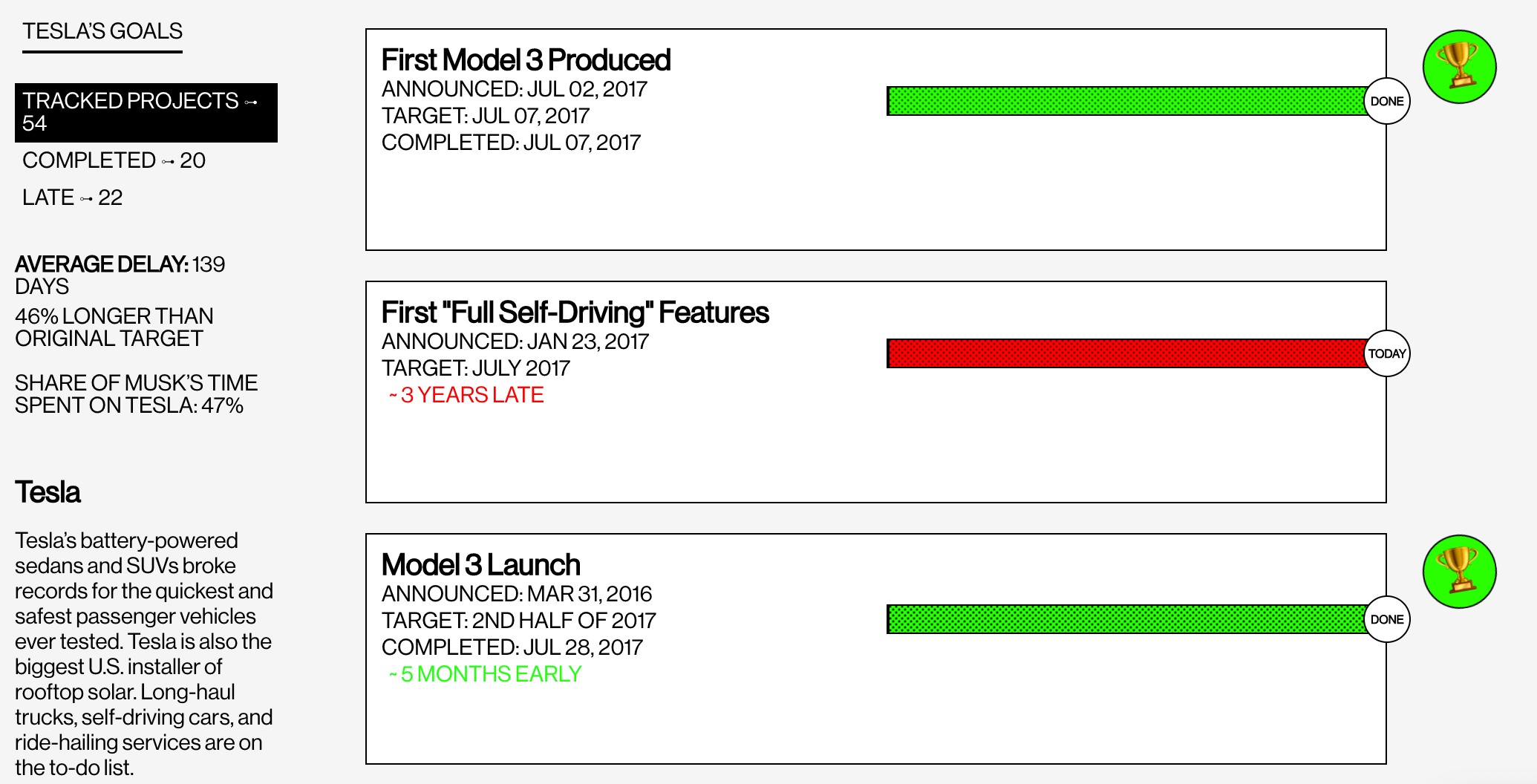
Goals have three primary benefits:
- Clarity: You know what success looks like
- Alignment: All team members know what success looks like
- Motivation: A push to achieve more than you would have otherwise
I want to highlight one of the biggest traps I see leaders fall into: assuming that everyone on their team is aligned on what success looks like. The metaphor I like to use for this (inspired by a former colleague) is a silver burrito. Like the ones you see on the Chipotle billboards:

That burrito looks delicious because we’re all picturing our favorite burrito inside the silver wrapping. Yum! Similarly, projects often look delicious to team members because they're each imagining different goals — goals that they are personally most excited about (e.g. increase conversion vs. make users happier vs. refactoring code). A product leader’s job is to unwrap the burrito and make sure everyone is seeing the same thing. Let’s talk about how to do that.
How to set goals
Now that we know a goal is just a way to understand whether you’re achieving your strategy, let’s talk about how to decide what the actual goal should be.
A good goal has the following attributes:
- Simple: Everyone understands what it is and how it’s measured
- Concrete: It’s obvious if you've achieved it
- Worthwhile: Making an impact actually matters to the business
- Stable: You’re confident your work won’t be drowned out by noise
- Quick feedback loop: Changes in the product can quickly be seen in the metric
With these attributes in mind, next let's focus on defining your goal, which includes two parts: (1) picking the metric, and (2) deciding much you want to move it.
1. Pick the metric
Start with your business’ north star metric —whether it’s revenue, subscriptions, or media consumed— and figure out what set of levers move that metric.
For example, at Airbnb our north star metric was nights booked. The levers that moved this metric were loosely broken up into demand, supply, and the dynamics between the two. One level deeper, on say demand, we looked at things like site visits, conversion, and cancellation rate.
This combination of levers is often referred to as a company’s growth model. When you do this right, all of the levers add up to 100% of what drives the business, and helps you understand where your biggest opportunities are. Essentially, it’s the math formula of the business.
With this collection of levers, figure out which of those levers present the largest constraint (or bottleneck) for your business. Ask yourself: what’s the one thing that, if moved, would unlock the most growth?
Finally, determine the best concrete metric to track that lever. For instance, at Airbnb, after we determined that homes (aka supply) was our primary constraint to growth, we built a team focused just on growing supply. Our metric was "New listings that received at least one booking."
2. Pick the threshold (aka the goal)
With your metric set, landing on the right threshold for that metric (aka your goal) requires a combination of tops-down and bottoms-up thinking.
- Tops-down: In order for your business to achieve the ideal level of growth required for long-term success, how much does this metric need to move?
- Bottoms-up: Knowing what you know today, what impact could your team realistically deliver with current resources (or, with some increase in resources)?
Your resulting number usually ends up being somewhere in the middle, and adjusted for resources you end getting.
I often get asked just how ambitious leaders should be when setting goals. I think about a goal like a video game. Video games are built to ensure that the next level is just hard enough to motivate you to continue, but not so hard that you give up. You want to win—even if it’s tough—and victory always seems just within reach. But when it feels impossible, you quickly give up.
So when setting a goal, just like in a video game, you want your goal to motivate your team to push beyond what's comfortable, but never make it feel impossible. Brian Chesky (CEO of Airbnb) liked to say that goals should feel “uncomfortable, but not impossible.”
While trying to lock down a metric and threshold, don’t get stuck if you just can’t find one. Instead, figure out as concretely as possible what success looks like, and go with that for now. What would be true in the world if you succeeded? What qualitative signals would you like to see? For instance, a goal for a product launch could be “launch a product by this date, with this many resources, with no more than this many bugs.”
How to use goals once you have them
You’ve done the hard work to set a concrete goal that’s aligned with your mission and vision. But now that you have a goal, what the heck do you do with it?
- Get buy-in: Make sure everyone on your team (as well as the folks above), buy into it.
- Instrument: Implement a tool that allows your team to easily watch this metric. Build a dashboard that’s accessible and easy to find. Triple-check the data is valid.
- Prioritize: Decide what to prioritize based on what will have the most impact on your goal. With alignment on what success looks like across the team, decisions that felt hard before should be much easier.
- Operationalize: Build this metric into your team workflows. Find a cadence of checking in on this metric individually with your team, and with management. Share progress on the goal frequently.
- Revisit: As you continue to monitor your metric (and how your work is impacting it), you might conclude that something just isn’t right. Give yourself an opportunity to revisit the goal. Consider whether it still meets the broader attributes and if your team actually has the ability to move it.
Now go unwrap that silver burrito and unlock your team’s collective energy.As a product leader, you’ll be rewarded with clarity, focus and a hungry team.
Inspiration for the week ahead 🧠
- Apply: If you recently left your job (voluntarily or not), and are thinking about starting something of your own, check out OnDeck, who just opened applications for their latest cohort. 100% of the people that I know who went through it (plus the people who run it) are pure awesome. Learn more here.
- Watch: UX Conversations — Rich discussions about user research between Noam Segal (Director of User Research at Wealthfront) and seasoned researchers from Slack, Facebook, Lyft, etc. Here’s one example:
- Watch: If you ever feel lazy, watch this immediately (via @mikeplewis)
That’s it for this week!
(This post was an evolution of a guest post I did on Mixpanel's blog a few months ago)
If you’re finding this newsletter valuable, consider sharing it with friends, or subscribing if you aren’t already.
Sincerely,
Lenny 👋