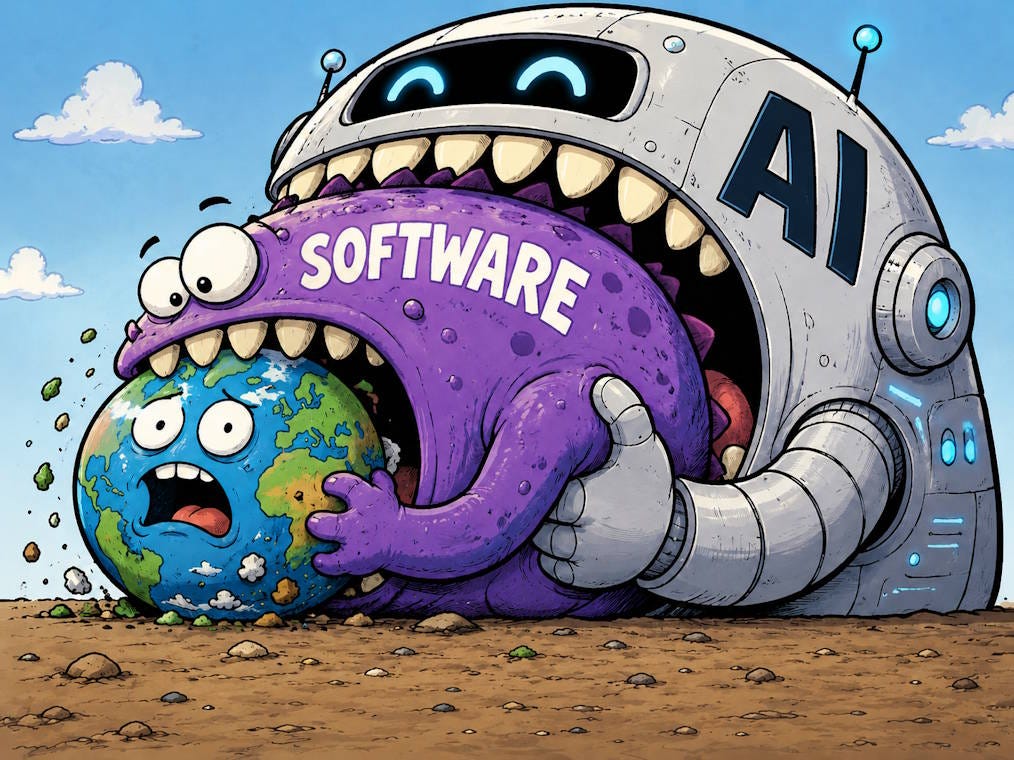
So, Anthropic is going to IPO! The company is valued at almost $1 trillion, so this is going to be one of the biggest IPOs in history — the only other competitor being SpaceX, which is also set to go public soon. It’ll be one of the largest wealth creation events in history — the company’s seven founders are each going to be worth almost $20 billion, and regular employees will be worth in the millions to tens of millions. So much for my chances of buying a house in San Francisco!
Whether Anthropic is worth this valuation is not the topic of this post, but I guess it’s interesting to touch on. Anthropic is showing more impressive revenue growth than any company in history, having recently blown past OpenAI to an annualized rate of about $45 billion per year. Worries that the company would be unprofitable have been blown away by this hypergrowth — Anthropic is about to turn its first operating profit.
In fact, I think the price being offered for Anthropic is pretty conservative. A multiple of 20x annualized revenue really isn’t that expensive for a company growing at 130% a quarter. Obviously that’s going to level out at some point soon, but it would take only a little over one more year of that sort of growth for Anthropic to be priced like a value stock. The cautious pricing probably reflects the danger of competition, both from OpenAI and from the cheap Chinese open-source models perpetually nipping at the leaders’ heels.
The reason for Anthropic’s meteoric rise, of course, is the success of coding agents. For years, OpenAI had struggled to find a market for its state-of-the-art chatbots; everyone was wowed by the technology, and everyone used it, but people couldn’t figure out how to get it to produce lots of economic value. Anthropic basically solved that problem by being the first to invent usable coding agents — AIs that write software on their own. Claude Code, Anthropic’s agentic software, gained a huge amount of brand value, even though OpenAI’s Codex product is competitive in terms of quality.
This was true product-market fit. AI had already proved that it worked in terms of the underlying technology — probably around 2024, when reasoning models cut down on the hallucination problem. Now it had found its killer app — the equivalent of e-commerce and search for the internet, or spreadsheets and word processing for computers. Suddenly, everyone in the world was “tokenmaxxing” — trying to use coding agents as much as humanly possible.1
I first encountered this trend at a dinner event on the economics of AI (I go to a lot of those dinners these days). An entrepreneur at the dinner breathlessly told me and a couple of other attendees that he ordered his employees to “spend their salary in tokens” — that is, to create so much code with Claude Code and Codex that it cost as much as their entire paycheck. I remember asking him: “What are they using all those tokens to create?” I don’t think I got a straight answer; I’m not sure he knew.
He wasn’t alone, though. Plenty of companies encouraged their employees to use AI coding agents as much as possible. Meta even briefly had a leaderboard for who could use the most tokens. One company reportedly spent half a billion dollars on Claude Code — equal to one percent of Claude’s annualized revenue!
Reading these reports, I just kept wondering: What are all these tokens actually producing? Just like with that guy at dinner, there never seemed to be a clear answer. Were Amazon and Meta and other software companies rolling out new features? Not that I’ve seen. A lot more apps are being submitted to the App Store, but I’ve only heard of one good one (Refine.ink). I’m sure there are more out there, but so far it’s nothing like the early days of the smartphone, where I was hearing about cool new apps every couple of weeks.
Maybe it was all on the back end? I’m not a software guy, so I don’t have a proper grasp of how hard it is to make a website like Instagram run, or optimize the cloud servers at AWS. Sites and apps aren’t loading faster or obviously more reliable. Was advertising getting better? Are click-through rates improving? Were companies fixing their long-standing problems, taking care of “tech debt” so they can avoid paying large costs in the future? Maybe!
I kept quiet about these questions, since it’s not really my area of expertise. But I saw a lot of other people — people who know a lot more than I do about software engineering — asking similar things. John Loeber wrote:
The stuff I’m hearing is just insane. People are spending hundreds of thousands of dollars a month on tokens? Guys, what are you shipping?…I am seeing people fully enraptured by illusions of productivity. They have swarms of agents coordinated by Byzantine Octopus harnesses. They’re munging thousands of tokens a second. They’re doing all this stuff, churning unfinished marginalia faster than ever before. Spinning their wheels and shipping absolutely jack shit for their customers…[W]e’re getting a lot of utility from AI for engineering at our company. I think we would really struggle to burn more than $5K per engineer per month.
Uber COO Andrew Macdonald said it wasn’t yet possible to draw a link between raw AI usage and useful products actually being shipped:
“That link is not there yet, right?” [Macdonald] said. “I think maybe implicitly there is more that is getting shipped, but it’s very hard to draw a line between one of those stats and, ‘Okay, now we’re actually producing 25% more useful consumer features.’”...He said that the trade-off costs from AI are harder to justify because he can’t draw a direct link.
Microsoft, meanwhile, began canceling Claude Code licenses. Salesforce started redesigning their employee targets to measure real output instead of AI input. And people who looked into the matter basically confirmed the suspicion that a lot of this AI coding wasn’t going into actual products being shipped:
For companies using advanced AI coding tools, only 18% of spending on tokens is translating into shipped coding products that reach real users, according to EntelligenceAI, a startup that aggregated data on more than 2,000 companies using advanced AI tools for coding.
Jellyfish, a company that tracks AI usage, found rapidly diminishing returns in terms of converting tokens to actual software.
You should absolutely NOT take this to mean that AI is a bubble, or that the tech doesn’t actually work, or that Anthropic’s IPO is overpriced, etc. A lot of this is perfectly normal. When a very capable new general-purpose technology bursts onto the scene — steam power, electricity, computing, the internet, etc. — a ton of people play around with it to see how it works and experiment with how they might be able to use it. That experimentation is healthy, and we shouldn’t expect it to last forever.
It’s also reasonable for companies to push their software engineers to try something radically new. Most professionals who have written code by hand all their lives will naturally be reluctant to switch over to letting a machine take the first crack at it. Rewarding AI usage for its own sake is silly in the long run — it’s just as subject to Goodhart’s Law as anything else, and it predictably resulted in people checking the weather with AI just to hit their targets. But in the short run, it could be good to shove stodgy old engineers out of their comfort zone.
But I also think there are two more interesting things that are potentially going on here:
Companies are finding out, once again, that turning task-level productivity into economic productivity is a lot harder than it looks. This has implications for the big “AI and jobs” debate, upon which the shape of our future society could hinge.
It’s very possible that the software industry as we know it is a mature industry, like steelmaking or internal combustion. If AI creates major improvements in software, it’s possible — even likely — that it’ll be in new types of software industries instead of just “better Facebook and Amazon”.
Tokenmaxxing versus bottlenecks
Chad Jones is probably the greatest theorist of growth economics in the business today. In his paper “AI and our Economic Future”, he explains that it’s actually really hard to grow the economy by automating existing tasks:
[T]he presence of weak links can limit the growth that emerges from artificial intelligence…[E]ven with infinite amounts of some input, overall production remains finite — again because we are limited by the weakest link…In this sense, it becomes clearer how automating many tasks might not lead to huge output gains: output is always constrained by the weakest links that are not yet automated.
To see a familiar example of this phenomenon, just look at your computer. You have on your desk roughly 100 million times the computing power that was available on the best computers from the early 1970s. But you and I are not 100 million times more productive…
[I]nfinitely automating a task that costs the economy a fraction of GDP given by s raises output by the factor 1/(1−s)…Spending on software accounts for around 2 percent of GDP…In other words, having access to infinite amounts of the tasks that software performs today would only raise GDP by around 2 percent. Why is the gain so small? Weak links.
The same logic that applies to a whole economy applies to a single company. Just as fully automating one sector of the economy doesn’t send growth to the moon, fully automating certain tasks within a company like Amazon or Microsoft — even big important ones like writing code — is not going to send the productivity of the whole corporation to the moon.
This is a cliche to people who work at these companies, but to people who don’t, it bears repeating: Producing software products is a lot more than just writing software, the way that producing cars is a lot more than just bending some metal. You have to decide what software you need to produce. You have to assess customer needs, understand the landscape of current technology, and plan to meet demand. You have to maintain the software, fix it when it breaks, and help people use it. And you have to sell it to the customers.
AI may someday be able to do much of that, but as of now you can’t just say “Hey Claude Code, make me a hit software product, make no mistakes”. There’s a lot of human work still involved, both by a software engineer and by coworkers in other roles less amenable to instant automation. Demirer et al. have a paper modeling how this works:
[W]e find that successive generations of AI coding tools produce increasingly large task-level productivity effects. Yet these gains attenuate sharply across the production hierarchy: sync agents lead to a 741% increase in lines of code and a 65% increase in pull requests, but releases rise by only 20%. We find similar increases in aggregate coding activity on GitHub…
Calibrating [our theoretical] model [of software production tasks] yields an elasticity of 0.25, pointing to strong complementarity between AI and human inputs along the production chain….[A]utomating one stage has bounded effects on final output…In software, the binding constraint appears to be shifting from writing code to reviewing, integrating, and ultimately distributing it.
They look at the releases of various AI coding tools and find that while AI agents are much better than older tools, and write code more than 17 times as fast as humans alone, this translates into a 1.3x increase in actual releases:
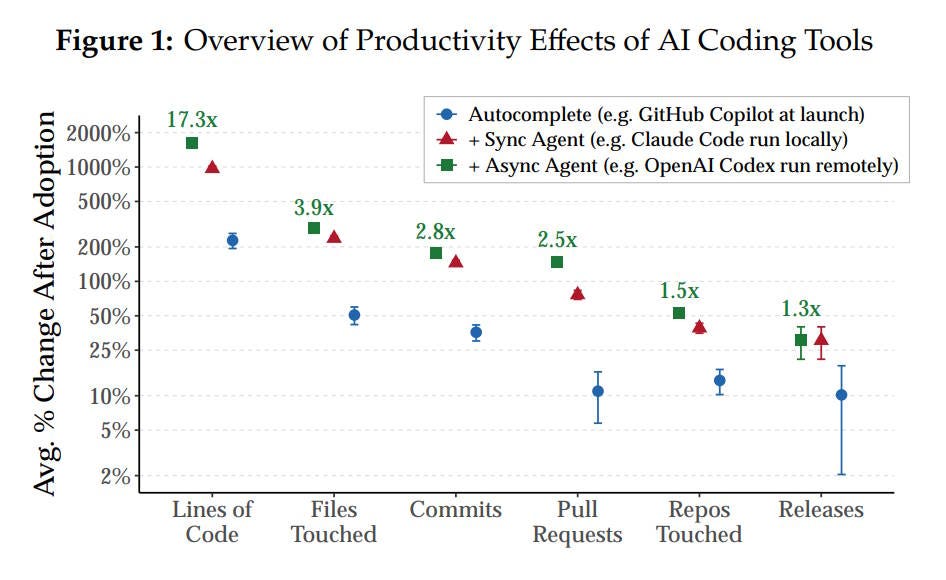
This is very important for the “AI and jobs” question. If AI automates 999 out of 1000 tasks, but humans still need to do the final task, that task will become very valuable. That final task — which might be something like “keeping the AI on task”, “providing a human touch”, or whatever — will capture a lot of the value of the entire hyper-automated AI production chain.
What if everyone tokenmaxxes?
There’s also another factor that Demirer et al. don’t even consider: market structure and competition. The economic productivity of a company isn’t measured in lines of code — it’s measured in dollars.
Every piece of evidence we have says that AI tools compress the skill distribution between humans — the best get a little better, the worst get a lot better. Traditionally, the top software companies — Google, Meta, Amazon, and the rest — could to some degree monopolize the limited supply of elite human coding talent. But with the coming of AI agents, upstarts with B-tier human engineers might be able to compete with the big boys. Which will put downward pressure on software’s famously high margins.
Increased competition and commoditization means that even a 1.3x increase in software releases — or even a 10x increase, once AI tools improve — might not translate into a big increase in revenue for those companies. That may be a big reason why the stocks of companies whose main product is software have not done very well in the AI era.
Commoditization of software due to a more level playing field would be bad for the employees and owners of those companies, but would at least make products cheaper for consumers, and it might even make the economy more efficient by removing a source of monopoly power. And it might limit the amount of money that software companies are able to pay companies like Anthropic for coding tools.
Software is dead, long live software
But there’s one more reason why tokenmaxxing might be producing disappointing results: The world may already have most of the traditional software that it needs.
It’s hard to remember right now, with the AI boom in full swing, but in 2022 we actually had a huge tech bust. Tech stocks crashed — some temporarily, some more permanently — and there was a huge wave of layoffs throughout the entire industry. The whole culture of Silicon Valley changed — the idea that anyone could get a nice easy high-paying job at Google just vanished overnight, replaced by the job anxiety that defines much of the rest of corporate America.
The standard story of that bust is that it was caused by higher interest rates, which punctured the expectations of permanently cheap capital that had taken root during Covid. I agree that this was the immediate cause, but in 2024 I speculated that we might also simply be seeing the end of a technological era — the buildout of the internet.
The physical buildout of the internet is mostly complete — except for Sub-Saharan Africa (which has little money to spend), most people around the world are internet users now:
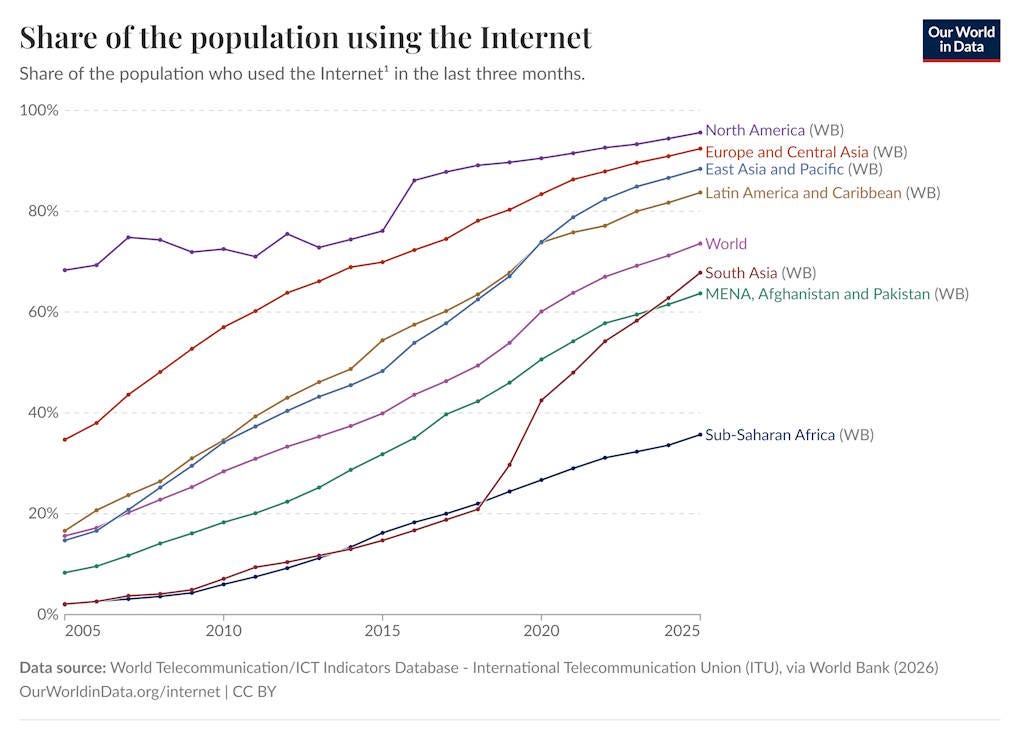
But the internet didn’t just saturate our world; it saturated our time. There are a fixed number of hours in a day — it’s a unique, finite resource. For a long time, we kept spending more and more of those hours online. But this trend appears to have peaked during the pandemic, and may now be going into reverse.
Once our lives moved totally online, there was no more attention left for software companies to grab. Our total time spent shopping on Amazon, scrolling on Instagram and TikTok, talking on Discord, and searching on Google was basically capped. That meant that if any other software products wanted to vie for our time, they could only do so by displacing the incumbents 1-for-1. You can increase the quality of consumer software, but that’s a much slower, more arduous process; Can you even imagine something more fun than reading a good econ blog article on Substack? I can’t!
You’ll notice that the software companies formed after Facebook — with the exception of ByteDance/TikTok — are just not that impressive. Uber and Airbnb are neat, but pretty prosaic and not exactly world-changing. Figma and Notion are cool productivity tools, but they aren’t going to change the game as much as the invention of the digital spreadsheet and the word processor. As for crypto…well, the less said about that, the better.
Timothy B. Lee, who has been blogging about AI for a very long time, wrote an interesting post about this a few years ago. He was talking about AI and unemployment, but the post ended up being more about software’s plateauing impact on our lives:

Some excerpts:
Computers and the Internet had already revolutionized a bunch of information-oriented businesses [by 2011]: books, movies, music, photography, telecommunications, and so forth. Software also played a major supporting role in more tangible industries. New cars had…computer chips in them…and the oil and gas industry made heavy use of software…[Marc] Andreessen, co-founder of the venture capital firm Andreessen Horowitz, argued that the software revolution was only getting started…
Andreessen’s essay reflected a persistent blind spot in Silicon Valley thinking: a tendency to overestimate the power of information technology and underestimate the complexity of the physical world…Airbnb has only a modest share of the overall lodging industry. And in recent years, the quality of Uber’s service has deteriorated, with higher fees and longer wait times…
In his 2011 essay, Andreessen specifically mentions health care and education as industries ripe for disruption by software. But as far as I can see that hasn’t happened…[P]eople largely go to the same schools and hospitals they did 10 or 20 years ago.
To be honest, after four decades spent continuously marveling at the next amazing thing I could do with a computer, I’m kind of softwared out. I don’t want to spend more time scrolling feeds of short videos. I don’t need to hear what someone in Pakistan thinks about Donald Trump. I want to touch grass, in the literal sense. LLMs were kind of the last magical thing that software did for me — an unprecedented miracle that redefined our whole notion of intelligence and required the resources of much of the globe’s tech talent to create — and I probably spend 30 minutes a day talking to GPT and Claude. It’s cool and it’s useful, but only marginally cooler and more useful than surfing the old Web or YouTube.
If consumer software — the kind of thing that Meta, ByteDance, and the traditional pieces of Amazon and Google sell — is basically maxed out, then that puts a pretty hard cap on the economic value of the Claude Code tokens that software engineers use to create and maintain that software. Sure, you can make the back-end run a little more smoothly, eliminate some tech debt, improve ad targeting a bit, but that’s hardly the stuff of 5% annual GDP growth.
But I’m not the kind of person to say “software is dead”. Even if one category of software — the category that most of our big existing legacy companies, and Claude Code’s biggest customers, specialize in making — is mostly maxed out, there are still plenty of other things we could do with software that no one is really doing right now because they were too hard.
One, which Lee discusses at length in his post, is robotics. Yes, I know, robotics is already a big industry. But if we can solve the problem of robot dexterity, it could unlock enormous applications for robotics; the physical world would basically come alive, get up, and start walking around.
Making good robots will take a lot of software, and a lot of AI tokens. I don’t know if the AI that eventually “solves” robotics is going to be an LLM like Claude or GPT, or a world model like the ones a bunch of high-powered startups are now trying to build, or something else. But software to govern the physical world through robotics would be an enormous growth industry.
The other one is business software. B2B SaaS is a big business, of course, but its impact on productivity is probably pretty marginal; in the way our businesses are all set up, everything still has to go through human bottlenecks. It’s not clear whether AI will ever replace all of the tasks in a corporation — whether Jeff Bezos will ever be able to say “Hey Claude Code, run Amazon for me, make no mistakes!”. But it’s a pretty daunting last-mile problem.
A number of people are starting to write about this. And they all come back to a basic pattern in economics: General purpose technologies require whole new business models in order to exploit their full potential.
The classic example of this is electricity. I wrote about this back in 2021:
[W]hen new technologies appear, you can’t always just swap them out for existing ones — you often have to entirely reorganize your systems of production around the new technology…
Most of the key electrical inventions (light bulbs, generators, AC, etc.) happened in the 19th century…But U.S. productivity growth…accelerated only during the 1920s….[F]actories were very slow to adopt electricity, and industries that electrified early didn’t see big productivity gains til the 1920s.
What happened? In a pair of famous papers in 1989 and 1990, economist Paul David offered an explanation (summarized here by Tim Harford). Basically, at that time, factories used centralized steam power, which was transmitted throughout the factory by a bunch of giant machinery. Simply swapping out a big electric motor for a big steam motor got you a small boost, but not much; it generally wasn’t worth the cost, so if you did this, your productivity would usually go down rather than up.
It was only once factory owners started building entirely new types of factories that they were able to realize the true gains from electricity. Basically, you could put a little motor at each workstation and power it through electric transmission lines. This meant that instead of having to keep a huge machine constantly turning, you could run each little machine only when you needed to. Not only did that save a ton of energy and make factories much nicer and safer places, it allowed workers to do things when they needed to be done instead of adjusting their workflow to the rhythm of a giant machine. That allowed all sorts of flexible production lines that you just couldn’t make with steam power. And productivity followed.
There are many other examples. David Oks has a good post about how information technology didn’t displace bank tellers by automating their more routine functions with an ATM; it displaced bank tellers by letting people bank on their phones, which reduced the demand for bank branches:
Oks talks about this pattern in the context of job destruction, but it applies just as much to value creation.
Azeem Azhar and Nathan Warren argue that if companies want to stop uselessly tokenmaxxing and instead extract massive value from AI agents, they’re going to need to invent AI-first business models:

They write:
[I]ndividual workers are getting faster and more productive. But for now, those individual gains from AI do not compound into firm-level ROI…Most of the AI products we see today are all about individual productivity…[T]he unit of work is still the task that the individual has to hand…AI agents are better than chatbots. They can handle whole workflows rather than single tasks. But…they are attached to the existing organizational geometry. In the case of electricity, this was the shop floor layout. For AI, it’s the web of processes designed by the companies well before anyone knew what an LLM was.
Azhar and Warren believe that the equivalent of rebuilding factories around electricity — or rebuilding banking around smartphones — will be rebuilding organizations around AI from the ground up. If AIs can just talk to AIs, without having to talk to humans in the loop, it could unlock all sorts of incredible productivity improvements, simply because everything would go so fast.
That’s a lot easier said than done, of course. If we ever do reach the “AGI” that can replace every human in a corporation in a push-button manner, new business models won’t matter; the AI will just invent them. But until we reach that point, it’s a nontrivial task to think of business models that could be fully automated even with an AI that can’t yet do everything. That’s going to be hard! If I had any good ideas for how to do that, I’d go become a billionaire myself.
At some point, though — maybe in the very near future — people (assisted by AI) will come up with those revolutionary new business models. At that point, tokenmaxxing will suddenly become a lot more economical, and Anthropic — or whoever has good coding agents by that time — will stand to make untold amounts of money.
A token is the unit of output for an AI coding agent, and for LLMs in general.