There is a pernicious and persistent pattern among many partisan pundits and politicians, pertaining to public debt. When their own party is in power, they minimize or ignore the problem, but as soon as the other guys win the presidency, they start shouting that the debtpocalypse is upon us.
Do I follow this pattern? Maybe a little bit. As recently as 2022, in Biden’s second year as President, I was not very worried about U.S. government debt. My reasoning was that A) interest rates were going to go back down after the surge in inflation had ebbed, preventing borrowing costs from getting severe, and B) Biden-era inflation had eroded some of the government’s debt burden.
But I still warned that there was some limit to government borrowing — eventually, at some difficult-to-predict point in time, too much debt would cause first interest rates and then inflation to soar. And I warned against listening to “fiscal arsonists” like the MMT folks, who aggressively advocated for higher government deficits.
And by 2023 — still under Biden! — I was starting to worry a lot more. Interest rates weren’t coming down much, making austerity more necessary — except no one, including Democrats, was talking about austerity. And by 2024 — still under Biden! — I was warning that there was no good reason for all the deficit spending we were still doing, and that continuing on our current path would run the risk of spiraling inflation:
So I definitely didn’t wait until Trump came to power to start worrying about the debt. But I do admit that under Trump, my worries have intensified. The Democrats listen to intellectuals — although the party has become more dominated by progressives who tend to worry less about government debt, there was always the possibility that concerted shouting by pundits like myself could shift the consensus among left-leaning think-tankers and staffers, who could then pivot the Dems back to the fiscal austerity of the Bill Clinton years.
Republicans — especially Trump and his movement — are a different beast entirely. They stopped listening to egghead intellectuals a long time ago, and even the finance-industry and right-wing think-tank types who have some residual impulse toward fiscal hawkishness have steadily lost influence as MAGA heads toward full cult-of-personality status. The only person in the Trump orbit who even talked about fiscal hawkery was Elon Musk, but this glimmer of hope1 faded when DOGE utterly failed to reduce government spending:
So when Trump returned to the presidency and DOGE flamed out, my mounting alarm turned to full-blown panic:
Anyway, it’s a year later, and I’m still panicking. Trump has been about as bad on deficit spending as Biden was (which is actually less bad than I expected him to be!), but a rise in long-term interest rates is making the debt less sustainable, and Trump seems uninclined to do anything about it. Nor do I expect rate cuts or AI-fueled growth to ride to the rescue here. As for Democrats, they’re playing with fiscal fire by proposing tax cuts for the upper middle class.
As I see it, the only hope here is to start scaring people. Bipartisan fear of deficits back in the late 1980s and early 1990s — probably spurred by high interest payments — forced every contender in the 1992 election to promise their own version of austerity. If we can raise the alarm now, there’s the possibility that both parties might be pushed toward fighting the debtpocalypse for populist reasons.
Government interest costs are exploding, and we’re borrowing more to pay the interest
A lot of economists will tell you that the government isn’t like a household, so you can’t think about government debt the way you think about your own mortgage or credit card debt. That’s very true. But there are still some similarities between governments and households, and one of them is that both have to pay interest on their debt every month. Debt, after all, is simply a promise to pay back a certain amount of money at a certain time, and monthly interest payments are part of that.
Government debt is a bit like a floating-rate loan. Yes, Treasury bonds and bills have fixed interest rates, but they’ve got to be rolled over when they mature. The average maturity of U.S. debt is a little less than 6 years. Interest rates started going up in early 2022, so we’re starting to see a big increase in monthly interest payments:
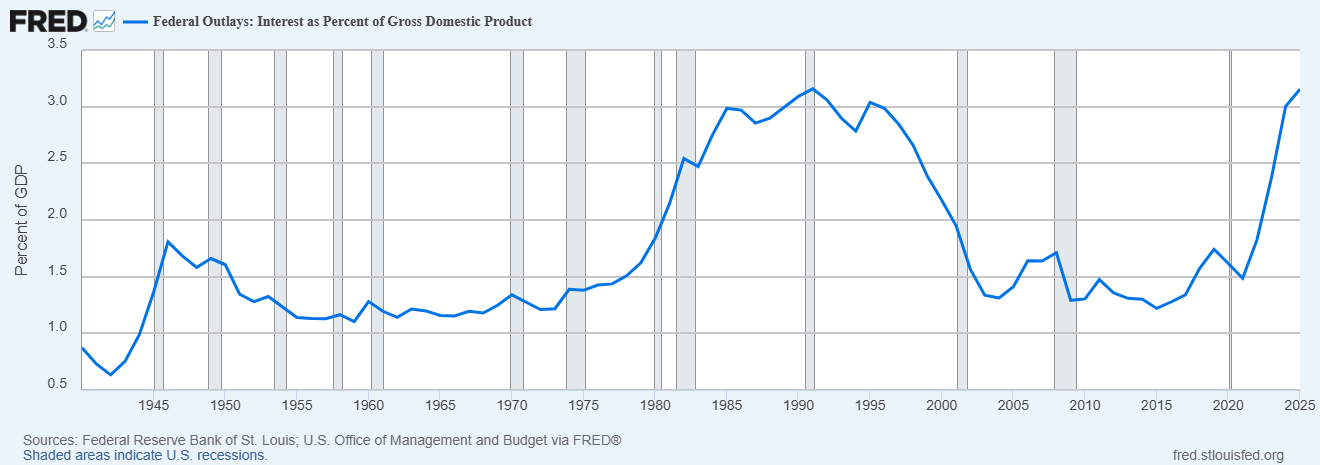
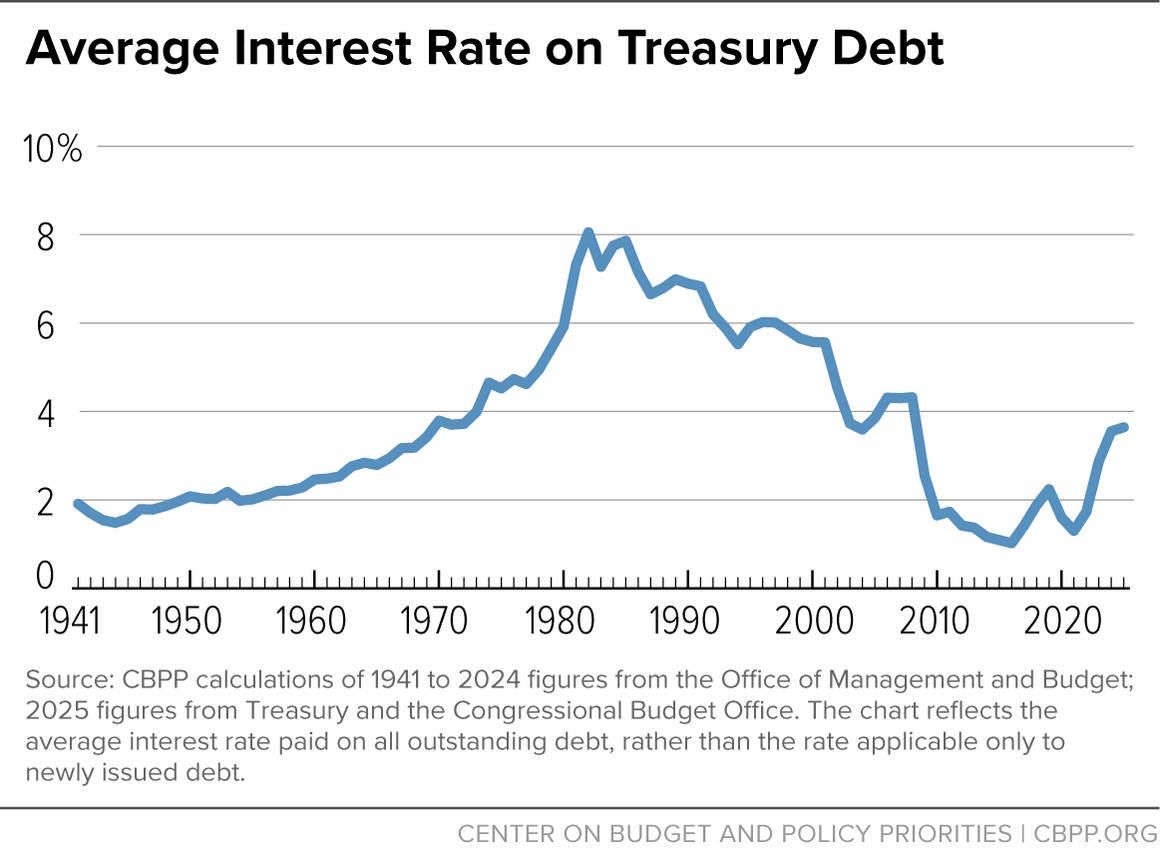
Everybody talks about how the U.S. had such high debt after World War 2, but the thing about that debt is that it was borrowed at very cheap rates — about 1.5-2%. That’s why interest costs stayed so low after the war. In the late 1980s and early 1990s, interest costs were high because interest rates were high, even though we didn’t have nearly as much total debt relative to our GDP.
As of 2026, we’re in double trouble. Our national debt is back up above 100% of GDP — similar to what it was right after WW2 (and much higher than in 1990). But now the interest rates our government has to pay on its debt are almost twice as high as they were after WW2:
High interest payments force the government to do one of two things:
fiscal austerity (spending cuts and tax hikes), or
borrow more to cover the interest payments.
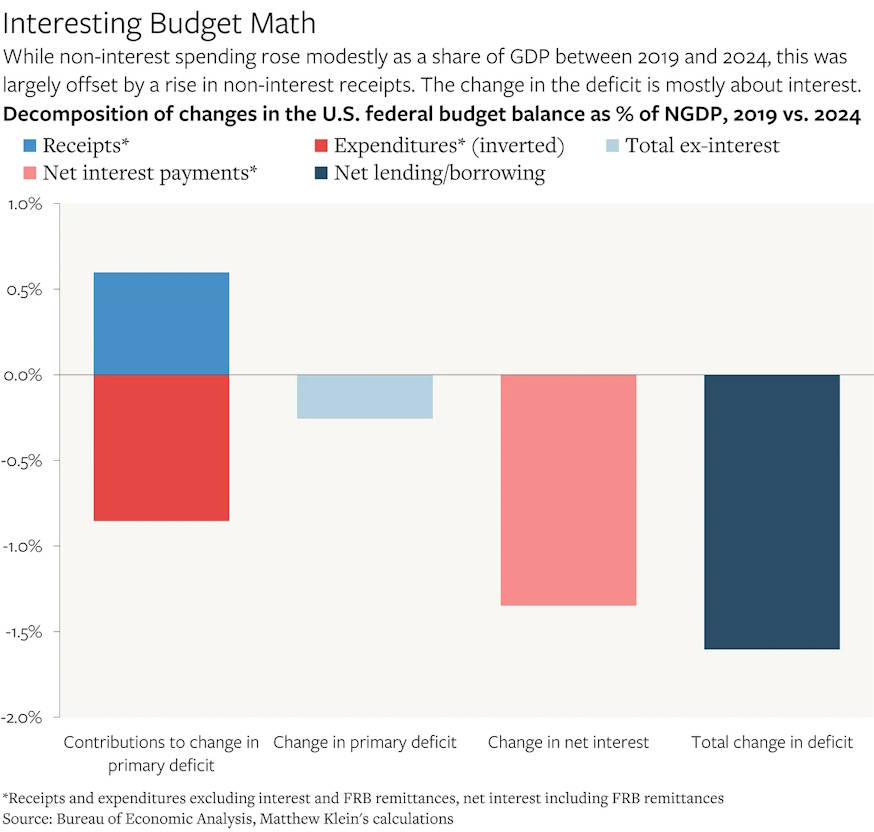
Right now, what we’re doing is (2). Almost all of the increase in the budget deficit from before the pandemic is due to higher interest costs:
Trump, as it turns out, has kept the annual budget deficit at about the same size it was during Biden’s term, relative to GDP:
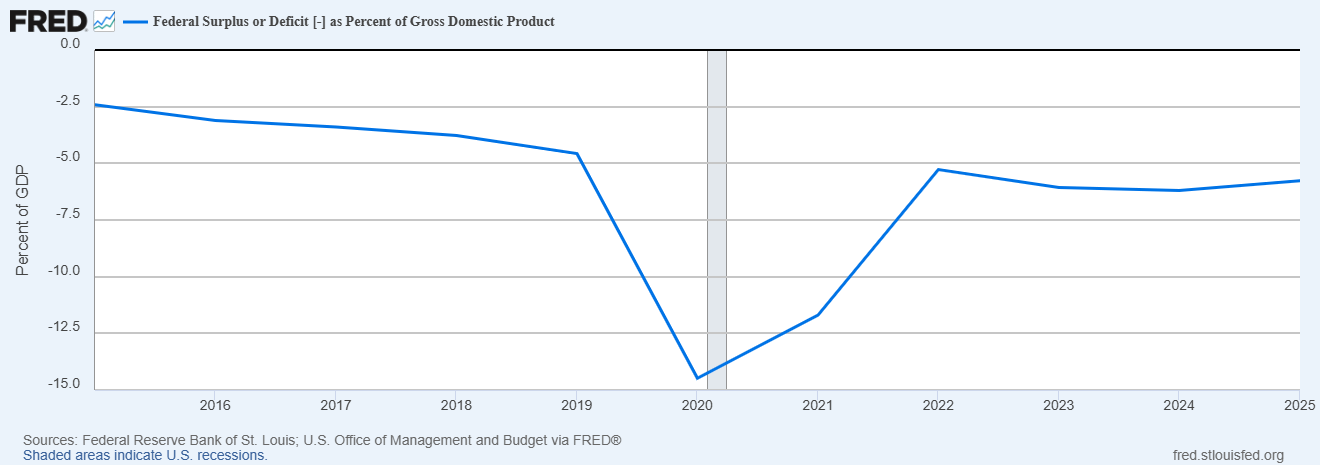
But things are worse under Trump than they were under Biden, for three reasons.
First, this is a very large annual deficit, and it’s all being borrowed at the new, higher interest rates. In addition, during Biden’s first two years in office, inflation eroded the debt.2 Inflation is back down to a fairly low-ish level now, meaning the debt isn’t getting eroded. And finally, interest rates have now been high for long enough that the debt Trump borrowed in his first term to pay for Covid relief is now being rolled over at higher rates.
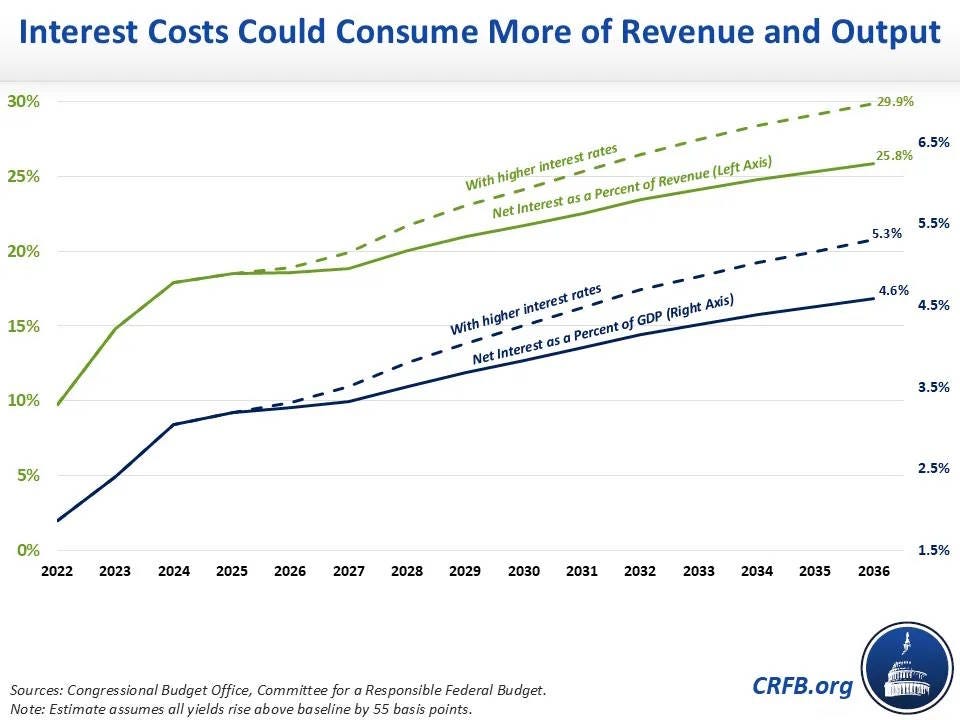
So right now, the national debt continues to explode, because the government is borrowing money just to pay the interest on the money it borrowed before. This increased debt naturally results in even greater interest costs, forcing the government to borrow even more to fund those interest payments. And so on. Interest payments and debt just go to the moon.
This isn’t some far-future scenario — it’s happening right now. But unless something changes, it’s going to get a lot worse:
Why can’t we just cut interest rates?
Faced with mounting interest costs, one obvious thing to do would be to have the Fed cut interest rates. Trump has been trying hard to pressure the Fed to do this. But there are a couple problems with that approach.
First, it might raise inflation. Inflation never quite went back down to the 2% target, even though the Fed has kept interest rates at over 3.5%. Now, with the Iran war raising the price of oil (which feeds through to the prices of a lot of other things), inflation has spiked:
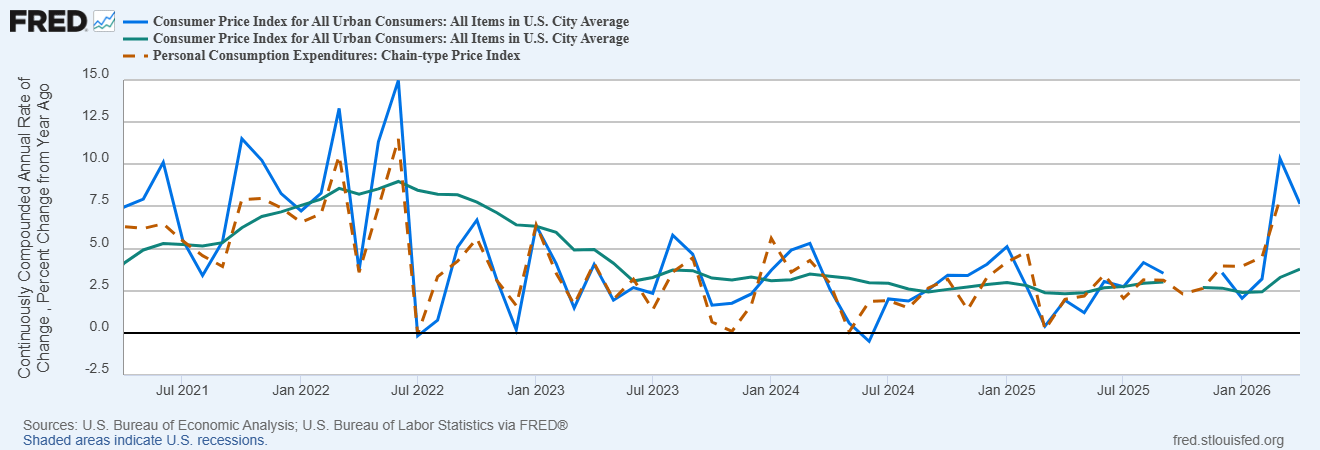
The Fed is supposed to target “core” inflation (which doesn’t include energy prices), but headline inflation numbers like this have got to scare them. It probably means there’s still inflationary pressure in the U.S. economy. And that means that if the Fed reduces rates by a large amount, we could see the high inflation of 2021-22 make a comeback.
So the Fed is understandably reluctant to reduce rates. And if Trump does manage to bully the Fed into bailing out his deficit spending with rate cuts, regular Americans of all stripes are going to see that the Fed is now a captive institution that prints as much money as necessary in order to support infinite government borrowing.
That could do three bad things.
First, it could cause inflation to go way up. Inflation expectations can often be a self-fulfilling prophecy — if businesses think prices are going to go up, they raise prices preemptively. Here’s what I wrote a year ago:
[W]hen you do look at hyperinflations, you tend to see some regularities. The most famous work here is Sargent’s 1982 paper, “The Ends of Four Big Inflations”, which looked at the post-WW1 hyperinflations in central Europe. The basic idea is that we can make a good guess about what caused a hyperinflation by observing what makes it stop…Sargent observes that each of the post-WW1 hyperinflations ended when the government did two things: First, it cut fiscal deficits by a lot. Second, it established an independent central bank that stopped lending money to the government…
Basically, Sargent argues that hyperinflation happens when the government manages to convince or force the central bank into printing money in order to fund infinite deficits. Once people see that this is what’s going on, they realize that the money-printing is just not going to stop. So they start raising prices, and inflation explodes.
It’s not easy to verify whether this is really what’s going on. Sargent, Williams, and Zha (2006) look at some later hyperinflations in Latin America, and conclude that a similar process was at work. Dornbusch and Fischer (1986) look at Argentina and Israel, and agree that fiscal deficits were the key culprit.
In fact, you can get this effect without runaway hyperinflation. Ricardo Reis shows that countries that borrowed more during Covid saw faster inflation:
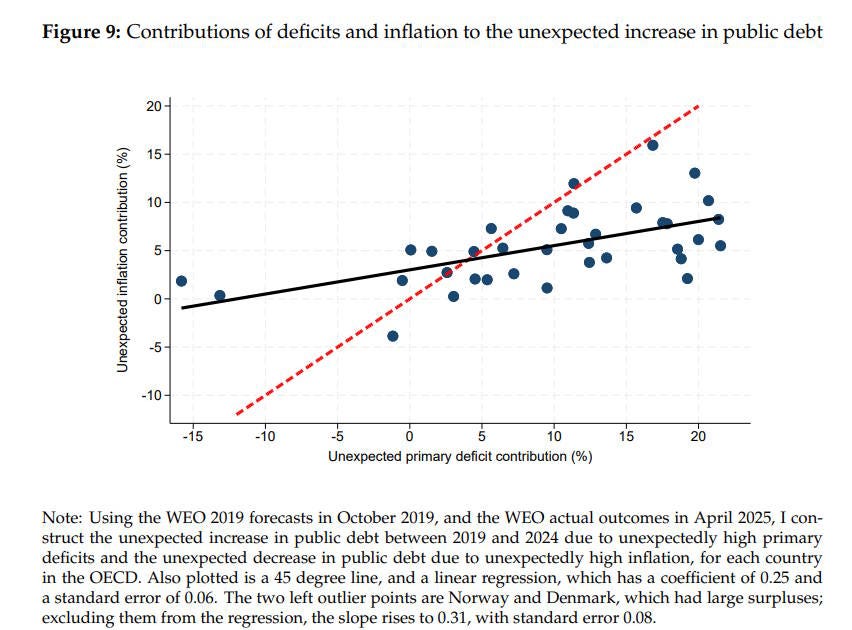
The second danger is that forcing the Fed to cut short-term interest rates could cause long-term interest rates to go way up. If banks and other private investors think that the government is going to inflate away the money it’s borrowing instead of paying it back, they’ll be a lot more wary of lending to the U.S. government. They’ll charge higher interest rates on long-term bonds, as compensation for the risk that they won’t get their money back. That will hurt the U.S. economy. It’ll also make it a lot harder to get a mortgage.
Bankers are already warning about this. Here’s Chase’s Jamie Dimon in April:
Jamie Dimon…warned that rising government debt levels could trigger a crisis in the bond market, urging policymakers to act before markets force their hand…Dimon’s statement was in response to a question about whether he was worried about rising levels of government debt “around the world and in your country.”…“The way it’s going now, there will be some kind of bond crisis, and then we’ll have to deal with it,” Dimon said at an investment conference…
A bond crisis would likely mean a sudden jump in yields and a breakdown in market liquidity, where investors rush to sell and buyers recede, typically forcing central banks to step in as buyers of last resort.
Higher long-term rates would hurt the real economy. As Matt C. Klein points out, this is what has happened to Brazil — the country ran up so much debt that it now has to keep borrowing tons of money just to cover the interest, resulting in high long-term rates that slow down the economy and make the debt hard to pay back.3
In fact, long-term rates have been rising ominously in recent months, even as short-term rates have gone down:
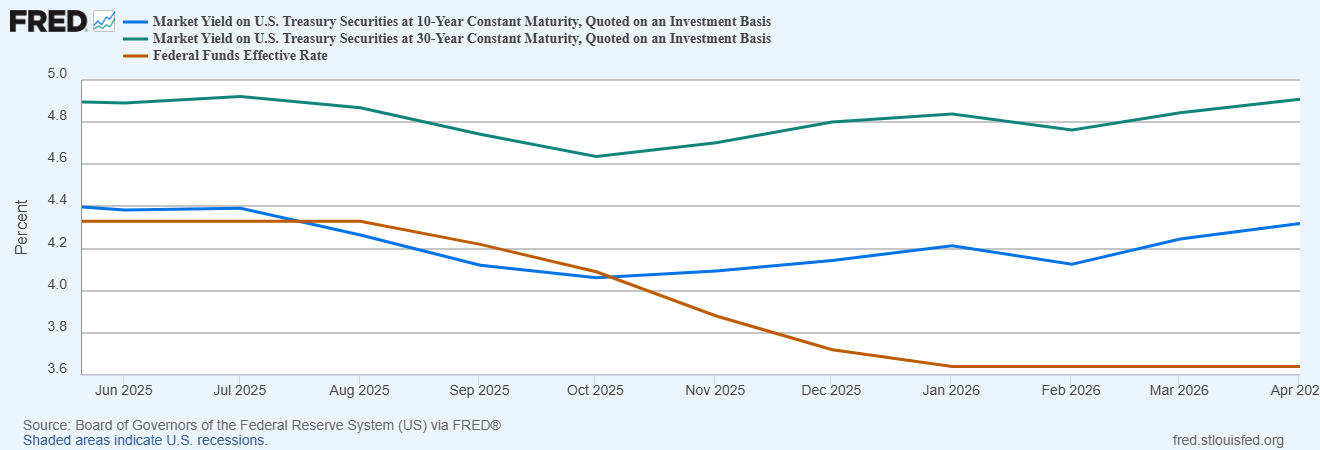
Worry that the U.S. has finally hit its fiscal limits might be one reason behind those higher long-term rates.
The final bad thing that could happen is a currency crisis. If investors watch Trump (and his successors) borrow infinite money and then bully the Fed into printing infinite money to support that borrowing, they may conclude, as Paul Krugman writes, that “we are no longer a serious country”. At that point they would pull their money out of U.S. assets and stash them elsewhere, causing a crash in the U.S. dollar.
A dollar crash would be incredibly disruptive to the global financial system, and would almost certainly cause a deep recession in America. It would also make debt much less sustainable in the U.S., because once the dollar stopped being the world’s safe asset, countries would be much less willing to lend to the U.S. government. Choi et al. (2024) argue:
We study the extent to which the perceived cost of losing the exorbitant privilege the US holds in global safe asset markets sustains the safety of its public debt. Our findings indicate that the loss of this special status in the event of a default significantly augments the debt capacity for the US. Debt levels would be up to 30% lower if the US did not have this special status. Most of this extra debt capacity arises from the loss of the convenience yield on US Treasuries, which makes debt more expensive following its loss and provides strong incentives to repay debt.
So basically, bullying the Fed into keeping rates low is a path fraught with dangers. Some of the negative consequences could be irreversible.
Can we just grow out of debt with AI?
One hope is that the AI boom will just allow America to grow our way out of debt. Forecasters expect AI to raise the growth rate of the U.S. economy by a modest but significant amount. AI-driven productivity growth could also allow the Fed to cut interest rates without raising inflation, as happened during the internet boom of the late 1990s. Faster growth and lower rates could take a big bite out of the debt while minimizing interest costs.
But there’s a problem with this. An AI growth boom will probably put upward pressure on long-term interest rates. Chow et al. (2025) write:
[W]hile advanced AI could lead to rapid economic growth, some researchers argue that superintelligence misaligned with human values could pose an existential risk to humanity. Theoretically, we show that either possibility would predict a large increase in long-term real interest rates, due to consumption smoothing. We then use rich cross-country data on real rates and growth expectations to show that, contrary to other recent findings, higher long-term growth expectations are indeed associated with higher long-term real interest rates.
Higher long-term rates make government debt less sustainable (unless the government tries to borrow only short-term T-bills!). Alec Stapp points out that this means AI is unlikely to ride to the rescue when it comes to government debt:
In fact, long-term rates are rising now. Could AI be one reason they’re rising? It’s possible. That could be making the debtpocalypse a bit worse.
What about Japan? How did they get away with it?
As a side note, a lot of people (especially progressives) argue that since Japan got away with high debt levels for a long time, government debt is a lot safer than people think. Indeed, even though America’s national debt is projected to become one of the highest in the developed world, Japan’s is still higher:
What’s more, for many years, Japan seemed to defy the warnings in this blog post. The Bank of Japan simply printed money and purchased bonds from the government, and inflation failed to rise. How did they get away with this?
Well, there are three answers. The first is that for a long time, Japan’s economy was stuck in a liquidity trap — it had such low aggregate demand that even a bunch of money-printing couldn’t bust it out of deflation.
The second answer is that Japan’s government does one thing that America’s government doesn’t do: It acts like a giant hedge fund. The extra money that Japan’s government makes on currency trades, equity investment, etc. balances out some of what it borrows. If you take Japan’s whole government trading portfolio into account, Japan’s national debt was the same as America’s in 2022.
The third answer is that Japan didn’t get away with this forever. After the pandemic, higher inflationary pressures finally busted Japan out of its long liquidity trap. The Bank of Japan had to raise short-term rates. At the same time, private Japanese investors started shying away from buying Japanese government bonds, forcing long-term rates higher. As people started pulling their money out of Japanese bonds and putting it overseas, the yen fell — a pretty clear case of capital flight.
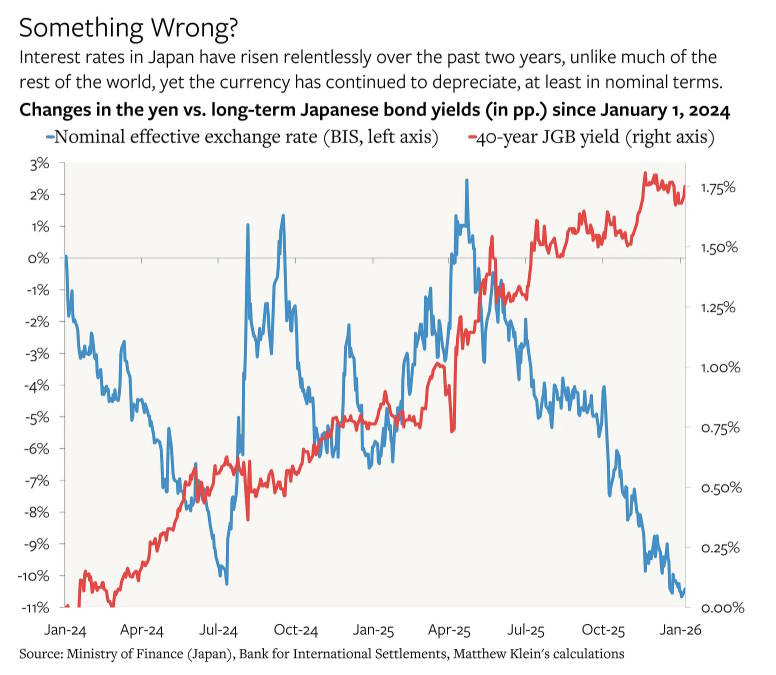
So Japan didn’t find some magic secret sauce to avoid ever having to deal with the complications of high government debt levels.
What to do now
A reckoning is coming for the U.S. It may be already here, with recent rises in long-term interest rates being just the start. Or it may still be on the horizon. But no matter when it comes, our best bet is to start preparing for it now.
There are two things we can do. The first is just to yell about government debt and scare everyone, as happened in the early 1990s. This is the exact opposite of dishonest fearmongering — government debt is something Americans ought to be scared of.
In fact, voters from both parties are already concerned about the national debt — it’s one of the few things Republicans and Democrats agree on. Americans don’t need to be convinced that the debt is dangerous — they just need the salience of the issue raised. In other words, we need to start shouting about this more, so it becomes top of mind.
After that, we need practical solutions. Balancing the budget will require a politically palatable mix of spending restraint and tax hikes. A lot of people are actually working on compromise plans like this, including Marc Goldwein of the Committee for a Responsible Federal Budget, and Jessica Riedl of the Manhattan Institute:

At that point it becomes a matter of having Republicans sell one version of the plan (heavier on the spending cuts, obviously) to their constituents, and having Democrats sell a different version (heavier on the tax hikes) to their own voters. After there are two competing plans for deficit reduction — as there were in 1992 — the parties can take their plans to the voters and see who wins, then hammer out a reasonable compromise in Congress.
But what we can’t do is persist in the populist delusion that a little more deficit splurging is all we need in order to defeat the other party in the next election. That sort of competitive fiscal arsonism has been going on for too long; we need a return to the spirit of 1992.
There was not really a glimmer of hope.
Inflation erodes the national debt because higher prices mean higher tax revenues in dollar terms, while the amount of debt stays the same. This makes the debt easier to pay off.
Of course, central banks could also push long-term bond rates down with quantitative easing. But this goes back to the inflation scenario.