
A few days ago I wrote a post about why Democrats can’t build a welfare state by taxing only billionaires:
I wrote:
Once upon a time, class politics pitted the middle class and poor against the upper classes; now, American politics may reflect a status conflict between millionaires and billionaires. If Democrats have become the party of the millionaires-against-billionaires, that would explain why their tax policies are focused on soaking the ultra-rich while easing the burden of the merely-rich.
As if to emphasize this point, just a couple of days later, Alexandria Ocasio-Cortez declared that “There’s a certain level of wealth that’s unearned…You can’t earn a billion dollars.”
This immediately raises the question: What amount of wealth does AOC think you can “earn”? A hundred million dollars? Ten million? Presumably there’s some number of millions that she thinks can be earned. That definitely fits the “party of millionaires-against-billionaires” framing from my post.
But the more important question is: Is AOC right? Can a billion dollars be “earned”?
It depends on what “earned” means, of course. To most people, the word probably means something very vague — basically, “I think you deserve this amount of money.” You can come up with more specific definitions if you want. For example, if you’re a socialist, you might define only labor income as “earned” and capital income as “unearned”. If you’re a free-marketer, you might define “earned” income as your marginal product — i.e., the amount by which society would be poorer if you had never been born. And so on.
But I’m not sure how useful that sort of exercise is. The socialist idea that capital income is unearned is just a moral judgement, so it leads to endless emotional debates over whether taking risk, making capital more available, etc. are things people ought to get paid for. The free-market concept is more interesting, because it’s objective, but it’s pretty unknowable — unless you’re in the movie It’s a Wonderful Life, you can’t really run the natural experiment of removing someone from the timeline.1 On top of that, most people simply won’t accept such simple, restrictive definitions of “earned” and “unearned”. So these arguments just never resolve.
But when AOC says “unearned”, she seems to mean something else:
You can’t earn a billion dollars. You just can’t earn that. You can get market power. You can break rules. You can do all sorts of things. You can abuse labor laws. You can pay people less than what they’re worth. But you can’t earn that, right?
AOC seems to mean that in order for someone to get a billion dollars, they have to do something that society ought to forbid. In other words, billionaires can’t get their wealth just by being lucky; they have to get it by being bad.
The obvious rebuttal here is to invoke Taylor Swift. The singer’s net worth is estimated at $2 billion. She got those billions from her share of ticket sales, merchandising, and music sales; unlike many artists, Swift owns her entire music catalog.
Formally, AOC is right in this case — Swift did become a billionaire with market power. Intellectual property — the ability to own your own music catalog and charge people to download your songs — is a form of government-granted monopoly. But would AOC really claim that every writer, every photographer, every artist isn’t earning their income? I doubt it. Meanwhile, Swift didn’t obviously break any rules, abuse labor laws, pay anyone less than they’re worth, etc.
But OK, Taylor Swift is the exception here. Most billionaires are more traditional types of businesspeople, who don’t obviously have celebrity superstar appeal or sell their personal artistic output. How should we think about the typical billionaire? Is AOC right that they only amass vast fortunes by either breaking the law and/or hurting the economy?
If so, it means that the vast majority of the U.S. economy — along with both the wealth and the jobs that economy has generated for the middle class — is built on illegality and unfairness. That’s a breathtaking indictment of the entire capitalist system, and it goes way too far. We do need to think about how much to tax the super-rich, but that discussion should absolutely not start from the assumption that all great fortunes were ill-gotten.
Almost every big company in America was founded by a billionaire
Measuring the wealth of the world’s richest people is actually difficult, because they try to hide their wealth for tax purposes (and to avoid being targeted by governments in other ways). The typical data source is the Forbes 400, but there’s another list by Hurun that finds a much higher number of billionaires in China and a slightly lower number for the U.S. But even if there’s some uncertainty here, a quick look at the Forbes list gives us a very clear picture of who the billionaires are in America:
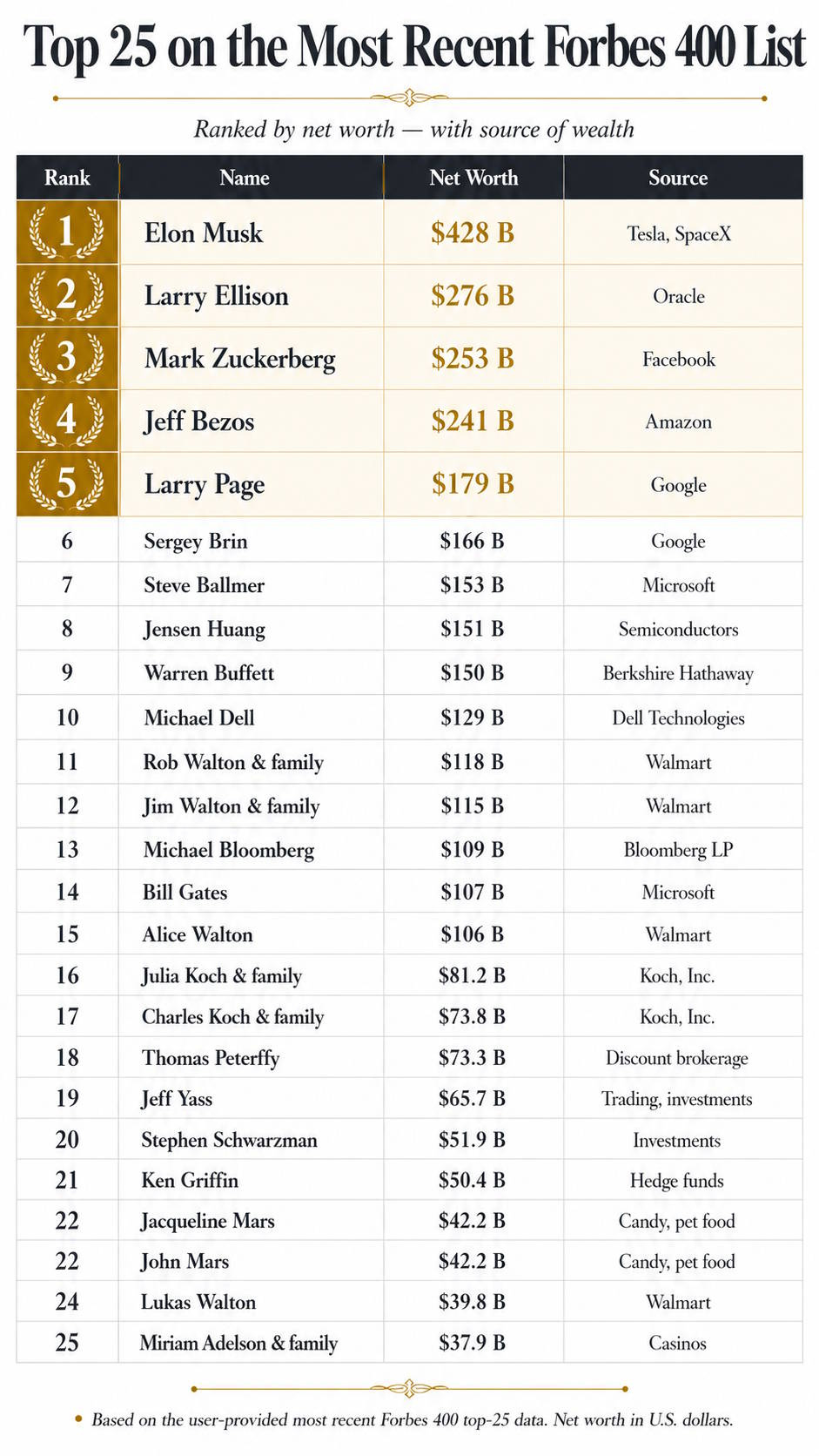
There are some people on this list who inherited their fortunes — the Waltons, some of the Kochs, and so on. But most of them were company founders.
What’s really interesting here is the sheer breadth of the billionaires’ sources of wealth. The list of companies they founded is just a list of almost every big company in America. Amazon, Google, Microsoft, Nvidia, Walmart. Candy companies, retail outlets, fast food chains, newspapers. The list of American billionaires is just a list of American industries.
This is almost a law of nature. Most of the big companies that weren’t founded by billionaires are the ones that are so old that they were founded back before inflation made $1 billion the measure of extreme wealth; their founders were extremely rich for their day and age. There are a few exceptions — IBM, CVS, and Walgreens — and there are a few cases where a super-rich person who started a company lost his fortune. But for the most part, if you start a big company, you become a billionaire.
In fact, this fits the economist Frank Knight’s theory of why some entrepreneurs get incredibly rich. Knight hypothesized that vast fortunes, when they occur, are a result of entrepreneurs’ ability to tolerate true uncertainty — not to gamble with investment dollars and take calculated risks, but to venture forth into the complete unknown with no idea of the odds of success. In order to start a company that goes from tiny to huge, you usually have to try something that hasn’t really been tried much before, like Bill Gates dropping out of Harvard to create a software company at a time when almost no one in the world had gotten rich doing that.2
So if AOC is right that every billionaire’s wealth is based on lawbreaking, unfair labor practices, monopoly power, and so on, then this must also be true of basically all big American businesses. And if that’s true, then it’s not just the wealth of billionaires that’s illegitimate — it’s the wealth of every middle-class worker whose retirement account owns stock in Tesla, or Wal-Mart, or Amazon. So although she may not have thought about it too carefully, AOC is implicitly claiming that most of America is sitting on ill-gotten gains. Her claim also implies that the jobs of the large percentage of Americans who work at big companies are made possible by that same unfairness.
But is it true? In fact, almost any big business probably has either broken or bent the law at some point, or enjoyed an unfair advantage of some kind — after all, competition is cutthroat, laws are imperfectly enforced, and lots of people are greedy or opportunistic. Some percent of corporate profit — and therefore of corporate market value — is almost certainly due to market power.
But it’s very hard to argue that most of the profit-generating activity of large American companies is due to some form of cheating or unfairness. Economies of scale, “superstar” effects from concentration of talent, network effects, sheer luck, and other benign factors are powerful and important sources of corporate value that AOC ignores.
Because billionaires and big business are one and the same, AOC’s indictment of the former is really an indictment of the latter. She seems to be implicitly operating with a mental model of a perfectly competitive economy, in which any company that gains an advantage over its competitors must be breaking the rules. If that were true, then bigness would itself be evidence of badness.
But while I’m sure there are a few people who believe that, economic theory and evidence just run counter to the notion that an efficient, fair economy is made up of a bunch of independent businesspeople producing software, steel, and insurance from their living rooms. The progressive animus against big business has just gotten out of hand.
Almost every country has billionaires
Another important fact in this debate is that almost every country in the world has some number of billionaires:
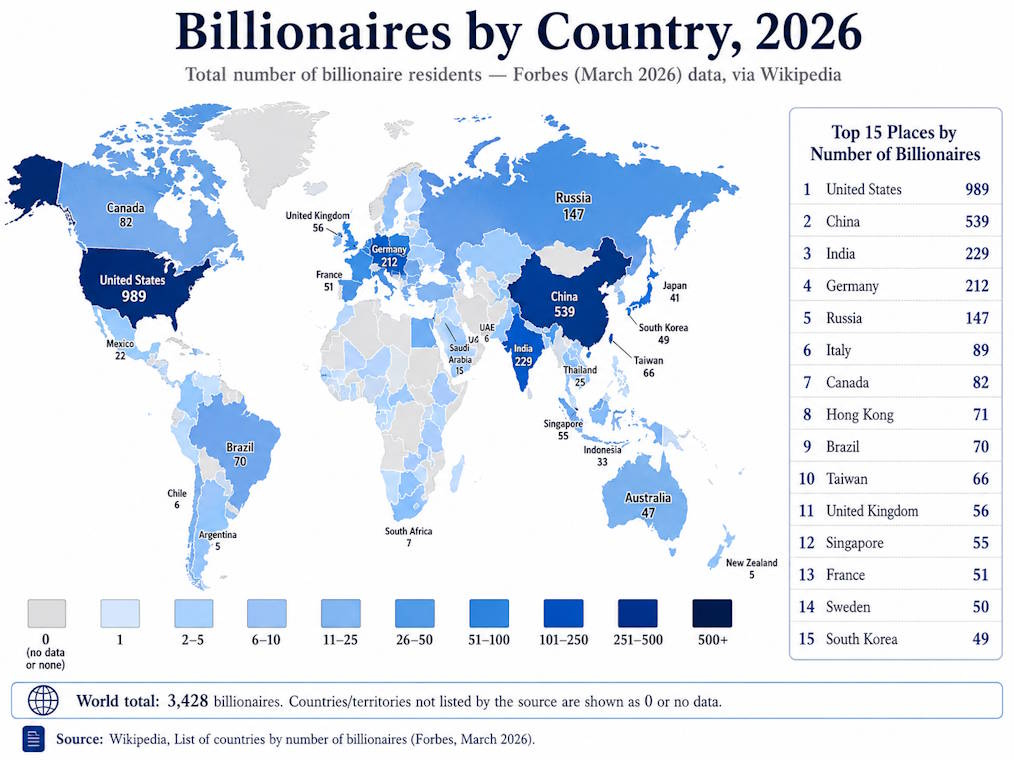
Even European countries, with their generous welfare states and famously high taxes, have billionaires. In fact, Sweden — often held up as the paragon of socialism by American progressives — has almost twice as many billionaires per capita as the United States!
Looking at this map, it’s clear that when modern American progressives propose to “abolish billionaires,” there is no developed country on Earth that they can use as a model. If there’s a way for a country to be even modestly wealthy without having some billionaires, no one has ever found it. AOC and other progressives are asking us to travel into the unknown — to join a club of nations currently occupied only by the likes of Cuba and North Korea, and to simply trust that somehow we’ll still be able to maintain a comfortable standard of living. It doesn’t sound like a safe bet.
How we should think about billionaires
In fact, the accumulation of vast fortunes does present society with a challenge. Billionaires make some of their fortune by sheer luck — when entrepreneurs venture into the complete unknown, who wins big can’t just be a matter of intelligence and hard work. There is some element of windfall involved. Whether or not you think billionaires “earned” those windfalls by taking the initial risk, it’s understandable that many people would look on the outcomes as unfair.
Meanwhile, the standard principle of human welfare says that we should tax billionaires to help the less fortunate. Wealth has diminishing marginal utility — having $20 billion probably doesn’t make someone much happier than having $10 billion, while giving a poor person just a few thousand dollars could change their life. Redistributing money from billionaires to regular people could potentially make the country a happier place.
You might assume that taxing billionaires more would discourage people from starting startups, because the potential payoff would be lower. But for the average entrepreneur, who can barely even imagine what life would be like as a billionaire, it seems unlikely that the dream of a $20 billion payoff would feel much different than the dream of a $10 billion payoff.
In fact, the evidence is pretty split on how much top-end taxes affect entrepreneurship. There’s some evidence in favor of the idea that high income taxes discourage entrepreneurship, just as you might expect, and that high capital gains taxes discourage VC funding. But there are also some papers that find that high income taxes encourage entrepreneurs, because they allow you to deduct more losses, and thus offload some of the risk of entrepreneurship to the government. And there are yet other papers that find very little relationship for personal income taxes at all. Meanwhile, Sweden has more billionaires per capita than America does, despite famously high top tax rates. So the jury is still out on this question.
In other words, there is every reason to think that billionaires should be required to give some of their fortunes to the government — not because capitalism is inherently unfair and exploitative, as AOC tried to claim, but because a lot of its rewards are random. Even if a billionaire did nothing shady to win his billions, there’s still a sense in which it seems unfair that he should cruise around on a 450-foot yacht while regular people struggle to put food on the table. We want to encourage entrepreneurs to strike out into the unknown and discover whole new business models to enrich our country. But there is a limit to how much of their buried treasure they should be allowed to keep.
This requires that we see billionaires not as malefactors — as AOC seems to see them — but as milk cows. Billionaires’ entrepreneurial activity makes our country richer — and by taxing them, we can spread that prosperity around more evenly. Abolishing billionaires is a foolish quest; instead, we must use them as engines of broad-based prosperity.
In fact, you can do something a little similar for wages, macabre as it may be — you can look at worker deaths and see how this affects corporate income and the salaries of other workers. But this is only possible because wages are a flow, not a stock; you can’t do the same for wealth, because when someone dies, their wealth has already been produced.
This is probably why entrepreneurs tend to be overconfident; that overconfidence isn’t necessarily a good financial decision, but it can still be socially beneficial, because it leads to experimentation and discovery.