If I were a conservative, I’d argue against California’s proposed one-time 5% “billionaire tax” on the grounds that it would reduce the incentive for billionaires to invest and create jobs. I’d argue that in order to guard and support the engines of our prosperity, we have to keep taxes low, etc. etc.
But I am not a conservative. I actually support taxing rich people more, and I support taxing the super-rich at higher rates. Tax progressivity is good; there’s no reason America’s income tax brackets should stop increasing after $600,000. Capital availability isn’t a problem in America (as evidenced by the data center boom), and raising taxes on the super-rich isn’t going to make Elon Musk give up his American citizenship and move to Singapore. The moral case against high taxation of top incomes is weak; the United States government and social system is what made it possible for American billionaires to make their money, and they ought to give a lot back to support that system.
But California’s proposed plan — a one-time confiscation of 5% of the total net worth of everyone who has net worth of over $1 billion — is a silly way to go about doing this, for three reasons:
A one-time tax is bad, because it can’t provide consistent funding for anything, and because it just creates uncertainty about future taxes.
A state-level tax on the ultra-rich is not a very efficient way of raising revenue, since the rich can just move out of state.
In general, this tax idea fits into the increasing trend toward “slopulism” in Democratic policymaking — the idea that a modern government can be funded solely on the backs of the super-rich, while the merely-rich get big tax cuts.
Let’s start with the first two considerations here.
Pragmatic arguments against the California Billionaire Tax
The first big problem with California’s proposal is that it’s a one-time levy instead of a regular tax. Taxes are predictable — you pay some percent of your income every year. That predictability isn’t just good for the taxpayer — it’s also good for government, because government can plan its budgets around regular income streams.
Taxes aren’t entirely predictable — recessions and booms change the amount of income that people pay taxes on. Capital gains taxes, which depend on whether the market goes up or down in a given year, are especially volatile. But in general, a state’s tax revenue is pretty predictable over time:
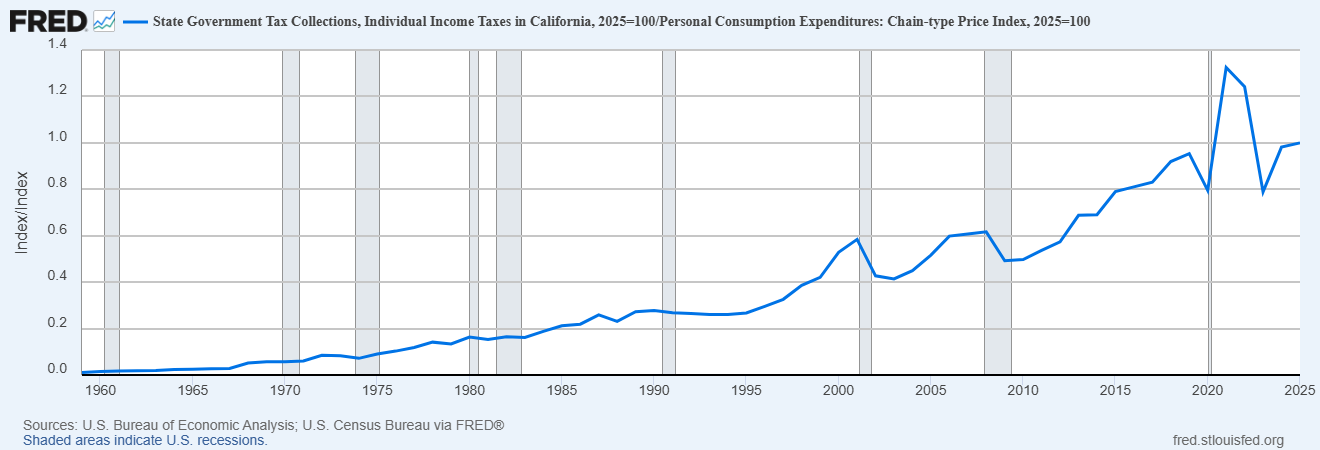
That allows the state to plan how much it’ll be able to spend on education, health, infrastructure, and so on — not just in the current year, but in five years’ time. States generally have balanced budget amendments, so they have to make sure that revenue approximately balances out expenditures.
But California’s proposed “billionaire tax” doesn’t work like this; it’s a one-time confiscation of 5% of billionaires’ total net worth. The proposal stipulates that this money would go toward health care, education, and food assistance. The problem is that since it’s a one-time levy, the money for those health care, education, and food assistance programs will eventually run out. In fact, the proposal stipulates that the money will be spent over five years.
At that point you’ll have three choices: raise tax rates, do another one-time levy, or cut the programs. This is basically a time bomb — it sets you up for another bruising political battle down the line. There’s no guarantee you’d win the battle for a second one-time levy in five years. If you don’t win, then you just created a ton of social programs that you have to yank away from people. And if you could just raise tax rates on an ongoing basis, why not just do that today instead?
This is a bit like when Congress enacts “temporary” tax cuts or a one-time rise in the debt ceiling — it just kicks the can down the road and sets the stage for chaos. But it’s worse, because states, unlike the federal government, have to balance their budgets; they can’t just borrow to cover up the holes in their funding.
If you want to tax billionaires, just raise their tax rates, like countries in Europe do — or like Massachusetts does with people making over $1M a year. Don’t mess around with this one-time levy stuff.
The other problem with California’s plan is that billionaires are likely to move out of the state to avoid the tax. 5% by itself isn’t huge, but if it were successful it would obviously set the stage for further confiscatory “one-time” levies. So billionaires have a big incentive to just move out of the state to avoid the eventual confiscation of a large portion of their wealth.
It’s actually fairly easy for billionaires to pick up and move to a different state. Normal rich people — mere millionaires — tend to be tied down by local friends and community ties, so they don’t move much in response to tax hikes. Young et al. (2016) found that millionaires move very little in response to state taxes on ultra-high-income residents. But billionaires are built different — Moretti and Wilson (2023) found that when a state implements an estate tax, about 35% of Forbes 400 billionaires move to another state.
There are plenty of well-known examples of this. Jeff Bezos moved from Seattle to Miami, probably in response to Washington State implementing a capital gains tax. The Google founders, Sergey Brin and Larry Page, are moving their businesses out of California and probably physically moving out of the state as well,1 likely in anticipation of the “billionaire tax”.
For many billionaires, social life and business just depend much less on local ties. You can often run your corporate empire from anywhere, and your friends and family consist of a bunch of other ultra-rich jet-setters. Taxing billionaires at high rates will thus erode a state’s tax base, reducing future revenue. This makes state-level taxation of billionaires much less effective than national-level taxation — even for the ultra-rich, it’s a lot harder to move to Singapore than to Texas.
For normal taxes, the state usually still comes out ahead in terms of revenue — Moretti and Wilson find that the reduction from billionaire exit isn’t usually enough to balance out the amount a state gets from implementing an estate tax. But for a one-time 5% wealth levy, the calculus will probably be different. If a bunch of rich people move out of state permanently in response to a one-time fundraising operation, you’ve eroded your long-term tax base in exchange for only a short-term bump in revenue.
This is basically burning the furniture in terms of the state’s capacity to fund itself.
If you want to tax America’s wealthiest individuals, the way to do it is by raising tax rates, not via a one-time garnishment. And ideally, this should be done at the national level, not at the state level. California’s measure is just poorly thought-out.
When did Democrats become the party of “tax cuts for everyone except billionaires”?
But California’s “billionaire tax” proposal is worrying for reasons that go far beyond the poor design of the policy itself. It’s part of a more general shift in Democratic and progressive policymaking, toward the idea that the country can fund itself entirely on the backs of the ultra-rich.
In recent years, Democrats have increasingly advocated tax cuts. The most prominent recent proposals would focus mainly on cuts for the middle class:
Sens. Cory Booker, D-N.J., and Chris Van Hollen, D-Md., recently rolled out sweeping tax cut plans. Booker seeks to create a federal tax exemption for up to $75,000 in income for married couples. Van Hollen wants to set that figure at $92,000…In California, progressive candidate for governor Katie Porter, a former Democratic congresswoman, is proposing to wipe out state income taxes for California families making up to $100,000 per year.
But over the last few years, Democrats have also tried to cut taxes for the upper class — people making up to four times the median family income. Dems supported repealing the SALT deduction cap — a tax cut that would mostly put money in the pockets of high earners living in high-tax blue states like California and New York. Joe Biden regularly pledged not to raise taxes on Americans making under $400,000 a year, and fought to extend Donald Trump’s first-term tax cuts for people making under $400k.
When Democrats have tried to raise taxes, they’ve consistently targeted only the very highest earners. Biden and Harris proposed a 25% tax on the unrealized capital gains of people with wealth of over $100 million. Bernie Sanders and other socialists in Congress have proposed extremely high wealth taxes — much higher than those in European countries — on people worth more than $1 billion.
In other words, Democrats increasingly seem to believe that the government — including a significantly expanded welfare state — should be funded by a much narrower and wealthier slice of the citizenry.
This is basically a fantasy. For one thing, the country just can’t afford tax cuts right now. As I wrote in my last roundup post, federal interest payments are exploding to unprecedented levels; unless we raise taxes and cut spending, our only way out of the debt trap will be higher inflation, which will enrage the American public.
But even without taking the debt into account, we need to tax the upper middle class and the upper class if we want to have the kind of social protections that Democrats are trying to enact. Europe is living proof of this — every European country with a robust welfare state funds it by taxing both the rich and the upper middle class. Although rich Europeans get taxed, this isn’t enough to fund Europe’s generous social protections. Taxes that hit the middle and upper middle class — high income tax rates and value-added taxes — are also necessary:
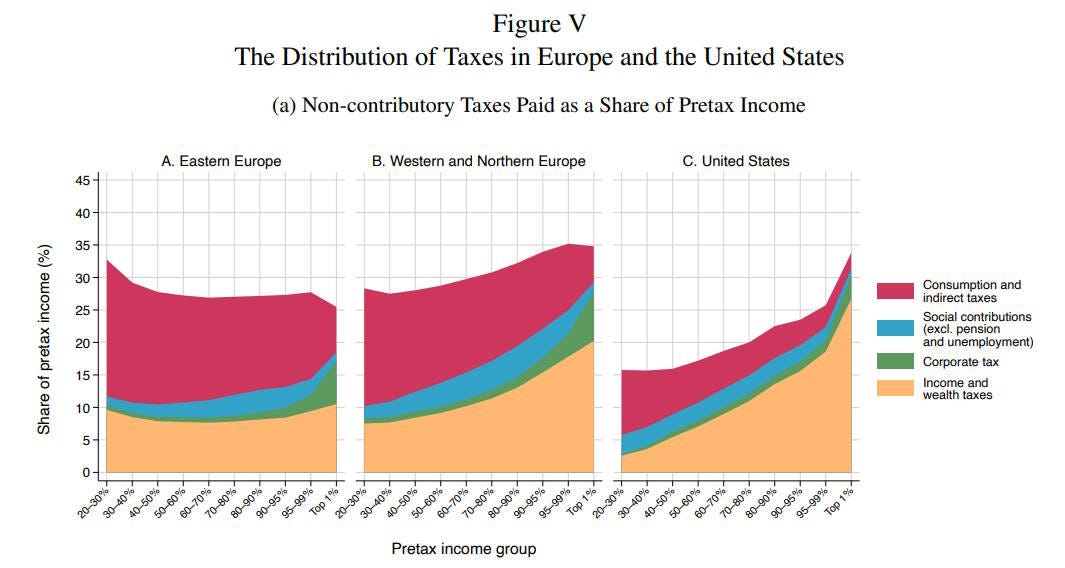
You can get a lot of money out of the top 1%, but Europe shows there’s a limit. At some point, legal tax avoidance, illegal tax evasion, and reduced business activity simply limit how much you can squeeze from the ultra-rich. If you want a European-style welfare state, you have to have high taxes on the upper middle class and the merely-rich — you have to tax millionaires, not just billionaires.
Disturbingly, though, it’s not clear that funding a welfare state is Democrats’ main reason for taxing the ultra-rich. When faced with the prospect of top earners leaving her state due to high tax rates, Seattle’s self-described socialist mayor Katie Wilson responded: “Like, bye.”
Why would a socialist grin at the prospect of a reduced tax base? It’s possible that the reason progressive Democrats want to tax the ultra-rich is not to fund anything, but simply to reduce the social status and power of the billionaire class. In a 2019 op-ed, the economist Gabriel Zucman — whose ideas about taxation have been extremely influential in the progressive movement — wrote the following:
But that’s not the fundamental reason higher top marginal income tax rates are desirable. Their root justification is not about collecting revenue. It is about regulating inequality and the market economy. It is also about safeguarding democracy against oligarchy…An extreme concentration of wealth means an extreme concentration of economic and political power. Although many policies can help address it, progressive income taxation is the fairest and most potent of them all, because it restrains all exorbitant incomes equally.
Zucman argues that curbing the power of the rich, rather than raising revenue to fund the government, is the main purpose of progressive taxation. It’s an article of faith among most progressives that money equals power in America’s system, even though the evidence for that is mixed at best.
But listening to statements like Katie Wilson’s, one wonders if the core issue isn’t power, but social status. If the ultra-rich are oligarchs, they will presumably continue to exercise their oligarchic power at the national level even if they move from Washington state to Texas. So why would Wilson be happy to see them leave her state? Presumably because forcing the ultra-rich out of her own back yard would feel like a status victory — a demonstration that Wilson and her political tribe had the power to push the ultra-rich around.
This, along with the Democrats’ attempts to cut taxes for people making $350,000 a year, raises a darkly cynical possibility about the motivations of the modern Democratic Party.
There is plenty of evidence that richer Americans have shifted from the GOP to the Democrats in recent years. Kamala Harris’ electoral coalition in 2024 was significantly richer than Trump’s. As of 2023, Democrats had a registration edge among upper-income voters.
It’s possible that the Democrats’ tax agenda is reflective of this shift. Once upon a time, class politics pitted the middle class and poor against the upper classes; now, American politics may reflect a status conflict between millionaires and billionaires. If Democrats have become the party of the millionaires-against-billionaires, that would explain why their tax policies are focused on soaking the ultra-rich while easing the burden of the merely-rich.
California’s “billionaire tax” proposal seems like a particularly stark example — a poorly-designed piece of “slopulism” that would give the ultra-rich a slap in the face but do little to create a durably supportive society for the vast majority of voters.
If this is the future of the Democrats, America is in trouble. If we have one party that wants to only tax billionaires, and another that doesn’t want to tax anyone, we’re headed for a sovereign default (or worse) and a withered welfare state. That’s not a future I want.
For a very rich person, moving your pass-through businesses is more important than moving your physical body.