
I’m a little late to the party on this one, but two weeks ago, Dwarkesh Patel had a really excellent episode in which he interviewed Nvidia founder and CEO Jensen Huang:

Zvi Mowshowitz had what I thought was a very good in-depth breakdown and analysis of the discussion, which covered Nvidia’s technology, their business moat, and the question of chip sales to China:
Dwarkesh is rightfully gaining recognition as one of the podcast world’s best interviewers. He’s not an adversarial interviewer like Isaac Chotiner; his goal is not to get you to slip up, or to expose the contradictions in your thinking. Instead, he tries to draw his subjects out and help them explain their worldviews to the audience.
As someone who also prefers this style of interview, I can attest that it’s actually very difficult to pull off. It’s all too easy to slip into doing a softball puff piece — fawning all over your guests and treating them like gurus dispensing wisdom from a mountain. This is an even easier trap for someone like Dwarkesh, who is very young and who is primarily known for interviewing people instead of for dispensing his own thoughts. So it’s extremely impressive that he consistently avoids this trap — he always manages to challenge and provoke his subjects, rather than just letting them spout their usual talking points.
Rarely, though, do we see Dwarkesh actually debate his subjects. In his interview with Jensen, they really get into it on the subject of chip export controls to China. Those export controls — which Trump has significantly loosened — are preventing China from purchasing the best AI chips. Jensen, whose company sells those chips, wants to sell more of them to China. Dwarkesh thinks that’s not a great idea, and pushes back hard.
I actually wrote a post on export controls not too long ago, and I was wondering whether to write another:
But Jensen is one of the premier industrialists of our time, and Dwarkesh really managed to create some interesting dialogue in this interview, so I thought I’d go ahead and score their debate.
Before I get started, though, it’s important to make one distinction. There are actually two types of American semiconductor export controls on China:
Prohibitions on the sale of chipmaking equipment (for example, ASML’s EUV machines) to the Chinese semiconductor manufacturing industry
Prohibitions on the sale of AI chips (for example, Nvidia’s Blackwell chips) to China’s AI industry
There is very little debate about the first of these two types of controls — the controls on chipmaking equipment. There probably are a few people within the Trump administration who would love to sell EUV machines and such to China, but they’re being silenced. The entire debate is about the second type of controls — about whether to sell American-designed AI chips to China. That’s what Dwarkesh and Jensen are arguing about. (In fact, as I’ll talk about in a bit, the stunning success of the equipment controls is the only reason we’re even having a debate about the chip controls in the first place.)
Also, keep in mind that I’m only covering the part of the Jensen-Dwarkesh conversation that’s about export controls. They actually covered more than just that, and for analysis of the other pieces, I recommend Zvi’s breakdown (though be warned, Zvi is very focused on the concept of superintelligence).
So anyway, let’s get to it. Here are the most important points that jumped out at me while watching1 Jensen and Dwarkesh go at it. Overall, I thought Jensen didn’t do very well in this interview — he made a lot of incoherent, self-contradictory arguments, and ignored or waved away some of Dwarkesh’s most important points. He did make some interesting arguments and important points, but didn’t articulate them especially well. Dwarkesh, meanwhile, did a great job pressing Jensen on specific points while also giving him the space to talk.
Jensen’s argument that China already has enough compute is not coherent
Dwarkesh’s main argument for export controls — which is also Dario Amodei’s argument — is that America needs to stay ahead of China in terms of critical security capabilities. Anthropic’s new Mythos model, with its reportedly superior hacking abilities, could represent a powerful weapon. China’s models are improving fast, but if the U.S. maintains an edge, it’ll maintain a military edge as well — one that could help balance out China’s superiority in manufacturing physical weapons like drones.
That’s not necessarily a slam-dunk argument — it relies on a lot of assumptions — but it’s a coherent one. Jensen’s counter to this argument is less coherent. He argues that China already has the compute necessary to train models like Mythos, because they can just use a larger number of older, slower chips:
Mythos was trained on fairly mundane capacity, and a fairly mundane amount of it…The amount of capacity and the type of compute it was trained on is abundantly available in China. So you just have to first realize that chips exist in China…They manufacture 60% of the world’s mainstream chips, maybe more…AI is a parallel computing problem, isn’t it? Why can’t they just put 4x, 10x, as many chips together…If they wanted to, they just gang up more chips, even if they’re 7nm…Huawei just had the largest single year in the history of their company…They have plenty of logic, and they have plenty of HBM2 memory.
I am not an AI researcher, so I can’t evaluate Huang’s claims about being able to train and run AI models just as easily by wiring together older chips as by using newer chips. But if he’s right, it raises a question: Why does Nvidia make so much money in the first place? Nvidia now makes most of its money — now up to $120 billion a year in profit, and growing fast — selling chips for AI models. If AI companies could train and run their models just as easily by wiring together a bunch of dirt-cheap slower older Chinese chips in parallel, why are they shelling out such huge premiums for Nvidia’s chips? And if China has all the compute they need for AI, why would they need Nvidia?
Presumably, Nvidia’s advanced chips confer some sort of very important advantage for AI companies — it’s cheaper and/or faster to train models on Nvidia’s chips. And if that’s true, then having exclusive access to Nvidia’s chips must confer some kind of important advantage for American AI companies over Chinese ones.
In fact, Jensen seems to admit this, when he talks about the heroic lengths Chinese AI researchers have gone to in order to make up for their lack of computing power:
The fact of the matter is, [China’s] AI development is going just fine. The best AI researchers in the world, because they’re limited in compute, they also come up with extremely smart algorithms.
OK, so if China is “limited in compute”, and being forced to invent all of these workarounds, then doesn’t that pretty much invalidate Huang’s earlier argument? For what it’s worth, some of China’s own leading AI companies have also publicly declared that the country’s shortage of compute is holding back their models. Wouldn’t selling China all the compute they want allow them to catch up to American models, thus eliminating the U.S. advantage in cyberwarfare?
Dwarkesh presses Huang on this question, but Jensen never gives him a straight answer.
Jensen ignores the success of the controls on chipmaking equipment
The classic argument in favor of selling chips to China has always been that if we don’t do it, China will just make their own chips. Jensen has made this argument many times. Here’s what he said in 2025:
[Nvidia] Chief Executive Jensen Huang said U.S. export controls limiting the sale of advanced chips to China were a failure, contending they have galvanized Beijing to push ahead faster with its own artificial-intelligence technologies…“The local companies are very talented and very determined, and the export controls give them the spirit, energy and the government support to accelerate their development,” Huang said Wednesday in Taipei, where he is attending an industry conference…“I think all along the export control was a failure,” Huang said.
He repeats this argument in his interview with Dwarkesh:
[I]f we’re forced to leave China, first of all, it’s a policy mistake. Obviously it has backlash. It has turned out badly for the United States. It enabled, it accelerated their chip industry. It forced all of their AI ecosystem to focus on their internal architectures. It’s not too late, but nonetheless it has already happened.
The “export controls galvanize China to do it themselves” argument has always struck me as nonsense from a logical standpoint alone. China’s government has always placed an incredibly high priority on catching up in the chipmaking industry. The Chinese government has been throwing absolutely unprecedented amounts of money at its indigenous chipmaking industry since 2014 — well before America put any export controls on China — and that amount has only increased in recent years. The notion that by selling Nvidia chips to China, we could return the Chinese to a state of complacency and cause them to abandon or pare back these efforts, has always felt a bit ludicrous. Here’s how I put it in a post last year:
If you want to keep China hooked on American products for strategic reasons, it’s probably a bad idea to scream “HEY CHINA, WE’RE SELLING YOU CHIPS AND EQUIPMENT SO YOU’LL STAY HOOKED ON OUR PRODUCTS, FOR STRATEGIC REASONS!!”. China’s leaders, being smarter than, say, a gerbil, will refuse to take this bait, and will work hard on developing their own indigenous chip supply chain anyway. Which is exactly what they’ve been doing for over a decade now.
But in fact, we’ve also seen the “export controls will galvanize China to catch up” argument disproven in real time, when it comes to the controls on chipmaking equipment.
Back in 2023, a lot of people — including the highly respected consultancy SemiAnalysis — predicted that the equipment controls would fail, and that China’s semiconductor industry would catch up to the West. They were wrong.2 Years later, China’s chipmaking industry has not caught up, and the equipment controls are probably the biggest reason why.
Splashy announcements like SMIC’s 7nm chip — which was supposed to indicate that China had beaten the controls, turned out to be Potemkin breakthroughs. China had already begun making those chips before export controls were even announced, using older equipment from ASML. But using that older equipment came at a cost — yields were bad, China was unable to maintain the older ASML equipment without help, and Chinese companies have proven unable to progress past 7nm so far. China’s efforts to develop indigenous tools to rival ASML have not been successful.
In fact, the dramatic success of export controls on chipmaking equipment is exactly why we’re now having the discussion about chip controls at all. If export controls had simply “galvanized” China into doing everything themselves, they wouldn’t even need Nvidia chips. As things stand, Huawei’s chips are far behind Nvidia’s, and expected to remain so for years:
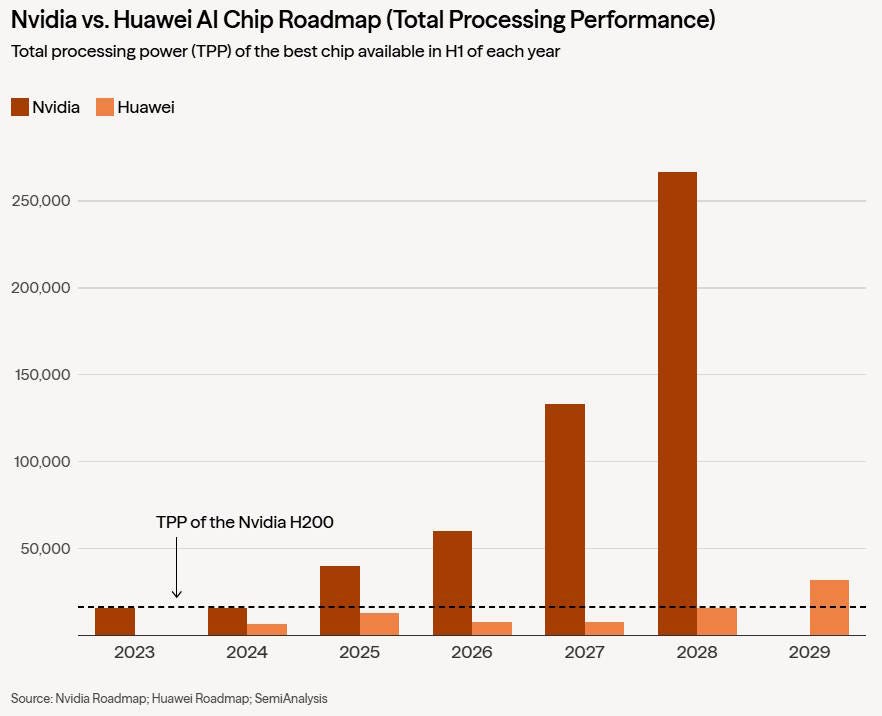
In his interview with Dwarkesh, Jensen also seems to admit that export controls have held back Chinese chipmaking. When he talks about China’s chips being less powerful, and talks about having to wire together, older, cheaper chips in parallel, he’s conceding that China’s chipmaking industry has not, in fact, caught up to the West in response to the export controls on chipmaking equipment. (I wish Dwarkesh had pressed Jensen more on this point.)
It’s not clear why the “galvanizing” argument, which failed so spectacularly in the case of equipment controls, would hold true in terms of chip controls. But let’s assume, for the sake of argument, that it did. Perhaps when China’s government and industry leaders realized that it would really never be able to get their hands on Nvidia chips, they would finally be “galvanized” to accelerate their development of indigenous chip designs, chip programming environments, chip design software and so on.
How would that matter, if China still couldn’t make those chips? Without EUV machines and such, how can China compete with Nvidia on the chipmaking frontier? The whole “galvanizing” argument seems clearly invalid in the presence of effective controls on chipmaking equipment.
Should we worry about who controls the ecosystem?
To be fair to Jensen, he does have one argument here that’s subtler and more coherent than the two described above. He argues that by refusing to sell Nvidia chips to China, we’re helping China expand the reach of its own software ecosystem.
The chips Nvidia sells aren’t just hardware; there’s also a lot of software that goes along with them, like the CUDA programming ecosystem. It’s a package deal — you use Nvidia chips, you use Nvidia software. Huawei has its own alternative software, called CANN. Jensen worries that the more companies — inside or outside of China — use CANN instead of CUDA, it’ll weaken Nvidia’s network effect, and strengthen Huawei’s network effect:
[W]hat we also want is to make sure that all the AI developers in the world are developing on the American tech stack…It would be extremely foolish to create two ecosystems: the open source ecosystem, and it only runs on a foreign tech stack, and a closed ecosystem that runs on the American tech stack…
Suppose [a model like DeepSeek is] optimized for Huawei, suppose it’s optimized for their architecture. It would put ours at a disadvantage…
We are not [selling] a car…I can buy this car brand one day and use another car brand another day…Computing is not like that…These ecosystems are hard to replace. It costs an enormous amount of time and energy, and most people don’t want to do it. So it’s our job to continue to nurture that ecosystem…
Computer science matters…The impact of AI largely comes from the computing stack, which is the reason why CUDA is so effective, which is the reason why CUDA is so beloved. It’s an ecosystem, a computing architecture…To the extent that we have architectures and software stacks that are optimized for our stack, for our ecosystem, it is obviously good…Why do people always love programming CUDA first? They do. They do. So do the researchers in China.
I am not an AI researcher, so this argument is hard for me to evaluate on technical grounds. But I don’t think Jensen does a good job of explaining why it’s important to keep Chinese model-makers programming on CUDA.
Obviously, if Chinese programmers use CUDA, it locks them into the Nvidia ecosystem — it makes their companies buy more Nvidia chips. But this is just another way of saying “Selling Nvidia chips to China makes money for Nvidia”. We already know that. Simply explaining how and why it makes money for Nvidia is beside the point; the question is why “making money for Nvidia” is more important than security concerns about which country has the best models. Benjamin Todd made a pretty devastating cartoon in response to the interview:

Jensen might have argued that if Chinese programmers are all locked into the CUDA ecosystem,3 it could give America some geopolitical leverage over China. Perhaps, in the event of a Chinese invasion of Taiwan, America could threaten to withdraw China’s access to CUDA, thus tanking their chip industry (at least temporarily). I’m not sure how much leverage this would actually confer, but it’s a coherent argument, and Jensen could have made it. He didn’t make it, but he might be thinking of it, or trying to imply it. So it’s worth thinking about, at least.
He also seems to make an argument about AI models themselves having economies of scale that depend on the underlying computing architecture:
[T]he potential cost [of export controls] is we…concede an entire market—the second largest market in the world—so that they could develop scale, so that they could develop their own ecosystem, so that future AI models are optimized in a very different way than the American tech stack. As AI diffuses out into the rest of the world, their standards, their tech stack, will become superior to ours, because their models are open.
It’s difficult to figure out what scenario Jensen is envisioning here, and he doesn’t spend much time on it. He seems like he might be arguing that if Chinese AI models are made on CANN instead of CUDA, then CANN will eventually get better than CUDA, and Chinese models will surpass the American models. Whereas if we can trap Chinese programmers on CUDA, we can keep the software playing field level between the two countries.
I am not an AI researcher, and I’m not capable of evaluating that argument. But it seems like the only really coherent argument that Jensen makes against export controls. Sadly, he doesn’t articulate it very well, despite spending a significant fraction of the podcast talking about the “ecosystem”. But if this is what he’s arguing, it’s worth following up on.
Are we cooperating or competing with China?
Jensen makes one more argument for selling China chips, which is that the two countries need to cooperate on AI safety:
[W]hat is the best way to create a safe world?…Victimizing [China], turning them into an enemy, likely isn’t the best answer. They are an adversary. We want the United States to win. But I think having a dialogue and having research dialogue is probably the safest thing to do. This is an area that is glaringly missing because of our current attitude about China as an adversary. It is essential that our AI researchers and their AI researchers are actually talking. It is essential that we try to both agree on what not to use the AI for.
This is stated a bit incoherently — Jensen declares “they are an adversary”, and then immediately criticizes “our current attitude about China as an adversary”. But I get the point. The point is that cooperation between the U.S. and China on AI safety is extremely important, and that trying to kneecap China’s AI industry will make such cooperation a lot harder.
A cynical interpretation of this argument — which I have seen many “natsec” types make — is that Jensen doesn’t actually care about American interests that much, and is trying to play both sides of the U.S.-China rivalry for his own personal enrichment. Other corporate executives have actually done this: The co-founder of SuperMicro Computer, Yih-Shyan Liaw, was just arrested and charged with smuggling Nvidia AI chips to China and defrauding the U.S. government.
A less cynical, but still pessimistic view is that Jensen is just making another version of the same mistake U.S. policymakers and businessmen have been making for four decades now — assuming that playing nice with the Chinese Communist Party will make the CCP play nice in return. This was the assumption that drove Bill Clinton and George W. Bush to open American markets to Chinese goods. It was the assumption that a bunch of multinational companies made when they moved production to China, only to have their tech stolen and used against them — a recurring phenomenon I’ve dubbed the “China Cycle”.
But I actually wouldn’t be so quick to dismiss Jensen’s argument out of hand. International cooperation on AI safety probably will be very important — as scary as the Chinese Communist Party is, AI-assisted bioterrorism is probably even scarier. Previous arguments that the U.S. and China should put aside their differences underestimated the threat posed by the CCP, but I think now we’re in danger of underestimating an even greater threat.
That said, I don’t think there’s any guarantee that the CCP itself will actually play ball here, even if it’s in their best interests to do so. And it seems highly speculative that lifting export controls would really move the needle on how much China is willing to cooperate with America on averting existential risk, rather than just using the opportunity to kneecap America and seize control of all of global AI.
So if this is Jensen’s argument, he needs to start making it more explicitly. But if he does, it’s one we should at least take seriously.
Is what’s good for Nvidia good for America?
Overall, I think Jensen didn’t come off very well in this interview. He had entertaining swagger — his proud declaration that “You’re not talking to somebody who woke up a loser” was entertaining, but it helped contribute to the impression of a man who cares about personal aggrandizement and victory more than about the future of the nation. Jensen is certainly one of the most accomplished and brilliant industrialists of our time, but so is Elon Musk.
What’s good for a “winner” is not necessarily good for America. And what’s good for the profits of one American company — even a huge company that’s a key technological leader in a crucial industry — is not necessarily good for America, either. Following the interview, a bunch of people pointed out that selling Nvidia chips to China would raise their price in the U.S., starving American AI companies of compute at a time when compute is becoming more critically scarce. Dwarkesh mentions this briefly, but Jensen waves it away, declaring that the U.S. will always be first in line for Nvidia’s best chips without ever explaining exactly how that would work without export controls.
I am not the only person who thought that Jensen came off as a self-interested profiteer in this interview. Zvi Mowshowitz thought so as well, as did Dmitri Alperovitch, Daniel Eth, and other online commentators in the AI space. Many people, like Alec Stapp, Peter Wildeford, and Alex Imas pointed out the incoherence of many of Huang’s arguments.
I think Jensen can do better. The swaggering, leather-jacketed Gen X “winner” image is fun, but isn’t doing him many favors in the court of public opinion here. The point about U.S.-China cooperation on AI safety is an important one, and the argument about economies of scale in model-making is subtle and interesting, and needs to be fleshed out more. But most people are simply not going to be convinced that what’s good for Nvidia is automatically good for America.
I do not actually listen to or watch podcasts. It’s too time-consuming. I read transcripts.
Note that Semianalysis also recommended a bunch of ways that export controls could be tightened, and that the Biden and Trump administrations followed some of those suggestions. That may have had something to do with why equipment controls worked out better than Semianalysis originally predicted. So let’s not give Dylan Patel & co. a hard time here — it’s better to worry too much, and take action, than to be complacent.
In fact, there are other aspects to Nvidia’s software ecosystem besides just CUDA. I’m using “CUDA” as a shorthand for the entire Nvidia software ecosystem, and I think Jensen is doing the same in this interview.