.jpg)
Greg Ip of the WSJ is one of my favorite economics writers, and you should always read what he writes. But in a recent post about manufacturing, I think he gets the main narrative wrong. Greg writes that America is in the middle of a “manufacturing revival”, which his headline writer calls a “stealth manufacturing boom”:
You won’t hear this from either critics or fans of President Trump’s tariffs, but there’s a manufacturing revival going on…Critics have focused on the fact that factory jobs have steadily slid since Trump took office last year…Unlike jobs, though, actual factory output has risen briskly, and may even be picking up speed. This stealth recovery, though, isn’t because of tariffs. Instead, credit goes to the most basic economic force of all: demand. The U.S. is good at making things that happen to be in big demand right now.
As a macro story, “AI boom cancels out tariffs” isn’t a bad description of the U.S. economy right now — including the manufacturing sector. But it’s just not right to say that the former is winning out when it comes to manufacturing.
Let’s look at the data. Here’s Greg’s evidence for the boom:
First, a few data points. Since January 2025, manufacturing jobs have indeed fallen by about 100,000 workers, or roughly 0.6%. In the same period, though, manufacturing production rose 2.3%, and manufacturing shipments, unadjusted for inflation, climbed 4.2%.
Regarding manufacturing shipments…why wouldn’t you adjust for inflation? Inflation is important! Shipping more dollars of stuff doesn’t indicate a boom if a dollar is worth much less. As it happens, there’s no price series that exactly corresponds to the data series for manufacturing shipments, but we can probably approximate it by using the producer price index for manufacturing. Here’s what we get when we do that:
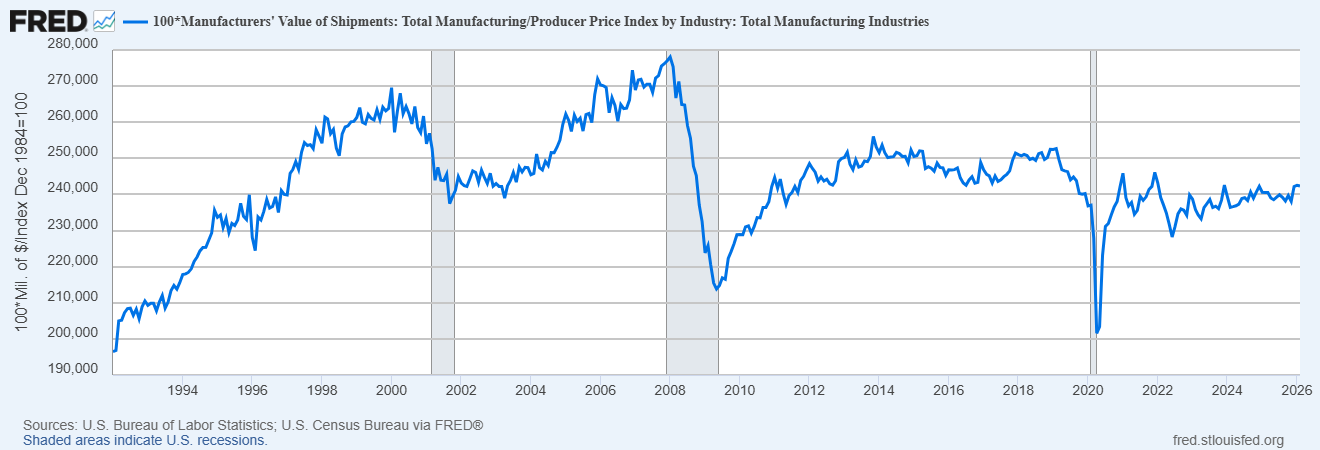
Do you see a “stealth manufacturing boom” since January 2025? I sure don’t. What I do see is the continuation of a decades-long stagnation in American manufacturing.
Let’s look at some other measures. Here’s industrial production in the manufacturing sector:
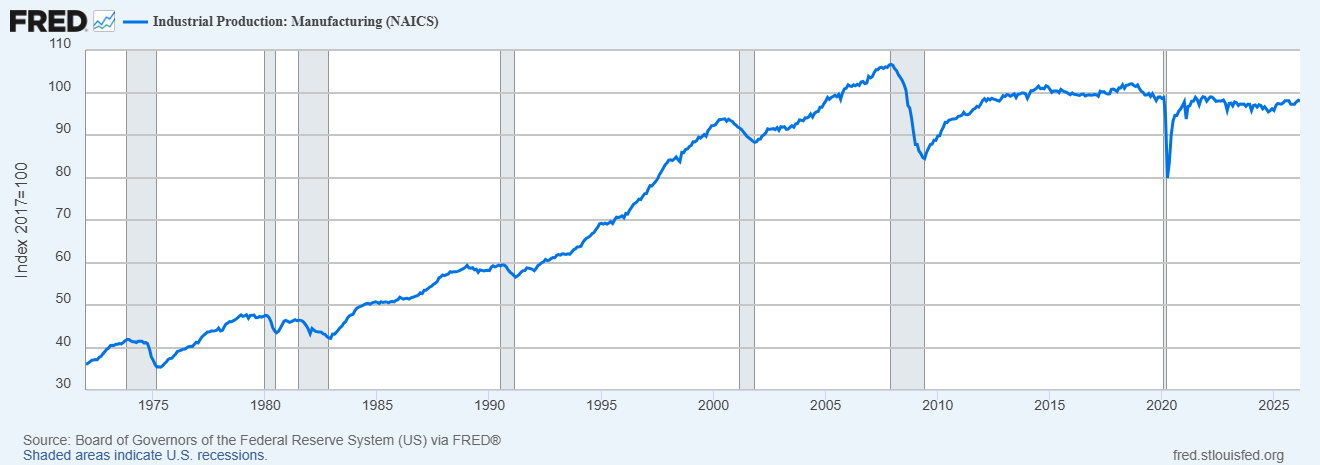
I guess if you squint very hard, you can see a slight rise since the end of 2024. But really this is just the same story as before: American manufacturing has been stagnating since 2008.
Let’s look at gross manufacturing output, adjusted for output prices:
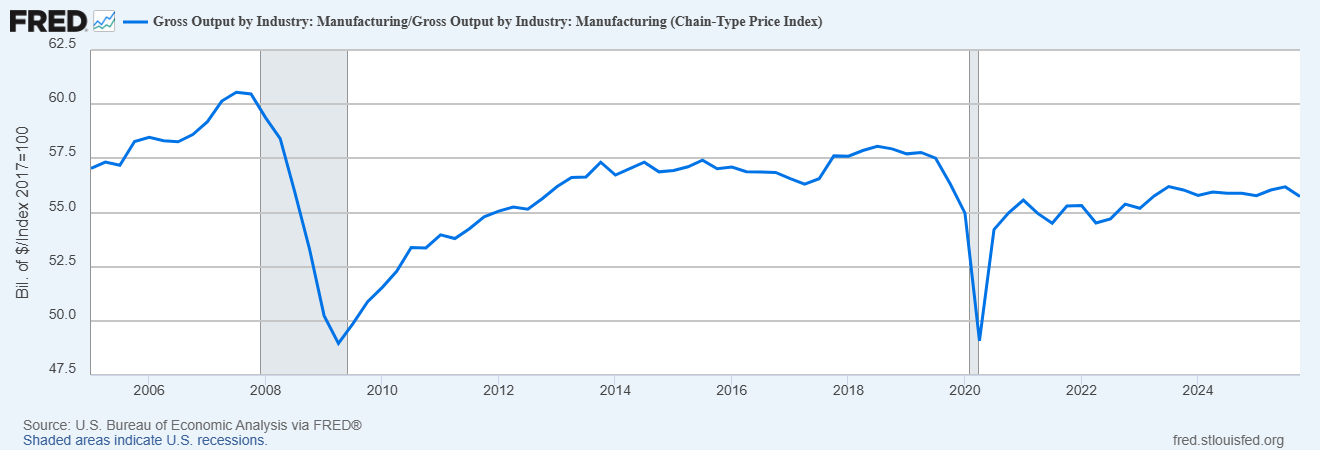
Same exact story, only this is quarterly data and the last quarter of 2025 looks bad.
Fine, let’s look at real manufacturing value added:
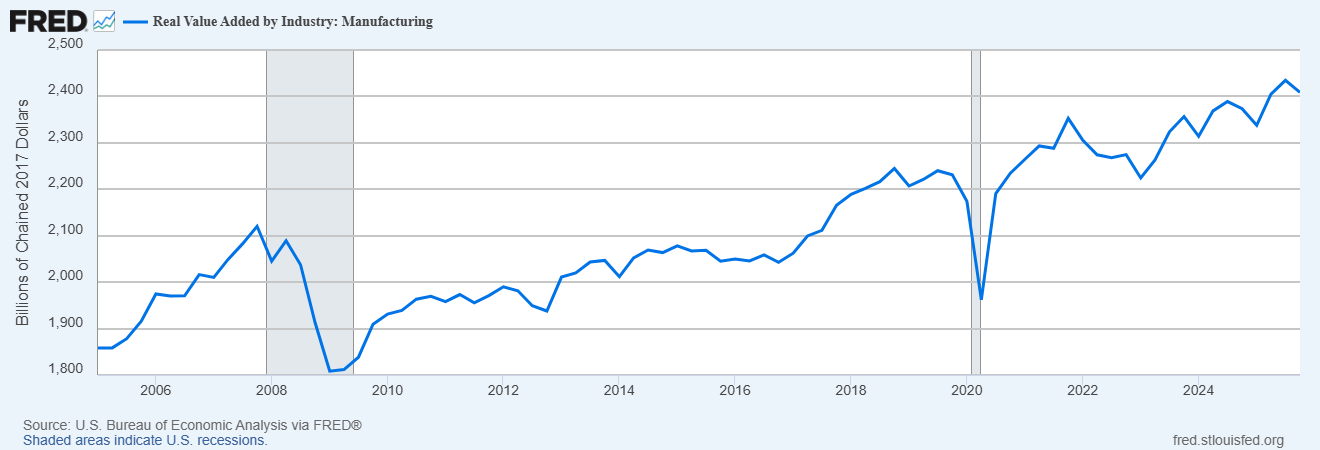
OK, finally we’re starting to see some action! This number is up a little bit — about 1.4% — since Trump was elected (I don’t know where Greg is getting his 2.3% number). But that’s a pretty anemic growth rate, compared to either Trump’s first term or to Biden’s term — to say nothing of the pre-2008 days:
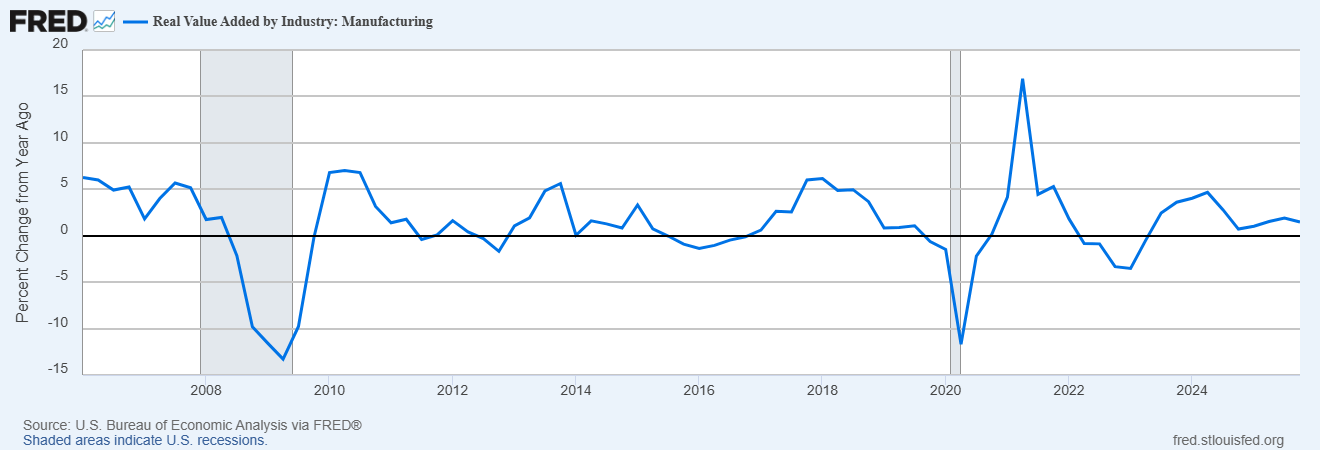
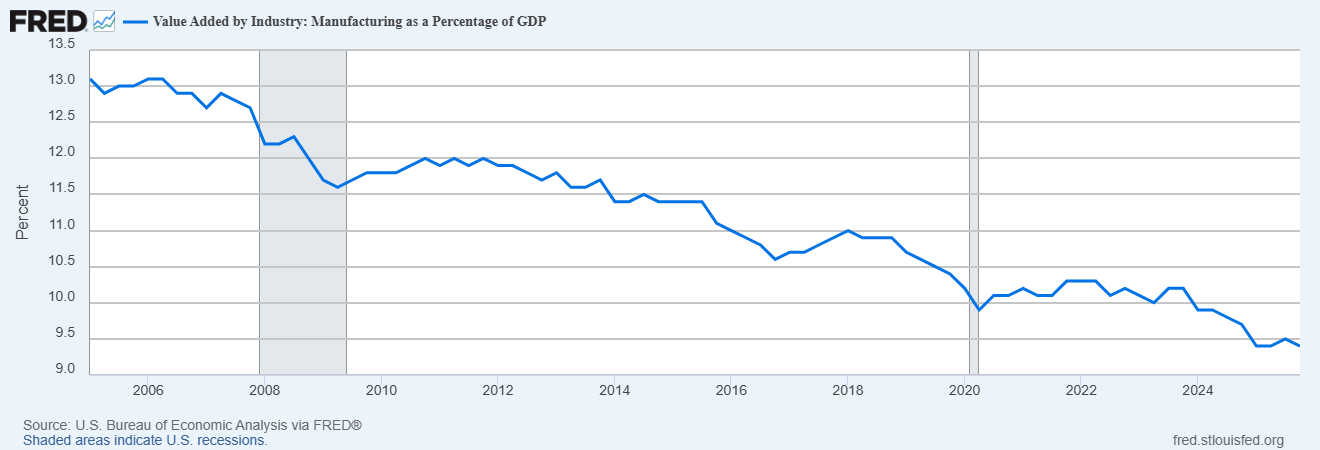
And keep in mind, this is during a time of solid economic growth. Manufacturing is growing anemically, but much slower than the rest of the economy. You can see this by looking at manufacturing’s percent of output, which continues to shrink under Trump:
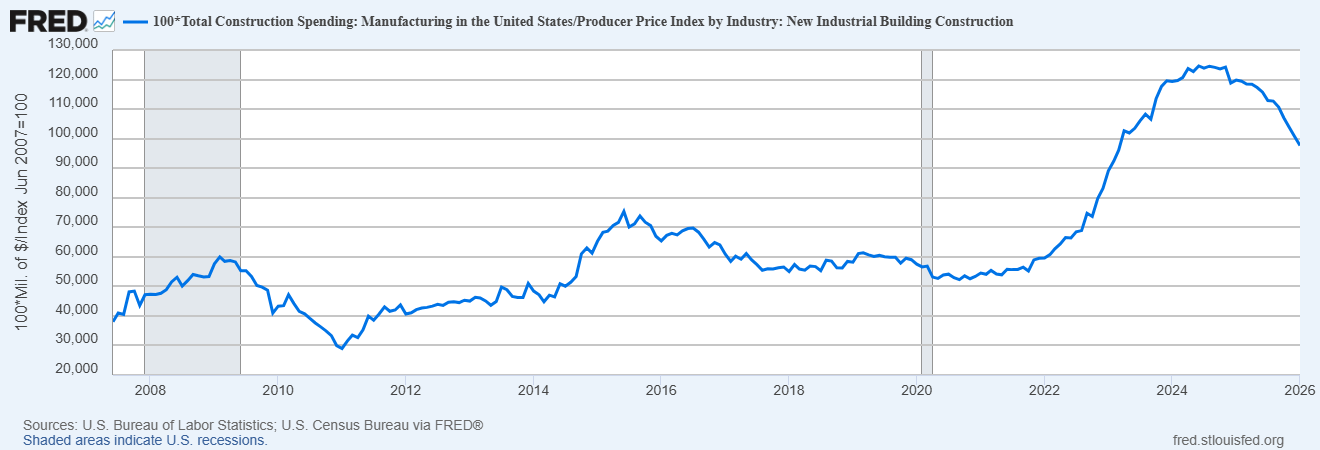
Also, if we were in a manufacturing boom, you’d think that companies would be spending more on constructing new factories. But factory construction spending is actually way down under Trump, after soaring during Biden’s term:
Here’s a breakdown by sector:
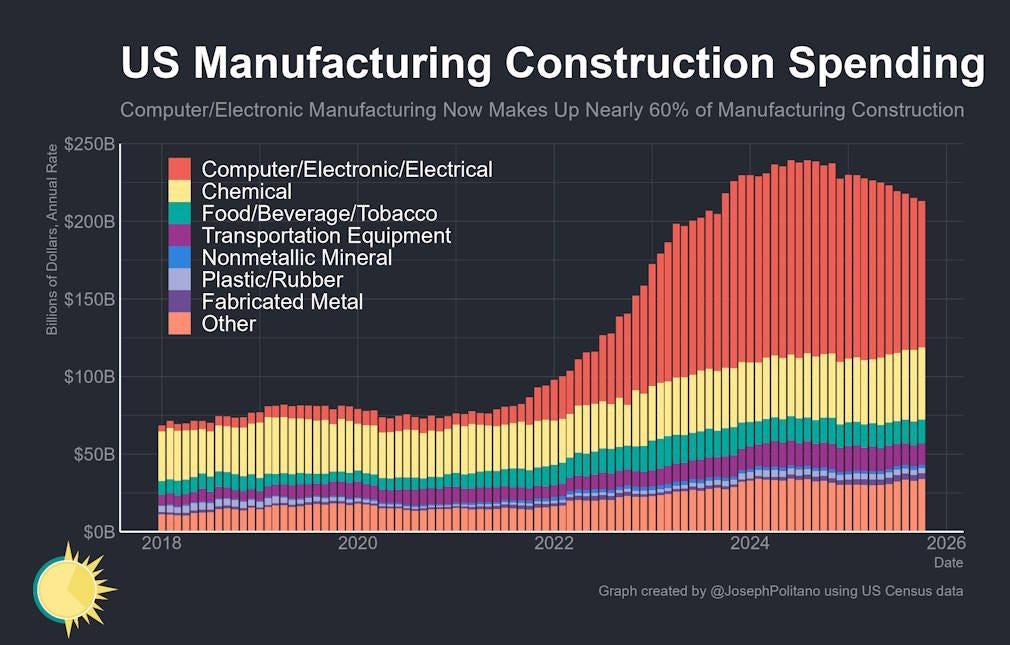
Greg writes that manufacturing is being driven by demand for AI. But America is spending less on computer/electronic/electrical factories than we were under Biden. Why would this be true if AI were driving a boom in demand for U.S.-made electronic products? If such a boom existed, wouldn’t companies be ramping up capacity in this sector? Granted, factory spending in that category — and overall — is still above where it was during Trump’s first term. But shrinking spending doesn’t exactly suggest a wave of optimism about demand.
So basically, the narrative of an American manufacturing boom under Trump just seems flat-out wrong. There is no boom. The source for Greg’s claim seems to be one of those private reports by the McKinsey Global Institute (MGI). I can’t see the report, but my experience is that these reports are sometimes solid, and sometimes try too hard to push a headline-grabbing counterintuitive narrative.
The Economist is on much more solid ground here. They’ve been consistently reporting on the weakness in the manufacturing sector, and they have a good update from March 31st. Here are some excerpts:
The purchasing-managers’ index…suggests that the [manufacturing] sector spent most of 2025 in recession, but the measure has perked up a little over the past month or two. Production of manufactured goods is up a little too, but only back to the levels of a few years ago. Much of that boost comes from a few specific sectors: aerospace (following a production ramp-up by Boeing after strikes and safety woes), computers and electronics (subsidised by the 2022 CHIPS Act) and pharmaceuticals (revved up by the boom in anti-obesity GLP-1 drugs).
The slight uptick in recent months is probably what Greg Ip and MGI seized on as proof of a manufacturing renaissance. But The Economist correctly fingers the end of the Boeing strike in November as a key factor having nothing to do with either AI or tariffs. It also mentions Biden’s industrial policy — especially the CHIPS Act.
In fact, semiconductor production is a bright spot in U.S. manufacturing. Industrial production in semiconductors started rising in late 2024, and is now up by almost 30%:
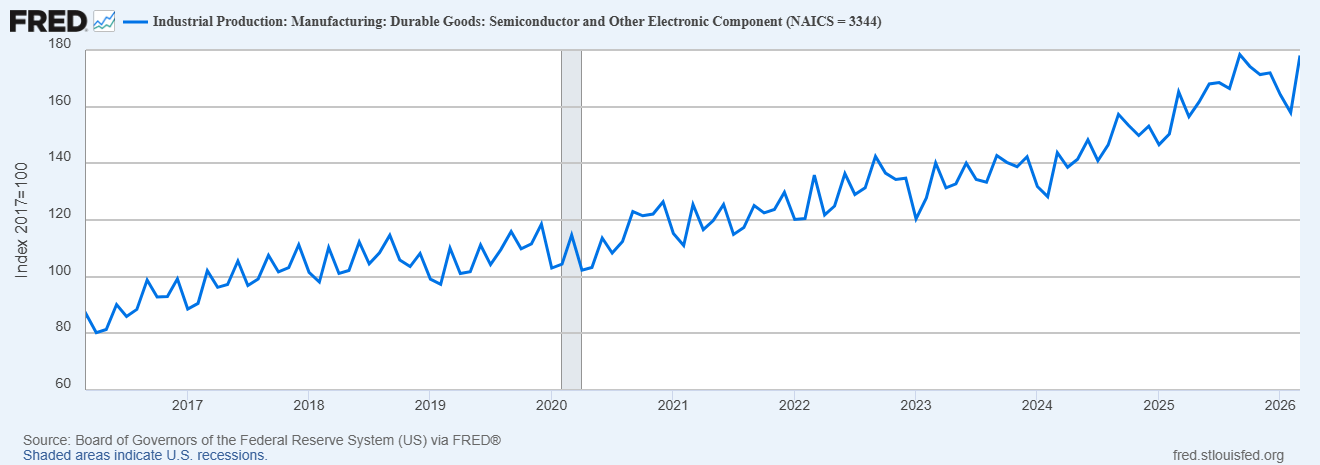
Yes, this is a story about the AI demand boom, but it’s also a story about the CHIPS Act. Had Biden not successfully ignited a boom in American chip factories — including foreign-built factories like TSMC Arizona, which is pumping out chips at an accelerating rate — U.S. data centers would have been importing even more chips from Taiwan instead of ordering them locally. That big boom in factory construction in the “computer/electronic/electrical” segment in 2022-2024 is thanks to demand from AI, but also thanks to Biden’s CHIPS Act.
Greg overlooks this factor in his post. He writes that “semiconductor capacity has been kick-started by the Trump and Biden administrations”, but only the “Biden” half of that statement is accurate. The first Trump administration saw no increase in chip factory construction, Trump attempted to kill the CHIPS Act as soon as he came into office, and chip factory construction has fallen during his second term even as the AI boom has ramped up. There is no way in which Trump deserves credit for this rare bright spot in U.S. manufacturing.
The semiconductor industry shows how industrial policy could have been used — and still could be used — to reverse the long, slow decline of American manufacturing. Importantly, the boom in chip factory construction and output was accomplished with very little actual subsidy money, suggesting that the government mostly acted as a coordinating force. That’s a positive sign for any future administration who wants to take manufacturing seriously.
But the current administration does not want to take it seriously. In addition to trying to cancel the one policy that has been effective at boosting American manufacturing, Trump has stuck to his strategy of high, variable, and uncertain tariffs. The Economist writes:
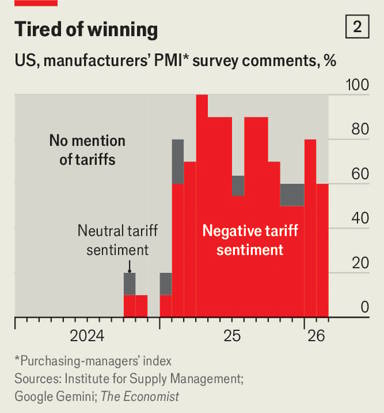
[M]ost American manufacturers seem to view the trade war as a setback to be navigated, not a triumph to be celebrated. Since Mr Trump took charge, most of the comments from manufacturers that ISM has published along with its surveys have mentioned tariffs. Not one has been positive (see chart 2). Many of the unpublished ones are more forceful still. “A fair number of comments just say the word ‘tariff’,” says Susan Spence of ISM, who compiles the [PMI] survey. Or, among some less-polite respondents: “’Same as last month, it’s just tariffs, stupid.’”…
Constantly shifting tariffs have made planning for hiring, spending or investment nightmarish. Monthly measures of economic-policy uncertainty hit record highs after “Liberation Day”, beating the records set during the early months of the covid-19 pandemic…That has left plenty of manufacturers furious. “People understand when business cycles go down and customers stop spending,” says Ethan Karp of MAGNET, a pro-manufacturing non-profit. “There’s particular anger to the government doing something that directly hurts them.”
And here is a chart:
The Economist also notes that, just as any economist would predict, tariffs on inputs like steel have made life harder for U.S. manufacturers who rely on those inputs:
Even manufacturers that do the bulk of their work in America tend to import components from abroad…For many manufacturers, tariffs on steel have been a particular menace; steel is widely used and often imported, and America makes less than it consumes. Input tariffs are especially damaging for exporters, which are competing with foreign factories that don’t pay the levies at all…
One year on from “Liberation Day”, then, America’s tariffs are surprisingly friendless, even among manufacturers…America has plenty of recent industrial success stories, but mainly in sectors like data centres or liquefied natural gas that are largely shielded from the tariffs.
Although he doesn’t cite the PMI data, Greg Ip agrees that tariffs are not helping. He notes — again citing MGI — that the U.S. manufacturing sectors that are doing relatively well are the ones that have been importing more since the tariffs went into effect, while the sectors that have been importing less — autos, for instance — tend to be those whose imports have been blocked by Trump’s tariffs.
So even though Greg and MGI are overly optimistic about the state of U.S. manufacturing, even they agree that tariffs are not a good policy for promoting reshoring. In fact, almost nobody likes the tariffs at this point. To find tariff boosters, you have to go to the likes of American Compass, which cherry-picks recent numbers in a couple of smallish sectors to claim that Trump’s policies have produced a manufacturing boom.
These last-ditch defenders invariably ignore the overall picture presented by the charts at the top of this post — the flatlining industrial production and gross output, the falling factory construction spending, the declining share of manufacturing in GDP, and so on. At this point they’ve been reduced to claiming victory on the grounds that American manufacturing hasn’t totally collapsed since “Liberation Day”.
Essentially no one takes this seriously anymore.1 Tariffs are clearly a headwind for American manufacturing; if they weren’t being fought by the combined force of a historic AI boom and the legacy of Biden’s industrial policy, we’d be seeing decline instead of continued stagnation. But even with those tailwinds, American manufacturing is spinning its wheels under Trump.
Greg Ip does cite American Compass in his post about a manufacturing boom. This turns out to be a bad idea.