For perhaps the first time in years, a truly interesting thing happened the other day on X. The platform began automatically translating Japanese tweets to English, and recommending them to English-speaking users. Japanese people use X at much higher rates than people in other countries, mostly because the platform’s pseudonymity offers them a chance to comment publicly on their personal lives without revealing their real identities. Because it’s mostly a platform for personal use, it’s much less toxic than the English-speaking version, which is mostly used for political arguments.
English-speaking X users were naturally delighted at the influx of sanity and normalcy, not to mention the delights of quirky Japanese online culture. I predict this honeymoon will last only a short time, until Anglosphere culture wars infect and overwhelm Japanese-speaking X. This will be the digital version of the tourism boom, in which international delight at being able to travel cheaply and easily to Japan has resulted in an epidemic of bad behavior and the complete overrunning of tourist hotspots like Kyoto and the west side of Tokyo.
But glum predictions aside, it is pretty magical for people in other countries to get a taste of Japanese culture without having to learn the language. Yes, many of the stereotypes of Japan are either exaggerated or just plain wrong — it’s not very conformist or collectivist, people behave well much more out of internalized “guilt” than externalized “shame”, and so on. But there really are quite a lot of unique and interesting things about Japanese culture, most of which developed behind the barrier of linguistic and geographic isolation. Now that those barriers are falling, a lot of people will get to experience the wonder before it, too, is subsumed by the homogenization of global online culture and ruined by flame wars between rightists and leftists.
But anyway, in honor of this moment of cultural exchange, I thought I would share some of my own personal observations of how Japan has changed over the last two decades. I first moved to Japan almost 23 years ago, and even though I haven’t lived there for a while, I try to spend at least a month out of every year in the country if I can.
Over that time I’ve seen a few things remain startlingly constant — my favorite neighborhood sushi shop from 2004 still serves the same excellent crab salad. But a whole lot has changed; though many people overseas (and even a few unobservant long-term residents) tend to think of Japan as a static, unchanging society, the truth is that in some ways, the country feels unrecognizable.
Three years ago, I wrote a post about some of these changes:
In fact, this post only scratches the surface, so I thought I should write a deeper dive. Here’s a list of some changes I’ve noticed in Japan’s society and its built environment since the mid-2000s. Keep in mind that I’ve spent most of my time in Japan in Tokyo and Osaka, so this account will leave out many of the changes that have happened in smaller cities and rural areas.
If there’s one way to summarize these changes, it’s that Japan is becoming a much more normal country than it was when I lived there. The quirky art culture, vibrant street scenes, and mosaic of small independent businesses that defined 2000s Japan are vanishing under the relentless assault of aging, economic stagnation, and social media. Japanese people have started dressing down, and their waistlines have begun to expand. But at the same time, Tokyo has become a sort of enchanted spaceship of a city, with world-beating food scenes and architecture. And Japan as a whole has become more international and open, less sexist, and less soul-crushing of a place to work.
The whole country feels poorer, even though it isn’t
Japan feels like a poorer country than it did when I lived there, but this is actually an illusion; it’s actually slightly richer:
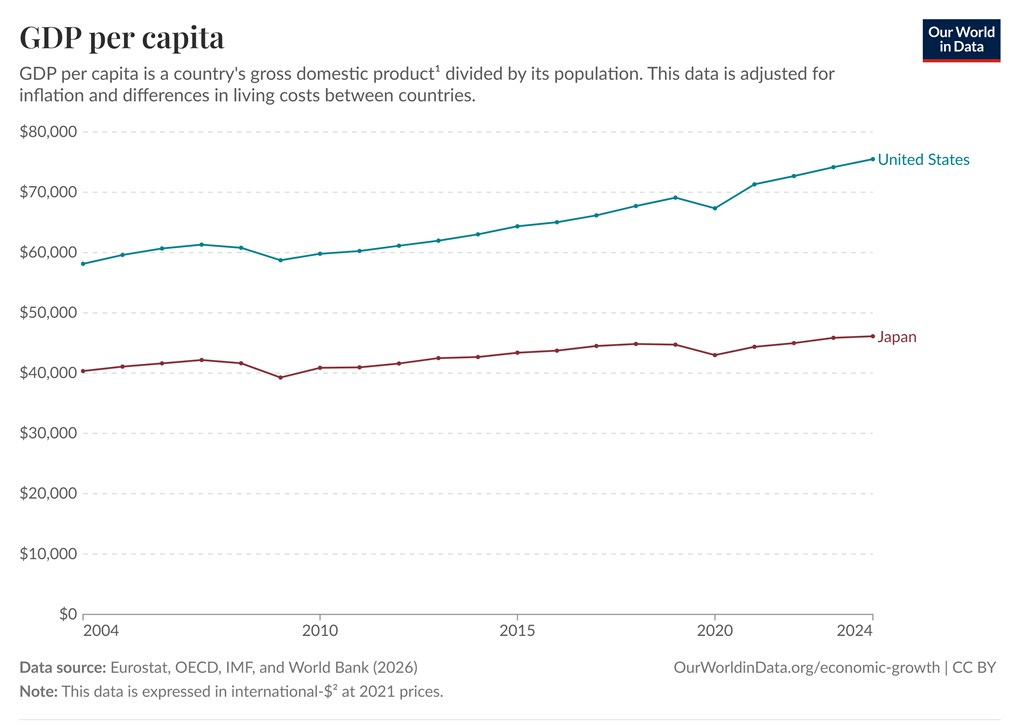
One difference is that my standards for what counts as a comfortable standard of living have crept up, due to America’s own more rapid rate of growth since the mid-2010s — and possibly from my own income growth over that same time period. Twenty years ago, for example, the cheap quality of Japanese furniture didn’t seem that different from the more comfy but dilapidated American version; now, Americans (and my social circle) tend to have nicer and newer furniture, while Japanese furniture basically hasn’t changed.
Another factor is the depreciation cycle. In the early 2000s, Japan was just coming off of a decade-long construction boom — some of it engineered by the government in an attempt to fill the hole in aggregate demand left by the country’s “lost decade”. A lot of building facades and train stations that looked shiny and perfect in 2004 now look a little weathered and dilapidated, despite Japan’s tendency to spend a lot on maintenance and upkeep. This doesn’t mean those buildings and infrastructure function any less well than they did when they were new, but the slow depreciation creates the subtle illusion of a shabbier country. (This will, of course, be an even more pronounced phenomenon in China in the 2030s.)
A third factor is the weak yen. When I lived in Japan for the first time, a dollar was worth only about 100 to 120 yen; now it’s 160. Foreigners can really live like kings here now, thanks to the exchange rate. That makes the locals feel poorer in comparison.
Yet another subtle change is that fewer young Japanese people live with their parents than they did two decades ago. The “parasite singles” of 2004 were able to live nice lifestyles while working only a low-paying or part-time job, or even not working at all, because their parents’ high incomes and stored-up savings were footing the bill. Now, with that wealth having largely run out, and with the high-earning Boomer generation having retired, you don’t see as many young people able to afford international vacations, designer handbags, and so on. (Luxury brands have proliferated, but this is more due to population aging and the tourism boom.)
There are other factors creating the illusion of Japanese poverty, which deserve their own separate sections. These include aging, the expansion of paid employment, and the effects of social media.
Everyone is 50 years old
When I lived in Japan 20 years ago, it felt like most people around me were my own age, or maybe a little older. Now, when I go to Japan, most people around me still feel…my own age, or maybe a little older.
This is also partly an illusion; I’m less likely to go to places frequented by young people, like dance clubs. But Japanese cities are dense, and everyone walks and uses public transit. I still go to the most crowded neighborhoods, including places with plenty of bars, clubs, cafes, clothing shops, cheap restaurants, and so on. There are simply far fewer young people in the streets and in the shops.
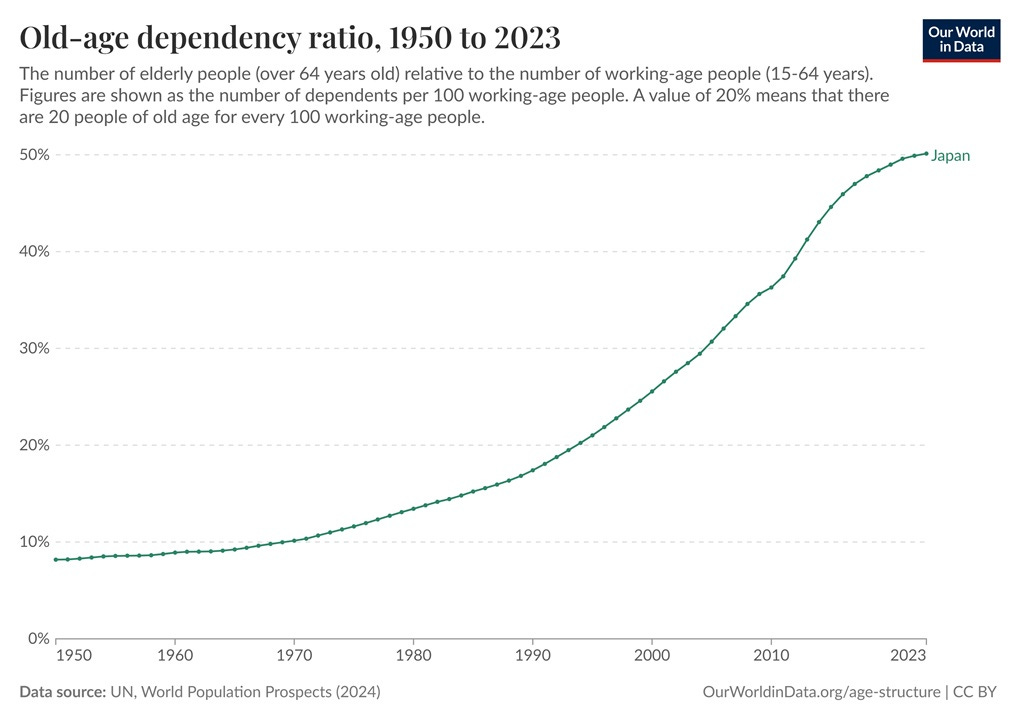
Part of this, too, may be an illusion, driven by behavioral change — the kids may be at home on their phones watching TikTok or tweeting, while older people still go out and experience the physical world. But the statistics don’t lie. When I lived in Japan for the first time, the country’s median age was around 42; now it’s almost 50. Back in the mid-2000s, there were more than three working-age Japanese people for every person past the age of 65; now, there are fewer than two.
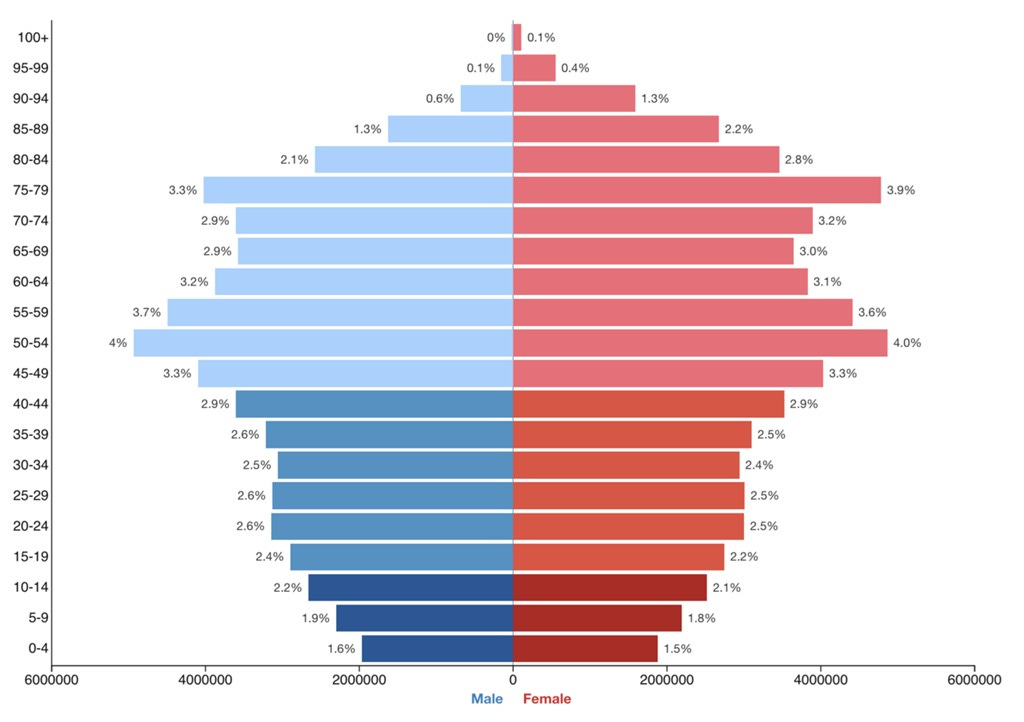
The country’s population pyramid shows this pretty clearly. The generation slightly older than me — now in their early and mid 50s — was actually the most populous, while the generation in their 20s right now is maybe only 60% as large:

The slow disappearance of young people from public spaces has given the country a more tired, less energetic feeling. Whole neighborhoods of Tokyo and Osaka in the mid-2000s felt like what William Gibson once called “the children’s crusade” — a mass of youth imposing their aesthetics and attitudes on society by sheer force of energy and numbers. That’s all gone now.
Aging has also meant less prominence for youth culture in the built environment — anime, fashionable clothing, pop music, and cheap trendy eateries are all less common motifs in Japan than they were decades ago. Meanwhile, nice restaurants and luxury brands — things older people consume — are steadily taking over urban spaces.
The leisure class that made Japan so quirky is vanishing
A major goal of Abe Shinzo’s economic reforms in the 2010s was to put more Japanese people to work. In the 2000s, Japanese people with formal jobs tended to work very hard, but this was only one segment of the population — a very large percentage of old people, young people, and married women simply didn’t work in the formal sector.
Abe changed this, both with macroeconomic and microeconomic policies. Old people now work longer, there are far fewer young “NEETS” or “freeters”, and a change in Japan’s gender roles has led to soaring female participation in the labor force (and, increasingly, in corporate management). When I first lived in Japan, around 63% of Japanese people between the ages of 15 and 74 had a job; now, it’s almost 75%:
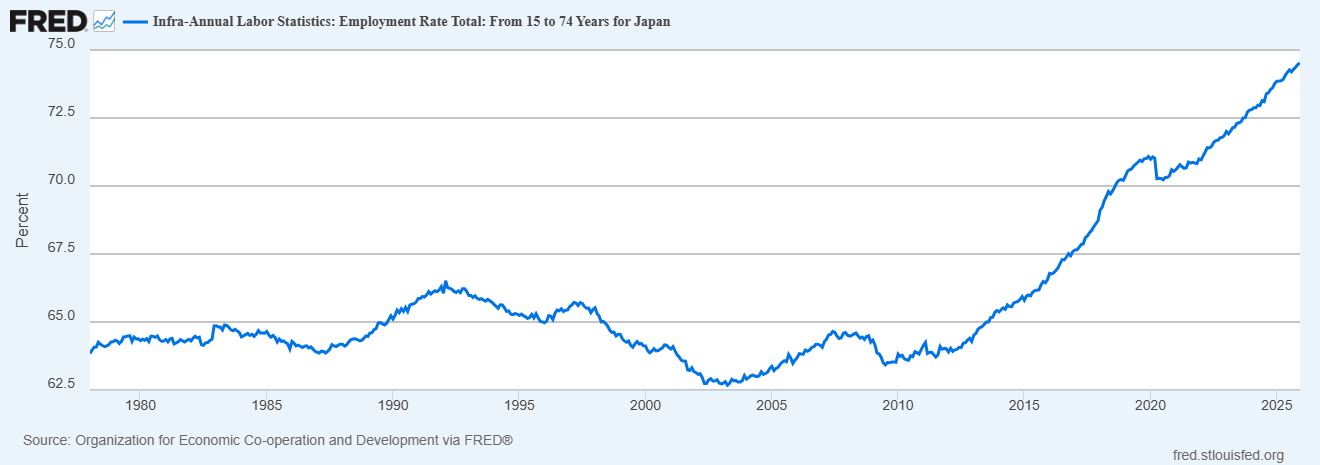
This has been partially compensated for by an improvement in work-life balance. Most prime-age men no longer work long into the night, and local businesses send their employees home at a more reasonable hour. But the disappearance of Japan’s large leisure class has taken with it some portion of the vibrancy and the relaxed, fun atmosphere of the previous era.
This has allowed Japan to preserve its material standards of living, and even increase them a bit, in an era of slow-growing productivity and population decline. It has also facilitated big leaps in gender equality — Japan is a far less sexist society than it was two decades ago. That’s a very welcome change, and it wouldn’t have been possible without the hothouse labor market that Abe’s policies produced.
But the trend toward universal full employment has also come at the cost of the leisure society that some segments of the Japanese population were able to create in the 1990s and the 2000s. That leisure society couldn’t last, of course, but it defined much of what made Japan distinctive during that era.
Without its leisure class constantly working on quirky passion projects, Japan will be a little bit more “normal” of a country. There will be fewer slackers playing in wacky garage bands or sitting around making bizarre art or assembling killer outfits out of secondhand clothes. And that means there will be less of a milieu from which truly gifted independent auteurs — people like Anno Hideaki, Kojima Hideo, Shiina Ringo, or Yazawa Ai — can emerge.
The food is amazing (and young people are getting fatter)
Japanese food is renowned for its quality the world over, and everyone who goes to Japan comes back with starry-eyed tales of how amazing the food is. What few people outside the country seem to realize is that this is mostly a recent phenomenon!
When I first lived in Japan twenty years ago, most Japanese food felt a bit boring to me — bland lunch sets, soggy donburi, and a lot of the same old fish-with-rice sorts of stuff. There were pockets of excellence, but your day-to-day fare was not noticeably better than in America. On top of that, the grocery stores had a pretty narrow range of items — good cheese was incredibly hard to find, fresh fruit cost a ridiculous amount, and so on.
Much of this was due to Japanese agricultural policy, which was some of the most protectionist in the world. In the 2010s, Abe Shinzo broke the power of the Japanese farm lobby and opened the country up to cheap imported food. Combined with the supply boost from the internet and the demand pull from the tourism boom, this led to an explosion in high-quality Japanese food.
In just a few years, bento boxes and soggy donburi were replaced with upscale izakaya, creative fusion dishes, fancy Italian eateries, and ubiquitous A5 wagyu. Japan’s dense cities created a hothouse of competition where chefs constantly strove to outdo each other, experimenting with newly cheap foreign ingredients, while top restaurateurs flocked to the country from Europe and elsewhere.
This was the true birth of what tourists now know as “Japanese food”, and it is amazing. Tokyo is now the world’s best food city, bar none, and Osaka isn’t far behind. If you simply book a random restaurant on Tabelog or pop into a random eatery in one of those two cities, chances are good that you’ll eat somewhere that’s as tasty — and as atmospheric — as the best places you know in New York, or San Francisco, or wherever. Japan’s dining scene is without equal.
The restaurant scene, together with the cafes, the architecture, and the general beauty of Japanese design, is a big part of what has made Tokyo the world’s premier cultural city:
But the opening of Japanese agriculture had another insidious effect: the expansion of waistlines. Japan had long resisted the global obesity epidemic, but the percentage of overweight men (and to a lesser degree, women) has been creeping up since the mid-2010s. A big driver of this is probably the increased availability of cheap calories. This will have ripple effects for years, since research shows that feeding kids more sugar in their youth makes them fatter as adults.
The pandemic contributed to the trend as well. The pausing of school lunches — which were mandated to be healthy traditional Japanese food — led to the percent of overweight kids shooting up:
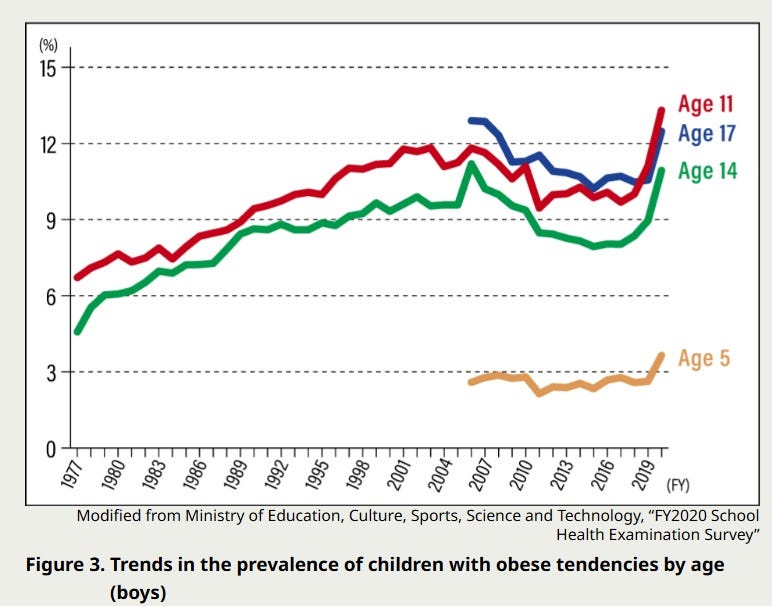
You can really see this on the street — younger Japanese people are chubby in a way they never were before. It’s nowhere near as bad as in America yet, of course. But I expect the use of GLP-1 drugs to rise at a rapid clip.
Tokyo has become a very international city
The biggest change everyone notices now when they come to big Japanese cities is how international they feel. This is mostly due to the ongoing tourism boom, which continues to hit new records despite a petty Chinese boycott. But the long-term population of Japan — and especially Tokyo — is quietly becoming more internationalized as well. As the country’s youth disappear, businesses need workers, and the government has responded with a combination of guest-worker programs and attempts to lure high-skilled permanent residents:
Japan’s total foreign-born population is still smaller than that of Europe (because of the EU and the Schengen agreement) or the Anglosphere (which has a history of mass immigration). But it’s increasing rapidly:
Japan was home to a record 4.12 million foreign residents [at] the end of 2025, an increase of 9.5% from a year earlier, the Immigration Services Agency said Friday…Meanwhile, the total number of foreign residents included 930,428 people from China, the largest group by nationality, followed by 681,100 from Vietnam and 407,341 from South Korea.
Note the sources of the foreign residents. The vast bulk of immigration to Japan is from East and Southeast Asia, with a few from Sri Lanka and Nepal:
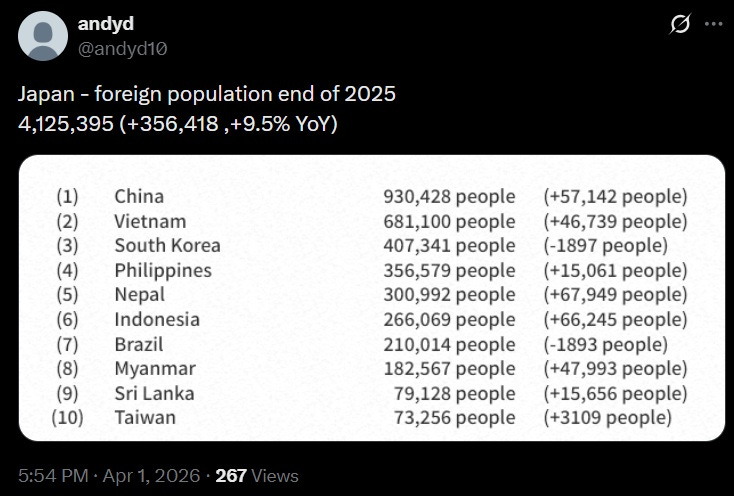
This is why immigration to Japan is mostly invisible to foreign tourists; they see Asian faces on the street and assume everyone Asian is Japanese. This is like assuming that Greeks, Italians, and Poles were “American” in 1915. Underneath the surface, it’s a huge shift. The exception here are the Nepalese and the Sri Lankans, whose presence behind the counters of convenience stores helps disabuse tourists of the old notion that Japan is closed to immigration.
Tokyo is quietly becoming home to an important and influential expat community, including tech entrepreneurs and artists — some of whom live there part-time. Nakameguro in Tokyo is becoming a trendy neighborhood for Americans in the tech industry to live — or to buy second homes.
The anti-immigration backlash in Japan is real, but muted. The Takaichi administration has made it harder to move to Japan permanently, but it’s still not that hard, and there has been no real sea change in the country’s immigration policy. But trouble lies ahead, especially regarding Islam, as the country’s small but highly concentrated population of Pakistanis and Bangladeshis grows.
But in any case, between the tourists and the immigrants, Tokyo now feels like a truly international city — perhaps not on par with NYC or London, but more on the level of Hong Kong before the crackdown.
Social media has mostly destroyed the street scene
Japan is famous for being a society where people live out in public. Instead of hunkering down in giant suburban houses and driving from parking lot to parking lot, they use the train, eat out in their neighborhoods, and walk down the street. This is downstream of Japan’s mixed-use development pattern (and low crime and efficient government):
It enables a high density and variety of small, independently owned businesses. And in the past, it created a vibrant street culture. Young people would practice dances in the train stations, sing and perform on the street for fun (or for money), meet each other at cool hangout spots, show off their clothes, sell independent art on the street, and display their art and other creations in small cheap galleries throughout the city center.
But ever since Instagram, TikTok, Twitter, and other social media platforms took off in Japan in the late 2010s, this street culture has been ebbing away. Social media simply makes it a lot easier to show off your clothes, sell your art, meet people from like-minded subcultures, get a date, and so on; you don’t need the physical public square, because you have a digital one. And public squares have a network effect; once half the people leave, the other half have much less of a reason to stay.
The independent boutiques are disappearing. The dancers are gone from the train stations and parks. The indie art galleries are closing down, or only exhibit on weekends. There is almost no neighborhood where you can just go and hang out and meet cool Japanese kids on the street anymore1 — they’re all on Instagram and TikTok.
This is not only because of social media, of course. The dwindling youth population, increased labor force participation, and falling real incomes all have a lot to do with it as well. But if you ask people why the street scene that defined the 2000s went away, they’ll almost always say “Instagram”. The new technology has reduced friction, but at the cost of serendipity, and that serendipity — the accidental encounters of the physical public square — were part of what made urban Japan so great in its heyday.
Dressing up is out of fashion
The disappearance of the street scene, together with falling purchasing power for young people, has resulted in the slow death of one of my favorite things about Japan: the fashion. When I went to Japan for the first time, I was astonished to see a whole nation of people who seemed to take their appearance seriously — instead of loose-fitting T-shirts and jeans, they wore layers of carefully chosen well-fitted branded clothes that looked good and usually worked together as an ensemble. This is why I briefly took up street fashion photography as a hobby.
In the decades since, Americans have learned to dress a bit better (still not amazing, but a LOT better than in 2004!). But Japanese people dress much worse. Tight-fitting clothes have been replaced by baggy jackets and jeans. Flashy shoes are out; New Balance Classics are in. Complex color schemes have been replaced by simple, muted palettes of browns and blacks and dark blues. In short, most Japanese people just don’t dress that well anymore.
There are a number of reasons for this. One is the continuing influence of the pandemic, which got Japanese people in the habit of not coming out of their houses. Another is the rise of social media, which means that the street is no longer the place to see and be seen. A third factor is falling real incomes and vanishing savings, which force people to shop at discount chains like Uniqlo. Japan’s expanding waistlines might also figure into the picture.
This is one of the changes I’m least happy about, since Japan’s fashion scene has always been one of my favorite things about the country. There are still pockets of greatness, however, and you can see some of these on the TokyoFashion Instagram.
Malls and big brands are taking over
One of the key features of urban Japan that makes it so quirky is the vast number and diversity of small, mostly independently-owned restaurants, boutiques, cafes, and bars. Emergent Tokyo is a great book about how Japan’s built environment makes this diversity of small businesses possible:
Japan’s government also made a concerted effort to promote small business as an alternative to the corporate “salaryman” career — an entryway into the middle class for independent-minded people who didn’t want to deal with the stifling Japanese office culture.
But as Japan ages, those small businesses are disappearing. Restaurateurs and bar owners die without heirs, or with children who would rather not take over the family business. Younger Japanese people tend to prefer the safety of a corporate job, especially now that Japanese work-life balance has improved and workplace culture has become less soul-crushing. The dearth of young people, and the rise of tourism, has shifted the composition of pedestrian traffic toward people who appreciate Louis Vuitton and Zara more than some no-name indie Japanese brand.
Into the void have stepped big Japanese developers, building giant malls where low-rise zakkyo buildings once stood. Monstrosities like NEWoMan Takanawa, Azabudai Hills, and Shibuya Sakura Stage are popping up all over Tokyo, and starting to appear in other cities as well. The interiors of these buildings are beautiful and well-designed, but far more sterile and orderly than the indie landscape they’re slowly replacing. The overhead to put a shop in one of these complexes is large, meaning that big chains and well-known international brands have a decisive advantage.
As a result, Japan’s retail experience is becoming more like that of China, or Singapore, or Southeast Asia, than like the unique, chaotic, quirky, jumbled cityscapes of the 2000s. Everything is gorgeously designed, but the contents are a lot more similar to what you’ll find in other big international cities.
To sum it all up, Japan is losing many of the quirks and special features that made it such a magical place to live in the 2000s. And at the same time, it’s being forced to deal with severe population aging, which is putting a huge burden on its citizens. But daily working life is becoming more tolerable — work-life balance is improving, sexism is diminishing, and corporate culture is becoming less stifling. Just as Japan Twitter is going to merge with the rest of Twitter, Japan itself is converging toward the rest of the world.
I know one or two remaining ones, but I won’t say where they are.