
In the 1980s, a lot of people wrote books and articles about how Japan was going to be the world’s leading country. The most famous of these was Ezra Vogel’s Japan As Number One: Lessons for America. At the same time, in 1989, Bill Emmott wrote a book called The Sun Also Sets: The Limits to Japan’s Economic Power, in which he predicted that Japan would revert to the mean. History has judged Emmott the winner of this contest of ideas. He didn’t get everything right — his characterization of Japan as an export-led growth model didn’t fit the facts, for instance — but in general, he got more right than wrong. His analysis of Japan’s financial weakness, aging challenges, and low service-sector productivity were right on the money.
At the time, though, with Japan at its zenith, it was easy to make Vogel-like predictions of continued domination, and it was out of vogue to be a contrarian like Emmott. The same is true of China today. Over the past few years, skepticism of China’s rise has mostly evaporated in the West, and most Americans now believe that China has either overtaken their country or will do so in the near future:
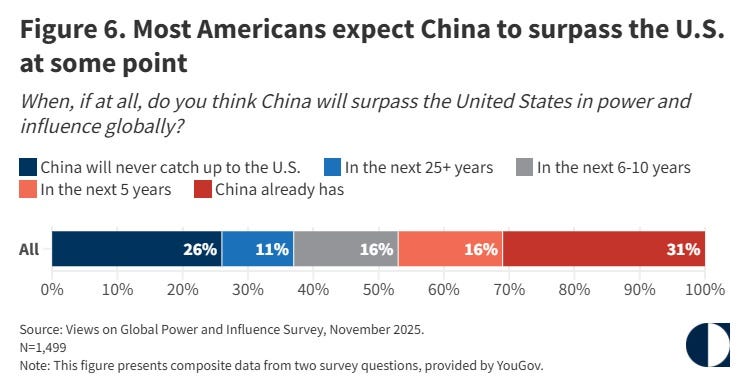
There are still a few hawkish types out there writing articles about China’s coming collapse, but almost no one is paying attention. All the attention is on Chinese cars, Chinese cities, Chinese trade surpluses — or on America’s flailing in the Middle East, its chaotic policymaking, its divided society, and its inability to manufacture anything in volume. Between America’s dysfunction and China’s technological achievements, the idea of a Chinese Century has become conventional wisdom.
In a post last year, I assessed that this conventional wisdom was probably right — that the 21st century would be a Chinese century, although China’s dominance wouldn’t be as pronounced or as beneficial to the world as America’s was in the 20th century:
I don’t think I made the same mistake that Ezra Vogel and many others made when assessing Japan in the 1980s — of just assuming that recent trends would continue. China is about 12 times the size of Japan. It can dominate the world, industrially and geopolitically, without ever coming close to the U.S. or even Japan in terms of per capita GDP.
I also hedged my bets a bit. Though I’ve always been highly skeptical of the idea that demographics will sink China (I think they’ll be more of an annoying but minor drag), and although I don’t think China’s housing bust will sink it, I do think that China’s dictatorial system is already putting it in danger via the personal failings of Xi Jinping:
In the past couple of months, though, I’ve become more of a Chinese Century skeptic than I was before. I’m not quite ready to write a Bill Emmott-style book about how China is going to bump up against hard limits. But I do see several factors that have adjusted my thinking a bit in the direction of China-pessimism, and I don’t see a lot of other people writing about these. So I thought I’d write a post about why I’ve updated.
Basically, the four things I’ve noticed are:
China’s industrial policy is hitting its limits faster than I expected
The rapid rise of AI agents makes me think that China’s technological advantage is less defensible
Xi Jinping is entering his paranoid “Death of Stalin” phase earlier than I expected
Trump’s attacks on Venezuela and Iran, whether you think they were good ideas or not, demonstrate possible Chinese military weakness
These factors don’t mean I expect China to go into decline today or within the next few years. But I do now think there’s a good chance that China is now stumbling in ways that will become more apparent in a decade or two, and will cause it to disappoint many of the current boosters and bulls.
China’s new economic model is quietly hitting its limits
China’s GDP growth has been steadily slowing since around 2010. When the country’s property bubble burst in late 2021, its leaders decided to replace real estate with high-tech manufacturing. This, they reasoned, would have the dual effect of A) boosting employment and aggregate demand, and B) upgrading the country’s technology level. (B) definitely succeeded. There have been many chroniclers of China’s technological achievements since the pandemic, but my favorite is Kyle Chan. Here’s what he wrote in January:
Across a growing array of products — electric vehicles, batteries, drones, rare earth magnets — it is now China that stands at the global frontier…This shift is most apparent in EVs and batteries, where China has become the clear global leader. Ford is licensing battery technology from China’s CATL to produce LFP batteries for EVs and energy storage in Michigan…Western automakers such as Volkswagen and Stellantis are partnering with Chinese EV start-ups to gain access to Chinese EV platforms. Renault, which does not even sell cars in China, established a new R&D centre in Shanghai to take advantage of China’s EV technology ecosystem…
In biotech, western pharmaceutical companies are signing billions of dollars in licensing deals to access intellectual property from Chinese drugmakers, reaching $41.5bn in 2024. In robotics, American start-ups are building with Chinese hardware platforms, such as Unitree’s nimble G1 humanoid robot.
The auto industry is the real centerpiece of China’s post-pandemic tech push. For decades, China had tried to break into the gasoline-powered car industry, with very little success. Then batteries got good enough, and the country leapfrogged the internal combustion engine entirely.
It turned out that the supply chain for EVs was much the same as the supply chain for phones, with the addition of rare-earth magnets (which China had been working on dominating for decades). That supply chain dominance, on top of all the industrial policy subsidies and cheap bank loans, and on top of the country’s huge domestic market, allowed EV makers like BYD and Xiaomi to make what are arguably the world’s best cars for an unbeatable price.
For those who are interested, I highly recommend this Rhodium Group analysis of China’s many auto industry advantages. The story is much the same throughout the Chinese manufacturing ecosystem — a combination of domestic supply chains, enormous scale, and cheap financing is what makes China such a manufacturing powerhouse.
China’s industrial policies led to technological advantages, via the traditional method of learning by doing. China made so many electric cars — and machine tools, and robots, and batteries, and motors, and drones, and ships, and so on — that a huge army of engineers learned how to make those things very efficiently. In developed countries, with their smaller market size and fragmented supply chains, fewer engineers learned these tricks.
That’s why when Chinese companies open up factories in America, they’re more productive than factories owned by companies from other countries. China doesn’t just have a cost advantage; they have the know-how. This is especially important in the rare earth magnet industry, which China dominates and America doesn’t yet know how to replicate at home.
But the industrial policies that enabled this boom came with some big drawbacks. The main one, as I wrote last year, was that China was basically paying its companies to compete away each other’s profit margins:
This was very evident in the auto market. BYD and other Chinese automakers actually started out with pretty good profit margins, but these have steadily eroded as overproduction has resulted in price wars. China’s leaders faced a choice between withdrawing subsidies and letting manufacturing industries consolidate, or forcing their top manufacturers into unprofitability (which would make them less efficient and deprive them of funds for R&D and long-term investment).
In the case of the auto industry, they’re choosing the former, leading to a slump in Chinese auto sales:
China’s auto sales fell in February, reflecting cooling demand as Beijing dials back government subsidies and tax benefits for purchases of electric vehicles…Retail sales of passenger cars fell 25% to 1.03 million units in February compared with a year earlier…Sales fell 33% compared with January…Retail sales of new-energy vehicles, a category encompassing EVs and hybrid cars, fell 32% to 464,000 units in February from a year earlier, the data showed.
Cutting subsidies was probably the right move for China — it’ll force necessary industrial consolidation, leaving the stronger players like BYD and Xiaomi healthier. But the fact that so many car companies — and so many other manufacturing companies — were paid to make products that didn’t turn a profit will result in a wave of bad bank loans. The massive wave of industrial loans — many of them made at below-market rates at the government’s insistence — meant that China’s overall bank debt has kept going up despite the property bust:
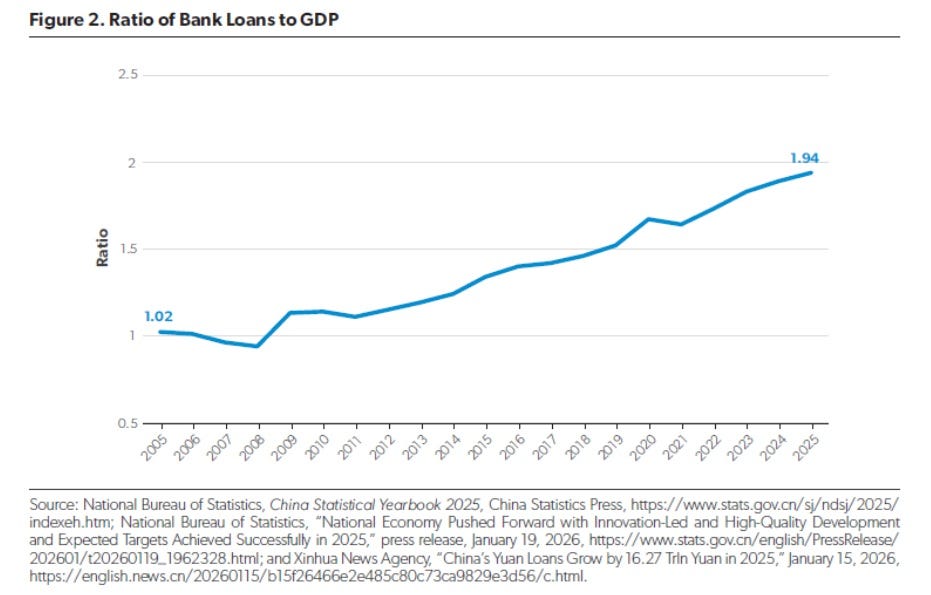
Withdrawing subsidies will mean that a lot of the companies that borrowed a ton of money since 2021 will not be able to pay the money back. That will put a strain on China’s banks, creating pressure for them to “evergreen” the loans — i.e., to keep companies afloat through continued below-market lending in order to delay the day when bad loans are recognized. (This happened in Japan after that country’s bubble burst.)
Thomas J. Duesterberg writes:
Falling tax revenues and low-to-negative returns on investment contribute to distressed balance sheets of central and local governments as well as in the state-dominated banking system…
Chinese banks are consistently encouraged to extend (and “pretend”) the terms of distressed loans to SOEs and favored private firms to avoid social unrest from unemployment and from government failure to provide adequate basic services. This adds to the impact on the banking sector and increases the need to offload goods produced by “zombie” manufacturing firms to international markets. Households holding accounts in distressed banks are at risk of losing their savings and competitive income, which gives authorities an incentive to avoid social unrest by subsidizing the banks.
Beijing is being forced by the rapidly declining rate of return on capital investment to devote an increasing portion of lending to recapitalize and subsidize both banks and firms operating at a loss. Net interest margins have declined by half since 2014. As a result, loans to the real economy have fallen by 9 percent of new credit creation in recent years. Much of the gap is likely going into propping up the banking sector instead of to new investment.
To make matters worse, China’s overproduction has also led to deflation, which raises the real value of the bad debts from the property bust, as well as the new wave of bad debts from the industrial binge. The oil shock from the Iran war may help counter that deflation for a while, but that’s the kind of medicine you don’t want, since it will hurt GDP. Meanwhile, the deflation problem is structural, and will only go away once banks withdraw lending from zombie companies and allow some of them to fail — which requires slowing the country’s overall growth.
Meanwhile, all of this industrial policy is of questionable value to China’s actual citizens. Many analysts inside and outside of China have noted how industrial policy has diverted resources away from Chinese consumers, who were already hurting badly from the loss of their life’s savings in the property bust. This is exacerbated by the fact that the new high-tech industries China’s leaders have promoted don’t provide nearly enough employment to make up for all the jobs that were lost when the real estate sector crashed.
So China’s industrial policies have led to a bit of real productivity growth, some impressive technological showpieces, and probably some increased military capabilities. But they haven’t fixed the hole left by the property bust, and in many ways they’ve probably made it worse.
In fact, the shortcomings of China’s economic model are a bit reminiscent of Japan’s in the 90s. There are plenty of institutional differences, but the overcompetition, profligate bank loans, zombie companies, and property bust are recognizable echoes.
AI has changed the game
China’s techno-industrial model is also optimized for a technological paradigm that is rapidly disappearing. Just as Japanese companies ultimately lagged behind in the age of the internet,1 Chinese companies may end up losing much of their secret sauce in an age dominated by powerful AI.
At first glance, this might seem preposterous. After all, despite export controls on AI chips, Chinese AI models like DeepSeek, Qwen, Kimi, and others have managed to stay somewhat competitive in terms of official benchmarks, on the hardest ones, they’re still significantly behind. And because Chinese companies have access to limited computing power — thanks to U.S. chip controls — they’re forced to use tricks like distillation to keep up. Although we don’t have hard data on whether these tricks come at a cost, many people claim that Chinese models have more “jagged” capabilities — they are near world-class at some things, but fail more often at others.
This isn’t preventing China from deploying AI very rapidly. But as Kyle Chan writes, they’re pursuing a very different strategy from their American counterparts. Instead of racing to “AGI” — i.e., trying to develop more and more powerful general-purpose models — Chinese companies are focusing on AI applications. They’re focusing on AI for manufacturing, AI for robotics, and AI features for apps.
That’s fine and good as far as it goes. And AI will certainly help China overcome its demographic decline, which is one reason that particular story about China’s future weakness doesn’t concern me much.
But if American companies succeed in creating truly powerful, robust, general AI models — as they all claim that they will be able to do over the next few years — it could seriously disrupt China’s entire economic model.
China’s industrial supremacy is based on tacit knowledge and human capital. Basically, the country has an incredibly huge number of skilled and semi-skilled engineers who know from experience how to set up factories efficiently, run production processes cheaply, and make all kinds of different products. It’s very hard for smaller countries like the U.S. and its allies to compete with that sort of pool of accumulated knowledge, since it depends in part on having the enormous scale required to employ all those engineers.
But with truly powerful AI, that all changes. If factory workers and engineers feed all of their data back to AGI models, those models can probably accelerate their learning and efficiency quite a lot. And when one worker or engineer learns a trick for how to improve a production process, AI can transfer that new knowledge to every other worker and engineer. This could dramatically cut down the time it takes for manufacturing companies to execute learning-by-doing, and allow America to catch up in industries like rare earths and battery manufacturing where it currently lags.
And if American AI companies make significant progress with world models — AI that understands the physical world at a deep level — it could erode China’s manufacturing dominance even further.
China boosters will argue that China will take the lead on these applications, shoveling huge resources toward AI-enabled manufacturing. But this ignores the change in the competitive landscape that truly powerful AI would bring. Right now, China is the only country that can accumulate tacit knowledge in a vast array of manufacturing industries — and that knowledge generally stays in China. But if AI democratizes manufacturing know-how, then everyone will have that know-how, not just China. Sure, China will be investing in AI-enabled factories — but everyone else will be able to do the same.
China’s privileged position in the industrial world, built up through all of that carefully nurtured human capital, will be devalued in a world where human capital is devalued. If this comes to pass over the next decade or two — as many are betting it will — China’s greatest economic advantage will be significantly eroded.
More fundamentally, an AI-centric world is a world where China’s biggest asset as a civilization — its enormous human population — will be far less of a source of power. Its willingness to build huge amounts of physical capital — including the electricity to power data centers — will still be important. But the more automated the world gets, the less of an innate advantage big countries have over smaller ones.
Xi Jinping is probably in his “Death of Stalin” phase
On top of economic vulnerability, China is suffering from serious weakness in terms of its political system. In the 1990s and 2000s, the country looked like it had successfully transitioned from a dictatorship into a bureaucratic one-party state with power distributed among a broad oligarchy — not a democracy, but perhaps something within spitting distance of Singapore.
Then Xi Jinping came to power in the 2010s, and immediately began reversing the broadening of power under his predecessors. He purged his rivals and their power bases, installed his cronies in all the country’s key positions, and made himself the key decision-maker across a wide variety of government functions. In other words, Xi has turned China back into a true dictatorship.
Dictatorships have a number of well-known weaknesses, but the most classic and glaring weakness is related to the issue of succession. A man who holds absolute power will not typically be willing to surrender it lightly — and indeed, Xi removed his own term limits and seems intent on ruling until he dies.
Extreme centralization of power also incentivizes coups, plots, and other schemes to seize power, since it makes the leadership position such a huge prize. Dictators know this, of course, which is why they tend to get very paranoid as they get older and the succession starts to loom. Compounding that real reason for paranoia, of course, is the fact that men like Xi got where they are today by being more paranoid and ruthless than the people around them.
This famously manifests as the “Death of Stalin” phenomenon. Stalin was always paranoid and given to rounds of purges, but in the late 1940s and early 1950s his madness went into absolute overdrive, and he began spiraling, purging one ally after another and embracing wild conspiracy theories, until his death in 1953 at the age of 74. Mao Zedong also went into purge madness in his 70s, famously starting the Cultural Revolution at age 72 and tearing China apart just to win back factional power in his sunset years.
The early 70s seem to be a turning point for dictators — the age where slowing mental agility combines with increased talk of succession to drive already-paranoid tyrants over the edge into a never-ending spiral of purges. Xi Jinping is now 72, and there are signs that he’s entering a similar phase. Earlier this year, he purged a top general who was one of his closest and longest-standing allies:
Among China’s generals, one had long seemed immune to the sweeping purges of the high command in the past two years. Zhang Youxia, its most senior uniformed officer…was not just a personal friend of Xi Jinping, China’s leader. He was one of the few military commanders with combat experience, having fought with distinction in a war with Vietnam in 1979. That bolstered his authority as the senior of the two vice chairmen of the Central Military Commission (CMC), which commands the armed forces (and is headed by Mr Xi)…On January 24th the defence ministry announced that General Zhang, 75, and another member of the CMC, General Liu Zhenli, had been placed under investigation for “suspected serious discipline and law violations”….General Liu, who is 61, heads the joint staff department, which oversees operations, intelligence and training. Perhaps more pertinently, he is thought to have close personal ties to General Zhang as another veteran of the border war with Vietnam.
The investigations mean that Mr Xi has now, in effect, hollowed out his entire military leadership in a purge unmatched since the death of Mao Zedong in 1976.
This was only the latest and most spectacular in an ongoing series of purges in which Xi has cleaned out most of the country’s military leadership, much of whom he himself had appointed in the first place. Although some people think that Xi has been doing this in order to clear the way for generals who will be more willing to invade Taiwan, the lack of experienced military leaders will probably force Xi to delay any invasion plans for at least a couple of years — after which he’ll be 74.
And it seems likely that as those new generals consolidate their own authority over the military, an increasingly paranoid Xi will quickly come to see them, too, as potential rivals. China could thus see an escalating series of purges, similar to the late 40s and early 50s under Stalin, where basically anyone competent becomes a target. This would naturally fuel actual plots to remove Xi, as everyone else in China’s top ranks realizes that his purges are a threat to the country’s power and stability. And those plots would simply accelerate the purges, unless and until one of them succeeds.
If this comes to pass, the next five to ten years could see China turn inward in a spasm of domestic political conflict. That would weaken China’s ability to dominate the rest of the world, and it could introduce uncertainty into economic policymaking as well. China has a huge number of competent managers at the corporate and local government level, and lots of smart people in advisory bodies, but as they say, “the fish rots from the head” — having a dictatorship just tends to impose very predictable costs.
War won’t help
Finally, there’s the question of whether China could simply push past these looming economic and political challenges, and win a major war that would cement its status as the global hegemon. Some analysts have even suggested that these problems may cause China to think that their window is closing, and motivate the country to be more aggressive and warlike in the short term.
So it may be. But war is unlikely to help China with any of its long-term challenges.
First of all, there’s the possibility that Xi Jinping would be killed in a war. China’s best radars have notoriously failed to detect U.S. stealth aircraft in both Venezuela and Iran. This, combined with America’s use of AI tools to pinpoint the locations of Nicolas Maduro and Ali Khamenei, allowed the U.S. to execute two swift and successful decapitation strikes. America might not be able to out-produce China in a long war, but if Xi knows that starting a major conflict with the U.S. would mean his own death, that will be a big reason to hesitate.
But even if China did beat America in a limited war, that wouldn’t change any of their fundamental problems. War production might give their economy a temporary boost, but the incentives for overproduction and over-loaning would still be there, along with all of those bad debts. Sinking some of America’s carriers or destroying some of America’s bases wouldn’t change the trajectory of AI. Nor would a war allow Xi to feel secure enough on his throne to stop his purges — if anything, war empowers generals and weakens civilian leaders, which would put Xi even more on edge.
In other words, although some Chinese nationalists might believe they need to seize Taiwan and drive U.S. power out of the Pacific before the “deadline” imposed by China’s long-term vulnerabilities, this is actually just a fantasy. As Putin and Trump are now both discovering, wars don’t revitalize declining countries — in fact, they often simply accelerate the decline.
China, of course, is not currently in decline. It is arguably the world’s leading civilization and nation-state at this point, and it is at its peak. But I’m starting to suspect it won’t occupy that peak for as long as the U.S. did, in its day. It’s not yet time to declare that “the sun also sets” on China, but I think there’s reason to be more skeptical of the long-term success story compared to a year ago.
Mostly because they failed to raise white-collar productivity and also had trouble switching to globalized supply chains.