
There are three basic facts you need to know about the U.S. macroeconomy right now:
The economy overall (growth, employment, inflation) is doing pretty well.
Productivity growth is unusually high.
Job growth is terrible.
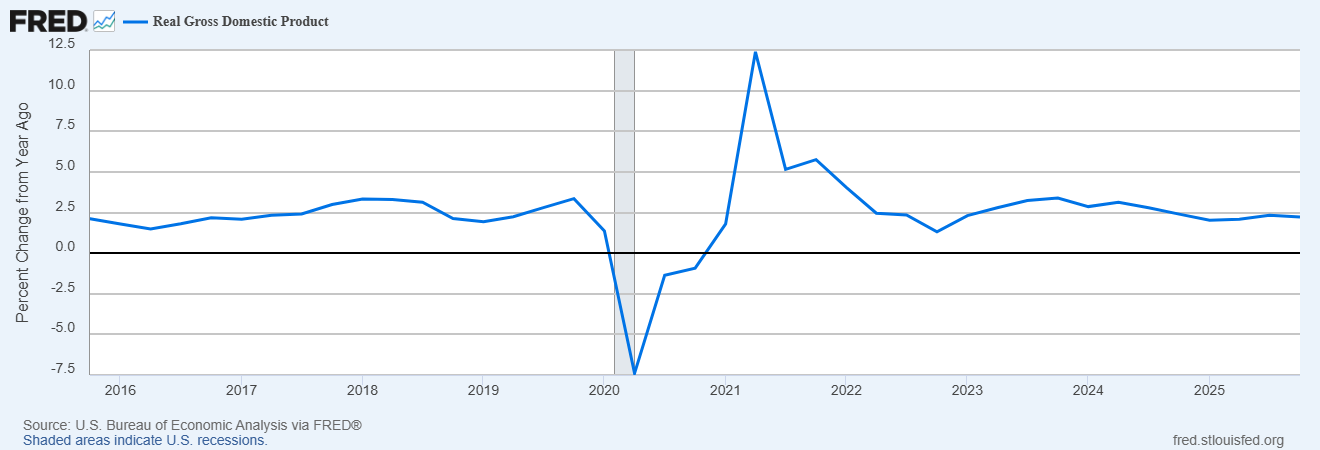
Let’s start with some numbers. Late 2025 is the latest number we have for GDP growth, but it looks pretty solid — around 2.5%, about where it was in the late 2010s.
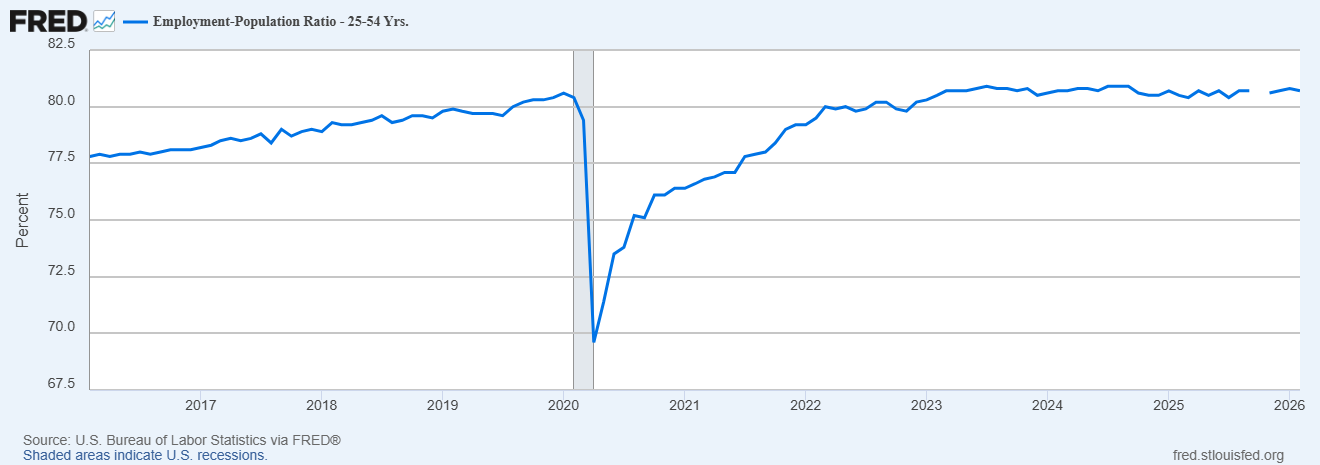
And most people still have jobs. Prime-age employment rates — my favorite single indicator of the labor market — are still really high. Higher than any time in the 2010s, actually:
If you look at unemployment, you can see a slowly rising trend since mid-2023, even if you restrict it to the prime age group. But this is entirely due to more people saying that they’re looking for work — prime-age labor force participation has been steadily rising. So that’s not very scary either. It’s just more of the people without jobs saying that they’re looking for work, instead of just sitting around.
Meanwhile, inflation is still in the 2.5% range — a little higher than we would like, but not particularly fast.
So in terms of the headline numbers, everything is kind of just bumping along. From a bird’s-eye view, this economy looks pretty normal and healthy. Under normal circumstances, I’d be inclined to not even write a post about the macroeconomy this month.
But underneath the surface, two interesting things are happening. The first is that productivity growth has accelerated; the second is that job growth has stalled out. On its face, this sort of pattern might suggest that AI is finally starting to take Americans’ jobs — and lots of people are suggesting this conclusion. But when we look closely at the numbers, the story becomes more complicated.
Productivity is booming
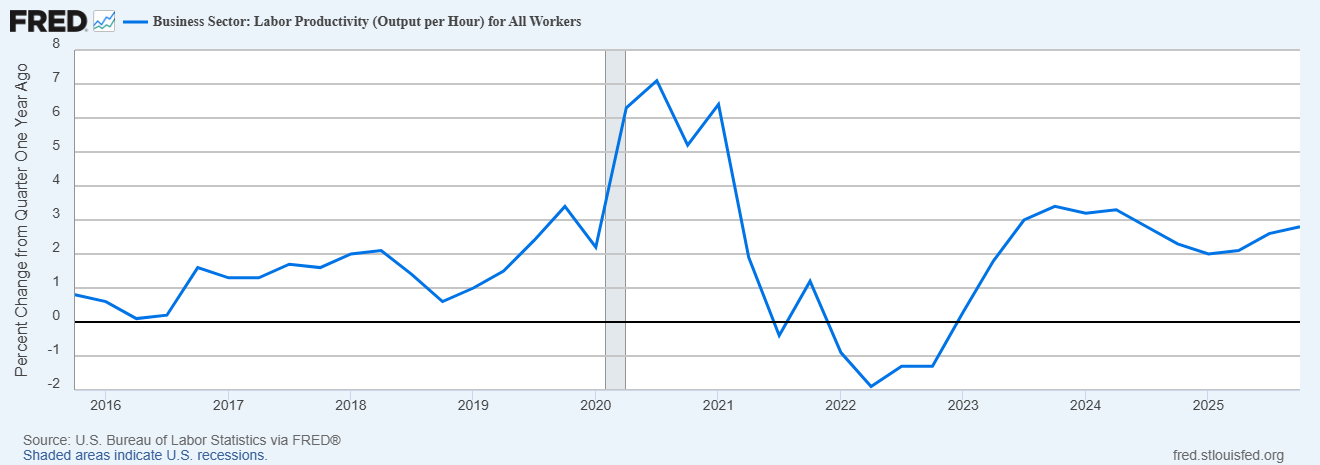
The first is that productivity growth has accelerated. Output per hour — also called “labor productivity”, which is sort of a quick, rough-and-ready measure of productivity — is growing significantly faster than it was in the late 2010s. It’s been at around 2.5-3% since late 2023, compared to more like 1-2% during Trump’s first term:
In fact, productivity is well above where economists thought it would be six years ago:
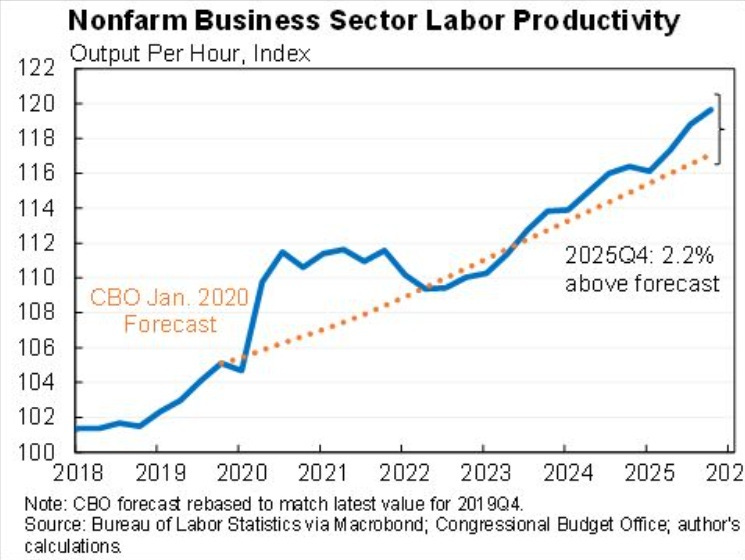
That’s a major acceleration. 2.8% labor productivity growth is about equal to the best decades we’ve seen since World War 2. If that rate is sustained for a decade, or accelerates further, it’ll be pretty historic.
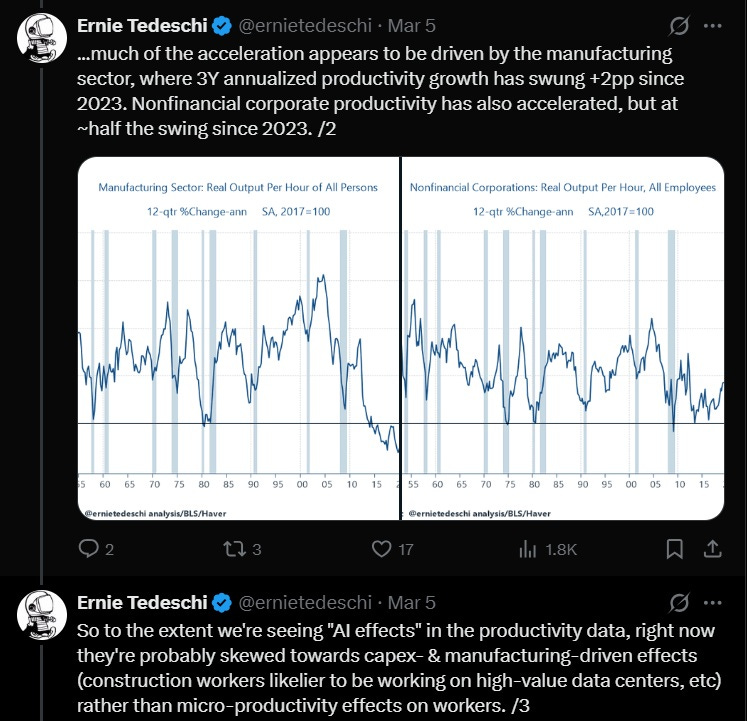
What’s driving the productivity boom? It’s tempting to conclude that AI is making white-collar workers more productive, but Ernie Tedeschi points out that the biggest swing has been in manufacturing productivity. For a long time, manufacturing productivity was basically flatlining in America; now it’s suddenly growing again.
Tedeschi argues that this is also probably AI-driven, but it’s not about people using ChatGPT and Claude Code at work — it’s about the fact that a ton of data centers are being built, and data centers are very valuable:
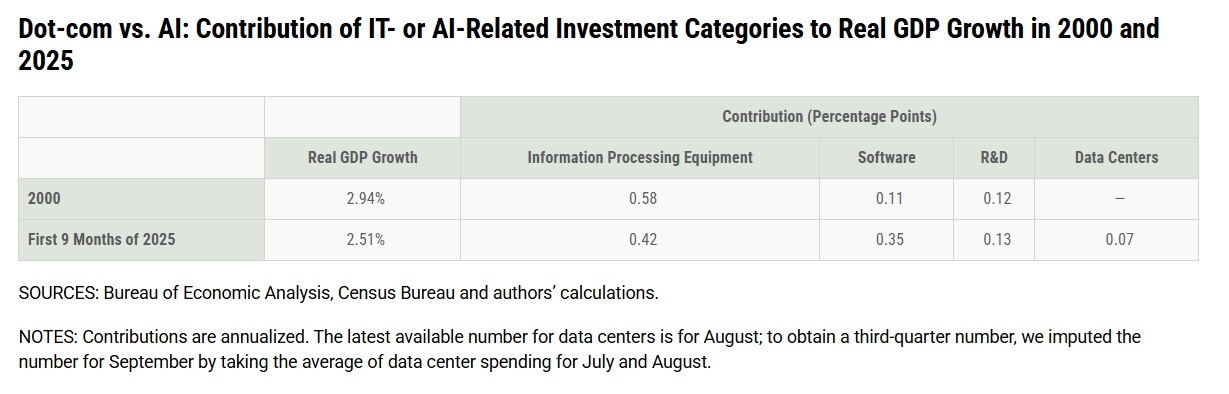
If you look at data centers’ contribution to growth itself, it looks pretty small, but this masks the value of the computers contained within the data centers. Together, the creation of data centers and computing equipment have been contributing about as much to GDP growth as they were during the dot-com boom:
A second thing that’s happening is that American capital is being utilized more intensively — machines are being run for more hours of the day, buildings are keeping the lights on longer, and so on. The San Francisco Fed makes monthly estimates of Total Factor Productivity growth — productivity growth once you take the amount of labor and capital into account — and they find that it’s been pretty fast since late 2023. But once you take utilization rates into account, it looks like there was a moderate burst of TFP growth in 2023-4 that faded in 2025:
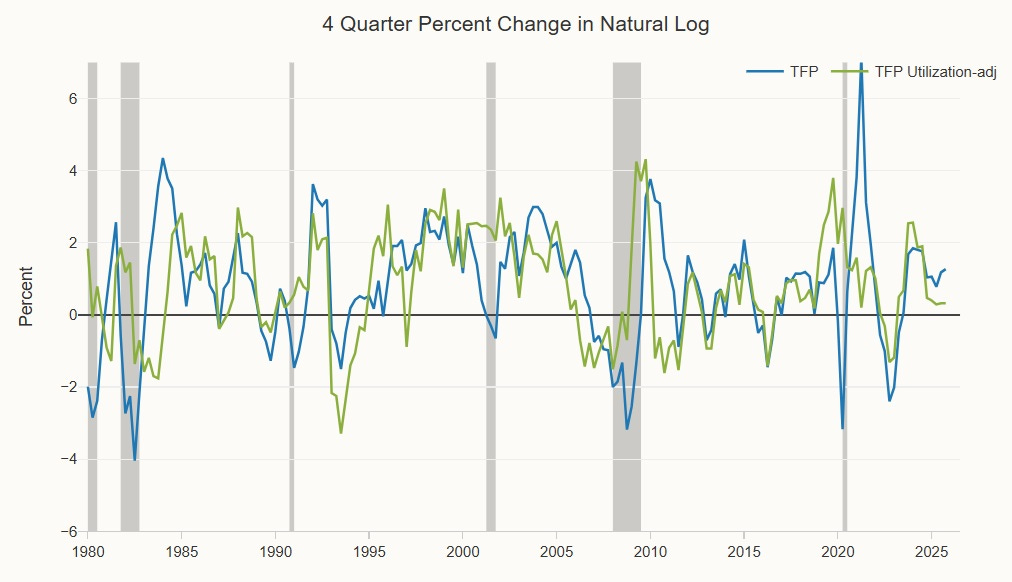
This is also consistent with the story that the data center boom, not an AI use boom, is driving fast productivity growth in America.
A second factor in high labor productivity growth might be less optimistic — Trump’s immigration crackdown might be polluting the numbers. If the President sends ICE into American cities to kick out tons of low-earning immigrant workers — and if lots more low-earning immigrant workers leave the country out of fear of ICE — then you’ll see labor productivity go up just because of a composition effect. But that’s not good for the economy. Rayhan Momin, for example, claims that about 0.6 percentage points — more than a fifth of labor productivity growth — is due to this sort of effect.1
Momin also estimates that a chunk of productivity growth is due to “capital deepening” — i.e., workers having more tools to work with:
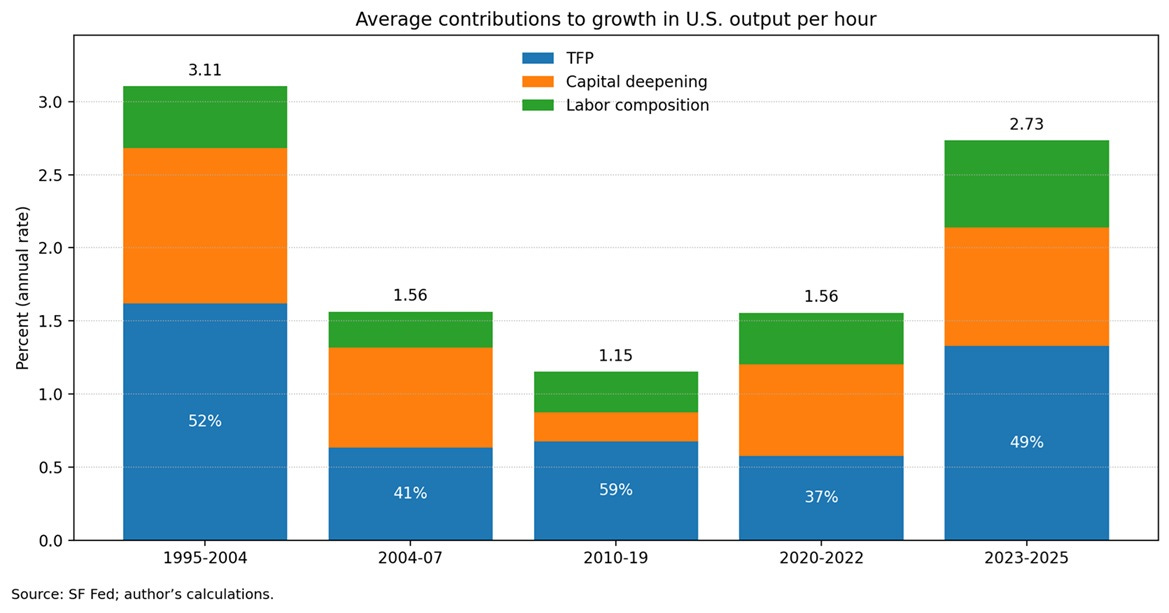
That could be AI. AI tools are an important type of capital — if you give workers more to work with, they’ll be more productive. The BLS confirms that in 2024, output got a big boost from addition of “intellectual property” capital. It’s not clear whether this is AI, but it’s a likely candidate. And remember that software investment has been contributing a lot to growth in recent quarters.
So it looks like AI probably is contributing to productivity growth. The biggest part of this is still the data center buildout, but people using AI more at work — and becoming more productive as a result — is probably part of the story now too.
Jobs aren’t growing, and hiring is way down
The second unusual thing we’re seeing in the American macroeconomy is the jobs numbers. In general, you’d expect job growth to go down as the economy reaches full employment — after all, if almost everyone who wants a job has one, there’s not a ton of room for jobs to grow. But that being said, in the late 2010s, even though employment rates were really high, the U.S. economy still added jobs at a decent clip. In contrast, job growth has been much weaker in recent years — it slowed in late 2024 and again in early 2025, and has actually started turning negative since mid-2025:
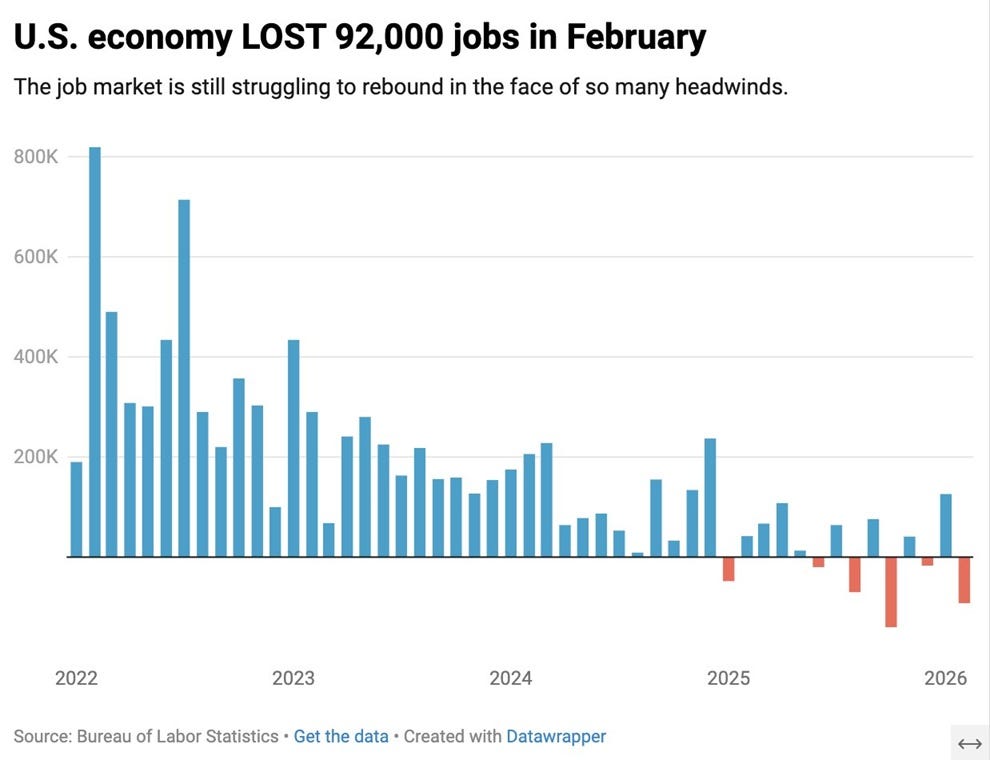
How can the number of jobs be declining if almost everyone in their prime-age working years still has a job? One reason is that a lot of immigrants have been leaving the labor force, due to Trump either kicking them out or — more commonly — scaring them into leaving the country. The civilian labor force hasn’t gone down, but those numbers are based on a survey of individuals, and illegal immigrants might not answer the survey; the jobs numbers are based on surveys of companies, so that might capture the fact that a lot fewer immigrants are being employed.
That said, the employment-to-population ratio for native-born Americans has gone down in the last two years:
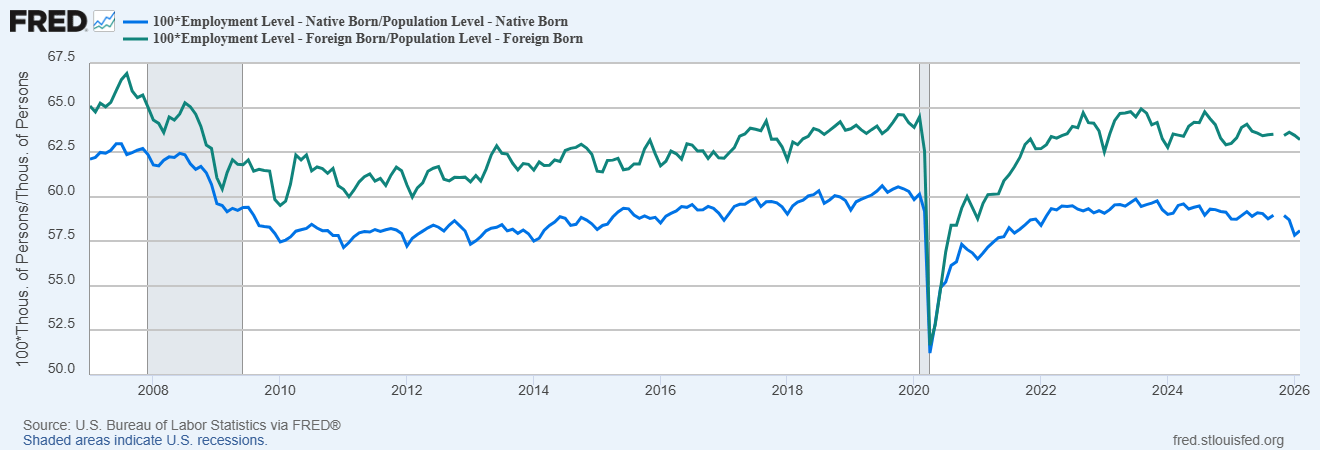
Some of that is going to be due to aging, but aging was also happening before 2023. It’s also worth noting that native-born unemployment has risen sharply. So the native-born workforce is probably seeing a weakening job market.
Another reason jobs can go down while prime-age employment rates hold up is that not everyone is in their prime working-age years. There has been a lot of concern over young people’s employment rates. Youth unemployment has gone up, but this could be because more young people are looking for jobs. Employment rates for young people are down a bit:
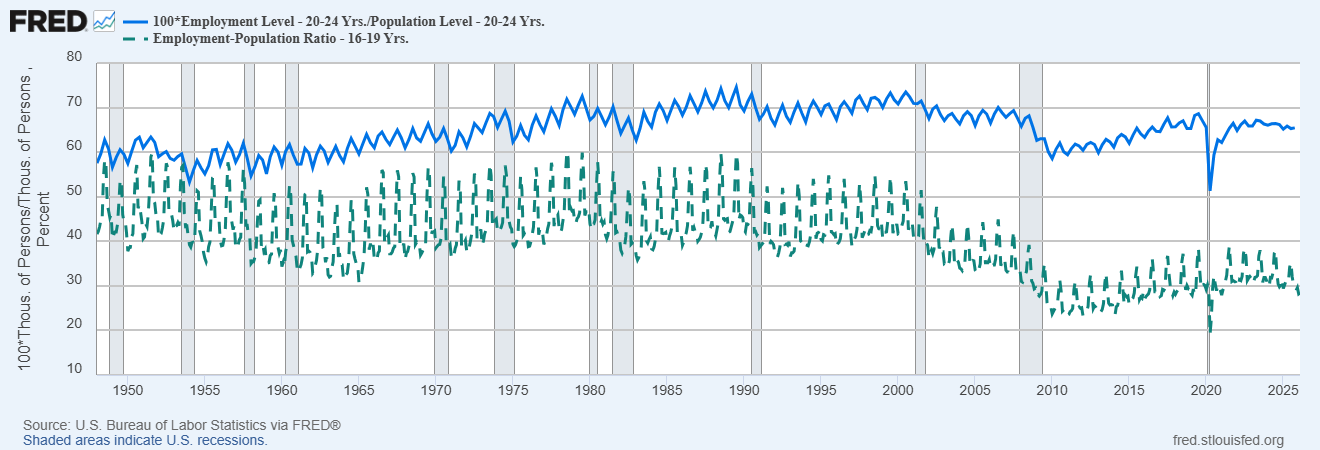
You might think that a lot of this is AI, preventing young educated service and professional workers from getting a job. In fact, there is micro evidence that companies that use generative AI more tend to hang onto their old workers and reduce their hiring of young workers. And indeed, at the macro level, we do see a decline in young college-educated workers’ employment rate, which accelerated in late 2025:
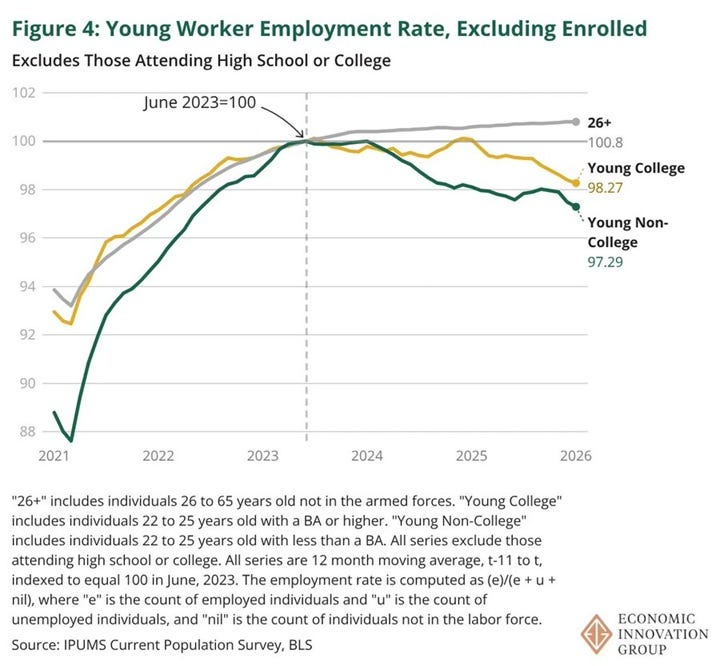
Interestingly, though, the decline for young non-college workers has been more pronounced — despite the data center buildout, which has required lots of construction workers. So although AI-generated job loss might be a story for some young workers, it’s probably not the biggest thing showing up in the aggregate statistics. Something else is going on as well.
So far, despite the bad jobs numbers, the overall weakness in the labor market looks very mild. But underneath the surface, something weirder is going on. People are still working, but they’re not changing jobs like they used to. Hiring is way down, relative to the number of workers in the labor force:
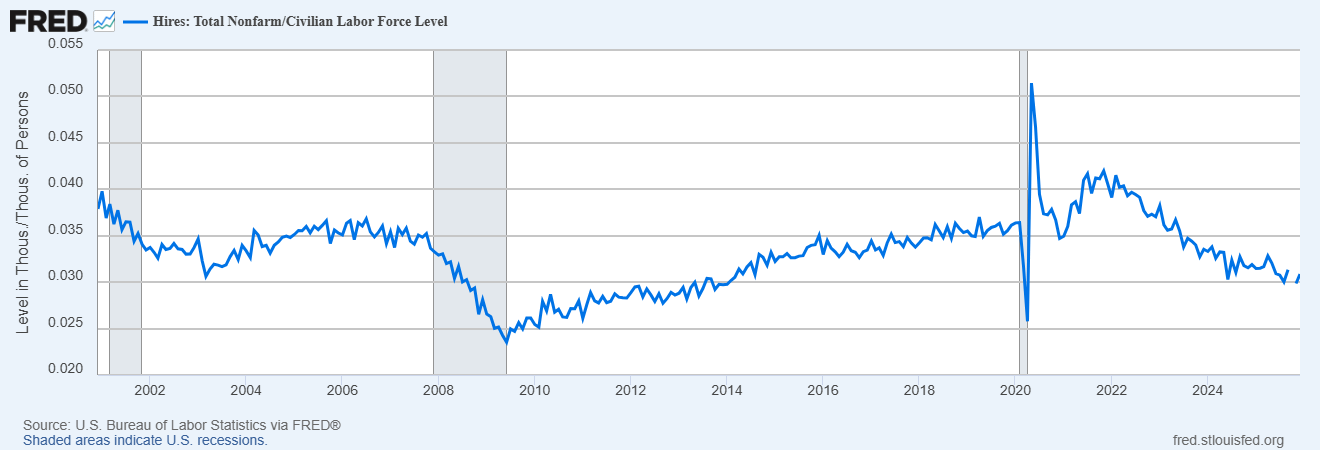
This is basically recession-level hiring. The only reason most people still have jobs is that layoffs and quits are also way down. People are just hunkering down in their existing jobs, and companies are keeping them on board instead of laying them off. There’s just very little churn.
This could definitely be AI. Again, we do have evidence that when companies get AI, they tend to hang onto older workers and reduce hiring of younger ones. That’s consistent with what we see in the white-collar workforce, and in the lack of job market churn.
We also see employment weakness in the tech industry, where the impact of AI is probably hitting the hardest:
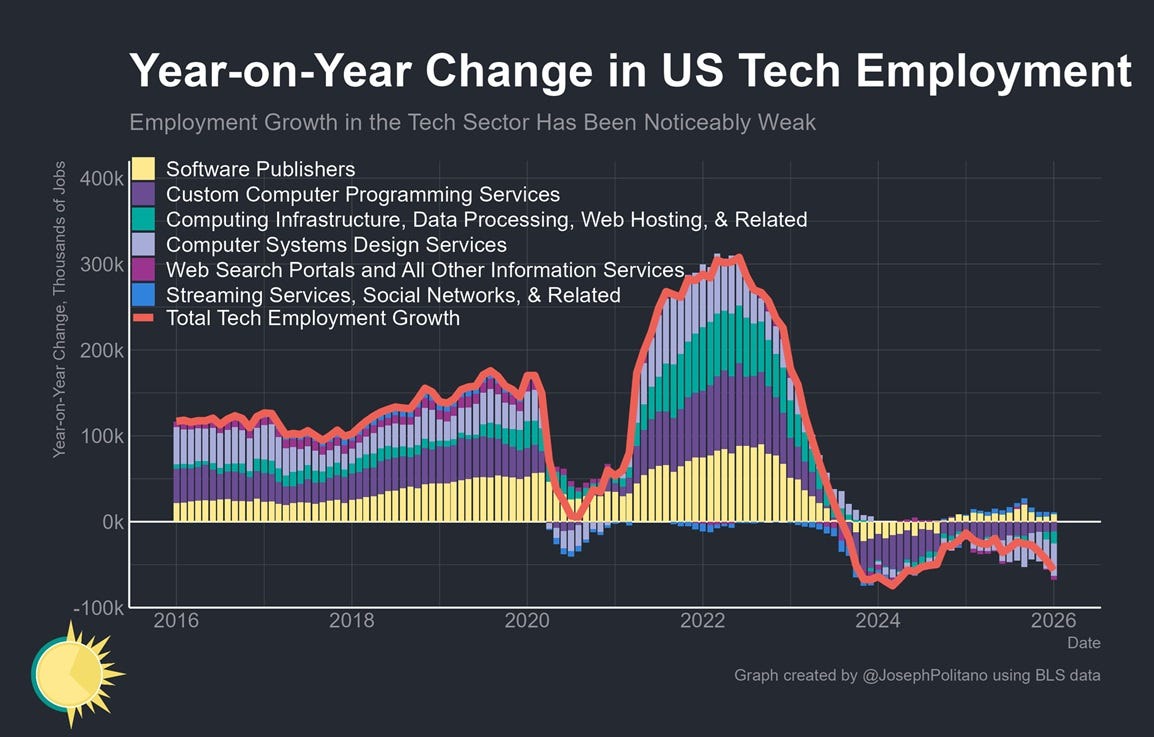
In 2024 it was easy to think that tech companies had just over-hired during and immediately after the pandemic, and were having a much-needed correction. But the slump has now lasted so long that tech employment is below its long-term trend:
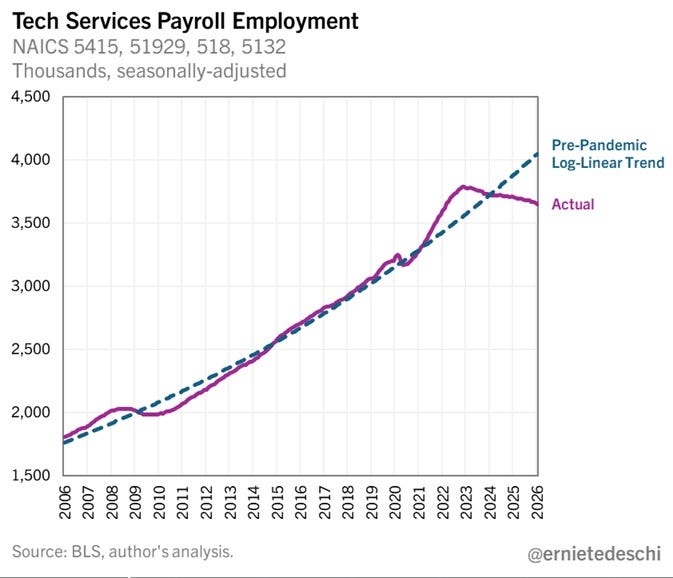
So this could definitely be AI.
But note that the typical story of “companies have AI, so they don’t need human workers” doesn’t have to be the main culprit. It could also be the case, as Matt Darling suggests, that AI has gummed up the job market by allowing applicants to spam applications, making it harder for companies to figure out who to hire:

Another possibility, which seems obvious to me but which I haven’t yet seen anyone suggest, is that AI uncertainty could be more important than the actual effect of AI here. Companies probably don’t know how to use new AI tools like Claude Code yet. And they also don’t know what those tools are going to look like a year or two years from now. So it makes sense for them to hold off on hiring new workers until they figure out how many and what kind of new workers they need.
So “AI is hurting the job market for some workers” doesn’t necessarily mean “humans are going obsolete”.
And in fact, tech is only a small piece of the U.S. workforce. Blue-collar employment has also taken a big hit, especially in manufacturing and in transportation/warehousing:
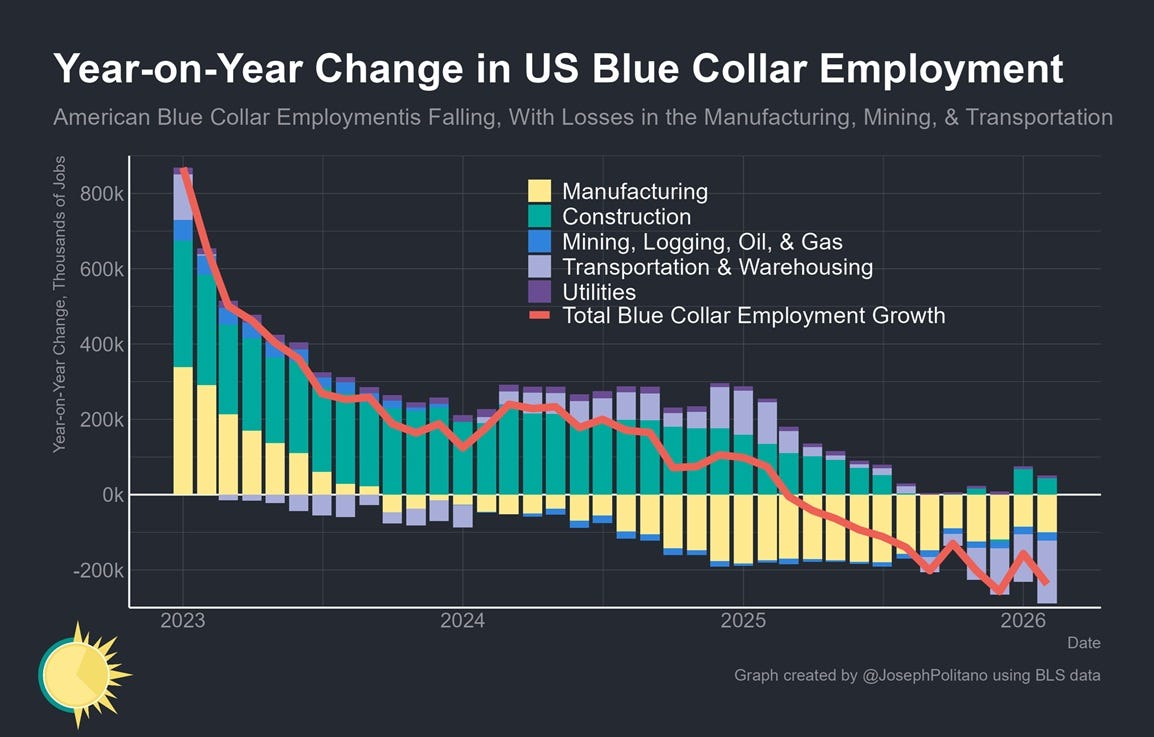
This doesn’t suggest AI; automation of factories and trucks has not proceeded very far yet. A much likelier culprit is tariffs. Manufacturing and transportation/warehousing are two of the most tariff-exposed sectors — the former because manufacturing relies on imported intermediate inputs, the latter because imported goods have to be moved around and stored.
It’s also possible that Trump’s immigration crackdown has just hurt a bunch of blue-collar industries like food processing that rely on immigrant labor, forcing them to shrink their operations and lay off native-born workers as well.
So anyway, there is lots of weirdness going on underneath the surface of our seemingly normal, healthy economy. AI probably is propping up productivity and might be hurting some parts of the labor market, but the simple story of “humans are getting replaced” probably doesn’t explain the aggregate numbers. Other weird stuff is going on — the mad scramble for AI investment, Trump’s tariffs, the immigration crackdown, technological uncertainty, and other factors are all in the mix here. The U.S. economy isn’t broken (yet), but it doesn’t work like it used to.
It’s hard to estimate; you have to make a guess at the productivity level of the workers who left employment.