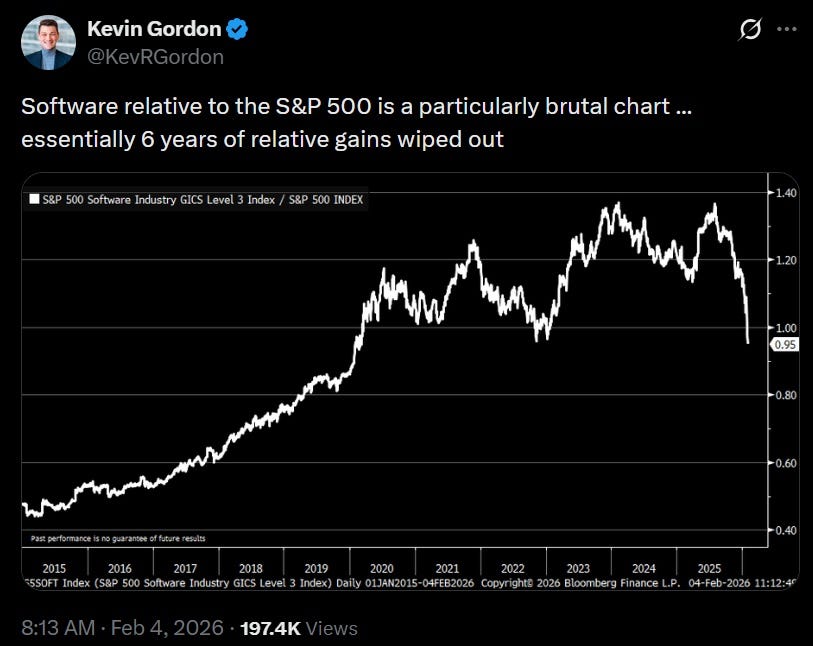
Software stocks crashed today. It’s never possible to be sure why something like that happens — this selloff may even be irrational — but everyone seems to agree that it’s being driven by the fear that AI is rendering a bunch of software business models obsolete. Here’s Bloomberg:
In the span of two days, hundreds of billions of dollars were wiped off the value of stocks, bonds and loans of companies big and small across Silicon Valley. Software stocks were at the epicenter, plunging so much that the value of those tracked in an iShares ETF has now dropped almost $1 trillion over the past seven days…
[T]his drubbing…was triggered [by] concern that AI is on the verge of supplanting the business models of a wide swathe of companies that doomsayers have long predicted were at risk…
AI startup Anthropic PBC released a new tool for legal work, like reviewing contracts…The latest developments raise the specter that AI leaders will overtake established industry players in innovation.
[I]t took a wave of disappointing earnings reports, some improvements in AI models, and the release of a seemingly innocuous add-on from AI startup Anthropic to suddenly wake up investors en masse to the threat. The result has been the biggest stock selloff driven by the fear of AI displacement that markets have seen. And no stocks are hurting more than those of software-as-a-service (SaaS) companies…Few in the software and data spaces have been spared…Shares of software companies including Microsoft, Salesforce, Oracle, Intuit Inc. and AppLovin Corp. tumbled, dragging down the technology sector and weighing on the broader stock market.
Software company valuations are approaching the levels they hit at the trough of the 2022 crash. Nor is this part of a broader market downturn:
Essentially, modern software companies have a stable of human software engineers who implement some sort of task for a client — keeping track of their sales leads, or helping with tax preparation, etc. The client pays the software company a fee to maintain access to that stable of human engineers. They are experts — master craftsmen who draw on a mix of esoteric knowledge, hard-won experience, raw IQ, and access to a vast community of other experts. They are the master weavers, the master potters, the artisan blacksmiths of the modern age.
And like those predecessors 200 years ago, their skills are in the process of being rendered obsolete by automation. Just as a power loom allowed an unskilled peasant to make cloth almost as good as what a master weaver would make — and at a fraction of the price — new AI coding tools are making it possible for relatively unskilled workers to turn out vast reams of software that’s almost as good, and far cheaper, than what a master software engineer would make.
This is “vibe coding”. At first, AI served as a kind of fancy autocomplete for people who already knew how to write code. But with the release of more and more powerful tools like Anthropic’s Claude Code — which assigns an AI “agent” access to your files and lets it keep repeating its efforts until it achieves high-quality results — it’s now possible for complete novices to learn how to make functional applications in hours, simply by telling AIs what they want in English. As these tools continue to improve, the amount of detail and technical knowledge that a user will have to have in order to create a working application will approach zero; software will be conjured up rather than crafted. Executives are already talking about creating software businesses with zero software developers.
Even the world’s greatest engineers are increasingly leaning on AI. Here’s Andrej Karpathy:
Given the latest lift in LLM coding capability, like many others I rapidly went from about 80% manual+autocomplete coding and 20% agents in November to 80% agent coding and 20% edits+touchups in December. i.e. I really am mostly programming in English now, a bit sheepishly telling the LLM what code to write... in words. It hurts the ego a bit but the power to operate over software in large "code actions" is just too net useful, especially once you adapt to it, configure it, learn to use it, and wrap your head around what it can and cannot do. This is easily the biggest change to my basic coding workflow in ~2 decades of programming and it happened over the course of a few weeks.
Karpathy notes that vibe coding helped him realize how much drudgery is involved in traditional software engineering. Dina Bass noted the same thing in a recent post:
But a lot of modern coding is repetitive and time-consuming work that isn’t creative at all, he said. “Engineering isn’t always beautiful code. It’s drudgery,” [Jeff] Sandquist [of Walmart Global Tech] said. “If we can get that off people’s plates, there won’t be nostalgia for that.”
In other words, software engineering was probably less of a “creative class” job than we had allowed ourselves to believe, and more of a “routine cognitive” task — the kind that’s especially vulnerable to automation.
This does not mean there will be no work for people with expertise in software, or no role for businesses that provide software. Code created purely by vibes will usually still have weaknesses, because the humans telling the AIs what they want don’t understand enough to make proper requests. Their software will have security flaws, tech debt, etc. Humans who understand these concepts — who have a detailed, nuanced understanding of what software is supposed to do — will probably be somewhere in the loop to fix problems, maintain code bases, and provide advice to vibe coders (all using AI tools as well, of course). But what they do will simply be different from what software engineers did until just a few months ago. It will be much less of a craft, and much more like setting up and maintaining a factory full of machines.
A great deal of ink has been spilled over the question of whether AI will render human workers obsolete en masse. This question is both catastrophic and unknowable, which is why it’s such a favorite topic. But no one disputes that a new technology can render existing stocks of human capital — the reservoirs of skills and expertise that certain highly paid workers have built up painstakingly over their whole careers — obsolete overnight. It has happened before, and it is happening again now.
Whether AI will do the same to every engineering and scientific discipline is still very much up in the air. We may soon have “vibe physics theory”, “vibe electronics”, “vibe airframes”, and so on — or we may not, if AI hits technological limitations that are as poorly understood as its explosive rise. But it seems certain that although software is particularly amenable to automation by AI1, the current technological revolution is not done upending the lives of various types of technical experts.
It occurs to me that this represents something momentous — the end of an economic age. My entire life has been lived within a well-known story arc — the relentless rise, in both wealth and status, of a broad social class of technical professionals. That rainbow may now be at an end. The economic changes — not just on careers, education, and the distribution of wealth, but on the entire way our cities and national economies are organized — could be profound.
The human capital economy was the Revenge of the Nerds
“All of this wealth attracted a dragon” — The Hobbit
Engineers were always valuable, but they were not always at the top of the economic heap. Books like Emanuel Derman’s My Life as a Quant detail how even through the 1980s, technical experts were modestly compensated and often subordinated within the hierarchy of corporate America — in other words, nerds were weirdos relegated to the basement. Even as late as 1999, the movie Office Space played off of this trope.
Who were the masters of that old economic universe? They were the people we used to call the “jocks” — backslapping businessmen whose networks of human connections and ability to manage large groups of workers made them able to manage large organizations and form stable long-term business relationships. They made sales, they made deals, they inspired the hearts of workers. Compared to those skills, the ability to design a slightly better carburetor was of only limited economic value.
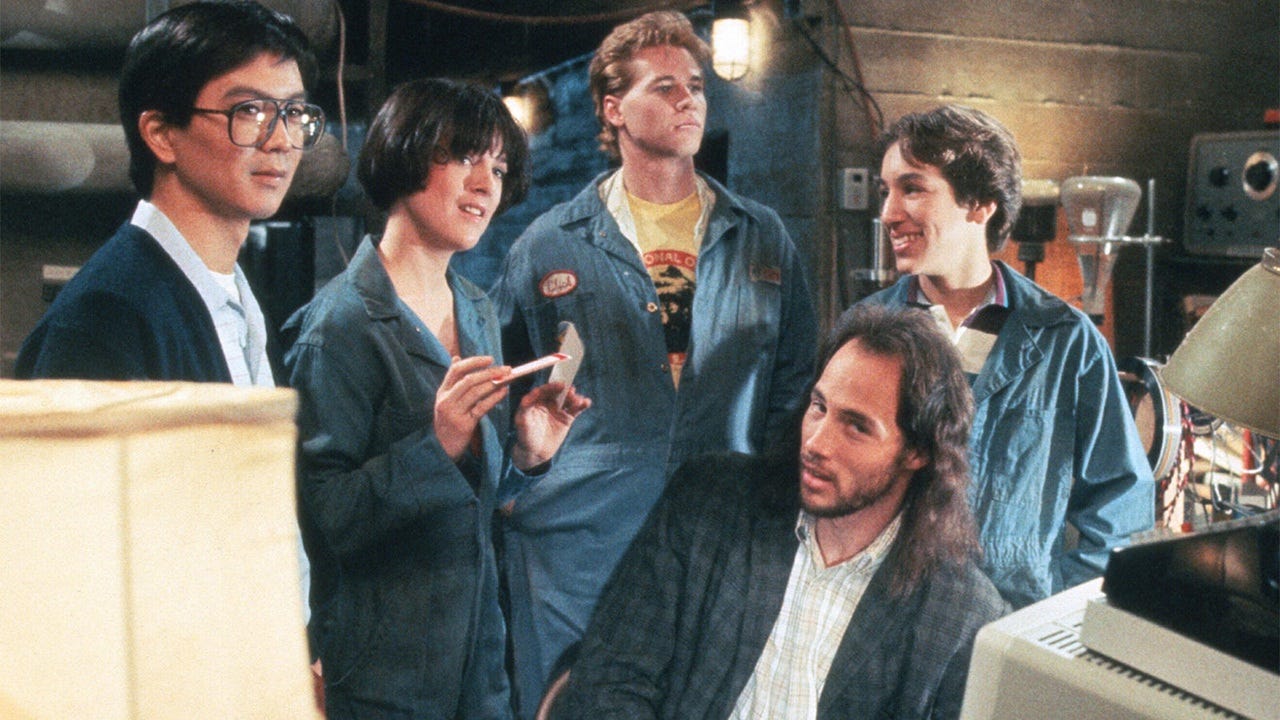
When I was young, I could already feel the winds of change blowing. Movies like Real Genius, War Games, Revenge of the Nerds, and others glorified the exploits of technically gifted social oddballs. It was still a bit of a social liability to be a nerd in high school, but at the same time, everyone was telling me to learn how to program a computer.2
By the time the 1990s rolled around, the Revenge of the Nerds had gone from movie trope to economic reality. The new companies rocketing to the pinnacle of the U.S. economy were not old-line industries like steel and autos, or the financial and retail service firms of the 1980s. They were computer companies like Apple and software giants like Microsoft. These businesses were so technical that they required nerds at the helm. The stereotype of “rich guy” in America changed from the slick-haired finance tycoons of the 80s to the bespectacled Bill Gates.
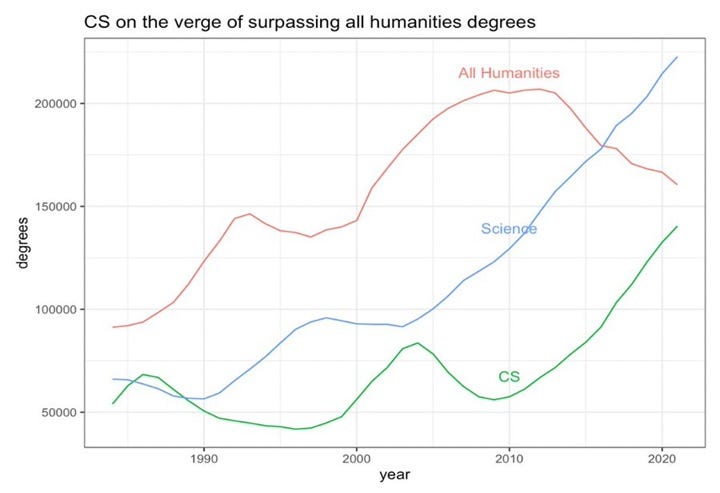
Suddenly, it was cool to be a nerd. That trend only intensified over the next decade. By the 2010s, software engineers were making half a million dollars at big tech companies after only a few years, and big tech companies dominated the U.S. stock market. “Learn to code” was an epithet flung at struggling humanities majors, and people were taking the advice — by 2022, computer science alone was almost as popular in America as all humanities majors combined.
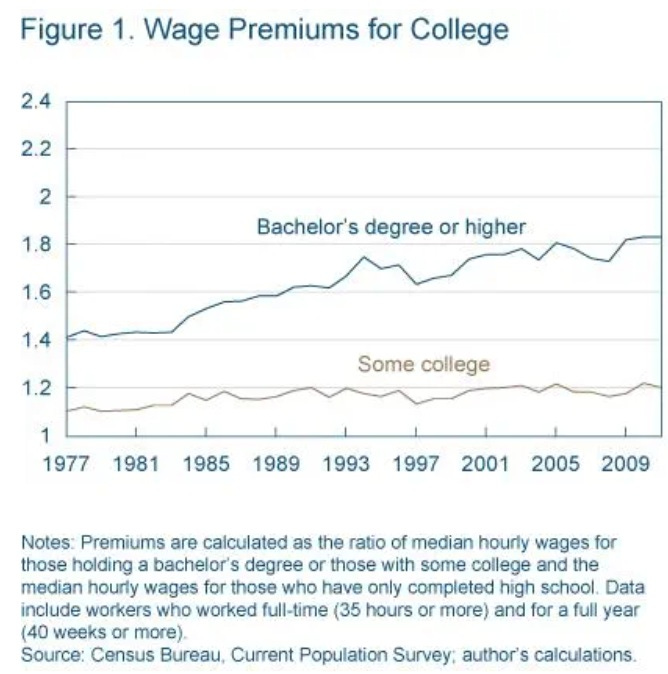
The rise of software engineering as a lucrative career path was actually just the most visible instantiation of a deeper change that was sweeping America: the rise of the human capital economy. As Asia became the world’s factory, the United States won an even more privileged role as the world’s research park. Knowledge industries — software, biotech, finance, entertainment, high-tech manufacturing, and so on — became ever more important to the economy. The college wage premium rose relentlessly, starting right around the time that the kids in Stranger Things were first depicted playing Dungeons and Dragons:
This shift altered the entire geography of America. As Enrico Moretti documented extensively in his book The New Geography of Jobs, the late 20th and early 21st centuries saw a massive shift in prosperity, opportunity, and social health towards places with large concentrations of college graduates — tech hubs like San Francisco and Austin, big coastal cities like NYC, and college towns. If your town had the nerds, it had the money.
It also altered the distribution of wealth. Although there has been much debate about the importance of “skill-biased technological change” for rising inequality, the preponderance of evidence indicates that it was an important factor. The people who could use computers effectively saw their wages go up; those who lacked the education, talent, or inclination to work in the new knowledge industries saw their pay stagnate.3 Today, the people at the top of the list of richest Americans are all entrepreneurs who made their money in tech businesses — Elon Musk, Larry Ellison, Mark Zuckerberg, Jeff Bezos, Larry Page, Sergey Brin, Steve Ballmer, Jensen Huang, and so on.
The nerds had their revenge.
There is a theory in economic history that when workers are expensive, inventors are incentivized to replace those workers. This is Robert Allen’s explanation for the Industrial Revolution. And in a 2017 paper, he specifically applies it to the creation of the power loom that so famously devastated the incomes of master weavers:
With the expansion of factory spinning in the 1780s, the demand for hand loom weavers soared in order to process the newly available cheap yarn. The rise in demand raised the earnings of hand loom weavers, thereby, creating the ‘golden age’. The high earnings also increased the profitability of developing the power loom by raising the value of the labour that it saved. This meant that less efficient–hence, cheaper to develop--power looms could be brought into commercial use than would have been the case had the golden age not occurred…The cottage mode of production was an efficient system of producing cloth, but it self-destructed as its expansion after 1780 raised the demand for sector-specific skills, thus providing the incentive for inventors to develop a power technology to replace it. The power loom, in turn, devalued the old skills, so poverty accompanied progress.
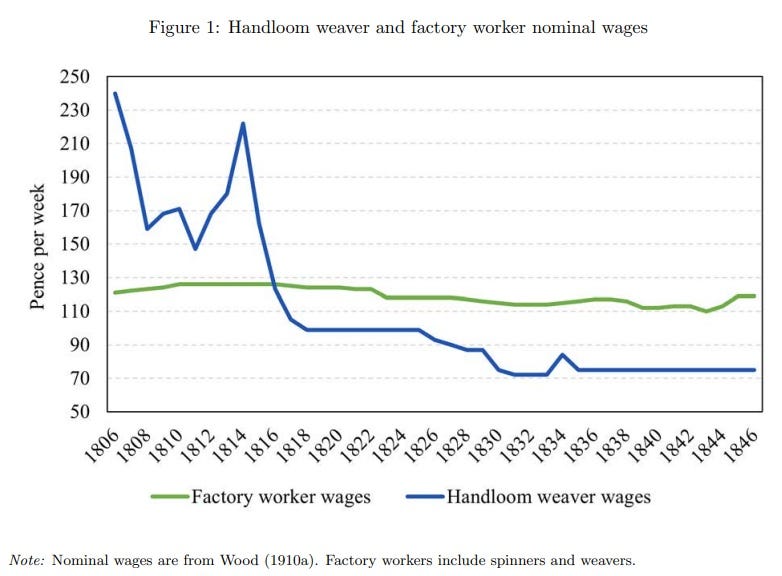
And so it may have been with the nerds. A class of workers can only earn fantastic wealth for so long before inventors start looking for ways to replace their skills with machines that can be scaled up until the cost of those skills falls. And so it was with the nerds; in fact, it was the software engineers themselves who set about trying to automate their own jobs. Now they look to have largely succeeded.
The rise of the nerds in late 20th and early 21st century America felt like a triumph of sorts, especially to older Millennials like myself who could still vaguely remember the scorn once heaped upon computer enthusiasts by back-slapping jocks. But there was an arrogance to my own social class — a sense that we would always be the Masters of the Universe, that as the most intelligent beings on the planet, we would always be the favored sons of any technological paradigm.
But the nerds flew too high, and the sun melted off their wings. It turned out that even intelligence itself was subject to commoditization, and that technology was more powerful than the users of technology. A generation of smart apes trained themselves to make their brains act like computers; it’s hardly surprising that computers eventually rose up and reclaimed their core competence.
Economic implications of the Fall of the Nerds
The age of the nerds is ending, but what will replace it? The human capital economy is about far more important things than who gets to be the cool kids in high school. Careers, fortunes, and the destinies of whole regions are all at stake.
One consequence, as I pointed out a couple of years ago, could be wage compression:
So far, it seems like AI complements lower performing workers more than higher-performing ones, compressing the distribution of skills — much as power tools equalize the physical capabilities of weaker and stronger workers. Althoff and Reichardt (2026) formalize that empirical result into a model, concluding that “AI substantially reduces wage inequality while raising average wages.”
This doesn’t mean that smart people won’t make a lot of money in the future (in fact, it’s possible that everyone will make a lot of money). But it may mean that we come to redefine “smart” not as simple performance on a math test, but as a grab-bag of mental abilities that complement AI — perhaps some sort of combination of traditional smarts with initiative, entrepreneurialism, out-of-the-box thinking, focus, perseverance, and so on.
This sort of broad, subtle skill mix will be hard to identify, but will probably matter a lot in the age of AI. As Joshua Gans points out, modern AI is a “jagged” sort of intelligence — good at some things and bad at others, and it’s not always possible to predict which will be which. Having a broad set of skills will allow human workers to smooth out those jagged edges as needed.
That could mean that the careers of the future look a bit like the traditional “salaryman” jobs in corporate Japan. Salarymen are traditionally identified by which company they work for, not what they do at that company — engineers often stayed in engineering, but other types of workers tended to be rotated through various departments and roles throughout their careers. If you don’t know exactly what AI will be able to do for your company, you’re probably best off in a fluid role where you can find where you complement AI best.
In fact, traditional Japanese work culture had a concept of broad, general work skill, which they called “brain power”:
Although often misunderstood, the term “ability” (nōryoku), which serves as an evaluation criterion in Japanese companies, does not mean specific job skills, but rather means a person’s potential ability or social skills. Another evaluation criterion frequently used is “aspiration” (iyoku). Employees who work hard until late at night are more likely to be valued as having high aspirations than those who voluntarily study to improve their specific job skills. Meanwhile, at the typical workplace in Japan where employees carry out their work by forming a group, it is difficult to distinguish individual employees’ performance, which makes it difficult to evaluate them based on the performance. On the other hand, in the Japanese workplace where work is carried out in groups, distinguishing the performance of each individual is challenging, which makes it difficult to evaluate them on the basis of “results.”
That sounds like it could roughly translate into people’s ability to work with AI.
But AI might also decrease the returns to labor itself. A replacement of human abilities with machines might take us back to the early industrial age, when physical capital — the ability to finance the creation of a factory — was scarce, while cheap labor was plentiful. In the AI age, the return to physical capital — GPUs, data centers, etc. — might soar, driving up capital’s share of income. In fact, labor’s share just hit an all-time low in America:
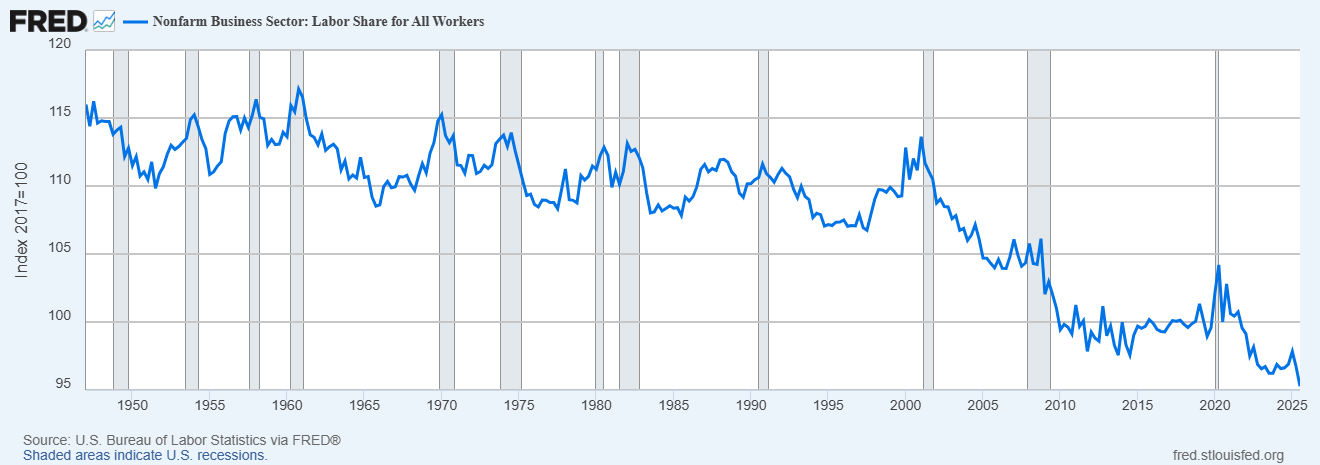
Of course if the AI industry turns out to be hyper-competitive, companies could compete away the return to physical capital, leaving more for labor even as labor performs fewer and fewer tasks. But if AI companies do find ways to protect the value of their vast capital purchases, the Age of the Nerd could be replaced by a new Age of the Robber Baron.
The most troubling impact of the end of the human capital economy, though — and one that few people seem to be thinking about — is that it could devastate the economies of tech hubs like San Francisco. It’s widely believed that clustering effects are responsible for sustaining the ultra-high incomes in tech hubs; engineers simply perform better when they’re closer to each other. They exchange tacit knowledge and diffuse ideas from one company to another as they move between jobs. They also create a “thick market” effect — companies want to locate in San Francisco because that’s where all the engineers are, and engineers want to move to SF because that’s where all the employers are.
But in the age of AI, this may matter much less. Nothing more cleanly demonstrates the end of the age of software engineering than the collapse of Stack Overflow, a website where programmers would ask each other technical questions:
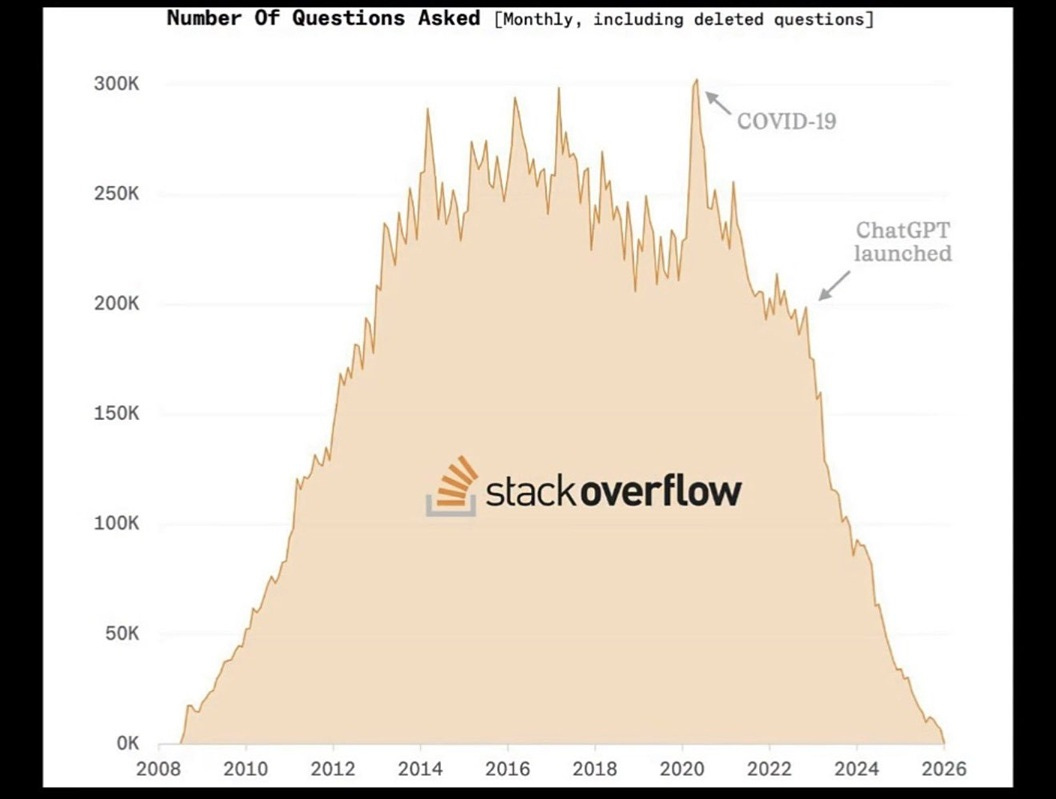
This represents the end of what Brad DeLong calls a “community of engineering practice”. Software engineers are no longer exchanging ideas with each other online; they are getting their ideas from AI, which embeds the distilled understanding of every software engineer who ever lived.
If the people who work with software don’t need to learn from each other, there’s a lot less of an economic reason for them to live near each other. And if companies don’t place a high priority on software specialists in the first place, that removes the “thick market” reason for clustering as well.
A lot of people think that clustering effects are invincible. But we should note that California’s percentage of U.S. tech jobs has actually been falling since the pandemic:
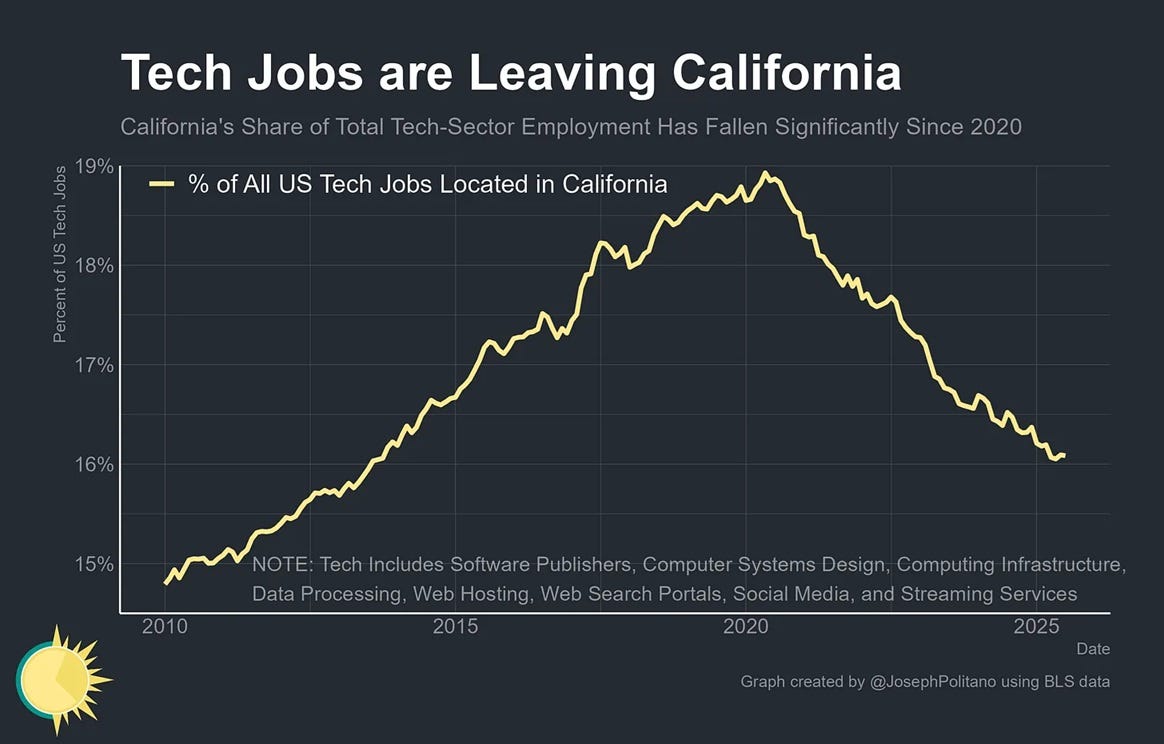
Most of this isn’t due to AI, because most of it happened before AI started automating the jobs of software engineers. But it’s a sign that something has changed, and that clustering effects aren’t the all-powerful force they were long assumed to be. San Francisco and other tech hubs need to take seriously the possibility that they could wind up like Detroit.
My instinct says that the Fall of the Nerds will be a deep, far-reaching, systematic change. The economy that America developed over the past half century — with its tentpole industries based on communities of smart humans working in close proximity — may no longer be tenable in the age when intelligence itself is a commodity to be bought and sold. Throughout history, many social classes have assumed that their dominance was more permanent and less precarious than it turned out to be.
Software’s function is fully specified by a known language, and essentially every effective piece of software is contained in online repositories that can be used to train AIs. These things are not true for many forms of engineering, which contain plenty of approximations, judgement, and data that has never been written down. It will be quite a while before Xi Jinping can tell DeepSeek to design him a working EUV machine.
I proved fairly bad at this, due to my frustration with debugging. I eventually majored in physics, where I could substitute bursts of inspiration for diligent mental drudgery.
Note that Deming (2017) finds that social skills were always an important complement to math skills in the U.S. labor market; engineers who worked well on teams did better than solitary number-crunchers.