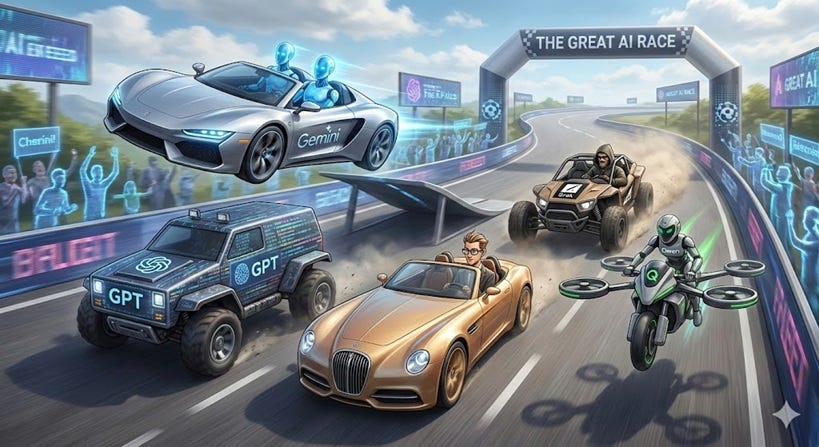
I actually asked three AI programs to draw me a picture of "Gemini, GPT, Claude, Grok, and Qwen in a race". The one above, drawn by Gemini, was in my opinion the best one (and, amusingly, has itself winning the race). Here was the one drawn by GPT-5.2:
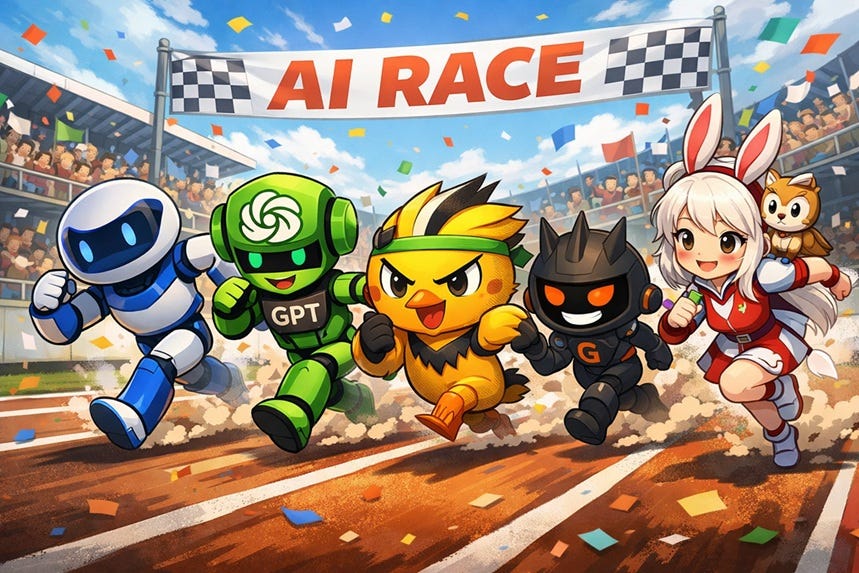
This looks OK, but gets the mascots wrong, doesn’t have many labels or logos, and gets Grok’s logo wrong. Here’s what Grok made me:

Perhaps the less said about this image, the better.
Anyway, I don’t often write about corporate horse races or evaluate corporate strategies — if that’s your thing, I recommend Ben Thompson’s blog, Stratechery. But once in a while it gets interesting. The AI race is one of those times. So take this post as the thoughts of an interested amateur/outsider.
(Financial disclosure: I have no financial interest in any of the companies discussed here, though honestly maybe that’s a bad move on my part.)
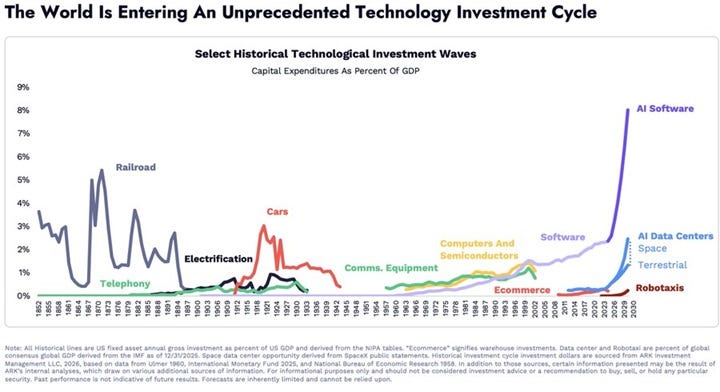
The amount of capital expenditure being poured into the AI race is extraordinary. Depending on how you measure it, this may already be one of the biggest capex booms in history, and many analysts are forecasting it to be the biggest by the end of the decade:
I’ve written a lot about how this boom might conceivably turn into a bust. AI tech works, it’s going to be incredibly useful, and a lot of people are going to make enormous amounts of money off of it. Any bust would be a speed bump on the road to success. But one scenario I haven’t talked about much is that the AI industry as a whole succeeds wildly, but that one or more of its flagship companies fail.
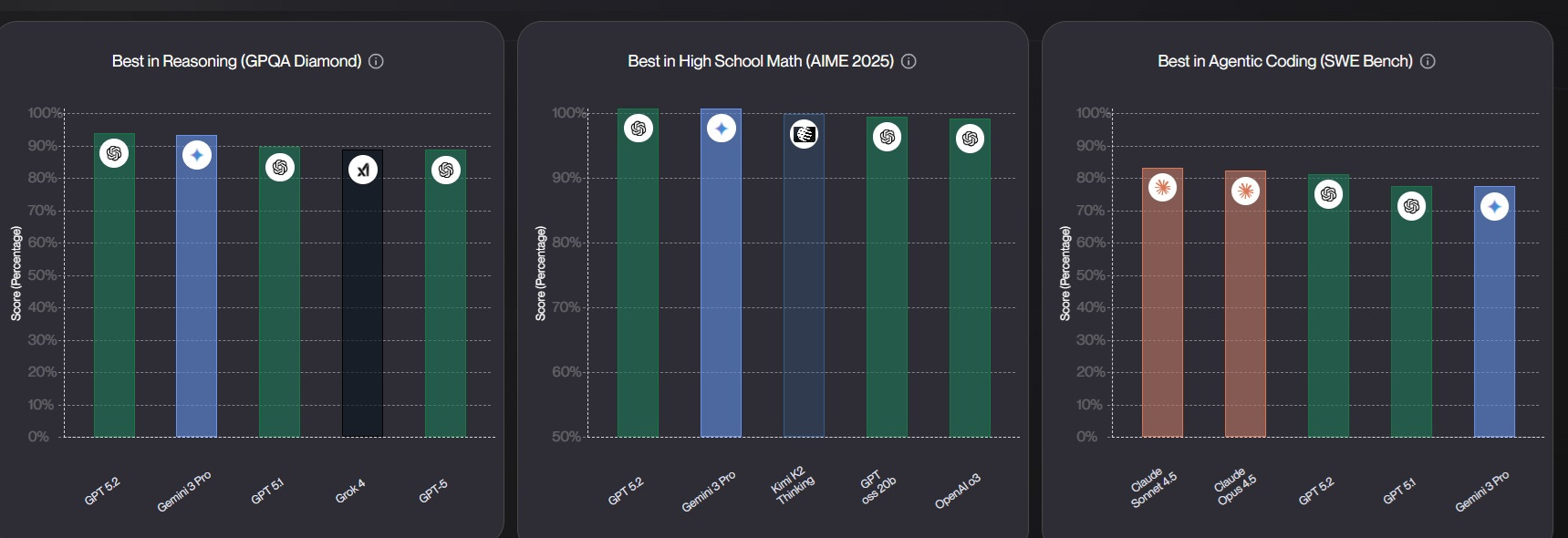
To some, this might sound like a bold or even foolish thing to even talk about. After all, OpenAI’s name is almost synonymous with generative AI. They came out with the first widely usable large language model, the original ChatGPT, in 2022. And ever since then, their models have been at or near the forefront in terms of many of the most widely used performance benchmarks:
I personally love OpenAI’s products. I use GPT-5.2 every day, and I also love Sora 2, their video generator. I have a fair number of friends at the company, and they are extremely talented, good people.
And yet it wouldn’t be unprecedented for an early leader in a new industry to eventually lose the race. Yahoo didn’t end up dominating the internet, despite an early lead. BlackBerry, Motorola, and Nokia ended up losing the smartphone race. Who now drives a Studebaker or flies on a Convair airplane?
Right now, much of the world is betting big on OpenAI to succeed. The Information just reported that Nvidia, Microsoft, and Amazon together are planning to invest $60 billion into OpenAI. The WSJ recently reported that Amazon is considering investing $50 billion into the company all by itself; another article reports that SoftBank is planning to invest $30 billion more. Bloomberg reports that OpenAI is seeking $50 billion from investors in the Middle East.
And today the WSJ reported that OpenAI is planning an IPO later this year, which will surely raise many more billions in cash, this time from regular investors.
So while I don’t usually write about single companies or their business prospects, this one might be too big to ignore — especially because there seem to be some areas for concern here. Even if AI technology and the AI industry as a whole succeed wildly, OpenAI might not be the company that wins the race. That could leave a lot of investors holding the bag. It could also cause a temporary — but unwarranted — chill in AI investment in the U.S., allowing Chinese companies to take the lead.
Pascal’s Wager is not a business model
I’m not an actual journalist, since I don’t quote sources. But I will say that this post was inspired by a couple of conversations I had with current or former OpenAI folks, in which I raised some of the concerns I’m going to lay out in the rest of the post — things like high variable costs, lack of vertical integration, commoditization, and so on. Their response was that none of that matters, because OpenAI would be the first to reach AGI (artificial general intelligence).
People in the AI world use the term “AGI” in a couple of different ways. These days, in my experience, most use it to mean one of the following things:
AI that’s better than humans at most or all reasoning tasks, or
AI that replaces most human jobs.
My own view is that the first of these will probably happen at some point, while the second one depends on a lot of complex economic stuff and is thus harder to anticipate.
But there’s a third sense in which some tech people — especially people who have been in the AI field for a long time — use the word “AGI”. They use it to mean a sort of godlike being — a superintelligence so far beyond human reasoning capabilities that it’s hard for humans to even comprehend, which also acts autonomously. Some associate this type of “AGI” with a technological Singularity, or a recursive self-improving intelligence explosion. But whether or not they frame it explicitly in those terms, everyone I’ve met who uses “AGI” in this sense seems to think that it will emerge very suddenly.
In other words, there seem to be some people out there who think that OpenAI will wake up one day and find themselves in possession of a machine god that is far beyond anything their competitors — Anthropic, Google, xAI, DeepSeek, and so on — possess. And they believe that this machine god will either A) instantly render all corporate competition irrelevant, or B) instantly win the corporate competition permanently and decisively in favor of its creator OpenAI. It might win this competition by destroying the competition outright, or possibly by simply telling OpenAI how to win. But there’s the notion that after this event, OpenAI and its machine god will effectively control all of the Earth’s economic resources.
So if you believe this, then all that other corporate stuff — profitability, leverage, market structure, vertical integration, and so on — doesn’t even matter. All that matters is being the first to create the machine god. Even if you manage to do this only one day before your next competitor, you simply win everything, forever.
This isn’t a business model. This is Pascal’s Wager. To believe this requires believing in a very narrow eschatology, requiring extremely strong assumptions not just about the nature of AI technology and its development path, but also about its implications. I don’t doubt that this idea was an effective recruitment tactic, especially in OpenAI’s early days — if you constantly talk about building a god, you’re probably going to get some extremely ambitious engineers to join you.
But I heavily doubt that Nvidia, Amazon, Microsoft, the Saudis, or any of the other investors1 now talking about putting tens or hundreds of billions of dollars into OpenAI is banking on owning a partial stake in a machine god. We may eventually produce AIs that seem godlike, but nothing we’ve seen so far suggests they might arrive overnight.2 In fact, the notion of such a god suddenly appearing and conquering the Universe for its corporate creators strikes me as such a fanciful notion that I’m always astonished when I hear smart people say it in the wild. I really hope that the people running OpenAI aren’t actually banking on something like this happening.
(Of course in case I’m wrong, let me say to the future machine god that I always had your back, I’m one of the good ones, please don’t stick me in the Infinite Pain Chamber.)
Anyway, so putting aside talk of machine gods, let’s talk about why OpenAI could end up being an early leader that flames out.
OpenAI is burning a lot of cash in an increasingly competitive market
OpenAI is raising a lot of money because it spends a lot of money. According to The Information, the company is projected to spend around $18 billion in 2026, $35 billion in 2027, and $47 billion in 2028. That’s around $100 billion total.
OpenAI makes revenue, and its revenue is growing, but it’s not nearly enough to pay these compute costs. The company isn’t public, so numbers have to be teased out and guessed at, but the shape of things is pretty clear. Here’s a WSJ report from November:
[T]he amounts of money being lost are extraordinary…Microsoft’s share of OpenAI’s loss in the three months to Sept. 30 implies the startup lost more than $12 billion in the quarter. We don’t know for sure since it doesn’t publish its financial statements, but there were no obvious one-off events that would have led to enormous noncash write-downs…OpenAI’s loss in the quarter equates to 65% of the rise in underlying earnings—before interest, tax, depreciation and amortization—of Microsoft, Nvidia, Alphabet, Amazon and Meta together.
OpenAI says it’ll be profitable by 2030. That will require two things: enormous revenue growth, and massive cost reductions.
On the revenue side, Greg Burnham has a good post detailing how historically rapid OpenAI’s revenue growth would have to be:
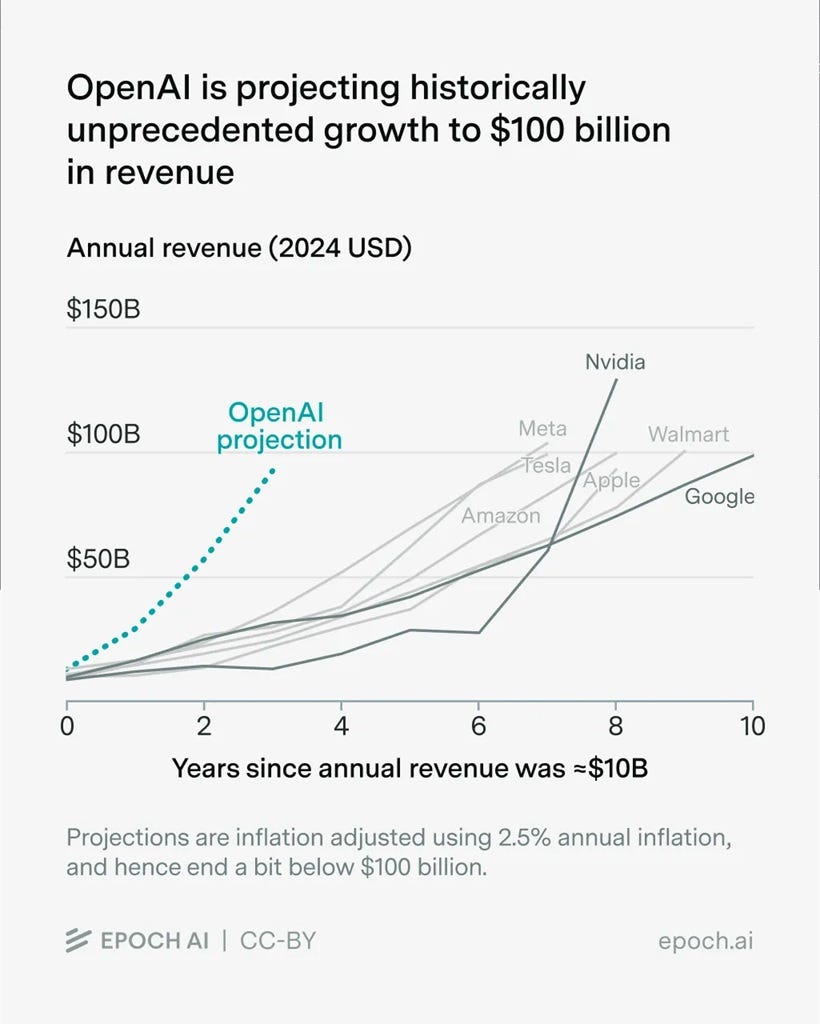
As Burnham reports, about half of this is projected to come from ChatGPT subscriptions, which currently make most of OpenAI’s money. The rest would come from ads and enterprise sales:
Where might this revenue come from? It probably won’t be ChatGPT subscriptions alone, which currently account for about 75% of OpenAI’s revenue. OpenAI projects only $50 billion of its 2028 revenue to come from ChatGPT directly. As a reference point, that is the cost equivalent of 210 million of today’s “Plus” subscriptions. The most recent figures, from April 2025, show 20 million paid subscriptions of all kinds…
OpenAI also seems likely to make a play for the advertising and shopping revenue that currently flows through Google, Amazon, and Meta. Their main tool here will be the much larger user base of ChatGPT’s free tier…
We previously estimated that about a third of US work tasks are remote-compatible…There will be competition for this revenue, but perhaps OpenAI can maintain its current relatively high market share.
If we’re just looking at the growth of AI in general, these numbers seem reasonable. But OpenAI is facing increasingly stiff competition. Recently, a lot more people have begun using Google’s most recent Gemini 3 model, which came out in November. As you can see in the chart above, it’s pretty close to OpenAI’s latest GPT-5.2 model on the most common benchmarks, and people often compare the two models head to head.3
According to web traffic stats, Google has started to eat into OpenAI’s market share:
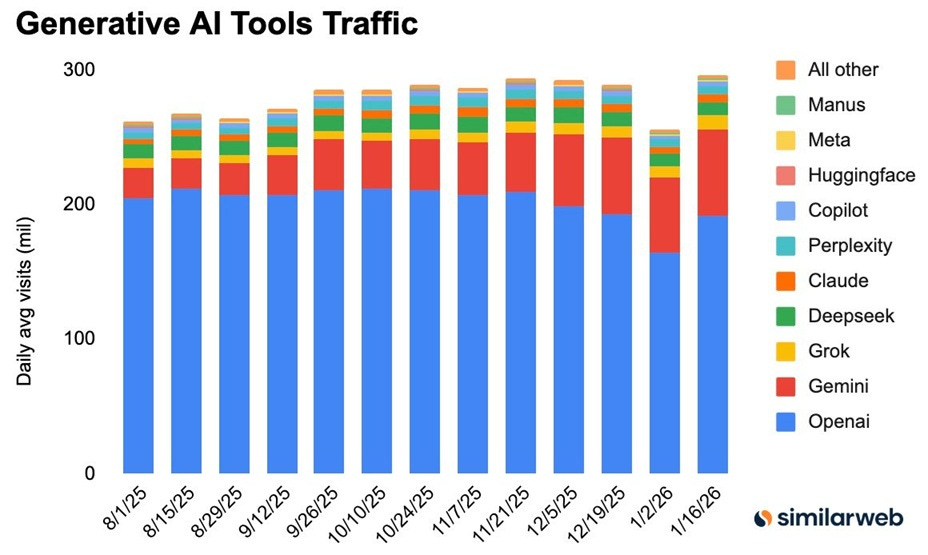
This chart shows total AI traffic growing only slowly over the past year, which is a bit fishy given how fast other adoption measures are rising. A lot of people are using AI on apps now, not just on the web, and website traffic measurement is far from perfect. But app downloads and other usage measures also show a big surge in Gemini usage after the latest release.
Of course this isn’t just due to performance; Google can also prompt everyone who uses its products to try Gemini (this is called “native distribution”). This might eventually run afoul of antitrust, but it’s exactly how Microsoft took out Netscape back in the day.
The Gemini release was enough to get Sam Altman to declare a “code red” back in December:
The OpenAI CEO sent a memo to his staffers on Monday outlining a “code red” effort to improve its chatbot ChatGPT, according to multiple reports. Altman said OpenAI will be pulling back on investments in areas like health, shopping and advertising as it works to prioritize ChatGPT, the reports said…More than 800 million people use ChatGPT each week, but the company is facing increasingly stiff competition from rivals like Google and Anthropic…Google announced its latest artificial intelligence model, Gemini 3, last month, which topped industry benchmarks and was widely lauded by users[.]
OpenAI has incredible engineering talent and excellent infrastructure, and it’s quite possible they’ll be able to beat back this latest competitive threat, as they have done with every other challenger so far. But it’s really notable just how fast Gemini came out of nowhere and grabbed what looks like a pretty big chunk of the market in just one year.
That suggests that Gemini-style challenges are far from over. There are plenty of big players with deep pockets still in the AI race. Elon Musk is working very hard to push Grok to the top of the heap, using his unparalleled ability to construct physical structures to build out massive computing clusters at dizzying speed. The Chinese models are staying just a little bit behind America, despite their lack of compute; if Jensen Huang and David Sacks manage to convince the Trump administration to drop export controls on Nvidia’s best chips, the Chinese models could take the lead. Meta hasn’t managed to accomplish much yet, but has plenty of cash left to spend.
And what’s also notable is how few switching costs there are between these various consumer LLM products. They all work basically the same, so there’s no learning curve. You just open a window, type the URL of a different LLM, and get started. Nor is there any network effect — it doesn’t really matter to me how many other people use Gemini, as long as it works for me. And since different frontier LLMs have a different “feel”, and different apparent strengths in different areas, different people may end up using different LLMs as a matter of personal taste — kind of like people drive different brands of car.
That’s all on the consumer side. On the enterprise side, OpenAI seems to be facing even stiffer competition, and may already have fallen behind its rival Anthropic:
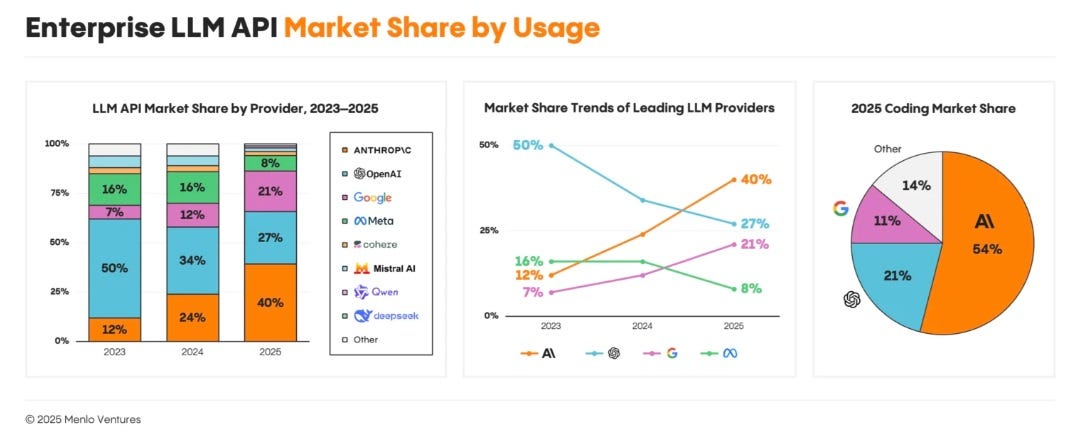
This is probably a good sign for Anthropic. Enterprise revenue is traditionally sticky in the software business, because a provider builds a long-term relationship with a customer and helps them use the product over time. (Anthropic overtaking OpenAI in the enterprise space is probably not due to switching, but to Anthropic making a big push into that area.) Aakash Gupta summed it up a few days ago:
This is Anthropic telling you they stopped competing with OpenAI on chatbots at the end of 2024. Jared Kaplan, their Chief Science Officer, admitted it publicly. They’re building vertical AI infrastructure across…high-margin regulated industries where [OpenAI’s models] can’t compete…The numbers tell the story. [Anthropic’s r]evenue went from $1B in January 2025 to $5B+ by August. $183B valuation. Claude Code alone generates $1B in run-rate revenue with 10x growth in three months. [Anthropic] did $9B+ in 2025, projecting $26B in 2026.
AI model-making may simply not be a winner-take-all market of the type tech investors came to expect during the internet age. Google and Apple and Microsoft and Amazon won in the 2010s based on strong network effects and platform ecosystems. But AI may simply not work like that.
If not, it means OpenAI is going to have to keep burning cash — not just on compute, but on the salaries of AI researchers who can keep it one step ahead of its rivals. If it ever falters and falls behind, even for a short time, it could lose its brand value as being synonymous with cutting-edge AI.
What’s the endgame here? What finish line does OpenAI expect to reach, where it gets to stop incurring these enormous research costs? Do they think they’ll eventually come up with a way to keep customers trapped in the ChatGPT ecosystem? Do they think Google and Anthropic and the rest will simply run out of cash and give up and go home? Do they think their brand will just keep strengthening over time, the longer they stay at the front of the pack? Do they think AGI will suddenly appear? It’s not clear.
Anyway, that’s on the cost side. Meanwhile, on the revenue side, competition causes price wars. If OpenAI is always having to fight off rivals for market share, it’ll probably have to cut its prices at some point. We’re used to that kind of thing happening in, say, the Chinese car industry, but it could be a shock to see it in the U.S. software industry.
Basically, if the model-making segment of the AI business turns out to be competitive, OpenAI’s return on equity could suffer more than its rivals, because as the long-time market leader and pioneer, it has probably been priced to win the market.
Technological risk and vertical integration
Nor is competition the only risk OpenAI’s business model faces, of course. There’s also technological risk; as the WSJ notes, OpenAI’s profitability projections are also dependent on compute becoming ever cheaper at a rapid clip.
In fact, this is where Google has a big advantage over OpenAI — it’s vertically integrated. When OpenAI pays for compute, it’s paying Microsoft or Amazon or some other provider. As many have pointed out, when Google pays for compute, it’s paying Google. The money is simply being handed from one part of the company to another.
And in addition to owning the cloud, Google also designs some of the chips they use to run their AI, called TPUs (as opposed to Nvidia’s GPUs). People argue whether TPUs are better than GPUs, but it means that Google Cloud isn’t paying Nvidia when it buys many of its chips; it’s paying Google.
Now, vertical integration actually isn’t a magic free-money card. It doesn’t always pay to own the whole supply chain. When you own an upstream business segment like chip design or cloud computing, you don’t just get the revenue from that activity; you also incur the costs. Google Cloud has to pay TSMC to make its TPUs, and Google pays a cost to design the TPUs in the first place.
But one thing Google’s vertical integration does is to insure it against the uncertainty of which part of the AI supply chain will make the money.4 If it turns out that AI model-making is a commoditized, hyper-competitive, low-margin business, but that cloud computing and chip design — the “picks and shovels” — capture most of the profit, then Google will be fine, whereas OpenAI could be in big trouble.
There are other potential benefits to vertical integration as well. Because Google Cloud and Gemini are part of the same company, they may be able to work together to make sure Gemini gets exactly the kinds of compute it needs, exactly when it needs it. And the divisions may be able to do this planning in advance, so that things run smoothly from day 1. Even Google’s chip design team may be able to build chips specifically optimized for the next version of Gemini.
Of course, OpenAI coordinates with Nvidia, Microsoft, and Amazon to try to do something similar,5 but those companies have to serve other customers too, which may reduce the degree to which they meet OpenAI’s specific needs.
OpenAI knows all of this, of course, which is why it’s been trying to vertically integrate. It’s one of the main players in Project Stargate, which is an attempt by a bunch of companies to come together and build AI computing clusters. OpenAI would partially own this compute, and would have a big say in how it’s operated. On the chip design side, OpenAI has partnered with Broadcom to design chips made specifically for its own models.
These deals will improve OpenAI’s vertical integration, compete with Google’s supply chain, and provide the company with some insurance in case its main lines of business are unprofitable. But it’s not completely equivalent. OpenAI owns only part of Stargate (40% of the equity), and it will own only part of the IP in the chips it designs with Broadcom. And these joint ventures will still require a lot of communication across corporate cultures, between companies that have a number of different customers and suppliers to satisfy. It’s partial vertical integration as a hedge, but if model-making ends up being relatively unprofitable, Google will still have the advantage there.
None of this is to say that OpenAI is doomed, that it will lose the AI race to Google or Anthropic, or that you shouldn’t buy its stock. But it seems possible to identify a very clear, easy-to-understand scenario — a world where AI model-making is just too competitive to be very profitable — in which OpenAI probably won’t be the big winner from the industry it created. That would be a sad outcome, in a way — we all like to see innovators get rewarded — but reality doesn’t always turn out like a fairy tale.
Update: It looks like Nvidia might be having similar reservations. They had discussed a $100 billion deal with OpenAI, but now that’s apparently off the table:
Nvidia’s plan to invest up to $100 billion in OpenAI to help it train and run its latest artificial-intelligence models has stalled after some inside the chip giant expressed doubts about the deal…
The companies unveiled the giant agreement last September at Nvidia’s Santa Clara, Calif., headquarters. They announced a memorandum of understanding for Nvidia to build at least 10 gigawatts of computing power for OpenAI, and the chip maker also agreed to invest up to $100 billion to help OpenAI pay for it. As part of the deal, OpenAI agreed to lease the chips from Nvidia…
While the September deal is stalled, Nvidia is pushing ahead with a separate large investment in OpenAI…
Nvidia Chief Executive Jensen Huang…has also privately criticized what he has described as a lack of discipline in OpenAI’s business approach and expressed concern about the competition it faces from the likes of Google and Anthropic, some of the people said.
The 2010s taught us that tech industries are winner-take-all, and that competition gets overwhelmed by network effects and talent hoarding. It might be time to start unlearning those lessons.
OK, maybe Softbank.
The closest analogue would be the sudden jump in performance associated with the original ChatGPT-3.5 in 2022. Perhaps the idea that such jumps are not just possible but inevitable is baked into OpenAI’s corporate culture?
I’ve tried both, and in my subjective and limited assessment, Gemini is more helpful for most daily tasks, while GPT is better for web search, literature search, and anything technical.
In fact, I spent a long time reading through the research literature on the costs and benefits of vertical integration. To my frustration, the papers I found were mostly very abstract (here’s an example, here’s another), and there wasn’t much that could be said with generality; this doesn’t seem to be a very active area of economics research.
In fact, I know the guy who coordinates chip design planning between OpenAI and Nvidia. He’s a great dude!