
“Damn it feels good to be a gangsta/ Gettin' voted into the White House” — Geto Boys
I recently listened to an audiobook about the Napoleonic Wars. Overall, the book wasn’t very good, but there was one interesting part where it described Napoleon’s ruling style as being mafia-like. His insistence that other European countries buy French exports, his attempts to shut Britain out of European trade, and a bunch of his other economic policies were fundamentally gangster-ish — they were ad hoc impositions of personal power, often with an eye toward taking revenge on personal enemies and entrenching his own authority.
I immediately recognized this as Donald Trump’s style of governance. Like Napoleon, Trump’s top priority isn’t creating durable institutions that will outlive him — indeed, he regards any such institutions as threats to his own personal power. Many observers have labeled this approach “personalism” or “patrimonialism”, but it’s really just gangsterism. Trump treats America like a mafia organization, and himself as the godfather.
That’s what I thought about when I watched this remarkable video from Fed Chair Jerome Powell:
Powell reveals that Trump’s Justice Department has been investigating the Fed, with an eye to pressuring the Fed to cut interest rates:
On Friday, the Department of Justice [threatened] a criminal indictment related to…a multi-year project to renovate historic Federal Reserve office buildings.
I have deep respect for the rule of law and for accountability in our democracy. No one—certainly not the chair of the Federal Reserve—is above the law. But…This new threat is not about my testimony last June or about the renovation of the Federal Reserve buildings…The threat of criminal charges is a consequence of the Federal Reserve setting interest rates based on our best assessment of what will serve the public, rather than following the preferences of the President.
This is about whether the Fed will be able to continue to set interest rates based on evidence and economic conditions—or whether instead monetary policy will be directed by political pressure or intimidation.
This is remarkable and unprecedented. Nothing like this has ever happened in the history of the Federal Reserve. Powell is a consummate professional, who cares only about doing his job, and would only make a statement like this under extreme duress.
If a guy like Powell is accusing Trump of threatening lawsuits over interest rate policy, you know he’s not just going on a hunch or spinning a conspiracy theory — there must have been some very explicit backchannel communications from the White House indicating that the Fed could avoid a DOJ lawsuit by lowering interest rates.
This fulfills my pre-election prediction that Trump would spend much of his second term feuding with the nation’s institutions, and that the Fed would be a prime target. The shape of Trump’s strategy against the institutions is now clear. His two main weapons are A) executive orders, and B) DOJ lawsuits. He obeys the courts when they rule against him, but follows none of the traditional norms of the executive branch, using the DOJ and other administrative agencies as arms of his personal political machine. Trump has used this approach against law firms and media organizations that have challenged him, and now he’s running the same playbook against the Fed. It’s all very Napoleonic — which is a nice way of saying it’s gangster-ish.
The more interesting question is what Trump hopes to accomplish by forcing the Fed to cut rates. The conventional wisdom is that Trump is worried about a recession, possibly caused by his own tariffs, and wants rate cuts in order to boost the economy and employment. According to this theory, Trump is basically what I call a “macro-progressive” — he fears unemployment, and he doesn’t worry too much that low rates will cause inflation.
That’s consistent with Trump’s massive binge of deficit spending. Like the progressives at think tanks like the Roosevelt Institute, Trump may believe that inflation is best controlled with administrative measures, supply expansions, and price controls, rather than by the more traditional tools of high interest rates and fiscal austerity.
But I’m beginning to think there’s also something else going on here. Trump’s populist instincts are still strong. He knows that affordability, not jobs, is the American public’s main economic concern right now. For example, here’s a Gallup poll from last month:
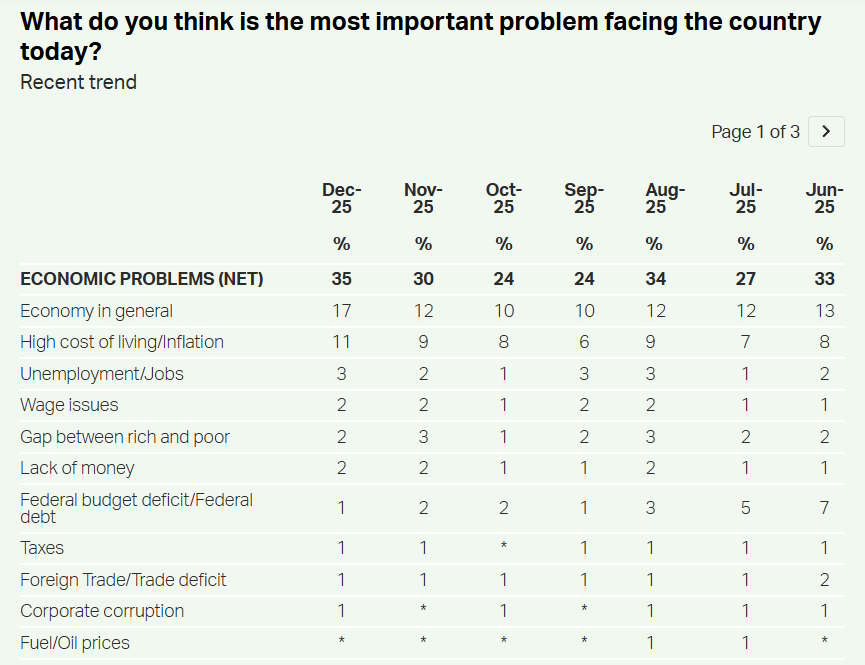
General concern over “the economy” takes the top spot as usual, but worries about inflation and the cost of living top worries about unemployment, by a lot. In fact, inflation is the thing that voters seem to be most upset at Trump about, specifically:
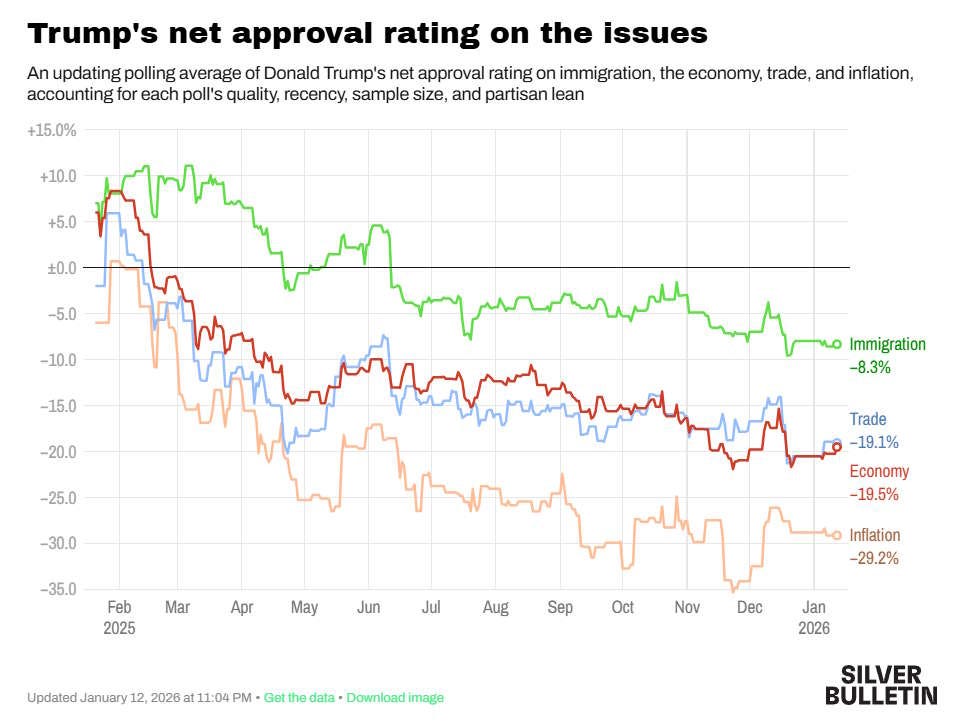
Whether he’s concerned about the midterms, worried about his legacy, or intends to try for a third term, Trump knows that the best thing for his popularity would be to bring living costs down.
He also must know that this is easier said than done. Usually, reducing the cost of living means holding down the rate of inflation, so that wages outpace prices over time. But there’s evidence showing that many Americans expect the government to actually drive prices down, rather than just curbing the rate at which they go up:
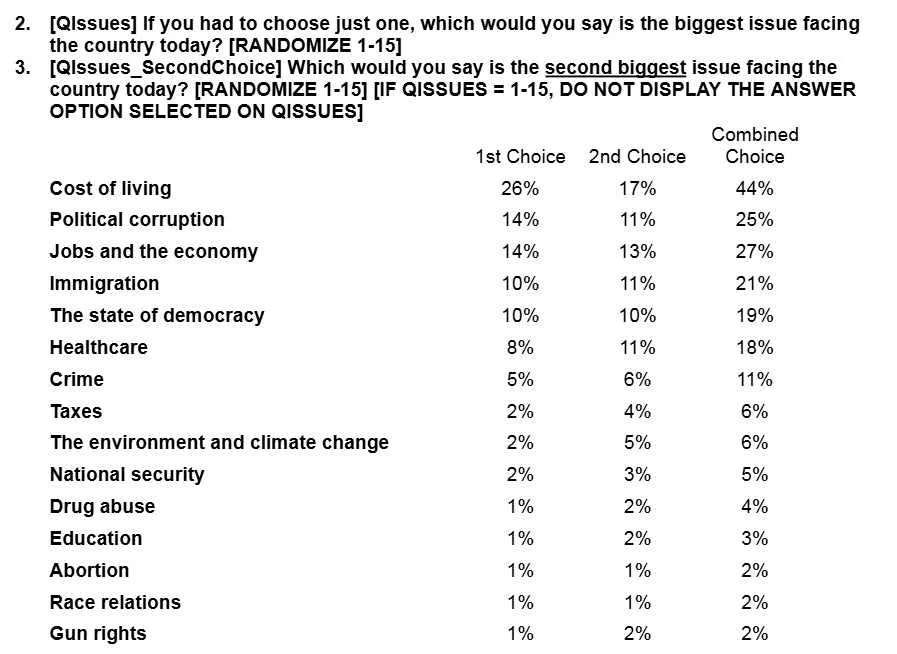
Driving prices down is normally very hard to do without causing a recession. But a few weeks ago, I wrote a post about how there are actually some prices that the government could feasibly bring down:
I’m starting to think Trump read my post!1 The prices I mentioned are exactly the prices that Trump has targeted with a recent spate of highly unorthodox measures. The attacks on the Fed might be part of this strategy, because one of the items I mentioned is the price of credit.
In his own gangster-ish way, Trump may be trying to bring Americans the affordability they demand. The problem is that the gangster approach can have grave long-term costs in terms of economic stability and efficiency. Like Napoleon, Trump may be headed for a series of boondoggles and quagmires.
Trump is following the Noah Smith playbook for “affordability” (but in a gangster-ish way)
In my post last month, I wrote that there are two very important prices that the government can cause to go down without inducing a recession. These are the price of gasoline and the price of credit.
Here’s what I wrote about the price of gasoline:
Over the long term, gas prices have gone up in dollar terms, but there are still extended periods of time when they’ve gone down — for example, in the early 1980s and the late 2010s…In fact, gasoline prices…seem to hold a special place in the American voter’s heart. There’s research showing that even once you control for overall inflation, gas prices have a big impact on presidential approval ratings…The easiest way to bring gasoline prices down is just to bring oil prices down. Glut the market with crude oil, and gas will get cheaper.
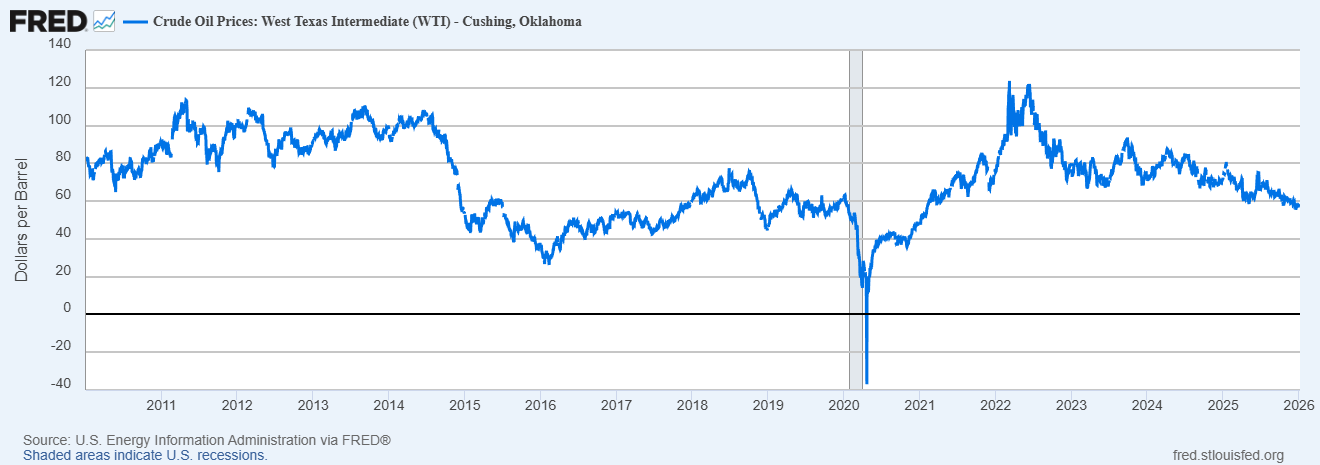
In fact, oil prices — and gas prices — go down all the time. Oil prices have been going down since mid-2022, and are now back to the levels of Trump’s first presidency:
And gas prices are down by almost as much:
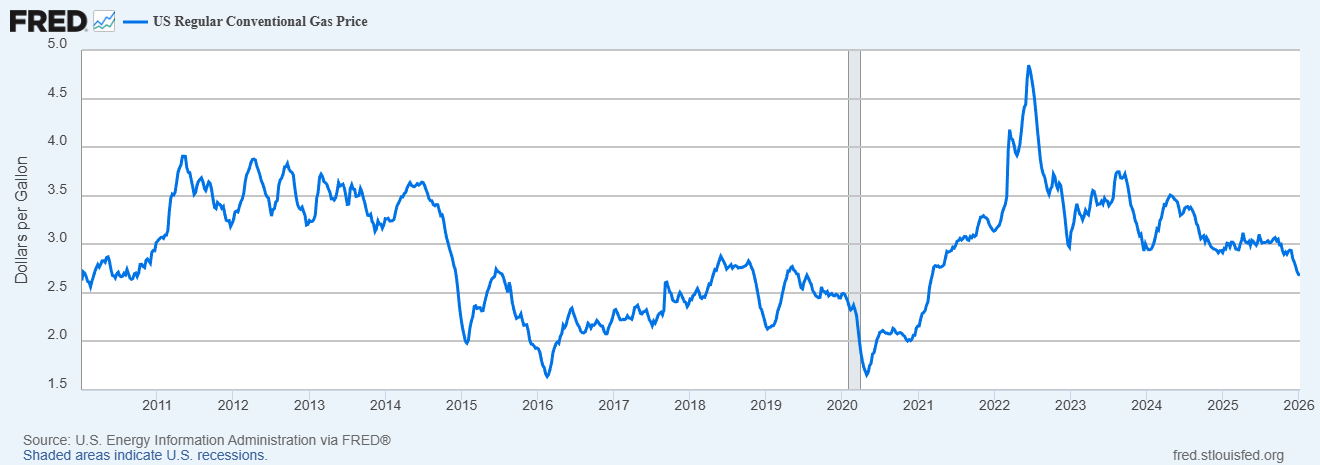
This hasn’t been enough to make Americans feel good about the economy. But you could always just try doubling down — flooding the international market with even more oil, to bring gas prices back down to $2 or even $1.50 a gallon.
One way to do this would have been to lift sanctions on Venezuela and throw a lifeline to the ailing Maduro regime. Instead, Trump sent in the troops, captured Maduro, and simply declared that America will run Venezuela now. Trump has made it clear that flooding the market with oil is a big part of why he did this.
Back in the old days, everyone thought that when America went to war for oil, it was in order to make money for U.S. oil companies. But Trump’s Venezuela move is likely to hurt the U.S. oil industry. This isn’t 2003 — America is a net exporter of oil now. If you flood the market with Venezuelan oil, U.S. producers — especially frackers — are going to take a big hit.
Of course, U.S. oil majors like Exxon can go produce oil in Venezuela, but they don’t want to do this — understandable, given the risk that the country will collapse into even deeper instability and chaos. Trump simply saying “We’re going to run this country now” is no more reliable a method of long-term governance than it was in Napoleon’s time. So Trump is trying to bully U.S. oil companies into going into Venezuela and pumping crude to flood world markets. It looks very much like his goal is simply to reduce oil prices, to boost his own political fortunes.
The other main price that Trump is trying to reduce is the price of credit. The interest rate isn’t counted in official inflation numbers, but it’s basically the price you pay to borrow money. In fact, Bolhuis et al. (2024)2 have a paper claiming that the cost of borrowing is a major reason why American consumers are so dissatisfied. They write:
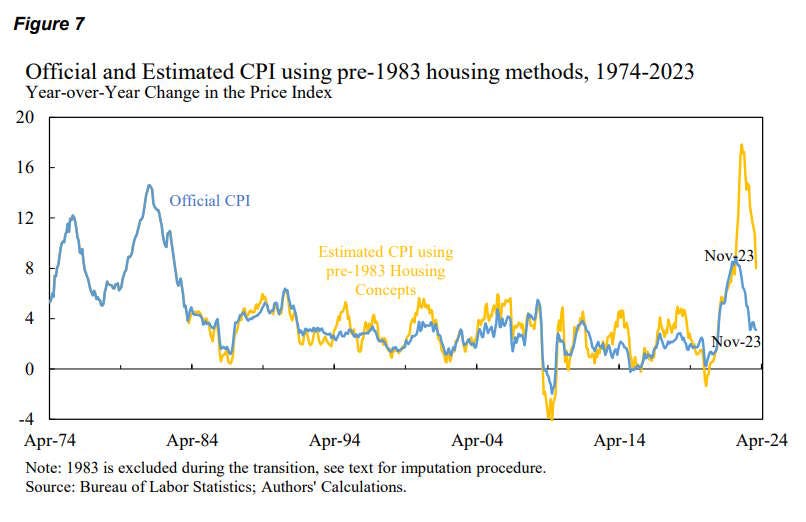
The [Consumer Price Index] excludes interest payments…This was not always the case….[T]he measurement procedure for the CPI [originally] included measures of interest costs. This changed with the CPI redesign of 1983…Before January of that year, homeownership variables, including housing prices and mortgage rates, entered directly into the CPI…After years of research, the Bureau of Labor Statistics (BLS) [replaced these measures of housing costs with] owners’ equivalent rent, which has a stronger theoretical justification…Housing prices and financing costs were removed from the index. But [the interest rate] did not disappear from the effective costs borne by would-be home buyers or…those borrowing to finance cars and other forms of consumption. This paper argues that this disconnect in inflation measurement, on the one hand, and actual increases in the cost of living due to higher financing costs faced by consumers, on the other, underpins the recent divergence between official inflation data and consumer sentiment.
The authors show that if you use the pre-1983 inflation measure, which includes interest rates (and also house prices), the recent inflation was just as bad as the one in the 1970s:
Interest rates are another kind of “price” that often goes down. In fact, the government — i.e., the Fed — has the power to make these go down whenever it wants.
So if high borrowing costs are what’s bothering America, one obvious way to make Americans happier would be to lower interest rates. And in fact, bullying the Fed to cut short-term rates isn’t the only way that Trump is trying to make borrowing cheaper for Americans. He’s also trying to order credit card companies to charge dramatically lower rates:
Reviving a campaign pledge, President Donald Trump wants a one-year, 10% cap on credit card interest rates…Trump was not clear in his social media post Friday night whether a cap might take effect through executive action or legislation, though one Republican senator said he had spoken with the president and would work on a bill with his "full support." Trump said he hoped it would be in place Jan. 20[.]
So Trump is clearly trying to make borrowing cheaper across the board.3
The parsimonious explanation here is that by trying to flood the market with oil and push down interest rates, Trump is targeting the two prices that A) Americans care about a lot, and B) can actually go down by large amounts. This seems like a savvy move.
The idea that Trump is campaigning for affordability is bolstered by some other moves of his. He recently announced his desire to ban corporate landlords from owning single-family homes, and has been using the government’s negotiating power to try to force pharmaceutical prices lower — two policies traditionally associated with the left.
These ideas aren’t coming from conservative ideology, and it seems unlikely that Trump is doing them out of the goodness of his heart. The likeliest explanation is that he’s campaigning for affordability, in order to shore up his most glaring political weakness.
Well, OK. Americans want affordability. Specifically, they want prices to go down, not just to rise more slowly. And they probably especially care about gas prices, interest rates, and maybe rent and health care. So the President they elected is trying to give them what they want, in his own peculiarly gangster-ish way. What’s wrong with that?
What’s wrong is that the peculiar, gangster-ish tactics that Trump is using to try to deliver affordability may incur long-term costs down the line — including making America less affordable in the long run.
The long-term dangers of Trump’s strategy
The problem with Napoleon is that although he was very good at getting his way in the short term, his policies were boneheaded in the long term. Cutting continental Europe off from British trade simply caused shortages in Europe and put a lot of merchants out of business. Forcing conquered territories to buy uncompetitive French exports hurt the industry of other European nations. Both of these things fostered resentment that ultimately led Europe to rebel against French rule at the first opportunity.
The immediate effects of Trump’s Napoleonic affordability policies may be pleasing to the American populace. His housing initiative won’t accomplish anything — despite grabbing lots of headlines, corporate landlords are an insignificant force in America’s housing market. But all the rest will probably go over well, if Trump can pull it off. Americans would love to see gas prices, credit card rates, and mortgage rates go down.
The problem is that Trump’s methods, like Napoleon’s, may be sowing the seeds of their own destruction.
Take Trump’s approach to oil prices. Getting oil out of the ground takes lots of long-term investment. You’ve got to buy a lot of equipment, drill a lot of holes, and so on. This is doubly true for places like Venezuela, whose oil is especially expensive to extract and refine. Long-term investment requires low risk and political stability.
Trump’s decapitation strike on Venezuela seems unlikely to stabilize that country in the long term. Instead of installing the legitimately elected democratic opposition, Trump simply allowed Maduro’s lieutenant Delcy Rodriguez to take over, and then began to bully and threaten her. Even if she does what Trump says in the short term, that sort of behavior isn’t likely to make her favorably disposed toward Trump; she will be looking for ways to escape from under his thumb, perhaps by cozying up to China. This is especially likely because Rodriguez comes from Maduro’s anti-Western ideological camp in the first place.
Furthermore, what kind of a power base does Rodriguez have? She was installed by default after her boss was kidnapped; that doesn’t mean she’s fit to rule. And her regime’s policies are still those that have impoverished her country, causing years of unrest and conflict. Oil revenues might mollify the unrest somewhat, but it’s unlikely that the people of Venezuela will be happy to be ruled by a Trump puppet, any more than the people of Naples and Holland were happy to be ruled by Napoleon’s relatives.
No wonder Exxon is calling Venezuela “uninvestable”.
The biggest danger, though, is that other oil-producing countries will start to fear similar decapitation strikes. This could prod them to cozy up to America in the short term, but it could also create risk, since oil companies won’t know if they’re dealing with a regime that’s still going to be in power a few years down the line. That could cause investment to dry up in other countries, ultimately pushing up oil prices in the medium term.
Trump’s approach to interest rates is even more dangerous. Threatening to investigate the Fed on trumped-up charges unless they carry out the President’s wishes on interest-rate policy is a de facto abolition of central bank independence. That could raise inflation in the long run, by quite a lot.
Although there is much economists don’t understand about how inflation works, the leading theory of how central banks keep inflation low and stable is credibility. This is the idea that if inflation rises, the central bank will bring inflation back down by raising interest rates. If businesses believe that the central bank will contain inflation, they won’t raise their prices much in the first place, and so the expectations of low inflation become a self-fulfilling prophecy.
But if businesses believe that the central bank won’t raise interest rates, they may expect inflation to rise — and this can become a self-fulfilling prophecy, because when you expect inflation to rise, the rational move is to raise your prices right now. Hazell et al. (2022) study the inflation of the 1970s, and they conclude that the Fed’s failure to raise rates by a sufficient amount following the oil shock of 1973 was probably responsible for the bulk of the 1970s inflation.
Therefore, if the leading macroeconomic theory is right, it’s very important that people believe that the Fed will raise rates when necessary. If everyone knows that the Fed is Trump’s puppet, and that Trump is always going to bully the Fed to keep rates low, they’ll know that the Fed will not raise rates when necessary. And the result of that loss of credibility could be inflation — lots of inflation, for quite some time. (Incidentally, inflation also drives up nominal interest rates, since lenders have to charge people enough to make back their money plus inflation.)
I’m not saying that’s certain to happen, but it’s a big risk. And it’s a risk Trump may not understand — the logic of monetary policy as a game of self-fulfilling prophecies is a bit hard to wrap your head around, and Trump has no close advisors who have studied this.
Alternatively, Trump may simply calculate that the rebound in inflation will come only after a few years — and that by that time he’ll be out of office, and it’ll be a problem for his (Republican or Democratic) successor. That would be like when Hugo Chavez forced Venezuela’s oil company to disinvest, cratering production and wrecking the economy, but only after Chavez died.
Meanwhile, Trump’s credit card plan could also backfire. The banks that make credit card loans don’t charge high interest rates because they’re greedy and evil — they charge those rates because that’s the only way to make a profit in the credit card business. A lot of people borrow money on credit cards and then just don’t pay it back. Banks need to charge high rates to the people who do pay it back in order to justify lending to the people who don’t.
If you ban banks from charging high rates, they’ll accept reduced profits or even losses for a while — but if the policy goes on long enough, many banks will just stop making credit card loans altogether. Then a lot of people won’t be able to get credit cards, so they’ll have to either make purchases with cash, or they’ll have to borrow from shady loansharks (who also charge very high rates, and are more inclined to break your kneecaps when you don’t pay up). Neither of those long-term outcomes is particularly good for American consumers.
This is the problem with running economic policy like a gangster. In the short term, bullying people into going against their economic self-interest might get you what you want. But in the long term, it just makes the economy less efficient, while the ad-hoc nature of policymaking causes instability and uncertainty. For a few years, everyone bends the knee, but eventually things start to break.
Not really.
One of the authors of this paper is Larry Summers, who is currently serving time in the doghouse of public opinion for asking Jeffrey Epstein’s advice on an affair he was having with another economist. Don’t let anyone tell you that economists lead boring lives! Maybe they should, though.
Cynical explanations based on the idea that Trump is trying to lower borrowing costs for his own businesses don’t make sense when it comes to credit cards, because it’s unlikely that Trump uses this form of financing.