
A lot of readers tell me that my fundamental optimism about the world is one of the reasons they appreciate my blog. I think my usual sunny attitude springs from my above-average skill at resisting the negativity bias inherent in the media. It’s very easy to read the news every day and conclude that the world is in a never-ending hydra-headed “polycrisis”; if you have a cool, detached perspective, you’ll realize that things are rarely so dark.
That said, this year I was a bit of a downer. The coming of the second Trump administration means the end of the era of stability that the world enjoyed after World War 2. Even if the U.S. can fix its domestic problems (which are not all Trump’s fault by a long stretch), the ascendance of China and Russia as the world’s dominant power bloc will not be so easily undone, and the ramifications of that shift are only getting started. That’s what motivated the somewhat darker tone of my blog this year.
But that doesn’t mean I think the world is going to Hell in a handbasket. From India’s resilient economic growth to Europe’s timely rearmament to the ongoing technological revolutions in AI, electric technology, and biotech, there is plenty to be happy about.
Even when it comes to American society, I see lots of quiet reasons for optimism. Our politics is dysfunctional and our media landscape resembles a demon-haunted wasteland, but underneath the surface, I see signs that our society is starting to knit itself back together after the unrest and chaos of 2014-2021. Health is improving. Violence is falling. Americans are starting to use technology more responsibly. Some of the economic sclerosis of the pre-pandemic years seems to be falling away.
I suspect that there are “macrosociological” forces at work. To my knowledge, sociologists haven’t really modeled a cycle of aggregate social division and health,1 but if you look at events like the collapse of the USSR and the decade of violence and self-destructive behavior that followed in Russia, or the multi-decade rise in pro-social behavior around the mid-20th century in America, it’s hard to avoid the suspicion that such forces exist.
But I’ll leave the grand theorizing for another day. Today I just want to document ten positive trends in American society. It’s been a tough year; you all deserve a little optimism!
Life expectancy is up
This is probably the most encouraging recent social trend in America. One of the biggest downsides of life in the U.S., compared to other rich countries, is our low life expectancy. A big gap opened up a few decades ago, and in recent years, and in the late 2010s, Americans’ life expectancy fell outright for several years. Then came the pandemic, of course, and it fell right off a cliff.
But I’m happy to report that this trend has now reversed! Not only has U.S. life expectancy more than bounced back from the pandemic, but the negative trend of the 2010s seems to be over as well. The gap with other rich countries remains, but the U.S. is no longer falling further and further behind:
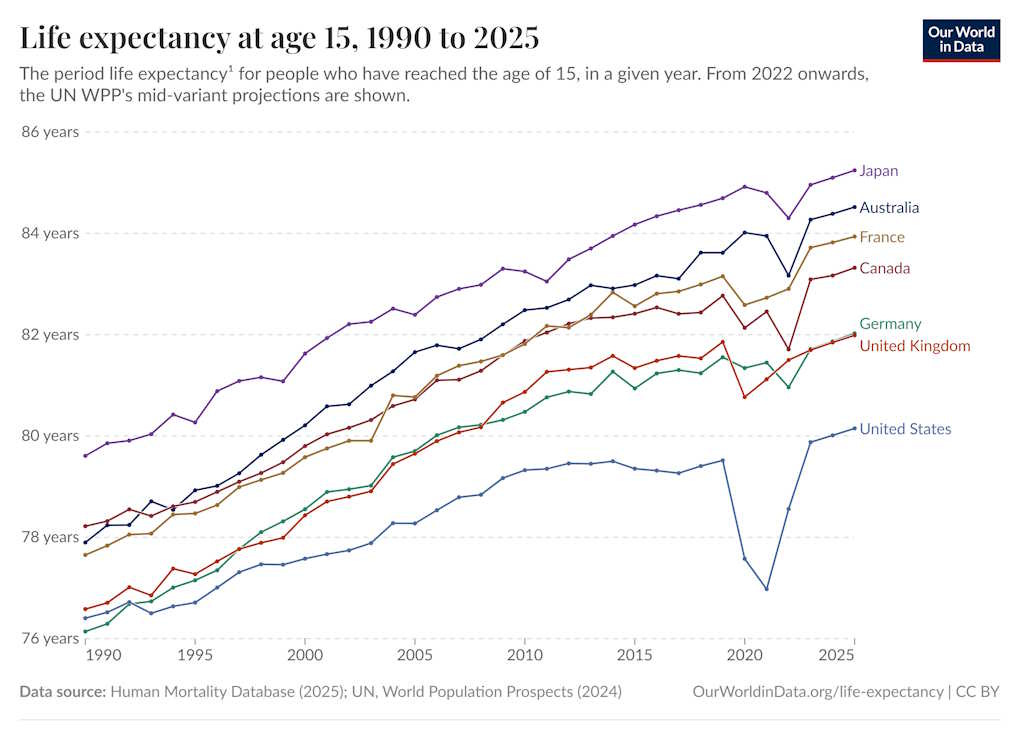
Why is U.S. life expectancy improving? There are two main reasons why Americans live shorter lives than their rich-world counterparts: Unsafe behavior, and obesity. The first of these — overdoses, suicides, murders, and traffic accidents — surged after the pandemic but is now on the wane.
Murder is down (and violence is down in general)
The most important way in which life in America differs from life in other rich countries is our high level of violence. Murder rates — the most reliable measurement of violence — are typically around 5 or 6 per 100,000 people in America. That’s about five times as high as in Europe and ten or twenty times as high as in East Asia. And it’s a proxy for a bunch of other kinds of public violence — assaults, robberies, etc. — that are harder to compare across countries or across time.
I believe that America’s high violence levels are the main reason our cities are so car-dependent — many people refuse to take public transit or walk on shop-lined streets if they’re in danger of getting mugged or attacked. That means that some part of our obesity and boredom is also downstream of violence.
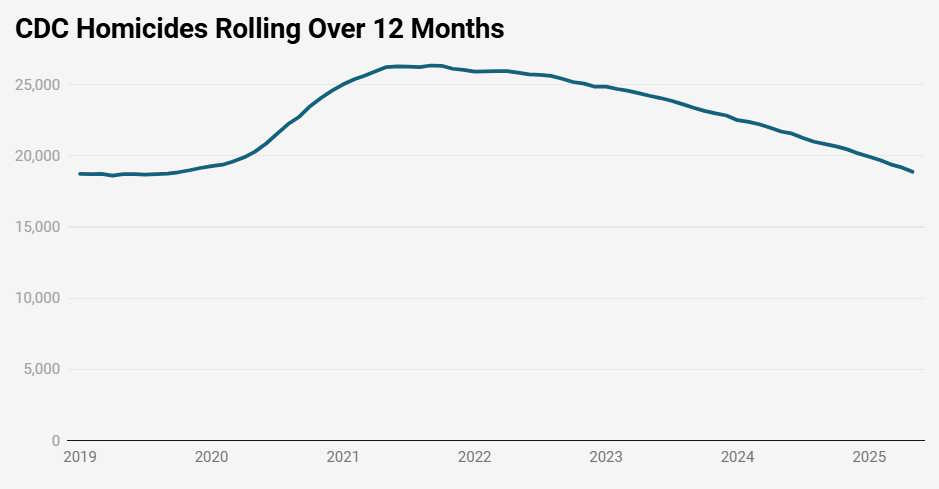
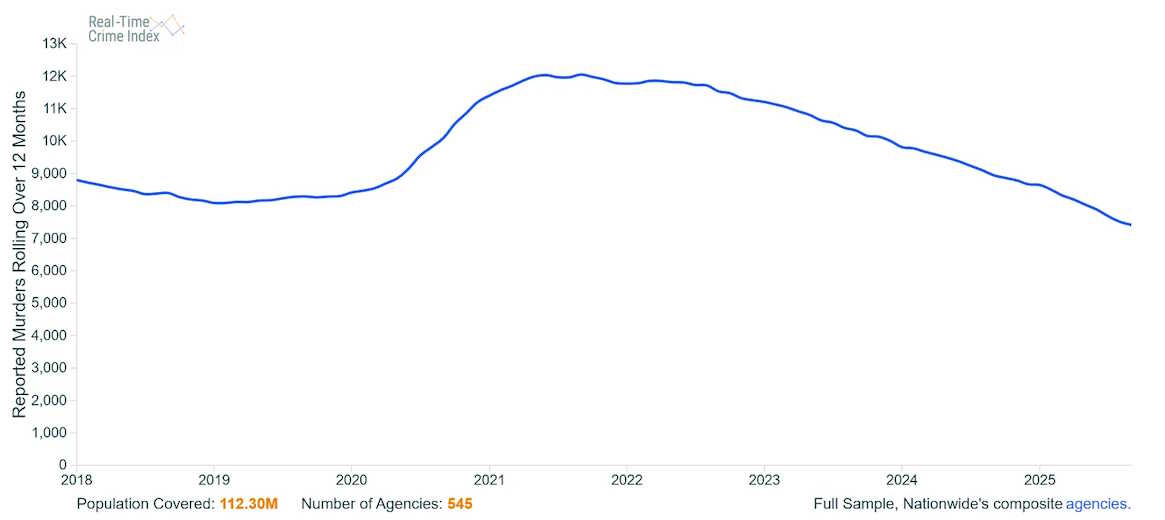
In the late 2010s, U.S. murder rates went in the wrong direction, rising from their low point in 2014. Then in the pandemic they spiked alarmingly. But in late 2021 or 2022, murder rates started falling, and they haven’t stopped falling since. There are several data sets that record murder rates, based on reporting by hospitals, police agencies, and so on. But they all closely agree. Here are two sources:
Jeff Asher, who does a great job documenting trends in American violence, notes that many other indicators of violence in America are down as well, including reports of gun crime and reports of violent crime other than homicides:

Most encouragingly, the drop appears to have continued, or even accelerated, in 2025. Murders are plunging in almost every big city:
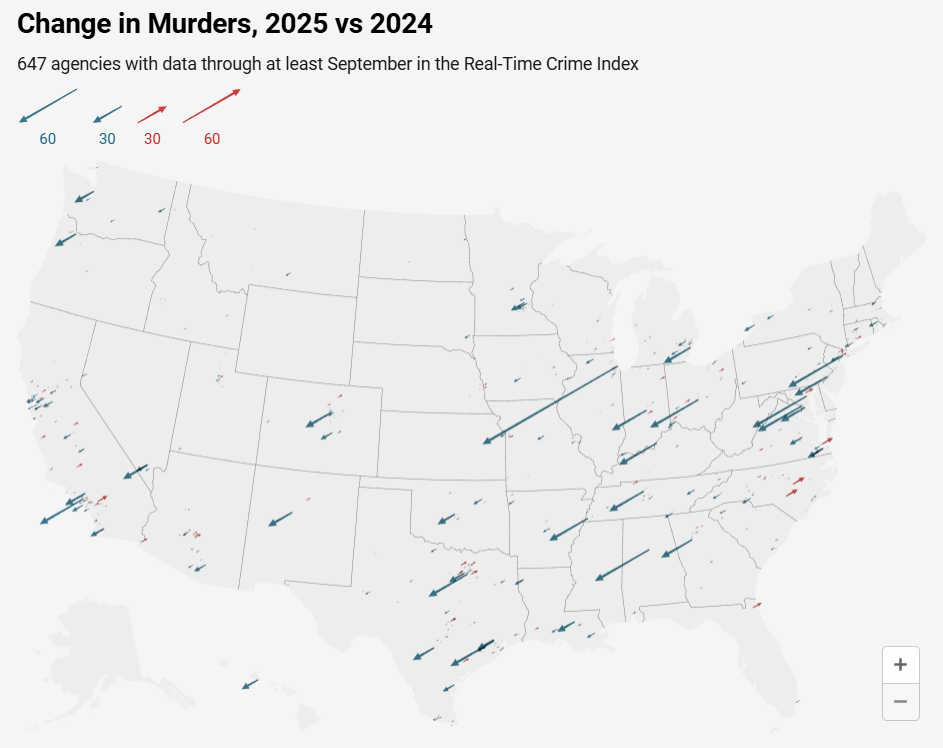
Trump’s return has not led to the reestablishment of the negative trend of the mid-2010s. Just why this has happened deserves a longer blog post, but for right now we should just celebrate the new trend.
Asher’s best guess is that although overall violence in America remains above its historic low point in the early 1960s, murder and property crime are now less common than they were during that famously peaceful era. Part of that is due to mitigation efforts — everyone moved out to the ‘burbs and started locking their houses and driving everywhere. America remains far too violent to support the kind of pleasant urban life that Europeans and East Asians enjoy. But for many years we were going the wrong way, and now we’re headed in the right direction.
Overdoses are down
Starting around the turn of the century, U.S. overdose rates started trending up, driven by an explosion in prescription opioids — and then a widespread turn to heroin once access to prescription painkillers was tightened up. Then in the 2010s, overdose rates exploded, thanks to the arrival of fentanyl, a powerful synthetic opioid. This was a big reason for the drop in U.S. life expectancy in the 2010s, and was central to the idea that America was suffering from an epidemic of “deaths of despair”.
But in 2024, this horrifying trend began to reverse itself. Overdose deaths are still way above where they were a decade ago, but they’re plunging:
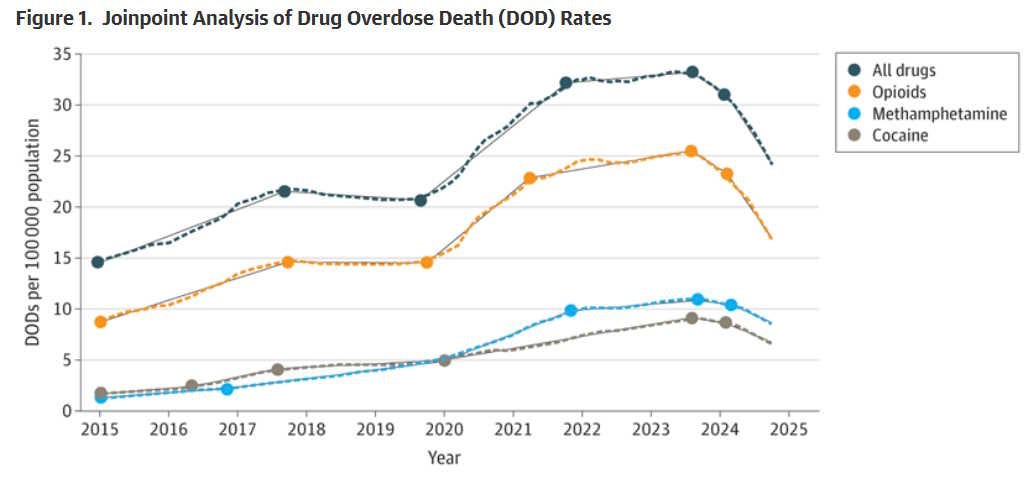
One big reason is the ebbing of the fentanyl epidemic. Dowell et al. (2025) argue that lots of fentanyl users have just died off, while the rest of the population has been warned that fentanyl is a death sentence and is thus avoiding the drug.
That’s consistent with common sense and casual observation. But it’s worth noting that overdose rates are also falling for meth and cocaine as well — drugs that should be far less impacted by the opioid epidemic, and which Americans have known about for a very long time. This suggests that something is going on beyond fent simply burning itself out.
Traffic deaths are down
The rise in road deaths in the U.S. has been one of the most alarming trends of the past few years. After falling steadily for decades, traffic fatalities started an upward trend in the mid-2010s, right around the same time as a number of other negative social indicators. By the early 2020s, America’s road death rate was, by some accounts, worse than Russia’s.

But like overdoses, this trend may also have gone into reverse in 2024:
U.S. traffic deaths fell 8.2% in the first half of the year…The National Highway Traffic Safety Administration said 17,140 people were killed in vehicle crashes through June 30, down from 18,680 deaths during the year-ago period…Traffic deaths fell 3.8% in 2024 to below 40,000 for the first time since 2020.
Jeff Asher speculates that the causes include increased traffic enforcement, a surge of Covid-era spending on road safety, and lower car thefts. He also suspects (and I agree) that a historically low rate of alcohol abuse is a big factor here:
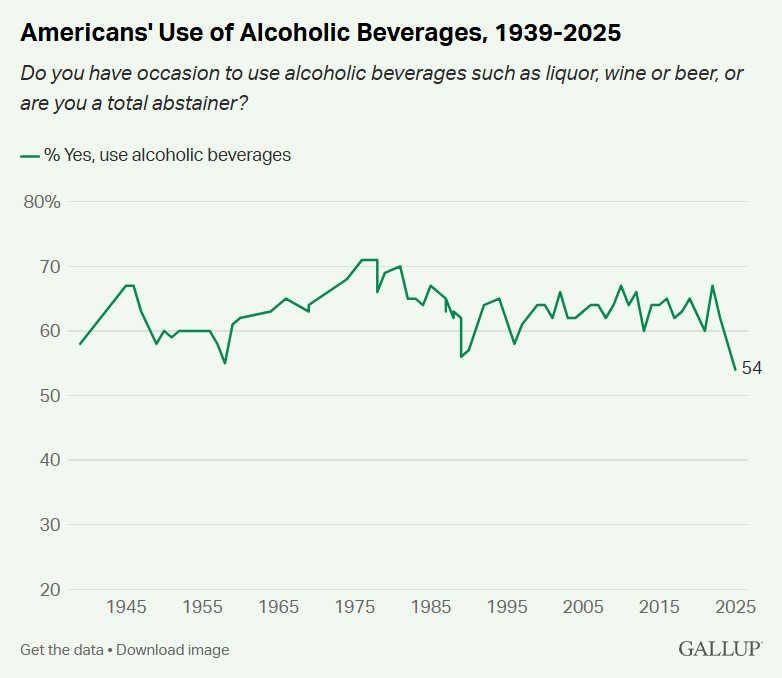
Less drunk driving means fewer accidents. But anyway, whatever the reason, it’s a good trend, and it fits with all the other positive health trends.
Suicide is down
In addition to violence, overdose, and bad driving, the final major type of self-destructive behavior that rose in America in recent years was suicide. Suicide actually started to rise in the early 2010s, a little earlier than the other negative social trends. By 2022 it was at an all-time high.
But like many others, this bad trend may also have reversed in 2024:
A little over 48,800 suicide deaths were reported in 2024, according to provisional data from the Centers for Disease Control and Prevention, roughly 500 fewer than the year before…The overall suicide rate fell to 13.7 per 100,000 people.
This has been driven by a fall in teen suicide and depression, specifically:
A new federal report finds that the percentage of adults with suicidal thoughts and attempts remained about the same between 2021 and 2024…But…Over that same time period, depression and suicidal thoughts and behaviors in teens declined…
The new report shows that the prevalence of serious suicidal thoughts in 12-to-17-year-olds fell from nearly 13% in 2021 to 10% in 2024. And the prevalence of suicide attempts by teens also fell slightly — from 3.6% to 2.7%.
As with all the other trends, it’s not clear what’s behind this one. It could be that lower rates of teen drug and alcohol abuse are paying dividends. But it could also be that one of the fundamental drivers of unhappiness in America’s was technological — and that young Americans are learning to use technology more responsibly.
Social media may have peaked
There’s a great deal of evidence suggesting that the advent of smartphone-driven social media was bad for people’s emotional health, and hit young people especially hard. The trend toward youth unhappiness spans many nations, and coincides perfectly with the introduction of smartphone technology that put everyone on social media 24/7. There’s also a bunch of causal and experimental evidence, most (though not all) of which points toward the same culprit.
Although I’m an inveterate techno-optimist, I also think that new technologies typically have an adjustment period, where people learn (often through bitter experience) how to use those new technologies responsibly. So it seems entirely plausible to me that after an initial period in which everyone moved their entire social life to big open platforms like Twitter, Facebook, and Instagram, people are now learning that the “town square” is a bad place to live your life. Worldwide use of social media appears to have peaked for all ages in the early 2020s, and is now in decline:
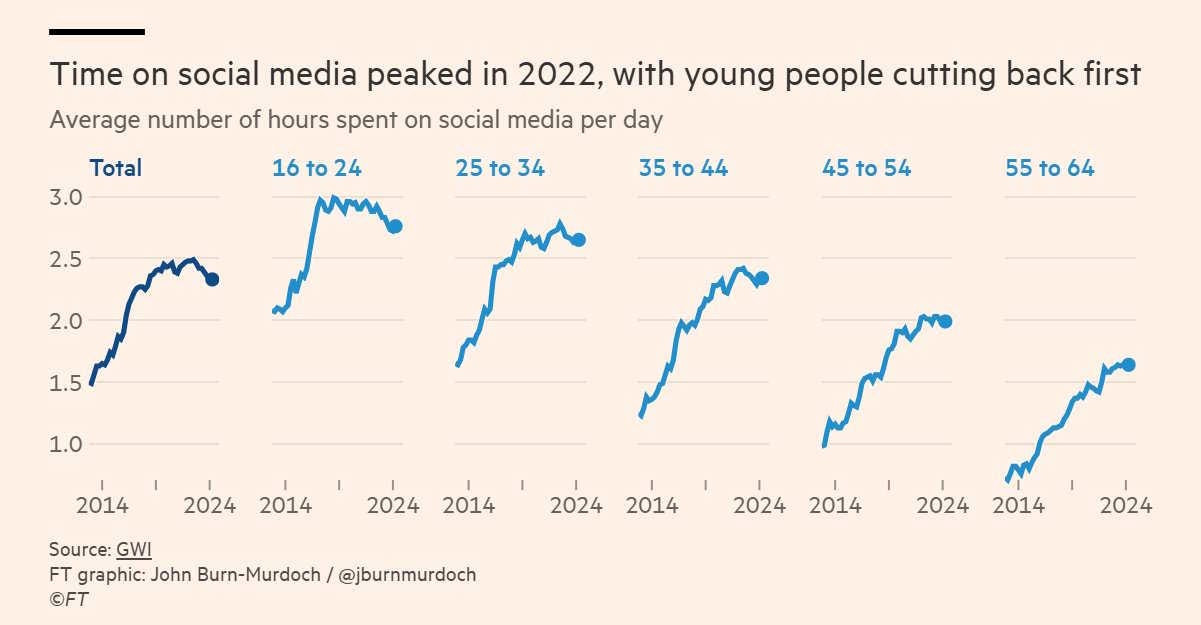
This is less true in the U.S., where use of social media platforms has plateaued but has not yet begun to decline. Encouragingly, however, the “public” social media apps — especially X/Twitter, but also Instagram — seem to have seen the biggest outflows in recent years:
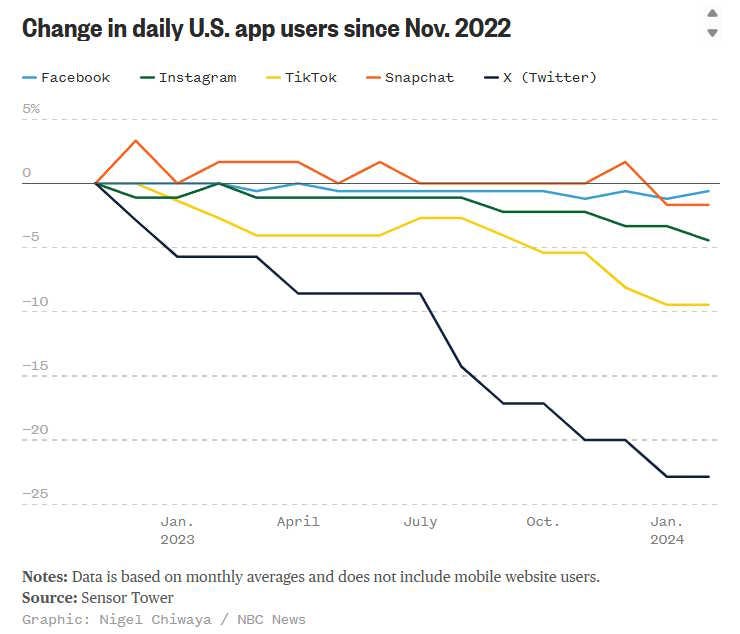
Importantly, this is probably being driven by general realization among young people that social media use is unhealthy:
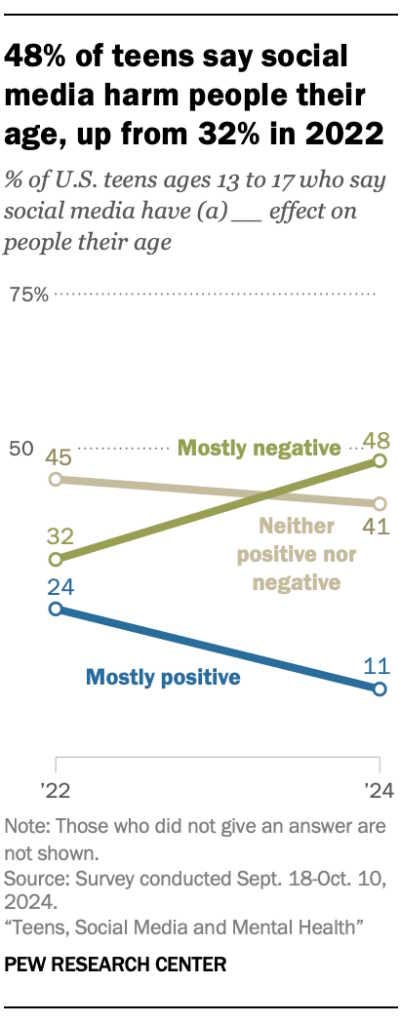
And broad usage statistics match subtler trends in the way Americans, especially young people, are using social media. John Herrman has a good article on this:
Earlier this year…Meta…shared a wild stat: Just 17% of time spent on Facebook, and 7% on Instagram, was spent viewing content posted by “friends.”…A 2023 survey by Morning Consult found a significant segment of social media users were consciously posting less than they used to. At The New Yorker, Kyle Chayka argued that we might be moving toward “Posting Zero,” a situation in which regular users “stop sharing things on social media,” shifting to a purely consumptive mode.
“Social media” is shifting toward a combination of A) passive television-like consumption, and B) private conversations in DM groups, private messages, and small-group forums like Discord. The trend where people post things for everyone else to see, and then other people criticize them for what they post, may have been a transient, self-limiting, unhealthy fad.
Obesity is down
Besides unhealthy and violent behaviors, the main reason Americans have lower life expectancy than people in other rich countries is obesity; Americans are fatter, which causes them to have higher rates of heart disease, diabetes, kidney failure, and so on.
Obesity rose relentlessly for years in America, and many people came to treat this as just a fact of the Universe, turning to things like the “fat acceptance” movement to learn to live with our new, fatter future. But then in 2023, the trend suddenly went into reverse:
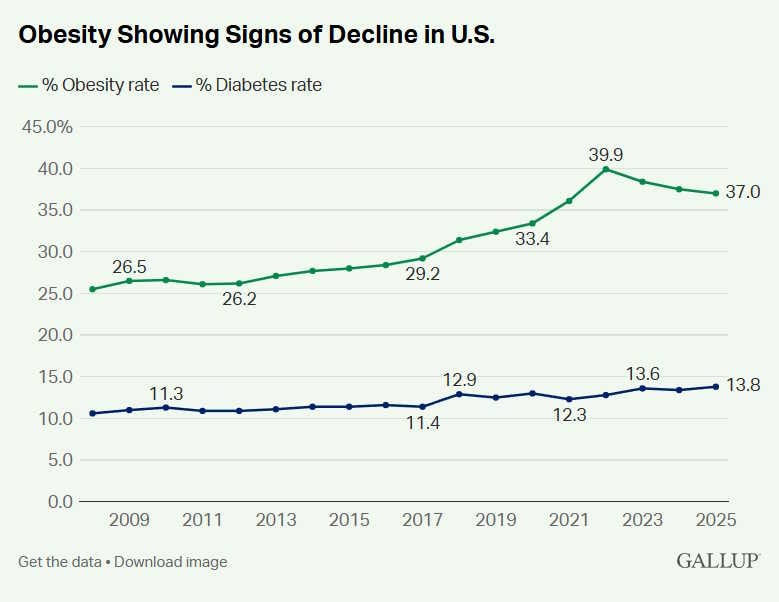
Multiple other data sources find the same thing.
Why have Americans suddenly started getting slimmer? There’s always the possibility of a correction after a pandemic-era spike; obesity rates are still well above what they were even just a decade ago. But the likeliest cause is the advent of GLP-1 drugs. Ozempic is the most famous of these, but better ones like Retatrutide are being invented all the time. So far the side effects seem generally small compared to the enormous benefits.
If GLP-1 drugs bring America back to fitness, it could change long-term eating habits; importantly, for most people, some or even all of the weight seems to stay off once people stop the drugs. It could also change the way food is produced in America, decimating the junk food industry and moving food production toward things that deliver essential nutrients. It could also cause a social cascade, in which everyone expects everyone else to be thin, and so obesity is more frowned upon.
This could end up saving untold American lives, bringing our life expectancy back in line with other rich-world countries.
Fewer dating apps, more sex?
“Kissy face, kissy face sent to your phone, but/ I'm tryna kiss your lips for real” — Rosé
One worrying trend that cropped up in recent years was dubbed the “sex recession”. Although drops in risky teen sexual behavior and pregnancy were welcome, these accompanied a broader decline in young people’s tendency to form couples. Americans in general report having sex less frequently — even married Americans.
But some data suggests that in the past two years, young people are having more sex. Here’s data from the General Social Survey:
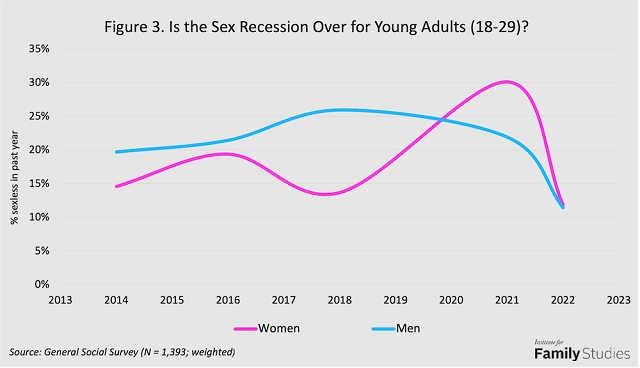
And eHarmony agrees:
For the past few years, general consensus has suggested that Gen Z hates sex…But now, new research from eHarmony suggests that the Gen Z sex recession is over…The recent survey found that both Gen Z and Millennials in relationships are having more sex, with 20 per cent of Gen Z having sex daily, the highest among any generation. In addition, 61 per cent of Gen Z say they enjoy being “sexually adventurous” with a partner…Overall, people in relationships report having sex three or more times per week, increasing from 31 per cent in 2023 to 35 per cent in 2024…It’s clear there has been a clear shift in attitudes: 36 per cent of Gen Z are having more sex now than they were a year ago…
There are several reasons for this sudden sex spike. 57 per cent say it’s because they feel more confident, 38 per cent say it’s because they’re making a conscious effort to prioritise sex, while 35 per cent say it’s because they are less stressed. Plus, 17 per cent of Gen Z report that they had more sex in the past year because they started therapy.
Interestingly, this possible rebound in young people’s sex drives coincides with the waning popularity of dating apps:
It’s true that the amount of time spent on dating apps has declined over the years. A recent Forbes poll of dating app users showed that, on average, they spend about 51 minutes per day on them. Ten years ago they were devoting 100 minutes daily to platforms like Bumble…[T]he growth of paying users has slowed down of late, accompanied by a slight dip in the number of Americans who say they use dating apps.
The main dating apps have lost tens of millions of monthly active users since 2022. And surveys suggest that young people, in particular, are abandoning the apps in favor of more real-world connections.
This might be another example of how a new technology created temporary disruptions, but over time, people learned how to use it responsibly.
Religion is no longer declining
A lot of people I grew up with would take issue with the notion that religion is good for American society. Back in the 90s and early 2000s, America’s culture wars often centered around the role of religion, especially Christianity, in American public life — and lots of liberals didn’t like that role.
But with the advent of the internet, Christianity went into steep decline in America. And that has prompted a rethink of religion’s usefulness in terms of fostering offline community and real-world connection. Although some surveys show a continued decline in religiosity, at least one large and careful survey shows that Christianity’s decline has leveled off and even reversed:
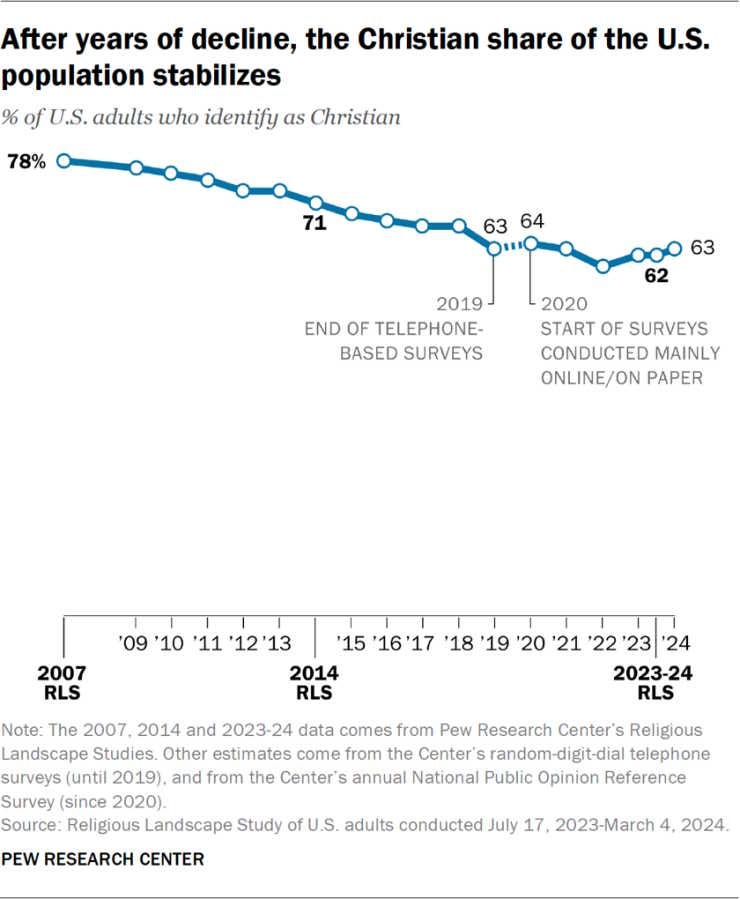
Importantly, young people appear to be behind this trend. And other surveys have shown more young people going to church:
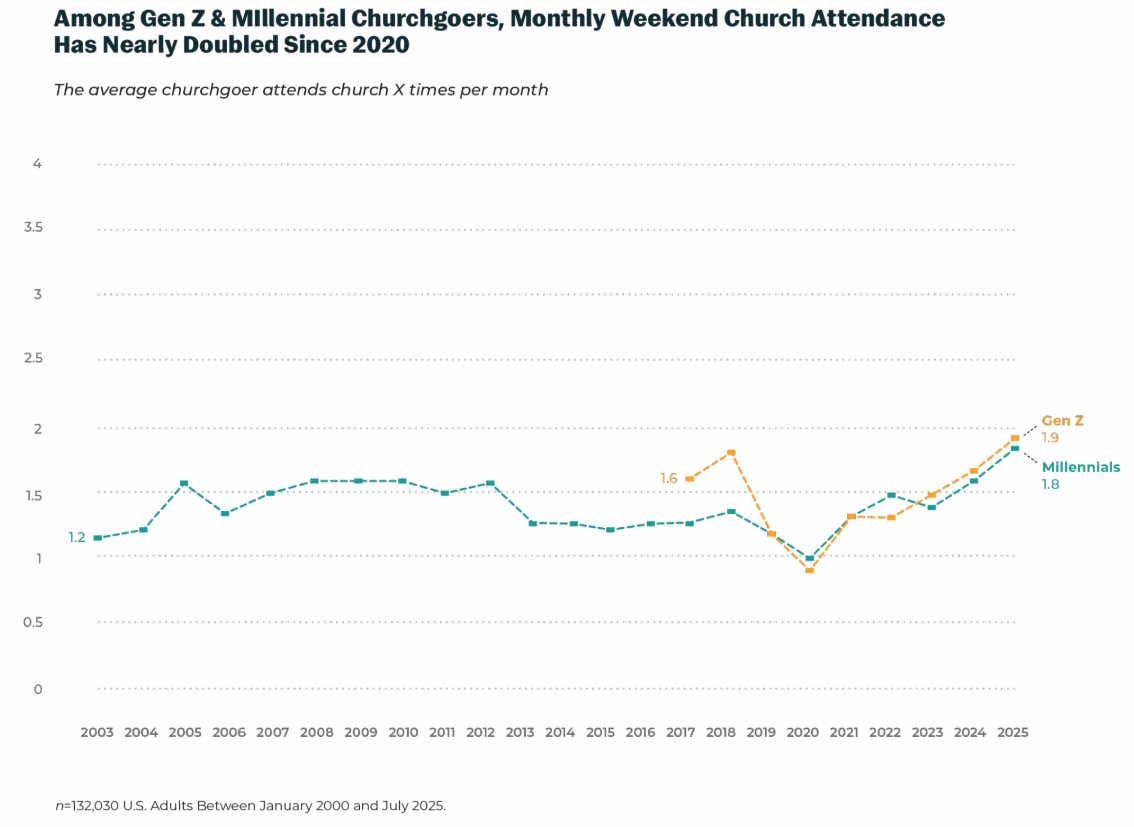
It’s important to remember that church attendance was one metric that sociologist Robert Putnam used to demonstrate an “upswing” in civic-mindedness in the early and mid 20th century. As much as my liberal social circle looked down on Christianity in the 2000s, it was always an important way that U.S. society knit itself together.
Business dynamism is up
Sociology inevitably influences economics, and one sign of social health is people starting more businesses. For decades, business dynamism declined across the developed world, mostly due to population aging, but also potentially due to other factors. But after the pandemic, there was a huge surge in new business formation. Some of this was probably people rushing to start new businesses to replace the ones that went kaput due to Covid.
But the wave of new business formation was bigger and persisted for much longer than economists would expect if it were just a post-pandemic recovery:
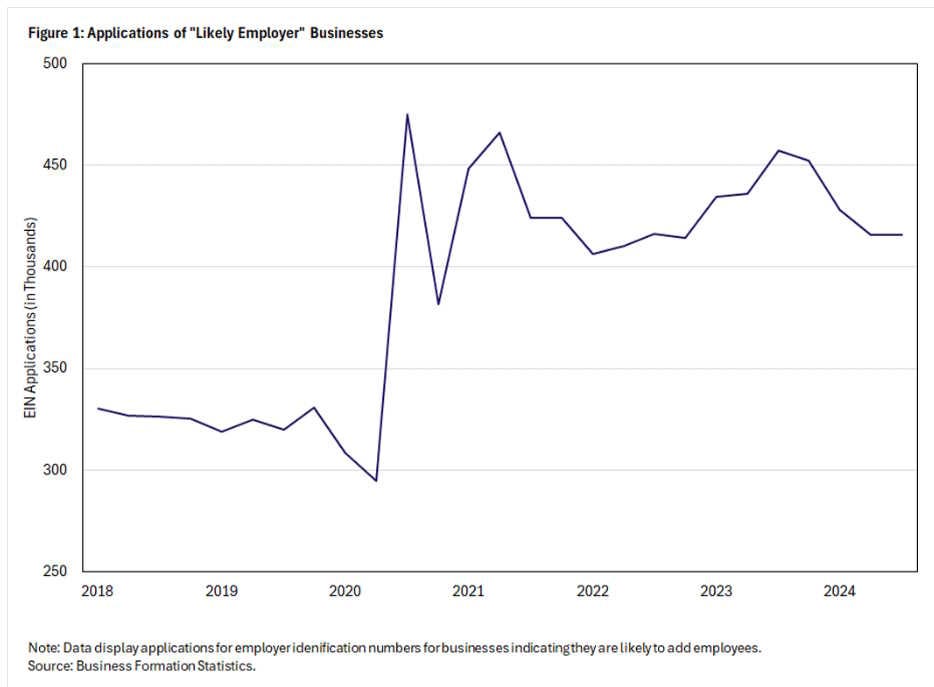
This suggests there has been a sea change in Americans’ willingness to take risks, embrace the future, and venture into the unknown.
Taken together, all of these trends suggest an American society that is healthier than its media and politics would suggest. It may not yet be a massive “upswing” on par with what happened in the early 20th century, but there are a bunch of signs that at the grassroots level, America is starting to knit itself back together after a destructive and chaotic decade.
Happy New Year!
A few historians like Peter Turchin have tried. And sociologists like Robert Putnam have certainly documented comovement in a variety of social variables, though they don’t have clear theories as to why this happens.