

Two weeks ago, the world of education was rocked by a bombshell report from the University of California San Diego. It revealed that the number of UCSD students who lack basic reading and math skills has absolutely exploded since 2020. The percentage of students needing a remedial class on basic junior-high-school level math jumped from 0.5% to over 12%. Some were even unable to do basic elementary school math. More than a fifth of entering students now fail to meet basic writing requirements.
According to the report, pandemic learning loss is one reason there are so many incapable students showing up at UCSD, but most of the problem is due to falling admissions standards. The UC system eliminated standardized test requirements in 2020, and since then it has been admitting rising numbers of kids from bad schools that inflate grades by ridiculous amounts.
Lots of people have written very good articles about this report since then, so I’ll quote from a few of them. The Argument’s Kelsey Piper talks about how the problem isn’t that UCSD students haven’t completed the required K-12 math courses — it’s often that they did complete the courses but were given passing grades without actually learning math:
Only 39% of the students in the remedial class knew how to “round the number 374518 to the nearest hundred.”
Reviewing test results like these, you would expect transcripts full of Cs, Ds, or even failing grades. But alarmingly, these students’ transcripts…said they had taken advanced math courses and performed well.
“Of those who demonstrated math skills not meeting middle school levels,” the report found, 42% reported completing calculus or precalculus…The students were broadly receiving good grades, too: More than a quarter of the students needing remedial math had a 4.0 grade point average in math. The average was 3.7…A number of high schools are awarding A grades to AP Calculus students who do not have any calculus skills and who would get the lowest possible score on the AP Calculus exam if they took it…
“I have taught AP Calc in circumstances that produced this kind of result,” one public school high school math teacher told me. “No one can do fractions.”…[A]lmost all of them fail the AP Calculus exam at the end of the year.
And The Atlantic’s Rose Horowitch finds that while the problem is especially severe at UC schools, it’s a nationwide issue, and it has its roots in falling standards at public schools:
[UCSD’s] problems are extreme, but they are not unique. Over the past five years, all of the other University of California campuses…have seen the number of first-years who are unprepared for precalculus double or triple. George Mason University…students began arriving at their calculus course unable to do algebra…
America’s students are getting much worse at math. The decline started about a decade ago and sharply accelerated during the…pandemic. The average eighth grader’s math skills, which rose steadily from 1990 to 2013, are now a full school year behind where they were in 2013, according to the National Assessment of Educational Progress…
Many [school] districts adopted a “no zeros” policy, forcing teachers to pass students who had little command of the material. One study of public-school students across Washington State found that almost none received an F in spring 2020, while the share of students who received A’s skyrocketed. Math grades have remained elevated in the years since…Together, these changes meant that even as students’ math preparation was stagnating, their grades were going up.
New York Magazine’s Andrew Rice has more details on the collapse of public education in America:
Last winter, the federal government released the results of its semi-annual reading and math tests of fourth- and eighth-graders…On reading tests, 40 percent of fourth-graders and one-third of eighth-graders performed below “basic,” the lowest threshold…
Nearly 30 percent could not pick the answer (“He wants to read it instead”). A similar proportion of eighth-graders failed to come up with the following sum:
12 + (-4) + 12 + 4 = _______.
…One math problem set out a scenario involving a restaurant check…Test-takers were asked to add the costs of…six items and calculate a 20 percent tip. Three-quarters of the high-schoolers were unable to correctly answer one or both parts of the question.
Rice’s article is very long and has many more details about how and why public education quality has collapsed in America. The basic story is that the education reform movement spearheaded by George W. Bush, which focused on improving test scores, collapsed in the mid-2010s. After that, public schools across the country began to lower their standards — passing kids who didn’t know the material, making their curricula a lot easier, etc. Often, kids just skip class entirely — in Oregon, around a third of all schoolchildren are chronically absent from school.
This was sometimes done in the name of “equity”— even though the new lax policies lead to widening racial and gender gaps. The rise of phones in schools probably exacerbated the trend, as did the pandemic, but the fundamental cause is lax standards everywhere.
Most of the articles about this slow-motion disaster just stick to decrying the report, calling for tighter educational standards, and tracing the demise of the education reform movement. I share their alarm, and I agree with their prescriptions. But I think it’s also worth thinking about exactly why education is going down the tubes in America.
One obvious possibility is that this is just another case of progressive activist culture on autopilot. In the past two or three decades, progressive governance has absolutely collapsed at the city and state level in a number of areas — housing, crime, infrastructure city services, and so on. It makes sense that education would just be one more failure of a progressive ideology that consistently prizes the bad ideas of the loudest activists. In this case, it was activists who pressured the UC system into dropping standardized test requirements.
Another obvious theory is that America is a very rich country, and the richer people get, the less they want to work hard — and helping your kids get through a tough, demanding education system is certainly hard work. Andrew Rice’s article mentions how local school board elections are usually dominated by upper-income white voters, while the degradation of educational standards tends to impact disadvantaged minorities more.
But I think there’s something else going on here. The extremely widespread nature of the breakdown of American education suggests that it’s not just progressive activism and lazy rich people. I basically see efforts to dilute and hobble the U.S. education system as a misguided attack on our pervasive economic and social inequality. To put it bluntly, Americans think that by giving everyone a free pass and refusing to educate smart kids, they can smooth out some of the inequality that results from the uneven distribution of talent.
Killing education is an incredibly bad form of “predistribution”
Why does anyone care about inequality in the first place? In most economics theories, it’s purely a matter of material well-being — poor people obviously need stuff more than rich people do, so it makes sense to take a bit from the rich and give to the poor. But in reality, a lot of people are probably upset not just about material disparities, but also status disparities. There is plenty of economic evidence that people care about income not just because of what they can consume with what they earn, but because of the social position their income gives them, relative to other people.1
This becomes important when deciding whether to orient policy around “redistribution” — progressive taxation and welfare states — or “predistribution” that reconfigures the economy to be more equal. Redistribution is effective at rectifying material disparities, but it might not be as good at reducing status disparities — if you get your income via a welfare check, you’ll probably get looked down on. I think this is one reason people often turn to predistribution instead.2
Usually, predistribution takes the form of things like unions and minimum wages — measures that try to rectify the unequal distribution of power within corporations. But there are also disparities that result from differences in ability. Some people are just naturally smarter, or have personalities that are more effective for earning money. Others get educated and trained by their parents from an early age. Sometimes, people try to use predistribution to cancel out those disparities, by making higher education less selective, or by canceling education programs that accelerate high-ability students.
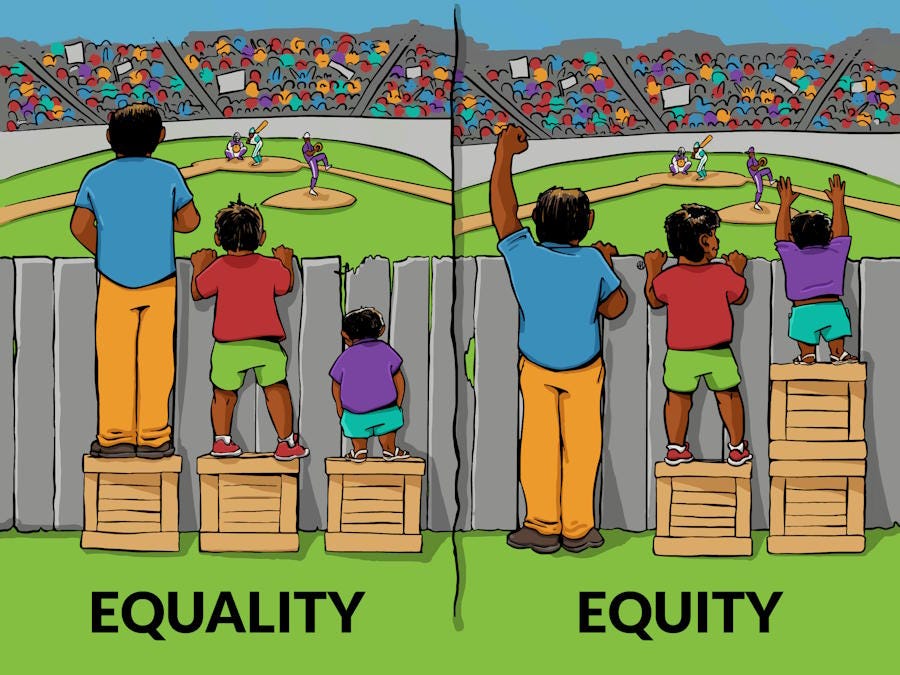
This is usually presented as a way of giving people with less natural ability a boost, as depicted in the famous “equality vs. equity” meme:
But some cynical observers note that in practice, this can easily end up hobbling high-ability people instead:
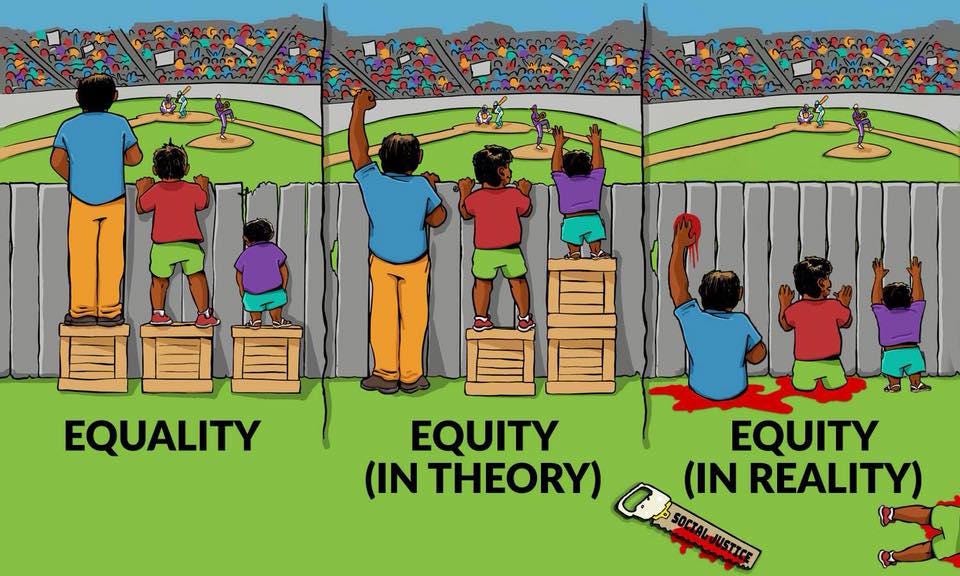
This latter idea is often described as a real-life version of the Kurt Vonnegut story “Harrison Bergeron”, about a future where talented people are intentionally hobbled in the name of social equality.
An example of a Harrison Bergeron-like policy is California’s repeated attempts to delay the teaching of algebra to junior high school students. The idea is that early algebra classes are only useful to high-ability students, so that stopping students from taking those classes will result in more equitable outcomes. In a post back in 2023, I explained why this sort of policy inevitably backfires:
Now imagine what will happen if we ban kids from learning algebra in public junior high schools. The kids who have the most family resources — the rich kids, the kids with educated parents, etc. — will be able to use those resources to compensate for the retreat of the state. Either their parents will teach them algebra at home, or hire tutors, or even withdraw them to private schools. Meanwhile, the kids without family resources will be out of luck; since the state was the only actor who could have taught them algebra in junior high, there’s now simply no one to teach them. The rich kids will learn algebra and the poor kids will not.
Canceling a few algebra classes in one city hardly seems like a national outrage. But the UCSD report, and the investigative articles written in its wake, suggest that something similar is happening more quietly and informally across the entire U.S. educational system.
And predictably, the same approach is yielding the same results. Here’s Andrew Rice again:
The students scoring in the 90th percentile — the effortless and self-motivated learners — are still doing about as well on standardized tests, and in some cases better than ever, but the bottom-performing cohort is now doing far worse. “At the tenth percentile, achievement has declined by almost two grade equivalents,” Kane says. The old racial and gender gaps have once again started to grow larger. Girls are now behind boys in math by a third of a grade level.
Why do people think that watering down educational standards will help correct achievement gaps, when the reverse is true? There are probably a number of reasons.
First, there are the progressive activists. These activists, I think, don’t care very much about the quality of the education that people receive. They view the economy as a fixed pool of resources to be divvied up, rather than as a productive enterprise that depends on the citizenry’s ability to do math. Activists, I think, envision remaking the American economy as a cradle-to-grave sequence of distributive programs — easy grades in public school, equity-based college admissions, and DEI-based hiring and promotion in the working world. The idea is that if everyone can go through the entire system without ever having to demonstrate actual ability or prove themselves in a real competition, the fixed pool of society’s resources will end up distributed equitably — a perfect form of economic predistribution.
That is very foolish, because the economy is not a fixed pool of resources; in order to have something to distribute at all, we have to learn and apply skills like math and reading. The progressive dream of cradle-to-grave equity, if implemented, will result in a profound misallocation of talent in the short term — surgeons who don’t understand anatomy, pilots who don’t know how to land planes, etc.
But in fact, that won’t even be the biggest problem. The biggest problem is that without the incentive to try hard in school, people won’t learn nearly as much, and the country’s productive power will suffer in the long run — leaving a much smaller pie to distribute.
I sometimes feel that there’s a strange alliance between progressives and rightists on the topic of education. Neither one seems to believe that effort matters. Progressives believe — or claim they believe — that educational outcomes are all due to structural inequalities in society, while rightists tend to believe that inborn talent rules everything.3
And yet the data says that effort matters a lot! Kremer et al. (2009) study the effect of merit scholarships on students in Kenya, and find that the students angling for the scholarship study a lot more and learn a lot more. Stinebrickner and Stinebrickner (2007) find that being assigned a roommate who plays video games reduces student effort and results in lower test scores. Leuven et al. (2010) find that simply paying students to pass their tests makes them pass a lot more tests. And so on.
Effort isn’t the only thing that matters for education, but it matters! I feel like old-school conservatives understood this, and most modern political movements don’t. If you destroy the incentives for students to try hard by giving them all automatic A’s and easy admission to good colleges, they’re going to try less hard in school, and they’re going to be less smart as a result. The result will be an erosion in the quality of our nation’s human capital, above and beyond misallocation.
In fact, old-school conservatives — or at least, the governments of red states — are doing a great job putting theory into practice in the Deep South. Pragmatic, phonics-based teaching methods have allowed states like Mississippi and Louisiana to zoom past progressive bastions like Oregon and Washington in terms of reading skills — especially for the disadvantaged minorities who need public school the most.
When conservatives are outperforming progressives when it comes to education, you know something is wrong. Progressive activists have forgotten the wisdom of the progressives of a century ago, who made quality, universal public education one of their key causes.
That having been said, most Americans are not progressive activists, and don’t envision the future America as a cradle-to-grave sequence of equity allocations. Instead, they’re probably making a mistake about the difference between K-12 and college.
Let’s look at a simple equation. In general, how well someone does in school will be a function of both their natural talent and the quality of the education they receive:
A is how much talent matters, B is how much a good school matters, and C is how much better talented people do at a good school, relative to less talented people who can’t handle the work.
I think a lot of people instinctively believe that C is large for K-12 and small for college — or at least, large relative to A and B. They seem to assume that teaching junior high algebra or other accelerated material is a form of tracking, and will lead to the smart kids zooming ahead and leaving everyone else behind. But they also seem to believe that colleges like Harvard have a magical effect on anyone who goes there, and can make everyone a success.
In reality, it’s likely to be the exact opposite. K-12 is easier than college — most people can learn how to solve a simple equation, but only a few people can learn how to solve partial differential equations. Being talented matters more in college, because the material is more advanced. C is big for college, smaller for K-12.
This means that ideally, you want to be selective in college but not in K-12. In K-12, since almost everyone can learn the material, you want to invest as much as you can in improving school quality, so that everyone can learn. But for college, you want to select only people who can really handle the material.
Instead, because people nowadays seem to intuitively believe that talent matters more in K-12 than in college, they end up watering down standards in high school for the sake of equity, while reducing the selectivity of colleges because they think college will magically make up for a crappy K-12 education. That’s fantasy. Now colleges are having to spend huge amounts of resources trying (and often failing) to compensate for the crappy job that K-12 schools are increasingly doing, while being forced to accept students who can’t handle high-level material.
In any case, whatever the reason that people are trying to use crappy schools as predistribution, the potential harms here are substantial. As I discussed in my earlier post, the policies are likely to backfire and increase inequality. But even more worryingly, failing to educate kids effectively will harm the U.S.’ talent pool. That will severely hurt U.S. industry — especially because companies are now having a much harder time getting immigrant workers under Trump. Ramanuj Mukherjee has some more details on the human capital crisis that’s already afflicting America:
[O]nly 7.3% [of U.S. bachelor’s degree holders] are in engineering, manufacturing & construction, 43rd of 44 countries benchmarked…[It’s] getting worse. Senior-year achievement is at or near series lows. NAEP 2024 grade‑12 math and reading both fell 3 points vs 2019; NAEP’s governing board summarized 2024 grade‑12 results as the lowest ever reported on each assessment…Adult fundamentals and reasoning are below OECD norms. In…2023, U.S. adults scored below the OECD average in numeracy and adaptive problem‑solving…Among 16–24‑year‑olds, scores are also below OECD averages…
You can’t expect to stay the richest country in the world with a populace that can’t read or do math. A few top people can hold the economy together for a while with knowledge industries like AI, but without that broad base of educated workers, a country will struggle in the long run. Plenty of papers show that better schools accelerate economic growth; worse schools will naturally have the opposite effect.
More insidiously, the combination of low-quality K-12 schools and unselective colleges will severely hurt the university system in the United States. The more unprepared students go to the University of California San Diego, the less a degree from UCSD will indicate skill to potential employers. Companies will say “Oh, a UCSD graduate…well, they might be one of those kids who can’t do basic elementary school math.” And then the diploma gets discounted.
Do this to enough schools, and the entire university system is in peril. If “college degree” no longer means “both smart and well-educated”, the economic value of a degree goes way down. That means students will pay less for college, causing a funding crisis at major schools. A funding crisis in turn will hurt the quality of education, while also leaving less money for research.
The educational approach of watering down K-12 quality while watering down college selectivity isn’t just bad for America — it’s self-defeating. It will hurt exactly the students it’s supposed to help, while weakening and defunding the progressive colleges that embrace it. Americans need to leave this crazy educational approach behind, and return to the tried-and-true approach of tough grading in public schools and selectivity at good colleges. We should be treating this like a national emergency.
Why don’t economic models typically assume that people care about relative status? Because this makes the math of economics very hard, for one thing. Also, if economists declare that relative social status is important, it makes economics seem more political, because then economists will be asked to choose who deserves to have more status, and who deserves less. It’s easier for economists to seem more neutral and apolitical by talking about inequality only in terms of the welfare effects of individual material consumption.
Another reason is that America already does a lot of redistribution, and doing even more might be politically difficult. Research shows that the remaining inequality gap between the U.S. and Europe is mostly due to differences in predistribution, so it makes sense to try to look for predistributive policies to shrink inequality in America.
In reality, I suspect many progressive educators and activists also believe talent is mostly inborn, but instead profess to believe in structural disparities because it’s more politically correct.