

As expected, Zohran Mamdani has won the New York City mayoral election. Most of the commentary about Mamdani has centered around either his Muslim religion, his leftist ideology, or some intersection of the two. This is only to be expected. The GOP electoral victory in 2024 left the Democratic party without any obvious leader, and Mamdani is a charismatic guy who ran a slick, competent campaign and inspired a lot of people. It would be an exaggeration to say that Zohran is now the de facto leader of the progressive movement or of the Democrats as a whole, but he’s definitely soaking up a ton of attention, and his success is widely seen as an indicator of where the left in general is headed.
Mamdani’s Muslim religion and his stance on Israel will certainly soak up a lot of attention and controversy. But ultimately his leftist ideology will probably be more important to how he governs as mayor. Back in June, I argued that Mamdani’s socialist roots have given him some bad instincts about how to run a city:
Essentially, Zohran’s instinct for improving affordability is to provide a bunch of free services at the city level — free buses, city-run grocery stores, and so on. That will not work very well. If he’s successful, the quality of those services is likely to be poor, drawing criticism and backlash far out of proportion to their actual economic significance. But many of the plans are unlikely to be implemented in the first place, given the need to win approval from statewide agencies like the MTA.
Meanwhile, Zohran’s housing and education policies are likely to be contaminated by bad ideas from the progressive information-bubble. Mamdani’s attack on elite public schools is based on the common but mistaken idea that these schools worsen racial gaps; in fact, they are a vehicle for discovering and giving a boost to talented minority kids. Zohran’s housing policy is based on subsidizing “affordable” homes, but — as we’ve seen in California — this will make housing harder to build overall, while increasing construction costs, and will ultimately not lead to a big boost in supply.
It’s therefore easy to envision a pretty depressing scenario for Mamdani’s tenure in office. Identity, foreign policy, and ideology might soak up tons of attention, stirring general nationwide fear about the direction of the Democratic party, while distracting from NYC’s real material concerns. And the failures of a few economically minor but symbolically important socialist initiatives could draw widespread condemnation, painting Mamdani’s whole tenure in office as a failure. This would basically parallel what happened to Chesa Boudin, San Francisco’s leftist district attorney, or (more loosely) to Chicago’s socialist mayor Brandon Johnson.
And that would be a shame, because New York City has some serious problems that Mamdani really should be addressing. NYC is America’s flagship city — in some sense, its only real city. But its tentpole industry is slowly abandoning it, leaving the future of its economic base in doubt. And it’s beset by ruinously high costs, leading to a slow degradation of public infrastructure and services. These are problems that socialist approaches will simply never fix — but if NYC is going to thrive, someone has to fix them.
The finance industry is slowly leaving NYC
Let’s take a step back and ask why cities exist in the first place.
One obvious reason cities exist is that some people just like to live in a city. There are lots of restaurants, lots of people to date and befriend, lots of art and comedy and so on. For young people and rich people especially, the consumption benefit of cities is substantial. If you have a lot of money and you don’t have kids, why would you live in some small town in Iowa when you could live in Manhattan?
But consumption alone isn’t enough to sustain most cities. Urbanization also brings substantial production advantages. There are generally three reasons why cities are thought to be more productive: 1) agglomeration, 2) clustering, and 3) local public goods. I’ll talk about public goods in the next section; for now, let’s talk about agglomeration and clustering.
Agglomeration is when you have lots of different industries located near to each other. This is important because workers are also consumers; the people who work at one company will also buy things from another company. And it costs money to transport stuff (and to transport people), so it makes economic sense to have a bunch of different companies put their offices and factories near each other, so their workers can consume each other’s products. This is the basis of Paul Krugman’s New Economic Geography theory, which helped win him the Nobel prize.1
Clustering, on the other hand, is when a single industry clusters in a city. Think about how tech is concentrated in the San Francisco Bay Area, or how the movie industry is centered in Los Angeles, or how Detroit used to be the “Motor City”. These clusters are important for innovation; Enrico Moretti finds that without clustering, overall patenting in the U.S. would be 11% lower. Other research finds broadly similar effects. This innovation boost happens because ideas diffuse across companies; Silicon Valley engineers hang out with each other and share ideas and knowledge, and they move from company to company and bring their expertise with them.2
But the economic benefits of clustering extend far beyond innovation itself. The thick market effect makes it a lot easier for companies to hire employees and find funding — tech companies go to Silicon Valley despite the high housing costs and high taxes, because that’s where a bunch of engineers are, and that’s where a bunch of venture capitalists are. And engineers and venture capitalists move to Silicon Valley because that’s where the companies are, so there’s a self-reinforcing clustering effect.
On top of that, the knowledge industries that tend to have strong clustering effects — software, advanced manufacturing, moviemaking, and so on — tend to be local export industries that bring in huge amounts of revenue from outside a city. That money gets spread around, stimulating local services like housing, health care, food service, and so on.
New York City has several knowledge industry clusters, including publishing, entertainment, and the country’s second-largest tech cluster. But by far, the city’s most important industry — and what it’s known for all over the world — is finance. NYC is not just America’s most important financial center, but arguably the world’s. Here’s some context from a 2023 article by Vassilios Gargalas and Mario Corzo:
The Finance and Insurance sector is one of the most important industries in New York City. It plays a major role in the City’s economy in terms of its contributions to employment, output, tax revenues, and wages…The securities industry (a subsector) accounts for about 7% of NYC’s tax revenues, 74% of the City’s industry tax collections, and 23.3% of its income taxes…By 2021, its share of the City’s total non-farm employment, private sector employment, and services sector employment [was] 8%, 9.3%, and 8.4%, respectively[.]
As the authors of course know, this dramatically understates the importance of finance for NYC. If they didn’t sell financial services to the rest of the world, New Yorkers would have far less money to spend on health care, housing, food, and so on; those industries would be much poorer, and would contribute far less in terms of tax revenue and jobs. NYC would still exist without finance, but it would be a vastly diminished version of itself.
And finance is slowly leaving New York City. Although the total number of finance jobs in the city has held steady, since at least the early 1990s it has failed to keep up with job growth as a whole:
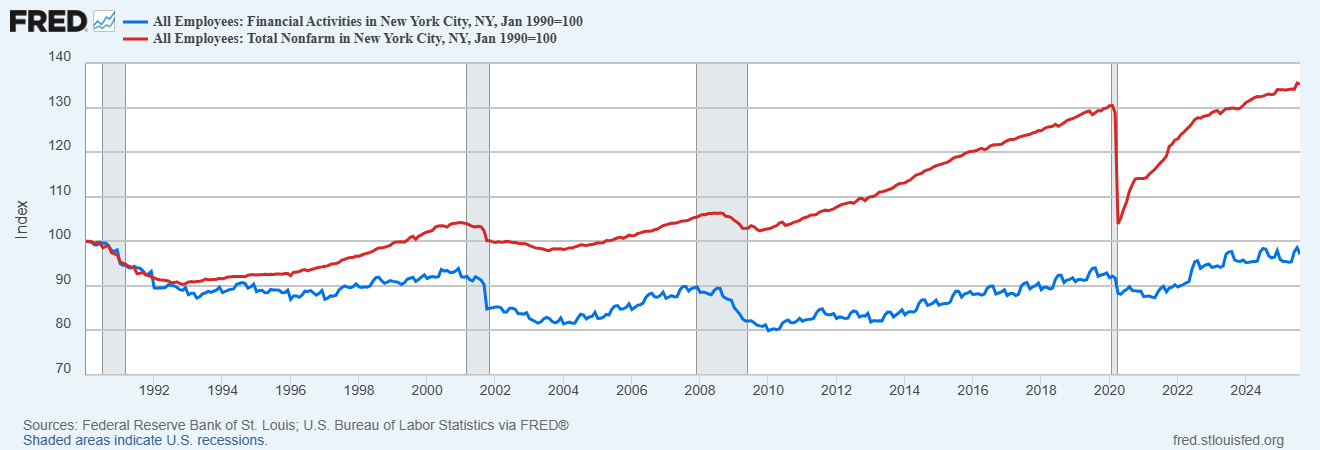
The Economist reports:
Of the 233,000 jobs in the industry created in America over the past five years, the state of New York secured only around 19,000, behind Texas, Florida, North Carolina and Georgia.
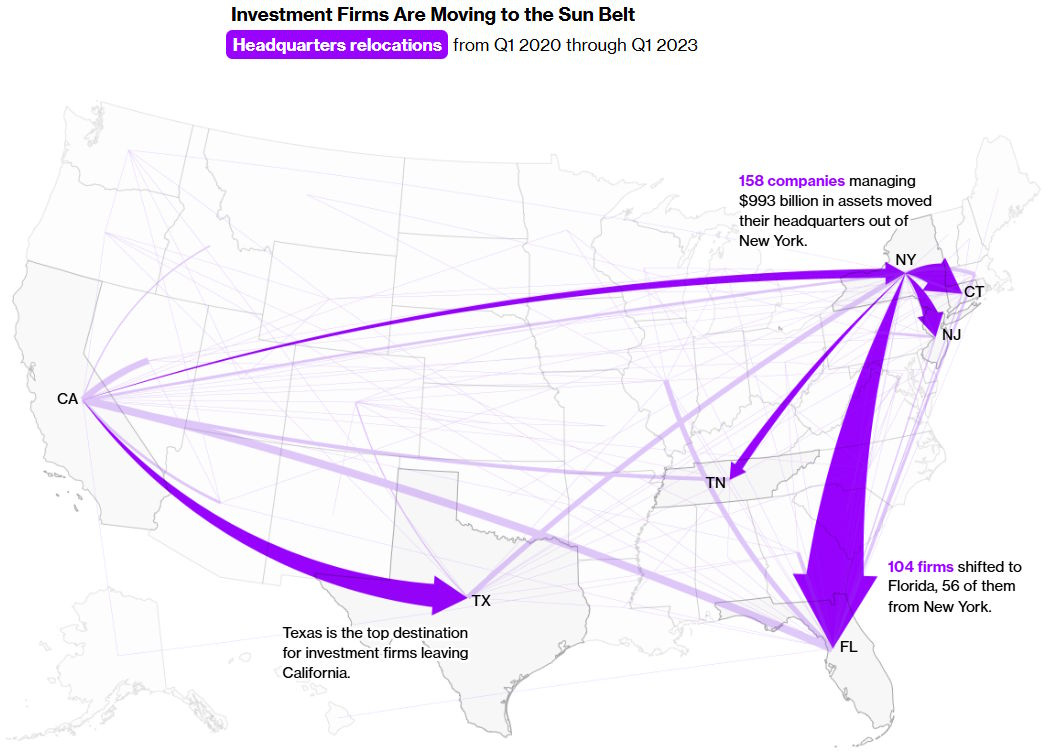
That’s not a five-alarm fire by itself; it could mean that finance’s multiplier effect is increasing, or it could simply reflect the fact that NYC has added other clusters like tech on top of its existing finance cluster. But it’s also the case that financial companies are moving out of New York, usually to the Sun Belt. This is from a 2023 Bloomberg story:
The drip, drip, drip of the finance industry’s exit from New York and California has been measured anecdotally, one at a time, these past few years. Elliott Management decamped to West Palm Beach. AllianceBernstein to Nashville. Charles Schwab moved to suburban Dallas…Now, for the first time, there are hard numbers…Both states have in the past three years lost firms that managed close to $1 trillion of assets, Bloomberg News calculated after going through corporate filings from more than 17,000 firms since the end of 2019.
And here is Bloomberg’s map of relocations:
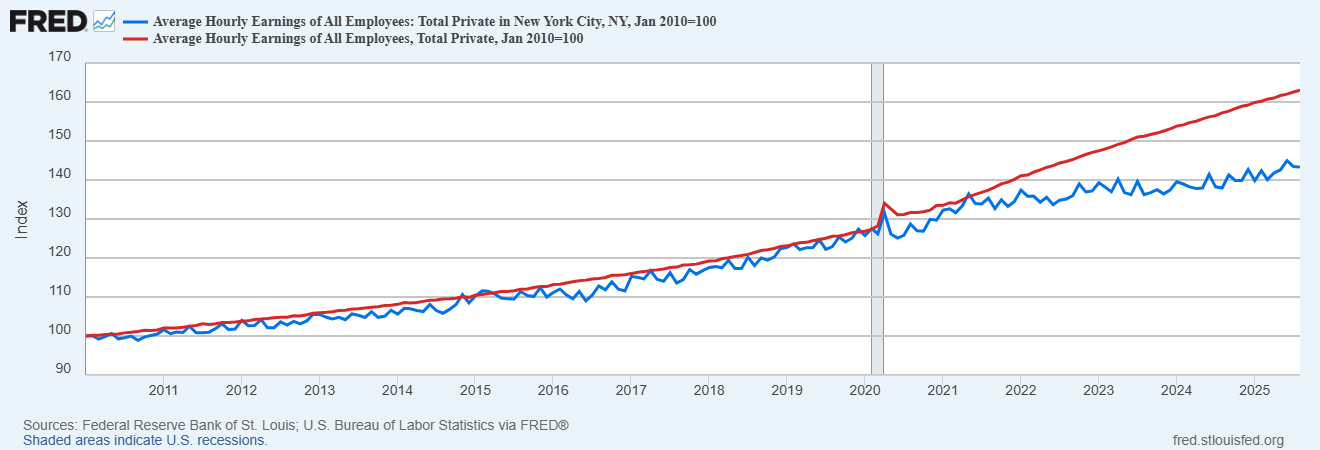
Basic urban economics predicts that if a city loses some of its industrial clustering effects, its income advantage relative to the rest of the country should fall. This is both because high-paying jobs in the cluster industry disappear, and because the multiplier effect goes down.
Until the pandemic, wages in NYC kept pace with the country as a whole. But since then, wage growth in NYC has lagged badly:3
So far, this isn’t a catastrophic exodus for the NYC finance industry, and industry cycles do come and go. But it is a worrying erosion. There’s the troubling possibility that we’re witnessing a “slowly, then all at once” situation here. As Detroit has shown, it is possible for a city to lose a tentpole industry cluster and never get it back. If there’s one American city whose history you don’t want to emulate, it’s Detroit.
Why is NYC’s position as America’s dominant financial center eroding? A report in The Economist blames high taxes, overregulation, and high living costs:
Why is the city’s financial pre-eminence slipping? Kathryn Wylde, head of the Partnership for New York City, an influential business group, blames a double-whammy of high costs and heavy taxes. New York state’s corporate income tax, at 7.25%, is not especially burdensome. But the city, unusually, piles its own corporate income tax on top, as well as a levy for the regional transport network, leaving some local businesses paying more than 18% in local taxes alone…
Another burden comes from exacting local regulations on hiring, such as rules that prevent firms using AI tools without an independent audit on their bias, or those that stop employers asking potential employees about their criminal or salary history. The result is that financial firms can cut costs dramatically by shifting work to cheaper places…
Workers have good reason to shun New York, too. They also face high taxes and other costs…New York state’s share of American taxpayers reporting more than $1m in income declined from 12.7% in 2010 to 8.7% in 2022. Such people paid $34bn in income tax to the state and city in 2022, a figure that would have been $13bn higher if New York’s share of millionaires had held up. Estimates from Goldman Sachs suggest that fully 10% of households in New York City with incomes of more than $10m established residency elsewhere between 2018 and 2023.
If you just look at the impact of personal taxes in isolation, it actually looks pretty small. There’s a bunch of research showing that high personal taxes have a real but small impact on where rich people live. California has similarly high tax rates, and this hasn’t eroded Silicon Valley’s dominance.
Corporate taxes also usually aren’t a dealbreaker. This is from Giroud and Rauh (2015):
For C corporations, both employment at existing establishments (intensive margin) and the number of establishments in the state (extensive margin) have corporate tax elasticities of -0.4. Pass-through entities, which serve as a control group for the corporate tax reforms, respond only to the personal tax code, with tax elasticities of -0.2 to -0.3. Around half of the effects are driven by reallocation of productive resources to other states where the treated firms have establishments. Capital shows similar patterns but is 36% less elastic than labor. A narrative approach confirms that the results are robust and strongest in the sample of tax changes that were implemented due to inherited budget deficits, long-run goals, or cross-state variation caused by Federal tax reforms.
If you isolate the effect of the corporate tax here, it’s pretty small — an elasticity of 0.4 instead of 0.3 would mean that doubling the corporate tax would lead to 10% of employment leaving, and then maybe 7.4% of capital leaving. That’s enough to worry about, but not catastrophic.
The thing about clustering effects, though, is that minor effects can become major ones once they pass a certain threshold. If so many financial companies leave NYC that Dallas and Miami and other places become the key hubs for pieces of the financial industry, you could see threshold effects where a whole bunch of companies flee NYC all at once to go to the new clusters.
There’s also the possibility that the finance industry itself has less of a clustering effect than it used to. This is pretty speculative on my part, but it’s worth thinking about. The Dodd-Frank Act of 2010, along with other regulations following the financial crisis of 2008, changed the way the finance industry works in America.
For example, the Volcker Rule — part of Dodd-Frank — prohibits banks from doing proprietary trading. This means that there’s a lot less of a reason for traders to live in the cities where banks are located. So they may simply choose to live in Greenwich, CT, or Dallas, TX instead, for the quieter life, bigger houses, lower living costs, and lower taxes.
Regulation of systemically important financial institutions might also have had an effect. U.S. banks’ role in the economy changed after the crisis; they still do a lot of financial plumbing, but they’re a lot less important in terms of lending. If you think of lending as a knowledge industry like tech, then perhaps the shift from big bank loans to bond markets — and to small regional banks — represents the weakening of an important clustering effect in New York City.
Think about how this might work. If you were a mortgage lending specialist at Bank of America in NYC in 2005, your presence in the city may have encouraged Citibank and Chase and other banks to keep their offices in the same city, in order to potentially hire you and benefit from your knowledge. Now, with those banks doing less lending overall, you don’t necessarily have a reason to live in the city. And when you leave, financial companies have one less reason to keep their offices in NYC, because not only are they not doing as much lending overall, but they can’t hire you for other kinds of jobs either.
Technology may be weakening the clustering effect as well. Traders used to have to meet in a big physical pit to trade; now they can just call each other over secure lines, chat on a Bloomberg machine, or — in the case of stocks and a few other assets — trade completely electronically in an automated market. Some kinds of financial deals can now be negotiated over the internet. The rise of remote work in the pandemic may also have prompted some finance jobs to go full remote.
If this is true, it means that factors that might be small for a robust cluster like San Francisco might suddenly be decisive for NYC. Factors like personal income taxes, corporate taxes, regulations, living costs, and crime might have been shrugged off by the NYC of the 1980s, but today, altogether, they might be enough to start a cascade effect that hollows out New York’s tentpole industry.
Mamdani should thus tread very carefully. Raising taxes yet more to pay for expensive free public services, denying kids the ability to go to magnet schools, allowing only “affordable” subsidized housing, and other measures that make life a little harder for finance employees and entrepreneurs might be more dangerous now than they would have been twenty years ago. Instead, Mamdani should be thinking about how to keep NYC’s flagship industry firmly entrenched in the city. So far, there’s little sign that he’s thinking about this.
NYC can’t afford its own infrastructure
A third basic reason that cities exist is local public goods. If everyone lived out in the country, it would be a lot more expensive to build sewer systems, water systems, electrical grids, and roads that served everyone. When you add a new resident to a city, it’s relatively cheap to get them hooked up to all the urban infrastructure they need.4
New York City’s infrastructure is actually pretty good. What other city has a subway like NYC’s? But this infrastructure is maintained only at truly incredible — and increasing — expense. In 2017, Brian Rosenthal wrote a scathing story called “The Most Expensive Mile of Subway Track on Earth”, which I strongly encourage you to read if you haven’t already. NYC’s Second Avenue Subway cost $2.6 billion per mile to build in its first phase, and $4.4 billion to build in its second phase. In comparison, a typical mile of subway costs less than $0.4 billion to build worldwide. New York City is paying between five and ten times as much to build a train as countries like France.
That enormous cost bloat is unconscionable and unfair to the taxpayers of New York City. It’s also unsustainable — NYC’s ancient train systems are physically falling apart, but maintenance is as ruinously expensive as construction. Delays and other problems on the subway dropped in the pandemic but have been climbing steadily since then.
The Transit Costs Project later did a more in-depth study of the Second Avenue Subway, the main focus of Rosenthal’s article, and came to very similar conclusions. The main reasons why New York City’s trains cost so ruinously much are probably:
Hiring way too many people to build the subway
Hiring too many outside consultants
Inefficient and uncompetitive government procurement processes
Building stations that are too large
Which of these problems is Zohran prepared to attack? Subways are built with union labor, and unions often insist on overstaffing; Mamdani, with his leftist background, seems extremely unlikely to fight them on this, unless it’s an “only Nixon could go to China” situation. He might cut out consultants and reform procurement processes, but so far he hasn’t shown much interest in this as an issue. As for the size of stations, this would presumably improve if more transit planning expertise were brought in-house; this seems like the kind of thing a socialist would like, but Mamdani has yet to make it a priority.
Meanwhile, the subway isn’t the only piece of NYC infrastructure that’s badly in need of repair. In 2023, a water main over a century old ruptured and flooded the Times Square subway station. The city’s pipes are leaking vast amounts of water. Problems like these have been visible for decades, but high costs mean it’s hard to do anything except patch the ancient infrastructure up and pray it lasts another year.
Poor infrastructure also compounds the industrial clustering problem I described in the last section. What banker wants to ride the train in a city where the subways always seem to be late or cancelled, and screech so loud they damage your ears? What asset manager wants to live in constant fear of ruptured water mains, or feel her taxi bump and judder over potholed roads on the way to a meeting? Crappy public goods are just one more reason for tentpole industries to move to the Sun Belt.
Mamdani could follow in the footsteps of America’s “sewer socialists”, who focused on making big government work effectively and built high-quality public infrastructure a century ago. His open-mindedness on housing does provide a glimmer of hope here. But so far, his main approach toward public transit seems to be to make it free to use, rather than to make it cheap to build. Like most 21st-century American socialists, his focus is on making things seem free instead of making them actually cheap.
If Mamdani really wants to prove that a socialist administration can work for New York City, he’s going to need to find a way not to drive the city’s key businesses away, and he’s going to need to tackle the city government’s inability to provide public goods at low cost. Otherwise, he risks becoming yet another cautionary tale about the dangers of electing an ideological leftist to public office.
Fujita Masahisa should have shared that prize.
One hypothesis is that California’s refusal to enforce noncompete agreements is what made Silicon Valley (and possibly Hollywood) such a strong cluster; engineers could move from company to company and spread ideas around.
These wage numbers aren’t adjusted for inflation. The reason is that if you’re comparing two places (in this case, NYC vs. the overall U.S.), you don’t really need to adjust for inflation to show a growing gap. If you want to show the way a single place’s real wage has changed over time, you need to account for inflation. Here, I just wanted to show a gap.
Infrastructure is not a pure public good, of course, but it has a network effect that gives it a positive externality, which means it has similar issues.