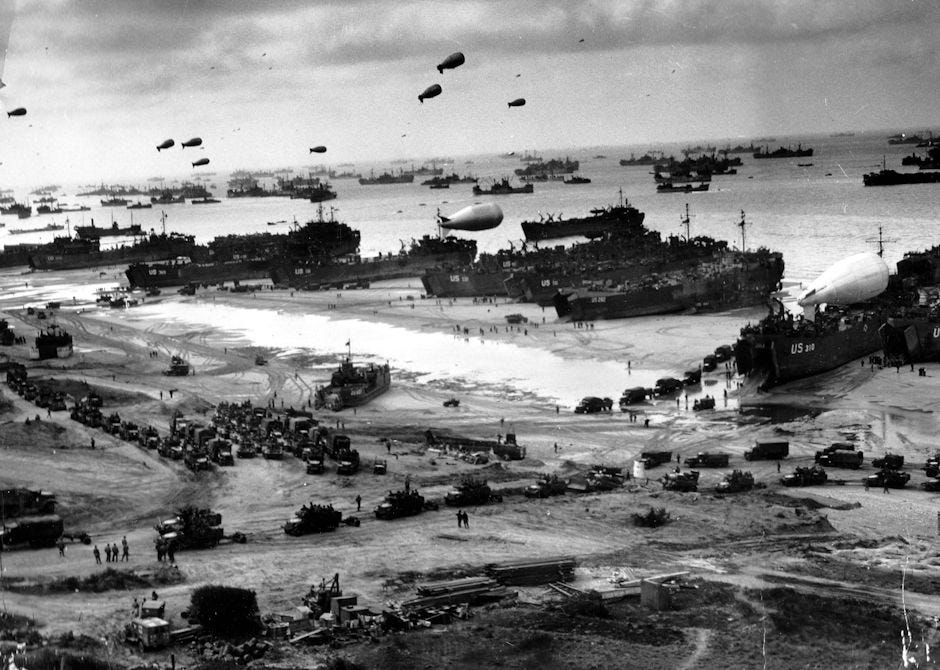
My father’s father was a bombardier in Europe in World War 2. Around Christmas in 2002, I asked him to tell me everything he remembered about the war. I had always had great reverence for my grandparents’ generation, and growing up I pestered them for as many of their stories as they could tell me. But the war, and especially combat itself, had been the one thing I avoided asking about directly; instead, it simply loomed silently in the background, defining and giving meaning to everything.
But my other grandfather, who had been an infantryman in the Pacific, had died a few years prior, and had taken most of his dark secrets with him to the grave — why he couldn’t see certain objects without throwing up, or the nature of the secret wound that had earned him his “extra” purple heart. I told my remaining grandfather I didn’t want to let his own stories perish completely. So he sat down with me in his living room and told me every story he could remember. We talked all night and into the morning.
The picture I got of the war from those stories was far from the glossy cartoon version of World War 2 that we learn from popular culture. It was full of foolish mistakes and gross incompetence, casual brutality, petty vice. Most of all what I realized was how confused everyone was. The one line my grandfather repeated, over and over, was “For all we knew, we were going to die the next day!” When we hear the story of World War 2 now, we know how everything turned out — what the ultimate conclusion was, what the important battles were, and so on. We’ve had time to turn it into a coherent narrative. But at the time, the people fighting that tremendous conflict had very little idea what was actually going on, or how it would all turn out.
By convention, we call my grandparents’ generation the Greatest Generation, and though it’s a bit cheesy, it was precisely that utter confusion that made them deserve the moniker. In 1932, there had never been an economic downturn like the Great Depression1; nobody knew whether capitalism was permanently collapsing, but they kept on going to work every day. In 1942 nobody knew whether the Nazi and Japanese empires would conquer Eurasia, enslave its people, and use its vast resources to cow the United States into submission — but they didn’t flinch from the task of beating those enemies back.
With smug hindsight, we now know that capitalism is largely self-correcting, and that the Allies could easily outproduce the Axis. Imagine getting up every day to fight, or work in a factory, not knowing any of that, and yet knowing that as long as it took, and as hard as it got, you would keep fighting. There was a saying in the early days of the war: “Golden Gate in ‘48, bread line in ‘49.” That’s how long Americans expected the war to last, and what they expected the cost to be.
That generation left us an inheritance so priceless that we will never really appreciate its value. For decades, our world was free of great-power conflict, and that long period of relative stability brought unprecedented economic growth. The war brought the end of the age of European empires, self-determination for Asia and Africa, and the long fall of global inequality and extreme poverty. It brought us the United Nations and the Universal Declaration of Human Rights. It brought us an age of wonders — the computer revolution, the atomic age and the space age, modern health care, the age of Big Science.
Like my grandparents’ lives, World War 2 silently loomed in the background of the entire American Century. Talking all night with my grandfather, what I came to understand was that he and his generation — their pain, their sacrifice, their confusion, and their stubborn perseverance — were still watching over us, still protecting us and guiding us. Our happy, carefree modern lives — the paid vacation, the startup exits, the casual sex, the dance music festivals, the stock market, the psychedelic drugs, all of it — was an inheritance they fought to bequeath to us.
And now they are gone. The Greatest Generation has largely passed, and at the same time, we are discovering that some of those precious inheritances have been spent down. The moral anchor of the victory over the Axis has been largely lost. The Arsenal of Democracy, which endured throughout the Cold War, has been strangled by institutional sclerosis and ceded to China.
We’ve lived all our lives in the Great World 2 Afterparty, and now that party is over.
The evil of the Nazis is no longer our moral anchor
General George Patton’s nickname was “Old Blood and Guts”. He was no stranger to violence. And yet when he walked into the Nazi death camp at Ohrdruf, Patton reportedly vomited in horror, describing the camp as “one of the most appalling I have ever seen.” Eisenhower agreed, writing:
The other day I visited a German internment camp. I never dreamed that such cruelty, bestiality, and savagery could really exist in this world! It was horrible.
When he liberated Buchenwald later, Patton forced over a thousand local German civilians to come look at the sight, to behold and reckon with the evil they had supported.
Eisenhower famously ordered U.S. troops to tour Ohrdruf, saying “We are told that the American soldier does not know what he is fighting for; now, at least, he will know what he is fighting against.” He understood that those atrocities would serve as a moral anchor that would give meaning to Americans’ struggle. And so it did; when they went home, Americans remembered what they had seen.
That moral anchor long outlasted the fighting. The whole modern notion of human rights, enshrined in the UN Charter and various international declarations, was in large part a reaction to the horrors perpetrated by the Axis. This necessarily involved some degree of whitewashing of the Allies’ own war crimes.2 But the moral tally is unambiguous. The kind of systematic mass slaughter perpetrated by the Nazis and the Japanese Army was something unseen since the days of premodern conquerors like Tamerlane or Genghis Khan.
Adolf Hitler, in particular, was the all-time champion of genocide — the Holocaust is only the best-publicized part of his rampage, with Jews being perhaps only a quarter of his victims. And had they not been defeated by the Allies, the Axis would have just kept on killing and killing — Hitler’s explicit plan was to murder over 60 million more Slavs in order to make room for German expansion, and it’s unlikely he would have stopped with the Slavs.
That unspeakable evil — which has been exhaustively documented with untold amounts of photos and eyewitness accounts, to the point where no serious historian questions its scale and severity — gave the people of the West something to define our moral compass against. And yet now, after the generation who defeated that evil has passed, a new generation of American rightists is trying to rehabilitate the Nazis. Yair Rosenberg reports:
The story we got about World War II is all wrong,” a guest told Tucker Carlson on his podcast two weeks ago. “I think that’s right,” replied Carlson. The guest, a Cornell chemistry professor named David Collum, then spelled out what he meant: “One can make the argument we should have sided with Hitler and fought Stalin.” Such sentiments might sound shocking to the uninitiated, but they are not to Carlson’s audience. In fact, the notion that the German dictator was unfairly maligned has become a running theme on Carlson’s show—and beyond.
Last September, Carlson interviewed a man named Darryl Cooper, whom he dubbed “the most important popular historian working in the United States today.” Cooper’s conception of honest history soon became clear: He suggested that British Prime Minister Winston Churchill might have been “the chief villain of the Second World War,” with Nazi Germany at best coming in second. The day after the episode aired, Cooper further downplayed Hitler’s genocidal ambitions, writing on social media that the German leader had sought peace with Europe and merely wanted “to reach an acceptable solution to the Jewish problem.” He did not explain why the Jews should have been considered a “problem” in the first place.
Darryl Cooper has also appeared on Joe Rogan.
Meanwhile, the so-called Groyper movement, which has explicit neo-Nazi themes and is led by a man named Nick Fuentes, is rapidly winning influence on the political right. Richard Hanania, a former rightist who has spent a lot of time documenting this spiraling extremism, reports on how mainstream conservatism is starting to bend the knee:
I imagined the mainstreaming of Nicholas Fuentes and his supporters would take a good while…Now, the most storied think tank in the history of modern conservatism has fallen.
On Thursday, Kevin Roberts, the president of [the] Heritage [Foundation], took the side of Tucker Carlson in a dispute over the former Fox News host conducting an interview with Fuentes. Roberts declared, “We will always defend our friends against the slander of bad actors who serve someone else’s agenda” and vowed that Carlson would always be a friend of Heritage. Those criticizing Carlson’s interview with Fuentes were part of a “venomous coalition,” Roberts said, that is “sowing division.” While denouncing anti-Semitism and disavowing some of the things Fuentes has said, Roberts argued that he shouldn’t be cancelled, but debated.
This was widely seen as a capitulation to the Groypers, coming down on their side over and against those who criticized Tucker’s interview and his more general descent into conspiratorial anti-Semitism…
“Groyper” refers to the loose network of mostly young, male, hard-Right types who orbit around Fuentes, a live-streamer and social-media personality [who] built his following through hours-long webcasts mixing irony and an ideology that is a combination of racial nationalism, Christian theocracy, and hostility toward feminism and immigration.
Why are rightists eager to rehabilitate the 20th century’s greatest monster?3 Because they realize that the memory of 20th century Nazism is a cudgel that their enemies can use to beat them with:
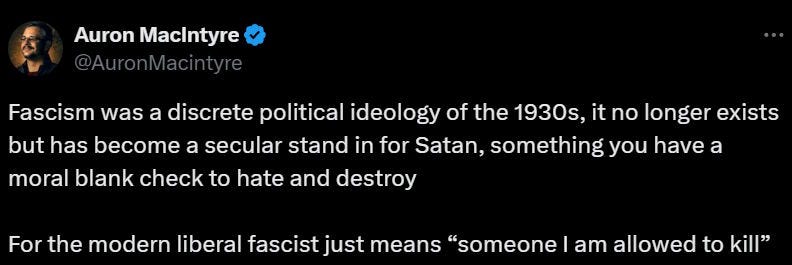
On one hand, some modern rightists clearly do deserve to be tarred by association with Nazi Germany — if you march around waving swastikas or make excuses for Hitler, you don’t get to complain when people associate you with old Adolf, even if you aren’t personally drawing up a plan to exterminate 60 million Slavs and replace them with Germanic homesteaders.
But on the other hand, in the 2010s, progressives absolutely did over-apply the “Nazi” label to regular conservatives — and sometimes even to liberals — in many social media statements and interactions. I myself get called a “Nazi” fairly regularly by anonymous online leftists, as do people like Matt Yglesias and Nate Silver.
Of course this type of hyperbolic insult is not a new or recent thing in America. If you marched in support of U.S. troops in Vietnam in 1970, hippie protesters might scream “Nazi” at you. Hunter S. Thompson called cops “Nazis” in Fear and Loathing in Las Vegas. It was always part of the standard lefty lexicon. But because there was no social media until recently, normal people didn’t hear it, and it wasn’t dominant in the discourse.
After progressive activists and anonymous shouters took over from liberal commentators as the voice and face of the American left, there was simply no way that any normie conservative could avoid having the charge of “Nazi” thrown in his face all day long. That’s not enough to make your average conservative a Hitlerite, of course. But when everyone is yelling “Nazi” at you all day long, it can become background noise, and the visceral power of the epithet starts to fade. Social media is definitely cheapening the moral anchor of World War 2 through overuse and constant trivialization.
Meanwhile, the Nazis are slowly losing their status as the Great Satan among online leftists as well. Leftist discourse on X and other international discussion platforms is “decolonial” in orientation, meaning it’s heavily influenced by people from Muslim countries like Pakistan where the words “Nazi” and “Hitler” carry little stigma. Although Hitler would have gleefully exterminated every Pakistani given the chance, the people of Pakistan, and of many other formerly colonized countries, have no memory of battling the Nazis, and may even see Hitler as a force that helped push out British colonialism.
A lot of people in Muslim countries are more likely to see Israel as the epitome of all evil than Hitler, and this attitude is seeping into the American left via the Palestine movement. Many Palestine activists also resent the use of the Jewish Holocaust as a moral anchor, since they see it as providing Israel with cover to commit what they see as genocide against Palestinians. That attitude is more prevalent overseas than in America, but it’s starting to seep into the progressive movement here too; many progressives are leaping to defend Maine Senate candidate Graham Platner for having a Nazi tattoo, but just imagine the reaction if it had been an Israeli flag instead.
If the Greatest Generation were still around to dominate American politics, none of this would be happening. The living memory of Nazi evil, and the pride in America for having smashed that evil, would override all the perverse social media dynamics and attention-grabbing activism. But most of the people in the discourse now aren’t even the children of the Greatest Generation — they’re their grandchildren or younger. To them, World War 2 might as well be the conquests of Genghis Khan.
And so despite all the unending documentation of Nazi evil, the moral certitude that flowed out of World War 2 is fading.
The Arsenal of Democracy is gone
America certainly was the “good guys” in World War 2, but we did not win the war because of greater moral virtue. We won it because of overwhelming industrial production, and because of scientific and technological innovative capacity. The U.S., in particular, massively outproduced the entire Axis all by ourselves, pouring vast armadas of ships, airplanes, and tanks into the fight:
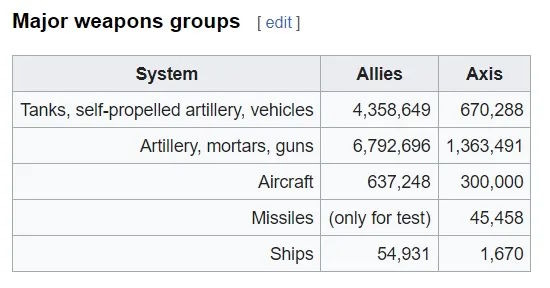
Even the mighty Soviet Union probably would have fallen without massive U.S. war production to support it, as Joseph Stalin himself stated. And America’s destruction of Germany’s air power and industry through aerial warfare was invaluable to defeating the Nazis as well. That’s in addition to the U.S. basically defeating Japan single-handedly at the same time, of course.
Raw productive capability was absolutely crucial to winning the war. One of the stories my grandfather told me on that night in 2002 was about how his life was saved when his plane was grounded for engine trouble; that day, his entire bomber wing was almost completely slaughtered by German jet fighters.4 Germany had developed far more advanced fighter planes than anything America could muster at the time, not to mention ballistic missiles and cruise missiles. But these wonder weapons ultimately didn’t make a difference for the outcome of the war, because Germany couldn’t produce them in sufficient quantity; America and the USSR simply overwhelmed the Nazis through superior numbers of decently good weapons.
America and its democratic allies remained the world’s productive powerhouse through the end of the Cold War, which was almost certainly decisive in the outcome of that struggle as well. But as of the 2020s, America and its allies have forfeited that crown to China:
Although the UN’s prediction that China will represent 45% of global manufacturing by 2030 may be exaggerated, the share is already over 30%, and will probably hit 35%:


If American and its allies are forced to go to war against the new industrial colossus, it will be the reverse of WW2 — the Allies will be forced to rely on small numbers of wonder-weapons, while China produces endless waves of drones, missiles, and ships. The U.S. industrial base is now almost totally hamstrung by pervasive anti-development regulation.
Currently there is no real plan to reverse this. The Trump administration seems to think that tariffs — including on America’s allies — will restore U.S. manufacturing, but this is folly. Tariffs will mostly just raise input costs and hamstring the manufacturing sector, as is already happening. Massive regulatory streamlining, robust industrial policy, and close economic integration with Europe, Japan, and Korea would be necessary in order to match China’s industrial strength. But although Trump might be amenable to deregulation, he has so far eschewed industrial policy because of its association with Joe Biden, and has spit in the face of most of America’s allies and hit them with tariffs.
Meanwhile, European manufacturing is being held back by a thicket of poorly designed regulation, as well as misguided environmental movements. Germany destroying its perfectly serviceable nuclear power plants is the most prominent example of this, but it’s only the tip of the iceberg.
Needless to say, none of this will restore the Arsenal of Democracy.
Of course even if it’s ultimately production volume that wins extended wars, technology still counts for a lot. It was American technological and scientific prowess that gave the Allies a decisive advantage in many areas. The Manhattan Project and the nuclear bomb are only the most famous example. America greatly advanced radar technology, giving the Allies the ability to see the enemy before being seen. American codebreakers cracked Japanese codes, leading to the victory at Midway. Long-range bombers, mass production of antibiotics, early computers, synthetic rubber, and a bunch of other innovations were key to the war effort.
America didn’t just invent specific technologies in WW2; it invented Big Science itself. The Office of Scientific Research and Development, created during the war, became the progenitor of peacetime scientific institutions like the National Science Foundation, the National Institutes of Health, and DARPA that have underpinned American scientific and technological leadership during and after the Cold War. Much of modern technology came out of those institutions — even the internet itself.
But under Trump, the U.S. is willfully gutting many of those institutions, in an attempt to root out progressive ideology:
This is coming at exactly the same time that China is ramping up its scientific and innovative efforts. China is determined to be the world’s premier technological power, and even if so far it has produced fewer breakthrough discoveries, its incremental innovations add up. In war, it’s the latter that matter more; America didn’t invent penicillin or radar, nor were Americans the first to split the atom, but America’s incremental innovation allowed us to have the best radar, the most antibiotics, and the first working nuke.
In fact, the U.S. is turning its back on practically every advantage it used to win World War 2 and the Cold War. High-skilled immigrants — Jews and dissidents from Nazi Germany — built the nuclear bomb and supercharged American science in the postwar years, while skilled immigrants helped keep America ahead of the Soviets technologically. But the Trump administration, worried about demographic “replacement”, is discouraging foreign students and skilled workers from coming to our shores.
The most important institutional inheritance of World War 2 — world-beating manufacturing and science — has now also been just about spent down. All the power is in the hands of a totalitarian country whose leadership sees America as their main rival for world domination. Even as America loses the moral compass that made us better than our opponents in World War 2, we’re losing the real physical advantages that let us win the war.
The work begins again
As the world drifts farther from the resolution of World War 2, it’s becoming a more authoritarian place. The trend toward democracy that started after the war’s conclusion peaked in the mid-2000s and has started to reverse in the two decades since. The demonstrable economic and technological success of the world’s premier authoritarian power, and the weakness of its greatest democratic champion, is a big part of this.
But even within America, authoritarianism is rising; right now, masked federal agents are going around arresting people at will in American cities, on suspicion of being illegal immigrants. During the Cold War, the U.S. would mock the USSR for being a “papers, please” society. Now we are one.
Most Americans don’t seem to realize how much this puts their personal freedoms under threat. If the MAGA folks manage to permanently delegitimize and sideline the Democratic party — and if the Democrats help them do so by embracing a deeply unpopular and sometimes illiberal progressive ideology — then there will be nothing standing in the way of MAGA doing essentially anything its leaders want to do. Restrictions on speech, assembly, and the press may become commonplace. Curbs on birth control are a possibility. And if the Groypers continue gaining influence on the right, who knows what else could be on the menu?
The legacy of World War 2 no longer protects us against any of these threats, either from within the country or from foreign shores. The Greatest Generation bequeathed us a strong moral compass and strong economic and technological institutions, and for eight decades we lived in what we may eventually come to recognize as a beautiful dreamland of relative freedom and peace.
Our grandfathers are gone. We’re on our own again. If the next century is to be a time in which regular people can live in wealth and freedom and happiness, we’re going to have to struggle and persevere through some very nasty adversity. We are going to have to deal with the Groypers, with the leftists, with Chinese manufacturing, with low fertility and population decline, with the madness of social media, with the corrosive inertia of our own regulatory state, and with all the unexpected challenges that new technologies throw our way.
And just like the Greatest Generation, we have no idea how any of this will turn out. Hopefully it won’t be as hard for us as it was for them, but it might be. Or it might be even harder. And if it is, we need to be ready for that.
We should not fault ourselves for partying for eighty years. Our grandparents fought very very hard to throw that party for us, and we honored them by enjoying the wealth and freedom they secured. But now it’s the morning after, and our head is throbbing, and it’s time to go back to work.
No, not even the Long Depression of the 1870s.
For example, the way the UK’s war effort let millions of Indians starve, the mass rapes of German women by Soviet troops, and the indiscriminate firebombing of Japanese and German civilians.
Yes, Hitler was even worse than Stalin and Mao. Stalin was maxed out on murder, while Hitler was trying to kill far more people than Stalin ever wanted to. Mao’s famine probably resulted in more deaths than Hitler’s wars and genocides, but the majority were due to incompetence rather than intentional murder. That said, Mao and Stalin were figures of towering evil who deserve to be more vilified in American history than they are. And Pol Pot, the communist ruler of Cambodia, was every bit as evil as Hitler, and was even more murderous on a per capita basis. So yes, commies are bad.