
The Trump administration is not doing a good job. Tariffs are punishing the U.S. economy. Masked federal agents are rampaging through the streets of American cities, grabbing people off the street. Corruption is rampant. The people Trump put in charge of the country’s public health services don’t even believe in the germ theory of disease. And as a result, Trump’s approval rating keeps slipping:
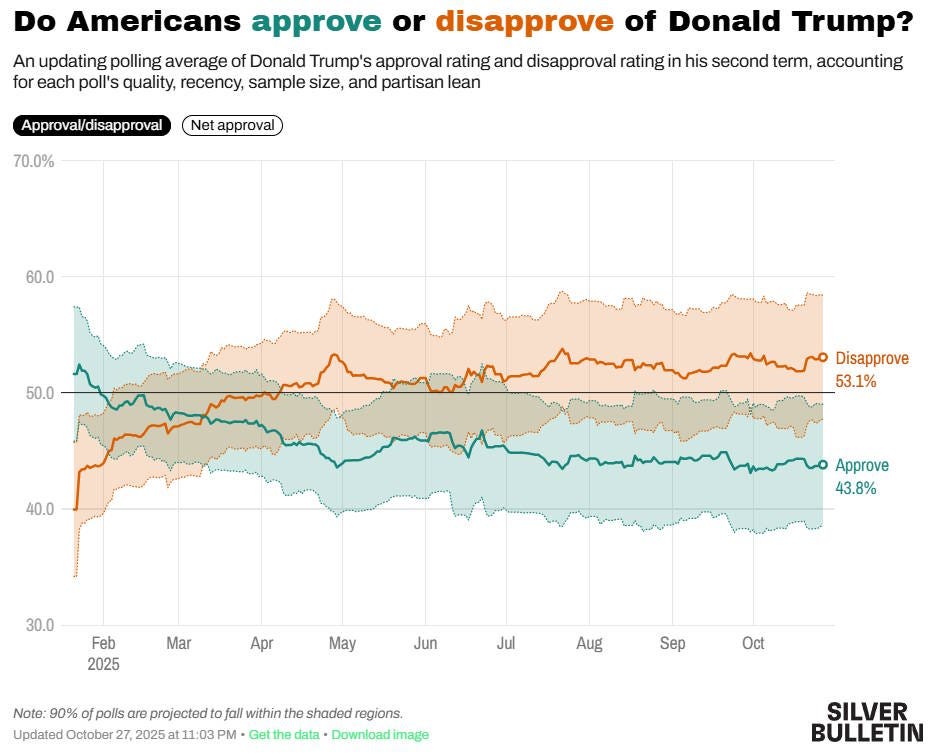
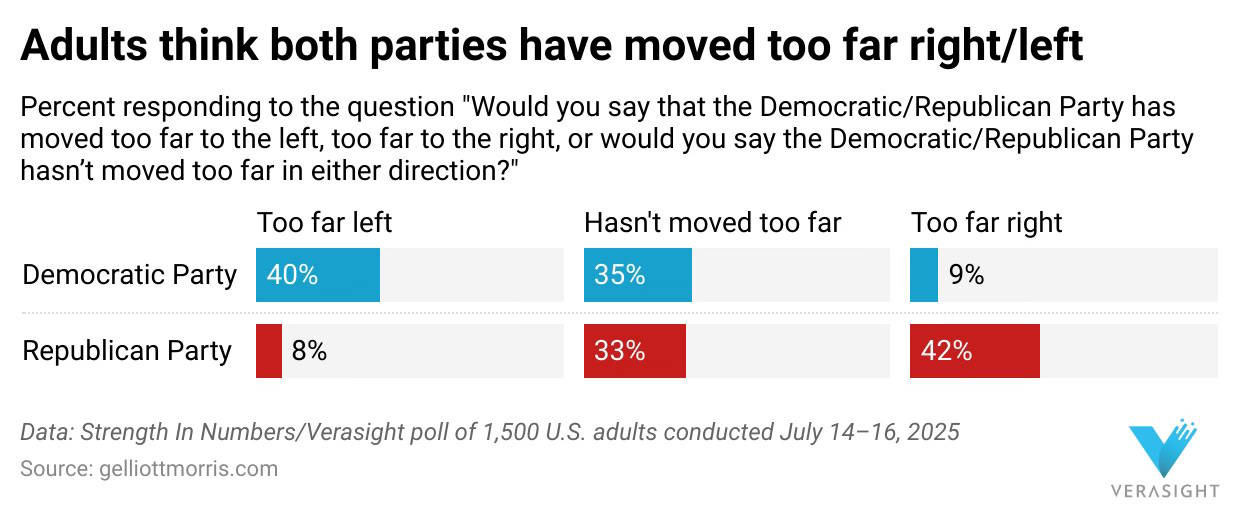
And yet as unpopular as Trump is, the Democrats seem to be in even worse shape. The two parties are neck and neck in terms of approval, with the GOP slightly ahead, even though a thermostatic reaction to Trump’s overreaches and blunders ought to be making the Dems more popular right now. And despite the fact that Trump is talking about a third term and ending birthright citizenship and cracking down on the press etc. etc., people perceive the GOP as no more extreme than the Dems:
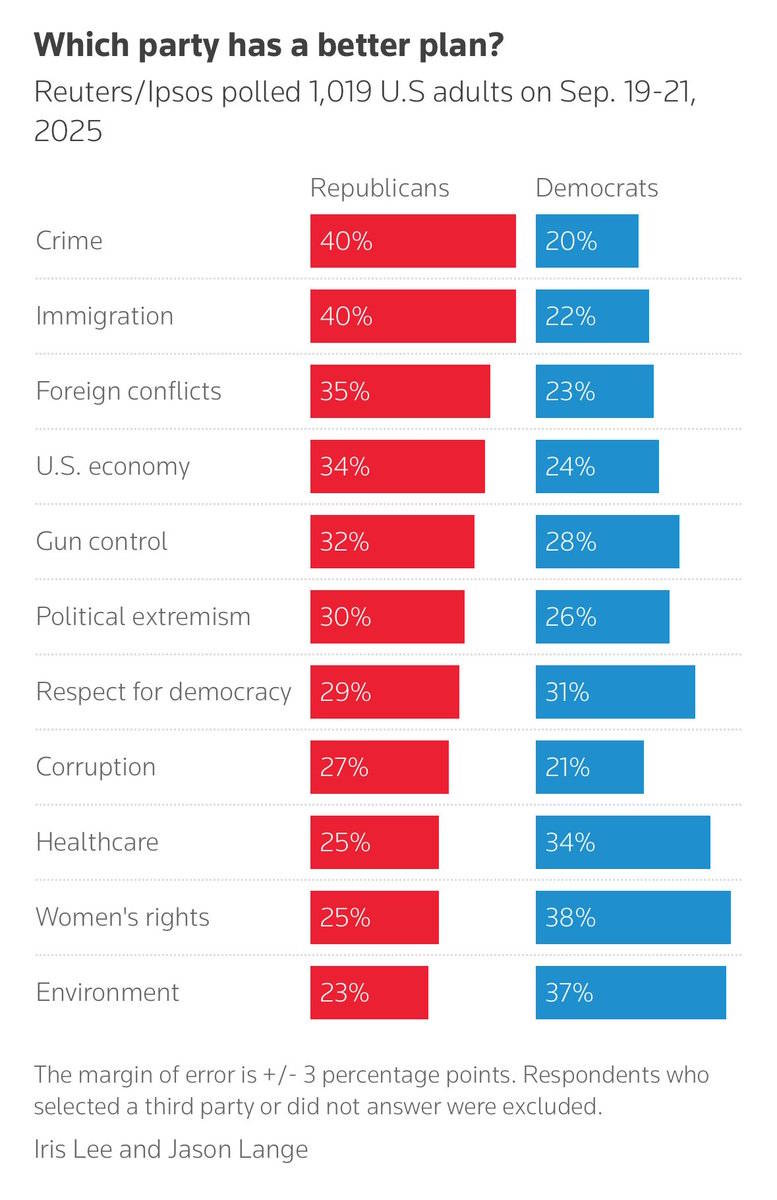
Even worse, polls find that the American public prefers Republican ideas over Democratic ones on almost all issues:
This is a tragedy, because the Democrats are the only force in America with a real chance of resisting Trump and the MAGA movement.
What’s going on? Why do people dislike the Dems so much?
Almost every serious analyst puts the problem in terms of extremism versus moderation — basically, the idea is that Democrats, who are more and more dominated by wealthy and highly educated progressives, have become out of step with the mainstream on a variety of issues, and need to tack back to the center. In fact, I wrote a post making this argument, a few months ago:
For example, there’s a long-running technical debate on whether moderation helps Democrats win elections. It’s not totally settled yet, but I’d say the pro-moderates have the upper hand:

_-_0707.jpg)
Meanwhile, Matt Yglesias argues that even more than individual moderate candidates, what Dems need is a moderate image as a party:
[I]n the modern era of nationalized media and nationalized politics, it’s harder than ever for an individual member of Congress to…reap the rewards of moderation…
[C]ounting on smart candidate recruitment won’t save Democrats, because they’ll still be hampered by the “D” next to their name…Democrats could benefit a lot from moving to the center, not in the sense of recruiting occasional moderates in frontline races, but in the sense of having party leadership articulate a more moderate national ideological profile.
That seems reasonable. In fact the New York Times Editorial Board recently argued something very similar.
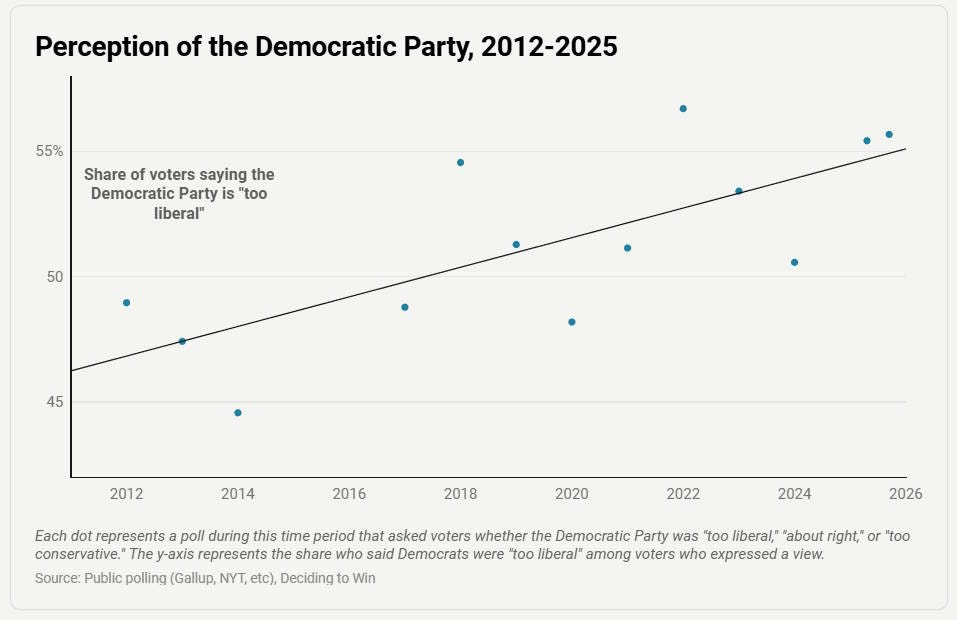
And a group called Welcome recently released a big report called “Deciding to Win”, with lots of data showing that Americans think Democrats are too extreme. For example:
The basic story they tell is that the Democrats are dominated by highly educated (disproportionately white) progressives, who prioritize things like climate change, trans issues, and so on, while swing voters and nonvoters — who tend to be less educated — care most about economic issues:
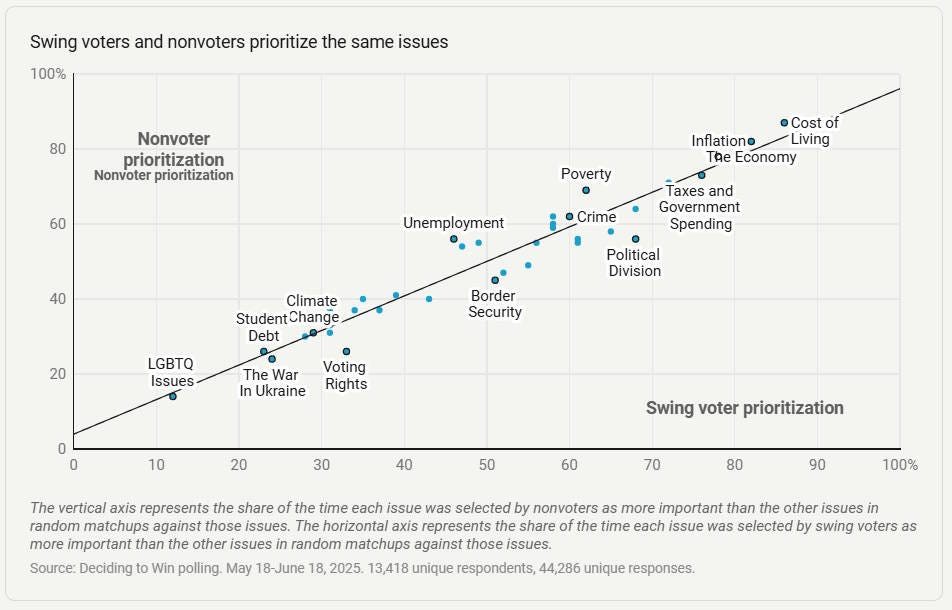
They recommend, sensibly, that Democrats focus on bread-and-butter economic issues, while moderating on things like immigration and identity politics.
All of this seems quite reasonable, and I think Democrats should probably take Welcome’s advice. One wrinkle here is that Welcome’s polls, like those of Reuters, find that Americans trust the GOP more than the Dems on economic issues.
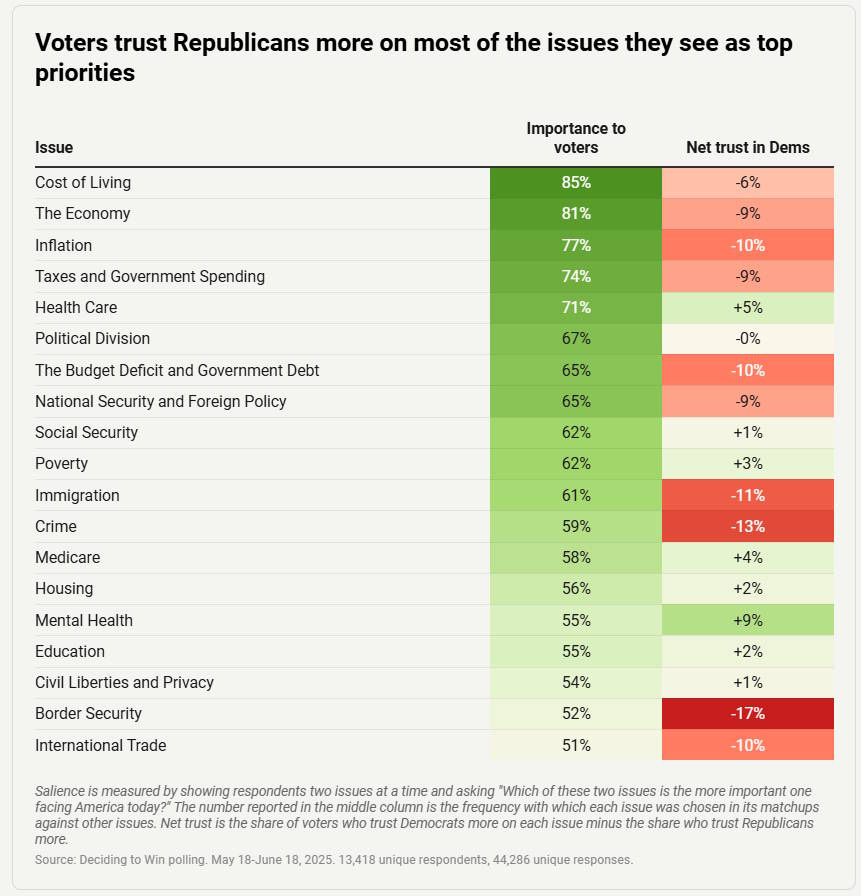
Basically, the biggest problem here is that Democrats’ economic playbook got stuck in the Great Depression — and in 2008, which resembled the Depression in many ways. Progressive economics is all about jobs, jobs, jobs — an approach that works spectacularly badly when everyone already has a job and inflation is the economy’s main problem. Biden’s progressive approach, adapted for 1933 or 2009, poured fuel on the macroeconomic fire in 2021, and Dems suffered the consequences.
But in fact, I think there’s another, deeper question we should be asking here. Why are Democratic positions on social issues so toxic?
The typical story is that a bunch of out-of-touch PhD-holders created a woke cultural bubble whose mores evolved very quickly into something that didn’t match the broader American public. Ideas like self-identification as the sole determinant of gender, anti-white hiring discrimination in the name of DEI, anti-meritocracy in schools, and permissive approaches toward crime are things that lefty intellectuals convinced themselves to believe in very strongly, but which regular Americans reject.
There’s probably a lot of truth to that story, but I think there’s another factor that more people should be paying attention to. Politics is inherently coalitional; a lot of people vote for whoever they think supports their identity group. That identity group could be BIPOC, or trans people, or Heritage Americans, or Christians, or the working class, or whatever. But whoever you think your “team” is, you’re probably a lot more likely to vote for the party that you think is on the side of that team.
Ultimately, the most important identity group in any nation is the national group. In America, that group is Americans. If both parties convince the country that they’re on the side of Americans, then identity politics becomes less important — voters know that whether the Republicans or the Democrats win, there’s some baseline level of national solidarity that means the people in power will have their interests at least somewhat in mind. That makes for healthy politics, because it allows the electorate to de-prioritize identity conflicts and social cleavages, and focus more on pragmatic issues like inflation or health care.
But what happens when only one party represents Americans as a group, while the other deemphasizes and denigrates the national identity? Elected Democrats still pay some amount of lip service to America and Americans, and you still see people waving American flags at the Democratic National Convention. But broadly speaking, Democrats have become very down on the United States as a country:
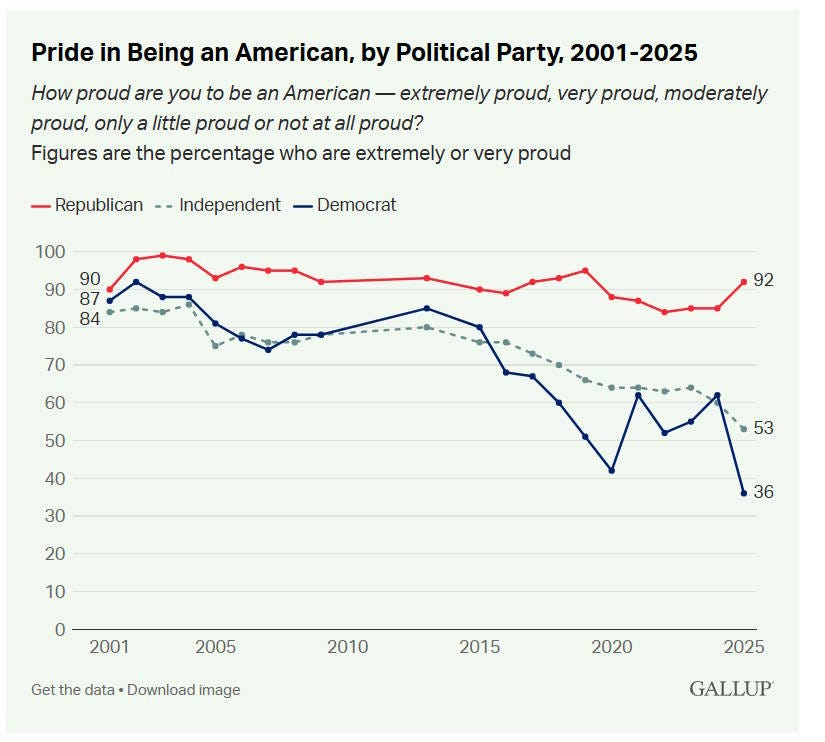
It’s not just lack of national pride, though. Many of the progressive morals and ideals that have become de rigueur over the last decade are explicitly anti-American.
For example, many Democratic events now open with land acknowledgements, declaring that America is “stolen land” or that it belongs to indigenous people. Technically, the “stolen land” thing is true (all land was stolen at some point), but that’s not the point. Land acknowledgements are explicitly anti-American, because they paint the U.S. as an illegitimate nation with no rightful claim to the land it currently occupies. That sends the message that Democrats hate America.
Another example is the way Democrats go to the mat to prioritize the economic needs of quasi-legal immigrants over native-born Americans. One reason the government is currently shut down is that Democratic legislators insisted on only passing a budget that includes health subsidies for asylum seekers (most of whom will be rejected for asylum). Americans are right to ask why they should pay taxes to provide health care for non-Americans who exploit loopholes in their country’s laws to hang out in the country while they wait for their asylum claims to be rejected. And when Democrats focus so much on protecting asylum-seekers as a group, it sends a signal about where the party’s priorities lie. (Incidentally, health benefits for the undocumented represent one of the least popular policy ideas.)
Those are only two examples; there are many more. The attack on Columbus Day. The toppling of statues of America’s founders because they owned slaves. Biden’s bizarrely tolerant policy toward asylum-seekers who cross the border illegally. Condemnation of America as an entity is deeply rooted in modern progressive mores. Just the other day, a young Democratic speechwriter rattled off an inspiring patriotic quote by Woodrow Wilson, but then said that he wouldn’t be allowed to put it in a speech, because Wilson was a white supremacist. Progressive shouters regularly spew anti-American screeds on social media. The one I always remember most is this:
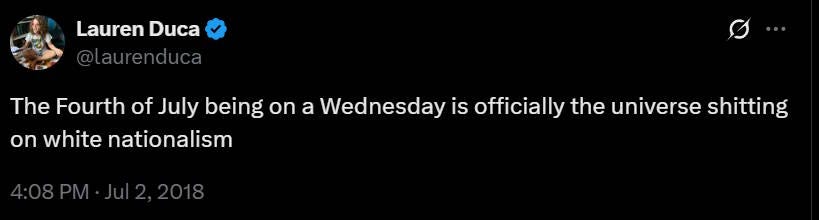
This is a huge break with the past. Progressives may still admire the New Deal, but the administration of Franklin D. Roosevelt was incredibly patriotic — in fact, FDR defined a liberal nationalism that served the Democratic party all the way up through Barack Obama. It was only during the Great Awokening of the late 2010s that FDR-style liberal nationalism was thrown under the bus. That’s when you see the gigantic collapse in Democrats’ national pride.
Essentially, modern progressivism has adopted many of the trappings of a revolutionary movement — a movement that wants to overthrow an irrevocably tainted nation and start anew. Fortunately, that affectation is not matched by real action; progressives give off the impression of being armchair revolutionaries,1 sitting around lazily spewing bile on Bluesky or X or TikTok.
But that anti-Americanism still probably has an effect on public perceptions — it convinces many Americans that the Democrats don’t care about them as Americans, but instead only supports other narrow identities that cut across national lines. If you’re a Mexican American man living in Phoenix, you might think the Democrats care about you because you’re Latino (er, Latinx), or because you’re working class. But the Republicans at least say that they care about you as an American — that this is your country, that this country has a right to be here, and that you therefore have a right to be here.
Of course there are forces in the GOP that also want to throw American nationalism under the bus. The people who talk about “Heritage Americans” would love to exclude a Mexican American man living in Phoenix from their concept of the nation’s core polity, especially if that man has any ancestors who came illegally. After Trump leaves office, I expect this strain of racial nationalism to become more powerful and prominent, and to cause major headaches for the Republicans. But in the meantime, the GOP has seized the torch of American nationalism very strongly, and the Democrats — the party of FDR, of JFK, of Bill Clinton and Barack Obama — has refused to do the same.
This is just a hypothesis of mine, of course. No one polls this — at least, not that I’ve seen. But the issue of patriotism and national identity needs to be more prominent on the radar of the moderates now trying to reform and revitalize the Democratic Party. I’m very encouraged by the No Kings protests, which are steeped in patriotic symbolism and a positive view of America as a country that stands against tyranny. Perhaps this is the beginning of a return to the liberal nationalism that served the American left so well for so long. But even if so, we still have a very long way to go.
Update: In the comments, Nathan Smith2 writes:
First, not nationalism; PATRIOTISM. Patriotism is love of country. Nationalism is collective selfishness, the prison gang instinct writ large; I’ve got your back if you’ve got mine. A patriot asks what he can do his country. A nationalist asks what his country can do for him. Patriotism is generous and brave. Nationalism is cowardly and paranoid. Patriotism is good, nationalism is bad.
Well I think Nathan is correct that patriotism means love of country, while nationalism — like all identity politics — is collective selfishness. But I think he’s wrong to say that this is bad. Nationalism subsumes other identities and allows all the people who live in a certain region to get along better with each other. This makes society more harmonious, allows more effective provision of public goods, and makes elites more supportive of redistribution and other policies to uplift the less fortunate. It obviously has problems (the tendency to go to war against other nations), but so far, liberal nationalism is the best way we’ve found to organize a country.
FDR was a liberal nationalist, as was JFK, and “cowardly and paranoid” is a very foolish and inaccurate way to describe FDR and JFK.
Lay-Z-Boy-sheviks?
My parents came very close to naming me “Nathan Smith”! They wanted something with N, and went with Noah over Nate and Nick. For some reason, they never considered Ned.