
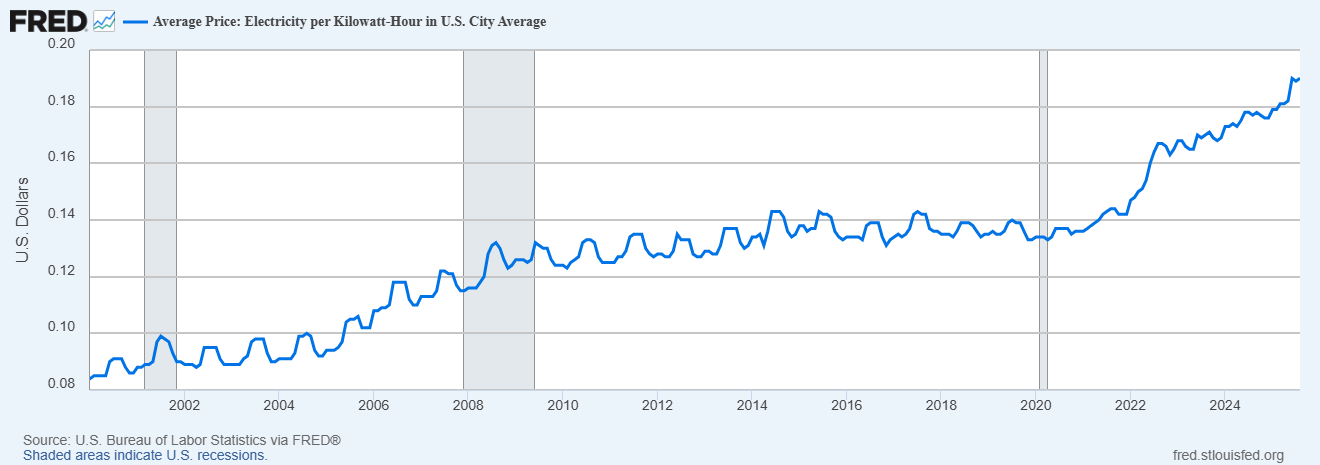
You may have heard that the cost of electricity is increasing in America. It’s true! Even as inflation has moderated in general, electricity prices have surged:
It’s important to put this increase in context. When we measure electricity prices relative to how much people earn, we find that the recent rise in prices is pretty modest. In fact, so far it hasn’t even canceled out the big drop in electricity prices in the late 2010s:
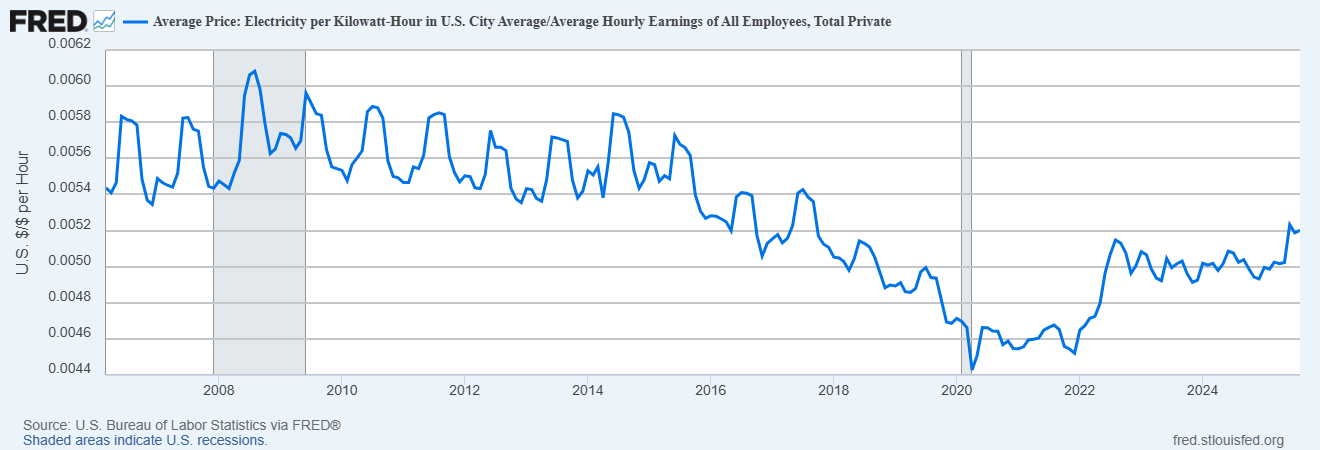
But rising costs are rising costs, and it would be a bad idea to wait until things get really bad before we address the problem.
What’s more, this is the exact opposite of the direction that electricity costs ought to be going in. We’re in the middle of a miraculous revolution in energy technology. The cost of solar power and battery storage has absolutely plunged in recent years, to the point where developing countries like India are choosing renewables over coal simply because it’s cheaper to do so. Energy prices should be going down, not up. And in China prices are going down, in fact, despite an explosion in demand. Why is America different?
Everyone agrees that there are a bunch of factors at work. For example, here’s Wired:
There are several dynamics driving the current power price spike. Rising electricity demand, volatile fuel prices, inflation, tariffs, a slowdown in transmission line construction, and long delays in adding new generators to the power grid are all conspiring to create more expensive utility bills.
The Wall Street Journal also cites the increasing cost of rebuilding power infrastructure after natural disasters.
But one factor that lots of people cite is the AI boom. AI runs on computing power (or “compute”, as they say). You need compute to train models, and you also need compute to make AI “think” about the answers it’s giving. Scaling up this latter type — which is called “inference compute” — is now the most important way that AI companies are improving their models over time. And compute requires energy, because you’re running electricity through a bunch of chips in some data center somewhere. Every time you ask AI a question, it’s using some noticeable amount of electricity.
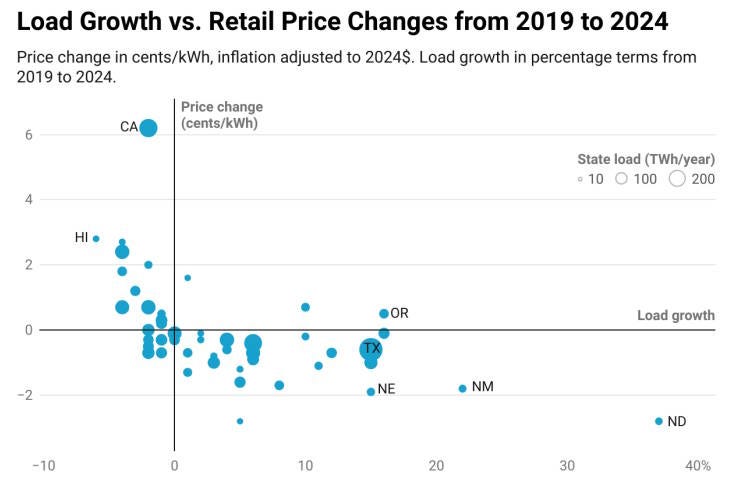
People go back and forth about how much the increased electricity demand from AI is already affecting electricity prices. A recent report from Lawrence Berkeley National Laboratory argues that AI hasn’t affected electricity prices yet, pointing out that states that saw greater electricity demand growth actually had falling prices over the past few years:
But Bloomberg Technology disagrees. Their analysis looks at smaller geographic areas, and considers wholesale rather than retail prices, and argues that data centers are already having big local effects:
A Bloomberg News analysis of wholesale electricity prices for tens of thousands of locations across the country reveals the effects of the AI boom on the power market with unprecedented granularity. The locations and prices were tracked and aggregated monthly by Grid Status, an energy data analytics platform. Bloomberg analyzed this data in relation to data center locations, from DC Byte, and found that electricity now costs as much as 267% more for a single month than it did five years ago in areas located near significant data center activity.
As the country builds a lot more data centers, we can expect this effect to filter through to retail prices, and start squeezing American consumers.
And remember that AI scaling tends to be exponential, meaning that AI is forecast to use a lot more compute in the near future. Here’s the EIA’s projection:
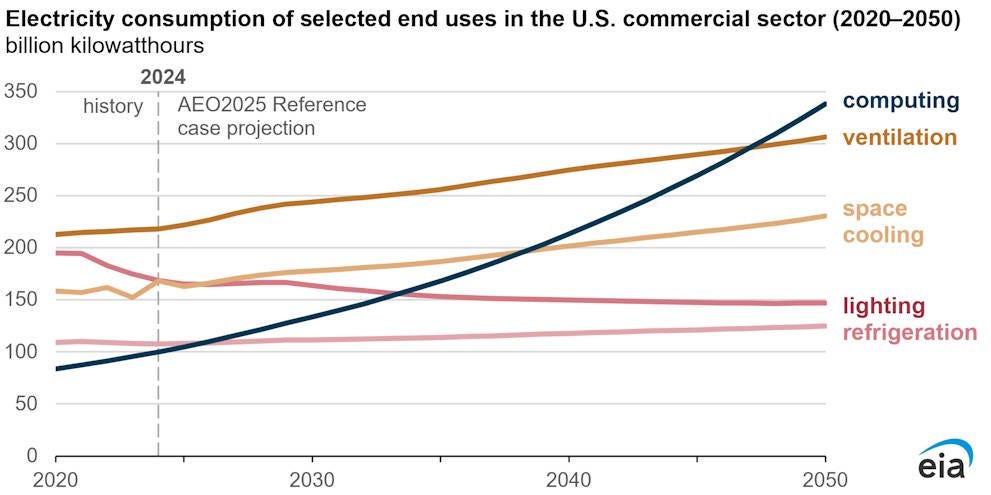
So right now, the rise in electricity costs has actually been modest, as has the effect of AI on those costs. But if AI keeps scaling up, things are going to get very hairy in the next decade. And that’s not even counting the increased electricity usage from switching from internal combustion cars to EVs.
It therefore seems like scaling up electricity generation in the U.S. is an incredibly important and pressing task. We don’t want a future in which AI outcompetes humans for scarce electric power and forces them to live in the dark and cold. Nor do we want a future in which America sacrifices the most crucial high-tech industry simply because we’re unwilling to build power lines, solar panels, and batteries. What we need, now more than ever before, is energy abundance.
And yet despite a few promising initiatives, the policies of the Trump administration are not geared toward providing America with energy abundance. In many cases they’re actually going to prevent us from getting the energy we need. Trump’s whole approach to energy seems like a mess of conflicting values, ideas, and policy initiatives.
Trump is flailing on energy
Cutting electricity prices was one of Donald Trump’s most important promises during the 2024 election, when the cost of living took center stage:
On the campaign trail…President Trump vowed, “Under my administration, we will be slashing energy and electricity prices by half within 12 months — at a maximum, 18 months[.]”
But as we saw in the charts above, electricity prices have not fallen in the first 9 or 10 months of Trump’s term — indeed, they have risen.
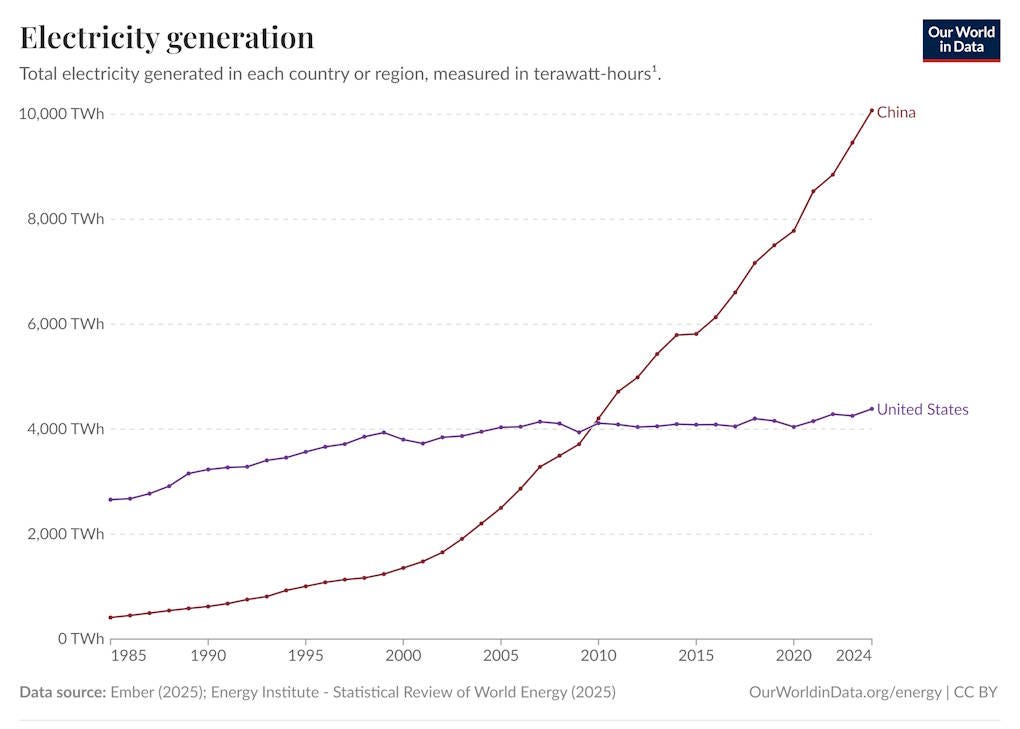
Trump has also promised to win the AI race, repeatedly vowing to “beat China” and “make America the world capital in artificial intelligence”. But AI’s most important input — other than chips — is electricity. In recent years, China has been building a vast amount of new electric power — previously mostly coal, but now shifting toward solar. In terms of total energy generation, it has already blown past the U.S., which has stagnated since the turn of the century:
In fact, Trump’s White House recognizes the crucial importance of electric power in this race:
AI is the first digital service in modern life that challenges America to build vastly greater energy generation than we have today. American energy capacity has stagnated since the 1970s while China has rapidly built out their grid. America’s path to AI dominance depends on changing this troubling trend.
Trump’s strategy for winning the electricity race, outlined in that same document, includes:
streamlining permitting
using federal lands for construction
preserving existing power infrastructure
developing new fossil fuel and nuclear energy
In fact, Trump has actually taken some steps in this direction. The administration has begun to reform NEPA (the main federal environmental permitting law), allowing individual agencies to set permitting policies instead of subjecting them to blanket rules and using emergency measures to expedite permitting of fossil fuel supplies. It’s opening up federal lands for fossil fuel mining. Perhaps most importantly, it has offered loan guarantees for building power lines, even continuing a Biden-era program.
And yet at the same time, Trump has launched a vigorous all-out attack on the solar power industry:
Two months after President Donald Trump and congressional Republicans finished gutting tax credits for renewable energy projects in the One Big Beautiful Bill Act…Trump officials are making their next moves in a campaign to undercut the solar industry. They are leaning on trade measures in an attempt to further strangle the industry, while delaying permits for renewables projects. And on Wednesday, Trump officials canceled $7.6 billion in clean energy funding, including for solar projects to connect to the grid, on top of $27 billion in grants they are already trying to claw back.
Trump’s defenders will say that all the President is doing here is removing government supports for the solar industry, and letting free-market competition work its magic. But that’s obviously just false. Expediting government permits for fossil fuels, while blocking permits for solar power is actively putting the thumb of government on the scale against solar. And providing federal lands for fossil fuel power while forbidding them from being used for solar power is using the heavy hand of government to stifle market competition. On top of all that, Trump is enacting heavy tariffs on imports that the solar industry needs.
In fact, solar is just such a great technology that even with Trump using the power of the federal government against it, it’s going to win out:
Solar will continue to grow faster than gas or coal power plants, but SEIA and consultancy Wood Mackenzie expect growth to be 18 percent lower through 2030 as a result of Trump’s policies.
Technology is ultimately more powerful than government, but Trump is doing America no favors by trying to use his power to strangle the cheapest source of electricity for much of the country. Texas is building solar as fast as it can, but Trump is going to make it harder.
Trump’s policies are also threatening the deployment of batteries, which in many ways are even more transformative than solar. Even as Trump supports lithium mines — which produce the key element for modern batteries — he’s canceling government programs that support battery adoption:
The administration’s broader assault on clean energy infrastructure became evident with the Energy Department’s October 2 announcement canceling $7.56 billion in funding for 223 clean energy projects. The cuts, reported by the Washington Post, disproportionately affect Democratic-led states and include numerous battery storage initiatives…
Paradoxically, while dismantling renewable energy projects, the Trump administration is simultaneously investing in the battery supply chain’s foundation. The Energy Department announced it will take a 5% equity stake in Lithium Americas and its Nevada Thacker Pass mining project…“It’s in America’s best interest to get that mine built,” Wright told Bloomberg Television, emphasizing that Thacker Pass production could help reduce China’s dominance in the lithium market.
Why would the Trump administration do both of these things? Lithium is almost entirely used in batteries. So if the Trump administration thinks it’s important to mine lithium, it must think it’s important for America to produce batteries. Yet at the same time, the administration is cutting industrial policy programs to boost American battery production. Where do they think the lithium from the mine is going to go??
I doubt that Trump has some secret master plan here, or is following some kind of coherent ideology. Instead, it seems likely that the people in the administration are simply working at cross purposes. On one hand, there are probably some people in the administration who realize that batteries are incredibly important, and who want to break China’s chokehold over the industry by mining lithium domestically while using tariffs to favor domestic battery production.
But on the other hand, there are probably lots of people in the administration who are more focused on domestic culture wars than on economics or geopolitical competition. And to these people, energy policy is a culture war, with fossil fuels and nuclear being the energy of the Right, and solar and batteries being the energy of the Left:
The idea that solar power can’t possibly work because of intermittency — which requires essentially disbelieving in the existence of batteries — has almost become a bizarre religious canon on the right.
This is obviously a very foolish and unproductive way to think about energy technologies. Things like lithium ions and hydrocarbon atoms are governed by physics, not by ideology; whether solar or coal has the potential to be a cheaper source of energy has very little to do with the pronouncements of political factions. If you refuse to have a government that respects the judgements of the natural world, then you will inevitably suffer material hardship — in this case, in the form of higher electricity prices.
For all the Trump administration’s bluster about China and AI and lowering the cost of living, it still usually acts as if culture wars are its top priority. This focus on the symbolic sucks the oxygen away from the administration’s actual substantive policies, resulting in a self-contradictory, incoherent mess.
Meanwhile, China simply builds solar and batteries and power lines. More and more, faster and faster, every year. Some civilizations want to win, and others want to stare at their belly buttons.