
I don’t particularly like to write about the U.S. political situation, but I do it. American politics is never particularly tranquil, but there are certainly smoother periods, and it’s in those times when econ policy wonks like myself really flourish. When we know who’s in charge, and what they want, and everyone basically accepts their legitimacy, you can write things like “I think we should replace the corporate tax with a Destination-Based Cash Flow Tax”, and you can imagine that people might even listen to you and there might even be some policy momentum in the direction of your idea. But at times of political conflict, wonkish concerns about optimal policy get drowned out by the imperatives of raw power. No one wants to hear about the DBCFT during a civil war.
America is not in a civil war right now. This is a simple, plain, obvious fact. There is no large-scale violence between organized groups. In fact, there’s some evidence that political violence has been going down for a few years now. Here’s CSIS’s data on terrorist attacks:
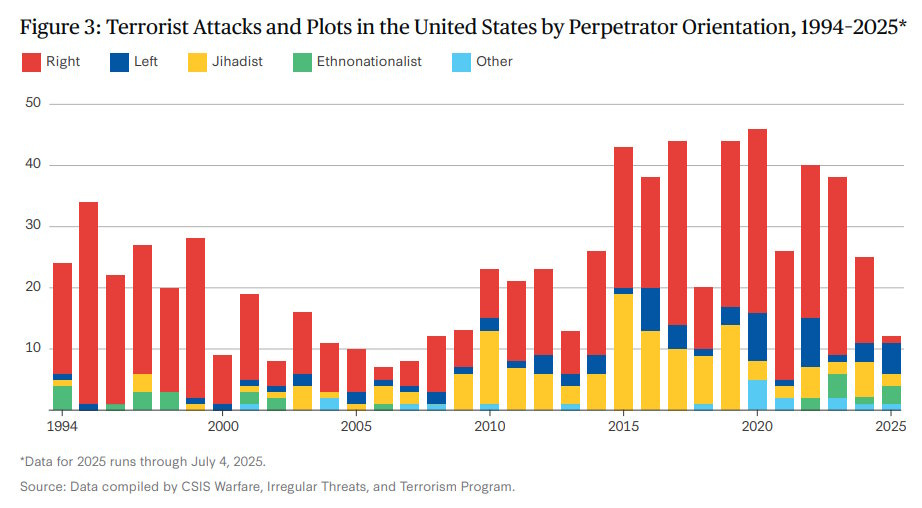
Alternative data sets largely paint the same picture.
Left-wing terrorism has increased a bit this year, including the murder of Charlie Kirk, but it’s still at a pretty low level. Right-wing terrorism has collapsed this year, possibly because rightists are more satisfied with Trump in power (though this didn’t seem to deter them during Trump’s first term). And the wave of jihadist attacks in the 2010s has faded. There are certainly some minor clashes between ICE and protesters in American cities, but nothing really big, and to my knowledge no one has been killed yet.1
So not only is the U.S. obviously not in a civil war, we also aren’t experiencing anything like Italy’s Years of Lead or Ireland’s Troubles.
But this has not stopped the Trump administration and many of its supporters from talking as if the United States is in a civil war. Donald Trump says this regularly. For example, here’s what he said to a gathering of generals at Quantico a week ago:
America is under invasion from within. We’re under invasion from within, no different than a foreign enemy, but more difficult in many ways because they don’t wear uniforms…These people don’t have uniforms. But we are under invasion from within. We’re stopping it very quickly. After spending trillions of dollars defending the borders of foreign countries, with your help, we’re defending the borders of our country from now on…It’s a war from within. Controlling the physical territory of our border is essential to national security. We can’t let these people live.
Who does Trump think America is at war with? The answer seems clear. It’s A) immigrants, especially (but not exclusively) illegal immigrants, and B) any Americans who try to oppose Trump’s deportation efforts. Just today, Trump threatened to invoke the Insurrection Act against anti-ICE protesters in Portland.
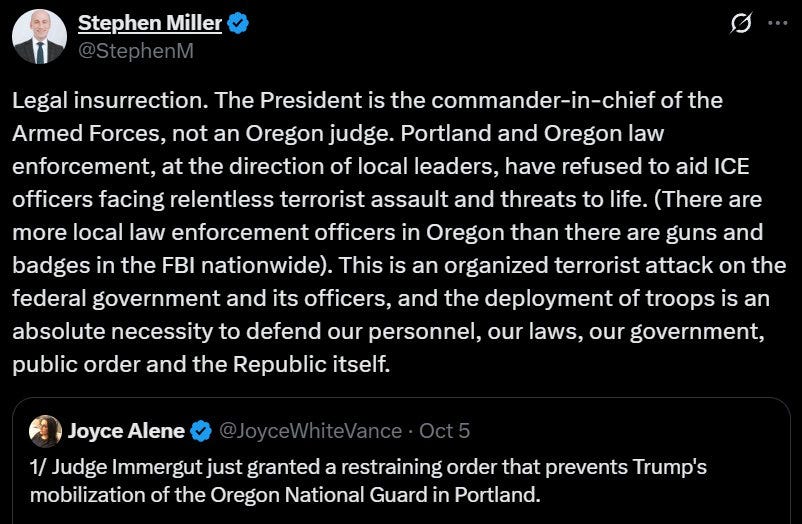
Stephen Miller, Trump’s powerful advisor, has broadened his definition of the enemy to include judges who rule against Trump’s policies:
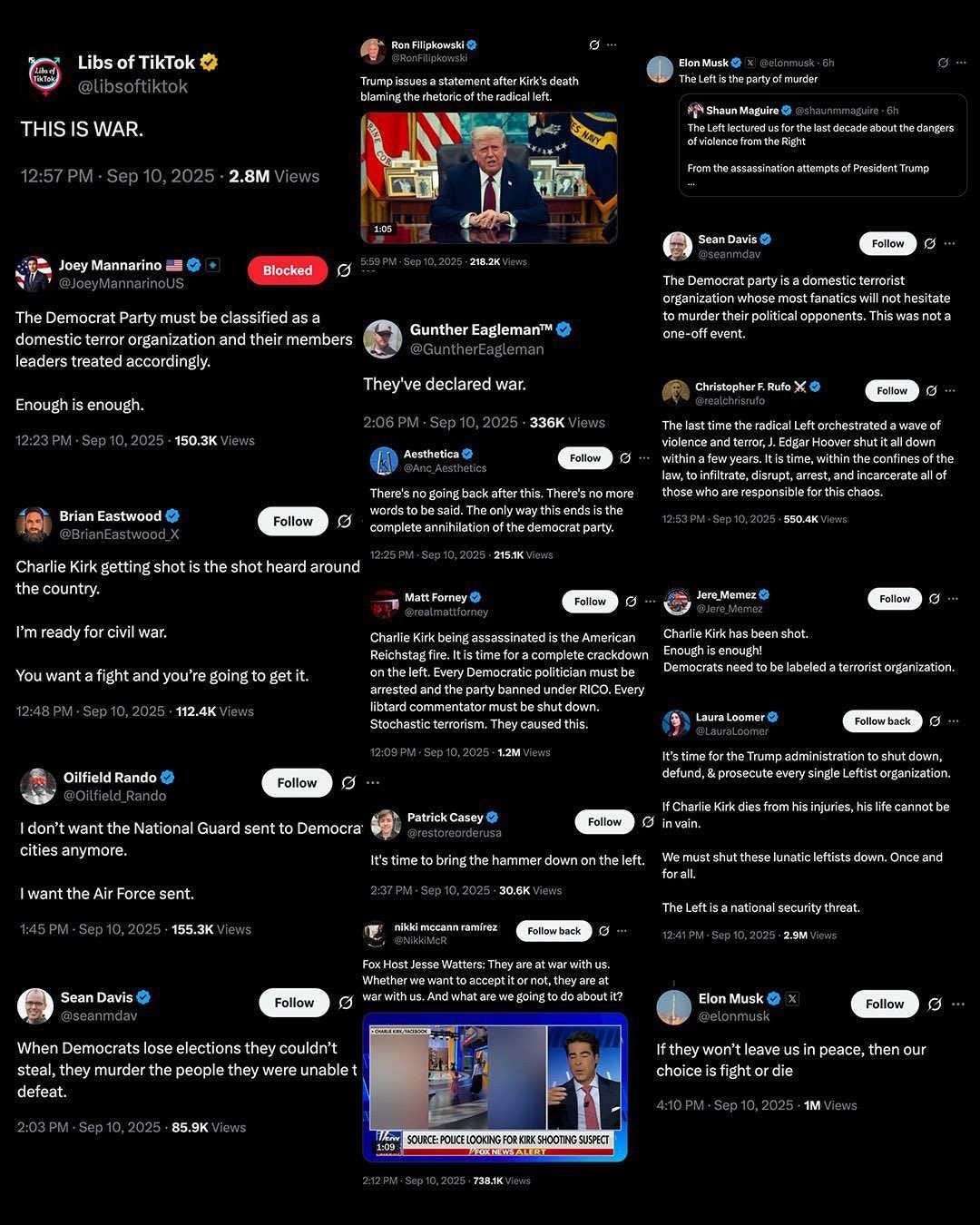
And of course in the aftermath of the Charlie Kirk assassination, a very large array of right-wing people declared that America was in a “war”:
Democrats have been much more reluctant to use this sort of violent language. But there are a few cases, such as Virginia politician Jay Jones:
Jones…imagined a hypothetical situation in which he had two bullets and needed to decide whether to shoot [GOP state legislator Todd] Gilbert, Adolf Hitler or Pol Pot. “Gilbert gets two bullets to the head,” Jones wrote. “Spoiler: put Gilbert in the crew with the two worst people you know and he receives both bullets every time.”…“Yes, I’ve told you this before,” Jones [said]. “Only when people feel pain personally do they move on policy.”
And when you poll people about whether violence should be used to create social change, you get a startling number of progressive youngsters saying “yes”:
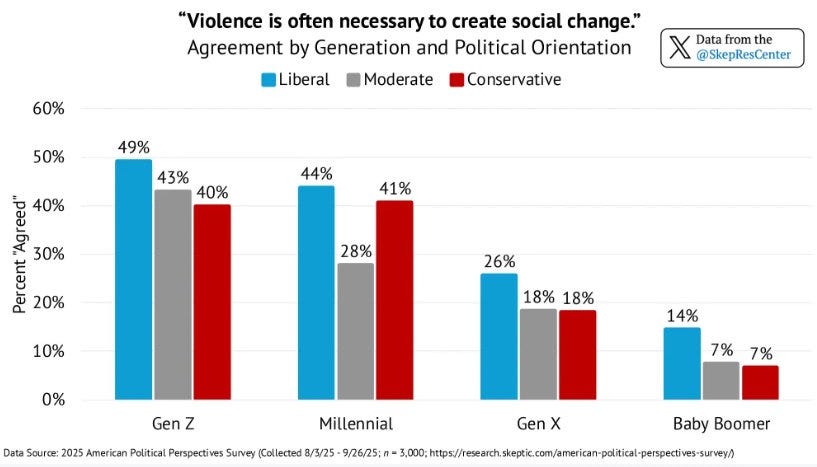
It’s reasonable to see all this and be afraid that America is about to have an actual, real civil war. Yes, the numbers probably overstate the percent of people who would be willing to actually countenance violence. But any normal person would see polls like this and be worried.
So what’s going to happen next? And how did we get to this juncture? Unfortunately, we’ve reached the point where I’m forced to think about this if I want my ideas and opinions to stay relevant. So here are my assessments of the two broad “sides” in this so-far-mostly-rhetorical conflict, and where things might be headed.
My assessment of the American right
The right in America is pretty united at this point. The last vestiges of establishment conservatism, Reaganites, and libertarians have been swept away or subordinated, and the Christian right backs Trump fully despite the fact that he doesn’t share their values. MAGA is now the only game in town.
There are some cracks underneath the surface that could widen in the future. The Tech Right is in favor of high-skilled immigration (which the tech industry depends on), while “national conservatives” despise the idea of a brown elite in America. The antisemites — Tucker Carlson, Marjorie Taylor Greene, etc. — clash regularly with the pro-Israel wing of MAGA, which so far seems to have the upper hand. These conflicts could become acute after Trump’s term ends, or if he dies of old age. But for now, everyone is united behind the old man and his chosen lieutenants like Miller.
Ideologically, the right deeply believes in the story of a “Great Replacement”. They believe that “the left” wants to import as many nonwhite immigrants as possible, in order to A) vote the Republican party out of power, and B) disempower and subordinate white people in the U.S., the Anglosphere, and Europe. Once white people have been made a minority in these countries, the theory goes, they will be subordinated via various methods — anti-white discrimination (DEI), selective permissiveness toward crime by nonwhites (“anarcho-tyranny”), and so on.
This used to be a somewhat fringe theory in right-wing circles, expressed in books like The Camp of the Saints. It is no longer fringe. My assessment is that while not every GOP voter believes the Great Replacement story, it is now absolutely core to the MAGA belief system. I believe that J.D. Vance, Stephen Miller, Elon Musk, and every other important MAGA figure other than Trump himself believes in some version of this basic story. (Trump’s beliefs are more idiosyncratic and less coherent than those of his followers.)
Is the Great Replacement real? Rightists wildly exaggerate the idea, but there are certainly a few nuggets of truth there. Some Democrats, seeing how California was turned permanently blue by Mexican immigration, hoped that the same thing could be accomplished at the national level. And I have even seen a few progressives espouse Great Replacement-like goals.
The George Floyd protests also loom incredibly large here, by the way. Like the Asturian Revolt that prompted Spanish nationalists to start the Spanish Civil War, the great protests of summer 2020 convinced the American right that their destruction was imminent unless they took drastic and ruthless action. The Biden administration’s wholehearted embrace of DEI only seemed to confirm the idea that 2020 had kicked the Great Replacement into high gear.
The MAGA right sees themselves, fundamentally, as defending Western Civilization against an internal enemy that seeks to destroy it through forced demographic change:
The Great Replacement is what the MAGA people see themselves as being at “war” with. They don’t know exactly who their enemy is — they imagine there must be some kind of central coordination, but they don’t know who’s doing it. Stephen Miller declares:
There is a large and growing movement of leftwing terrorism in this country. It is well organized and funded.
But as to who is organizing and funding it, he can’t say. MAGA’s enemy is a nebulous entity — a swirling cloud of threats. Antifa, the Democrats, South American narco-terrorists, George Soros, corrupt judges, and so on. They must all be working together, right? The right works together and forms a hierarchy under a single charismatic leader, so mustn’t the left work the same way?
But if MAGA is uncertain about who their enemy is, they’re a lot more certain about how to defeat it. With educated progressives dominating elite institutions and culture in America, the right can’t use business or the civil service as cudgels against the left like they could in Reagan’s time. That means their only real weapon is elected leaders like Trump. Rightist blogger Curtis Yarvin summed up the mentality well:
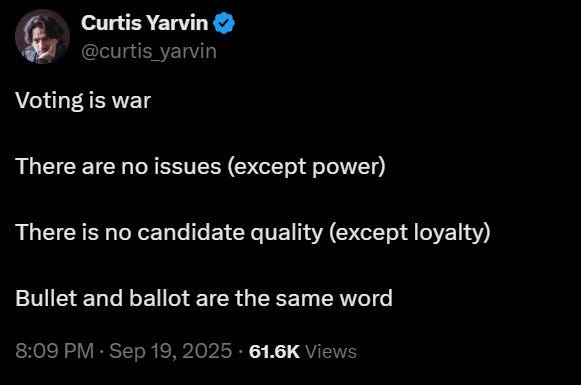
And so MAGA believes that they must invest Trump with maximal executive power, in order to prosecute the struggle against the Great Replacement. If Trump has any checks on his power, they believe, then progressive-dominated institutions will drag his whole movement down and stymie it.
Thus, the plan — whether acknowledged or not — is to turn Trump into the kind of authoritarian, elected quasi-dictator that has become all too common in the 21st century. Putin created the template in the 2000s, and Erdogan, Netanyahu, and Orban are prominent recent examples. The strategy involves governing by executive order instead of by passing legislation. And it involves slowly but relentlessly pushing for maximal definitions of executive power while discrediting and attacking every institution that tries to act as a check on the executive — the judiciary, the civil service, the media, and if necessary the military.
Dictator-like power isn’t an end in and of itself for the MAGA folks. It’s a means to an end — the goal is to fight the Great Replacement. But they realize that increasing executive power to that degree will be difficult. Most Americans don’t want a dictator. Most Americans respect and value the judiciary’s check on executive power.
This goes part of the way toward explaining MAGA’s constant “war” language. Yes, they really do see their fight against the Great Replacement as the moral equivalent of war, and the consequences of defeat as being just as grave. But they also need the idea of war in order to legitimize their extreme actions to the public in general. America has historically been willing to allow presidents extremely expanded powers during times of total war — Lincoln, Wilson, and FDR being the prime examples. MAGA wants to convince America that immigration is the country’s next existential war.
But I suspect that MAGA folks are also trying to convince themselves. They were all raised to value American democracy, at least rhetorically. They know that turning the presidency into a dictatorship will have irrevocable far-reaching consequences — that they will go down in history as the people who ended the 250-year-old democratic experiment. Already, some MAGA-aligned influencers are starting to get a whiff where this is all going, and quietly distance themselves.
But at the same time, the MAGA people are absolutely desperate. They believe the wolf is at their throat, and this is their last chance to save their civilization. So they are trying to talk themselves into being as ruthless as possible — into doing whatever it takes to defeat their enemies.
I think a lot of the “war” talk is aimed internally — an exhortation by rightists to other rightists not to shy away from doing terrible things. They are saying “war” over and over because they’re trying to talk themselves into doing the kind of things they would do in an actual war.
Now, everyone is going to ask me: Is this fascism? Well, yes, I think that’s not an inaccurate description — it’s authoritarian right-wing ultranationalism. But there’s not much of the grassroots movement, utopian theory, grand territorial ambitions, or systematic party apparatus of the type that characterized Nazism. Instead, MAGA is a reactive, hastily-cobbled-together, fear-driven right-wing nationalism more akin to Francisco Franco’s.
My assessment of the American left
In fact, there is no central directorate of “the left”. This is a consistent mistake that rightists have always made about leftists; they have trouble perceiving the spontaneous, grassroots nature of leftist uprisings.2 The American progressive movement is not an organization at all — it is a broad, diffuse upwelling of sentiment.
During the 2010s that sentiment swelled to a crescendo, but in the 2020s it has begun to wane. The popular outpouring of “antiracist” sentiment that characterized the “Great Awokening” has petered out, and with it has gone the feeling of overwhelming progressive cultural domination. Bari Weiss, who got run out of the New York Times for being insufficiently progressive, just got hired to run CBS News. Cancel culture is canceled.
The protests of summer 2020 that scared the right into extremism were actually a black swan event. It’s probably now safe to admit — as some of my friends who participated even admitted to me at the time — that a whole lot of people joined the Floyd protests because of frustration with Covid lockdowns, rather than out of a sincere desire to overthrow America and remake it along “antiracist” lines.
Meanwhile, the activist energy that powered the smaller, initial version off BLM in the mid-2010s is gone now. That generation of activists has largely gotten exhausted and/or aged out. When the Supreme Court killed Roe v. Wade and banned affirmative action in college admissions, there was no major grassroots pushback. All the grassroots energy on the left now is invested in the Palestine cause, which is basically harmless to Republicans.
And the policy ideas that came out of the woke era mostly flopped. Black Americans did not like the country’s brief experiment with anarchy in 2020, and became much more pro-cop, which put an end to “defund the police”. The flood of illegal and quasi-legal immigrants that Biden allowed during his time in office ended up turning much of the country against immigration (at least temporarily). The trans movement is losing on key issues such as women’s sports teams.
But in response to all of these losses, progressives have failed to moderate their views — they’re generally sticking with the package of ideas that was canonized in the 2010s. Here’s Jonathan Chait, reporting from a progressive convention called Persuasion 2025:
Representative Greg Casar, a progressive Democrat from Texas, rebuked all who “blame progressive organizations for the Democratic Party’s problems.” Jenifer Fernandez Ancona, a co-founder of Way to Win, called for an “alignment of party and movement forces,” which apparently means bringing Democrats closer to progressive positions, rather than avoiding positions and rhetoric that alienate a majority of the electorate.
Numerous speakers warned against throwing any progressive constituency “under the bus,” a phrase that has become a term of art in the factional battle. It stands for the idea that Democrats should not retreat from positions taken on behalf of allies, however unpopular they may be. No compromise with the electorate was the conference’s standing order…
“You cannot feed your opposition’s narrative,” Shenker-Osorio argued. She is even more absolute on her website: “Conventional wisdom says to meet people where they are. But, on most issues, where they are is unacceptable.”…
The party’s progressives seem determined to reeducate the public rather than compromise for their votes. This is a seductive approach if the goal is ideological purity. It is a problem only if the party hopes to win elections.
Instead, progressives have retreated to safe spaces where they still maintain the absolute cultural dominance that so intoxicated them in the 2010s — universities, NGOs, a few companies, and the small social network Bluesky. There, they can wield some facsimile of the cancel-power they once enjoyed:
Progressives in these spaces are spending their energy canceling each other and launching (often futile) attacks on centrist types:
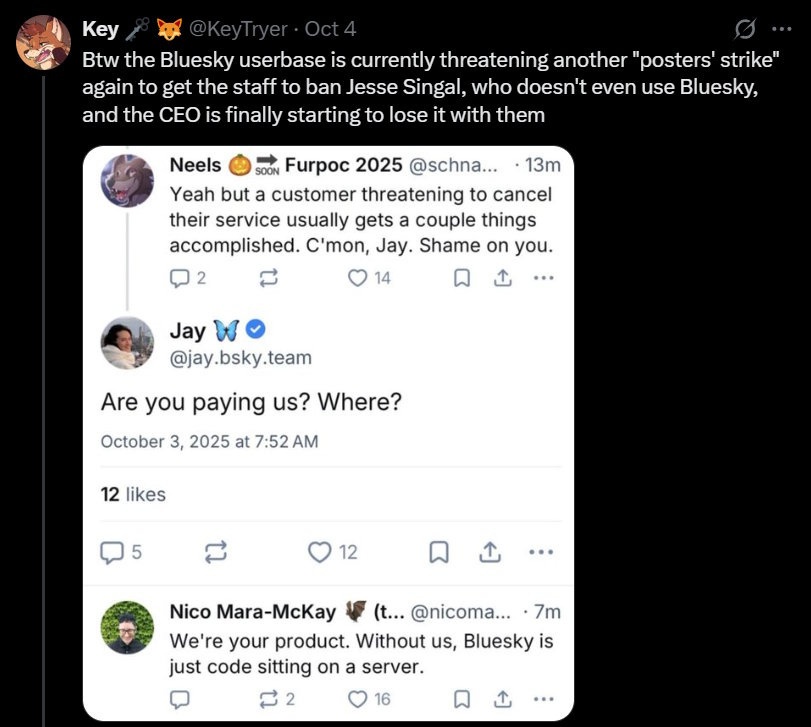
Meanwhile, quietly and behind the scenes, progressives are still quietly pushing Democrats to support policies that no one outside the progressive bubble really likes.
This kind of thing renders progressives extraordinarily ineffective against Trump’s anti-democratic blitzkrieg. It’s also probably a big part of what makes the Democratic party so incredibly unpopular:
Even now, long after Trump’s honeymoon is over, some polls show that people still seem to like the GOP more than they like the Democratic Party. Others show Dems narrowly ahead in Congressional balloting for the election next year. But whether Dems are slightly ahead or slightly behind the Republicans in popularity, the fact that it’s even close is a staggering indictment of the progressive movement.
In other words, even as MAGA slowly works up the courage to attack the core institutions of American democracy and liberty, Trump’s potential opposition has done everything it can to render itself irrelevant to the broader conversation.
It’s possible that this is just really bad timing, but it’s also possible to see how there might be causation here. The moral, social, and organizational collapse of American progressivism has probably emboldened Trump and his movement to be more ruthless and amoral than they otherwise would have dared. Trump knows that a few disgruntled people might come out to throw rocks or stare down ICE, but that his mass deportation program is not going to provoke a repeat of 2020.
It’s time for some game theory
It’s worth remembering that in a struggle between two factions, one of two things can happen:
One side can defeat the other, or
Both sides can ratchet down the tensions until a detente is reached.
That’s it. There are no other options. So which is it going to be this time?
It’s easy to dismiss the possibility of detente between the right and left in America, given all that has transpired over the past decade. But in fact, that’s exactly what happened the last time America experienced political conflict. The period from the late 1960s through the mid 1970s was extremely turbulent — there were race riots far more brutal and violent than anything seen in 2014-2020, along with constant street battles, the biggest sustained protest movement in American history, unprecedented levels of domestic terrorism, a huge wave of assassinations, and the hollowing out of whole cities.
But both Democrats and Republicans responded by ratcheting down tensions. Democrats marginalized their hippie extremist faction, nominated moderates, and retreated from their most inflammatory policy ideas (busing, racial quotas). Republicans embraced Reagan instead of harder-right alternatives, and accepted the basic civil rights framework from the 1960s. Eventually, both parties agreed on a tough approach to crime, defusing the most important source of tension from the 60s.
I don’t know if something like this is still possible today, but it’s worth a try.
For their part, Democrats and progressives need to realize what a weak hand they’ll be playing in any actual conflict. Restless Gen Z kids who talk big online about doing political violence are not going to be a bulwark against Trump’s mad power grab. At best they’ll just gripe ineffectually online, and at worst they’ll go out and do terrorism like the guy who shot Charlie Kirk.
Instead, the left has to realize that if there is a civil war-like conflict, and one side does win, it’ll be the right. Their goal should be to ratchet down rhetoric, reject the influence of extremist pressure groups, and compromise on core issues. Josh Barro is right when he argues that immigration is the core issue where Dems overstepped and have to walk it back, by explicitly embracing the idea of a nation with sovereign, inviolable borders. This would be the equivalent of the embrace of “tough on crime” policies back in the 80s and 90s.
But progressives and Democrats should never compromise on democracy and freedom. They need to resist Trump’s executive overreach (legally, of course) and stand up for the American way of life.
That will send a message to the right that they also need to compromise. Yes, if it comes to a right-left civil war, the right will win, like Franco did in Spain. But rightists and Republicans need to realize that that victory would be a Pyrrhic one. Destroying America’s democratic institutions and making the president into a tyrant would create an America that even conservatives wouldn’t really like to live in. It’s just not worth it.
Instead, the right needs to learn how to “take the W”, as the kids say. In the 2010s, conservatives started to believe that they always lose, and that the long arc of American history really does bend toward leftism, and that their only chance was to fight like cornered animals.
But the truth is that America goes through cycles of liberalism and conservatism, and we’re in a conservative cycle now. The vibes have shifted, and wokeness is in retreat. Opinion has mostly turned against progressive dogmas. The GOP is getting their way on immigration, despite having to fight some court rulings. SCOTUS is unraveling much of 20th century liberal jurisprudence. The right could take a second Reagan-like revolution, build some durable right-leaning institutions, and call it a day.
But if the right doesn’t take the W, and insists on escalating ad infinitum, it will awaken a sleeping dragon. The American public is quiescent now, exhausted from years of unrest and disgusted with political extremism in general. But if Trump becomes an honest-to-God dictator, expect that to change, and expect widespread popular resistance to materialize. Americans don’t like the left, but they also won’t surrender their democracy without a fight.
America is in a very dangerous political moment, but I think if people want, we can still get out of it OK. The sooner I can get back to talking about Destination-Based Cash Flow Taxes, the better.
Some people have been shot in ICE custody, though.
In fact, there isn’t even really a single “left” in America — instead there are multiple left-of-center factions, which overlap to some degree but are occasionally at odds with each other. You’ll notice that people on the right use the term “the left” a whole lot, but people on the actual left barely ever do, because they don’t think of their movement as unified.