
Advanced civilizations sometimes really do throw it all away. I recommend reading the book Lost Enlightenment, which is about how the golden age of Islamic science and scholarship and literature gave way to centuries of religious fundamentalism and backwardness. During the Ming and Qing dynasties, China turned its back on exploration, refused to import Western technologies, and generally de-emphasized science; centuries of economic stagnation and military weakness followed.
These are useful examples, but they’re all from the premodern period, where cutting-edge science and technology didn’t make a huge difference in people’s standard of living; most people were farmers living on the edge of subsistence. But around 200 years ago, technology really started to matter, and living standards began to skyrocket in a way they never had in history. Thanks to technology, humanity is now about 20 times richer on average than we were two centuries ago, and the number keeps going up:
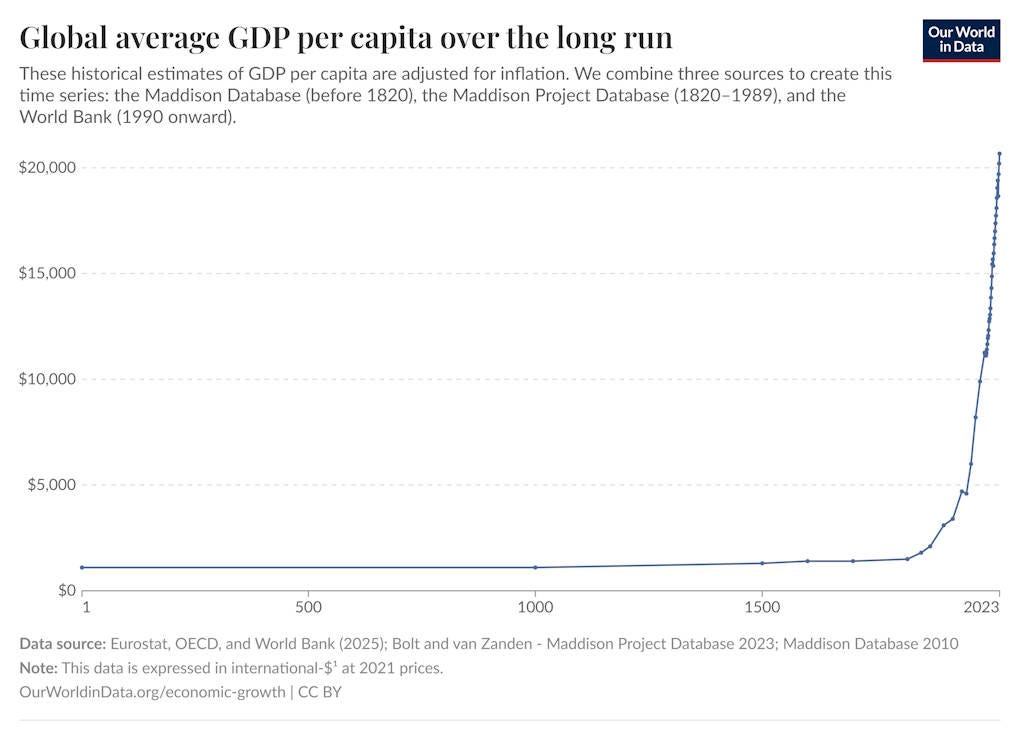
For a civilization to turn its back on algebra in 1100 or on spring clocks in 1800 was certainly foolish. But for a civilization in 2025 to turn its back on the technologies that took our species from indigent peasants to modern standards of living would be just unfathomably insane.
And yet that is exactly what I now see Western civilization doing. In the U.S., the Anglosphere, and Europe, there are simultaneous backlashes against a number of key technologies that have either made the modern world what it is, or promise to make it even wealthier. These include:
vaccines
solar and wind power
batteries
AI
software platforms
anti-obesity drugs
lab-grown meat
self-driving cars
air conditioning
I’m a well-known techno-optimist. Here was a manifesto I wrote about why technology is (usually) a good thing:
And here’s an essay I wrote about why the creation of industrial modernity — which depends crucially on technology — is by far the most important accomplishment of humankind:
In past years, I would write a techno-optimist post at the start of the year, gushing about all the marvels that are coming our way — here are the ones for 2021, 2022, 2023, and 2024. But this year I didn’t write one, because it seemed like America was generally turning away from techno-optimism, toward a dark, reactionary Luddism. I can still write a list of inventions to get excited about, but I feel like I’ll be setting myself up for disappointment when the general reaction is fear, cynicism, and superstition.
So instead, here’s a post about how the West is turning its back on the light of technology — the very thing that made it great in the first place.
The American right vs. the germ theory of disease
The thing that inspired this post — and the header image at the top — is the American right’s turn against vaccines, so let’s start with those.
The chief villain of this story, of course, is RFK Jr., who spent most of his political career as an antivax kook on the left, and was only embraced by Trump in a strategic alliance in 2024. Here’s a video from 2023 in which RFK told a podcast interviewer that the polio vaccine “killed many, many more people” than polio ever did.
That is, of course, complete nonsense. The polio vaccine is incredibly safe; the worst recorded incident of a defective vaccine, in the 1950s, killed a total of 10 people, and the total number of documented deaths ever resulting from the polio vaccine is no more than a couple dozen. In a typical year before the introduction of the vaccine, about 1,000 Americans died of polio every year:
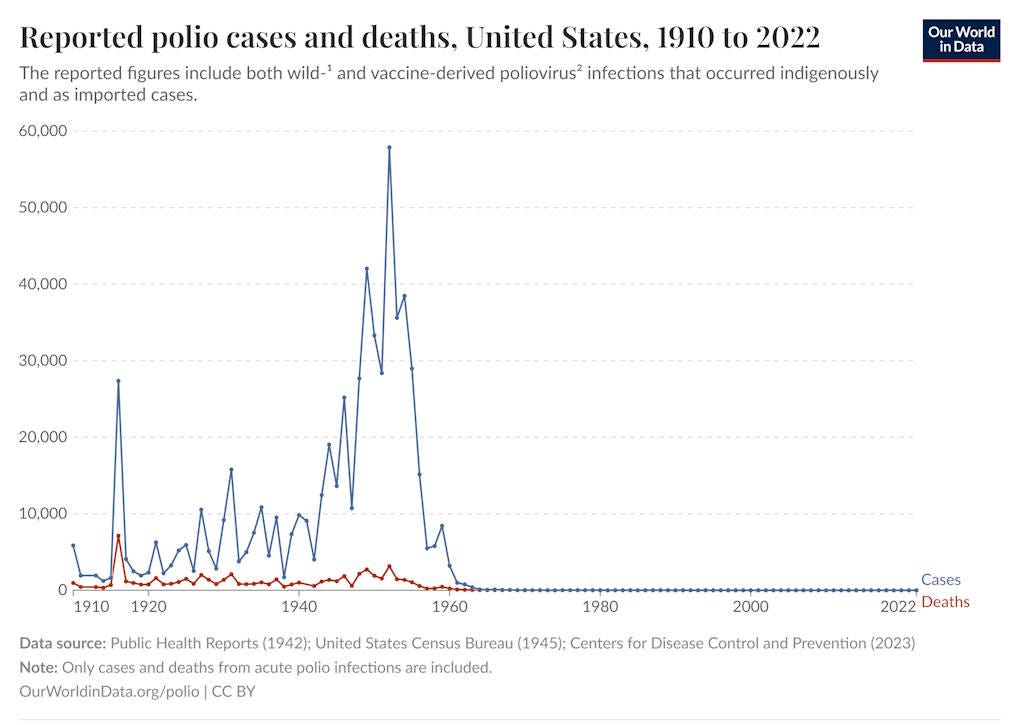
The drop to zero, of course, coincides with the introduction of polio vaccines in 1955, which rapidly defeated the disease.
But this is very far from the kookiest anti-science thing that RFK Jr. has uttered. In his writings, he has expressed doubt about the germ theory of disease itself, and embraced a version of an ancient, discredited theory of disease called “miasma theory”. Ars Technica reports:
[RFK] wrote an entire section on [the germ theory of disease] in his 2021 book vilifying Fauci, titled The Real Anthony Fauci. The section is titled "Miasma vs. Germ Theory," in the chapter "The White Man's Burden."…He writes: "'Miasma theory' emphasizes preventing disease by fortifying the immune system through nutrition and by reducing exposures to environmental toxins and stresses."…
Kennedy contrasts his erroneous take on miasma theory with germ theory, which he derides as a tool of the pharmaceutical industry and pushy scientists to justify selling modern medicines. The abandonment of miasma theory, Kennedy bemoans, realigned health and medical institutions to "the pharmaceutical paradigm that emphasized targeting particular germs with specific drugs rather than fortifying the immune system through healthy living, clean water, and good nutrition."
According to Kennedy, germ theory gained popularity, not because of the undisputed evidence supporting it, but by "mimicking the traditional explanation for disease—demon possession—giving it a leg up over miasma."
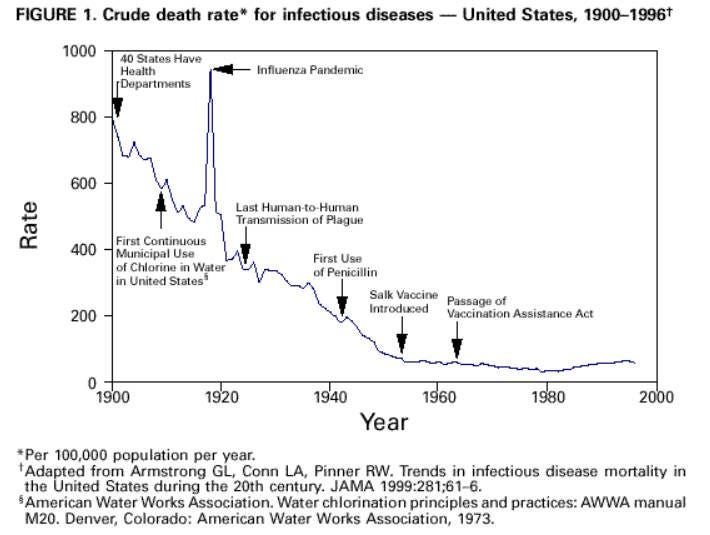
Miasma theory? Seriously??? One X user referred to RFK’s ideas as “actual, honest-to-god medieval peasant beliefs”, and he isn’t wrong. The discovery that germs cause disease — and the subsequent development of vaccines, antibiotics, and sanitation to combat germs — was one of the fundamental break points that lifted humanity out of medieval conditions. In 1900, around 0.8% of all Americans were killed every year by infectious disease; today, in a typical year, it’s about a hundred times lower than that:
RFK is already putting his medieval peasant theories into practice, canceling federal support for mRNA research that promises to turn cancer from a death sentence into a manageable condition:
To his credit, Donald Trump has broken with his HHS secretary on the vaccine issue:
"I think you have to be very careful when you say that some people don't have to be vaccinated," Trump said…"They're just, pure and simple — they work," he added. "They're not controversial at all. And I think those vaccines should be used."
But although Trump’s power over the GOP is great, it’s not infinite. Despite Trump promoting the Covid vaccines that his first administration pioneered, the American right was eventually dominated by the antivax movement, leading to a large number of unnecessary deaths among conservatives.
Now, the antivax turn in the GOP is far bigger than RFK. The state of Florida is ending all vaccine mandates for schoolchildren. This won’t only harm kids whose parents choose not to vaccinate them; it will also endanger kids whose parents do vaccinate them. This is because vaccines work via herd immunity; vaccines aren’t 100% effective, but if everyone or almost everyone gets vaccinated, transmission gets halted because vaccines are effective enough that viruses can’t keep spreading.
If just 7% of parents don’t vaccinate their kids for measles, herd immunity against measles will be impossible, and lots of vaccinated kids will get measles too.1 This is why we have vaccine mandates — by going unvaccinated, antivaxers aren’t just placing themselves and their own kids in danger, but everyone else around them as well.
Already, measles is starting to make a comeback in America, as a result of antivax superstition. There have been over 1400 cases this year so far — not a huge number yet, but growing alarmingly. If vaccine mandates are scrapped in red states, those numbers will continue to climb.
Slowly, the American right is turning into a movement against the germ theory of disease, and only bad can come of it.
Fighting the future
The antivax movement is just one of the ways in which the American right is turning against technology. The other big important one is energy. Solar power and batteries have become incredibly cheap — so cheap that China, Texas, and many African countries are all embracing these technologies at a rapid pace. And yet as I wrote in a post a couple of months ago, the GOP has begun an ideological jihad against solar, wind, and batteries:
Recently, Chris Wright, Trump’s energy secretary, has blamed renewables for soaring electricity prices, trotting out tired old arguments about the intermittency of solar and wind:
Wright told the Washington Examiner in an interview Friday that the president was “correct” in saying that states that have leaned heavily on renewable energy sources are seeing record energy price hikes…The secretary claimed that, without proper battery technology, wind and solar energy infrastructure is essentially “worthless” when it is dark and when the wind isn’t blowing…“As you deploy more renewables, you’re basically building a whole separate grid,” Wright said…“If you take a grid or a system and grow the renewables penetration, you will raise the price of it. The president’s 100% correct in that,” he added…Wind and solar projects have faced the ire of the administration since Day One, through numerous executive orders and agency actions.
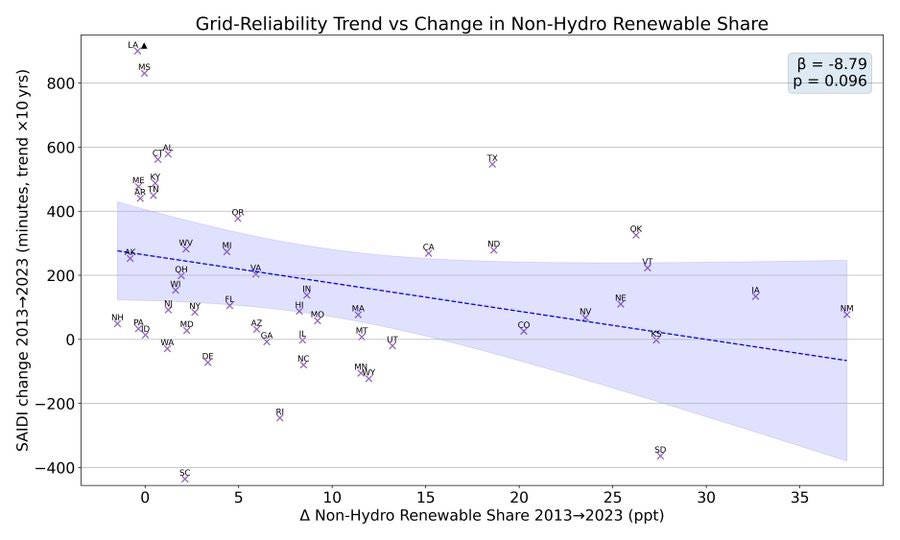
Wright is, of course, wrong.2 The states that have added more renewables to their grids over the last decade have experienced fewer outages, which demonstrates that solar and wind complement fossil fuels even when batteries aren’t totally built out yet:
I guess it’s good that Wright left himself a little wiggle room by saying that renewables are intermittent “without proper battery technology”. Because the truth is, proper battery technology has become extremely cheap, and is becoming far more common. Nowhere is this more true than in Texas, which has been building batteries like crazy to complement its solar and wind power boom.
With batteries, you don’t have to build out a whole second grid in order to get solar and wind to provide baseload power. Brian Potter has a great post showing just how much of the grid we can afford to power with solar and wind for various levels of battery cost:


Potter shows that even at current battery costs, we can power 40% of our grid with solar and wind and still save money relative to a gas-powered grid.
Wright, and the Trump administration more generally, are simply unaware of these facts. They are still living in the world of 1990, when solar panels were prohibitively expensive and battery storage was a distant dream. They could have listened to Elon Musk on the subject, but they chose not to. And so they’re fighting the energy technologies of the future, forcing Americans to accept more expensive and more unreliable energy.
Nor are vaccines and energy the only revolutionary technologies that the American right wants to ban! Red states are banning lab-grown meat, which promises to end untold suffering of animals in factory farms and eventually make meat much cheaper for humans to eat:
The Lone Star State has officially outlawed lab-grown meat in its stores and restaurants…Gov. Greg Abbott signed Senate Bill 261, which took effect Sept. 1, banning the sale of cell-cultured meat in Texas until Sept. 7, 2027…Texas Department of Agriculture Commissioner Sid Miller touted the victory in a news release…"Texans have a God-given right to know what's on their plate, and for millions of Texans, it better come from a pasture, not a lab," he said…"It's plain cowboy logic that we must safeguard our real, authentic meat industry from synthetic alternatives."
These justifications are basically gibberish (“cowboy logic”?). The truth is that the bans are probably intended to protect the politically well-connected ranching industry from competition. But there’s probably also an instinctive distrust of new technology mixed in along with the industry capture.
Luddism, Luddism everywhere
So far I’ve talked entirely about the American right. Now here comes the part where I say “The right is worse, but the left has big problems too.” Such asymmetric criticism is sadly necessary in many areas of American political life.
When I say “the left”, I’m going to include Europe, because Europe’s anti-tech sentiment is almost entirely motivated by Greens and social democrats. The most ridiculous piece of this, of course, is Europe’s rejection of the century-old technology of air conditioning:
As I explain in that post, a quick back-of-the-envelope calculation shows that if Europe embraced AC as much as America has, it could save up to 100,000 European lives per year. But Europeans have so far refused to do this, because of the ideology of degrowth.
Many European elites avoid the unpleasant fact that Americans are richer than Europeans by telling themselves that air conditioning is an unnecessary extravagance. Citing the carbon emitted by running AC, they pat themselves on the back for their abstemious lifestyles, making a virtue of their relative poverty. There’s also probably an undercurrent of sentiment that AC isn’t part of traditional European culture — similar to the American right’s instinctive revulsion at lab-grown meat.
Europe is also the land of GDPR, the mostly useless software regulation that has made the World Wide Web far less usable and pushed internet users even more onto the big social media apps instead. It’s also far more eager to regulate AI than the U.S., embracing a whole host of concerns about the technology that would be quite familiar to American progressives. A few of these regulations may have been wise, but overall their effect may simply be to forfeit Europe’s chance to become a major player in the industry.
American elites are less eager to regulate AI, but at the grassroots level, the U.S. may be the most AI-negative of them all. Of all countries surveyed in a recent Ipsos poll, Americans expressed more negativity about AI than almost any other country:
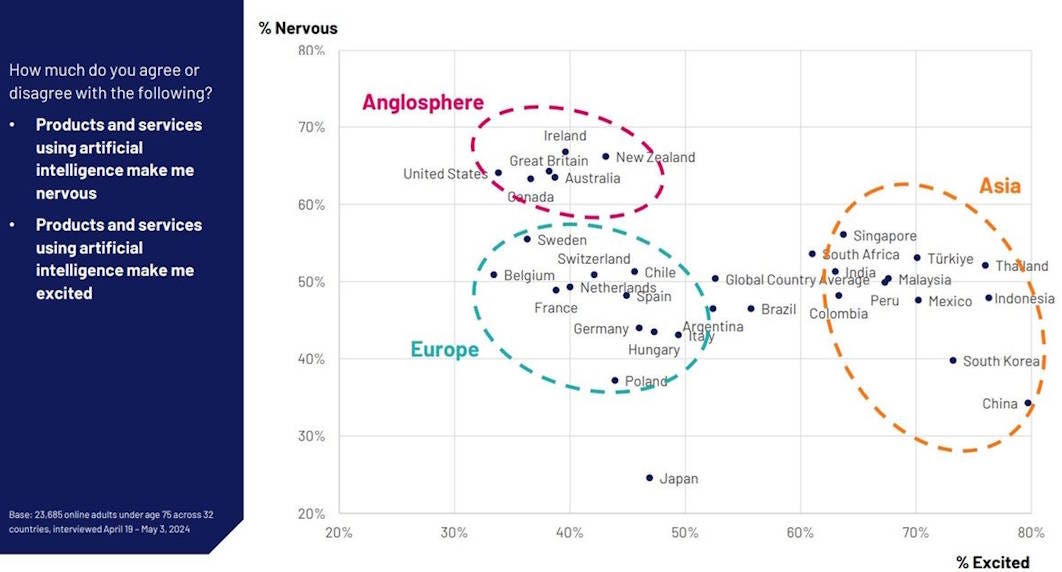
To be fair, anti-AI sentiment in America is very bipartisan at the grassroots level; I guess it’s darkly ironic that the one thing Republicans and Democrats seem to agree on is fear of a cutting-edge technology. But it’s progressive intellectuals who have been the most aggressive about coming up with reasons not to like AI, mostly out of fear that the technology will create inequality, unemployment, and so on, while giving huge windfalls to the owners of tech companies. It’s unions trying to block automation of ports. It was the Biden administration that tried to increase regulation of AI by executive order, while Trump has reversed that regulation.
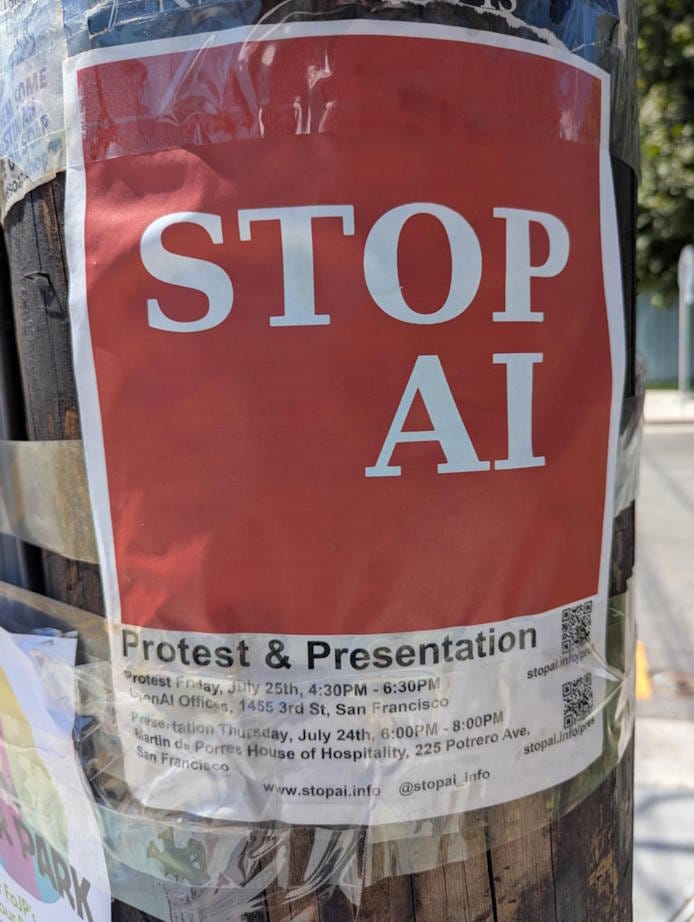
It’s not conservatives putting up posters like this on telephone poles:
And it’s progressives who want to stop the most beneficial form of AI technology: self-driving cars. Unions have tried to block deployment of self-driving taxis and other autonomous vehicles, out of fear that their jobs will disappear. Meanwhile, leftist protesters have tried to physically stop AVs from moving on the street, and anti-ICE protesters in Los Angeles set Waymo cars on fire. (Update: It’s not just the lefties, apparently. Republican Senator Josh Hawley of Missouri has said he plans to introduce a bill to ban driverless cars at the national level. It seems I spoke too soon!)
Stopping self-driving cars would be an incredibly bad move, because the technology has the power to save tens of thousands of Americans’ lives every year. About 40,000 Americans die from road injuries each year. A recent study found that self-driving vehicles have injury rates about 96% lower than human-driven equivalents. That means that self-driving cars have the potential to save more than 38,000 American lives per year. Not too shabby!
Meanwhile, some progressive activists have also resisted the rise of the GLP-1 drugs (Ozempic, Zepbound, etc.) that promise to make obesity a thing of the past. Obviously, it’s not yet known if these drugs are totally safe in the very long term. But activists are opposing the drugs for a different reason — they fear that finding a technological solution to obesity would interfere with the progressive culture of fat acceptance. The WSJ reports:
From the perspective of these activists and scholars, the hype around GLP-1 agonists, for which Ozempic has become the catchall term, only dials up the pressure to lose weight…
“Ozempic is 100% making things worse for us,” said Tigress Osborn, executive director of the National Association to Advance Fat Acceptance (NAAFA), an advocacy group founded in 1969. “It’s created an even louder public narrative that you could just solve all your problems by taking this magical drug, and if you don’t take it, well then, you deserve what you get.”…
Fat studies, an interdisciplinary field that arose in the 1990s, focuses on what it calls “weight-based oppression” and those who benefit from it. It criticizes the weight-loss industry for repeatedly selling quick fixes that help perpetuate weight cycling in a drive for profit.
So while the American right is the worst in terms of attacking technology, the American and European left both have major problems here as well. In general, I find that a good rule of thumb is that the right fears physical technologies, while the left fears digital technologies (though there are obvious exceptions here).
But to be fair, there’s also a technology that centrists — myself included — dislike and distrust: phone-enabled social media. I give a lot of credence to the idea that phone-enabled social media has made our politics more extremist, our young people more depressed, and everyone dumber and more distracted:
Of course I don’t want phones to be banned (except in schools), but I do think that our society needs major adjustments in order to be able to safely handle this technology.
So between phones, AI, the internet, energy, and vaccines, essentially every rapidly advancing area of technology is feared and despised by some major group of Westerners. I guess reusable rockets haven’t gotten much hate, but give it time.
Why are Westerners starting to hate and fear technology?
Now we get to the real interesting question: Why are so many Westerners intent on standing athwart technological history, yelling “stop”?
It seems like a phenomenon mostly peculiar to America, Europe, and the Anglosphere. China, other than a brief sour-grapes denunciation of Western mRNA vaccines during the pandemic, doesn’t show this problem at all — both its leaders and its people seem intent on embracing and making full use of every possible technology. Go to Japan, India, or Korea, and you’ll see very little fear of air conditioning, or vaccines, or batteries, and much less fear of AI.
Furthermore, anti-tech sentiment in the West seems much stronger over the last decade than it was before. Everyone eagerly embraced the novelty of the internet in the 1990s, and only a very few fringe kooks questioned the efficacy of vaccines. Conservatives supported the oil and gas industry, but Texas was willing to be a pioneer in solar and batteries. Almost no one had a problem buying a smartphone and downloading Facebook to it in 2010.
Something has changed in the West, recently, to make people hate and fear technology. What is it?
One obvious possibility is inequality, which has risen throughout the West. When inequality is high, people worry that the benefits of technology will flow only to a few, and that everyone else will be left out in the cold. Here’s what I wrote in a post back in 2022:
William Gibson famously declared that “The future is already here — it’s just not very evenly distributed.” That pervasive, overpowering inequality…makes cyberpunk an inherently dark, noir genre, despite the neon skyscrapers…In the bright future depicted in Star Trek, everyone living on a planet seems to have a spacious house, and all their material needs met…Dystopias like the one in the “Alien” universe commonly have corporations or very rich individuals in charge; utopias — including, ultimately, The Expanse — depict democracy triumphing over both autocracy and plutocracy.
Inequality makes people question whether the institutions and elites of society are really looking out for them. And because it’s elites and institutions that get their hands on new technologies first, people are reasonable to worry that the costs of new tech could get shunted onto them, while the benefits flow only to a few.3
In other words, if the techno-future isn’t somewhere that we can all go together, maybe it isn’t even worth going.
This makes intuitive sense, but it’s also the case that inequality has risen much faster in China and India than in the West in recent years. By some measures, China is even more unequal than the United States. And yet China is the arguably most tech-positive country that exists right now, and we haven’t seen an explosion of Luddism in India. Furthermore, rich countries like Japan, Korea, Taiwan, and Singapore are experiencing similar pressures to the West, but haven’t turned against tech.
Another possible factor here is decline. Europe has seen its relative power declining for a century now, while America has seen China catch up with it — and, arguably, surpass it — over the last 20 years. Certainly, degrowth’s popularity in the UK feels like an attempt to make a virtue out of the loss of the British Empire and the loss of the UK’s technological leadership. Anti-tech sentiment could partially be a big case of sour grapes. But again, if this were the main reason, we’d expect to see anti-tech sentiment blossom in Japan…but it hasn’t.
A third idea is political divisions. Over the past decade or two, the U.S. has been roiled by disruptive political and social movements, creating deep divisions between implacably opposed political tribes. Europe did a better job of resisting the divisions, but tensions over immigration may now be disrupting their societies as well.
Political divisions mean technology has more risk. If society is divided into two warring tribes, then there’s always the chance that a new technology might empower the enemy more. China’s post-Tiananmen political unity may be what has allowed it to embrace technology wholeheartedly.
A final idea is complacency. Middle-class Americans are far richer than their equivalents in almost any other country, and Europe and the Anglosphere are still some of the richest regions in the world. Technology, of course, is what made that happen.
But the people of the West may feel so secure in their riches and comfort that they might now take those benefits for granted. They may not realize how vulnerable their prosperity is — how if a few key technologies are removed, they may find themselves poor once more. Take away vaccines, add heat waves without allowing AC, and starve countries of energy, and Westerners will quickly find out why being a medieval peasant was not actually a good life at all.
Great civilizations have declined before. But the towering, transformative power of the Industrial Revolution means that if a civilization abandons technology today, it has much farther to fall. Technology has always been our light, and we turn our backs on it at our peril.
Fortunately, kids who are vaccinated against measles will tend to get milder cases, and will thus be much less likely to die.
I’ve always wanted to say that.
This also manifests in the intense class hatred that the progressive intellectual class holds for the technocapitalist class (founders and VCs). A good rule of thumb is that Americans will hate anyone who went to the same college they went to, but who made more money than they did.