The other day a friend asked me whether it made sense to call America “the richest third-world country”. I’ve been hearing people ask similar questions for decades, and before, I always thought they were a bit silly and histrionic. Yes, the U.S. has dirty and run-down inner cities, high crime rates, and crappy public transit. But the average American lives in sprawling suburban comfort that only the wealthy of other developed countries can attain. America has chosen a different lifestyle and development pattern than France or Japan, but at the end of the day its middle class is still much richer.
But nowadays, when people call the U.S. a “third world country”, I find myself taking the epithet much more seriously. American politics is starting to look decidedly like something you’d encounter in a dysfunctional middle-income nation — Turkey, Hungary, Brazil, or Israel. Like in those countries, a populist strongman won power through democratic means, and then proceeded to usurp unprecedented power to the executive, often through open clashes with the country’s key institutions.
Consider a partial list of things that Donald Trump has done in just the last couple of weeks:
Although violent crime in the U.S. is at a 20-year low (and near the all-time lows from the early 1960s), Trump declared a crime emergency, and called the National Guard to patrol the streets of Washington D.C. and Los Angeles. He’s now planning to replicate these military deployments in other cities across the country, as well as creating special Guard units and rapid reaction forces to carry out domestic policing duties. So far, the guardsmen have been patrolling low-crime areas instead of high-crime ones, and have not been making arrests; instead, they’re just walking around with automatic weapons. It’s pretty clear that this is not really an anti-crime operation, but a show of force — a threat against potential civil unrest, and an attempt to intimidate the educated progressive residents of Democratic-leaning cities.1
Trump struck a major blow against the independence of the Federal Reserve, by firing Fed governor Lisa Cook. The President is only allowed to fire Fed governors “for cause”, which typically means some sort of malfeasance. Trump justified his firing of Cook by accusing her of mortgage fraud; this may not hold up in court, but in the meantime, Cook will not be working, which demonstrates Trump’s power over the Fed. The clear goal of the firing — besides getting rid of someone whom Trump’s people consider an unqualified DEI hire — is to allow the President to bully the Fed into carrying out whatever monetary policy he likes.
Trump used CHIPS Act funding and other government money to buy a significant stake in Intel. This came after Trump had publicly demanded that Intel’s CEO resign; the deal appears to have been a way to mollify Trump’s anger. Meanwhile, a Trump advisor declared the administration’s intent to take stakes in many more companies.
Trump issued an executive order to arrest and prosecute Americans for burning the American flag, despite a standing Supreme Court ruling that protects flag-burning as a form of free speech under the First Amendment. Although Trump’s order acknowledged the SCOTUS ruling, the Secret Service did arrest one man who burned a flag near the White House to protest Trump’s order.
Trump and his Secretary of Defense are conducting a purge of high-ranking military and intelligence officials, including the head of the Defense Intelligence Agency, the head of the NSA, the chief of U.S. Naval reserves, the commander of Naval Warfare Special Command, and others. It’s not clear why this is being done, but it’s probably to ensure ideological conformity and loyalty to Trump among the armed forces and the intelligence services.
Trump’s FBI raided the house of John Bolton, a prominent conservative critic of the President’s Ukraine policy.
The Trump administration is now trying to deport Kilmar Abrego Garcia, the man who was returned to the U.S. after being illegally sent to a prison in El Salvador, to Uganda. (A judge is blocking the move.)
These are just the very latest moves in Trump’s long-running campaign to suppress dissent, assume unprecedented executive power, punish political enemies, ensure personal loyalty, interfere in American business, and push the boundaries of the law. Remember that it’s only seven months into a 48-month Trump presidency; there’s much more of this to come.
As I said, this is the kind of thing that happens, if not in third-world dictatorships, then at least in middle-income countries with populist strongmen. Americans are coming to see Trump as a dictatorial figure. In April, 52% of Americans, and 56% of Independents — along with 17% of Republicans! — agreed with the statement that Trump is a "dangerous dictator whose power should be limited before he destroys American democracy". In fact, a significant number of Trump’s supporters want him to be a dictator.
A big question — other than who might push back on this, and what the consequences of the pushback might be — is whether Trump’s transformation of U.S. politics into a quasi-authoritarian system will hurt the economy. The U.S. is getting Third World politics; will it also get Third World poverty? So far, markets are shrugging off Trump’s latest repressive moves, having recovered from their crash after “Liberation Day” in April:
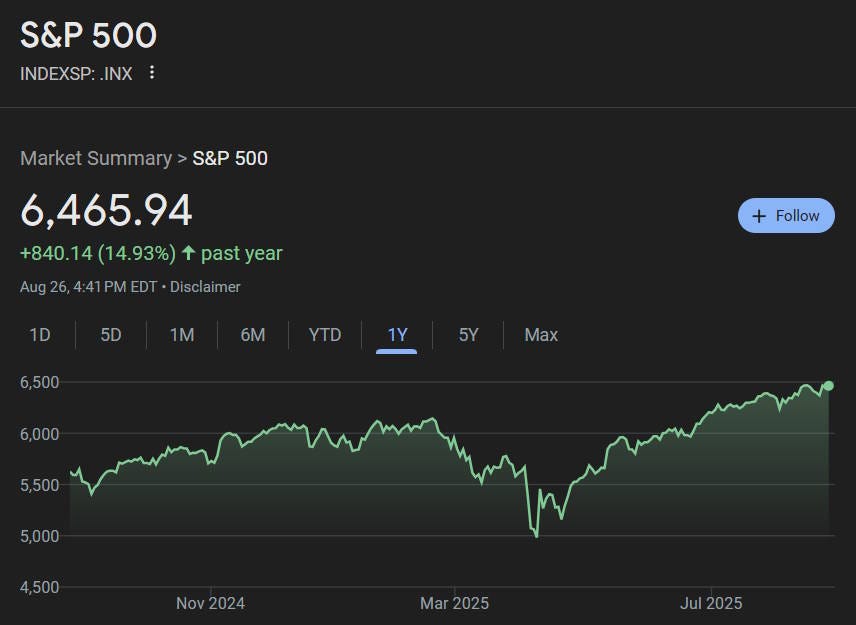
Investors still appear to be betting that Trump will chicken out of any economic policy severe enough to cause major disruption. But markets can be wrong. Trump’s degradation of American institutions may yet cause economic troubles further down the line, through several different channels.
Let’s start with the one people are talking about today — the danger that Trump will gain personal control of monetary policy
Why Fed independence is important
I’ve warned for a long time that if Trump were elected a second time, he would try to bully the Fed into doing his bidding. But why is this important? What bad thing happens if the President gains personal control of monetary policy?
The most obvious danger — and the one people usually talk about — is that electoral concerns will come to dominate prudent concern for the long-term health of the economy. If the President thinks a recession puts his reelection or his party’s candidates in danger, he might pressure the Fed to keep interest rates too low, in order to keep employment high.
But low interest rates can lead to inflation. And even worse, if American businesses decide that the Fed will now always be pressured into keeping rates too low, it can destroy the central bank’s credibility, leading to an inflationary spiral — if everyone expects inflation, everyone raises their prices immediately, creating an inflationary spiral.
A second danger is that the President and his cronies are simply incompetent at setting monetary policy. They might raise rates too high in response to inflation, causing an unnecessary crash. They might ignore warning signs of rising inflation, keeping rates too low for too long. Or they might whipsaw the economy back and forth by changing interest rates too abruptly. The Federal Reserve officials who handle monetary policy are very smart people, with lots of training and access to the best information; Trump and his political team are more skilled at winning elections and social media fights.
In fact, we have a good example of this from recent times. In the 2010s, Turkey’s President Recep Tayyip Erdogan decided to believe — contrary to standard macroeconomic theory — that low interest rates reduce inflation instead of raising it.2 In order to put this theory into practice, he replaced the technocrats at the central bank with cronies, and had them cut rates and keep them low. The result was a surge of inflation that topped 80%:
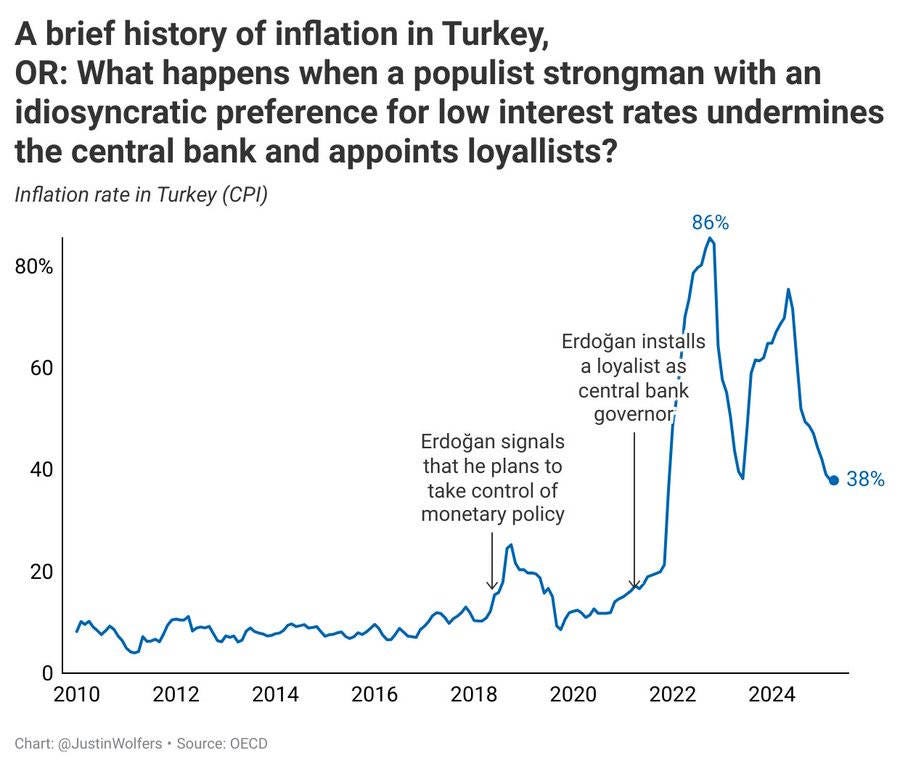
So when it comes to monetary policy, executive stupidity can be just as dangerous as electoral self-interest.
But in fact, neither of these obvious dangers is the biggest one. The biggest danger of a politically captured central bank is something we don’t often talk about, but which looms ominously in the background of all discussions of monetary policy. I’m talking about the danger of monetization of the national debt.
No matter who is in power, there are always plenty of things that the government would like to spend money on — the military, or social programs, or infrastructure, or payouts for cronies, or whatever. And because the government has the ability to create money out of thin air, there’s always the temptation for whoever is in power to treat this as an infinite money glitch in a video game — to just keep printing cash to get whatever it wants.3
The big obvious problem here is that if everyone realizes that the government is going to treat its money-printing ability like an infinite magic money tree, they’ll know that inflation is coming — and lots of it. And then you get the spiral, where everyone raises their prices because they know inflation is coming. And inflation just goes up and up and up, and you get hyperinflation, and then your country’s economy collapses.
In fact, research suggests that this is the main cause of hyperinflation. Here’s what I wrote a few months ago:
[W]hen you do look at hyperinflations, you tend to see some regularities. The most famous work here is Sargent’s 1982 paper, “The Ends of Four Big Inflations”, which looked at the post-WW1 hyperinflations in central Europe. The basic idea is that we can make a good guess about what caused a hyperinflation by observing what makes it stop.
Sargent observes that each of the post-WW1 hyperinflations ended when the government did two things:
First, it cut fiscal deficits by a lot.
Second, it established an independent central bank that stopped lending money to the government…
[I]f people think the central bank is going to print a lot of money in the future, there will be a lot of inflation today, because companies will raise their prices in anticipation of the future flood of new money…And the most important reason to expect the central bank to print a bunch of new money is if it’s using that money to fund permanent government deficits. Basically, Sargent argues that hyperinflation happens when the government manages to convince or force the central bank into printing money in order to fund infinite deficits. Once people see that this is what’s going on, they realize that the money-printing is just not going to stop. So they start raising prices, and inflation explodes.
It’s not easy to verify whether this is really what’s going on. Sargent, Williams, and Zha (2006) look at some later hyperinflations in Latin America, and conclude that a similar process was at work. Dornbusch and Fischer (1986) look at Argentina and Israel, and agree that fiscal deficits were the key culprit.
There’s also a sneakier way to go about this. Instead of printing money to fund government spending directly, the central bank can just keep interest rates at zero so the government can keep borrowing money without paying any interest, and just roll over its loans forever at no cost. When the federal debt and deficit are both really high, there’s a lot of pressure on the central bank to keep interest rates permanently low in order to avoid forcing a ruinous sovereign default.
This is called fiscal dominance, and it’s basically an indirect way of using the central bank to fund government spending. With the U.S. national debt and deficit both at unprecedented levels, Trump may be thinking about fiscal dominance as an attractive alternative to punishing austerity that would make him unpopular.
Some form of monetary financing of government spending is what we really need to worry about here. Of course, Trump doesn’t want to be blamed for turning the U.S. economy into Venezuela. But Trump is a very old man — at 79 years, he’s older than Biden was at this stage of his presidency — and he might think that the consequences of monetary financing will come after he has already shuffled off of this mortal coil (especially if the rumors about his failing health turn out to be true).
In fact, Lisa Cook was not a particularly hawkish member of the Fed — her natural predilections in terms of monetary policy probably align with Trump’s more than other Fed governors. But because Trump’s people view Cook as essentially a political hire, he probably expected her to put up more of a fight if and when Trump tries to revoke the Fed’s independence. So although a hyperinflationary catastrophe is still very unlikely, Cook’s firing is one more bad sign.
The poor track record of authoritarian populists
Bad monetary policy leading to hyperinflation would be the absolute worst-case scenario for the U.S. economy. But there are plenty of other ways that an authoritarian populist leader like Trump can hurt the country’s prospects.
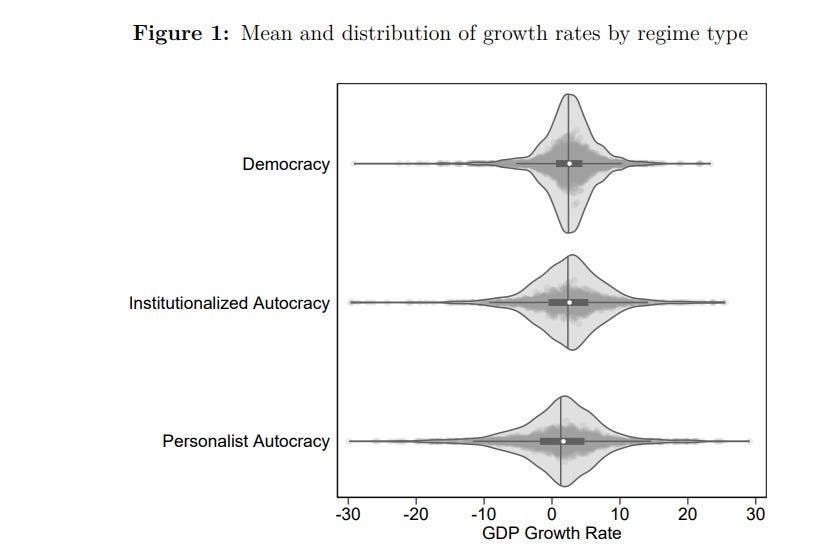
In fact, this is the typical outcome for leaders of this type. Blattman et al. (2025) classify authoritarian countries into “institutionalized” versus “personalist” regimes, and find that the personalist regimes grow more slowly:
Funke et al. (2023), meanwhile, study the effects of populist leaders — defined as leaders who primarily use anti-establishment rhetoric. They find that populism is bad for the economy:
How do economies perform under populist leaders? We build a new long-run cross-country database to study the macroeconomic history of populism. We identify 51 populist presidents and prime ministers from 1900 to 2020 and show that the economic cost of populism is high. After 15 years, GDP per capita is 10 percent lower compared to a plausible nonpopulist counterfactual. Economic disintegration, decreasing macroeconomic stability, and the erosion of institutions typically go hand in hand with populist rule.
And here’s their chart showing the growth penalty from populism:
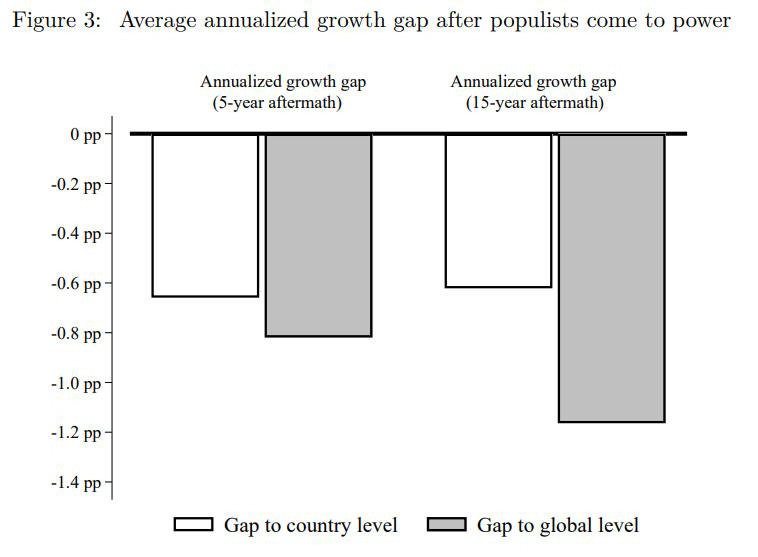
Of course, it’s possible that countries elect populists when they’re already in economic distress. Funke et al. try to control for this possibility by comparing countries with populist leaders to other countries with similar economic conditions who don’t elect populists.4 This method is far from perfect, but it’s probably the best available. The authors find that the effect of populism appears to be a causal one — populists really do implement bad economic policies.
Why are populists bad for the economy? Funke et al. find that populists tend to curb international trade, foment macroeconomic instability, and erode the quality of institutions:
Economic self-sufficiency is a common feature of populist rhetoric. Populists often formulate “my country first” policies and argue against open borders and global market integration as part of an economic order serving elites only…The unifying theme is the promise to shield “the people” from foreign firms, investors, organizations, and migrants…[We find that] international economic integration suffers under populism…
Dornbusch and Edwards (1991) argue that unsustainable macro policies are a key characteristic of populist rule…On the fiscal side, we study the evolution of the public debt-to-GDP ratio…After 15 years [of populist rule, we find that] debt levels are up to ten percentage points higher during a populist episode…Dornbusch and Edwards (1991) also point to another dimension of populist macro outcomes: the neglect…of inflation risks…There is some evidence for rising inflation under populists…
After populists come to power, institutional quality declines…. The process of institutional erosion starts shortly after populists come to power and continues for more than a decade…To get a sense for the magnitude: this drop roughly corresponds to the difference in institutional quality between Norway and Colombia.
This all sounds exactly like Trump, who is trying to cut off trade, run up the debt, and degrade the power of every institution in the country.5
In terms of the research on leadership styles, Trump really presents the worst of both worlds — he’s a personalist authoritarian and a populist. He’s a man who takes most decisions into his own hands, prizes loyalty to himself above all else, and relentlessly attacks institutions and elites. If the results above are right, Trump is perfectly positioned to exert a drag on U.S. growth, even if he doesn’t send it into an inflationary catastrophe.
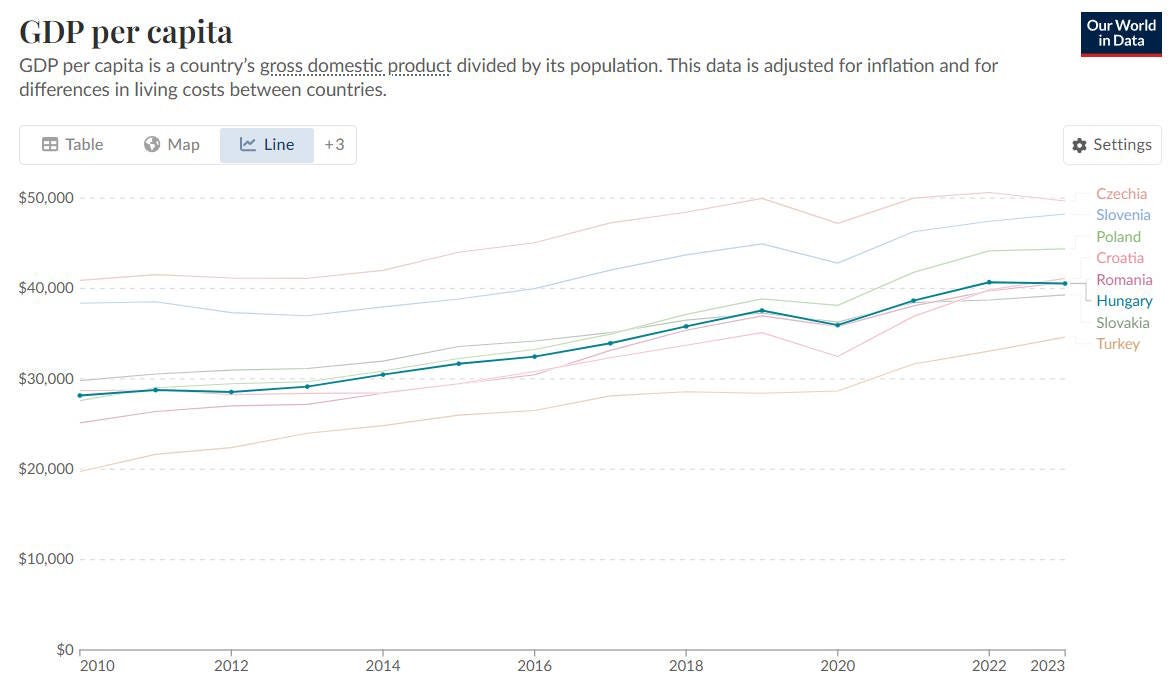
An analogy might be Hungary’s Prime Minister Viktor Orban. Hungary hasn’t been impoverished by 15 years of Orban’s rule, but it has fallen a bit behind neighbors like Romania and Croatia:
None of this bodes particularly well for America at this point.
The looming threat of political instability
But on top of Trump’s policies, there’s one more economic threat from America’s increasingly third-world-esque politics. That’s the specter of political instability from Trump’s attacks on his political enemies.
The research literature on the effects of political instability on economic growth is very large, and it all points in one direction: instability is bad. Specifically, the thing that hurts economic growth is the possibility of regime collapse. If businesses don’t know what type of regime or leader is going to be in power in one year or three years, they won’t invest. Of course there’s always some degree of uncertainty here; democracies throw their leaders out all the time. But when things like coups and revolutions come into play, the risks are far, far greater. It’s possible to plan for a Democratic or a Republican President in the U.S. — at least, in normal times. It’s not possible to plan for a coup or a revolution.
I don’t expect Trump to be violently overthrown. But his deployment of troops into the streets of American cities, along with his denial of the legitimacy of any election he doesn’t win, bodes ill for America’s political stability. Trump and his people seem to think that America is basically in a civil war, with immigration and progressive ideology as an internal enemy that must be defeated at all costs. The simple possibility that Democrats might ever come to power again must feel like an existential threat to many in the administration, if not to Trump himself.
Today this has led to troops on the streets of American cities, FBI raids on Trump’s critics, and purges of military leaders who might drag their feet on those efforts; tomorrow, it’s not out of the realm of possibility that it could lead to the arrest of Democratic leaders and direct interference in elections. In that case, Democrats would have two choices — to accept political exile and persecution, or to organize some kind of forceful resistance. Either choice would lead to the effective end of the democratic system that America has maintained for 249 years now.
That possibility bodes ill for America’s economic future. Markets don’t yet seem to be pricing in the possibility that American democracy will collapse. And although businesses are investing a little less this quarter, the specter of instability doesn’t seem to be fazing them much thus far.
My hope, of course, is that the markets and businesses understand something I don’t, and that Trump will chicken out of anything that truly puts the economy in danger. We might simply continue to sail onward into the future as the richest third-world country. But when I read the news, my country’s politics increasingly look like reports from a developing country. And it’s a little hard to imagine that our economic outcomes will permanently remain decoupled from that dysfunction.
It’s not hard to imagine these troops being ordered to patrol voting locations in heavily Democratic areas for whatever Trump deems potential “fraud”. We’ll just have to see!
In fact, in the early 2010s, someone from the Turkish government called me on the phone and asked me about a fringe macroeconomic theory that agreed with Erdogan’s wacky idea. When I told the person that the theory was a bad one, they were quite disappointed.
In fact, the cultish pseudo-theory that calls itself “MMT” is based on the idea that this is good, and that governments should do this regularly.
In fact, they compare populist-ruled countries with “synthetic controls” — hypothetical countries constructed from mathematical combinations of other real countries that don’t elect populists, designed to replicate the economic situation of the countries that do elect populists.
And although Funke et al. don’t test it, there’s another way that populist governance could hurt growth — via quasi-nationalization. Trump is now set on bullying major companies into selling ownership shares to the U.S. government. Research isn’t clear about the effects of turning companies like Intel into partial SOEs — for example, Borisova et al. (2012) finds that this tends to hurt corporate governance in most countries, but improve it in countries that have common law systems (like the U.S.).