
During the Biden years, I wrote a lot about U.S.-China competition. Like many other analysts, I was pretty convinced that the next decade or two would be shaped by geostrategic, military, technological, and economic competition between these two giant nations and their respective coalitions of allies. This seemed like a reasonable assumption, because of the political actions of the people in charge of the two nations. Xi Jinping seemed dead set on having China supplant the U.S. as the world’s dominant power, while both the first Trump administration and the Biden administration made competition with China a primary policy goal. Export controls, tariffs, industrial policy, and most other economic policy innovations in the U.S. all seemed oriented around the same goal: competing with China.
Most of the structural preconditions for a Cold War style confrontation seemed in place — territorial flashpoints, intractable ideological and institutional differences, competing tech ecosystems. Opinions of China in the U.S. and elsewhere plunged around 2019, adding fuel to the fire. The Ukraine war increasingly felt like a proxy war between China and NATO. On top of all that, we had the Second China Shock, as China’s post-pandemic industrial policy flooded the world with cheap goods and threatened manufacturers in every other country.
When Trump returned to power, many people predicted that the competition between the two countries would intensify. But I was suspicious of that narrative. Trump had already come out against the TikTok divestment bill, and denounced the Biden-era industrial policies that were giving the U.S. a chance of competing with China in strategic industries like semiconductors and EVs. Furthermore, prominent China hawks like Matt Pottinger seemed to have been purged from the Trump orbit.
The simplest explanation, in my view, was that Trump had simply chosen to change America’s alignment to a neutral, isolationist stance. He seemed to want to revive Charles Lindbergh’s idea of dividing the world into regional spheres of influence, ceding influence in Asia to China and influence in Europe to Russia.
After 7 months of the Trump presidency, however, I’m starting to gravitate toward a different theory. It now seems to me that the U.S. and China have simply mutually decided to pause their incipient rivalry in order to focus on domestic issues. In America’s case, this manifests as a combination of popular exhaustion and elite distraction; China, meanwhile, seems to be focusing more on its economic problems.
America isn’t even trying anymore
Back in July, Alex Tabarrok wrote a post comparing America’s response to the Soviet space program in the 1950s with its response to China’s emerging AI capabilities today:
In 1957, the Soviet Union launched Sputnik triggering a national reckoning in the United States…The country’s self-image as a global leader was shaken, creating the Sputnik moment…NSF funding tripled in a year and increased by a factor of more than ten by the end of the decade. The National Defense Education Act overhauled universities and created new student loan programs for foreign language students and engineers. High schools redesigned curricula around the “new math.” Homework doubled. NASA and ARPA (later DARPA) were created in 1958. NASA’s budget rocketed upwards to nearly 5% of all federal spending and R&D spending overall increased to well over 10% of federal spending…
America’s response to rising scientific competition from China—symbolized by DeepSeek’s R1 matching OpenAI’s o1—has been very different. The DeepSeek Moment has been met not with resolve and competition but with anxiety and retreat…Trump has proposed slashing the NIH budget by nearly 40% and NSF by 56%. The universities have been attacked, creating chaos for scientific funding…Foreign scientists are leaving or staying away…
[T]he contrast is stark: Sputnik spurred investment and ambition. America doubled down. DeepSeek has sparked defensiveness and retreat. We appear to be folding.

This is especially noteworthy because AI is the one specific industry where Trump has declared his intent to compete and win. Instead, the administration seems to be cutting off most of the inputs that go into making AI run.
AI basically runs on three things: talent (to make and use AI models), data, and compute. A large part of the talent pipeline is foreign at this point, with Chinese talent being particularly important. Here’s a chart of where top AI researchers do their work:
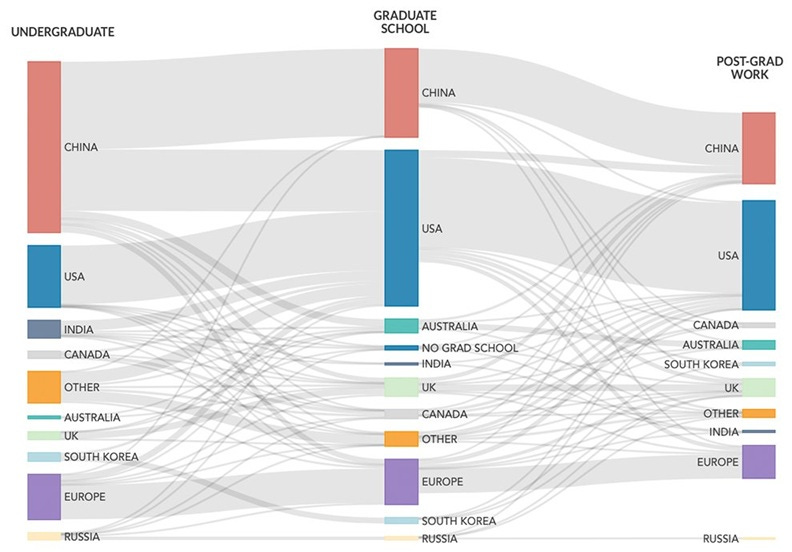
Chinese talent is so crucial for the world right now that by one estimate, almost half of everyone in the world who passes a university-level linear algebra course (extremely useful for AI and for many other applications) is Chinese. Fully half of Meta’s Superintelligence team is from China.
The Trump administration, worried about the influence of foreign ideas, is pushing foreign students out of the country. Trump has also made it harder to get a green card, as well as making life harder for skilled immigrants in other ways. As Brookings’ Judy Wang and Nicol Turner Lee report, this is going to make it difficult for the U.S. to get the talent it needs for its AI industry to be truly dominant.
As for compute, this depends on having chips and electricity. Thanks to Biden’s industrial policies, U.S. domestic chip production had been forecast to rise enormously. Trump has called on Congress to cancel the CHIPS Act, and is trying to limit the amount of money that gets disbursed to chipmakers. Partially as a result of this, the big semiconductor factory construction boom of the Biden years has plateaued and started to shrink.
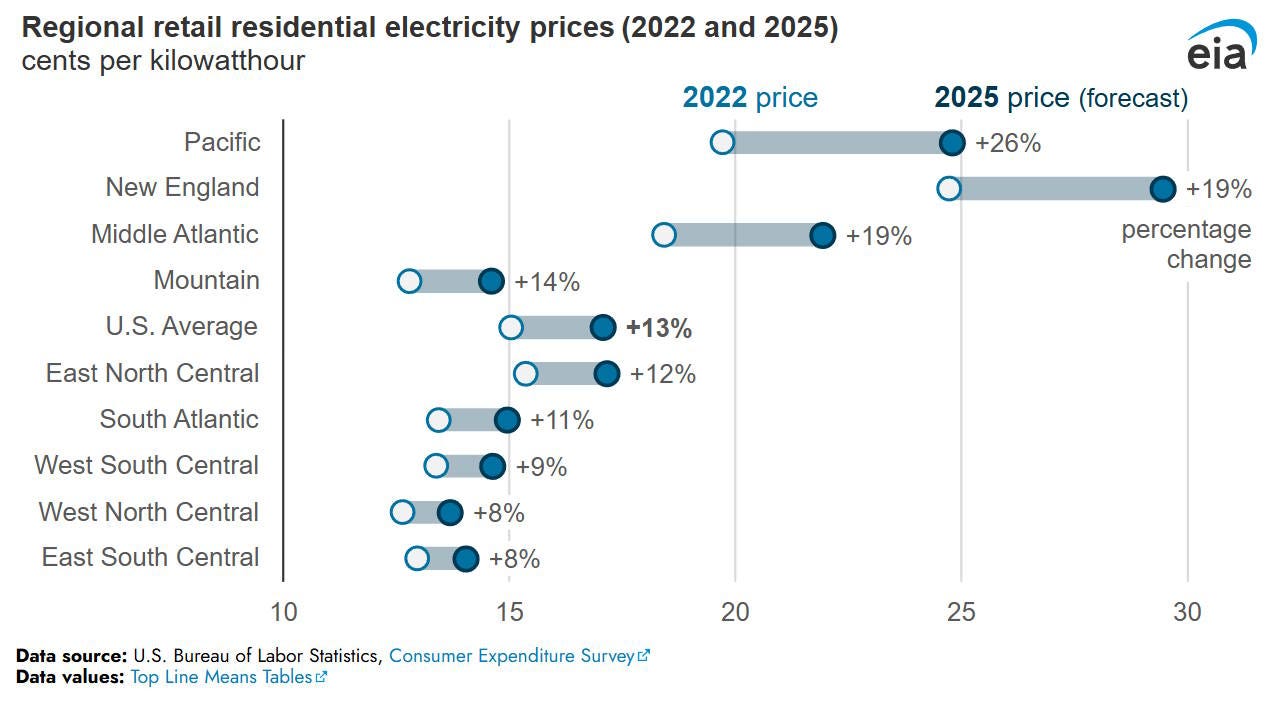
Meanwhile, Trump has launched an all-out assault on solar and wind power, which are now the cheapest sources of electricity in much of the country. Trump’s actions, along with all the various regulations that make it hard to build power plants and transmission lines in this country, have made it harder for America to keep up with soaring electricity demand from data centers and elsewhere. Electricity prices are rising all across the country:
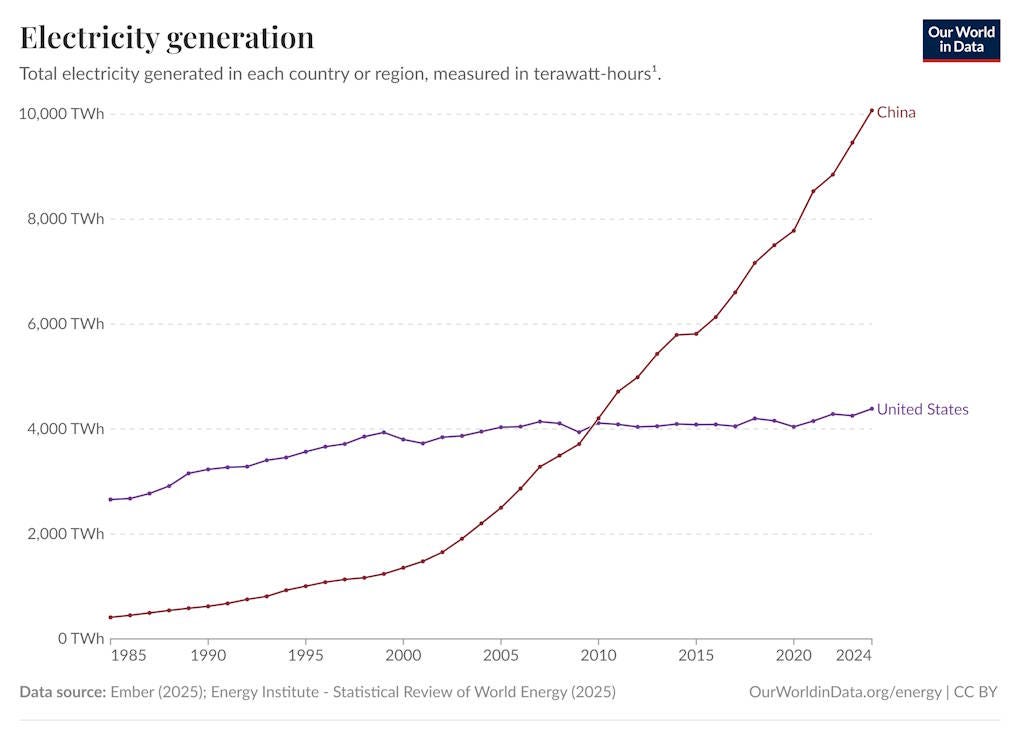
China, meanwhile, has embraced solar, wind, nuclear, and every other form of power, and as a result has zoomed past the U.S. in terms of total electricity generation:
On top of all of this, Trump is cutting funding to research fields that underpin AI.
So why would Trump come out with this big splashy announcement that he wants to make American AI the best in the world, and then systematically attack every resource America would need to build that AI?
The obvious answer is that Trump and his administration simply care far more about domestic politics than about international competition. Trump is attacking solar and wind not because he wants America to have less energy, but because he sees these energy sources through an inherently political lens — he sees them as liberal kinds of energy, and therefore an enemy to be defeated. Meanwhile, Trump sees foreign students as a vector for undesirable ideas. As for the CHIPS Act, it’s a Biden policy, and American politics means denying the opposing party a policy win whenever you get the chance.
In other words, if the things America would need in order to sustain technological competition with China are even slightly left-coded in the minds of MAGA, then America will simply forfeit the competition. Domestic politics takes precedence.
AI is illustrative, but it’s far from the only way that Trump’s focus on internecine battles is weakening America’s hand against China. A month ago I wrote about Trump canceling export controls, slashing science funding, and cutting naval construction:
Export controls are the starkest example of Trumpian capitulation. These controls were working effectively to limit the speed of China’s AI development,
At this point, every China hawk in the administration — or in the GOP in general — must realize they’ve had the rug pulled out from under them.
Even on trade, Trump shows every sign of capitulating to China, while attacking America’s ability to resist Chinese dominance. Trump announced big tariffs on China months ago, but has “paused” them again and again, until at this point it seems unlikely they’ll ever take effect. But Trump has put new tariffs on India, threatening to destroy the nascent India-U.S. partnership against China, and hurting companies’ attempt to decouple production from China.
In the case of export controls and tariffs, it’s likely that Trump is simply backing down from a fight. China’s export controls on rare earths appear to have scared the administration into looking for weaker targets — i.e., India. China even managed to bully Trump into blocking an international flight by the President of Taiwan.
In other words, America has become an internally focused country, entirely obsessed with its own culture wars, and increasingly incapable of meeting a real foreign threat as a result.
China is strangely quiescent
You might think that with the U.S. effectively withdrawing from the race, that China would use this opportunity to basically win the competition by default — to become the global geopolitical, military, and technological hegemon. But since Trump took office, China’s leadership has been strangely quiescent. They’ve levied export controls on the U.S. in order to (successfully) bully Trump into giving them what they want, but their international bellicosity has generally decreased.
The most obvious reason is that the Chinese economy is still down in the dumps. The huge overhang of bad debt from the country’s epic real estate crash continues to weigh on balance sheets and on the health of the financial system. Despite various rounds of stimulus and an enormous push into high-tech industrial policy, China’s macroeconomy continues to be weak. This is from a Bloomberg article three days ago:
China’s economy slowed across the board in July with factory activity, investment and retail sales disappointing…Production at Chinese factories and mines rose at the slowest rate since November and expanded a worse-than-forecast 5.7% last month from a year earlier…Retail sales grew 3.7% on year in July, the least this year and down from 4.8% in the previous month. Expansion in fixed-asset investment in the first seven months of the year decelerated to 1.6%, as a contraction in the real estate sector deepened. The urban unemployment rate climbed more than expected to 5.2%.
This is what tends to happen after big real estate bubbles. China has managed to avoid outright recession (at least, if you trust the official numbers), but growth continues to grind lower and lower.
For a few years, China bulls believed that high-tech manufacturing could replace real estate as the country’s main growth driver. To this end they deployed the biggest industrial policy ever seen, with lavish subsidies and a huge wave of bank loans to industrial companies. This policy push rocketed China to global leadership in a number of important industries, like EVs and robotics. It also probably sustained employment levels to some degree.
But a huge amount of the loans went to companies that had little involvement in high tech. And China also discovered that when you pay a whole bunch of companies to make the same stuff, they tend to compete each other’s profits to zero:
China is responding to this essentially the only way it can respond — by curbing the gigantic wave of industrial lending:
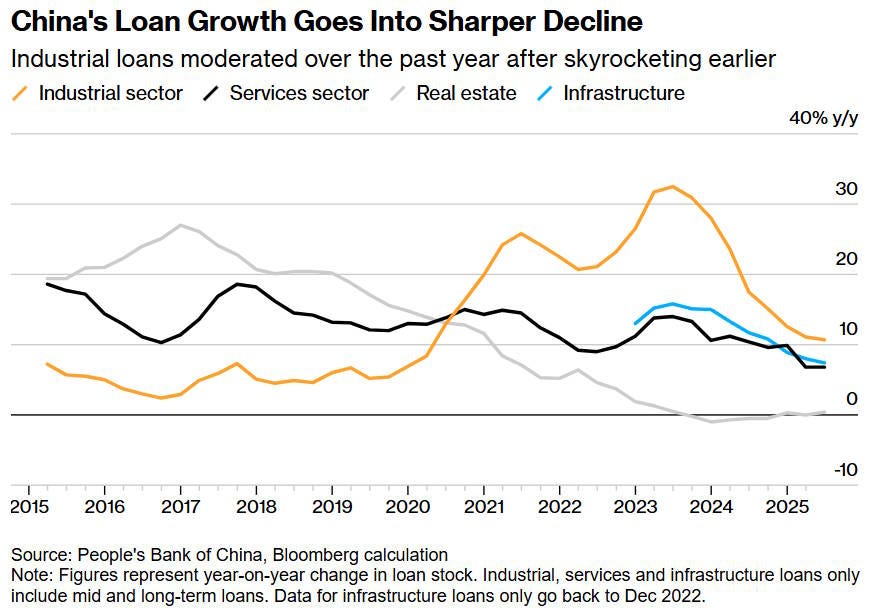
This slowdown in lending is going to reduce China’s growth going forward — there’s really no other sector to pick up the slack. And that four-year binge of industrial lending may end up leaving even more bad debt in the system, compounding the overhang from the real estate bust. Slowing industrial loans will also slow down the country’s remarkable tech progress, much of which is due to corporate investment.
Slowly, the country’s leadership is realizing that the central government is going to have to bail out much of the economy — banks, shadow banks, local governments, real estate, and various companies. A bank bailout has already begun. And more Chinese commentators are starting to talk about MMT,1 suggesting that people are looking for a reason not to worry about the high central government debt loads that will result from a general bailout.
But debt isn’t the only headwind China is facing. Despite Trump’s repeated climbdowns on China tariffs, the mere threat of tariffs is causing Chinese exports to America to plunge — and only a few end up getting rerouted through third countries. Foreign direct investment, which used to be the biggest driver of Chinese growth during their early industrialization, is dwindling rapidly.
And although China’s demographics will be largely fine for another two decades or so, after that there will be trouble. Fertility rates have crashed to levels previously considered unimaginable:
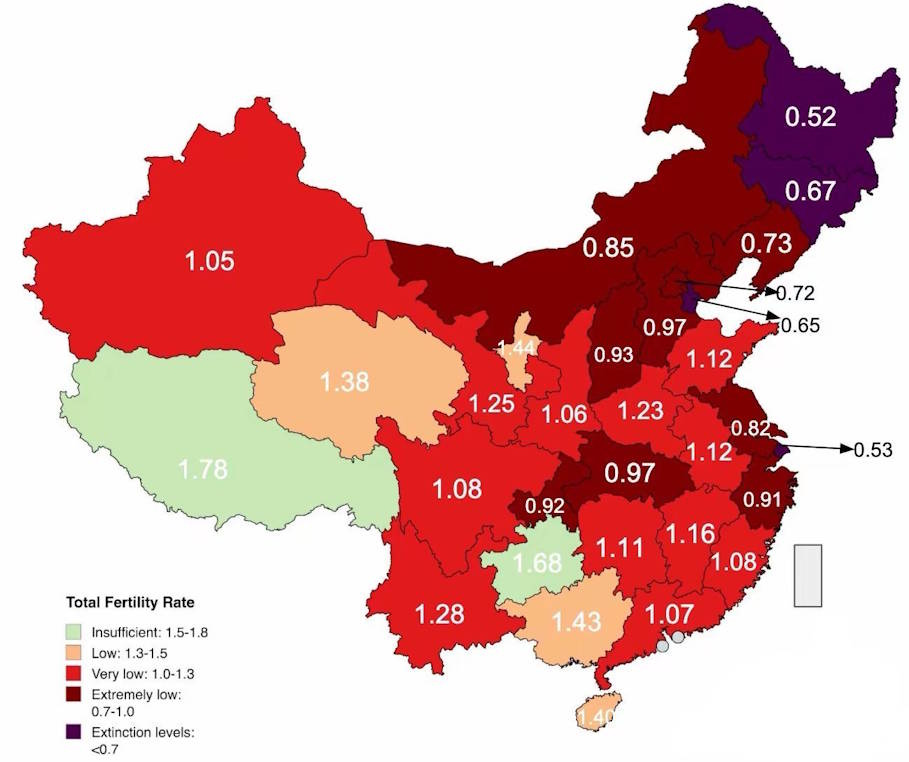
Some have theorized that the looming aging problem would make China more aggressive. But it’s possible that it’ll make China’s leaders more cautious instead, as they realize that any generation lost in a war wouldn’t ever be replaced.
So although China is still trying to be #1 in tech, they aren’t being quite as bellicose as they were a few years ago. They are using the respite that America’s internal social troubles have given them to try to fix their own economic troubles.
The long-prophesied U.S.-China clash thus appears to be postponed, at least for a few years, while each of the great powers tends to their own internal problems. Cold War 2 isn’t really over — Ukraine is still going on — but we get to enjoy a little pause.
Update: Alex Tabarrok has a good follow-up post on Sputnik vs. DeepSeek. Like me, he concludes that America’s internal divisions are distracting it from external competition:
In my view, the best explanation for the starkly different responses to the Sputnik and DeepSeek moments is the rise of zero-sum thinking—the belief that one group’s gain must come at another’s expense. Chinoy, Nunn, Sequiera and Stantcheva show that the zero sum mindset has grown markedly in the U.S. and maps directly onto key policy attitudes.
Zero sum thinking fuels support for trade protection: if other countries gain, we must be losing. It drives opposition to immigration: if immigrants benefit, natives must suffer. And it even helps explain hostility toward universities and the desire to cut science funding. For the zero-sum thinker, there’s no such thing as a public good or even a shared national interest—only “us” versus “them.” In this framework, funding top universities isn’t investing in cancer research; it’s enriching elites at everyone else’s expense. Any claim to broader benefit is seen as a smokescreen for redistributing status, power, and money to “them.”…
The looming danger is thus the zero-sum trap: the more people believe that wealth, status, and well-being are zero-sum, the more they back policies that make the world zero-sum. Restricting trade, blocking immigration, and slashing science funding don’t grow the pie. Zero-sum thinking leads to zero-sum policies, which produce zero-sum outcomes—making the zero sum worldview a self-fulfilling prophecy.
Wise words. Americans would do well to listen to Alex.